
Of nine planetary boundaries, seven are now crossed
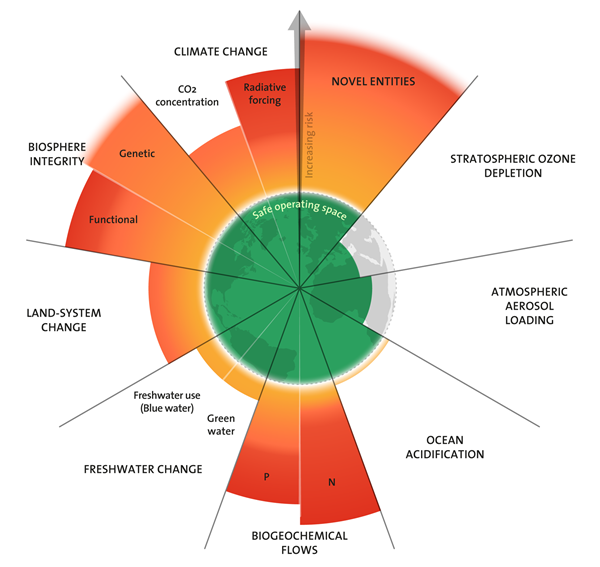
In June this year a notable research article appeared by Helen S Findlay et al – Ocean Acidification: Another Planetary Boundary Crossed.
Consideration of this research led the Planetary Boundaries group to deem that ocean acidification had crossed an important planetary boundary, one of nine that together maintain a stable and resilient Earth System.
[Warning. This is an untutored essay. I only did two years of high school chemistry. Length 1,700 words.]
Planetary Boundaries
Planetary Boundaries is a framework which highlights and measures the rising risks from human pressure on nine critical global sectors which are critical for all species to live sustainably in our planetary home which we, just one mammal species, are part of.
The framework was conceptualised by Johan Rockström and Will Steffen, working at the Stockholm Resilience Centre of Stockholm University, with 29 other authors in time for the failed Copenhagen Council of Parties (COP) of the UNFCCC. It was published in September 2009 in Nature (paywalled) but a version is available elsewhere as Planetary Boundaries: Exploring the Safe Operating Space for Humanity.
A second version was published in 2015 to coincide with the Paris Agreement, but the concept did not meet favour with some developing countries, who thought it may be used to prevent them developing their fossil fuel resources.
Impetus was regained when Rockström became joint director of the Potsdam Institute for Climate Impact Research in Germany in 2018. In 2023 the third iteration was achieved with an article by Katherine Richardson et al Earth beyond six of nine planetary boundaries. Will Steffen who appears as the second author was working on this project until his untimely death in January 2023.
Ocean acidification
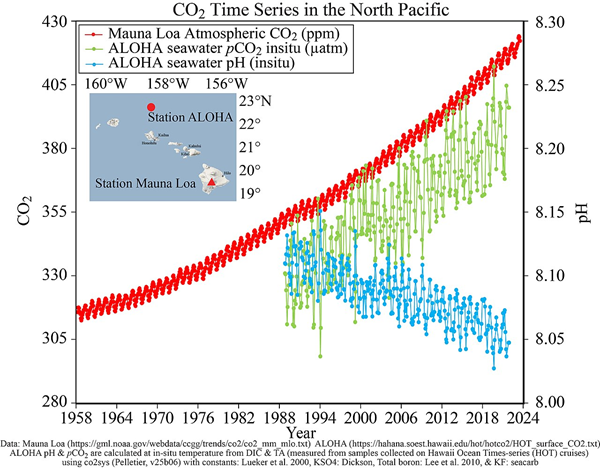
Ocean acidification is often expressed through the acid/alkaline pH scale which is logarithmic in character, where small changes in the numbers mean a lot. Each whole number represents a 10-fold difference. The scale runs from zero to 14. For millions of years now, pH has been 8.2 to 8.3, the latter during cold periods, the former during warmer periods such as the Holocene. In 2024 the pH scale was 8.04. Identifying the exact preindustrial base is problematic, so the 0.16 reduction is given by the reputable bodies below as an increase in acidity of 25, 30 or 40%.
-
European Environment Agency – Ocean Acidification
EPA – Understanding the Science of Ocean and Coastal Acidification
NOAA – Ocean Acidification
From the EPA:
- Once carbon dioxide dissolves in water, it reacts with water molecules to form carbonic acid. Carbonic acid can be further transformed to bicarbonate and carbonate ions. These four different forms of carbon (dissolved carbon dioxide, carbonic acid, bicarbonate, and carbonate) exist in balanced proportions in seawater. As more carbon dioxide is added to seawater, the balance shifts and the carbonate ion concentration decreases as it is transformed to bicarbonate due to increasing acidity.
And:
- Marine life uses carbonate from the water to build shells and skeletons. As seawater becomes more acidic, carbonate is less available for animals to build shells and skeletons. Under conditions of severe acidification, shells and skeletons can dissolve. (Emphasis added)
About 30% of human-produced CO₂ is absorbed by the oceans. That amounts to 3 billion tonnes of carbon annually (carbon, not CO₂.)
The Findlay et al paper
Mercifully for those like me who are mathematically challenged, the preferred scale used in the Findlay paper and Planetary Boundaries is Aragonite saturation (Ω Arag), a linear scale. The acidification planetary boundary was set at 2.86 which is 20% below the estimated preindustrial level of 3.57.
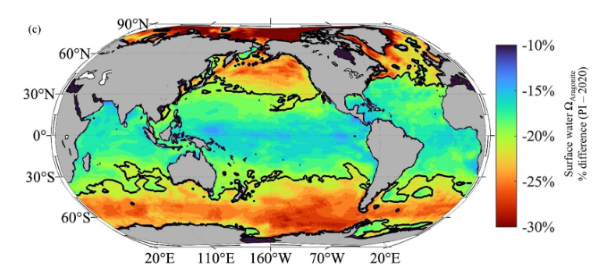
Findlay et al found that 40% of the global ocean surface had crossed that boundary, plus up to 60% of the global subsurface ocean (down to 200 m) where critters also live. They also found:
- significant declines in suitable habitats for important calcifying species, including 43% reduction in habitat for tropical and subtropical coral reefs, up to 61% for polar pteropods, and 13% for coastal bivalves.
In view of this they suggest:
- a revised boundary of 10% reduction from pre-industrial conditions more adequately prevents risk to marine ecosystems and their services; a benchmark which was surpassed by year 2000 across the entire surface ocean.(Emphasis added)
This extract from Figure 1 shows severe acidification up to the southern Australian coast:
The question then was, would the scientists working on the Planetary Boundaries project accept their recommendations?
Planetary Boundaries official finding
This year the Planetary Boundaries project has issued its second annual Planetary Health Check 2025: A scientific Assessment of the Health of the Planet.
Section 3.1 highlights The Ocean: The Unsung Guardian of Planetary Health which takes up around 90% of the excess heat coming from the sun, plus 25 to 30% of human‑induced CO₂ emissions.
- The ocean has an important role in maintaining Earth’s stability and habitability by absorbing anthropogenic heat and carbon.
Section 4.6 deals with ocean acidification. They found that the boundary was assessed as transgressed with a global surface aragonite saturation level of 2.84, just below the Planetary Boundary threshold of 2.86.
They also used CMIP6 model results for the CO₂ emission scenario SSP2-4.5.
They are silent on the Findlay recommendation to change the boundary to a 10% decline, but say as a key takeaway:
- Ocean acidification has gone beyond safe limits, increasingly endangering marine ecosystems.
On tropical coral reefs they say:
- While increasingly frequent marine heatwaves are the main cause of shallow-water coral reef degradation in tropical regions, ocean acidification adds further pressure by impairing the recovery of bleached reefs.
By contrast:
- Deep-water corals are particularly vulnerable to ocean acidification because they live near the aragonite saturation horizon – the depth where aragonite, the mineral that forms their skeletons, begins to dissolve.
In addition, acidification depletes the broader marine food web, reduces the capacity of oceans to take up our excess CO₂ emissions and impairs the production of oxygen.
Wikipedia on ocean acidification
Wikipedia has a very useful detailed article on ocean acidification:
- Ocean acidification is now on a path to reach lower pH levels than at any other point in the last 300 million years. The rate of ocean acidification (i.e. the rate of change in pH value) is also estimated to be unprecedented over that same time scale.
Rate of change is important. Life-forms and ecosystems adapt to slow change. Fast change causes global mass extinction events. This one could be worse than anything that happened in the last 300 years. A recent study found that the he Permian–Triassic extinction event, colloquially known as the Great Dying of 252 million years ago involved excessive CO₂ release over 50,000 years of more, resulting in a global temperature of 6°C to 10°C, rendering extinct 81% of marine species, and 70% of terrestrial vertebrate species. It took millions of years for biomes to ‘recover’. By comparison, what happened then over tens to hundreds of thousands of years we, homo sapiens, are managing over decades to centuries.
This image from By NOAA Pacific Marine Environmental shows clearly how things are trending.

The article has an extensive section on Impacts on oceanic calcifying organisms followed by Other impacts on ecosystems. The effects are widespread and devastating. Harmful algal blooms increase in frequency. Even the acoustics of the ocean are affected, as are fish larvae. Deoxygenation occurs, increasing ocean stratification of ocean layers, thus inhibiting productive vertical mixing of nutrients and species.
- Meta analyses have quantified the direction and magnitude of the harmful effects of combined ocean acidification, warming and deoxygenation on the ocean. These meta-analyses have been further tested by mesocosm studies that simulated the interaction of these stressors and found a catastrophic effect on the marine food web: thermal stress more than negates any primary producer to herbivore increase in productivity from elevated CO₂.
Finally:
- A study done in 2020 argues that ocean acidification is not only negatively affecting marine life, but also human health. Food quality, respiratory issues, and human health are all negatively affected by ocean acidification. (Emphasis added)
What can we do?
Ocean acidification will not respond rapidly enough to a reduction of emissions to net zero. Moreover, it is doing catastrophic damage now.
The topic in not sufficiently researched. Wikipedia has a section on Possible responses canvassing available options. A poorly planned YouTube a discussion with Greg Rau gets better as you go.
Rau is currently Chief Technology Officer and Co-Founder at Planetary Technologies, where he leads the development and scaling of ocean alkalinity enhancement (OAE) as a climate solution. The YouTube notes say his work focuses on safely accelerating the ocean’s natural ability to absorb and store atmospheric CO₂ – a process with the potential to remove gigatons of CO₂ annually. They are operating at a very small scale, and with the help from grants and philanthropy.
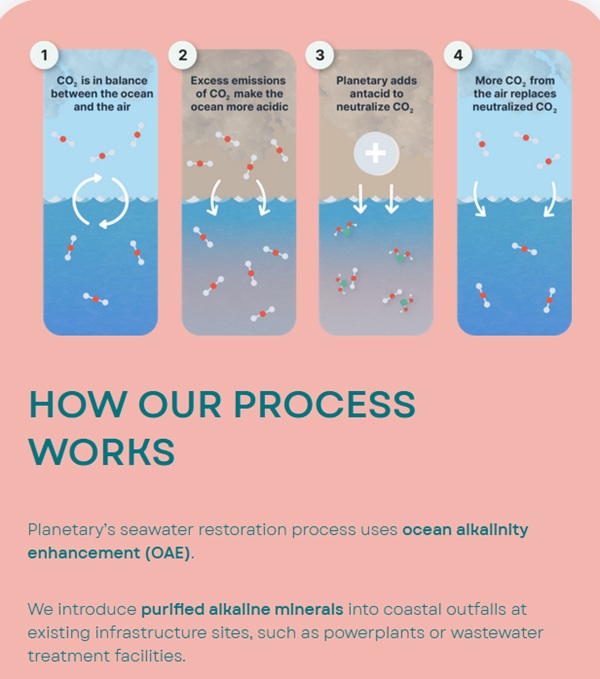
The process they use is adding antacid (magnesium hydroxide) to a wastewater outfall and power plant cooling facilities in Halifax, Nova Scotia. The antacid reduces dissolved CO₂, some of which is then replaced by CO₂ from the atmosphere, restoring the natural balance between CO₂ in ocean and air. Here’s an image from their explanation:
So far they have removed about 3,600 tonnes, a tiny amount, but in truth it has been a ‘proof of concept’ exercise. In June 2025 they said OAE is Here and It’s Delivering. They successfully removed 625.6 tonnes of externally verified CO₂ for paying customers using OAE. Then in August:
- Frontier buyers have signed a $31.3 million offtake agreement with Planetary to remove over 115,000 tons of CO₂ between 2026 and 2030 through ocean alkalinity enhancement (OAE).
They have also been working on an estuarine restoration project in Virginia at Elizabeth River near the University of Virginia and Dalhousie University. They are expanding collaborations to show that ocean-based carbon removal can scale responsibly and effectively in their mission:
Restore the ocean and climate health for future generations.
The ocean is a very large place. The World Ocean Review saw 38,000 gigatons of carbon in the ocean, 16 times as much carbon as in the terrestrial biosphere, and around 60 times as much as there was in the pre-industrial atmosphere.
The short story, I think, is that treating the whole ocean is beyond us. Nevertheless, Planetary Technology appears to be doing quality work which could be useful to heal small parts of the ocean, for example where we might triage coral reef refugia as global tropical reefs pass a tipping point.
Time to wrap. Here are some more links:
-
Global Ocean Acidification Network (GOA-ON)
The Ocean Foundation – Ocean Acidification
Phil Renforth and Gideon Henderson – Assessing ocean alkalinity for carbon sequestration (2015)