Tag Archives: renewable energy

Climate clippings 212

1. South Australia to get 30MW battery to create renewables-based mini grid

    The Australian Renewable Energy Agency says it is providing $12 million towards the $30 million cost of a major battery storage installation to be located on the Yorke Peninsula in South Australia and create a renewables-based mini-grid with the nearby Wattle Point wind farm.

The battery will pair with the local 90MW Wattle Point wind farm and local rooftop solar PV to form local micro-grid to ensure grid security and so keep the lights on in case the network failures elsewhere in the state. Continue reading Climate clippings 212
A tsunami of renewables

The AFR reports that Josh Frydenberg and Labor’s Mark Butler had a bit of a love-in when they shared a platform late last month. Ben Potter said they were peas in an energy pod.

    Frydenberg waxed lyrical about the shrinking cost of solar photovoltaic – from $1.6 per kilowatt installed in 2014 to 19 cents per kilowatt last year. Battery storage has also halved in cost and added half as much capacity again in just five years, he enthused, and “demand response” – where customers curtail their usage or offer their batteries and smart appliances to the grid during demand spikes to avert blackouts – has an “incredibly” important role.

    Butler took his cue, noting that the system is undergoing a “massive, profound and irresistible transition which will just continue whether we like it or not”.

Butler said that if anyone could get the Clean Energy Target (CET) through the LNP party room it would be Josh. Continue reading A tsunami of renewables

Coal-fired power trade-off for new clean energy target

That is as reported by Simon Benson in The Australian:

    The Turnbull government is expected to take its revised energy policy to the Coalition partyroom early next month with a plan to make a significant investment in cleaner coal-fired power as a counterbalance to also adopting a clean energy target.

    The Australian has learned that Malcolm Turnbull and Energy Minister Josh Frydenberg are working on a compromise deal on coal that would allow them to quell internal resistance to a CET.

Continue reading Coal-fired power trade-off for new clean energy target

Renewables make gas out of date, but coal not done yet

It’s the kind of article we expect in RenewEconomy, but this one by Angela Macdonald Smith is in the Australian Financial ReviewFuture for gas to be cut short by batteries and renewables:

    The conventional wisdom that gas will play an increasingly significant role in electricity supply as the market switches more towards renewables to back up that intermittent supply source, has largely gone out the window.

    Now it’s a discussion of how much an opportunity gas has before it gets squeezed out of the mainstream generation market by solar/wind and storage – not on carbon emissions grounds, but on costs.

Continue reading Renewables make gas out of date, but coal not done yet

Climate clippings 209

1. Power price wave slams business

That was the headline on the front page of the AFR on Friday.

Households are facing increases of up to 20 per cent, but businesses on five-year contracts signed in 2012 are facing hikes of as much as 83%. Continue reading Climate clippings 209

Climate clippings 208

1. Coal India closes 37 coal mines

Coal India, the largest coal mining company in the world, has announced it will close 37 mines because they are no longer economically viable. That’s around 9 per cent of the state-run firm’s mines.

Also:

    The government has announced it will not build any more coal plants after 2022 and predicts renewables will generate 57 per cent of its power by 2027 – a pledge far outstripping its commitment in the Paris climate change agreement.

Continue reading Climate clippings 208

Looking forward to Finkel

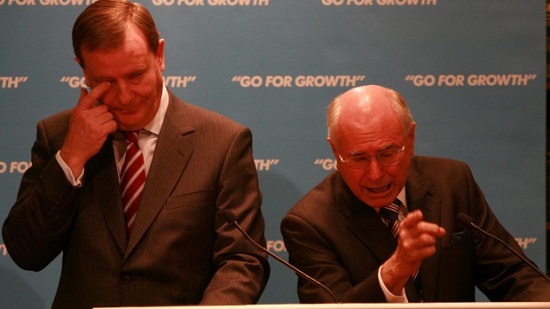
The Finkel review of the National Electricity Market is due to be revealed to the premiers at COAG tomorrow, but is you’ve been reading the Australian Financial Review it’s all done and dusted. There’s really only one horse in the race, and it’s the Low Emissions Target (LET), which Tony Wood of the Grattan Institute says is the third last horse in the race, but picked because it’s better than the other two. That may be harsh, but the visionary scheme was first proposed by John Howard in 2007. Here’s Howard and Costello launching the scheme way back then:

It’s the least-worst, least-best carbon pricing scheme, but has the attraction of giving coal a chance of sticking around for a while. Continue reading Looking forward to Finkel

Energy crossroads

Transformer over orange sky
The initial stimulus for this post was an article in the AFR entitled We are at an energy crossroad (paper version) by Tony Wood of the Grattan Institute, based on a new report Powering through: how to restore confidence in the National Electricity Market and a series of articles mainly at RenewEconomy. I’ll summarise them Climate clippings style, so the story should emerge and you can follow the links for elaboration if you choose. Continue reading Energy crossroads

Turnbull stands naked on climate policy

Giles Parkinson says of the 2017 budget that Turnbull lets [his] fig leaf droop and stands naked on climate policy. Matthew Rose says Turnbull’s budget ignores energy crisis and dodges climate. The Conversation article is headed Budget 2017: government goes hard on gas and hydro in bid for energy security, which is I think misleading. It goes for gas and hydro, but not hard.

Before looking at what the budget has to offer, it is appropriate to remind ourselves that at the UN climate talks in Morrocco last year, Australia’s proposed effort was ranked fifth worst in a list representing 90% of the world’s emissions. Moreover, Frydenberg has been backsliding since then, suggesting we may not achieve zero net emissions until 2100. Continue reading Turnbull stands naked on climate policy

Power tipping point

The Four Corners program Power Failure added to the sense of crisis around our power system, beginning with the breathless comment that there was almost a breakdown of civil order in South Australia when the lights went out in September. The program looked at the difficulties experienced when the power went off for three days. Recently in some places affected by Cyclone Debbie, crews couldn’t get in to start fixing for about double that time. I’ll come back to Four Corners via a series of articles published on the same day.

First, in the AFR tucked away on page 8, Mark Ludlow penned an article Renewables, EIS ‘make gas-fired power redundant’ (paper edition title). Ludlow interviewed Professor Frank Jotzow, director of the Centre for Climate Economics and Policy at ANU, who said gas had been overtaken by renewable energy, including battery storage, in the transition away from coal-fired power. We should skip gas and go straight to renewables with batteries. Continue reading Power tipping point

Gas has got to go

The Climate Council issued a report on the future of gas-fired electricity just after Easter – Pollution and Price: The Cost of Investing in Gas.

Gas is often thought of as a ‘transition fuel’ from coal to renewables. Their advice is clear:

    Do not provide policy support for new gas power plants or gas supply infrastructure.

And:

    Existing gas plants should be thought of as a short-term, expensive, emergency backup as renewable energy and storage is rapidly scaled up.

Moreover, we should leave most of our gas reserves in the ground. Continue reading Gas has got to go

Climate clippings 203

Renewable energy news

I’m reminded of my school days when our German teacher on the last day of term used to read us tales of Baron Münchhausen, who on one occasion jumped on his horse and rode off madly in all directions. There is so much going on, fully covered at RenewEconomy, so it is difficult to select the most significant. I’ll try a couple of themes, and include some AFR coverage, which is trying to keep business informed.

1. Batteries

The South Australian tender for 100MW grid-scale storage has received 90 expressions of interest from 10 countries, demonstrating an established global industry. Continue reading Climate clippings 203