Category Archives: Social Science and Society

Cologne: what happened and where to from here?

A Deutsche Welle report I heard on NewsRadio began along these lines:

    She was pulled to the ground by her long blond hair, then a man laid down on top of her.

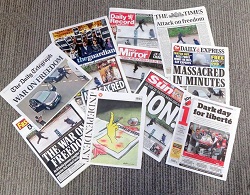
An extensive investigation by Der Spiegel tells us that groups of men humiliated, sexually assaulted and robbed women around the main railway station in Cologne on New Year’s Eve. What happened was not new and was not limited to Cologne. What was different was the scale, the presumed predominance of men from North Africa amongst the perpetrators, and the timing in relation to the dilemmas faced by the influx of refugees from Syria. Continue reading Cologne: what happened and where to from here?

The tip of an iceberg, or a broadbrush smear?

Terry Sweetman in the Courier Mail has raised a real question about the objectivity of Commissioner Dyson Heydon’s report on trade unions.

    the part of the iceberg he can identify is populated by about 30 unionists and 16 executives from large commercial organisations who are adversely mentioned or recommended for possible prosecution.

Sweetman says the misconduct identified by Heydon stems from just six of the 132 unions in Australia (Heydon’s figures). Continue reading The tip of an iceberg, or a broadbrush smear?

The year that was – 2015

Ian MaAuley hopes “we will make progress to becoming a real “developed” country, and not just a third world country temporarily enjoying a first world living standard.”

    Donald Horne wrote 50 years ago, “Australia is a lucky country, run mainly by second-rate people who share its luck.”

Well, we’ve run out of luck, and make that third rate people. Continue reading The year that was – 2015

Turnbull calls for ‘ideas boom’ as he unveils $1b vision for Australia’s future

The much awaited Innovation Statement has arrived. The ABC has a useful summary. Michelle Grattan has two lead-in pieces at The Conversation, where there is heaps more.

Bernard Keane at Crikey (paywalled) details how the Rudd/Gillard governments trailed their coat in this area without grabbing it by the throat, to mix the metaphors. The trouble says Keane is that we don’t have a business culture that facilitates innovation. Terry Cutler, back in 2008, wrote about our lifestyle approach to business:

    Too many of our business owners or managers have what we might describe as a lifestyle approach to business. Even many of our so-called success stories look like under-performers when benchmarked globally. This lifestyle model of business strategy imposes a false ceiling on ambition: success is having the designer car in the garage, and the holiday home or two…. At a recent forum I actually heard people saying they didn’t need to expand or export because they were doing it quite comfortably as things are.

Sounds like a sensible balance to work and life-style, but the raw facts are that it is easier to grow a company by a second $10 million than it is to achieve the first.

Another problem is that our managers are not much chop. David Gruen speaking in 2012 put our manufacturing managers at mid-range:
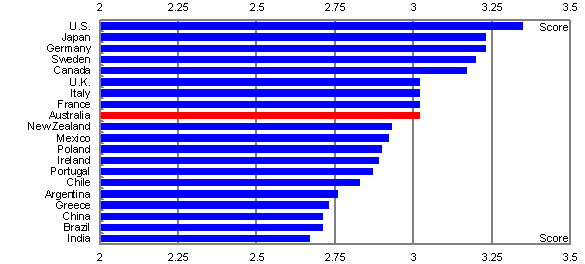
Management practices -Speech-8.ashx

For small companies, I think that’s flattering us.

Turnbull seems to be obsessed with high-tech start-ups, which, says Jason Murphy at Crikey, are a really bad idea.

    The key features of a tech start-up are this: it has no customers and a strong chance of going broke. What most of these businesses do is funnel capital (investors’ money) into work nobody asked to be done. They build a product for which there is no market, exhaust their funds, close. They’re a bit like a make-work project.

Some of the better ones are picked up by venture capitalists, and are subsequently bought by larger businesses. So:

    In short, the average tech start-up adds little value to the economy, employs few people, and pays out to a handful of already rich people if it succeeds. And we’re now going to give them tax breaks to do so.

    The other big winners from a successful start-up “eco-system” are the big companies that gobble up small start-ups.

Murphy says we need to think beyond technology, and beyond start-ups of new ideas. Innovation also means innovation in operational and managerial processes and marketing as well as in products. Innovation in that sense can be best leveraged in big business.

Finally, the notion that teaching coding to primary school kids is the answer really gives me the willies. We need creative problem solvers with excellent human relationship skills.


Karen Armstrong, ‘the myth of religious violence’ and the secular state

I’d like to establish a separate post on Karen Armstrong’s ideas, which entered the discussion here on the earlier thread and point towards the important issue of the secular state.

I want to make it clear that I’ve been defending the book Fields of Blood as an impressive piece of scholarship. I’m not saying Armstrong is right. Continue reading Karen Armstrong, ‘the myth of religious violence’ and the secular state

Paris attacks

No place is safe. You can be hit anywhere where people gather. This seemed to be the message of the six co-ordinated attacks in Paris on a sports stadium, a concert hall, three restaurants and a shopping centre. As the Paris metro ground to a stop, as air and sea ports were closed, as the streets emptied, as France closed its borders, and as the army fanned out onto the streets of Paris the terrorists’ strikes seemed to be successful. Continue reading Paris attacks

Computers in classrooms: a waste of money?

While the findings are quite complex, the take-out message from a recent OECD study is:

    On average, in the past 10 years there has been no appreciable improvement in student achievement in reading, mathematics or science in the countries that have invested heavily in information and communication technologies for education.

Continue reading Computers in classrooms: a waste of money?

Innovation and economic complexity

Goran Roos, Adjunct professor at University of Technology Sydney, explains why advanced manufacturing is an essential feature of ‘economic complexity’ and that “a nation’s potential to create prosperity is a direct function of its economic complexity.”

Australia’s economic complexity has declined over the last 25 years, to the point where it ranked 53 among all countries in 2012. The top three were Japan, Switzerland and Sweden. Losing the car industry is likely to lower Australia’s economic complexity by a further 5-15%. The share of manufacturing in Australia’s economy is likely to be below 5%, compared to Switzerland’s 20%. Continue reading Innovation and economic complexity

Will the bubble burst?

Seven years ago we were in Amsterdam airport departure lounge when the news came through that Lehman Bros would indeed go bust, which finally triggered the GFC (Global Financial Crisis).

James Headway, Chief Economist for the New Economics Foundation takes a look at what’s happening in China, and it’s scary.

China escaped by letting lending rip. Since then they have produced half the world’s growth. But in doing so they have created a giant property bubble, followed by a share market bubble. It looks like coming unstuck. Continue reading Will the bubble burst?