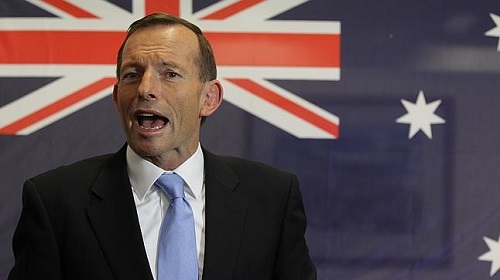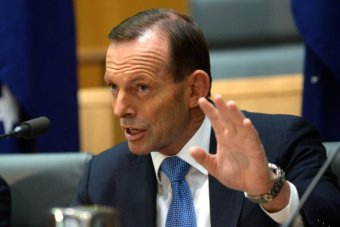
Trapped inside his own feedback loop

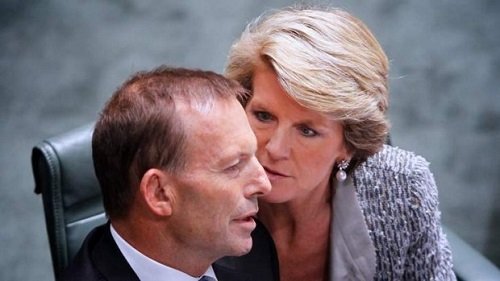
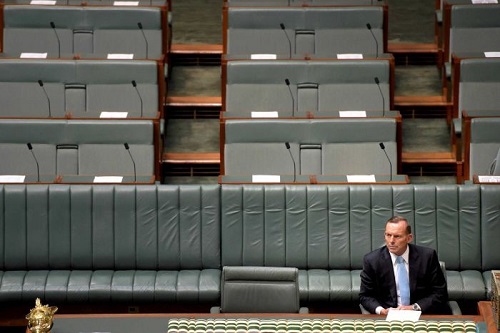
Tony Abbott is trapped inside his own feedback loop, understanding the world is still out there, but not really comprehending how to reconnect. He’s been gone so long now – for years. What is the pathway back?

That’s from a brilliant article by Katherine Murphy. It can be lonely at the top, but Abbott is still prime minister.
6079672-3x2-500

The opinion polls are shocking. Newspoll has Labor ahead 57-43 in two-party preferred terms. Fully 68% of people disapprove of the job Abbott is doing while only 24% approve.

The personal disapproval would not matter if the LNP was in a winning, or even competitive position. But it is not, and won’t be unless Abbott can fix the economy and the budget. On the 7.30 Report Abbott explained that he would complete “fiscal repair” by abandoning spending cuts, “putting money in families’ pockets” and giving small business a tax cut.

This has panicked the right in the party who can see the restoration of a balanced budget, or “fiscal consolidation”, disappearing over the horizon. Paula Matthewson reveals that there is a subterranean battle taking place within the party “between the right-wing conservatives who want to protect the Government’s current agenda and the moderates who seek to change it.”

Abbott is trying to play to both sides, so is adopting contradictory positions and basically floundering in an attempt to save himself. Jettisoning Joe Hockey has apparently been contemplated.

So far the only spending cut abandoned has been the parental leave scheme, which no-one except Abbott in the party seemed to favour. The conservative right will try to hold the line. The GP co-payment is actively being pursued and yesterday in parliament university deregulation, with swingeing cuts, was being vigorously defended.

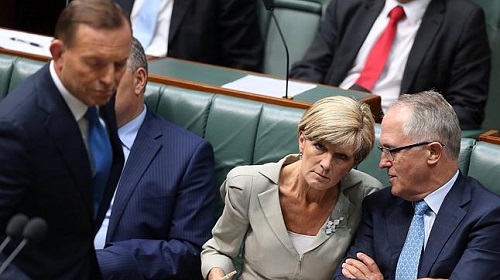
Since being in opposition is unacceptable, the right will need to be desperate to go for Turnbull. Julie Bishop is not considered competent enough by the right according to Matthewson, and the right still have the numbers.

I suspect, however, that Bishop as PM and Turnbull as treasurer may ultimately prevail.
64e75bbe-afbd-11e4-9790-a811272fa372_syd-6i7a69pkta0v3tfybah--500

Most seem to think six months of poor polling will see Abbott gone, sooner if he stuffs up again.

Ben Eltam sees the spill motion as Tony Abbott’s last gasp. There will be no ‘clear air’.

Laura Tingle has been emphasising the dilemma with the budget. The revenue base is “buggered”, there are no more big saves to be made, and the ones the Government chose are locked up in the Senate.

The economy continues to struggle to reach even its long term average growth levels. Commodity prices continue to slide. The world economy is not looking great. Confidence is mediocre and not being helped by the ludicrous spectre of the implosion in Canberra.

In this milieu the government is trying to remake itself as voters fear for their jobs. The strategy of having an early tough budget and locking in “reforms” has spectacularly imploded.

Having sprung radical overhauls of education and health funding on an unsuspecting electorate and been comprehensively rejected, the government is going to have to re-prosecute the cases, and restructure its policy offerings, much closer to an election – even making them mandate issues.

Peter Hartcher tells the inside story of how the Liberal leadership duo of Tony Abbott and Julie Bishop cracked. All Tone’s handiwork. And he’s going to have to get by with less direct minding from Peta Credlin, if she stays. Apparently she will no longer attend cabinet meetings or veto ministerial staff appointments.

Finally I’d like to return to Katherine Murphy’s article. Impossible to summarise, but she is saying that to become PM he has suppressed his real nature and moulded himself to fit the role in service to others.

Being a man for others has seen Abbott lose himself, and squander the opportunity to grow beyond his superstitions and self-soothing rituals to something approximating genuine self-expression. Abbott has denied himself the chance to be interesting. His confidence and judgment have taken a hit. The prime minister conducts himself less as a prime minister and more as a prisoner who can’t persuade the screws to give him early release.

But rather than admit defeat, he fights, and swaggers, and swings between bouts of brutal introspection and outright defiance. Rather than reach out he retreats, and roils at the fickleness of everything – entreating media boosters to validate him, telling the colleagues they have no right to desert him, while pondering who he can jettison in order to save himself.

Sad, but tragic for the nation.
Unseemly squabble over keys to the Executive Building

In a sense that is what the 2015 Queensland election has come down to. From the Brisbane Times:

Newly elected LNP leader Lawrence Springborg, who is taking on the role as party leader for the fourth time, accused Labor of “trying to snatch the keys to the Executive Building”.

When the LNP was elected in 2012, it moved into the government’s George Street headquarters the very next day, but Mr Springborg urged Labor to be cautious, given the “unprecedented” Ferny Grove situation.

It is believed to be the first time in Queensland’s political history where a seat is known to be disputed before it has been called. The situation in Mundingburra did not come to light until after it had been declared.

“You could have the possibility of the government changing in the next few days and then changing again in the next month or so,” Mr Springborg said.

Springborg is arguing that an LNP caretaker government would provide necessary stability.

A flaw with that argument is that if Ferny Grove, which Electoral Commission Queensland has referred to the Court of Disputed Returns, requires a by-election the matter could take 6 months or even a year to determine.

By Wednesday Ferny Grove will be represented by a duly elected Labor member and Annastacia Palaszczuk will have the numbers to command the floor of parliament with the assistance of Peter Wellington, the independent member for Nicklin, who puts the case very well:

To put Ferny Grove into the picture is nonsense. While the seat is subject to assessment by the Courts because one of the candidates was ineligible, the fact is that it was won by Labor and Labor is entitled to include that seat in their claim to govern.

Ferny Grove could face a by-election after a Court hearing or the Court may decide that the preferences were so insignificant that a by-election is not necessary. The timeframe for this decision is uncertain. It could take over 12 months and it is unreasonable to expect Queensland to remain in a state of limbo until the outcome is known.

It is farcical for the new Leader of the LNP to seek to hold on to power until then leaving the Newman appointed senior public servants to govern the State.

The Governor has the responsibility to hand the reins of government to whoever is able to deliver the 45 seats and should not be drawn into hypothetical scenarios involving the future of the electorate of Ferny Grove.

Wellington refers to a blog post by Antony Green, which says exactly that.

Green finds the situation similar to South Australia in 2002 and Tasmania in 1989 where Liberal premiers refused to resign in the face of similar electoral circumstances. They had to go.

Labor claims Springborg has no mandate to govern. Jackie Trad told fairfax Radio:

“What happened on the 31st of January was the LNP lost the election,” she said.

“They are now – in an arrogant and dismissive way – they are still not listening to Queenslanders, trying to hold on to power.”

They want Newman out of the Executive Building at 6.01 pm on Tuesday night.

I believe Graham Orr, a QU academic who knows about electoral matters, suggested Springborg was attempting a “constitutional coup”.

I’ve also been told that Possum Comitatus reckons Springborg wants the Governor to break the relevant electoral act.

We shall see.

Another flaw in the Brisbane Times article is this bit:

While the Ferny Grove result will be sent to the Court of Disputed Returns, where a by-election is expected to be the likely outcome, results can still be declared in the meantime. (Emphasis added)

From Green’s earlier post:

However, beyond the narrowness of the result, doubt has been thrown on the election outcome following the revelation that the Palmer United Party candidate for Ferny Grove, Mark Taverner, is by credible sources an undischarged bankrupt and therefore ineligible to be a candidate for election to the Queensland Parliament.

Will this cause the courts to overturn the Ferny Grove result, order a by-election and leave the fate of government undetermined for some time?

In short – no. Resolving the Ferny Grove matter could take several months based on past Court of Disputed Returns cases, and there is nothing to stop a new government being formed in the mean time.

The Queensland Times has uncovered a Supreme Court ruling from a Moreton Shire election in 1985 which could form a precedent. A candidate’s name appeared on the ballot paper although it was discovered prior to the election that his American citizenship rendered him ineligible. The votes caste for him were simply set aside.

Meanwhile the Katter boys have released their full list of demands on the major parties. If they get their way all the money will be spent in the bush. Apart from royalties to regions, a railway line to the Galilee Basin and other boondogles, they want a series of roads projects, including an inland highway.

Springborg has apparently agreed to their demands. If so it’s magic pudding budgeting.

Climate clippings 125

1. Paris climate talks won’t keep warming below the dangerous 2°C Limit

Joe Romm at Climate Progress believes the Paris climate talks should not be written off as a failure if they don’t do enough to keep warming below 2°C. He thinks the CFC ozone layer example is apt. The Montreal Protocol was concluded in 1987. Initially the protocol’s targets and timetables slowed the rate of growth of concentrations only slightly and would have still led to millions of extra cases of skin cancer by mid-century.

President Reagan endorsed the protocol, and the Senate ratified it. By the end of 1988, 29 countries and the European Economic Community — but not China or India — had ratified it. The treaty came into effect the next year. But it took many more years of negotiations, continuous strengthening of the scientific consensus, and significant concessions to developing countries before amendments to the treaty were strong enough and had enough support from both rich and poor countries to ensure that CFC concentrations in the air would be reduced.

Elsewhere 14 high-profile CEOs want to decarbonise the economy completely by 2050. They are the B Team led by Virgin founder Richard Branson. See also at The Guardian.

2. 2013 record heatwave ‘virtually impossible’ without climate change

That’s according to a new report from the Climate Council.

From The Guardian:

The country experienced its hottest day, month, season and calendar year in 2013, registering a mean temperature 1.2C above the 1961-90 average.

The Climate Council says recent studies show those heat events would have occurred only once every 12,300 years without greenhouse gas emissions from human activities.

Record hot days have doubled in Australia over the past 50 years. During the past decade heat weather records were set three times more often than cold ones.

Heatwaves across Australia are becoming hotter, lasting longer, occurring more often and starting earlier.

The ABC article has handy links to other sites.

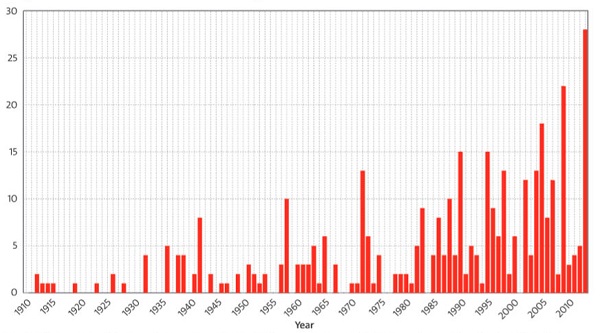
The following graph shows the number of days each year where the Australian area-averaged daily mean temperature was above the 99th percentile for the period 1910-2013:

Hot days Australia_cropped_600

3. Two degrees by 2036

Michael Mann using an Earth energy balance model has calculated that we could reach 2°C of warming as early as 2036. To stay within the 2°C guardrail we need to limit CO2 concentrations to 405 ppm. It would be 450 ppm but for the aerosol issue. If we cease burning coal we lose the cooling effect of the crap that coal spews into the atmosphere along with CO2.

Mann has done the calculation on the basis of climate sensitivity of 3°C. Problem is, he says, that this modelling is based only on short term feedbacks.

David Spratt at Climate Code Red has done a long and thorough post based on Mann’s article. Spratt looks in some detail at the longer term climate sensitivity issue, drawing also on the work of James Hansen, Aradhna Tripati and others. Hansen found that climate sensitivity with long term feedbacks was considerably higher than 3°C; Tripati found that in the Miocene with CO2 concentrations similar to now “temperatures were ~3° to 6°C warmer and sea level was 25 to 40 meters higher than at present”.

Spratt also reminds us that 2°C warming is not safe.

4. Would turfing Abbott help climate change policy?

In short, yes, but perhaps not a lot. The conservative side of politics is still infested with climate change denialists.

Mother Jones in an article One of the World’s Worst Climate Villains Could Soon Be Booted From Office would clearly like to see the back of Abbott. Julie Bishop has a background of denialism, but is pragmatic and has understood from the Lima experience that our stance on climate is negatively affecting our international standing.

Turnbull stated back in 2009:

“I will not lead a party that is not as committed to effective action on climate change as I am.”

He would now, of course.

Tristan Edis looks at actions Turnbull might get away with. Giles Parkinson thinks he might rescue renewable energy and could adapt Direct Action into a baseline and credit scheme.

See also Lenore Taylor at The Guardian.

Saturday salon 7/2 (on Sunday)

voltaire_230

An open thread where, at your leisure, you can discuss anything you like, well, within reason and the Comments Policy. Include here news and views, plus any notable personal experiences from the week and the weekend.

For climate topics please use the most recent Climate clippings.

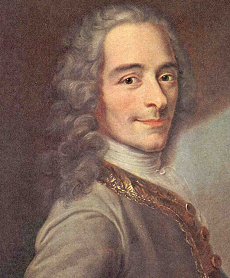
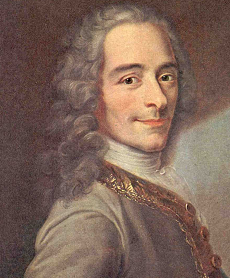
The gentleman in the image is Voltaire, who for a time graced the court of Frederick II of Prussia, known as Frederick the Great. King Fred loved to talk about the universe and everything at the end of a day’s work. He also used the salons of Berlin to get feedback in the development of public policy.

Fred would only talk in French; he regarded German as barbaric. Here we’ll use English.

The thread will be a stoush-free zone. The Comments Policy says:

The aim [of this site] is to provide a venue for people to contribute and to engage in a civil and respectful manner.

Here are a few bits and pieces that came to my attention last week.

SS delayed

It looks as though I didn’t hit the ‘publish’ button last night, although I’ll swear I did! Here goes!

1. Dead malls

By some estimates, half the shopping malls in the USA will close by 2030, suitable only for horror movie sets.

The big problem is oversupply. America has more retail space per capita than any other country.

The question is whether the same will happen in Australia. I tend to think not, at least I can’t detect any sign of it in Brisbane’s northern suburbs.

Thanks to John D for the link.

2. Rightwing rules rather than governs

Or you might say it’s government of the people rather than for. Jason Wilson peers into the rightwing mind and is horrified by what he sees. The article is a tour de force. Very impressive!

From Tony Abbott all the way down to pundits in the conservative press, the verdict is clear: elections are illegitimate when it returns a result they don’t like.

This extraordinary outpouring of contempt for the voting public is not simply a fit of rightwing pique. Rather, we can see that conservatives and a broader swathe of the political elite revealing some of their basic assumptions when put under pressure. To argue that democracy fails when it resists the imposition of fiscal austerity is simply to argue for our permanent subjection to the rule of property.

Apparently we are not competent to determine our own interests, or the kind of community we want to live in. Democracy becomes equated with disorder.

3. Growing brain drain as one young scientist chooses not to work here

Award-winning Dr Danielle Edwards applied for four years for work in Australia, but could only find it in the US. Eventually she was invited to apply for a position at the CSIRO, but the Abbott government was elected, a freeze was put on hiring and the job disappeared.

Then she was offered a Discovery Early Career Researcher Award, or DECRA, by the Australian Research Council.

Hugely competitive, her grant is worth $385,000, but Dr Edwards has chosen to turn it down.

She says the most recent round of funding cuts to science, and the prospect of university fee deregulation, means she sees no future in Australia.

The award-winning Dr Danielle Edwards has conducted research from the Greek Aegean to the Galapagos. She’s an evolutionary biologist specialising in reptiles, researching how genetic diversity is affected by factors like the environment.

Dr Edwards says her work feeds into important questions around what species can survive extinction, and why.

She’ll be doing her research, and raising her child, somewhere else.

4. No institution has the right to kill, whether it’s a nation state or Isis

That’s the view put by Gay Alcorn at The Guardian.

She points out Indonesia’s inconsistency in objecting to Saudi Arabia executing Indonesian nationals working there, and paying “blood money” to save them.

She points out our inconsistency in objecting to ISIS beheading sundry people, but ignoring Saudi Arabia where people can be put to death for such things as apostasy and witchcraft.

The death penalty is always brutal and violent and is never acceptable, no matter what the crime.

Elsewhere Greg Craven, Vice-chancellor of the Australian Catholic University and a campaigner against the death penalty warned staff at the ABC’s triple-j radio station that they’ll bear some responsibility if the Indonesian government executes the two Australians on death row in Bali.

The station conducted a survey showing a slim majority of those Australians who were polled support the death penalty for drug offences in other countries. The survey is being quoted in Indonesia to support its actions.

5. Mark is here

My son Mark is here, staying with us for a few days, which for me makes blogging difficult.

Catch his latest at The Monthly, telling us why Malcolm Turnbull gives him the irrits. People of the left who favour Malcolm should remember a few things!

Interest rate cuts, jobs, debt and absent vision

The Reserve Bank cut interest rates by 25 basis points in the jargon on Tuesday to a new low cash rate of 2.25%. This is the first cut since August 2013, just before the last election. Back then Joe Hockey lambasted the Rudd government for the sluggish economy requiring such stimulus. Now he hailed the RBA decision as good news for families, businesses and jobs.

ABC business editor Ian Verrender comments:

Make no mistake, this is an emergency cut to a level well below what already was considered crisis level.

Verrender explains that the RBA has two main roles. The first and primary role is to maintain steady prices, that is, to keep inflation under control.

Secondly, it has a responsibility to maintain the labour market as close as possible to full employment.

Verrender suggests that the RBA has now adopted a third role – massaging the level of the currency. This indeed seems to be supported by the Reserve Bank governor Glen Stevens’ continual commentary on the currency.

What really has spooked Mr Stevens are the actions of his global central bank contemporaries, many of whom have either embarked on programs specifically designed to depress their currencies or to cut interest rates.

Despite the Australian dollar falling sharply in the past year, from around US94 cents last September to US77 cents early this week, Mr Stevens argued the currency was still overvalued, given the crash in commodity prices and the decline in our terms of trade.

Last year Stevens called for a currency level of US75 cents. His comments indicate that he has an eye to the Trade Weighted Index, which measures our currency against a parcel of our trade partners. The TWI has not fallen as much, essentially because of the successful massaging done by other central bankers.

The Guardian quotes Stevens thus:

The Australian dollar remained above “most estimates of its fundamental value”, Stevens said, and reducing rates would therefore bring more downward pressure on the currency “to foster sustainable growth”.

Problem is that interest rates in other countries are down to almost nothing or less, so we will still attract money looking for yield, putting upward pressure on the currency.

On the box tonight one economist was suggesting that the RBA should trim a whole 100 basis points off the cash rate over the next year and take the currency down to US70 cents or thereabouts.

BT chief economist, Chris Caton, says the RBA is rightly concerned about employment and the investment needed to transition the economy out of its dependence on the mining construction industry. He sees Hockey as overly concerned about debt and deficits, which is not a big issue. Certainly it would be nice to reduce the deficit, but not at the expense of killing the economy.

Caton sees one more cut of a similar order down the road.

Chris Bowen (see at the bottom of the Hockey link) reminded Hockey of his 2013 comments.

“Joe Hockey and Tony Abbott both used to say that falling interest rates were a sign of a weak economy and a bad government,” he said.

“Instead of engaging in hypocrisy and spin, the Government just needs to start producing a proper economic plan with economic growth and jobs at its core.

“Making it harder for low and middle-income families to make ends meet while gutting science, research and development funding is no economic plan, it does nothing other than undermine future sources of economic growth.”

Peter Martin at The Age pointed out before the RBA move that our 10-year bond rate was now about 2.5%, basically the same as inflation. Effectively the government could borrow money for nothing.

Martin suggests that the government should borrow $100 billion or so to use in nation-building projects.

That’s enough to build the long-awaited Brisbane to Sydney to Melbourne high-speed rail line, or to build Labor’s original national broadband network, or Sydney’s $11 billion WestConnex road project plus Melbourne’s $11 billion metro rail project plus Melbourne’s $16 billion East West Link plus something big in each of the other states.

Or we could buy all the coal-fired power stations, shut them down and install solar with battery storage everywhere.

It’s a once in a lifetime opportunity. All we need is vision and confidence.

But that would mean ‘picking winners’, and increasing our debt numbers, so we’ll do exactly nothing.

Abbott looks terminal, but what about policy?

1379610000000_500

Dennis Atkins talking to the ABC on Tuesday afternoon said that on the weekend Abbott asked Julie Bishop and Malcolm Turnbull to say that they wouldn’t challenge for PM, or so the story goes. Bishop refused, apparently. This became a story on Tuesday morning. Bishop came out with the necessary words, but it took her 9 hours to do it.

Atkins reckons that the chatter will continue. Abbott can’t afford to make a mistake from here and must turn the polls around.

There are two problems with this. Firstly, opinion amongst the backbench is so sour that whatever he does will be seen as a mistake by some. For example, when Gillard announced the election date in early 2103, I thought it wasn’t a bad idea. To her backbench critics it was self-evidently the stupidest thing ever.

Secondly, the backbench revolt is no longer anonymous. Dennis Jensen and Warren Entsch have demanded a ballot on the Liberal leadership and say the PM’s position is ‘terminal’. Mal Brough says the leadership issue “needs to be resolved”.

The ABC was told that cabinet ministers have urged Abbott to resign.

Under these circumstances Abbott can’t get enough clear air to say anything that will not be seen through the leadership filter. Lenore Taylor wrote of his Press Club speech:

Tony Abbott’s press club speech had little to do with charting a path forward and everything to do with circling the wagons around his prime ministership.

But a path forward – a way out of its political mess – is the only thing that can save the prime minister and his government. Circling the wagons might hold his critics off for a while, but it doesn’t address the cause of their concern.

The speech was reported as much or more for its political intent – telling the backbench he was going nowhere – as for its policy content.

“the point of the speech was to tell agitating backbenchers that he would stare them down and that they were doing the country a disservice by the very act of leadership agitation.”

Ben Eltham laments the media role in this. The larger problem, he says, is that Abbott is wedged between the hard right agenda, favoured by backbenchers that put him there, and the fairer more humane deal that the electorate wants.

What could he do? Abandon university deregulation. Give up on the GP co-payments. Restore some of the family payments Joe Hockey cut in 2014. Fashion a 2015 budget for the middle class, not big business.

On these substantial issues, Abbott stayed the course. Perhaps he has to: ideologically wedded to a hard right agenda, the Prime Minister relies on right-wing backbenchers to stay on as leader. Such policy changes would never be acceptable to the bulk of the party room. Nor would the conservative pundits and commentators who wield so much influence on this government be pleased with such concessions.

And this is the real problem faced by whoever runs the Liberal Party in 2015. Conservative ideology has drifted well to the right of the general electorate. For a long time, the timidity of the ALP disguised just how toxic the neoliberal brand of conservative politics has become. But, in office, the nastiness of the Coalition’s attacks on the welfare state has become impossible to conceal.

As the ALP gropes towards a rediscovered belief in fairness and slowly rebuilds its grass-roots campaign base, the Coalition’s dominant political ideology looks increasingly out of touch. There is no sign that Julie Bishop understands this, or, if she does, can do anything about it.

As occasional commenter wpd indicated recently, it is the whole Institute of Public Affairs agenda that needs to be defeated.

Meanwhile the latest Essential poll has a lot of colour and movement about personalities, but the bottom line is that it has Labor ahead 54-46. That is what is scaring the backbench, and may it continue to do so!

Qld election wrap: a sea change in politics

Newman_861e87c5-8727-4aa1-974f-706e123dfdde-500

The Electoral Commission says it may take 10 days to finalise the Queensland election count. Remembering that 45 is the prize, the latest count has 42 seats to Labor, 38 for the LNP, 3 ‘other’ and 6 now undecided, up from 3 the day before.

It looks as though Pauline Hanson is in with a show in Lockyer, though Poll Bludger thinks she might come up short.

Without any confidence, I think the likeliest result will have the ALP on 44. In that case they would govern with the assistance of Peter Wellington. He could be offered Speaker, which he would refuse, preferring to actively represent his electorate. This result would avoid having to do a formal deal with KAP, but KAP would be consulted on any legislation brought forward. I think this would be ideal for democracy.

Second likeliest, I think, would be Labor on 43, necessitating a deal with KAP, who would insist on certain items like a 10% methanol in fuel mandate. It would be better if Labor could freely consider the merits of KAP policies.

Third likeliest is Labor on 45 or 42.

Meanwhile it is important to realise that Newman is still premier and leader of the LNP. Seeney announced a party meeting to resolve the leadership, for reasons best known to him, but was countermanded by Newman.

The best analytical piece so far is by Mark at The Guardian Queensland rejected hubris and unrestrained power when it rejected Campbell Newman. In effect it is a fleshing out of his statement I identified here that “the Labor victory in Queensland is a defining moment of change in Australian politics, which will never be the same.”

Some excerpts:

If the voice of Queenslanders said anything on Saturday, it thundered a rejection of the culture of power unrestrained and politicians’ hubris and arrogance. No more bills passed in the night, stripping citizens and workers of fundamental rights. No more dodgy donations. No more jobs for the boys and girls. No more “don’t you worry about that”. Queenslanders voted in massive numbers for a return to accountability and the basics of good government and democratic practice, conventions trampled underfoot by the RM Williams boots of the LNP’s ministers over the past term.

Any Queensland government must now understand there can be no going back to the dark days of the past, that there is no electoral reward to be had from “strong plans” that don’t factor in the human cost of unrestrained crony capitalism. There will from now on be no electoral reward from “strength”, if that means treating citizens with disdain and contempt.

Let all the misgovernment and malfeasance come to an end, and let it be unmourned. There was a sly charm in the old Queensland, a seductive whisper that the state’s distinctiveness was expressed through its baroque tropical politics, a humour beneath the cattleman’s hats. But Russ Hinze is dead, he’s not sleeping. He was never a king or an emperor, even if Sir Joh was a Knight, and after this result, he should never be coming back. Lawrence Springborg and the LNP – take note.

To understand fully the Russ Hinze reference, you have to read the whole piece, which I recommend.

One of the ways Labor reconnected with the community was through the choice of an “astonishingly diverse array of candidates”, including:

Leanne Enoch, the state’s first Indigenous woman MP, as well as electricians, defence lawyers, medical specialists and tradies.

In a sense, then, one sleeping giant has been awakened through this election – the sense that so many have of Queensland as a project. A work in progress, sure, but progress to a more humane, more inclusive, more transparent, fairer and more accountable polity and society. That project, the legacy not just of figures such as Tony Fitzgerald and the late Wayne Goss but also of a multitude of activists and citizens over the decades, has shown its strength when tested against the flim flam of “strong plans” offered by a rattled party in a state of advanced decay.

Political nostrums that have endured for ages should now be tossed out, along with the many, many LNP MPs who have lost their seats. The LNP must understand that Russ Hinze’s ghost no longer slumbers under the hills of Coomera. And Labor, though it will tread softly, has learned the key lessons of its defeat in 2012 – that privatisation is poison, that Queenslanders want a government that respects not hectors them, and that there’s life still in social democratic politics, provided it connects with citizens. This result is truly an astonishing one, and its implications are manifold. The political rulebook has been smashed to smithereens along with the LNP’s majority, and every political party must now take stock.

There will be fewer cranes, diggers and bulldozers than there would have been if people had voted for the ‘Strong Choices’ on offer, but as Mark says, Queensland is a project and we look forward to a softer, more congenial, more humane polity and society. Palaszczuk has promised a consultative, consensual style, of bringing Queenslanders together. She was never overtly ambitious, but has grown in the role of leader. We must hope that she can make the transition into the real job, where Newman manifestly failed.

Elsewhere Jason Wilson has a fine piece The world is turning against austerity. Now it’s Queensland’s turn, Mark outlines the sequence of the Newman/LNP maladministration in Why you should not go to war with the public #qldvotes, Jason Wilson again in Why Queensland will never Joh again, and Mr Denmore at Failed Estate has a piece Graffiti Crimes where he looks at the coverage, the disgraceful front page propaganda we got from the Courier Mail and the role of social media.

In a piece published before the election Brian Costar, inter alia, points out the difficulty encountered by polling companies in finding representative samples over the holiday period, and how optional preferential voting renders the concept of ‘two party preferred’ meaningless.

Climate clippings 124

1. Totten Glacier melting from below

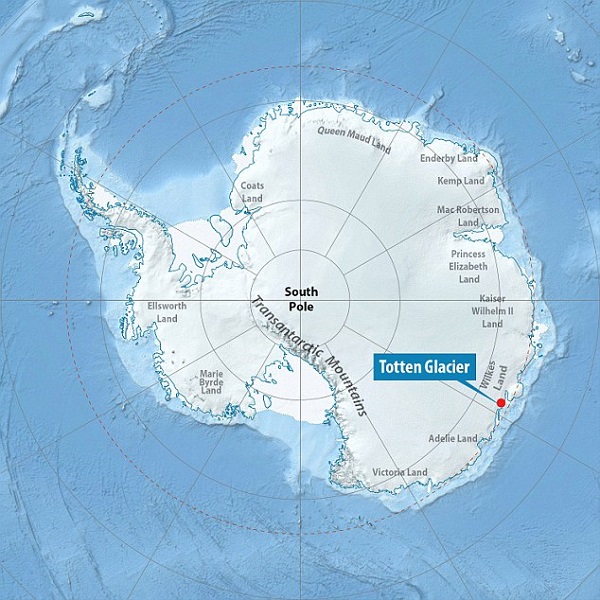
Scientists have found that waters around Totten Glacier are warmer than expected and that it is melting from below. Amazingly the glacier, in East Antarctica, has never been studied before.

Totten glacier_251552E400000578-2926354-image-a-31_1422281876786_600

A team of scientists on the Australian icebreaker Aurora Australis has recently taken a look. They don’t have comparative historical data to go by, but the concern is large. Totten is the biggest of the big and holds enough water to raise the sea level 6 metres. That’s somewhere between West Antarctica and Greenland!

2. State of the Climate 2014

The CSIRO and the Bureau of Meteorology have released their State of the Climate 2014 report. There is a summary at the ABC.

One thing that was new was a prediction of more extreme El Niño and La Niña events. They are talking here of extreme La Niña’s appearing once in 13 years rather than once in 23 years. So it’s not the garden variety events, rather the exceptional events.

For the rest of the report, it seems on a quick look to be much as expected – less rainfall in southern Australia, more extreme hot days, less snow, continued ocean acidification, more worries about sea level rise and so on. I’ll take a closer look if I get time.

Graham Readfearn points out that in 1995 at Amberley near Brisbane the mercury climbed above 35C on 12 days per year on average. That could become 55 days per year.

3. Australian sport needs to lift game on climate issues, Olympians and sport bosses say

It has been a year since extreme heat wreaked havoc at the Australian Open, with players forced to endure temperatures over 40 degrees Celsius on the courts.

Some athletes said the conditions were akin to “tap-dancing on a fry pan”.

Unfortunately Tennis Australia are not on their lonesome in forcing athletes to perform in dangerous conditions. There are concerns also for spectators and venues, for example subject to flooding. The Climate Institute has produced a report analysing the vulnerability amongst sports like AFL, tennis, cricket and cycling as well as winter snow sports.

Part of The Climate Institute’s ongoing research into climate risk and resilience, this report will form the basis of ongoing discussions in the sporting world, including with the newly formed Sports Environment Alliance, chaired by former International Cricket Council CEO Malcolm Speed.

4. Keystone showdown and American climate opinion

The Senate has passed legislation approving the controversial Keystone XL tar sands oil pipeline on a 62-36 vote.

asked Thursday about the vote, White House Press Secretary Josh Earnest reiterated that Obama would veto.

The Senate requires 67 votes to overturn a presidential veto.

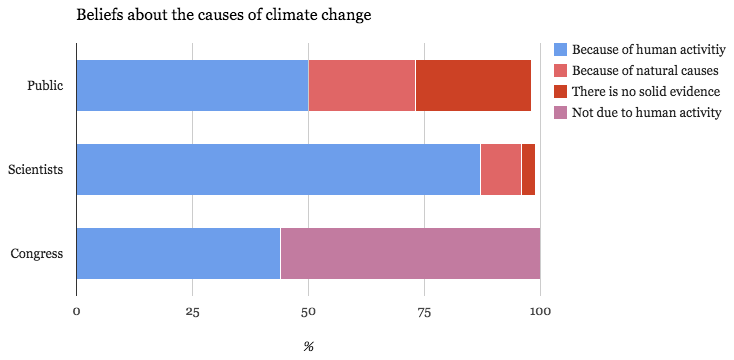
Meanwhile Carbon Brief takes a look at the gap in opinion between scientists, the public, and politicians on climate change from Pew Center research. This is how it pans out:

Screen Shot 2015-01-30 at 11.04.43

A case of the blind leading the partially sighted.

Across the ditch Hot Topic posts about a book that meticulously goes through the development of climate science from the time of Arrhenius. Seriously, there isn’t an argument any more about the basic science.

5. Economists begin to take climate change, and poverty, seriously

I find this surprising:

current economic models… generally conclude that the economically optimal pathway results in a global surface warming around 3–3.5°C.

Current economic models mainly treat economic growth as an external factor. In these models, global warming and its impacts via climate change don’t significantly affect the rate at which the economy grows.

A new study finds:

while the economies of rich countries continue to grow well in a warmer world, the economic growth of poor countries is significantly impaired.

That’s not so surprising.

The authors find that:

the best path for society would limit temperatures to between 1.6 and 2.8°C warming in 2100, with a best estimate of around 1.7°C warming.

Meanwhile the rulers of the world at the Davos World Economic Forum conference were given a straight message:

In particular, the nexus between climate protection and development is a striking conclusion of the World Bank analysis: without climate stabilization at still manageable levels, development advances, especially in the poorest countries, are set to be reversed. Indeed, development work of past decades (involving significant financial resources) is at risk and with it the well-being of the most vulnerable citizens on Earth.

The “World Bank analysis” is Turn down the heat : confronting the new climate normal, a report prepared for the World Bank by the Potsdam Institute for Climate Impact Research and Climate Analytics.

Palaszczuk premier, yay?!

Well, it’s still too close to call, but it’s looking that way.

Antony Green couldn’t believe what was coming out of his computer. Swings of 20% and more to the ALP. It kept coming, so he had to believe it.

There are 89 seats in parliament, so the magic number is 45. By 7.15 the computer was giving 42 to Labor and 3 ‘other’. They are Rob Katter and Shane Knuth of KAP and the long-standing, principled independent, Peter Wellington. All three are against asset sales and were, I understand, putting the LNP last.

At the end of the night the ABC computer gave 43 seats to Labor, 40 to the LNP, 3 other and 3 undecided. Antony Green reckons Labor will probably get 45, possibly 46. Wayne Swan reckons the LNP can’t get past 42.

Palaszczuk_RMB_05-05-2010_ROP_07_rok-forum4a_fct500x308x43_t620_220

Annastacia Palaszczuk says it’s too close to call, but she thinks Labor will form government. During the campaign she said she wouldn’t do deals with the cross bench. If she has more members than the LNP the Governor will be obliged to ask whether she can form government. At that point she doesn’t need to do a formal deal. She will just have to consult the cross bench before she brings any legislation to the parliament.

Mark on Facebook said:

Tonight’s Labor victory in Queensland is a defining moment of change in Australian politics, which will never be the same.

I hope he expands on that, but I am inclined to agree. I think the Newman/LNP style galvanised the ALP base. Kate Jones in Ashgrove (Newman is history; we never need to listen to his voice again!) said she had 500 volunteers working for her.

Tim Nicholls and Jane Prentice (federal member for Ryan) on the ABC panel both couldn’t grasp that their messages were wrong, not their messaging. Both said, we need to “explain better and take the people with us”. They couldn’t grasp that they were heading in the wrong direction!

By the way, Prentice signalled that Tony Abbott had just two days to turn things around. She was openly calling for a change in direction, or something, and said that his forthcoming address to the press gallery would be “pivotal”.

I’d love to know the numbers, but I was pleased with the number of women who won seats for Labor. Jackie Trad for deputy!

Saturday salon 31/1

voltaire_230

An open thread where, at your leisure, you can discuss anything you like, well, within reason and the Comments Policy. Include here news and views, plus any notable personal experiences from the week and the weekend.

For climate topics please use the most recent Climate clippings.

The gentleman in the image is Voltaire, who for a time graced the court of Frederick II of Prussia, known as Frederick the Great. King Fred loved to talk about the universe and everything at the end of a day’s work. He also used the salons of Berlin to get feedback in the development of public policy.

Fred would only talk in French; he regarded German as barbaric. Here we’ll use English.

The thread will be a stoush-free zone. The Comments Policy says:

The aim [of this site] is to provide a venue for people to contribute and to engage in a civil and respectful manner.

Here are a few bits and pieces that came to my attention last week.

1. Distracted by tennis

The second week of the Australian Open tennis is always interesting. Unfortunately watching it is incompatible with blogging.

Tonight Novak Djokovic prevailed 7-6 (7-1), 3-6, 6-4, 4-6, 6-0 over defending champion Stan Wawrinka and will now meet Andy Murray who beat the Czech Tomas Berdych in four sets on Thursday night.

Although Wawrinka’s game fell apart in the final set, prior to that he showed that he had the game to mix it with the top players. Berdych, ranked at seven in the world, still looks on the fringe. The old guard looks like running the show for a while longer. By the way Wawrinka and Berdych are both aged 29.

I’m tipping Murray for the final. Wawrinka broke Djokovic’s serve five times in all and I suspect he isn’t in prime physical condition. He looked vulnerable. Only a fool would write him off, however.

The women have been playing during the day in the quarters and semis, so I haven’t been able to follow them. Earlier I did see something of the young American Madison Keys, who looks one for the future.

2. Sydney siege update

The coroner was told that gunman Man Haron Monis executed Lindt Cafe manager Tori Johnson after making him kneel on the floor. The killing was witnessed by a police marksman who called the control centre. The police immediately stormed the cafe. Six fragments of a police bullet or bullets, which ricocheted from hard surfaces, hit Katrina Dawson, causing her death.

A former member of the Australian military’s elite domestic counter-terrorism unit has publicly suggested that police used the wrong rifles during the siege, with heavy bullets posing a high ricochet risk in the enclosed space.

Mitchell McAlister, writing in the American online journal SOFREP, a magazine presenting news and analysis from former special forces operatives, said he believed the choice of the M4A1 carbine may have contributed to the death of Ms Dawson.

3. Morgan poll

ALP support rose to 56.5% (up 2%) on Australia Day weekend, well ahead of the L-NP 43.5% (down 2%) on a two-party preferred basis. If a Federal Election were held now the ALP would win easily according to this week’s Morgan Poll on voting intention conducted with an Australia-wide cross-section of 2,057 Australian electors aged 18+.

Primary support for the ALP rose to 39.5% (up 1%) now ahead of the L-NP 37.5% (down 1%). Support for the other parties shows The Greens at 12% (up 2.5%), Palmer United Party (PUP) 3% (up 1%) while Independents/ Others were down 3.5% to 8%.

Support for PUP is highest in Clive Palmer’s home State of Queensland (7%) – which faces a State Election this weekend and Western Australia (4%) with negligible support for PUP in other States.

Some pundits are suggesting the Abbott has six months to turn things around. That makes the 2015 budget rather crucial.

The only demographic preferring the LNP is now the 65+ group.

4. Greek election

(Reuters) – Greek leftist leader Alexis Tsipras promised on Sunday that five years of austerity, “humiliation and suffering” imposed by international creditors were over after his Syriza party swept to victory in a snap election on Sunday.

With about 60 percent of votes counted, Syriza was set to win 149 seats in the 300 seat parliament, with 36.1 percent of the vote, around eight points ahead of the conservative New Democracy party of Prime Minister Antonis Samaras.

Paul Mason has the background in The Guardian: ‘Hope begins today’: the inside story of Syriza’s rise to power. He says:

Syriza’s victory has electrified the left in Europe – even moderate social democrats who have floundered in search of ideas and inspiration since the 2008 crisis. Now there is talk everywhere of “doing a Syriza” – and in Spain, where the leftist party Podemos is scoring 25% in the polls, more than talk.

I heard Tsipras say he wants discussion about Greece’s debts, not negotiations. The market’s have not taken fright, so I guess the sky won’t fall in. It is said that David Cameron’s hopes of achieving a “full-on” re-writing of the EU’s governing treaties have suffered a severe blow.

5. Birdman

On Australia Day we went to see the film Birdman, which I am informed was one of the better films of 2014.

Here’s a reviewer that liked it. The plot is unprepossessing – a washed up actor is directing and starring in a play, which in preview looks like one disaster after another.

It’s rivetting, funny and serious, with layers of meaning, beautifully acted and shot. Given the violence from time to time, it can’t end altogether well, but to tell would be a spoiler. Highly recommended.

Late momentum with Labor?

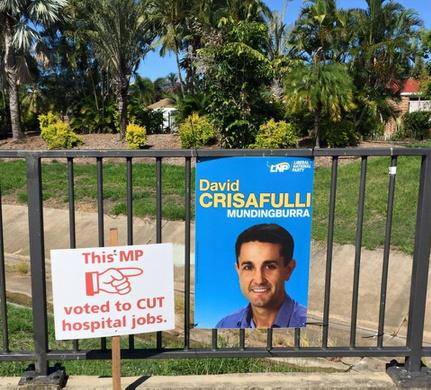
The second best photo of the election:

Crisafulli_1513644_10152699016553230_14347570202142734_n

For the best, go here.

On Monday Mark said that the ALP can win:

I know conventional wisdom is that the ALP can’t win, but I don’t see that myself.

In his interview with Phillip Adams, he said it was too close to call, but saw a hung parliament as the likeliest outcome, with the LNP having most seats. Now the Essential Report has the major parties at 50-50 (paywalled), but in the last week this has become 51-49 to Labor. The poll has has a fairly small sample size:

The Essential survey was conducted online over three weeks from January 9 to 26 and was based on a sample of 566 Queensland respondents aged over 18 years.

Newman has now rushed back to Brisbane from North Queensland to prop up his own seat. On the 7.30 Report the other night, we were told that more was being spent in Ashgrove than in the five neighbouring electorates combined.

Greg Jericho takes a look at the cost of austerity economics in Queensland. Employment growth is almost non-existent and mostly part-time. Oddly, Queensland is the only state where construction is the largest industry sector. Only 9% of the economy is attributable to mining compared with 30% in WA.

Meanwhile Graham Readfearn has taken a look at the major parties’ attitude to climate change.

One of Newman Government’s first moves was to scrap the state’s Office of Climate Change. Labor has announced no plans to re-instate it.

Deputy Premier Jeff Seeney instructed the Moreton Shire Council to take the science relating to sea level rise out of the council’s planning rules:

I direct council to amend its draft planning scheme to remove any assumption about a theoretical projected sea level rise due to climate change from all an any provision of the scheme, including strategic framework, zones and precincts, overlay assessment tables, codes and policies.

Later in the letter, Seeney wrote that any mandatory elements of the council’s planning scheme “must reflect only proven historical data”.

The Newman Government’s attitude to climate change was either ignore it or legislate against it. It appears Labor has just ignored it.

Captain’s pick

Abbott_500

Bill Shorten thought it was a hoax.

Some of Abbott’s Cabinet colleagues did too.

From the SMH:

Editorials of newspapers across the country have slammed Prime Minister Tony Abbott’s decision to hand Prince Philip a Knighthood, labelling the move “ludicrous” and “flabbergasting”.

Rupert Murdoch tweeted that it was “a joke and embarrassment”.

The Oz:

The broadsheet’s editors said knighting Phil was a “decision lacking leadership”, “high-handed” and “tone-deaf”, saying that another captain’s pick like this “might be mutiny”.

“It’s a decision that reeks of an outsider cocking a snook rather than a prime minister seeking to unite a nation,” the editors said.

The Courier Mail:

“On the day we should be celebrating Australia’s national identity … we were instead dragged by our elected leader into a cultural cringe so remarkable that it is almost beyond comprehension.”

The can and slam party did not end there. The newspaper also said the knighthood for Prince Philip was “fair dinkum ridiculous” and “out of touch”.

“Mr Abbott must decide whether he wants to be a monarchist, first and foremost, or the Prime Minister of Australia,” it finished.

Some-one tweeted, maybe it’s time to pick a new captain. Abbott dismissed social media criticism as “electronic graffiti”, but now Murdoch is at it again:

“Abbott again. Tough to write, but if he won’t replace top aide Peta Credlin she must do her patriotic duty and resign. Forget fairness. This change only way to recover team work and achieve so much possible for Australia. Leading involves cruel choices. Credlin a good person. Just appealing to her proven patriotism.”

It’s hard to believe Credlin would have supported such nonsense, but Murdoch may be blaming her for his at times lone wolf style.

The only support I’ve heard for the knighthood decision has been from Kevin Andrews and that royalist fella David Flint. Jim Middleton suggested that Abbott’s stupidity could cost the LNP in the Queensland election. I would have dismissed that as nonsense, but the ABC Vote Compass found that 19% of Queensland voters said they would be very affected by federal matters and a further 29% said somewhat. At the very least it has further tarnished the brand.

The irony is that Abbott had just spent a week phoning backbenchers to show them he is listening.

In truth Abbott may now be on a last chance to keep his job.

Climate change, sustainability, plus sundry other stuff