Tag Archives: Abbott_Tony

Abbott: a prime ministership in its death throes

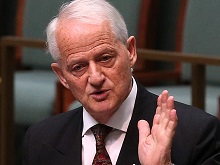
Ruddock_1423971165410_500

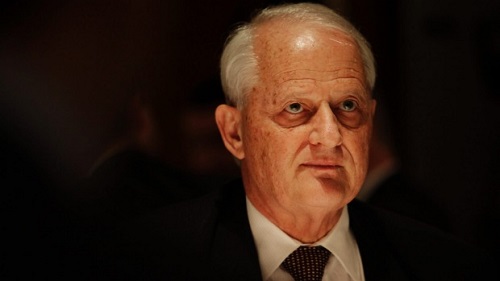
Nicholas Stuart thinks that when Tony Abbott sacked Chief Whip Philip Ruddock he lost the conservative core of the Liberal Party.

From the moment Ruddock’s removal was announced, late on Friday afternoon as part of a desperate attempt to bury the revelation, it became quite apparent Abbott’s time is up. His prime ministership is in its death throes. The only question is when. The issue that decides the timing of his demise will be the budget.

On the budget Stuart thinks Joe Hockey has simply given up and Mathias Cormann can’t do it on his own.

The key question facing Liberals when the party next meets in March is whether a new leadership team can craft a budget in the time available. Urgent action is required to both raise income and curb spending. The biggest problem for business confidence at the moment is that no one trusts the direction of the government. This crisis becomes apparent if you project the forward estimates out beyond the budget. Expenditure is growing faster than revenue. It’s unsustainable.

Meanwhile Abbott tries to distract us with talk about bad people treating us like mugs and terrorism. When Parliament meets next week he is going to address the gathered assembly on security.

Stuart finds that it is “in the national security space that Abbott’s egregious blundering has becoming most apparent.”

In Iraq our troops effectively watch from the sidelines. Iraq doesn’t even want our aircraft based there.

On submarines “Abbott wants to blind us into a tight alliance against China and he’s selling out our manufacturing and intellectual industries while he does so.”

Abbott has no concept of Australia producing anything. Defence research has been slashed, and now the government’s arbitrarily changing specs for our new armoured vehicle project.

On pay and conditions:

Effectively cutting remuneration for those in uniform is not just political suicide, it’s economically idiotic. It targets morale. It should also be a great way to win votes in marginal electorates – for Labor.

In the Fin Review Phillip Coorey says (paywalled) says MPs are angry and that the Ruddock sacking beggars belief.

He says that Ruddock struggled to get a hearing with Abbott, so he encouraged back benchers with concerns to take them to the Prime Minister’s Ofiice. There they were either refused a hearing or had their concerns dismissed.

One MP reported that under Howard the Chief Whip always attended full ministry meetings but this practice was stopped under Abbott.

Mungo MacCallum thinks the problem is with Abbott’s style:

Abbott has always believed that the best, indeed the only, form of defence is attack. At a long-ago bout in Oxford, an admiring reviewer said of the then Rhodes scholar: “No-style Abbott’s a real smasher!”

He won both that fight and a university blue, and in the 35 years hat have followed, not much has changed. Our Prime Minister is still reluctant to consult and conciliate when unbridled aggression will suffice – and it’s more fun, too.

Meanwhile Essential Poll found that LNP voters were spit over whether Abbott should stay on as PM.

Some 48% of LNP voters believed Abbott should stay on as leader until the next election, 34% said he should be given six months to improve and 14% said he should be removed immediately. Overall though:

39% said he should be replaced as soon as possible, while 22% gave him six months and 28% said he should be kept on until the election.

At New Matilda Ben Eltham writes that Tony Abbott’s biggest problem is not leadership instability, it’s the economy. The government has been asleep at the wheel on the economy from the outset and now is in a state of paralysis, more concerned with its own political survival.

The previous post on the Ruddock sacking is here.
Climate clippings 126

1. New research reveals extreme oxygen loss in oceans during past climate change

New research published this week reveals that vast stretches of the ocean interior abruptly lost oxygen during the transition out of the last ice age that occurred 17,000–10,000 years ago.

If that happened as a result of the relatively gentle forcing caused by changes in the Earth’s orbit, imagine what is possible now!

Like most of the life on the planet, the large majority of marine organisms need oxygen to live. Most marine life, from salmon, crabs, to shellfish, respires oxygen and many forms are intolerant of low oxygen seawater.

So-called ‘dead zones’ do contain life comprised of worms, bacteria, specialized urchins and bivalves, and other extremophiles, just not the kind of tucker we like to eat.

2. India ‘walking the talk’ on climate change

India is one country a bit allergic to discussing agriculture and climate pollution. They worry about feeding the millions. They also got a serve from Obama when he was there:

During a visit to New Delhi last month, Obama warned that the world does not “stand a chance against climate change” unless developing countries such as India reduce their dependence on fossil fuels.

India, as usual, is impervious to pressure, but the environment minister reckons they are doing their bit. New prime minister Narendra Modi is keen on renewable energy:

Since coming to power in May, Modi has pledged to increase India’s renewable energy in a bid to lower coal use and bring electricity to more than 300 million poor people currently without power.

Modi, who built up a solar industry in Gujarat state when he was chief minister, has set a target for India to have 100 gigawatts of solar capacity by 2022.

3. Abbott’s decline attributed to G20 Obama snub and climate change

On Newspoll Abbott’s net approval rating is now -44 (68% disapprove, 24% approve of how he is doing his job). Jason Wison says:

After a polling mini-recovery of sorts for Abbott between July and September, November – the month of the G20 and Obama’s address – marked a turning-point. Between September and November, Abbott’s always-poor net satisfaction ratings had improved and stabilised a little; from November they declined rapidly to where they are today. In some polls, Abbott now has more than half the voters saying that he should resign. November was also the month in which Bill Shorten decisively overcame Abbott as preferred prime minister, and Shorten’s lead is now wider than ever.

Wilson reminds us that Abbott refused to accept President Obama’s request to put climate change on the G20 agenda. Obama’s response was to kick off his stay with an address at the University of Queensland embarrassing Abbott with his references to Australia and climate change.

4. Maurice Newman wrongly claimed a UK charity had blamed the deaths of elderly people on renewable energy policies

Maurice Newman is of course Tony Abbott’s top science advisor. Graham Readfearn investigated his claim and found:

Newman is not only misrepresenting the charity’s position, he appears to be making up positions that the charity simply does not hold.

Also:

between 2004 and 2011 the average annual energy bill in the UK went up from £610 to £970.

Only £30 of that £360 increase was due to costs related to low-carbon power generation.

Most of the increase, the analysis said, was down to higher gas prices and network costs (maintaining poles and wires).

In my view, Newman’s attempt to pin the blame for the deaths of UK pensioners on renewable energy policies is either disgustingly dishonest or pathetically sloppy.

In the rest of the article Readfearn gives an explainer on how world surface temperature is measured.

5. Miocene temperatures

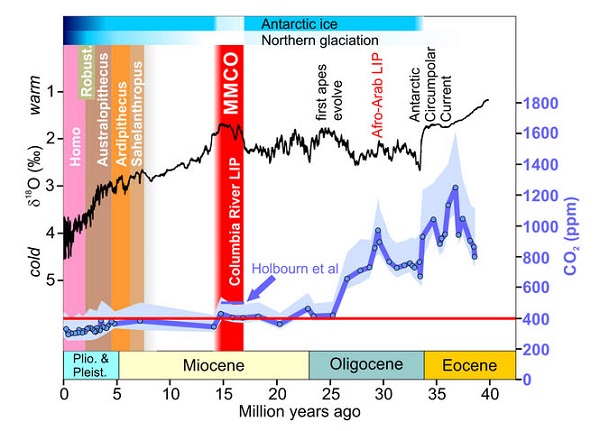
This Skeptical Science post gives a detailed account of what happened 14 to 17 million years ago in the “Mid Miocene Climate Optimum” (MMCO):

The MMCO was ushered in by CO2 levels jumping abruptly from around 400ppm to 500ppm, with global temperatures warming by about 4°C and sea levels rising about 40m (130 feet) as the Antarctic ice sheet declined substantially and suddenly.

Over the succeeding 2-3 million years Antarctic ice fluctuated dynamically in response to orbital wobbles, showing it was balanced on a knife-edge between a world with little ice and a world with substantial ice caps. Ice-free parts of Antarctica were rain-drenched and supported lush vegetation, while Arctic land was covered by temperate forests. Parts of the planet that had been arid before the MMCO rapidly re-greened and reforested (eg Patagonia).

This graph plots temperature and CO2:

Miocene_cropped_600

There were some differences between then and now. The Isthmus of Panama had not closed, for example. The warming happened on a warmer base.

Our warming is about 1000 times faster, giving less time for ecosystems to adapt. This is problematic for ocean acidification inter alia.

Abbott sacks Philip Ruddock

Tony Abbott has sacked Philip Ruddock, father of the house and government whip.

Veteran Liberal MP Philip Ruddock has been sacked as chief government whip in the wake of the failed leadership spill motion, a move one MP likened to the start of “the night of the long knives”.

Mr Ruddock, who is currently the longest-serving member of the House of Representatives, will be replaced by Queensland MP Scott Buchholz.

Tasmanian MP Andrew Nikolic, a prominent supporter of the Prime Minister, will also be promoted to a whip position.

Some senior ministers hold Mr Ruddock partly to blame [for the narrow loss of the leadership spill], saying one of his roles should have been to rally support for the leader.

But others believe his job is to act as a sounding board for the backbench and to pass on MPs’ concerns to Mr Abbott.

They say if that had happened, the Prime Minister would have been forewarned disquiet was building in his ranks.

After the spill Mungo MacCallum wrote Call this professional politics? Then give me amateurs. Imagine his column next week!

At The Guardian:

“It seems that someone has to be blamed for the fact that they can’t count,” one Liberal told Guardian Australia. “This is shabby treatment. What is he supposed to have done wrong?

“And he shows he has the guts to sack Ruddock, but not the guts to sack [the prime minister’s chief of staff, Peta] Credlin.”

After surviving Monday’s spill, Abbott promised there would be no repercussions, saying: “I’m not into retribution. We have been an outstanding team.”

Abbott is as good as his word, and you can see how good that is!

Ruddock was first elected in 1973, that’s 42 years ago.

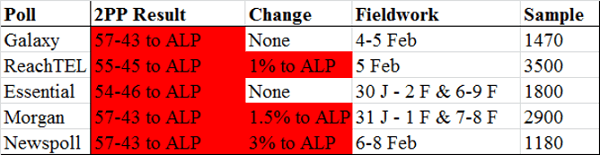
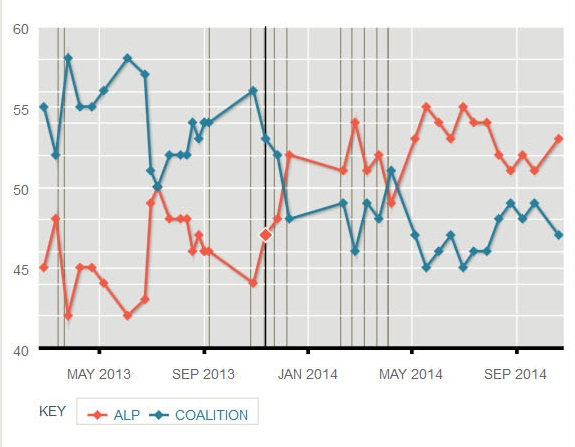
Elsewhere Adrian Beaumont tells us five polls released in the last week have Labor well in front, and Abbott’s approval rating continues to dive:

image-20150211-24660-10vds2s_600

Trapped inside his own feedback loop

Tony Abbott is trapped inside his own feedback loop, understanding the world is still out there, but not really comprehending how to reconnect. He’s been gone so long now – for years. What is the pathway back?

That’s from a brilliant article by Katherine Murphy. It can be lonely at the top, but Abbott is still prime minister.

6079672-3x2-500

The opinion polls are shocking. Newspoll has Labor ahead 57-43 in two-party preferred terms. Fully 68% of people disapprove of the job Abbott is doing while only 24% approve.

The personal disapproval would not matter if the LNP was in a winning, or even competitive position. But it is not, and won’t be unless Abbott can fix the economy and the budget. On the 7.30 Report Abbott explained that he would complete “fiscal repair” by abandoning spending cuts, “putting money in families’ pockets” and giving small business a tax cut.

This has panicked the right in the party who can see the restoration of a balanced budget, or “fiscal consolidation”, disappearing over the horizon. Paula Matthewson reveals that there is a subterranean battle taking place within the party “between the right-wing conservatives who want to protect the Government’s current agenda and the moderates who seek to change it.”

Abbott is trying to play to both sides, so is adopting contradictory positions and basically floundering in an attempt to save himself. Jettisoning Joe Hockey has apparently been contemplated.

So far the only spending cut abandoned has been the parental leave scheme, which no-one except Abbott in the party seemed to favour. The conservative right will try to hold the line. The GP co-payment is actively being pursued and yesterday in parliament university deregulation, with swingeing cuts, was being vigorously defended.

Since being in opposition is unacceptable, the right will need to be desperate to go for Turnbull. Julie Bishop is not considered competent enough by the right according to Matthewson, and the right still have the numbers.

I suspect, however, that Bishop as PM and Turnbull as treasurer may ultimately prevail.

64e75bbe-afbd-11e4-9790-a811272fa372_syd-6i7a69pkta0v3tfybah--500

Most seem to think six months of poor polling will see Abbott gone, sooner if he stuffs up again.

Ben Eltam sees the spill motion as Tony Abbott’s last gasp. There will be no ‘clear air’.

Laura Tingle has been emphasising the dilemma with the budget. The revenue base is “buggered”, there are no more big saves to be made, and the ones the Government chose are locked up in the Senate.

The economy continues to struggle to reach even its long term average growth levels. Commodity prices continue to slide. The world economy is not looking great. Confidence is mediocre and not being helped by the ludicrous spectre of the implosion in Canberra.

In this milieu the government is trying to remake itself as voters fear for their jobs. The strategy of having an early tough budget and locking in “reforms” has spectacularly imploded.

Having sprung radical overhauls of education and health funding on an unsuspecting electorate and been comprehensively rejected, the government is going to have to re-prosecute the cases, and restructure its policy offerings, much closer to an election – even making them mandate issues.

Peter Hartcher tells the inside story of how the Liberal leadership duo of Tony Abbott and Julie Bishop cracked. All Tone’s handiwork. And he’s going to have to get by with less direct minding from Peta Credlin, if she stays. Apparently she will no longer attend cabinet meetings or veto ministerial staff appointments.

Finally I’d like to return to Katherine Murphy’s article. Impossible to summarise, but she is saying that to become PM he has suppressed his real nature and moulded himself to fit the role in service to others.

Being a man for others has seen Abbott lose himself, and squander the opportunity to grow beyond his superstitions and self-soothing rituals to something approximating genuine self-expression. Abbott has denied himself the chance to be interesting. His confidence and judgment have taken a hit. The prime minister conducts himself less as a prime minister and more as a prisoner who can’t persuade the screws to give him early release.

But rather than admit defeat, he fights, and swaggers, and swings between bouts of brutal introspection and outright defiance. Rather than reach out he retreats, and roils at the fickleness of everything – entreating media boosters to validate him, telling the colleagues they have no right to desert him, while pondering who he can jettison in order to save himself.

Sad, but tragic for the nation.

Climate clippings 125

1. Paris climate talks won’t keep warming below the dangerous 2°C Limit

Joe Romm at Climate Progress believes the Paris climate talks should not be written off as a failure if they don’t do enough to keep warming below 2°C. He thinks the CFC ozone layer example is apt. The Montreal Protocol was concluded in 1987. Initially the protocol’s targets and timetables slowed the rate of growth of concentrations only slightly and would have still led to millions of extra cases of skin cancer by mid-century.

President Reagan endorsed the protocol, and the Senate ratified it. By the end of 1988, 29 countries and the European Economic Community — but not China or India — had ratified it. The treaty came into effect the next year. But it took many more years of negotiations, continuous strengthening of the scientific consensus, and significant concessions to developing countries before amendments to the treaty were strong enough and had enough support from both rich and poor countries to ensure that CFC concentrations in the air would be reduced.

Elsewhere 14 high-profile CEOs want to decarbonise the economy completely by 2050. They are the B Team led by Virgin founder Richard Branson. See also at The Guardian.

2. 2013 record heatwave ‘virtually impossible’ without climate change

That’s according to a new report from the Climate Council.

From The Guardian:

The country experienced its hottest day, month, season and calendar year in 2013, registering a mean temperature 1.2C above the 1961-90 average.

The Climate Council says recent studies show those heat events would have occurred only once every 12,300 years without greenhouse gas emissions from human activities.

Record hot days have doubled in Australia over the past 50 years. During the past decade heat weather records were set three times more often than cold ones.

Heatwaves across Australia are becoming hotter, lasting longer, occurring more often and starting earlier.

The ABC article has handy links to other sites.

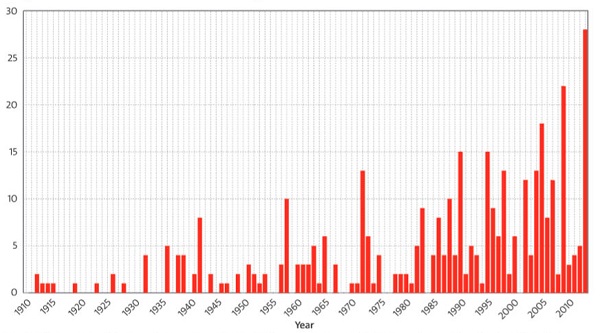
The following graph shows the number of days each year where the Australian area-averaged daily mean temperature was above the 99th percentile for the period 1910-2013:

Hot days Australia_cropped_600

3. Two degrees by 2036

Michael Mann using an Earth energy balance model has calculated that we could reach 2°C of warming as early as 2036. To stay within the 2°C guardrail we need to limit CO2 concentrations to 405 ppm. It would be 450 ppm but for the aerosol issue. If we cease burning coal we lose the cooling effect of the crap that coal spews into the atmosphere along with CO2.

Mann has done the calculation on the basis of climate sensitivity of 3°C. Problem is, he says, that this modelling is based only on short term feedbacks.

David Spratt at Climate Code Red has done a long and thorough post based on Mann’s article. Spratt looks in some detail at the longer term climate sensitivity issue, drawing also on the work of James Hansen, Aradhna Tripati and others. Hansen found that climate sensitivity with long term feedbacks was considerably higher than 3°C; Tripati found that in the Miocene with CO2 concentrations similar to now “temperatures were ~3° to 6°C warmer and sea level was 25 to 40 meters higher than at present”.

Spratt also reminds us that 2°C warming is not safe.

4. Would turfing Abbott help climate change policy?

In short, yes, but perhaps not a lot. The conservative side of politics is still infested with climate change denialists.

Mother Jones in an article One of the World’s Worst Climate Villains Could Soon Be Booted From Office would clearly like to see the back of Abbott. Julie Bishop has a background of denialism, but is pragmatic and has understood from the Lima experience that our stance on climate is negatively affecting our international standing.

Turnbull stated back in 2009:

“I will not lead a party that is not as committed to effective action on climate change as I am.”

He would now, of course.

Tristan Edis looks at actions Turnbull might get away with. Giles Parkinson thinks he might rescue renewable energy and could adapt Direct Action into a baseline and credit scheme.

See also Lenore Taylor at The Guardian.

Abbott looks terminal, but what about policy?

1379610000000_500

Dennis Atkins talking to the ABC on Tuesday afternoon said that on the weekend Abbott asked Julie Bishop and Malcolm Turnbull to say that they wouldn’t challenge for PM, or so the story goes. Bishop refused, apparently. This became a story on Tuesday morning. Bishop came out with the necessary words, but it took her 9 hours to do it.

Atkins reckons that the chatter will continue. Abbott can’t afford to make a mistake from here and must turn the polls around.

There are two problems with this. Firstly, opinion amongst the backbench is so sour that whatever he does will be seen as a mistake by some. For example, when Gillard announced the election date in early 2103, I thought it wasn’t a bad idea. To her backbench critics it was self-evidently the stupidest thing ever.

Secondly, the backbench revolt is no longer anonymous. Dennis Jensen and Warren Entsch have demanded a ballot on the Liberal leadership and say the PM’s position is ‘terminal’. Mal Brough says the leadership issue “needs to be resolved”.

The ABC was told that cabinet ministers have urged Abbott to resign.

Under these circumstances Abbott can’t get enough clear air to say anything that will not be seen through the leadership filter. Lenore Taylor wrote of his Press Club speech:

Tony Abbott’s press club speech had little to do with charting a path forward and everything to do with circling the wagons around his prime ministership.

But a path forward – a way out of its political mess – is the only thing that can save the prime minister and his government. Circling the wagons might hold his critics off for a while, but it doesn’t address the cause of their concern.

The speech was reported as much or more for its political intent – telling the backbench he was going nowhere – as for its policy content.

“the point of the speech was to tell agitating backbenchers that he would stare them down and that they were doing the country a disservice by the very act of leadership agitation.”

Ben Eltham laments the media role in this. The larger problem, he says, is that Abbott is wedged between the hard right agenda, favoured by backbenchers that put him there, and the fairer more humane deal that the electorate wants.

What could he do? Abandon university deregulation. Give up on the GP co-payments. Restore some of the family payments Joe Hockey cut in 2014. Fashion a 2015 budget for the middle class, not big business.

On these substantial issues, Abbott stayed the course. Perhaps he has to: ideologically wedded to a hard right agenda, the Prime Minister relies on right-wing backbenchers to stay on as leader. Such policy changes would never be acceptable to the bulk of the party room. Nor would the conservative pundits and commentators who wield so much influence on this government be pleased with such concessions.

And this is the real problem faced by whoever runs the Liberal Party in 2015. Conservative ideology has drifted well to the right of the general electorate. For a long time, the timidity of the ALP disguised just how toxic the neoliberal brand of conservative politics has become. But, in office, the nastiness of the Coalition’s attacks on the welfare state has become impossible to conceal.

As the ALP gropes towards a rediscovered belief in fairness and slowly rebuilds its grass-roots campaign base, the Coalition’s dominant political ideology looks increasingly out of touch. There is no sign that Julie Bishop understands this, or, if she does, can do anything about it.

As occasional commenter wpd indicated recently, it is the whole Institute of Public Affairs agenda that needs to be defeated.

Meanwhile the latest Essential poll has a lot of colour and movement about personalities, but the bottom line is that it has Labor ahead 54-46. That is what is scaring the backbench, and may it continue to do so!

Captain’s pick

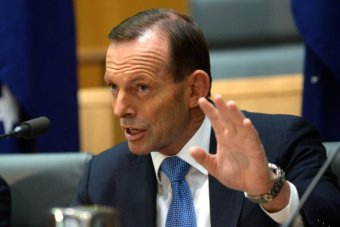
Abbott_500

Bill Shorten thought it was a hoax.

Some of Abbott’s Cabinet colleagues did too.

From the SMH:

Editorials of newspapers across the country have slammed Prime Minister Tony Abbott’s decision to hand Prince Philip a Knighthood, labelling the move “ludicrous” and “flabbergasting”.

Rupert Murdoch tweeted that it was “a joke and embarrassment”.

The Oz:

The broadsheet’s editors said knighting Phil was a “decision lacking leadership”, “high-handed” and “tone-deaf”, saying that another captain’s pick like this “might be mutiny”.

“It’s a decision that reeks of an outsider cocking a snook rather than a prime minister seeking to unite a nation,” the editors said.

The Courier Mail:

“On the day we should be celebrating Australia’s national identity … we were instead dragged by our elected leader into a cultural cringe so remarkable that it is almost beyond comprehension.”

The can and slam party did not end there. The newspaper also said the knighthood for Prince Philip was “fair dinkum ridiculous” and “out of touch”.

“Mr Abbott must decide whether he wants to be a monarchist, first and foremost, or the Prime Minister of Australia,” it finished.

Some-one tweeted, maybe it’s time to pick a new captain. Abbott dismissed social media criticism as “electronic graffiti”, but now Murdoch is at it again:

“Abbott again. Tough to write, but if he won’t replace top aide Peta Credlin she must do her patriotic duty and resign. Forget fairness. This change only way to recover team work and achieve so much possible for Australia. Leading involves cruel choices. Credlin a good person. Just appealing to her proven patriotism.”

It’s hard to believe Credlin would have supported such nonsense, but Murdoch may be blaming her for his at times lone wolf style.

The only support I’ve heard for the knighthood decision has been from Kevin Andrews and that royalist fella David Flint. Jim Middleton suggested that Abbott’s stupidity could cost the LNP in the Queensland election. I would have dismissed that as nonsense, but the ABC Vote Compass found that 19% of Queensland voters said they would be very affected by federal matters and a further 29% said somewhat. At the very least it has further tarnished the brand.

The irony is that Abbott had just spent a week phoning backbenchers to show them he is listening.

In truth Abbott may now be on a last chance to keep his job.

Will Abbott survive Medicare?

Before the recent backflip on plans to cut the rebate for short GP visits by $20 Tim Woodruff made a comment on the plans. There were three parts to the proposed changes:

The first is a direct cut of $5 to the Medicare rebate for everyone except pensioners and health care card holders. The ALP, Greens, and some crossbenchers have indicated they disagree with this so it may never happen as it must pass the Senate.

The second is to freeze the rebate until 2018 which means that because of inflation, this will amount to a $3 cut to the rebate for everyone by 2018. This can’t be stopped as it doesn’t require parliamentary approval.

The third part of the proposal, however, is to reduce by $20 rebates for visits less than 10 minutes in duration. The Government claims that this is intended to reduce “6 minute medicine”…

Only the third of these has been abandoned.

There are two points to be made about this.

First, the Government’s aims have not changed. They want the poor to go to the doctor less to ‘save’ Medicare, or as Woodruff suggests to institute a two-tiered medical system.

The Federal Government wants a two-tiered health system where credit cards decide what level of care one receives. This is the American way. The next proposal may be to replace our flag with the Stars and Stripes.

Secondly, the politics is just awful. As Norman Abjorensen points out, new minister Sussan Ley was sent out to dump proposals that Abbott had robustly defended not 24 hours earlier.

Was Abbott rolled? What does Julie Bishop think? Why did they get themselves into this mess in the first place? Clearly they didn’t sound out the senate cross bench.

Abjorensen says the question now is not whether Medicare will survive Abbott, but whether Abbott will survive Medicare. No wonder he looks worried:

5439940-3x2-340x227

Photographers can be cruel!

Tim Woodruff is currently the vice-president of the Doctors Reform Society and a specialist physician working in private rheumatology practice in Melbourne.

Climate clippings 119

1. Abbott appoints fruitcake to assist Greg Hunt

baldwin_220

He says he’s not a denier or a sceptic, so let’s just call him a fruitcake. In the recent ministerial reshuffle Bob Baldwin has been moved from Parliamentary Secretary to the Minister for Industry to Parliamentary Secretary to the Environment Minister.

Baldwin told the Chinese that the climate had been changing for millions of years and we wouldn’t have coal, oil or gas without climate change. That’s a typical denialist tack. Elsewhere he quoted that well-known authority on everything, Queensland radio shock-jock Michael Smith. If the atmosphere was a bridge a kilometre long, he said, the first 770 metres would be nitrogen, the next 210 metres oxygen, and so on until you come to CO2. Australia’s contribution of CO2 is the equivalent to 0.18 millimetres, the width of a human hair.

2. Bernie Fraser sends a Christmas message to Abbott

Bernie

Basically, keep the Renewable Energy Target (RET), it all you’ve got, and the Emissions Reduction Fund (ERF) may not meet its initial target of 5% emissions reductions by 2020. In any case it is not scalable to meet the targets we are likely to be committed to post 2020.

The Climate Change Authority has just completed its review of the RET and a review of the Carbon Farming Initiative (CFI), as mandated in the establishing legislation. I’d recommend reading Bernie’s Chairman’s Statement.

The CCA recommends extending the achievement date of the RET by up to three years, but this is the big picture:

The Authority has argued consistently throughout its short life that an effective policy response to the risks of climate change requires favourable winds on at least two fronts:

• first, a broad community consensus that climate change poses real risks to the community; and

• secondly, a well-stocked toolbox to be able to tap into opportunities to reduce emissions wherever they occur.

Neither exists today. The earlier broad political consensus has ruptured in recent years, and no early repair is in prospect. And the tool box is feeling less weighty, with the removal of the carbon pricing mechanism, an unproven ERF, and an uncertain outlook for the RET.

There’s more from Giles Parkinson who calls it “a damming assessment of Abbott government climate policy” and from Sophie Vorrath.

3. Harper flags carbon price rethink for Canada

Abbott-Harper-144x144

Before Christmas when Tony Abbott was asked what he’d achieved as Minister for Women he nominated dumping the carbon tax. At the same time the Canadian PM Stephen Harper, Abbott’s soul-mate on climate policy, suggested that he was open to a country-wide carbon pricing scheme similar to the one implemented in Alberta.

In Alberta, energy heavy polluting companies are required to reduce their energy intensity, or improve their energy efficiency, annually. If they don’t, they must contribute to a technology fund at $15 a tonne for carbon emissions.

“I think it’s a model on which you could, on which you could go broader,” Harper said in Wednesday’s interview.

4. Tesla pilots battery swap

Tesla is opening a battery swap station between Los Angeles and San Francisco on a pilot basis to see whether the idea goes anywhere. Zachary Shahan, the author of the linked piece, suggests perhaps not. The swap must be done by appointment and although it may be completed in less than a minute it would cost almost as much as a tank of premium. The alternative is free Supercharging for Tesla owners.

5. Technology on the move

In the same issue of RenewEconomy as the Tesla battery swap item above were three other technology announcements.

First, the ASX listed company Algae.Tec has issued rights to raise capital to build an algae biofuel plant in India.

Second, the ADF is looking to replace diesel generation with renewable energy to power Bathurst Island, north of Darwin, probably wind and solar.

Third, a solar plant that floats on water is being launched in South Korea.

6. Banks begin to take climate risk seriously

The large investor Australian Super has been asking banks about their climate change risk policies. It sounds as though banks are pretending to be more active than they really are, but it is clear that the investment landscape has changed forever. If the banks have not been actively concerned, they soon will.

Former Coalition opposition leader John Hewson, who chairs the Asset Owners Disclosure Project

is considering “naming and shaming” how the world’s 1000 biggest banks are responding to carbon risk, something it already does for pension funds.

Changing the barnacles

Abbott_Bishop_4394486-3x2-225

Would you believe Abbott has made 16 changes in all. Three barnacles have been dropped to the bottom of the ocean – Arthur Sinodinos, the already benched Assistant Treasurer, Defence Minister David Johnston and Brett Mason, Parliamentary Secretary to the Foreign Affairs Minister.

Some have had their role expanded. Ian Macfarlane is now Minister for Industry and Science; Christopher Pyne is now Minister for Education and Training.

The big movers are Kevin Andrews from Social Services to Defence, Scott Morrison from Immigration and Border Protection to Social Services, Peter Dutton from Health to Immigration and Sussan Ley from Assistant Education Minister to the cabinet post of Minister for Health and Sport.

Also Josh Frydenberg scored the Assistant Treasury ministry, whereas Hockey’s pick, Steve Ciobo, got a sideways flick as Parliamentary Secretary from Treasury to Foreign Affairs and Trade and Investment. Ciobo has been replaced at Treasury by newbie Kelly O’Dwyer.

Mungo MacCallum sees it as rearranging the deckchairs on the Titanic as the ship founders on. Scott Morrison, he says, now has “an opportunity to prove that he can be as brutal with welfare recipients as he has been with refugees.”

Paula Matthewson thinks the reshuffle is built on paranoia rather than progress.

Tony Abbott’s ministry reshuffle may appear to be a reset in preparation for 2015, but in reality it is more about the PM’s paranoia and tenuous leadership than it is about his Government’s rejuvenation.

For example, the Victorian young guns have been rewarded to quell their noisy agitation over Peta Credlin.

Julie Bishop has lost a friend and fellow West Australian in David Johnston.

Scott Morrison, she thinks, has been given a poison chalice, “a way for Abbott to push through one of his toughest reform agendas while also reducing the appeal of one of his competitors.”

The future is not bright for Kevin Andrews and Peter Dutton:

Kevin Andrews’ move to Defence will likely see him begging to be let go by the next election, for the Department is known for chewing up and spitting out their civilian “masters”. The future doesn’t look particularly rosy for former Health Minister Peter Dutton either. Dutton may be a retired policeman but it’s difficult to see him bring the same steely resolve that served Morrison so well in the Immigration and Border Protection portfolio.

Overall:

Prime ministers usually reshuffle their ministry to provide a fresh aspect on their government while hopefully also evoking a sense of stability through the regeneration. But with one or two exceptions, like the promotion of Ley, Abbott’s reshuffle is characterised by concessions to antagonists, throwing competitors in the deep end, and leaving the deadwood to atrophy.

Norman Abjorensen takes a somewhat similar view. The big threat, he thinks, is from Julie Bishop. A familiar scenario is taking shape in Canberra:

It runs like this: persistently poor polling for both the prime minister and the government creates anxiety over the next election, especially among those in vulnerable seats; a path is beaten to the door of the hitherto loyal deputy leader, who just happens to be a woman; the message is blunt: you have to challenge or we are gone.

Hockey, he says, is no longer a threat:

Then there is Treasurer Joe Hockey, who was once laughably seen as a future leader, and is shown in the polls as the most unpopular minister and as the least regarded treasurer in the past 40 years. He is a poor communicator – always ready to deflect a hard question with a smirk or a sneer rather than an answer – who has palpably failed in framing a budget that he is unable to negotiate through parliament. This violates the cardinal rule of politics: that it is all about the art of the possible.

Abbott, he says, is moving from a position of weakness, so the changes are essentially minor. He couldn’t undertake a big call like sacking Hockey, which at least one powerful member of the business lobby has privately advocated.

I’m staggered that Social Services is considered a key economics ministry. We know that is where the most money is spent, and certainly the Minister gets to join the so-called Razor Gang.

Andrews to Defence is, I think, a clever move. Abbott no doubt wants to run defence, with a white paper and submarine contracts on the go. Also Matthewson is probably right in that Andrews will beg to be released after a year, allowing another reshuffle.

From these reactions it is clear that leadership speculation, much loved by the media, has begun in earnest and will continue unless Abbott can turn the polls in his favour. Meanwhile his attention has been drawn to his own office, with leaks, shuffling staff and concern about communication strategy.

Update: Tim Dunlop has done a great piece on the reshuffle. He reckons it’s

like changing who wears which colour skivvy in the Wiggles: it doesn’t make any difference, and they all end up singing the same old tunes.

Tony Abbott is still the Prime Minister. Joe Hockey is still the Treasurer. They are still committed to their budget and its underlying philosophy of market liberalism and a wholesale attack on the pillars of the welfare state.

Let’s focus on that, not which Wiggle is wearing which skivvy.

PM’s stocks hit Gillard lows

That was the front page headline in the Australian Financial Review as a result of the new Ipsos-Fairfax poll.

Actually Abbott’s ratings were below Gillard’s in important attributes.

Overall the two party preferred vote was less bad than other recent polls at 52-48 to Labor or 53-47 if minor party preferences were allocated according to stated voter preference. The focus has been on the personal ratings and the attribute poll, which you can see in detail here.

In personal performance Shorten has improved 2 points to +5, whereas Abbott has slumped from -7 to -19. Shorten is now preferred prime minister 47-39 compared to 41-41 last month.

In his ability to make things happen Abbott at 48 is below any recent PM, below Keating, Howard, Gillard or Rudd. At the same time Shorten at 36 is below any recent opposition leader.

Is it any wonder that a snicker went around the party room when Abbott spoke of their ‘year of achievement’?

Of the eleven attributes, Bill Shorten has a statistically significant lead on six; being viewed as more competent (58%), having the confidence of his party (71%), being open to ideas (68%), being trustworthy (44%), and having a firm grasp of social policy (62%). He is also seen as being more easily influenced by minority groups (44%).

In contrast, Tony Abbott has a statistically significant lead on only two attributes; having a clear vision for Australia’s future (49%) and having the ability to make things happen (48%).

Opposition leaders don’t rate on making things happen, which leaves vision.

On vision, Abbott is roughly where Gillard was in April 2013. It must be said that Shorten is also low for an opposition leader.

In competence Abbott rates well below Keating, Howard, Gillard or Rudd, and below the Abbott of 12 months ago.

Ditto for the ‘strong leader’ category.

The question now is whether Abbott is being permanently written off as a dud by the electorate or whether he can recover. Abbott has already lost authority in the party room. If this performance in the polls carries on for a few months next year, how Bolshie will the troops become?

Peter Hartcher:

With the government’s support falling only marginally but Abbott’s precipitously, the people seem to be making a personal point.

This is about you, Prime Minister.

Abbott, seen by the people to be incompetent and untrustworthy, is a liability for his government and an asset for the Labor Party.

While most of Australia relaxes over the Christmas break, the Prime Minister will spend the time in serious self-reflection. If he’s in any way competent.

Abbott not rewarded for behaving badly

I heard the headline on the ABC news on Tuesday morning. The latest Newspoll showed that Australians overwhelmingly approved of Abbott’s statement about shirt-fronting Vladimir Putin. So I bought the Australian while I was out, and indeed they did – 63% in favour and only 27% against. They approved in all demographics – women 60%, the young 57% and Labor voters 51%. The headline was:

Abbott wins backing for Putin face-off

Actually, the story was almost relegated from the front page. It occupied one column on the far right. There was nothing positive about Labor on the front page, nothing at all. Nor in the headings and subheadings on page 2.

It’s something of a surprise to find, therefore, that this was the two-party preferred result:

Newspoll 17-19 Oct 14_cropped

In TPP terms Labor had increased two points to be 53-47 ahead. That’s landslide territory, and a stunning result.

Curiously Labor’s primary vote had stayed the same at 34% while the LNP had lost 3 points to reside at 38%. Ostensibly their loss had gone to the Greens who were now at 14%.

Everyone understood that Abbott was playing to a domestic audience, most of all the Russians, where Julie Bishop and Putin have since had what seemed a sensible and calm chat about things that concern Australians. So far, at least, Abboitt has not been rewarded politically at home.

It’s true that the Morgan Poll had the TPP gap narrowing by a point to 52-48 in favour of Labor. Curiously the LNP primary vote was down half a point, while Labor was up by the same amount and the Greens and others remained the same. The difference was in the flow of preferences.

But the bottom line is that Morgan too saw no great move to the LNP and Labor is still in a comfortable winning position.

As an aside, Abbott would be well advised to keep his shirt-fronting to the metaphorical level. Putin is said to be a black belt in judo. As such he would have umpteen ways of ensuring that Abbott’s body momentum towards him would result in Abbott literally biting the dust.