Tag Archives: Abbott_Tony

Who voted for this man?

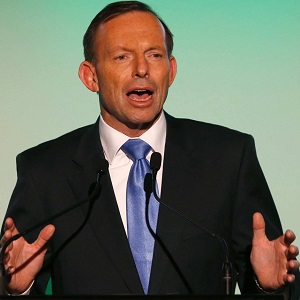
Abbott_300b

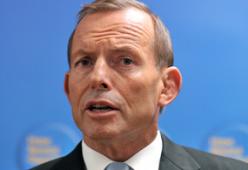
T. Abbott, our illustrious PM, continues to embarrass us all.

On the Scottish independence referendum first he said he would not presume to tell Scottish voters which way they should vote. Then he said this:

“As a friend of Britain, as an observer from afar, it’s hard to see how the world would be helped by an independent Scotland.

“I think that the people who would like to see the break-up of the United Kingdom are not the friends of justice, the friends of freedom, and the countries that would cheer at the prospect … are not the countries whose company one would like to keep.”

No doubt we should invade Scotland, or bomb them into submission!

That was last month. Next Tuesday 125 world leaders including US president Barack Obama and UK prime minister David Cameron will attend the UN secretary-general’s Climate Summit in New York. Tony Abbott will not be one of them. Yet the very next day he will be in New York to attend a UN Security Council meeting. He says he has more important things to do in the Australian parliament early next week.

While the New York meeting has no formal part of the climate talks leading up to the preliminary commitments countries will be asked to make by next March leading to the formal renegotiation of the Kyoto treaty in Paris in December next year, when the UN Secretary General says, “Come to New York, the planet is in trouble and needs you”, normally you would go, unless you want to make a statement about how you view the talks. In this regard Connie Hedegaard, the EU climate supremo, said:

“At least 125 heads of state have sent a strong signal to the rest of the world that … climate change is important, and they know they have a role to play and a responsibility to take in order for the world to address climate change.

“I do not know what the reasons would be behind it, but, of course, the world will interpret who is showing up and who will not be showing up.

“So that’s for your Prime Minister and your government to decide, what kind of profile they want in this.”

Hedegaard counsels us not to make too much of the fact that the Indian and Chinese leaders won’t be there. We know they are taking climate change seriously. We know, however, that Stephen Harper of Canada, Abbott’s ideological soul mate, has similar views to Abbott’s and also won’t be there although he too will be in New York a couple of days later. We know that Abbott is smugly satisfied with our pathetic 5% reduction target by 2020. He doesn’t appear to understand that this is about post 2020. His vision is clouded by denialism and the coal lobby.

The Pedestrian laments the fact that we are not the slightest bit surprised – Abbott is running true to form.
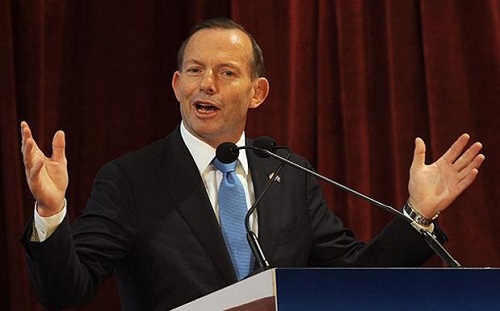
TonyAbbottClimate-500

Bernard Keane at Crikey finds that Abbott’s form is changing. He’s shedding the carefully scripted, softer-spoken persona he presented before the election and is returning to the more pugilistic Abbott of the Gillard years.

If you are not a Crikey subscriber but are on Facebook you might be able to read the piece here, courtesy of Mark. It begins:

“Tony Abbott is a man in a hurry. There’s a blue on, and he wants in. The Prime Minister has regressed from statesman to pugilist. He’s back to Punchy Tony, the Rocky of the Right, a bloke who’s up for any fight, even if he has to start it himself, the former boxing “blue” and front rower ready to deck anyone (including a young Joe Hockey), if they get in his way. Or even if they don’t.

Keane is speaking of Abbott’s statements hyping the terrorist threats:

But they also reflect Tony Abbott’s aggression, a trait he laboured hard to keep under wraps as opposition leader and harder still in his early days as Prime Minister—remember that parliamentary transition to the soft-voiced Prime Minister from the often shrill Abbott of the Gillard years.

But bit by bit it has re-emerged—the boyish grin sitting in the cockpit of a mocked-up F-35 (appropriately, on the ground, where the F-35s spend all of their time), the near-hysterical rhetoric about the threat of Islamic militants, and now dispatching tonnes of military hardware and some of our best troops to the United Arab Emirates, there to await whatever America wants them to do.

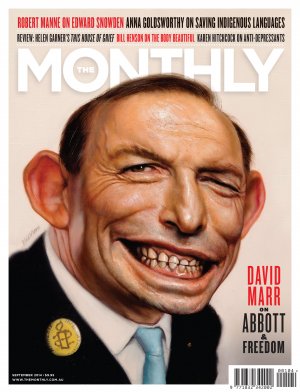
For a truly scathing assessment of the first year of the Abbott government, however, take a look at Nick Feik, the editor of The Monthly.

Feik says he’s passed six pieces of legislation and

After almost a year, the Abbott government has repealed one tax, a move that left the nation without a climate-change policy but had no discernible impact on prices, and implemented an increasingly inhumane, secretive and quite possibly illegal asylum-seeker regime designed in large part by the ALP.

And it has been good at undoing things:

It has cut funding to social, educational, health, research and advisory bodies. Any and every environmental action, movement, organisation or legislation has been made a permanent target.

Feik sees incompetence and incoherence everywhere. He concludes:

Beyond the budget, it’s unclear whether the government has a legislative agenda of any kind. Perhaps this explains recent efforts to reposition Abbott as an international statesman, in charge of keeping Islamic terrorism, Russian tyranny and Scottish independence at bay. He needs to be above the fray, because domestically his troops are stuck in the trenches, and they’re starting to turn on one another. They must be relieved the Opposition is showing no stomach for a fight.

I’ve used the cover image from The Monthly as the featured image on the home page.
Climate clippings 104

This edition begins with the weather and ends with a sad tale of revenge and tribalism as the basis for climate policy.

1. June the hottest on record

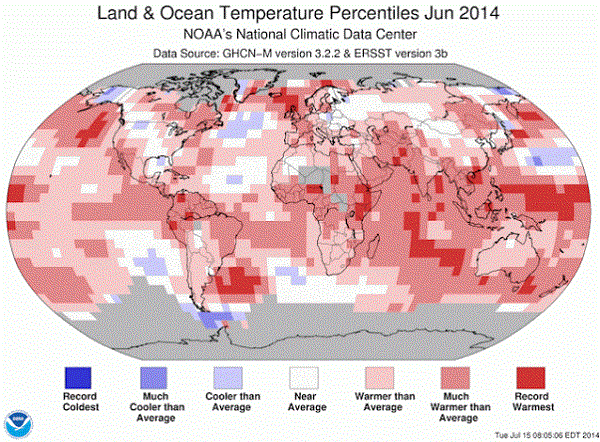
When we have some cooler than normal weather people are apt to say “So much for global warming!” They should realise how small a part of the globe we are.

The warmest May on record for the planet has been followed by the warmest June:

June 2014_201406-600

In fact June was the highest departure from average for any month on record.

The last below-average global temperature for any month was February 1985. The last below average June was in 1975 when Gough Whitlam was PM!

2. El Niño still favoured

The majority of models still favour a spring El Niño:

Warming in the tropical Pacific Ocean since the beginning of 2014 has primed the climate system for an El Niño in 2014, although an atmospheric response is yet to be observed. As a result, the transition towards El Niño conditions has slowed in recent weeks. While five out of eight climate models surveyed by the Bureau suggest El Niño will become established by October, all have eased their strength over the past few months. Three models suggest an El Niño will not occur in 2014, while another indicates only a brief period of El Niño-like conditions.

3. Temperatures poised to rise rapidly

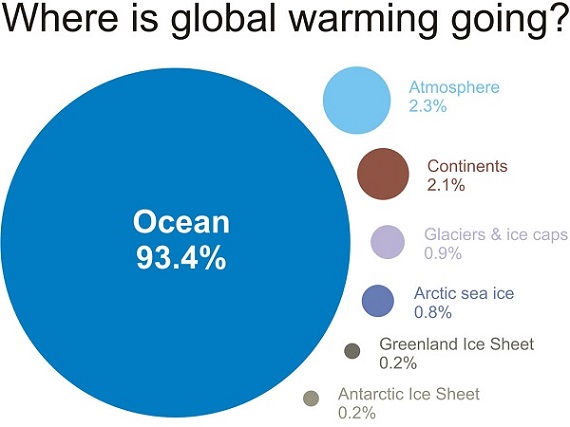
El Niño years are often associated with a higher than average temperature rise. However, there’s another reason temperatures may be about to rise. You may recall that around 93% of the extra global warming goes into the ocean and only 2.3% into the atmosphere:

GW_Components_570

In recent years the trade winds have speeded up causing deep mixing in the ocean, taking warm water deeper displacing cooler water which rises to the surface to be warmed. Sooner or later this will stabilise, with more heat going into the atmosphere.

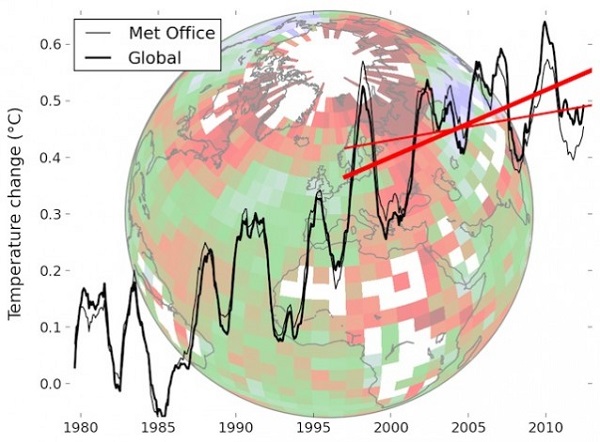
The article also points out the recent correction of the Hadley Centre temperature record, adding in an estimate for the polar regions, where there are no weather stations. This correction virtually eliminates the famous ‘pause’. The heavy lines show the corrected data:

Cowtan-600

4. Onshore wind is now the cheapest form of new energy in Denmark

6250146831_ffa2f45d46_b-500

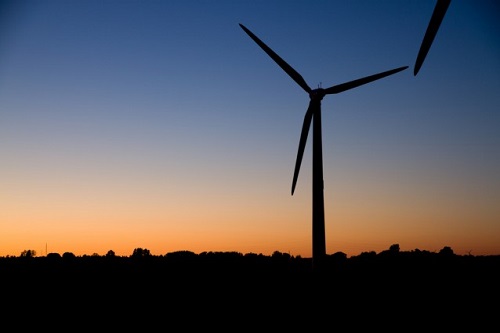
A new analysis from the government of Denmark found that wind power is by far the cheapest new form of electricity in the country. New onshore wind plants coming online in 2016 will provide energy for about half the price of coal and natural gas plants, according to the Danish Energy Agency (DEA), and will cost around five cents per kilowatt hour.

5. Abbott bets the house on coal

Meanwhile our visionary PM bets the house on coal as the world price is collapsing and countries turn to renewables.

The price for thermal coal has plunged more than 10 per cent in the last two months as the presumed major customers – China and India – make it clear that renewable energy is offering a competitive alternative to coal and gas.

The current spot market has been below the cost of production.

China may cease to import coal in a few years. The Europeans are talking about ramping up targets for emission reductions, energy efficiency and renewable energy. The Indians are

building of “mega” capacity solar farms, off-grid solar pumps for irrigators, solar installations over canals, cuts in tariffs for solar components and a doubling of the tax on coal – has been followed by an announcement that the country will look to expand a “rent-a-roof” program from solar installations initially begun in Gujarat, the home state of new PM Narendra Modi, who has promised a “saffron revolution” of solar power.

Tata Power is providing interest free loans up to $4,000 for rooftop solar.

Bloomberg New Energy Finance last week predicted solar would beat coal plants on costs by 2020. Chile has announced a whole series of large scale solar plants. On and on it goes.

Here in Sydney there was concern at the Clean Energy Week conference that Abbott can cripple renewables by doing nothing. According to one speaker

even if the 41,000GWh target was retained, and long term certainty provided, the removal of the carbon price will make it difficult to obtain financing for wind and solar farms from financial institutions.

That’s because the carbon price and the RET were designed to work together. If the carbon price is removed, then there is a massive shortfall in revenue when the certificates issued under the RET expire in 2030…

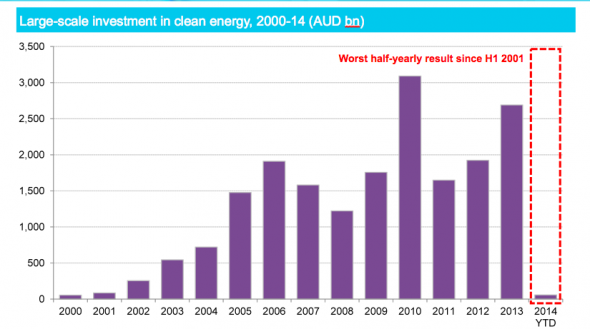
John D has been calling it but here’s a dramatic graph showing how large scale investment has stopped in its tracks:

bnef-finance-s-590x329

6. Tribal wars and revenge

I couldn’t find a decent review of Ian Chubb’s excellent book Power failure, which traces climate policy in Australia from before the 2007 election to the installation of the Abbott government. The link in the heading is to a revealing interview with the author by The Fifth Estate. Chubb:

“[Climate change denial] is a cultural issue for the Coalition. It’s nothing to do with rationality or reason or the future or business – it’s tribal. While this government is in power we can’t recreate the consensus.

“For this government burning coal to make electricity is the equivalent to eating red meat – if you don’t, you’re a sissy. So this government will never have sympathy for making renewable energy – only sissies do that. The government has attempted to shut down everything to do with renewable energy.”

He the goes on to talk about revenge, tribalism and well-flung mud.

He describes the current policy situation as current policy situation as a “ridiculous and expensive mess”. Two things might change it. One is leadership from the US. The other is that nasty things may have to happen from the climate itself.

My sense is that the damage to confidence wrought by this mob is such that a change of government with new policies may not be enough. We need the Tea Party to get real before confidence can be restored.

I need to say more about Chubb’s book which is clear-eyed about the strengths and weaknesses of both Rudd and Gillard. Anyone wondering why some of Rudd’s colleagues thought he had to go should read this extract in The Age.

An untrustworthy, unimaginative, incompetent dunderhead

That’s how voters see their prime minister Tony Abbott, says Laura Tingle of the most recent Nielsen Poll.

More of that later, but the poll sees the ruling LNP stabilise in landslide loss territory at 54-46:

Nielsen Jy 2014_cropped_600

The only demographics where the LNP has a clear lead in the primary vote are the 55+ group and WA. But in WA the TPP lead is only 52-48, well within the margin of error. Queensland has turned sour for the LNP at 45-55.

Abbott’s approval rating has improved from -25 to -18. Abbott’s overall personal rating may improve further due to his handling of the response to the Ukraine air tragedy but his real problem seems to lie in the voters’ view of his personal attributes. Abbott continually hammered the Gillard government over competency and trust. He fails on both counts.

According to Nielsen, voters now rate his competence as slightly lower than Gillard’s.

They do not rate him as being as strong a leader, believe him to be even less trustworthy, and have an even weaker grasp on economics.

At least the former prime minister had a majority of voters believing she had a firm grasp on foreign and social policy – only 43 per cent of voters rate Abbott on foreign policy and 34 per cent on social policy.

Abbott has strengths (above 50%) in his clear vision for Australia’s future and in his ability to make things happen. However, his weakness on social policy is severe, contrasting with Shorten’s strength. In context Abbott’s strengths may be problematic.

Shorten emerges as a more competent and trustworthy figure, but he is yet to be seen as a strong leader with a vision for the country and an ability to make things happen. Perhaps a problem of opposition.

Shorten still heads Abbott as preferred PM but has slipped slightly from 47-40 to 46-41.

On economic policy they are even, and not very good on 45%.

Prior to the budget Joe Hockey had a clear lead over Chris Bowen as preferred treasurer at 51-34. Now they are virtually even at 43-42.

Reading opinion polls is a bit like reading tea leaves, but the Abbott government’s problems appear fundamental.

Climate clippings 102

This week we start with trouble at the top and bottom of the world and finish with trouble with our leading media magnate and politician.

1. Geenland at a tipping point?

THE cracks are beginning to show. Greenland’s ice sheets slid into the sea 400,000 years ago, when Earth was only a little warmer than it is today. That could mean we are set for a repeat performance.

If Greenland goes, West Antarctica also goes, giving 13 metres of sea level rise from those sources. If that happens there will also be a complete loss of other glaciers and ice caps, thermal expansion and some partial melting from East Antarctica. A mess!

The question is how soon and what can we do? The answer is we need more research and we need to think more in terms of centuries.

We should be thinking about the next 500-1000 years, how ice sheet decay can be minimised, stabilised and headed in the other direction. Our plans for the next 50-200 years should be made in the light of this.

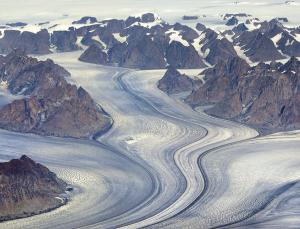
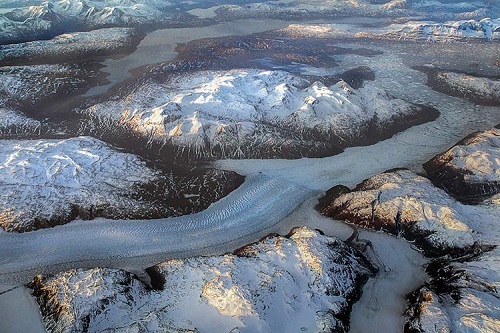
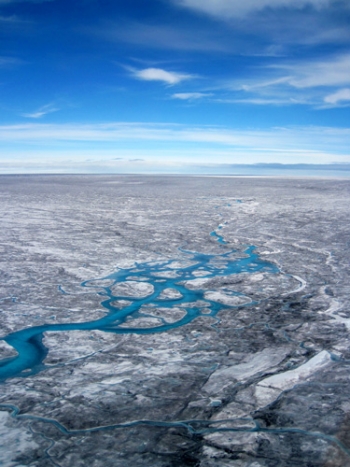
This image from the article shows a part of Greenland where the ice is quite dynamic.These areas are expected to grow.

New scientist_mg22229752.600-1_300

Here’s an image from another article:

greenland_cs_500

2. Big trouble in the Antarctic has been brewing for a long time

David Spratt at Climate Code Red:

“A game changer” is how climate scientist Dr Malte Meinshausen describes newly published research that West Antarctic glaciers have passed a tipping point much earlier than expected and their disintegration is now “unstoppable” at just the current level of global warming. The research findings have shocked the scientific community. “This Is What a Holy Shit Moment for Global Warming Looks Like,” ran a headline in Mother Jones magazine.

Meinshausen says this is new information. He says that the beaches we know and love all around the world will disappear. He also wonders what other nasty surprises lie this side of a 2°C temperature rise. Spratt says we told you ages ago it was coming, by James Hansen, for example and by himself and Philip Sutton in 2007.

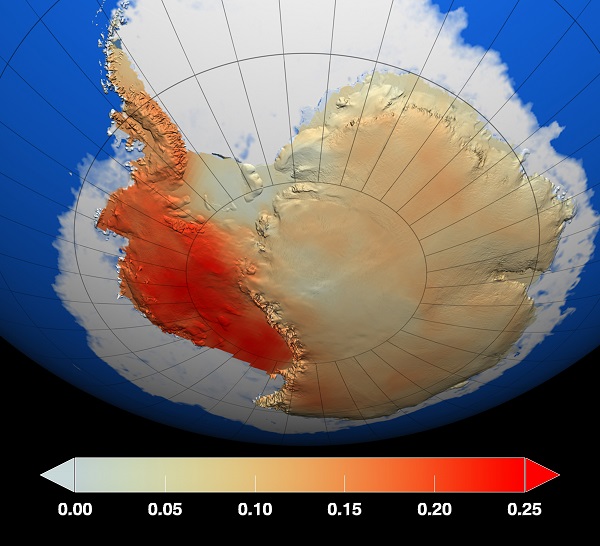
This NASA image shows the temperature changes from 1957 to 2006:

AntarcticaTemps_1957-2006_lrg_600

Hansen warned; Meinshausen says it’s happening. Spratt warns:

It’s par for the course for climate policy-makers to hope for the best, rather than plan for the worst. More than once this blog has warned that sea-level rises are being underestimated by Australian policy-makers, and that the tens of millions of dollars being put into adaptation planning for sea-level rises of no more than 1.1 metres by 2100 will be a waste of money, and all that work will have to be done again. And now that has come to pass.

3. Huge ‘whirlpools’ in the ocean are driving the weather

GIANT “whirlpools” in the ocean carry far more water than expected and have a big impact on the weather – though as yet we don’t know exactly what.

The areas of swirling water are 100 to 500 kilometres across. These “eddies” generally move west, driven by Earth’s rotation, until they stop spinning. Now, for the first time, the amount of water and heat they carry has been measured.

Article and image available also here.

dn25801_1_300

4. Gorgeous BioCasa_82

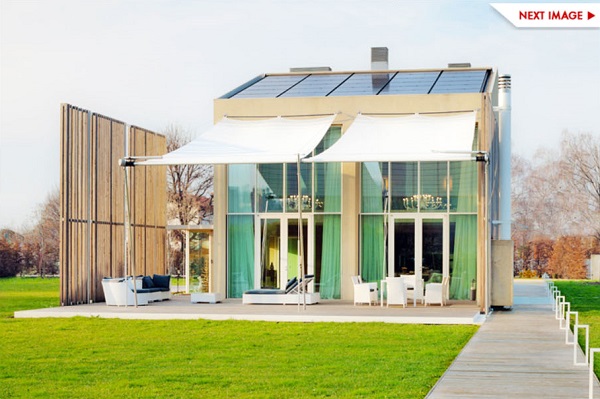
Nestled into the pastoral landscape of Treviso, Italy, BioCasa_82 is a beautiful home that boasts some seriously energy-efficient technologies.

BioCasa_82_cropped_600

The house is made from 99% recyclable materials and scores

117 points out of 136, according to the American protocol LEED Platinum, and 10 out of 11 points in regards to innovation in design, the building is a real gem in the European building practice.

According to the carbon footprint analysis, BioCasa_82 yields 60% less emissions than traditional buildings. Its photovoltaic system produces around 14kWh/mq of electricity, and a high-efficiency geothermal plant provides heat, hot water and cooling. These strategies are complemented by a rainwater harvesting system.

5. Rupert Murdoch doesn’t understand climate change basics

That is everyone’s problem since he owns a world-wide media empire.

Many of Murdoch’s news outlets are also among the worst when it comes to getting climate science wrong and disseminating climate myths and misinformation. Inaccurate media coverage is in turn the primary reason why the public is so misinformed about global warming.

I won’t go into the details, but Climate Progress observes that he ‘lowballed’ the numbers and minimized possible impacts. Here in Oz:

”We can be the low-cost energy country in the world,” he said. “We shouldn’t be building windmills and all that rubbish.”

Elsewhere Graham Readfearn finds that Tony Abbott’s views on climate are seriously crap.

Reminder: Use this thread as an open thread on climate change.

Angry voters and the question of mandate

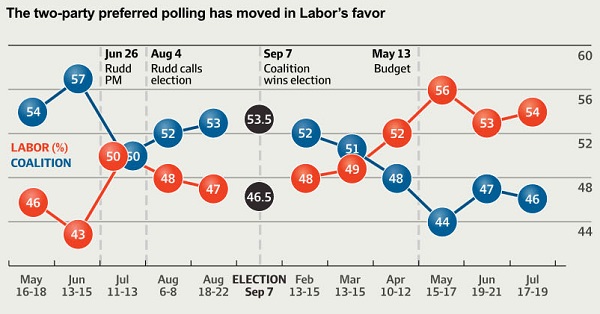
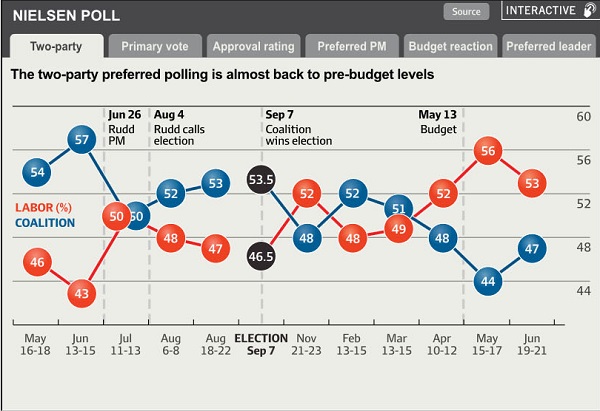
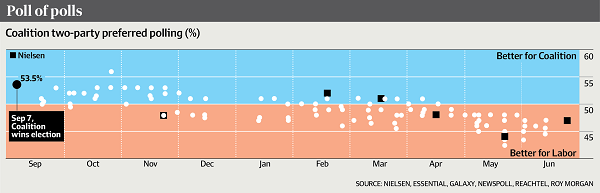
Nielsen and Newspoll both currently have Labor ahead 53-47 in two-party preferred (TPP) terms. This is almost the exact reverse of the 2013 election result which the LNP won 53.5-46.5.

This is how Nielsen is tracking:

Nielsen 23.6.14_cropped_600

This image from the AFR shows how the Coalition vote is trending in six polls:

AFR Je14_6e420e70-fa5f-11e3-80cb-3fa822d151bf_23p00 news poll of polls 600

Laura Tingle says voters are still angry over the budget:

Six weeks on from the budget, the rage is maintained: the majority of voters still think the budget is unfair and the task of confronting ever deepening voter hostility towards Prime Minister Tony Abbott is only growing.

It says something about the quality of the government’s budget sales job that, in the period since the budget, the number of Coalition voters who believe the budget is fair has actually fallen more sharply than the number of Labor voters who think it is fair.

The latest Nielsen poll figures suggest little the government has done has changed voters’ initial hostile reaction to the budget and, if anything, has only eroded its own base as the details of the budget’s impact on traditional constituencies like pensioners and families has become clearer.

Arguments about the budget crisis; that working people are working a month a year just to fund welfare recipients; that the government is not really cutting pensions – none of these seem to be cutting through.

John Quiggin in commenting on Hockey’s statement about “lifters” and “leaners” had this to say:

The hostile reception given to these Romneyesque arguments is unsurprising. The fact that Hockey is relying on talking points that failed even in the US is indicative of the level of delusion under which the government is operating. Having run a disciplined and entirely negative campaign, Abbott and Hockey ought to understand that they were elected by default. They owe their jobs to the fact that voters were sick of Labor’s leadership shenanigans.

The fiasco of the Senate election is a pretty clear indication of a “plague on both your houses” view. Instead, they appear to be under the impression that they were granted a mandate for radical change – and long after the budget is off the front page, the electorate will punish them for it.

Some of the hacks are finding comfort in the fact that the LNP has clawed back some support. In fact they’ve improved from a prospective landslide defeat to one that would just be demoralising. Of course much can happen suddenly in politics and the election is a long way away.

There can’t be much comfort, however, in Abbott’s approve/disapprove rating of 35-60, up from 34-62. The slide from November last year when it was 47-46 should be telling him something.

Shorten’s numbers are 42-41, down from 47-39. He was 51-30 in November, but most of the time since he has been about evens.

In the preferred prime minister stakes, Shorten leads 47-40.

The LNP support comes from the old, men, NSW and WA. Strangely Labor slipped in NSW from 58-42 to 46-54, well beyond the nominated margin for error of 4.6%. The numbers for the state break-up are small and one or both may be rogue results.

Overall, though, one might say that the voters are telling Abbott and Hockey that they do not in fact have a mandate for much of what they are attempting to do.

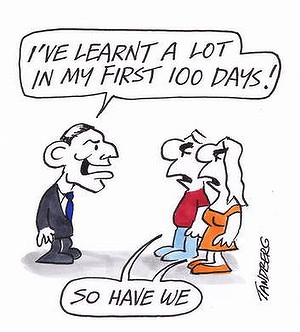
I’ll leave you with this Tandberg from a few months ago:

Abbott_AW-abbott-tandberg--300x0

Climate clippings 100

Kiribati_Fanning Is_478950-3x2-340x227Climate clippings_1751. Climate clippings reaches 100

Generally speaking I don’t rate the number 100 much except that it’s the number after 99 and the number before 101. Which might be just as well because when I was going through all the posts after transporting them (thanks tigtog) from Larvatus Prodeo I found two with the same number. So the 100th edition was actually number 99!

If you like to laugh Graham Readfearn has assembled 11 climate change comedy video clips to celebrate his 50th post on Planet Oz. I can recommend John Oliver and Australians for Coal, for example. There’s a bad language warning on the latter.

Huffpost has 9 Political Cartoons That Put Climate Change In Perspective:

slide_352590_3821132_free_500_cropped

2. Dust increases Greenland’s ice melt

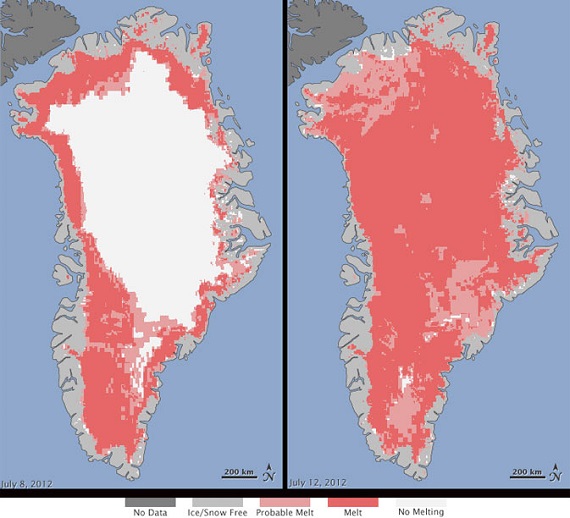
A ‘normal’ Greenland summer melt is illustrated by the left-hand panel taken at 8 July 2012, when about 40% of the ice sheet was subject to melting.

Figure 8

The right-hand panel shows what happened for about a week thereafter and is not relevant except as a harbinger of things to come.

A new study looks at the increased melting from dust and soot. It found that a relatively minor decrease in the brightness of the ice sheet could cause double the average yearly rate of ice loss seen over the period 1992-2010.

assets-climatecentral-org-images-uploads-news-6_8_14_Brian_GreenlandDirtyIce-350x467

Soot resulting mainly from wildfires in North America and Russia has a greater melting impact than dust as such. However, increased dust is being produced in the Arctic and finding its way to the Greenland ice. Now 150 times as much dust as soot has been found at a site in the north-east.

While this can’t be extrapolated to the rest of the ice sheet, there is concern that Greenland melting could be greater than previously thought. See also Antarctic images for context.

3. Green jobs declining in Australia

Yes green jobs are declining in Australia:

Australia is one of the few places in the world where green jobs are decreasing according to figures released by the International Renewable Energy Agency.

Globally the sector now provides an estimated 6.6 million jobs, an increase of 800,000 from 2013 figures, but in Australia, jobs across solar photovoltaics and solar heating have declined, with up to 22 per cent of jobs lost in PV and 20 per cent in heating, according to Ethical Jobs general manager Michael Cebon.

This is happening:

entirely the result of government policy, both through loss of incentives at the federal level and backpedalling by state governments.

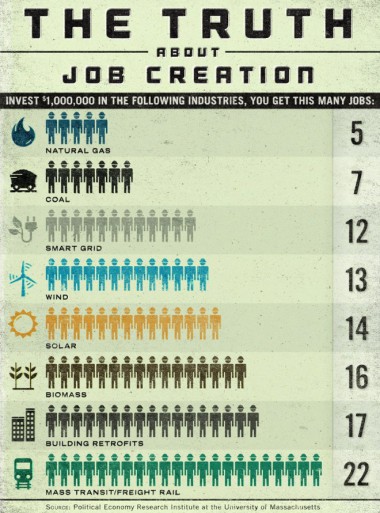
While a structural shift is occurring in the workforce elsewhere, Australia is regressing. The graphic shows the jobs potential of investment in various sectors:

comparison-fossil-and-renewable-380x513

4. Climate change impacts will ‘cost world far more than estimated’

That’s according to Lord Stern. He says that:

the economic models that have been used to calculate the fiscal fallout from climate change are woefully inadequate and severely underestimate the scale of the threat.

That includes those cited by the IPCC. They ignore the science, the full range of risks and simply assume away some of the worst economic impacts.

5. Historians will look back and ask ‘why didn’t they act?’

That’s the question asked by science historian Naomi Oreskes in her

latest book, The Collapse of Western Civilization: A View from the Future, [which] imagines a Chinese scholar in 2393 analysing the slow-motion disintegration of 21st-century democracies as they fail to tackle a growing environmental catastrophe.

It’s not a pretty picture.

By the end of the book, co-written with fellow historian Eric Conway, the Netherlands and Bangladesh are submerged, Australia and Africa are depopulated, and billions have perished in fires, floods, wars and pandemics. “A second dark age had fallen on Western civilisation,” Oreskes writes, “in which denial and self-deception, rooted in an ideological fixation on ‘free’ markets, disabled the world’s powerful nations in the face of tragedy.”

Oreskes and Conway say it’s a worst-case scenario, not a prediction.

One way or another, the game is up, we need to act with vigour and determination.

6. Coal to fuel human progress for decades – Tony Abbott

Our fearless leader has been strutting his stuff on the world stage, ignoring the science and embarrassing us all. He told Texan business leaders that:

we don’t believe in ostracising any particular fuel and we don’t believe in harming economic growth.

“For many decades at least, coal will continue to fuel human progress as an affordable energy source for wealthy and developing countries alike.”

Under the fig leaf of Direct Action anything goes.

Meanwhile Julie Bishop confirms that climate change won’t be high on the G20 agenda.

Once again they are out of tune with the nation. In a recent opinion poll 57% of those polled said the government should take climate change more seriously.

while more than half of respondents felt the federal government was the primary body which should address climate change, there was a negative rating of -18 when people were asked to rank the government’s performance.

This compares to a -1 rating from last year. These rankings are the differential between respondents’ “good” versus’ “poor” response to the government’s performance.

Reminder: Use this thread as an open thread on climate change.

7. Pacific presidents speak out against Australia’s stand on climate change

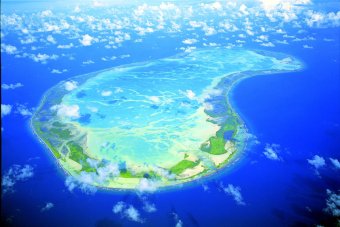
Out in the Pacific they are not happy with Abbott’s policy stance. The sea is coming up and they are going down. Here’s Fanning Island in Kiribati:

Kiribati_Fanning Is_478950-3x2-340x227

Lost in a mid-winter Canberra fog

Laura Tingle’s Friday AFR column ends with:

The despair in Coalition ranks is extraordinary. As thick as a mid-winter Canberra fog.

At the beginning:

“What on earth does the government think it is doing?” was the mystified question du jour in Parliament House. You might expect it from business executives who don’t have time to focus day to day on politics. It’s just a little more alarming coming from government backbenchers and even ministers’ staff.

The latest kerfuffle is over the use or non-use of the term “occupied” to refer to East Jerusalem and occupied West Bank territories. Apparently the term “disputed” preferred by Israel has been used. Rural Liberals are seething over Attorney-General George Brandis’s remarks about East Jerusalem, accusing him of “intellectual arrogance”.

They have very real concerns over live cattle exports. In Jedda, 57 Arab foreign ministers condemned the Federal Government’s decision not to use the term “occupied” when referring to east Jerusalem.

Their statement, issued in Jeddah, also calls on member states to “take necessary measures” in response.

The declaration was made as the Foreign Minister Julie Bishop sought to assure ambassadors from many of those countries that Australia’s position hasn’t changed.

It’s not clear if her efforts will have the desired effect.

Tingle says that Bishop apologised. No-one seems to know whether there has been a considered change in position, or whether it was a Brandis stuff-up. Bishop claimed on Insiders that there had been no change in position, claiming that practice is to use “East Jerusalem”, “West Bank” or “occupied territories”, but not in combination. She claims that they were verballed by Lee Rhiannon. Nevertheless they seem to have gotten themselves into a twist.

Beyond the East Jerusalem dispute Tingle says:

the government is under deadly attack from those communists at the Australian Medical Association. Its new president, associate professor Brian Owler, wrote this week the health measures in the budget “add up to bad health policy”.

“The health of Australians is too important for healthcare to be an ideological toy,” he said.

“The AMA is supportive of some co-payments, but not the one proposed by the government.”

This is the AMA leading the fight against a co-payment, an organisation that fought Medicare for decades.

Then business is reconsidering their relations with government finding Bill Shorten and Chris Bowen “are open to talking and that there are some Labor policies that are actually more pro-business than those of the government.”

Then there are all the welfare bludgers, the people Joe Hockey refers to as parasitic “leaners”. Tingle continues:

Liberal MPs report the outrage of aged voters who will lose their $800 seniors supplement.

But what is striking is that these voters aren’t angry about losing the $800 as much as they are about feeling they have been portrayed as welfare bludgers.

The feedback about an anger that is not going away is it is very different to what MPs have felt before because it isn’t just about hip pockets but a sense the budget has broken something at a community level, particularly universal healthcare and access to education.

What causes despair on the Coalition backbench is that the senior ranks of the government don’t seem to recognise that something has been genuinely broken that the Coalition team will never be able to get back. That an electorate that never quite got a handle on Tony Abbott has one it will now never let go.

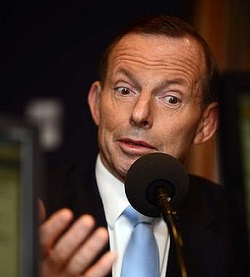
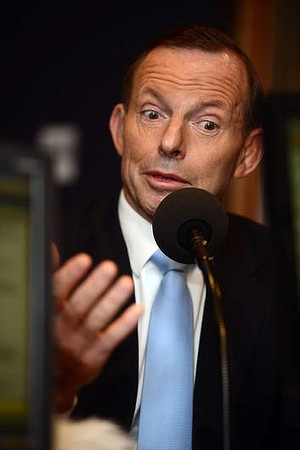
You will recall back in May the fearsome grilling Abbott suffered from ABC talkback radio callers who accused him of lying, fearmongering and endangering the health of pensioners. Photographers can be cruel. This was the occasion of Abbott’s famous wink, but take a look at this shot by Penny Stephens:

Abbott_ac-pm2-thumb-20140521102128242961-300x0

This post can serve open thread on politics.