Category Archives: Climate Action

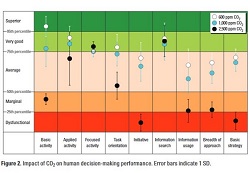
CO2 is scrambling our brains, but will it kill us all?

Ootz’s recent comment raised the question:

    should we be seriously looking at what the safe levels of CO2 in the atmosphere are for human beings?

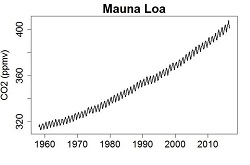
That was in the context of an informed comment that we have not seen CO2 levels above 320 ppm for 27 million years, which predates hominid evolution. Studies indicate that 600 ppm globally, which is where we could be by 2050, might just render us extinct.

To jump to the chase, we don’t really know what the full effects of elevated CO2 will be, or indeed what they are now. However, indications are that as CO2 rises, our brains will work less well and we will become more limp and sluggish. A bit like a frog in a pot of water gradually being heated. Continue reading CO2 is scrambling our brains, but will it kill us all?
Looking forward to Finkel

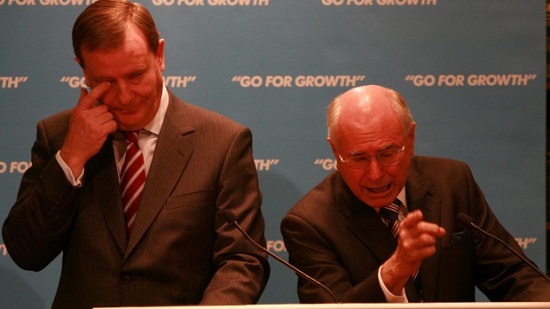
The Finkel review of the National Electricity Market is due to be revealed to the premiers at COAG tomorrow, but is you’ve been reading the Australian Financial Review it’s all done and dusted. There’s really only one horse in the race, and it’s the Low Emissions Target (LET), which Tony Wood of the Grattan Institute says is the third last horse in the race, but picked because it’s better than the other two. That may be harsh, but the visionary scheme was first proposed by John Howard in 2007. Here’s Howard and Costello launching the scheme way back then:

It’s the least-worst, least-best carbon pricing scheme, but has the attraction of giving coal a chance of sticking around for a while. Continue reading Looking forward to Finkel

Are the Chinese doing their share on climate change?

Donald Trump in announcing that the USA will withdraw from the Paris Climate Agreement made a big fuss about the Chinese being able to increase their emissions, and that this was unfair to the US economy.

So what are the Chinese doing, and is it enough? Continue reading Are the Chinese doing their share on climate change?

Trump shoots himself in the foot on climate

Trump has announced that the US will withdraw from the Paris climate agreement and seek to negotiate a ‘better’ agreement. I liked Emmanuel Macron’s reaction – “Lets make the planet great again”. Germany, France and Italy have committed to carry on, China will relish the opportunity to move into the vacuum.

Paul Hawken, who knows more about climate change action than most (post coming up) recently said:

    First of all, let’s be honest: The US has never led in this area. Ever. When they’ve tried on an executive level, they’ve never been supported by Congress. States have led, cities have led, but never the federal government.

Even so, he said people in the US think they lead in “this stuff”. They don’t, it’s Germany, China, France and Denmark. Continue reading Trump shoots himself in the foot on climate

Energy crossroads

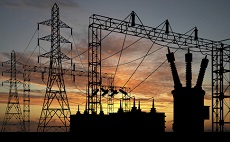
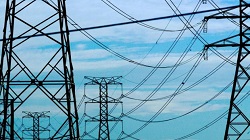
Transformer over orange sky
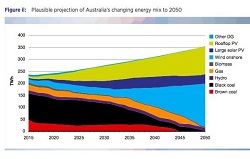
The initial stimulus for this post was an article in the AFR entitled We are at an energy crossroad (paper version) by Tony Wood of the Grattan Institute, based on a new report Powering through: how to restore confidence in the National Electricity Market and a series of articles mainly at RenewEconomy. I’ll summarise them Climate clippings style, so the story should emerge and you can follow the links for elaboration if you choose. Continue reading Energy crossroads

Turnbull stands naked on climate policy

Giles Parkinson says of the 2017 budget that Turnbull lets [his] fig leaf droop and stands naked on climate policy. Matthew Rose says Turnbull’s budget ignores energy crisis and dodges climate. The Conversation article is headed Budget 2017: government goes hard on gas and hydro in bid for energy security, which is I think misleading. It goes for gas and hydro, but not hard.

Before looking at what the budget has to offer, it is appropriate to remind ourselves that at the UN climate talks in Morrocco last year, Australia’s proposed effort was ranked fifth worst in a list representing 90% of the world’s emissions. Moreover, Frydenberg has been backsliding since then, suggesting we may not achieve zero net emissions until 2100. Continue reading Turnbull stands naked on climate policy

Power tipping point

The Four Corners program Power Failure added to the sense of crisis around our power system, beginning with the breathless comment that there was almost a breakdown of civil order in South Australia when the lights went out in September. The program looked at the difficulties experienced when the power went off for three days. Recently in some places affected by Cyclone Debbie, crews couldn’t get in to start fixing for about double that time. I’ll come back to Four Corners via a series of articles published on the same day.

First, in the AFR tucked away on page 8, Mark Ludlow penned an article Renewables, EIS ‘make gas-fired power redundant’ (paper edition title). Ludlow interviewed Professor Frank Jotzow, director of the Centre for Climate Economics and Policy at ANU, who said gas had been overtaken by renewable energy, including battery storage, in the transition away from coal-fired power. We should skip gas and go straight to renewables with batteries. Continue reading Power tipping point

Gas has got to go

The Climate Council issued a report on the future of gas-fired electricity just after Easter – Pollution and Price: The Cost of Investing in Gas.
Gas is often thought of as a ‘transition fuel’ from coal to renewables. Their advice is clear:

    Do not provide policy support for new gas power plants or gas supply infrastructure.

And:

    Existing gas plants should be thought of as a short-term, expensive, emergency backup as renewable energy and storage is rapidly scaled up.

Moreover, we should leave most of our gas reserves in the ground. Continue reading Gas has got to go

Do we seriously want to save the Great Barrier Reef?

Back on 17 March, 2017 Joshua Robertson’s article in the Guardian Stopping global warming is only way to save Great Barrier Reef, scientists warn reported four things happening simultaneously. First, a paper by 46 scientists published in Nature showed that bleaching of the Great Barrier Reef in 1998, 2002 and 2016 was determined by ocean surface temperature; water quality had nothing to do with it.

Secondly, Terry Hughes, the lead author of the paper was embarking on aerial surveys to chart the effects of the latest 2017 bleaching event, the first in consecutive years, and the first in a non-El Niño year.

Third, Queensland government officials were in Paris meeting with UNESCO officials to appeal for more time to make good on conservation efforts to ward off an “in-danger” listing for the reef. This conservation plan does not mention global warming, concentrating on such things as water quality.

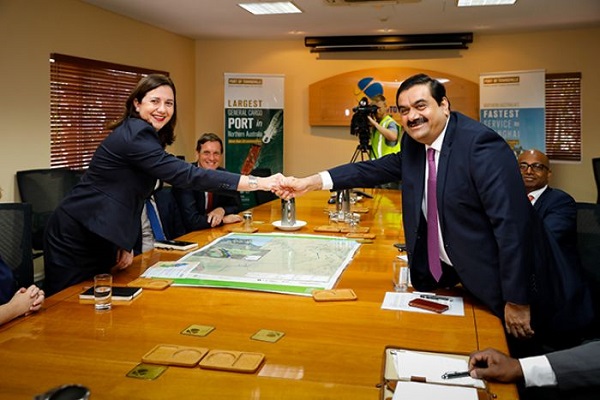
Fourth, Queensland premier Annastacia Palaszczuk went to India to lobby Adani to proceed with its giant coal mine in the Galilee Basin. Continue reading Do we seriously want to save the Great Barrier Reef?

Climate clippings 204

1. Antarctic ice melt may have tipped

David Spratt at Climate Code Red has a post surveying recent studies on Antarctic ice sheet melting. I’ll cut to the chase with his update of a recent report from NOAA:

    a revised worst-case sea-level rise scenario of 2.5 metres by 2100, 5.5 metres by 2150 and 9.7 metres by 2200. It says sea level science has “advanced significantly over the last few years, especially (for) land-based ice sheets in Greenland and Antarctica under global warming”, and hence the “correspondingly larger range of possible 21st century rise in sea level than previously thought”.

Continue reading Climate clippings 204