Category Archives: Climate Policy & Planning

NEG: the plan to do less than nothing

I did not get my full post on the NEG (National Energy Guarantee) finished last night, so it will have to await the COAG meeting today.

Commentators seem to think the NEG will get an amber light from the states. The main problem is that in terms of emissions reduction the NEG has been evaluated as worse than doing nothing by Reputex. To the world it will look like it is – Australia keeping up appearances while putting the mockers on renewable energy and giving coal the best chance ever to keep wrecking the planet. Continue reading NEG: the plan to do less than nothing
Saturday salon 14/4

1. “Eat, drink, and be merry, for tomorrow we die”

Two problems here. The first is that the above quotation is not found in the bible or Shakespeare, it’s a conflation of Ecclesiastes 8:15 and Isaiah 22:13, plus you could throw in Luke 12:19.

The second problem is more serious. It’s true – kind of. Comprehensive research has shown that if you drink more than five drinks a week every extra glass of wine ‘will shorten your life by 30 minutes’. Continue reading Saturday salon 14/4

Energy crisis? What energy crisis?

About a month ago Meridian Australia’s CEO Ed McManus said that while the electricity market can turn on a dime, stability had returned to the market and the trend looks good. They had just concluded a swag of hydro, wind and solar power deals which will deliver cheaper electricity than the company could buy in the wholesale market. So their retail arm Powershop was offering a 5 per cent price cut to consumers.

    Electricity contracts for delivery in 2019 were trading at more than $92 per megawatt hour in Victoria and $108/MWh in South Australia a year ago, when SA and NSW had just suffered power shortages and the closure of Victoria’s Hazelwood power station loomed.

    Contracts for 2019 have since fallen to $82.90 in Victoria and $94.36 in SA, while contracts for delivery in Victoria in 2020 and 2021 are trading at $76/MWh and $69/MWh and contracts for 2020 and 2021 in SA are trading at $86/MWh and $85/MWh.

Continue reading Energy crisis? What energy crisis?

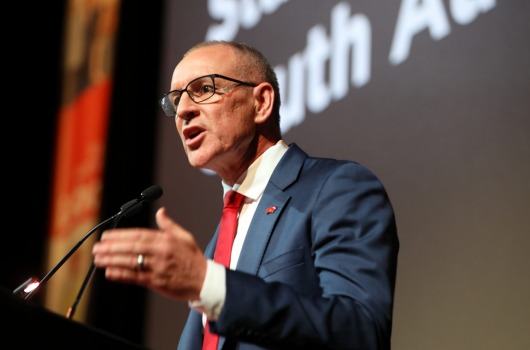
The South Australian election matters for climate change


When this is published SA voters will be lining up to select a new government. That is the hope. I understand the betting market favours a hung parliament. No pundit I’ve heard is willing to pick a winner. Kevin Bonham talks about the difficulty of modelling the outcome, with the entry of SA Best and the redistribution. The ABC has guidance on how we can follow the election and an Online Election Page.

On climate change the election matters. There is coverage at:

. Continue reading The South Australian election matters for climate change

Four Corners: Weather Alert

The Four Corners episode Weather Alert sets out its intent from the beginning:

    How Australia’s warming climate is changing the way we live and work.

    “This is very ‘now’. This isn’t a future problem which is 10 or 20 or 30 years (away).” Climate Risk Expert

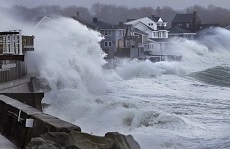
    Across Australia, farmers, small businesses, government planners and major corporations have stopped waiting for politicians to decide whether climate change is real. They’re acting now.

Continue reading Four Corners: Weather Alert

New Deputy PM is a climate denier

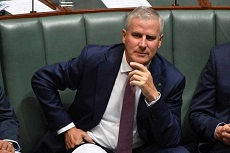
New Deputy PM Michael McCormack (Mick Mack) is a garden variety climate denier according to Paddy Manning at The Monthly:

    Given he is our new deputy prime minister, it is not surprising that “who is Michael McCormack?” pieces are now popping up everywhere. And yet, they glide over his worst offence: he appears to be just another National Party climate change denier.

Continue reading New Deputy PM is a climate denier

The energy wars continue in 2018

Josh Frydenberg has just written an opinion piece in the AFR about Why we can’t do without the power of Snowy 2.0.

Can’t do without it, that’s what he said. To impress us he said:

    With only 2 per cent of construction visible above ground, the scheme involved 16 major dams, seven power stations, a pumping station and 225 kilometres of tunnels, pipelines and aqueducts.

Continue reading The energy wars continue in 2018

AGL’s $1.36 billion plan to replace Liddell

Andrew Vesey, CEO of AGL made his attitude to new coal clear:

    “It is very simple: We are overloading the atmosphere with heat-trapping gas and the rest is details,” Mr Vesey told an investor briefing in Sydney, where he again forcefully ruled out any investment in new coal-fired power.

He said there were two strategic imperatives that govern all AGL’s investments – affordability and the tenet that the future will be carbon-constrained, making new coal too risky as an investment.

AGL has confirmed its plans to close the Liddell coal generator in NSW and “replace it with 1.6GW of renewables, plus storage and other technologies – saying it was a smarter, cheaper, cleaner and more reliable option than keeping the ageing and unreliable coal plant open.” Continue reading AGL’s $1.36 billion plan to replace Liddell

Climate clippings 118

1. South Australia going for broke

Malcolm Turnbull would call it a ‘reckless, irresponsible, ideological frolic’, but South Austria has been running 63% on wind and solar during the last few months, and is going for broke.

Giles Parkinson says SA must, and will, lead world on renewables.

    The Weatherill and Koutsantonis strategy is to embrace new technologies, cheap wind and solar and storage, smart software and smarter management, and put into practice the sort of scenarios envisaged by the CSIRO, Energy Networks Australia and more recently by the storage review commissioned by chief scientist Alan Finkel.

All that can stop Weatherill and Koutsantonis is Nick Xenophon at the next election putting the LNP into office. Continue reading Climate clippings 118

The best kept secret: ALP electricity policy for Queensland

I came across it via Facebook around midnight on Saturday night. Not sure when it was released but there’s been nothing in the media yet about it. Surely there will be, because it is more than a little stunning. It’s called Powering Queensland’s Future: Affordable, Stable and Balanced.

From a standing start after the LNP under Campbell Newman had ‘cleansed’ the state of renewable energy projects, since February 2015 the Palaszczuk Labor government has enough runs on the board to be dubbed “a leader in Australia’s renewable energy boom” in a report by The Climate Council – Billion dollar boom: Queensland’s bright renewables future. I’ll summarise what they said, but the Palaszczuk government is running even faster and further than you would be led to believe in that report. Continue reading The best kept secret: ALP electricity policy for Queensland

Cherry picking electricity prices in Qld election

It’s the season for cherry picking on electricity prices as an election is called in Queensland. This can happen because no-one, not journalists, not ABC radio hosts, and unfortunately not ‘experts’, reads Queensland Government media releases. The offending politicians from the opposition LNP are getting a free ride, with statements like ‘Prices increased 70% under Labor’ (Tim Nichols on TV) and, ‘We will put downward pressure on electricity prices’ without saying how.
I’ve assembled a fair bit of information in two posts – Queensland powers up for a warm summer and Electricity bills – Queensland acts because it can. In this post I’ll summarise what I think has happened, and then mention some of the cherry-picked claims being made. There is some new information in the post. Also there is a particular problem with Steve Austin on Mornings on local ABC radio. I don’t mind the bloke, normally, but on electricity he’s lost the plot.

I’ve provided some links here, but there are many more in the earlier posts. Continue reading Cherry picking electricity prices in Qld election

Electricity bills – Queensland acts because it can

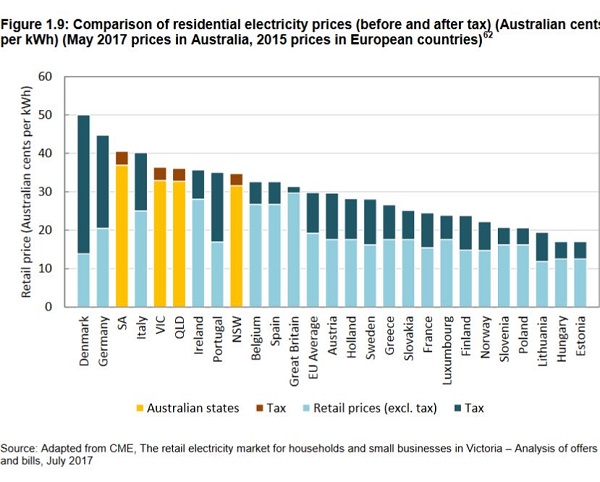
There is no doubt that electricity in Australia has become expensive. Here is a graph on the National Electricity Market (NEM) states, other than Tasmania, against European countries:

It’s from a Carbon + Energy Markets report cited by the ACCC Retail Electricity Pricing: Preliminary Report, September 2017 comparing May 2017 Australian prices with 2015 European prices. The ACCC also note that:

    There are currently no national surveys conducted in Australia that inform price reporting around what customers are actually paying.

Which is disconcerting. The one above was based on the weighted median offer of the three largest Australian retailers. Continue reading Electricity bills – Queensland acts because it can