
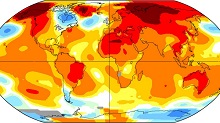
April 2016 was the hottest April ever, making a run of 12 hottest months in a row. We are starting to flirt with the 1.5°C warming threshold. Here’s the global map, showing impressive warming in high latitudes in the Northern Hemisphere. Australia is also noticeably warm: Continue reading Flirting with 1.5°C as we record 12 hottest months in a row
Category Archives: Climate Science
Climate clippings 171
1. 3D solar towers
MIT researchers have developed and tested a range of 3D solar towers to achieve power output that is up to 20 times greater than traditional fixed flat solar panels with the same base area. Here is an example of two of the models tested: Continue reading Climate clippings 171
Grim news from Cape Grim
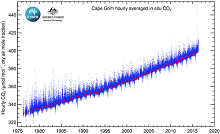
Cape Grim in Tasmania is a measuring station for atmospheric CO2 in the world. The measurement there tends to be a bit lower than at Mauna Loa and doesn’t wobble about as much. It’s baseline stands at 399.9 parts per million and is about to break through the 400 mark, as shown in this graph: Continue reading Grim news from Cape Grim
Climate clippings 170
1. Arctic ice in trouble
It’s too early to say whether the 2012 record for Arctic summer ice loss will be beaten, but it’s shaping up so that it could. The NSIDC satellite is broken, but robertscribbler has been looking at the Japanese satellite. This is what it shows: Continue reading Climate clippings 170
Hansen worries that all hell will break loose
 James Hansen worries that “we may be approaching a point of no return, a situation in which our children inherit a climate system undergoing changes that are out of their control, changes that will cause them irreparable harm”. He’s looked at the models, at current observations, and at what happened during the Eemian interglacial 118,000 years ago, and he doesn’t like what he sees.
During the Eemian, when global average temperatures were about 1°C more than now, sea level was about 3-4 metres higher than now for a considerable time. Then about 118,000 years ago, towards the end of the interglacial, it peaked at 6-9 meters, including a rise of 2-3 metres within several decades. A similar sea level rise of several metres now would see the inundation of many of the world’s major cities.
Also there were huge storms at mid-latitudes in the North Atlantic which would make Superstorm Sandy look mild. Hansen thinks that climate change may be entering a phase where similar events could occur this century. Continue reading Hansen worries that all hell will break loose
Climate clippings 169
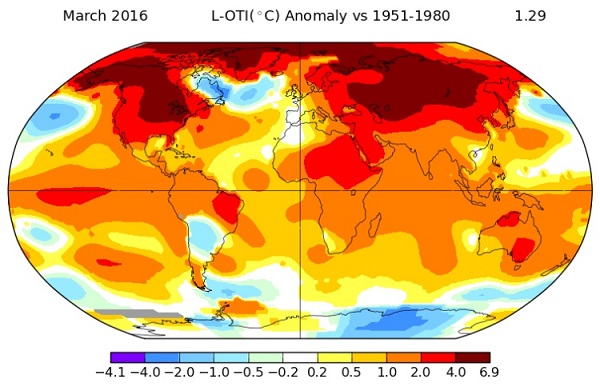
1. March scorcher
March temperatures were the hottest March ever and second largest monthly anomaly. Here’s NASA via Open Mind:
WMO Statement on the Status of the Global Climate in 2015
 The WMO Statement on the Status of the Climate in 2015 was released on 23 March. In short, the world continues to warm, the seas continue to rise, and the weather becomes hotter, wetter and drier, with continued extreme conditions.
The UN has a useful summary, or go to the new WMO site, or access the pdf document directly.
There were reports on ABC RN’s The World Today and at Climate Central, but the best I found with images that go beyond the report was on our ABC. I’ll pick out some of the elements that interested me. Continue reading WMO Statement on the Status of the Global Climate in 2015
Coral reef resilience
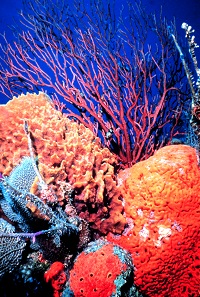 Recently we took a look at the most recent coral bleaching event in Great Barrier Reef will never be the same. John D subsequently sent me a link to an article Obituaries for coral reefs may be premature, study finds by John Pandolfi, Professor, School of Biological Sciences, at The University of Queensland.
So I thought we should take a closer look. Continue reading Coral reef resilience
Climate clippings 168
1. Tesla 3 sales going gangbusters
- Demand for Tesla Motors’ new lower-priced electric car surprised even the company’s CEO Friday as 198,000 people plunked down $US1,000 ($1302) deposits to reserve their vehicles.
The orders came from across the globe even though the car isn’t scheduled for sale until late in 2017.
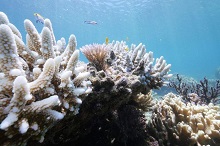
Great Barrier Reef will never be the same
Core samples of the Great Barrier Reef going back 400 years show no bleaching before 1998. There was another event in 2002. In those events less than 20% of reefs were bleached in the affected zones. This year 95 per cent of the Great Barrier Reef’s northern reefs were rated as severely bleached. Only 4 out of 520 reefs surveyed, less than one per cent, were found to be unaffected by bleaching.
The bleaching is destroying the northern sector of the Reef as we watch. Continue reading Great Barrier Reef will never be the same
Climate clippings 167
1. Hybrid wind and solar farms could deliver significant cost savings
- A total of at least 1GW of large-scale solar could be added to existing Australian wind farms, boosting renewable energy development, generation, and and smoothing its delivery to the grid, according to a new report from the Australian Renewable Energy Agency investigation the benefits of solar and wind “co-location.”
Climate clippings 166
1. Temperatures could be rising faster than we thought
Using a new model, researchers from the University of Queensland and Griffith University, predict the global average temperature could rise by 1.5°C as early as 2020. The model is based on forecasts of population and economic growth combined with rising per capita energy consumption. Continue reading Climate clippings 166