Category Archives: Life

Saturday salon 6/9

voltaire_230

An open thread where, at your leisure, you can discuss anything you like, well, within reason and the Comments Policy. Include here news and views, plus any notable personal experiences from the week and the weekend.

For climate topics please use the most recent Climate clippings.

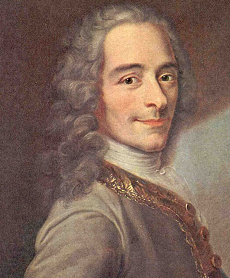
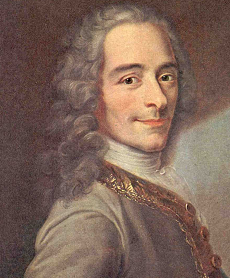
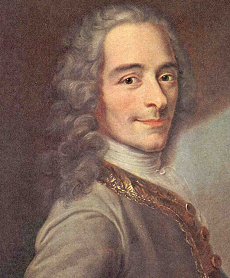
The gentleman in the image is Voltaire, who for a time graced the court of Frederick II of Prussia, known as Frederick the Great. King Fred loved to talk about the universe and everything at the end of a day’s work. He also used the salons of Berlin to get feedback in the development of public policy.

Fred would only talk in French; he regarded German as barbaric. Here we’ll use English.

The thread will be a stoush-free zone. The Comments Policy says:

The aim [of this site] is to provide a venue for people to contribute and to engage in a civil and respectful manner.

Here are a few bits and pieces that came to my attention last week.

1. Paul Kelly’s new tome

Richard Fidler talked to Paul Kelly about his new book Triumph and Demise. All of the main players talked to Kelly on the record, which they haven’t done for anyone else. In all other cases I know at least one or the other of them wouldn’t talk or wouldn’t talk on the record.

I’m hoping to do a full-length post. Kelly mentions at least one incident I didn’t know about. There was a conversation between Rudd and Gillard on the verandah of Kirribilli in January 2010. That was where Gillard told Rudd she thought he should forget about climate change for a time, so it supports the “She made me do it” thesis. Kelly will have none of that. He says Rudd ignored Gillard’s advice often enough and has to take responsibility.

At that meeting Kelly says Gillard formed the opinion that Rudd was in no shape mentally to lead the party to an election.

The book looks like a ‘must read’.

2. The Searchers

The Searchers is the name of a 1956 film which this review suggests is “considered by many to be a true American masterpiece of filmmaking, and the best, most influential, and perhaps most-admired film of director John Ford.”

Certainly it did not do well when it was made, but influenced film makers such as Martin Scorsese, Steven Spielberg, Jean-Luc Godard, Wim Wenders, and George Lucas. In a recent survey it was rated the seventh best film of all time. Now Glenn Frankel has written an amazing book called The Searchers: the Making of an American Legend. The book tells you everything you’d want to know about the incident it was based on, the Alan Le May novel, Frank Nugent’s script, about John Wayne, John Ford and the making of the film itself as though he was there on the set.

He also unravels the grisly truth about the story of how Cynthia Ann Parker was taken by Comanches in an 1836 raid and retrieved in a ‘battle’ (actually a massacre of old men, women and children) by Texas rangers in 1860. He tells the story of Cynthia’s son Quanah Parker. Most of all he tells us how the legend of ‘how the West was won’ was formed over a century or more, and the racism that underlies it.

I’ve read the book with pleasure, now I’d like to see the film.

3. Barrier Reef dredging plans changes

It looks as though plans to dump waste on the Great Barrier Reef will be changed so that the waste will be dumped on land. What the report doesn’t say is that the change of plans is based on new technology, making land dumping the cheaper option rather than an outbreak of good sense on the part of the minister, Greg Hunt.

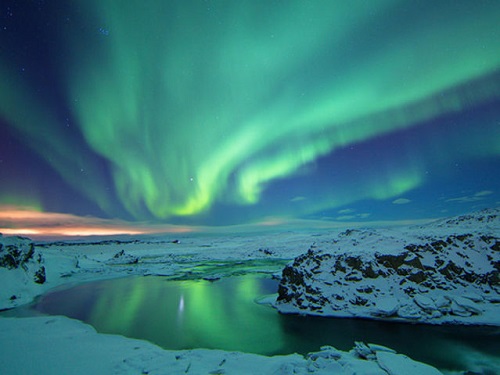
4. What Country in the World Best Fits Your Personality?

For me the answer is Iceland.

Iceland_b5d533e5-cd2f-4888-a1b3-774bc7f1e092_500

What a surprise!

Saturday salon 23/8

voltaire_230

An open thread where, at your leisure, you can discuss anything you like, well, within reason and the Comments Policy. Include here news and views, plus any notable personal experiences from the week and the weekend.

For climate topics please use the most recent Climate clippings.

The gentleman in the image is Voltaire, who for a time graced the court of Frederick II of Prussia, known as Frederick the Great. King Fred loved to talk about the universe and everything at the end of a day’s work. He also used the salons of Berlin to get feedback in the development of public policy.

Fred would only talk in French; he regarded German as barbaric. Here we’ll use English.

The thread will be a stoush-free zone. The Comments Policy says:

The aim [of this site] is to provide a venue for people to contribute and to engage in a civil and respectful manner.

For some reason three of the Saturday salons I preset to appear while I was away didn’t show up.

As mentioned elsewhere I didn’t hear much news apart from Hockey’s foot-in-mouth contribution. Here are a few bits and pieces that came to my attention since I got back.

1. Abbott reacts as per script

From The Brisbane Times
:

Horrific acts of terrorism such as the “truly sickening and utterly evil” beheading of journalist James Foley could happen in Western countries including Australia, Prime Minister Tony Abbott has said.

Bernard Keane at Crikey:

Yes, Prime Minister, that’s exactly why IS chose an executioner with a British accent, to induce hysteria from people like you.

From Facebook:

10385377_10152391991503191_5473164664640791266_n

I think Abbott is hoping for a war or something to boost his electoral stocks.

2. The real deal on Islamic State

Michael Ware, interviewed by Richard Fidler, gives perhaps the best exposition I’ve heard on the origins and nature of Islamic State. He’s also good on other jihadist groups and Islamic political movements elsewhere. He says IS are very media savvy and know exactly what effect on-camera executions will have. IS is by far the most extreme and vicious we have yet seen.

Ware’s forthcoming documentary Only the Dead to be released in 2015 shapes as essential viewing.

3. Rundle on the coming East-West conflict

Rundle reckons that Clive Palmer and Jacqui Lambie are uttering what many ordinary citizens believe when warning about invasions by China or Indonesia. Indeed he reckons that East-West conflict leading to a multi-polar world and a form of reverse colonisation is pretty much inevitable some time this century.

I think Rundle overcooks it somewhat but there is a perception that we are slack and lazy and have vast unoccupied space. There is every reason why we should be alert, but the move is more likely to be commercial in character. China, for example, would love to use their own labour to extract our minerals.

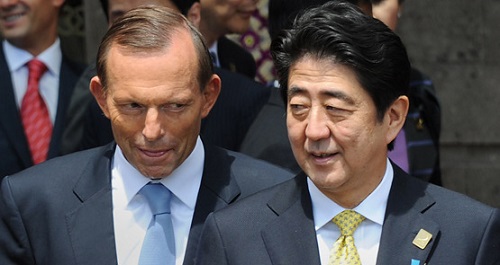
This photo of Abbott and the Japanese PM is priceless:

abbottjapan1_500

4. Poll Bludger: Sunshine State could deal Abbott govt a body blow

William Bowe explains that support for the LNP is on the slide federally in Queensland to an extent that could see Shorten in the Lodge. There are as many winnable seats for Labor in Qld as there are in NSW with its larger population. In fact in Qld the ‘sophomore effect’ only applies to two seats. This effect, worth about 1.5%, applies when you have a first-timer in the seat. Only two Qld seats fell in 2013, whereas a stack fell in 2010.

I’m back

Birdsville card cropped_450

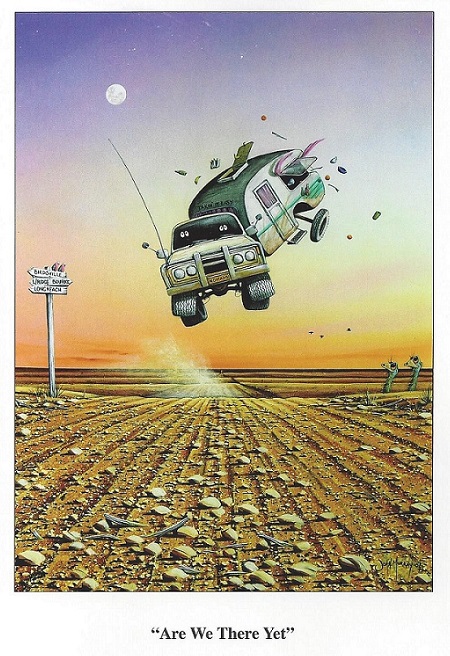
That’s not how it happened – there are no caravans crossing the Simpson Desert – but it’s how it felt! The image is a scan of a card I bought in the Birdsville Bakery. I almost bought this one too by John Murray.

Got back on Wednesday, but it took me 27 hours to log on. Still sorting myself out. Working out how to pay for the holiday, dealing with 571 emails and about 1500 photos we took on the trip.

About 7000 km at a leisurely pace over 26 days. 100 km was a good day in the desert!

Wednesday night Mark was in town and filled us in on happenings in the world. We did hear about Hockey’s foot in mouth in the middle of the desert but not much else. As Mark said, it wasn’t the worst thing that happened in the world, unfortunately.

Hope to be back posting properly next week!

Saturday salon 16/8

voltaire_230

An open thread where, at your leisure, you can discuss anything you like, well, within reason and the Comments Policy. Include here news and views, plus any notable personal experiences from the week and the weekend.

For climate topics please use the most recent Climate clippings.

The gentleman in the image is Voltaire, who for a time graced the court of Frederick II of Prussia, known as Frederick the Great. King Fred loved to talk about the universe and everything at the end of a day’s work. He also used the salons of Berlin to get feedback in the development of public policy.

Fred would only talk in French; he regarded German as barbaric. Here we’ll use English.

The thread will be a stoush-free zone. The Comments Policy says:

The aim [of this site] is to provide a venue for people to contribute and to engage in a civil and respectful manner.

Alice Springs – Simpson’s Desert odyssey progress

Where we are depends on whether we needed to extra day in the schedule for the desert crossing. If we made it across (praise the Lord!) we could be travelling from Birdsville to Windorah or Windorah to Emerald.

Blogging hiatus, again

On Saturday 26, July Len and I together with my wife are setting out for Alice Springs and points beyond, returning via the Simpson’s Desert. Len’s wife is doing the smart thing and flying out to the Alice to join us there. If we return it will be on 19 or 20 August. This week my thoughts are turning in that direction with increasing excitement and some trepidation. So blogging might be sporadic this week. After that I won’t be looking at a computer screen until we get back.

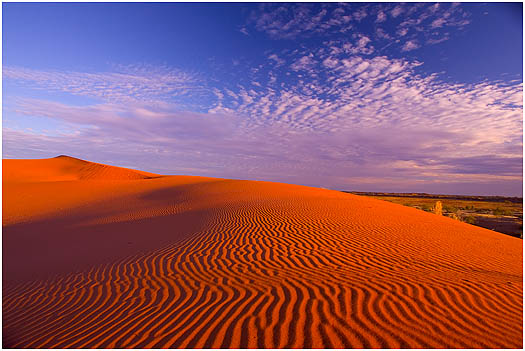
Deep Red sand dunes of the Strzelecki Desert in outback South Australia.

(Image from here.)

I will set up the Saturday Salon posts ahead of time, but with no topical input from me, as I’m not clairvoyant!

I’m not usually a happy camper, and have avoided it most of my life, but we’ve invested in modern gear including sleeping bags rated to -10°C. I think a howling westerly and a sand storm would be the most unpleasant. We’ll be doing the desert crossing in a convoy of five, with all sorts of emergency and recovery equipment. No-one in the group has actually done it before, but the detail of planning engenders a deal of confidence, so here’s hoping!

The ‘featured image’ on the front page is from here.

Saturday salon 19/7

voltaire_230

An open thread where, at your leisure, you can discuss anything you like, well, within reason and the Comments Policy. Include here news and views, plus any notable personal experiences from the week and the weekend.

For climate topics please use the most recent Climate clippings.

The gentleman in the image is Voltaire, who for a time graced the court of Frederick II of Prussia, known as Frederick the Great. King Fred loved to talk about the universe and everything at the end of a day’s work. He also used the salons of Berlin to get feedback in the development of public policy.

Fred would only talk in French; he regarded German as barbaric. Here we’ll use English.

The thread will be a stoush-free zone. The Comments Policy says:

The aim [of this site] is to provide a venue for people to contribute and to engage in a civil and respectful manner.

Here are a few bits and pieces that came to my attention last week.

1. National Library archives

The National Library of Australia plans to include the Climate Plus website in its PANDORA Archive, so our words here will be immortalised!

2. The Australian newspaper celebrates 50 years in print…

…with a glowing endorsement from Tony Abbott.

The Australian has celebrated 50 years in print with a glowing endorsement from Prime Minister Tony Abbott, who said John Howard had the newspaper to thank for his elevation to the nation’s top job.

Abbott apparently thinks it’s OK for a newspaper to play an active role in politics, in spite of his weasel words.

The article gives an account of the puke-making love-in between Tony Abbott and Rupert Murdoch.

On the same day Phillip Adams pointed out that the ABC had just said good-bye to some of its staff due to government funding cuts.

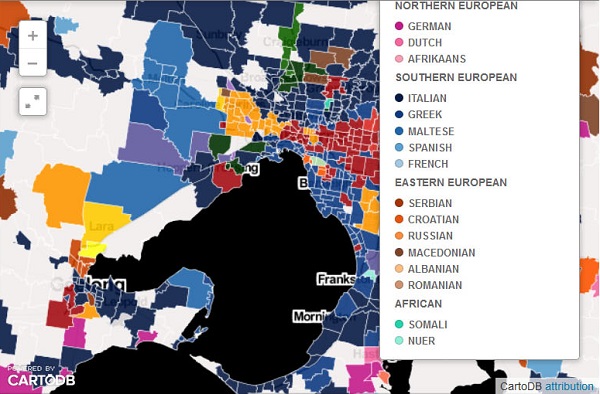
3. Melbourne language cacophony

More languages are spoken in Melbourne than there are countries in the world, a cacophony of 251 tongues whose voices stretch to all corners of the city.

Melbourne languages_cropped_600

Across the city, three in 10 people speak a language other than English when they get home. In seven suburbs, English is not the dominant language. Arabic is the sixth-most commonly spoken language other than English in metropolitan Melbourne, behind Greek, Italian, Mandarin, Vietnamese and Cantonese.

The population is very mixed compared to American cities such as Chicago and Washington DC, which are very segregated. Italian is the most widely dispersed non-English language, followed by German and Dutch.

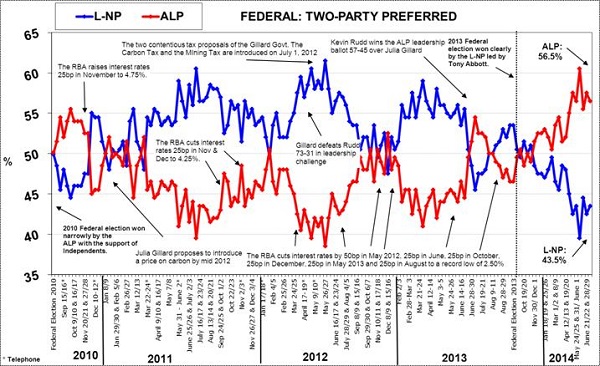
4. Morgan shows ALP at 56.5% down 1% as new senate blocks carbon tax repeal

f a Federal Election were held today the ALP would win easily (56.5%, down 1%) cf. L-NP (43.5%, up 1%) on a two-party preferred basis according to today’s multi-mode Morgan Poll conducted over the last two weekends – July 5/6 & 12/13, 2014.

Morgan Jy 2014_600

It would be too funny if passing the carbon ‘tax’ repeal saw the restoration of LNP fortunes.

Analysis by Gender

Analysis by Gender shows that ALP support remains strongest amongst women with the ALP 60.5% well ahead of the L-NP 39.5% on a two-party preferred basis. Support amongst men is closer with the ALP 52.5% just ahead of the L-NP on 47.5%.

Analysis by States

The ALP maintains a strong two-party preferred lead in all Australian States except Western Australia: L-NP 50.5% cf. ALP 49.5%. New South Wales: ALP 55% cf. L-NP 45%, Victoria: ALP 58.5% cf. L-NP 41.5%, Queensland: ALP 56.5% cf. L-NP 43.5%, South Australia: ALP 64.5% cf. L-NP 35.5% and Tasmania: ALP 61% cf. L-NP 39%.

5. Stafford by-election

We’ll keep an eye on this one. Antony Green says he expected a double digit swing in the polls for the inner-northern Brisbane seat, citing the 17 per cent swing against the LNP at the Redcliffe by-election earlier this year and recent opinion polls. Janine Walker told local radio that anything less than 20% and the LNP will reckon they’ve been let off easy.

Notably, PUP is not running. She says they know they won’t win so they want to maximise the protest vote for Labor. The idea is to bury the LNP as deep as possible.

Most south of the border reckon Palmer is about self-interest or revenge. Walker says all the above and more, but he thinks strategically and is focussed on power.

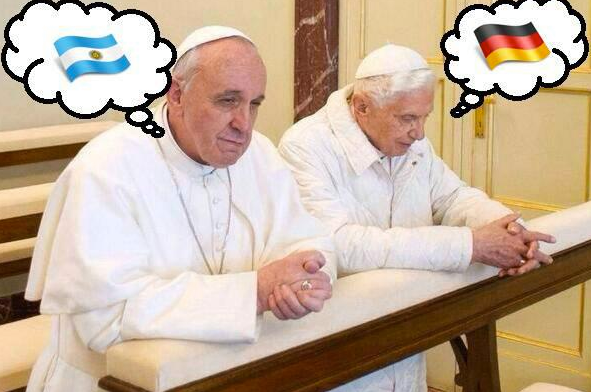
6. FIFA wins

Remember this?

Popes praying_10449976_816909721666770_8792909987461327130_n

Germany won, but did it?

John Oliver explains that soccer is a religion, FIFA is its church. It’s evil, even murderous and frankly appalling. Soccer excites the masses like no other sport, but FIFA takes the gold – literally!

Thanks to my friend in Erlangen for the heads-up!

Noel’s translation of Dąbrówka Wielkopolska (fmly Groß Dammer) article in Polish Wikipedia

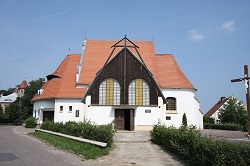
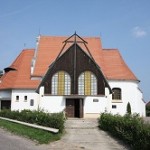
Noel Cameron-Baehnisch in a rush of enthusiasm has translated the Dąbrówka Wielkopolska (fmly Groß Dammer) article in Polish Wikipedia. This may mainly be of interest to specialists and enthusiasts but the persistent will be rewarded. I’ve added here some images from the article, first the famous folkloric church:
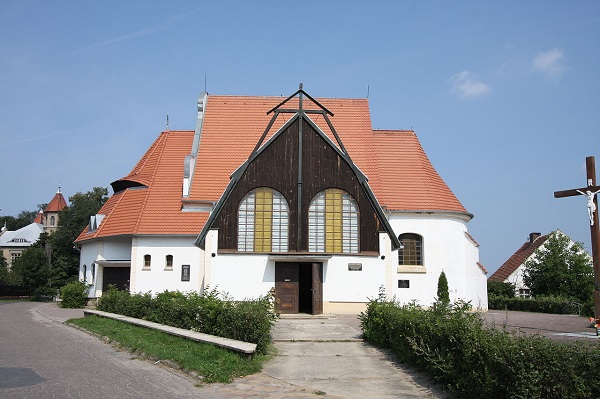
1280px-17330_Dabrowka_wlkp_kosciol_600

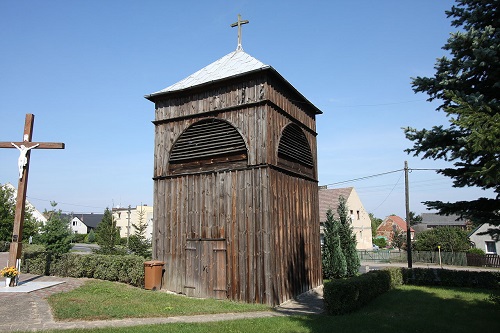
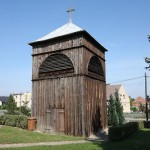
Next to the church stands a belfry:

1280px-Dabrowka_Wielkopolska_dzwonnica_500

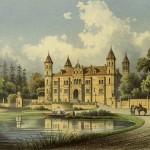
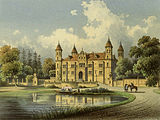
Here’s the famous chateau, apparently as it appeared in 1858:
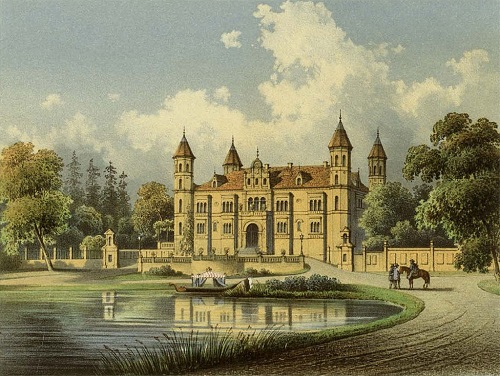
144_Dammer_500

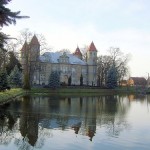
This is a more modern version, in a winter mood:
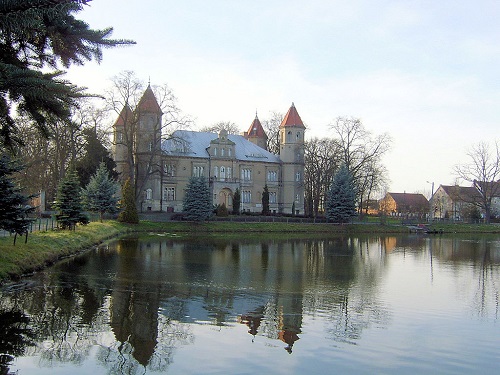
1024px-Dąbrówka_Wielkopolska_pałac_500

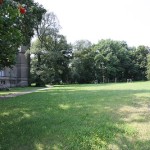
This is a park scene in the chateau complex:
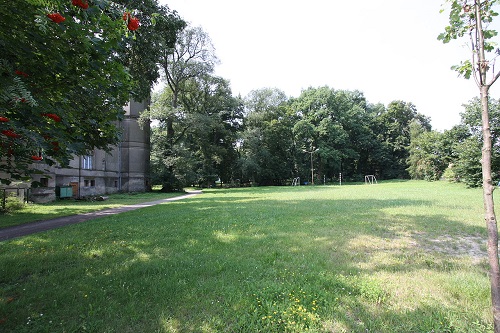
1280px-17333_Dabrowka_wlkp_park_500

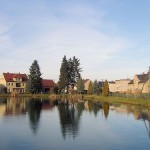
In the centre of the village we find an attractive pond:
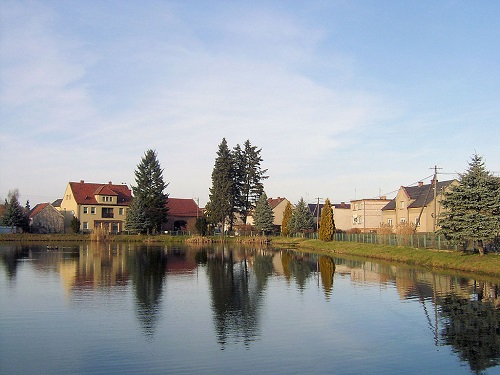
1024px-Dąbrówka_Wielkopolska_staw_500

Related articles may be found under the tag Bahnisch family history.

Here’s Noel:

My rough translation of the Polish WIKIPEDIA article: found 7/7/2014; translated word-by-word using the Internet on the 9 July 2014. Dabrowka (pronounced “dom-BROOF-kah”) is the village where my Polish ancestors, the Ruciaks (“ROO-chark”), came from; they were Prussian subjects but ethnically very Polish. I assume the information in this WIKIPEDIA article is accurate, though I know it consists of contributions from one person or several people, none of whom can be classified as professional historians. WIKIPEDIA is free; professional history is not.

Dąbrówka Wielkopolska (niem. Groß Dammer [2]) – wieś w Polsce położona w województwie lubuskim, w powiecie świebodzińskim, w gminie Zbąszynek.

Translation notes: Polish is a heavily inflected language; words typically consist of a stem followed by all sorts of complex “inflections” or case endings, like in Greek, Latin, Russian and German).

niem. (abbreviation) = German. wies = village (“-wice” in placenames; wsi = in the village). “w” is a preposition which means in, towards, to, etc.
Village on Polish territory, in the Lubuska Province, District of Swiebodzin, sub-district of Zbaszynek (the modern industrial and railway town just south of Dabrowka).

Państwo Polska [Nation of Poland]
Województwo lubuskie [Province of Lubuska]
Powiat świebodziński [District of Swiebodzin]
Gmina Zbąszynek [Sub-district of Zbaszynek]
Liczba ludności (2010) 1172 [1] [population in 2010]
Strefa numeracyjna (+48) 68 [telephone area code]
Tablice rejestracyjne FSW [car number-plate begins with “FSW”]

Spis treści [List of Contents]
1 Historia [history]
2 Zabytki [monuments]
3 Galeria


4 Przypisy [references]

[Brian – The above images appeared from nowhere. The aren’t in the Word file Noel sent me, or in the back-end copy that generates the post, so I can’t remove them!]

Historia
Miejscowość wzmiankowana była już w 1406 jako wieś szlachecka Dambrowca w dobrach zbąszyńskich. W XV w. osada była w posiadaniu rodziny Zbąskich. Niestety we wsi nie zachowała się stara kronika z XIV w. napisana po łacinie i po polsku przechowywana w miejscowym kościele św. Jakuba Apostoła, ponieważ wypożyczona została przez Uniwersytet Humboldta w Berlinie i nigdy już do Dąbrówki nie powróciła [3].

Zbaszyn = German Bentschen, an important town just SE of Dabrowka; many families left the Bentschen district for South Australia. Neubentschen (New Bentschen) = Zbanszynek.

This place was mentioned as early as 1406 as the wies szlachecka (noble village = village owned by an aristocrat) of DAMBROWCA in the Zbaszyn Town records. W XV. wieku (in the 15th century) this settlement (osada) was the possession of a Zbaszyn family. Unfortunately the village no longer has its stara kronika z XIV w. (14th-century Old Chronicle), written in Latin (po lacinie) and Polish (po polsku) and stored in the Church of Saint James the Apostle (Jakuba Apostola) – because it was borrowed (wypozyczona) by the Humboldt University in Berlin (the oldest and most prestigious university in Berlin) and nie powrocila (never returned)!!

Osada zbudowana na planie tzw. owalnicy z charakterystycznym placem wewnętrznym, zwanym nawsiem.

z = the preposition means with, from, about, out of, because of, in, etc.
Settlement built on a so-called oval (owalnicy) plan with characteristic … … [too difficult for me to translate the rest].

Mimo bezpośredniego sąsiedztwa z niemieckim obszarem etnicznym i procesów germanizacyjnych, polska ludność autochtoniczna stanowiła zawsze większość mieszkańców zachowując polską mowę i obyczaje. W 1905 we wsi mieszkało 1.038 osób, w tym 90,1% Polaków oraz 9,7% Niemców [4].

niemieckim = the stem niem plus a complex inflection and case ending = German.

Despite (mimo) the closeness of ethnically German territory and the process of Germanification (procesow germanizacyjnnych), the native population always (zawsze) preserved (zachowujac) its polska mowe i obyczaje (Polish language and customs). In 1905, we wsi (in the village) were 1038 people, of whom 90.1% were ethnically Polakow (Polish) and 9.7% ethnically Niemcow (German).

W 1910 jako dominium Gross Dammer miejscowość należała do Bernharda von Britzke. Mimo protestów polskiej ludności w 1919 pozostała w granicach Rzeszy na mocy decyzji komisji międzyalianckiej. W latach 1815-1945 Dąbrówka Wielkopolska należała do powiatu międzyrzeckiego (Kreis Meseritz).

In 1910, the “dominium” of Gross Dammer was owned by the aristocrat, Bernhard von Britzke (von is the aristocratic adjective and Britzke looks like a Slavic name; Bernharda is in the genitive case): in other words, the village was owned by Von Britzke, who obviously lived in the big palac (chateau). Despite (mimo) the protests of the Polish population in 1919, it remained inside the border of the Rzesz (Polish form of Reich), because of a decision by an international commission. In the years 1815-1945, Dabrowka belonged to Kreis Meseritz (the Prussian District of Meseritz Town).

W latach 1929–1939 we wsi działała polska szkoła, w której nauczało 3 nauczycieli, a uczyło się 140 dzieci [5]. Szkoła po raz pierwszy wzmiankowana była w 1640. W miejscowości istniało także przedszkole polskie założone w 1935 roku, z 70 dziećmi.

In the years 1929-1939, the village operated its own Polish school (polska szkola), in which 3 teachers (nauczycieli) taught about 140 dzieci (children). The school was pierwszy wzmiankowana (first mentioned) in the year 1640. There was also (takze) a Polish kindergarten (przed-szkole polskie), founded in 1935, with 70 youngsters (dziecmi).

W 1939 na 1.287 mieszkańców wsi Polaków było 986. We wsi w 1923 powstaje Polskie Towarzystwo Gimnastyczne Sokół założone przez Stanisława Mizernego, które posiadało męską i żeńską sekcję sportową. W miejscowości istniał także oddział regionalny Związku Polaków w Niemczech, Przysposobienie Rolnicze, Chór Polski oraz Kółko Rolnicze.

In 1939, of the 1287 village residents, 986 considered themselves to be Polakow (Poles). In the village, in 1923, was founded a branch of the POLSKIE TOWARZYSTWO GIMNASTYCZNE “SOKOL” by Stanislaw Mizern, which had male and female sporting sections. (This “Falcon” Polish Gymnastics Society was part of the Pan-Slavic Movement.) The village also (takze) had a regional branch (oddzial) of the non-political Zwiazku Polakow w Niemczech [Union of Poles in Germany], a Przysposobienie Rolnicze [agricultural college], a Chor Polski [Polish choir] and a Kolko Rolnicze [agricultural “circle” or club].

W 1934 roku, utworzono stały obóz Arbeitdienstu. W 1935 miasto Lipsk rozpoczęło tuż przy Dąbrówce budowę osady niemieckiej pod nazwą Limbach, dla uczczenia SA-manna Limbacha, zabitego w walce nazistów z komunistami. Wg oceny niemieckiej gazety “Deutsche Allgemeine Zeitung” osada ta powstała w celu wzmocnienia żywiołu niemieckiego “muszącego ciężko walczyć na Pograniczu z mniejszością polską”[6]. W lipcu 1938 roku, nastąpiło uroczyste poświęcenie 20 gospodarstw, wielkości 20 ha każde przeznaczonych dla niemieckich kolonistów-członków SA i SS [5].

[In 1933 Hitler ruthlessly grabbed power and strangled German Democracy.] In 1934, an Arbeit-dienst camp was set up. In 1935 the City of Leipzig (Lipsk) began to construct osady niemieckiej (German settlements), called Limbach after an SA soldier of that name, killed in Nazi action against German communists. (SA = Nazi Brownshirts.) According to the German newspaper (gazety) “Deutsche Allgemeine Zeitung”, the settlement was founded to strengthen the German presence in those border districts z mniejszoscia polska (with Polish minorities). In lipcu (July) 1938, there was a ceremony to dedicate 20 gospodstw (farms), each of 20 hectares, mainly for niemieckich kolonistow (German colonists) who were czlonkow (members) of the SA and SS. [You can be sure these colonists left quickly in 1944, of their own volition! Limbach is now called Samsonki, about 3 km east of Dabrowka.]

Podczas wojny, polskojęzyczna ludność Dąbrówki była przez Niemców wysiedlana i zsyłana do obozów koncentracyjnych, dotyczyło to szczególnie polskich działaczy społecznych i narodowych, np. Jana Budycha współorganizatora Banku Ludowego i jednego z organizatorów polskiej szkoły w Dąbrówce Wielkopolskiej. Łącznie zginęło 12 osób [7].

During the War (“wojn” is the stem for “war”), polskojezyczna (Polish-speaking) residents of Dabrowka were arrested by the Germans and sent to obozow koncentracyjnych (concentration camps), especially Polish social and nationalist activists (dzialaczy), such as Jan [John] Budych, managing-director of the local People’s Bank and one of the organizers of the local Polish schools (polskiej szkoly) in Dabrowka. Lacznie (in total) zginelo (were murdered) 12 osob (people), by the Nazis, including Jan.

(The surname Budych is significant because Carl Albert Budich [sic: “BOO-dik”] (1839-1911) married Franziska Naida (1845-1891) in 1863 in South Australia: Franziska was the niece and namesake of Franziska Baehnisch nee Ruciak (Ruciack); Fran Naida’s mother was Severina Ruciak, Fran Baehnisch’s sister. The Budich (Budick) surname is still found in South Australia. So are the surnames Naida (Nayda) and Ruciack. All these families left Dabrowka district and so missed out on the trauma and horrors of two idiotic ultra-nationalistic World Wars. Instead, they had the privilege of helping to destroy an out-of-control ultra-militaristic Germany, then watching from afar the formation of two new and peaceful Germanys, one free, one not free, next to a proud and independent, if not free, Poland.)

W 1945 wieś została przyłączona do Polski. W uznaniu zasług w zachowaniu polskości wieś, w 1973 została odznaczona Krzyżem Grunwaldu II klasy. W latach 1945-1954 siedziba gminy Dąbrówka Wielkopolska. W latach 1975-1998 miejscowość administracyjnie należała do województwa zielonogórskiego.

In 1945, the village (wies) was attached to Poland. In recognition of its meritorious behaviour as a polskosci wies (Polish village), in 1973 it was awarded the Grunwald Cross (Second Class). (In the battle of Grunwald, in 1410, the Poles crushed the Teutonic Knights.) From 1945-1954, it was in the sub-district (gminy) of Dabrowka. From 1975-1998, it was administered by the Province of Zielona Gora. [1998 marks the end of Communist Poland.]

Siedziba Parafii Niepokalanego Poczęcia Najświętszej Maryi Panny i św. Jakuba Apostoła.

Seat of the Parish of the Niepokalanego Poczecia (Immaculate Conception) Najswietszej Maryi Panny (of the Blessed Virgin Mary) and of Saint Jakub Apostol (James the Apostle).

Zabytki [Monuments]
Według rejestru Narodowego Instytutu Dziedzictwa na listę zabytków wpisane są [8]:

According to the National Heritage Institute’s list of registered monuments:

kościół parafialny rzymsko-katolicki pod wezwaniem Niepokalanego Poczęcia NMP, z połowy XVII-XVIII wieku
zespół pałacowy: pałac, neorenesansowy z lat. 1856-1859; park, z połowy XIX wieku.

kosciol (pronounced “KOSS-ya-choo-wa”) = church. parafialny = parish (adj.). rzymsko-katolicki = Roman Catholic. pod wezwaniem = called. z polowy XVII-XXIII wieku = [built in] mid-17th century to 18th century.
Chateau complex: the palac [“PAH-wah-ts”] or chateau, Neo-Renaissance, [built] in 1856-1859. And the chateau’s park, mid-19th century.

Galeria

1. Kościół par. pw. Niep. Poczęcia NMP [parish church called the IC of the BVM]
2. Pałac [palace or chateau]
3. Park w zespole pałacowym [park in chateau complex]
4. Staw w centrum wsi [pond in centre of village; staw is pronounced “STAH-ff”.]
5. Neorenesansowy pałac [Neo-Renaissance chateau]
6. Pałac na ilustracji z 1858 r. [chateau illustrated in 1858 year]
7. Dzwonnica przy kościele parafialnym [belfry beside the parish church]

[Brian – again the images appeared from nowhere. Curious because what we have here is not co-extensive with what appears in the linked article.

Przypisy [References]

Reference [4] is the most interesting one:

Na podstawie danych ze spisu powszechnego z 1905 r., wg deklarowanego języka ojczystego i religii; część ludności zadeklarowała inny język ojczysty. Gemeindelexikon für das Königreich Preußen. Heft V. Provinz Posen, Berlin 1908.

Based on data collected by the Census (spisu) of 1905, based on stated (deklarowanego = declared) jezyka ojczystego (native language = mother tongue) and religii (religions); segment of population declaring “other” (“inny”) native language. Parish Lexikon for the Prussian Kingdom. Volume 5. Province of Posen (Poznań in Polish). Berlin, 1908.

And finally, I must tackle the text of one of the 3 plaques I photographed in 2004 on the outside of the parish church. Our Polish guide Bolek told me the 12 listed people had died in WWII. I had always guessed that they were young men compulsorily drafted into Hitler’s armies and then killed in action. But I know better now. And I must apologize to the families of the 12 martyrs, who are my very distant cousins, for the misunderstanding. This is what happens when a family forgets how to speak Polish. Please pardon any bad transcription errors because it is very hard to read the beautifully carved text on the marble plaque. When I read about Jan Budych’s fate in the WIKIPEDIA article, I began to understand the following:

Boże zbaw Polskę. God bless Poland.
Bohaterom Dąbrówieckim. To the Martyrs of Dabrowka. (bohater = martyr.)
Milość. Wierność. Cześć. Love, Fidelity. Honour.

Jan Budych, Tomasz Budych, Marcin Bimek, Walenty Berent, Wojciech Berowicz, Jan Flejsierowicz, Wojciech Golek, Jan Golek, Antony Kwaśny, Stanisław Kędziera. Piotr Malysiak, Wojciech Młodystach.

Some of the surnames are Germanic or partly so (Flejsier = Fleischer?). Młodystach is very prominent in the South Australian Phone Book today: now spelt Modistach but unmistakably Polish; in modern Polish, the l-with-stroke ( ł ) is pronounced like the English ‘w’ sound – “m-WOR-dee-stah-k”.

Za Waszą Wiare i Wolność. For Your Faith and Freedom.
Życie Swe Oddali. They Gave Their Lives. (word-for-word, Lives Their They-Gave.)

This is an echo of Poland’s unofficial National Motto, which dates back to the disastrous 1830 Polish Insurrection: Za Naszą i Waszą Wolność (For Our and Your Freedom). The 12 Martyrs of Dabrowka not only fought for their own Freedom but for the Freedom of Everyone, then and now, for you and me.

Męczarniach Więzień i Obozów. Tortured to death in Prisons and Camps.
Miłosier Bądż ——-. Mercy Be ——–. Probably “upon their souls” or “upon all”.

And I can’t read the last line on the plaque.

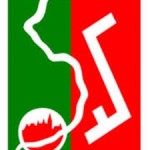
Finally, Reference [2] makes reference to the “Rodło”. I GOOGLEd this and read a fascinating story of adaption and survival. Kaczmarek died in exile in Washington DC in 1977; Kłopocka died in Communist Warsaw in 1982. Prussia had long before banned the use of the White Eagle as a Polish symbol inside Prussia. Hitler seized power in early 1933, so it seems the symbol was adopted before he rose to dictatorial power, despite what the English WIKIPEDIA article implies. I have edited the text slightly. In Polish, the Vistula is called the Wisła (”VEE-s-wah”). Rodło = “ROR-dwor”.

The Rodło is a Polish emblem used since 1932 by the Union of Poles in Germany. It is a stylized representation of the Vistula River and Kraków as the wellsprings of Polish culture.

After Adolf Hitler had seized power in Germany, Nazi emblems were soon compulsory nationwide. The swastika became the national emblem of the Third Reich and Poles from the Union of Poles in Germany could not use their national symbols anymore, because they were prohibited. Dr. Jan Kaczmarek approached the supreme council with the following proposal:

“Our acceptance of the swastika and the German Greeting [the Nazi Salute] could only signify agreement to total Germanisation. Therefore we must find a way, without risking the accusation of anti-state activity, of not accepting Heil Hitler and the swastika (…) we should at last have our own national symbol, which would enable us publicly to set ourselves free from the Nazi swastika.”

The Rodło graphic was conceived by graphic designer Janina Kłopocka who sketched the course of the Vistula River, cradle of the Polish people, and Royal Kraków, cradle of Polish culture. The white emblem was placed on a red background – the Polish national colors. It was adopted in August 1932 by the leadership of the Union of Poles in Germany.

This clever modern image combines the Rodło on the right with an explanatory graphic on the left.
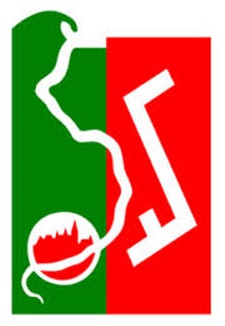
Polish image_cropped

The Polish WIKIPEDIA article says in part:

… i zewnętrznie wyglądające jak pół zmodyfikowanej swastyki, a jednocześnie nią nie będące. W ten sprytny sposób, Polacy w Niemczech uniknęli przyjęcia symboliki nazistowskiej.

… and outwardly looked like half a modified swastika, whilst not actually being that. In this clever way, Poles in Germany avoided the adoption of Nazi symbols.

We all have so much to learn about our Polish ancestors!

Please correct any Polish typos, Polish Clerical Errors, etc.
By Noel David Cameron-Baehnisch, 7 Park Road, Angaston 5353 SA; ncameron@vtown.com.au.

Brian: I can’t find the above image in the current article. It seems to have been replaced by this one:
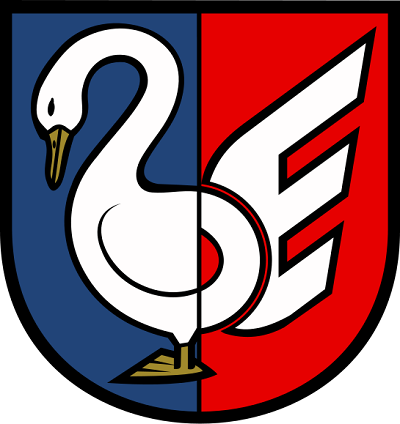

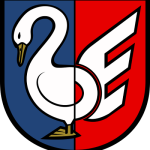
545px-POL_Zbąszynek_COA_1_400

Noel’s nostalgic trip down memory lane

Noel Cameron-Baehnisch took a trip to Poland in 2004, seeking out the places our ancestors emigrated from in the mid-19th century. Noel was the pathfinder for Len’s trip (see his A journey of ‘Bahnisch’ family discovery in Lower Silesia, Poland). Noel went on a tour with Homeland Tours, led by David Zweck and a Polish guide. Len found the same places with a hired car and a ‘Tom Tom’ with the help of notes supplied by Noel.

First some background on how it all hangs together, then a selection of Noel’s photos, together with edited comments he provided.

Len and Brian are brothers. Noel is the son of their oldest cousin, Mona, who married Jim Cameron.

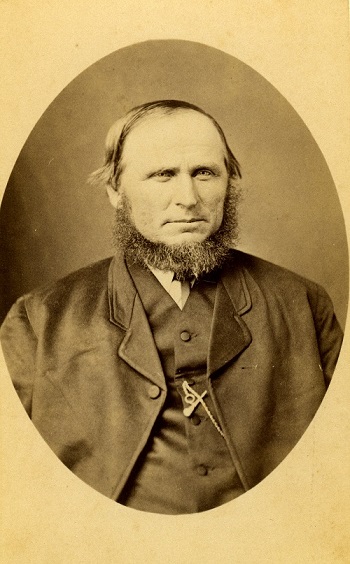
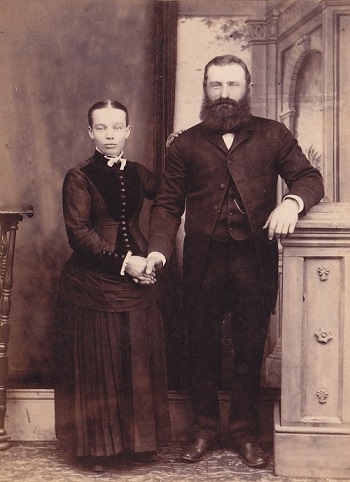
In the paternal line, Wilhelm (“Willi”) Bähnisch left Motyczyn (then Möttig) as a 17 year old in 1848. He married Franziska Ruciak, who came from Dąbrówka Wielkopolska (then Groß Dammer) as a 15 year old in 1846. Here’s a photo (see Note 1) of Willi:

image0000029A_350

Willi and Franziska had 13 children. Their eighth was also named Wilhelm (“Willi Junior” or “Bill”), Len and Brian’s grandfather. Bill married Louise Gregor. We have a photo (see Note 2) of them also:

EWBjr and Louise GREGOR 1889_upright_cropped p_350

Louise’s parents were Wilhelm August Gregor, who came from Pawłowice Wielkie, formerly Pohlwitz bei Liegnitz or Groß-Pohlwitz, and Ernestine Pauline Schulz from Bielany, formerly Weißenleipe.

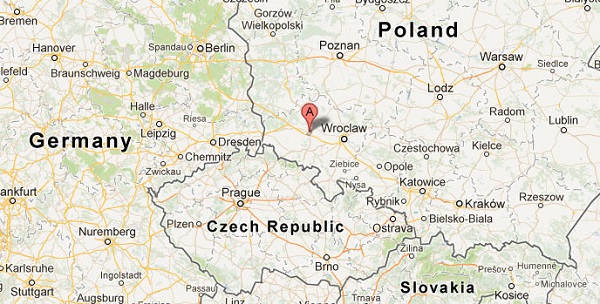
Motyczyn, Pawłowice Wielkie and Bielany are all near Legnica, formerly Liegnitz, a city of some 100,000 people and the main centre of Lower Silesia (Polish: Śląsk; German: Schlesien). It is marked “A” on this map:

Leignitz 2_cropped_again_600

Dąbrówka Wielkopolska is further north, almost due west of Poznań in the province of Posen. Both Posen and Silesia were provinces of the Kingdom of Prussia (German: Königreich Preußen) when our ancestors lived there.

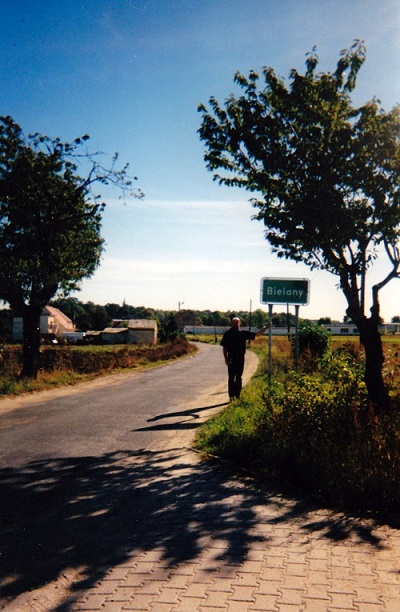
The first photo, taken by Noel’s Polish guide, Bolek, shows Noel leaving Bielany and heading west to Pawłowice Wielkie: it seems to be exactly the same sign as the one in Len’s photos:
1. Leaving Bielany for Pawlowice_0003_400

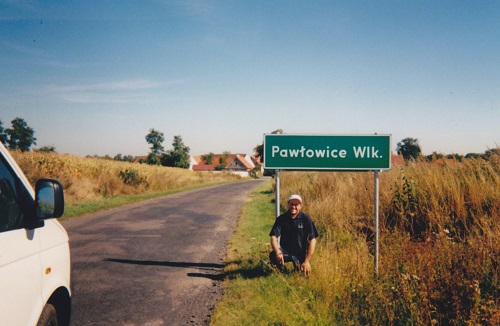
Next we have Noel at Pawłowice Wielkie (southern entrance), again taken by Bolek:

2. NDCB in PW 10 Sept 2004_500

The front of the VW tour van is in shot on the left.

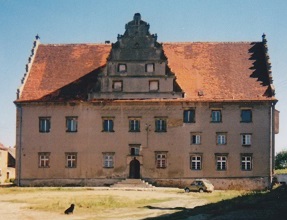
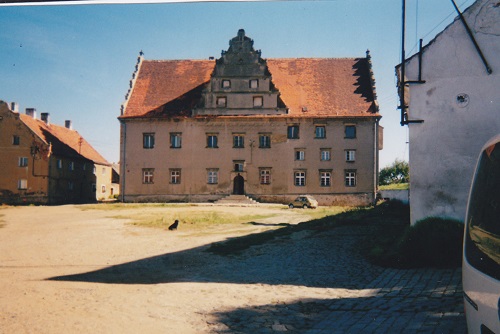
Next we have the Old Manor House in Pawłowice Wielkie, taken by Noel from inside the big courtyard. The little black dog in the photo was quiet but Noel says there was another dog barking at them as they were trespassing.

3. Big house in PW_0002_500

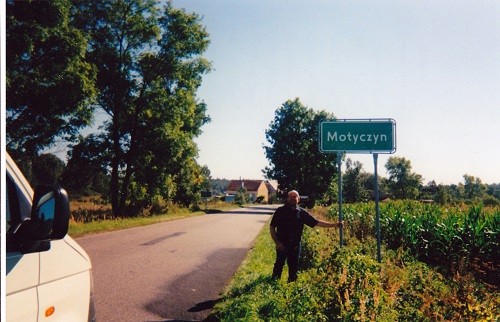
On the same day the tour went to Motyczyn:

4. NDCB in Motyczyn 10 Sep 2004_500

Noel was grinning because his right foot had just gone down into a ditch hidden by the grass. He was balancing himself by clinging to the sign. Again Len took a photo from almost exactly the same spot at the northern entrance to Motyczyn. In Len’s photo the tree has grown in the last ten years and a new house has been added on the right.

There were maize crops everywhere. Bolek said the maize is winter-fodder. In September the light is so different to June’s light: winter is approaching and the crops have to be gathered in, for the severe winter.

The average minimum in mid-winter Legnica is a bracing -3°C with the maximum a miserly 4°C, reason enough to emigrate!

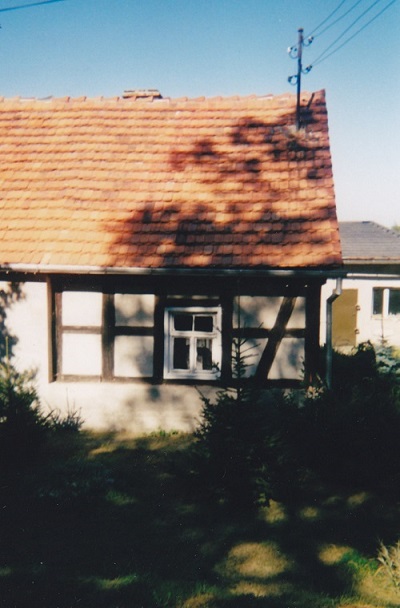
Noel found the next house the most interesting in the village: half-timbered, at south end of village, opposite the entrance to the South Wood:

5. Moettig (half-timbered house)_0004_400

In all probability the house has been repeatedly renovated and extended over the centuries.

Noel’s photo caption said: “The village is somewhere between prosperous and dilapidated.” Len had a similar impression.

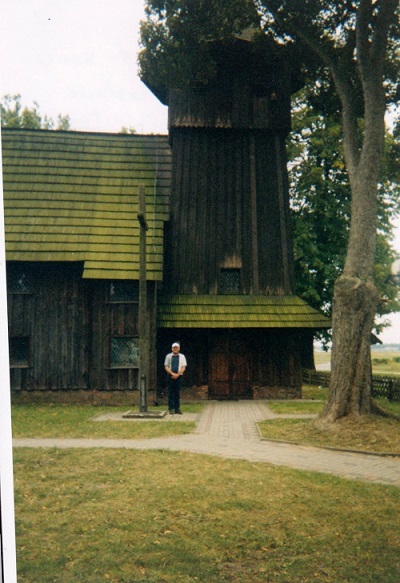
As Len said, the Ruciaks in Dąbrówka Wielkopolska worshipped in the tiny village of Chlastawa. Here’s Noel’s shot of the wooden church they attended:

6. Chlastawa church (1639) 11 Sept_0007_400

This church was Pastor Fritschke’s church: he and some of his congregation migrated to SA, where he clashed with Pastor Kavel. In Len’s photo the lowest branch of the pine tree has been sawn off during the last ten years; or maybe it got ripped off in a winter storm. While the Ruciaks worshipped there as Lutherans the church is now Catholic. The yellow-green colour covering the shingle-roof is probably moss.

The church was built by the local nobility in 1639; during the Thirty Years War (1618-1648), which mostly raged further west.

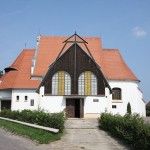
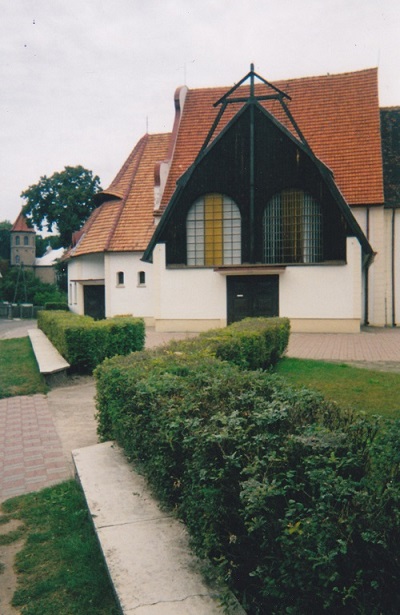
Noel also photographed the “folkloric” Catholic church in Dąbrówka Wielkopolska, where a lot of money had just been spent.

7. Church of Dabrowka Wlkp. 11 Sept_0005_400

The church which is heritage listed also dates from 1600s. The foundation stones were “glacial erratics”, left behind after the Great Ice Sheet retreated. The church has been repeatedly renovated and extended.

The low hedges in front are now gone. In the background, you can see one tower of the “Chateau” below:

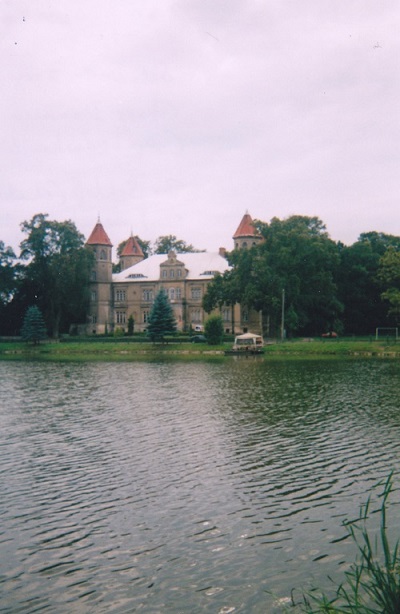
8. Chateau (1857) Dabrowka_0006_400

The chateau dates from 1859, after the Ruciaks left.

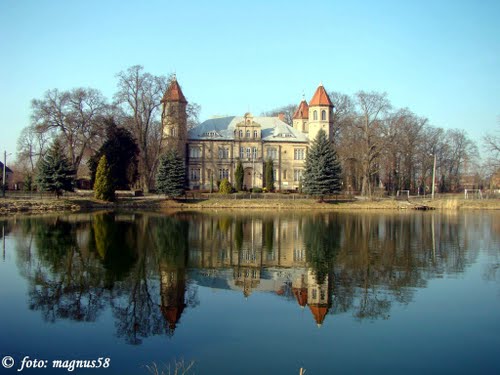
Here’s another photo from the internet in a different season.

9. 33726230

The Polish Wikipedia has an excellent article on the village with this thumbnail image:

10. 160px-144_Dammer

As a final note this post has used three different versions of our surname – Bähnisch, Bahnisch and Baehnisch.

Willi’s birth certificate, if they got it right, would have shown Bähnisch. The umlaut ä was dropped in Australia, because typewriters couldn’t cope. The umlaut is often rendered in English by adding an ‘e’ to the vowel, hence Baehnisch. One branch of the Australian family has adopted this practice. If you look in the White Pages you’ll see Bahnisch and Baehnisch in approximately equal numbers.

The pronunciation follows the Silesian German dialect with Bay-nish. The ‘ay’ diphthong doesn’t exist in Standard German (German: Standarddeutsch, colloquially also Hochdeutsch) which would render the sound Bair-nish.

Notes:

1. This photo was in Brian’s possession, probably from a shoe box of photos left by his mother. It was scanned commercially by Kodak.

2. Scanned by Noel Cameron-Baehnisch 31 Dec 2012 AD, from Ellen Bahnisch’s Collection. It portrays Len and Brian’s paternal grandparents. Louise Gregor lost her father to gallstones before she was born at Bethel, near Kapunda. After her mother died of heart disease, Louise was fostered and became a servant in the Stiller household at Bethanien (Bethany), where she was courted by old Bertha Stiller’s first cousin, Ernst Wilhelm (“Willi” in German, “Bill” in English) Bahnisch Junior. They married in Langmeil Church, Tanunda, in 1889 when he was 25 and she was 5 months older than him! She is wearing a beautiful two-tone black dress (black was required of all brides and married women); she is probably wearing a corset to give her that fashionable but unhealthy hourglass look. Both have blue eyes, which is why their eyes look a bit blank. Her hair style is that of Old Queen Victoria. Tragically she died of childbirth on the 24 Nov 1900, leaving behind 3 healthy children. RIP, Louise. Sadly her grave is lost.

For related posts see the Bahnisch family history tag.

Saturday salon 12/7

voltaire_230

An open thread where, at your leisure, you can discuss anything you like, well, within reason and the Comments Policy. Include here news and views, plus any notable personal experiences from the week and the weekend.

For climate topics please use the most recent Climate clippings.

The gentleman in the image is Voltaire, who for a time graced the court of Frederick II of Prussia, known as Frederick the Great. King Fred loved to talk about the universe and everything at the end of a day’s work. He also used the salons of Berlin to get feedback in the development of public policy.

Fred would only talk in French; he regarded German as barbaric. Here we’ll use English.

The thread will be a stoush-free zone. The Comments Policy says:

The aim [of this site] is to provide a venue for people to contribute and to engage in a civil and respectful manner.

Here are a few bits and pieces that came to my attention last week.

1. Trust in institutions

The High Court is the most trusted institution in Australia, followed by the ABC and the Reserve Bank. They are the only ones with more than 50% trust. Political parties are the pits. Overall there doesn’t seem to be as much trust around as last year.

Courtesy of this post we have the Readers’ Digest Australia’s Most Trusted Professions 2013. The top six are firefighters, paramedics, rescue volunteers, nurses, pilots and doctors.

Journalists are 43rd out of 50, just ahead of talkback radio hosts, real estate agents and sex workers. Politicians are 49th only ahead of door-to-door salespeople.

2. Which side is God on?

Popes praying_10449976_816909721666770_8792909987461327130_n

Courtesy of Mark’s Facebook.

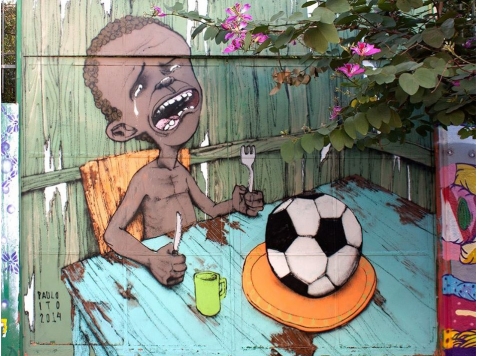
3. Seven Goals For Brazil (Through Street Art)

paulo_ito_0

Street art by Brazilian artist Paulo Ito on the entrance of a public schoolhouse in Sao Paulo. Image via the artist’s Facebook page.

Check the link for more. Also courtesy of Mark’s Facebook.

4. 20 Great Existential Films You Need To Watch

Akira Kurosawa and Ingmar Bergman had to be on the list, but I don’t know Ikiru and Shame. Through a Glass Darkly is one of my favourite Bergman films.

I missed Alain Resnais’ Last Year at Marienbad and perhaps Wim Wenders’ Wings of Desire

Others?

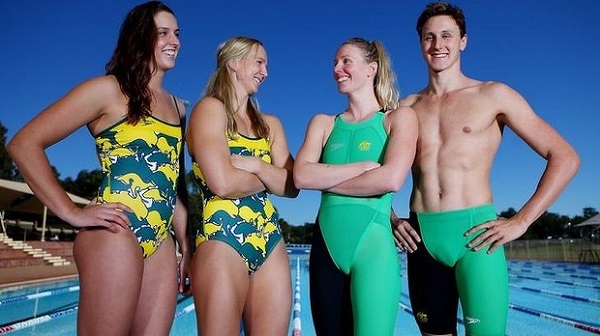
5. Commonwealth Games swimming uniforms

Surely this is a joke!

Swimming costumes_1404430855245.jpg-600

What do you think?

6. Palmer blows up budget

Clive Palmer has blown a fresh $9 billion hole in the Abbott government’s budget by torpedoing Coalition plans to abolish the Schoolkids Bonus, the low-income superannuation contribution scheme and a bonus for welfare recipients.

That’s nothing, Hockey is accusing Bill Shorten is of blocking $40bn of savings.

The Conversation has an explainer. Should be fun!

State of Origin: Blues triumph

Congratulations must go to NSW for their series victory in the second State of Origin. There’s a shorter account at Wikipedia.

608667-7df1d848-f846-11e3-9227-d59f5c5d579b_500

The match scores at 6-4 were close. The game statistics showed NSW edging Qld in most categories, except that penalties favoured the Blues 9-5 and missed tackles favoured them 29-13.

Experienced players have said that the series is the toughest they have played in. The injury carnage has been severe, with 15 players going down.

I’m not sure why the referees got the sack, except that it is what the NSW camp called for. I thought some penalties should have been blown early for extra work in the ruck. My maroon eyes saw two NSW high shots that were let go in the first 10 minutes. They probably were not sacked because they got the Thaiday no-try wrong.

Wrong? Yes, wrong.

From former referee and referee boss Bill Harrigan:

“On the Sam Thaiday incident, well … it’s a try,” Harrigan told Triple M on Friday night.

“I know people are saying he (Hayne) didn’t play at the ball — of course he played at the ball.

“He knocked it out of Thaiday’s hand. It means the ball is ‘live’, it’s not a knock-on, not a loose carry.

“If he didn’t touch the ball, Sam has it in his (arm) and he scores a try.”

Mal Meninga:

“I thought Sam’s was a try, seriously,” he said.

“He was stripped and here we go, whether he knocked the ball on … it was a strip.

“In Origin that can make a difference but we won’t offer any excuses.”

If Thaiday scores NSW have to score twice. Unlikely. They scored once, courtesy of us with poor discipline giving them five consecutive sets at the line.

The dead tree version of the Courier mail showed Hayne dislodging the ball from Thaiday’s grasp with a clenched fist punch as he threw his arm around.

Them’s the breaks and we have to suck it up.

The press gives the impression that the players hate each other, but there seems to be a lot of respect, as Reynolds showed when he told Thurston “I look up to you, man.”

Channel 9 won the night which was a ratings record.

For the third it should be a dry track so with the help of the referees we can hope for a bit more football.

Saturday salon 5/7

voltaire_230

An open thread where, at your leisure, you can discuss anything you like, well, within reason and the Comments Policy. Include here news and views, plus any notable personal experiences from the week and the weekend.

For climate topics please use the most recent Climate clippings.

The gentleman in the image is Voltaire, who for a time graced the court of Frederick II of Prussia, known as Frederick the Great. King Fred loved to talk about the universe and everything at the end of a day’s work. He also used the salons of Berlin to get feedback in the development of public policy.

Fred would only talk in French; he regarded German as barbaric. Here we’ll use English.

The thread will be a stoush-free zone. The Comments Policy says:

The aim [of this site] is to provide a venue for people to contribute and to engage in a civil and respectful manner.

Here are a few bits and pieces that came to my attention last week.

1. ALP (57.5%) increases lead over L-NP (42.5%)

From Roy Morgan:

If a Federal Election were held today the ALP would win in a landslide (57.5%, up 2%) cf. L-NP (42.5%, down 2%) on a two-party preferred basis according to today’s multi-mode Morgan Poll conducted the last two weekends – June 21/22 & 28/29, 2014.

Morgan has the ALP primary vote at 36.5% and the LNP at 35%.

The Greens support is 12% (unchanged), support for the Palmer United Party (PUP) is 7% (up 1.5%) and support for Independents/Others is 9.5% (up 1.5%). PUP polled 13% in Qld.

2. Abbott falls further behind Shorten in latest Newspoll

Here’s the poll.

Shorten leads Abbott 44 to 34 as preferred prime minister.

Labor leads 55-45 TPP up from 53-47.

… the Coalition would attract 35% of the primary vote if an election were held now, compared with 37% for Labor, 13% for the Greens, and 15% for others.

3. First World War centenary

It seems we could be celebrating this one for the next four years.

Radio National has a series of special broadcasts.

Quiggin reckons we’ve learnt nothing and have been fighting ever since.

Kelly Higgins-Devine looked at some big battles held in July, mostly in Europe.

4. Battle of Leipzig

Did you know that the battle of Leipzig in 1813 which ended the Napoleonic Wars as such involved over 600,000 soldiers, making it the largest battle in Europe prior to World War I.

The French had around 160,000 soldiers along with 700 guns plus 15,000 Poles, 10,000 Italians, and 40,000 Germans belonging to the Confederation of the Rhine, totaling to 225,000 troops on the Napoleonic side. The coalition had some 380,000 troops[2] along with 1,500 guns, consisting of 145,000 Russians, 110,000 Austrians and Hungarians, 90,000 Prussians, and 30,000 Swedes. This made Leipzig the largest battle of the Napoleonic wars, surpassing all of the wars’ past battles of Borodino, Wagram, Jena and Auerstadt, Ulm and Dresden.

Bigger also than Waterloo.

Casualties on both sides were astoundingly high; estimates range from 80,000 to 110,000 total killed, wounded or missing. Napoleon lost about 45,000 killed and wounded.

Out of a total force of 430,000, the Allies suffered approximately 54,000 casualties. Schwarzenberg’s Bohemian Army lost 34,000, Blücher’s Silesian Army lost 12,000, while Bernadotte’s Army of the North and Bennigsen’s Army of Poland lost about 4,000 each.

There is every possibility that my ancestors would have fought in the battle. It was only 35 years later that my great grandfather left Silesia. Memories of the napoleonic wars would have still been very alive, and perhaps a reason for departing to safer climes after the revolutions of 1848.

From memory, the Prussian population was depleted by about 11% during the Napoleonic wars.

5. What you don’t want to read

I already knew that visitors to this site read climate posts in fewer than half the numbers reading political posts.

This week I found out that most people really don’t want to read about Gillard and Rudd any more.