
There are lots of good health, environmental and economic reasons for using bikes as replacement for other forms of transport and recreation. However, on average, your chances of being killed or injured are much higher when riding a bike than travelling by car. This post looks at some of the advantages and disadvantages of riding a bike instead of travelling by car. Continue reading Parking Spaces to Protected Bike Lanes
Category Archives: Sundries
Posts on sundry matters of life the universe and everything: Culture, Environment, Life, Politics & Government, Science, Social Science and Society, Technology etc.
Trading away our rights and freedoms
John Quiggin has written about the Trans-Pacific Partnership (TPP) trade talks (article here, plus commentary at his blog).
This is meant to be a link post, but knowing how lazy people are with links I’ll highlight a few points here with a few comments of my own.
So far the negotiations involve twelve countries: Australia, Brunei, Canada, Chile, Japan, Malaysia, Mexico, New Zealand, Peru, Singapore, the United States, and Vietnam. Potential members include India and Indonesia. China, not so far but perhaps eventually.
Quiggin says that apart from agricultural products tariffs, quotas and other restrictions on trade have largely disappeared in our region. The TPP represents the emergence of “new generation” agreements. At the core of these agreements lie investor-state relations where a transnational corporation can sue a government for damaging its commercial interests by passing laws the detract from the corporations profits. Investor-state disputes are settled by a trade panel, usually three lawyers. Their rulings stand and are not appeallable in any court of law. Concerns include the environment, human rights protection, public welfare regulation, and health effects. Any law found u in the dispute ruling to inhibit a corporation’s profits is simply set aside.
For an overview, see AFTINET’s pamphlet and links at the end. For example, under the North American Free Trade Agreement (NAFTA):
Currently, the US Lone Pine energy company is using ISDS [Investor-State Dispute Settlement] provisions in NAFTA to sue the provincial government of Quebec for $250 million because it suspended shale gas mining pending an environmental study in response to community concerns.
Quiggin didn’t mention this, but the precautionary principle doesn’t apply. Under NAFTA a product must be proven to cause harm before it can be restricted. Any law based on the precautionary principle could be set aside in a dispute.
It’s beyond the imagination to think that the Americans would agree to labelling GM foods in the TPP.
The new generation agreements also have intellectual property components, which enhance the rights of corporations beyond what would be commonly thought reasonable.
Investor-state relations and intellectual property are being used already by Philip Morris and Big Tobacco in an attempt set aside Australian tobacco labelling laws. Philip Morris, for example, has incorporated in Hong Kong to bring a case under investor-state provisions we signed up to way back in 1993. If successful under trade dispute provisions a 6-1 High Court decision supporting the labelling regulations would be set aside.
Politically there has been strong bi-partisanship in Australia under the banner “free trade is good” since Latham and Conroy went to water over the US Free Trade Agreement in 2004. Hence recent agreements have been seen an an unmitigated good. Quiggin points out that one way of concluding agreements quickly, as Robb has done, is to concede the other party’s demands.
In the case of the agreement with Japan, for example, Australia secured some modest concessions regarding tariffs on beef, which will be reduced from 38.5 per cent to 19 per cent over a period of fifteen years. In return, our government accepted the total exclusion of rice from the deal, and the maintenance of most restrictions on dairy products.
The Korean agreement, KAFTA, was arguably even worse. Reversing our previous position, the government agreed to the inclusion of investor–state dispute provisions. This was apparently done not in response to Korean demands but because US negotiators were pushing the provision in the parallel negotiations for the TPP.
Negotiations are going on in secret, but sections revealed through Wikileaks give cause for alarm. In the end:
It seems certain that the final agreement will involve a substantial loss of Australian sovereignty and an acceptance of economically damaging intellectual property rules. In return, Australia will receive marginal and long-drawn-out improvements in market access for agricultural commodities. While a Labor government might perhaps have held out for a better deal, it seems unlikely that the opposition will reject legislation implementing the agreement.
Quiggin is right, I think, when he says:
The new generation agreements are primarily about imposing a particular model of global capitalism, with the United States as the model and multinational corporations as the main engines of economic activity.
Back in 1999 massive protests disrupted the ministerial meeting of the World Trade Organisation in the ‘Battle in Seattle’. The WTO countered by holding the next meeting in Doha in 2001, where protester access was impossible, and promoting it as the “development round” ostensibly to meet developing country concerns. Against developing country resistance “New Issues” including investor-state relations, were forced onto the agenda. See the Road to Cancun section of my Webdiary piece Reaching for the Moon: how the poor lost and won at Cancun.
The so-called “New Issues” stemmed from a special WTO meeting in Singapore back in 1996 and included investor-state relations, which were pursued under the infamous and controversial MAI (Multilateral Agreement on Investment) under the aegis of the OECD until they were defeated in 1998.
At Cancun although investment was taken off the table during the meeting, some of the New Issues remained. However, through Japanese and Korean stubbornness and developing country resistance the talks collapsed. Attempts were made to revive the Doha round, but Quiggin says here that it finally broke down in 2008. Since then the US and other free trade advocates have been pursuing their ends through bilateral and regional agreements.
There were protests at Cancun, although the site was a peninsula which was blocked off. A South Korean farmer, Lee Kyung-Hai, famously committed suicide, apparently unable to compete with cheap Australian beef.
Since then there has been little protest and little public discussion in spite of the efforts of AFTINET, Getup and Choice.
Behind closed doors trade negotiators are determining the kind of society in which we will live, and we are letting them do it.
Ironically our best chance is a US Congress stalemate. Not good enough.
Maharishi Mahesh Yogi – cultist, guru or con-artist?
Perhaps all three, in some measure.
In quoting an open letter on anti GM technology co-ordinated by Steven Druker I ended up being called an anti-science troll:
Good God. Steve Druker is the executive vice president of the Maharishi Institute. The Maharishi Institute is of course an Indian mystic cult movement that teaches yogic flying. Clearly you are an anti-science troll and not worth bothering with.
Clearly I should have Googled Druker and the appellation Executive Director, Alliance for Bio-Integrity should perhaps have triggered alarm bells. But then association with Maharishi Mahesh Yogi would not have caused great concern, because I had a mental impression of him that goes back decades.
Time for a bit of investigation and reflection.
Until Sunday I was not aware that Mahesh (to leave off the honorifics) was into yogic flying and the Natural Law Party. Probably about 35 years ago I knew people who had taken the Transcendental Meditation (TM) course and found it personally helpful. There was no brainwashing or ideological lode. There was no cultic aspect in the sense of being members of a group. You paid your money, took the course and walked away.
Later my wife and I attended yoga classes with the Yoga Education Centre, as it then was, in Brisbane. It was hatha yoga, concerned with physical well-being, but it involved several meditation techniques, but not TM. These helped us relax, become poised, centred, and able to deal more effectively with the personal, social and work environment. I think it made both of us easier to live with. There was no readily identifiable ideological content.
One exercise, for example, was called “quietening the mind”. You sat still with eyes closed and as thoughts appeared you saw them out the door. Effectively you emptied your mind. Difficult to do, because the mind is very restless.
In another, called “listening to sounds”, you simply listened to sounds in the ambient environment but did not name them, identify them, associate them with a source or think about them in any way.
We found that the positive effects took some months to appear. I formed the opinion that Mahesh had found one technique that gave early results, as the Western market tends to demand, but was perhaps less valuable in the long run. I can’t be sure because I have not done the course.
One effect of meditation practice was to clear away emotional clutter and make the functioning of calm reason more efficacious.
Our own yogic practice fell apart when we had a child, just on 28 years ago, and we’ve been somewhat off-balance ever since. Later as part of my heart surgery recovery I took an 8-week course on yoga run by the head nurse of the then psychiatric ward of the Wesley Hospital. I looked around for yoga classes, found amazing differences in the styles of yoga offered, but found none that attracted me.
More recently I’ve posted on the concept of emotional style. After 30 years of patient research Richard Davidson has charted the emotional life of the brain and what happens when we meditate. There is no reference to Transcendental Meditation in the index. And that reflects what I think of TM as I know it – of minor importance and basically harmless, does some good in some instances. According to reports, such research as exists is said to be of poor quality but tends not to show significant health benefits.
Incidentally Davidson talks about the massive prejudice there is against terms like “yoga” and “meditation”. He had to use other labels to get research funding.
The Wikipedia article on Mahesh says:
In the late 1970s, he started the TM-Sidhi programme that claimed to offer practitioners the ability to levitate and to create world peace.
With that step he clearly becomes ideological.
I can’t find much on TM-Sidhi, but the Wikipedia article on levitation says this:
The Transcendental Meditation movement claims that practitioners of the TM-Sidhi program of Maharishi Mahesh Yogi achieve what they call “Yogic Flying”. They say that there are three stages of Yogic Flying – hopping, floating, and flying – and that they have so far achieved just the first stage. Transcendental meditation groups have held annual “Yogic Flying Contests” to see who could hop the farthest or the fastest. Proponents say the hopping occurs spontaneously with no effort while skeptics say there is no levitation and they are using their thighs to bounce in the lotus position.
At best, self-deluded, but in any case ridiculous.
Then in 1992 Mahesh founded the Natural Law Party. It seems he always had an ambition to change the world to operate on principles of ancient Vedic science. In order to do his he chose to become direct and political. It’s a free country but I suspect the politics is going nowhere.
So far, however, I’ve seen nothing to suggest that the movement is anti-democratic. The term “cult” is problematic, so you take you pick. It’s a derogatory term which in this case has some warrant.
In my memory banks I have traces of Mahesh having a poor attitude to women. FWIW this was confirmed at the beginning of this YouTube which is very negative about his life and work and carries a Christian message at the end.
One thing is for sure, he made mountains of money.
Saturday salon 11/4 (late edition)
An open thread where, at your leisure, you can discuss anything you like, well, within reason and the Comments Policy. Include here news and views, plus any notable personal experiences from the week and the weekend.
For climate topics please use the most recent Climate clippings.
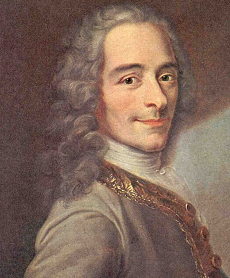
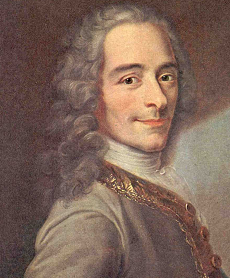
The gentleman in the image is Voltaire, who for a time graced the court of Frederick II of Prussia, known as Frederick the Great. King Fred loved to talk about the universe and everything at the end of a day’s work. He also used the salons of Berlin to get feedback in the development of public policy.
Fred would only talk in French; he regarded German as barbaric. Here we’ll use English.
The thread will be a stoush-free zone. The Comments Policy says:
The aim [of this site] is to provide a venue for people to contribute and to engage in a civil and respectful manner.
Here are a few bits and pieces that came to my attention last week.
1. Richie Benaud passes on
The ABC puts it well:
Cricket icon Richie Benaud, who distinguished himself first as a leg-spinning all-rounder, then as a daring Australian Test captain and later as the ‘voice of cricket’ in the commentary box, has died at the age of 84.
Benaud’s skills, drive and determination took him to the top on and off the cricket field, and made him one of Australia’s most recognised people, instantly identifiable simply as Richie.
He played 63 Tests for Australia, was the first player to score 2,000 Test runs and take 200 Test wickets, and never lost a series as Australian captain.
After hanging up his Baggy Green cap, he spent more than four decades as the king of cricket commentators, a man viewed around the world as one of the best callers, watchers and analysts of the game – and perhaps its best ambassador as well.
While acknowledging his record I’d rate him as a top-flight bowler who was a handy batsman rather than a genuine all-rounder, who would be selected for his batting and his bowling absent the other. Genuine all-rounders are rare. I can think of Garfield Sobers, Keith Miller and Ian Botham, also Adam Gilchrist in a sense.
Benaud, I think, gave some respectability to the Packer circus and was apparently quite influential in giving advice.
2. Opinion polls
In Great Britain Ed Miliband overtakes David Cameron in approval ratings, as Labour pulls ahead in the polls.
Here in Oz Newspoll studied quarterly trends with a larger than usual sample. The headlines and much of the reporting was about Abbott’s poor performance in WA. You had to dig to find the national TPP poll which had Labor ahead 55-45. Also:
Opposition Leader Bill Shorten leads Mr Abbott 44-34 as preferred prime minister.
He is now ranked as better prime minister in all states for the first time.
Roy Morgan now has Labor ahead 53-47 and as does the Essential Report.
If this keeps up Labor could lose the election, because they’ll give Abbott the flick and put in Julie or Malcolm.
Australia’s imprisonment rate at 186 per 100,000 is historically high and getting higher. Moreover:
In contrast to most other developed countries, this rate is palpably high. The rate in Canada is 118 per 100,000. The incarceration rate in Australia is nearly three times higher than in Scandinavian countries.
Standing apart from these trends is the world’s greatest incarcerator, the United States, which imprisons more than 700 people per 100,000 – an increase of more than 400% in three decades.
It’s costing us a pile of money – we spend $A80,000 per prisoner per year compared to $A30,000 in the US. This wouldn’t be so bad if it worked, but it doesn’t:
Sentencing is the area of law where there remains the biggest gap between what science tells us can be achieved through a social institution (criminal punishment) and what we actually do.
In fact
our prisons [are] where the greatest number of human rights infractions occur.
The solution?
The start and endpoint to the solution is to confine jails (almost exclusively) to those we have reason to be scared of: sexual and violent offenders.
Thanks to John D for bringing this article to my attention.
4. Keep an eye on Greece – something unusual is happening
James Galbraith has been to Greece to consult on their problems and reported in an amazing speech to the European Trade Union Institute.
So as these manoeuvres, as I call them, mature, there emerges an interesting possibility. And that is the possibility of a politically stable, anti-austerity government in Europe, led, as I think you probably have observed, by forceful personalities, and presiding over an economy which is so far down that it has no place to go but up. And that may well be, within a short period of time, on a track of some recovery, some improvement in jobs performance and stabilisation of its external debt situation.
This would be in the wake of a crisis that was brought on by the neoliberal financial policies of the early part of the 2000s. Which was then aggravated and prolonged by the austerity ideology that succeeded the crisis, by the profoundly counterproductive policies with which Europe has reacted to the crisis. And so the possibility that an anti-austerity government might lead the beginning of a recovery from the austerity regime is, I think, a present reality and it is, of course, a nightmare in certain quarters.
Finance Minister Yanis Varoufakis and Prime Minister Alexis Tsipras have faced a wall of grief and pain from a hostile media and European finance authorities. If they prevail it will be because in the end Angela Merkel is pragmatic rather than doctrinaire. The stakes are high:
It goes beyond that to the future of Europe and beyond that, to the meaning of the word democracy in our time.
If you have a spare hour, Yanis Varoufakis talks with Joe Stiglitz. I haven’t yet had time for more than the first half hour.

Where to with tax?
Since John Davidson posted the Greens’ ideas on tax there has been a lively debate. Here I give some links to views I have found interesting.
John Quiggin has started his own tax policy review Rethinking tax policy for Australia, a work in progress with a proposal so far to tax the “immensely profitable” banks to the tune of $5 to 10 billion.
Quiggin’s Guardian article is essential reading. Amongst the points he makes:
- The review itself is poor quality, adding little to the thinking of the Asprey Review of 1975. There are major omissions.
- The government is hoping for an increase in the GST, achieved through some combination of higher rates and the elimination of exemptions. This isn’t going to happen.
- “The fallback position, on which bipartisan agreement looks feasible, is a scaling back of the massive tax expenditures on superannuation. If that is the only outcome of Re:think, the exercise will have been a worthwhile one.”
Ben Eltham at New Matilda points out “reform” has become a dirty word. With this government it has come to mean mostly policies that are deeply regressive and unpopular. The government discussion paper on tax:
is the latest front in the Coalition’s neoliberal war on working Australians. It will fail for the same reasons the “reforms” to health and education failed: voters don’t want reform. They want high-quality public services, affordable housing, and a good job. They know companies aren’t paying their fair share, and they want them to pay more.
When will the government and business spinmeisters learn that “reform” is a massive turnoff for voters?
Clearly we need to pay more tax. The government’s way around this problem is to increase the GST. Peter Martin says that we should concentrate on captive sources of revenue:
The trick is to grab more of the money that’s bolted down and unable to leave the country, and less of the money that’s footloose. It’s anything but fair, but tax is about raising revenue more than it is about fairness, and we can’t raise revenue we frighten away.
So that means eliminating dividend imputation for shareholders, taxing superannuation and taxing people for owning property rather than buying it.
Don’t worry about the Googles, Microsofts and Apples. They’ll gravitate to the cheapest tax haven they can find.
Martin reckons that is we knock off dividend imputation the company tax could be reduced to 19 or even 15%. In any case it’s trending to zero.
Ian McAuley at New Matilda has a perceptive piece. He says:
Australia does need tax reform. There is even a case for increasing the rate and extent of the GST, but only if it is part of a comprehensive package aimed at collecting more revenue and making the whole system fairer.
But when tax reform is in the context of revenue neutrality, or even a reduction in overall taxes, and the message is that corporations should pay less tax while consumers pay more, the proposals are politically dead in the water.
McAuley is also not impressed with the notion that companies should pay less.
The regular World Economic Forum Global Competitiveness Reports tend to show that business tax concessions are the inducement of last resort, offered by countries with low education standards, poor infrastructure and unstable government.
Perhaps Hockey’s push for lower corporate taxes is in realisation that Australia is becoming that type of economy.
So to sum up, the Government’s main strategy seems to be to hold Commonwealth taxes to current levels, or less, but to shove off responsibility to the states for hospitals and schools necessitating an increase in the GST
However, they say that a change to the GST needs to be bipartisan. Labor sees it as highly regressive and won’t have a bar of it. Similarly the LNP won’t go near a price on carbon or a mining tax. There does seem to be some consensus now that super has to be part of the equation. In itself it’s unlikely to be sufficient.
What the exercise does do is to put the wood on both major parties to come up with proposals to take to the next election that are coherent, understandable and make a difference.
Science battles for recognition in Canberra

Generally speaking the Abbott government lacks recognition of science, to the point where its stance can be characterised as anti-science. That is certainly the case in climate science, but can be seen in many other ways, not least in the use of science infrastructure funding as a pawn in the political wars over how university teaching should be funded. Certainly too, the Abbott government lacks an appreciation of the contribution science and mathematics can make to transitioning out of our dependence on mining and other product exports in the economy.
In this context the Chief Scientist and the Australian Academy of Science commissioned a report The Importance of Advanced Physical and Mathematical Sciences to the Australian Economy. The report was produced by the Centre for International Economics (CIE).
The aim has been to produce an economic framework that can use the available statistics and economic modelling techniques to provide a timely reminder of how much of our national economic activity depends on the advanced physical and mathematical sciences (the APM sciences). The APM sciences comprise physics, chemistry, the earth sciences and the mathematical sciences, where ‘advanced’ means science undertaken and applied in the past 20 years. Biology and the life sciences were not covered in the report.
The direct contribution of the APM sciences is estimated to be 11% (or about $145 billion per year of the Australian economy). The contribution in additional and flow-on benefits equals another 11%, bringing the total benefits to 22% or around $292 billion per year.
This exercise was not helped by Age journalist Gareth Hutchens with an article entitled Australia’s scientists forced to rely on pseudo-science to be taken seriously in Canberra starting with:
It’s a shame that scientists have to stoop so low.
Climate scientist Roger Jones defended the report and its progenitors in a blog post.
We can all agree, Hutchens included, that it is a disgrace that such a report should be felt necessary for science to be taken seriously by those govern and plan for our future. There should be no need for a “timely reminder”; our leaders should have science and knowledge-based industries front and centre in their thinking. But to dump on the report in the way Hutchens does is in my view inflammatory, derogatory and misleading in that it gives the impression that the exercise was worthless. What Hutchens calls “guesses” were in fact informed estimates by the most knowledgeable people available.
In large part Hutchens is entering with hob-nailed boots the old argument of how much science there is in economics. I don’t know enough science or economics to usefully contribute, but Hutchens own account of the methodology used suggests a disciplined and rational approach.

Can we survive without chickens?
Chickens, or more accurately Gallus domesticus (I call them chooks), are everywhere – just about. Andrew Lawler contemplates A world without chickens (paywalled).
The short answer is that we’d struggle to survive.
There are 22 billion chooks in the world. They supply almost 100 million tonnes of meat each year, close to a third of all the meat we eat. In addition we gobble down over one trillion eggs every year.
Apart from that the world uses 400 million doses of flu vaccine each year. The serum is reproduced in fertilised chook eggs. It is estimated that without the vaccine 50,000 more Americans would die each year.
Replacing chicken with beef would require eight times as much feed and ten times the land – more than India and China combined. Or we could double the number of pigs. Pigs require only 14% more feed to produce the same amount of meat.
No other bird will do. Neither ducks nor turkeys produce meat or eggs as efficiently as chooks. Ducks need water. And they are not as adaptable. “You don’t find ducks in semi-desert subsisting on vermin” says one expert.
Lamb produces over five times as much greenhouse gas as chicken, beef nearly four times. Turning to pork would increase greenhouse gases by 75% for the same meat. But switching to beans would reduce emissions to less than a third.
Chicken generally is becoming more popular. As recently as 1950 Americans ate twice as much red meat as chicken. Today that situation is reversed. In China chicken is about to surpass pork in popularity.
Chooks have been around for a long time. Lawler says:
Some 3000 years ago, Polynesians took chickens with them on their expeditions to settle Pacific islands, using their bones to make sewing needles, tattooing implements and even musical instruments. Ancient Greeks considered the bird sacred to their god of healing, and believed its parts could cure illnesses ranging from burns to bed-wetting. Roman generals kept a flock of chickens on hand before battles for military advice. If the sacred birds ate heartily before the conflict began, then the generals could expect victory; if they turned up their beaks, then best to retreat. And cockfighting is probably the oldest spectator sport after boxing.
Lawler reports that Darwin spent a good deal of time and money studying the bird.
Darwin deduced that all varieties of domestic chicken descended from the red jungle fowl, a shy and elusive pheasant that lives across south Asia and parts of China, and is adapted to a variety of habitats. His conclusions were confirmed in 2004, when the bird’s genome was sequenced.
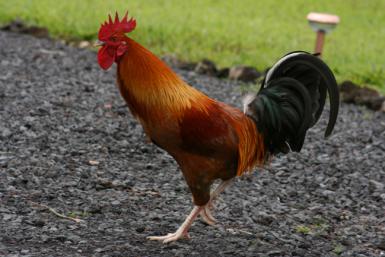
This source suggests that first domestication may have occurred in Thailand 8,000 years ago, or perhaps there were multiple origins in distinct areas of South and Southeast Asia, including North and South China, Thailand, Burma and India. The above photo shows a red junglefowl (Gallus gallus).
Domesticated chickens appear at Mohenjo-Daro in the Indus Valley by about 2000 BC and, from there the chicken spread into Europe and Africa.
The Spanish conquistadors brought chickens to the Americas, but “presumably pre-Columbian chickens have been identified at several sites throughout the Americas, most notably at the site of El Arenal-1 in Chile, ca 1350 AD.”
In modern times we treat chooks abominably, by and large. They have short and miserable lives and are often consumed in ways that are not particularly good for us.
There still seems to be some confusion about what such terms as “free range” and “organic” mean. If memory serves, I heard discussion on the radio about ‘free range’ being claimed where stocking density was up to 25,000 birds per hectare. This 2011 article claims that in Australia there is no single standard for organic or free range products and anyone can use those terms. Here is a sustainable table for free range chickens and eggs.
Yuval Harari, though gloomy about the future of Homo Sapiens, suggests that animal rights are going to be much more topical in the coming century. I hope he’s right. So-called ‘free’ trade agreements tend to produce the lowest common denominator. In the US free range regulations currently indicate only that the animal has been allowed access to the outside. Regulations “do not specify the quality or size of the outside range nor the duration of time an animal must have access to the outside.”
Europe has a formal standard whereby single eggs must be individually marked with a number to indicate one of four categories: Organic (ecological), Free Range, Barn, or Cages. Stocking density is limited to 2500 hens per hectare or one hen per 4m2. Britain has the largest free range flock, but standards are not always followed in practice.
Some retailers – such as Waitrose, Sainsbury’s, the Co-op and Marks & Spencer – no longer sell eggs from cage birds.
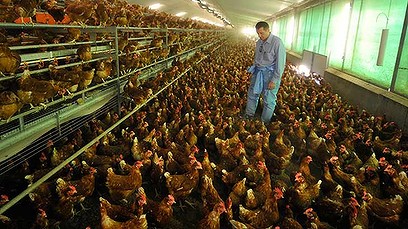
The article points out that under EU regulations free range allows up to nine hens to be crammed into every square metre of floor space when in the shed.
FWIW this post states that Coles in Australia accept 10,000 birds per hectare under their “free range” label. This photo is said to be from a Coles free range shed:
Finally, being Easter I’ll mention that when I was very young growing up in a settlement of German farmers there was no such thing as an Easter bunny or candy and chocolate Easter eggs. We had boiled eggs with coloured dye on the shells, fondly remembered.
Saturday salon 4/4
An open thread where, at your leisure, you can discuss anything you like, well, within reason and the Comments Policy. Include here news and views, plus any notable personal experiences from the week and the weekend.
For climate topics please use the most recent Climate clippings.
The gentleman in the image is Voltaire, who for a time graced the court of Frederick II of Prussia, known as Frederick the Great. King Fred loved to talk about the universe and everything at the end of a day’s work. He also used the salons of Berlin to get feedback in the development of public policy.
Fred would only talk in French; he regarded German as barbaric. Here we’ll use English.
The thread will be a stoush-free zone. The Comments Policy says:
The aim [of this site] is to provide a venue for people to contribute and to engage in a civil and respectful manner.
Here are a few bits and pieces that came to my attention last week.
1. Birthdays!
Three birthdays to mention.
Larvatus Prodeo was born at Easter 2005, so would be 10 years old if still alive. I started blogging there about three months later.
Secondly, I turned 75 just over a week ago.
I usually don’t make a fuss over birthdays, reasoning that I’m just one day older than the day before. So every day is new. My cardiologist is very happy with me, and I can tell you that since my triple bypass in 2000 he’s the main man!
Third, Climate Plus was born a year ago tomorrow. Some 318 posts later we are still here. It has been an experience – some surprises, some disappointments.
For the foreseeable future I plan to carry on. Political posts are more than twice as popular as climate posts, but our main reason for being here is climate. My aim is to keep the lay reader abreast of important developments in a brief and digestible form.
Feedback is more than welcome.
2. Vale Betty Churcher (1931-2015)
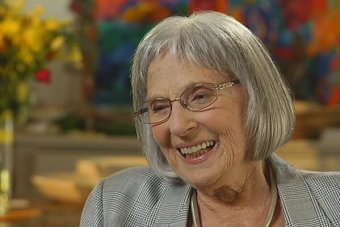
Betty Churcher died during the week, aged 1984. As an artist, as a teacher, as an arts administrator, and as a human being she excelled and attracted nothing but praise.
As a woman she had several firsts, most notably in 1990 she became the first woman at the helm of the National Gallery of Australia, where she was director for 7 years.
While there she earned the nickname “Betty Blockbuster” for presiding over 12 international blockbuster exhibitions, which in turn led to a corresponding growth in the gallery’s attendance numbers and revenue. She also initiated the construction of new galleries for large-scale temporary exhibitions, gave the gallery its current name after dropping “Australian National Gallery” and acquired Arthur Streeton’s Golden Summer, Eaglemont, 1889, for $3.5 million.
Image courtesy of the ABC.
3. Selling ugly produce at low prices
Every year Canadians waste some 40% of their food. A large part of the problem is that “ugly” food, misshapen or marked, is thrown out. Now one large retailer is selling this food at a discount in Ontario and Quebec.
Should happen here.
4. UK elections
The UK election campaign started in earnest. Here’s a prediction of the outcome.
According to that it could be a coalition of Labour, the Scottish National Party and what’s left of the Liberal Democrats.
Ed Miliband seems to have come through the leaders debate OK.
5. Jacqui Lambie starts her own party
Jacqui Lambie has applied to register The Jacqui Lambie Network as a political party.
She’s also got something else to think about.
A PUP statement released on Wednesday threatened to spend up to $3 million on legal fees in a bid to recover $2 million and $7 million from Senator Lambie and Senator Lazarus respectively.
Senator Glenn Lazarus quit the Palmer United Party earlier this year.
Senator Glenn Lazarus quit the Palmer United Party earlier this year.
PUP claims those are the amounts spent helping Senator Lazarus and Lambie get elected under the party’s banner at the 2013 election.
AdvertisementBoth senators have since abandoned PUP and are now sitting as independents.
Lambie says he promised not to sue.
6. Goodnight Goodluck Jonathon
President-elect of Nigeria Muhammadu Buhari told CNN’s Christiane Amanpour that he plans to aggressively fight corruption that has long plagued Nigeria and go after the root of the nation’s unrest.
For the first time in Nigeria’s history, the opposition defeated the ruling party in democratic elections.
Buhari defeated incumbent Goodluck Jonathan by about 2 million votes, according to Nigeria’s Independent National Electoral Commission.
The win comes after a long history of military rule, coups and botched attempts at democracy in Africa’s most populous nation.
Jonathon’s main contribution seemed to be making many billions of oil revenue due to the state magically disappear.
How humans and their dogs drove Neanderthals to extinction
Well strictly speaking Neanderthals are humans too, so for “humans” read Homo Sapiens, that is us.

I intended to write a post on taxation policy, but then I heard Phillip Adams’ segment Dogs: not the Neanderthals best friend, an interview with retired anthropologist Pat Shipman on her hypothesis that the domestication wolf-dogs gave us the critical edge to out-compete the Neanderthals. It reminded me of an article by Shipman in the New Scientist. If that’s paywalled there is an excellent exposition of her ideas by Steve Donoghue at Open Letters Monthly.
Anyway Sapiens vs Neanderthalensis won out over tax policy.
Shipman uses the example of Yellowstone National Park to demonstrate the effect a top predator can have on a whole ecosystem.
Though wolves were integral to that ecosystem for millennia, they were wiped out there by settlers by about 1920. The effects of removing the wolf were striking. Coyotes formed larger, more wolf-like packs, while elk populations soared, changing the vegetation close to rivers by eating young trees and shrubs. Pronghorn antelope populations dropped as more coyotes preyed on their offspring; beavers disappeared from the park and songbirds declined in number.
Then:
Reintroducing just 31 wolves in the mid-1950s transformed the ecosystem again. Wolves targeted their closest competitor, killing coyotes in confrontations over carcasses and consuming enough prey to hinder their survival. Coyotes avoided areas favoured by wolves and shifted to smaller prey. Coyote packs fragmented and their overall population declined sharply. More pronghorns survived; elk herds diminished; and riverine vegetation came back, encouraging the return of beavers and songbirds.
Neanderthals survived for about 250,000 years in an environment that presented challenges. Donoghue describes it thus:
Their populations had endured sweeping climate changes over the centuries, and they shared their landscape with animals as monstrous as anything the world had seen since the dinosaurs: massive cave bears, saber-toothed tigers, lions bigger than any in Africa today, cave hyenas, huge woolly mammoths, woolly rhinoceri, wolves, leopards, roving packs of dholes – a world as fearsome and strange as something out of a science fiction novel.
A few thousand years after Sapiens arrived some 45,000 years ago, apart from wolves all these large animals were gone, and the Neanderthals with them.
Shipman says that the common belief was that the Neanderthals moved south to avoid the advancing ice, and lingered until 27,000 years ago. However, she says that modern dating technology shows no southward movement and no trace of Neanderthals after 39,000 years ago.
Sapiens had two big advantages. One was projectile technology to enable killing at a distance. The other was possibly the assistance of the domesticated wolf-dog. Dogs assisted Sapiens in hunting and acted as guards.
It seems likely that Sapiens did not tolerate the presence of Neanderthals in ‘their’ territory. It seems likely also that with projectile weapons Sapiens would win any direct confrontation. If the Neanderthals crept up at night, the dogs would likely smell them and sound the alarm.
The effect of dogs was to increase the ecological niche in which Sapiens could operate. For the Neanderthals there was simply no good place to go, so they were squeezed into areas where they could not support themselves in the longer term. In this, climate change was still certainly a factor.
Shipman says we are “natural invaders, the mammalian equivalent of Burmese pythons, cane toads and Asian carp.”
Shipman stresses that her hypothesis “still requires elaboration and testing.” Nevertheless it is certainly food for thought.
Shipman’s book on the topic is The Invaders: How Humans and Their Dogs Drove Neanderthals to Extinction.
You might also be interested in Neanderthals r us and Sex with Neanderthals was good for us from 2011. Seems like yesterday.
Genetic mapping of Britain
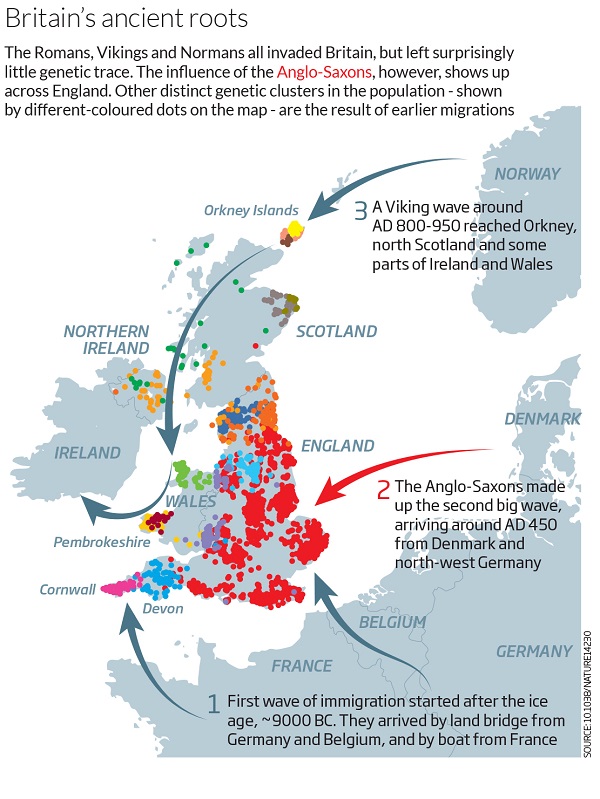
The Romans, came, they saw and they conquered. But they left no genetic imprint. The same goes for the Vikings and the Normans, with the exception of the Orkney Islands, which were Norwegian for 600 years. Nevertheless Viking DNA only accounts for 25% of today’s Orcadian DNA.
The New Scientist reports on DNA mapping undertaken of Britain’s Caucasian population. To qualify for sampling people had to have all four grandparents born within 80 kilometres of each other. So I guess there’d be a bias towards clustering, and clustering is what they got.
There were two main findings. First, the only invaders to leave a distinct genetic genetic footprint were the Anglo-Saxons in the east and the south, who arrived from AD 450. Still the DNA of earlier settlers dominates, with at least 60% deriving from earlier immigrants.
Secondly, there is considerable variety in the DNA of those earlier settlers, especially in the west and the north. In the south and the east the effect of the Romans was to dissolve somewhat the tribal clustering, partly through building roads.
The first immigrants arrived from about 9000 BC, as the ice melted, via land bridge from Belgium and Germany and by boat from France. The overall pattern is captured in this image:
The article does not mention language.
English, of course, is a Germanic language which came with the Anglo-Saxons. German as a language only developed from about 500-0 BC in what is now southern Scandinavia. The Germans emerged from the north onto the main European continent and beyond from about 0 AD. The Celts were already there. But the Celtic language only dates from about 1350-850 BC and appears to have arisen in central Europe. It’s part of the Indo-European family, which arose far away in the steppes north of the Black Sea, probably around 4000 to 3000 BC.
Quite obviously the early settlers of Britain spoke something else. But the Celtic language when it came took over to become the language of the masses. Whether this was a matter of sheer numbers, or cultural influence I don’t know. How this all came to be goes beyond my pathetic knowledge of ancient history.
Palaszczuk puts premiership on the line
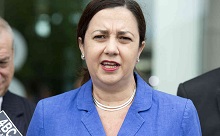
Annastacia Palaszczuk has put her premiership on the line by sacking Billy Gordon, the Member for Cook, from the ALP and asking him to resign his seat.
The state of the parties now is that the LNP has 42, the ALP 43, the Katter Party has two and there are two independents, Peter Wellington and Billy Gordon. To govern a party needs 45 votes, including the casting vote of the speaker, currently Peter Wellington.
To cut to the chase, Gordon is not legally obliged to resign, and I suspect he won’t. The Katter Party are in talks with Labor, as they “don’t want to be in the business of tearing down governments every six months or every year.”
The Katter Party:
wants Labor’s commitment on improving regional roads, water development, mandating ethanol in fuel and setting up a rural development bank.
This whole matter was raised by Geoff Henderson on the NSW election thread. For posterity I’ll attempt to outline the relevant information here.
The Brisbane Times link contains the full text of Gordon’s statement about his past. His record with the law is summarised at the ABC:
- Breaking and entering and stealing in 1987 in Innisfail
- Breaking and entering with intent, attempted breaking and entering and stealing in 1990 in Atherton
- Breach of probation in 1992 in Atherton
- Public nuisance in 1996 in Normanton and breach of bail conditions in 1999
- Driver licence suspended for unlicensed driving in 2004 and 2008
- Served with an Apprehended Violence Order in 2008 after a complaint by his mother.
I understand he also falsified tax returns to avoid paying child support. Furthermore on Friday Palaszczuk referred Gordon to police amid allegations he abused a former partner a decade ago.
Gordon has deceived the public, the ALP in pre-selection and Palaszczuk said he looked her in the eye and lied to her. He should resign from parliament.
However, his statement published in the Brisbane Times makes much of his underprivileged upbringing and his yearning for a “perfect father figure” when he got into trouble with the law as a teenager. I get the impression that he has forgiven himself much, and will do so again. His latest statement:
Mr Gordon, the member for Cook, said in a statement he was weighing up his options and needed time to seek further legal advice and discuss the matter with his family and supporters.
“I am very concerned that I should be afforded natural justice in any determination that my tenure as the Member for Cook should be terminated because of [the Premier’s] move to see me expelled from the Labor Party and her wish for me to resign as a Member of Parliament,” the statement said.
“The Premier has previously requested that the Police Commissioner investigate whether I have transgressed any law and that process should be allowed to continue its natural course.
“Any other attempt to remove me from the Parliament and force me to resign is a denial of natural justice.”
He said in the statement he had a “serious eye operation” on Monday.
Legally Professor Graeme Orr of Queensland University said Mr Gordon could only be forced to resign from Parliament if he served more than a year in jail.
A question has been raised as to whether Labor should accept Gordon’s vote. Personally I think this would only further disenfranchise the citizens of Cook.
Meanwhile the Katter Party are asking quite a lot of a cash-strapped government. The alternatives then are trying to govern as a minority government, or going to the people. Katter plus LNP does not add up without Wellington, and it is doubtful that he would give the LNP a go.
I understand that the LNP in post-polling analysis believe that dislike of Campbell Newman was worth about 7% to Labor. On that basis they would expect to win in a canter. Graham Young who has also done some polling believes that there was a significant “protest vote element” of people wanting to send the Newman government a message, but not wanting to elect Labor.
Update: Gordon holds Cook on a margin of more that 6%.

New South Wales election
The Morgan Poll has Mike Baird’s LNP a clear leader at 57.5-42.5 over the ALP, so an even race would be unexpected. If the win turns out to be 51-49 or even 52-48 questions will be asked about the influence of Abbott’s leadership travails, but that looks extremely unlikely.
Of interest will be whether the Greens can get themselves into second place in one or two of the northern seats and win on preferences.
Antony Green points out that there is a second election taking place, one that is crucial if the LNP is to proceed with it plan to privatise half the electricity distribution system. NSW of course has an upper house, the Legislative Council, where the LNP has only 19 of the 42 members. The ALP has 14 and the Greens 5, leaving the balance of power with the Christian Democrats (2) and the Shooters and Fishers(2).
After the LNP elects one member as president it has only 18 votes, hence has needed both minor parties to get the required 21 votes to pass legislation. An important sticking point is that Shooters and Fishers Party opposes the privatisation of electricity.
A term in the Legislative Council is eight years, so half the members face election each time. This time the LNP has 11 continuing members and 8 facing election. It needs to elect 9 to have the numbers to pass its privatisation legislation with the help of the Christian Democrats. Green reckons the LNP needs about 39% of the first preference vote to get 9 members elected. Morgan has them on 49% of the primary vote, so with the quota 4.55% it should be a cake walk. On that basis they could get 11, as they did last time. If so they’ll be home free without needing anyone else’s vote.
With 9 members elected the LNP would be in a situation where it could pass any legislation with the assistance of just one of the minor parties, assuming that both the Christian Democrats and the Shooters and Fishers elect one member each to add to their continuing single members. These minor parties typically need just 2 to 2.5% of first preference votes to achieve a quota of 4.55%. In 2011 Pauline Hanson failed on 2.5% because she attracted very few preferences.
Oddly other polls seem to favour the ALP less than Morgan. Essential has the LNP ahead only 53-47. Newspoll is on 55-45.
Altogether, though, it looks like a good news day for the LNP.
Elsewhere, Peter John Chen has a more comprehensive review of the election and the issues involved.