Category Archives: Sundries

Posts on sundry matters of life the universe and everything: Culture, Environment, Life, Politics & Government, Science, Social Science and Society, Technology etc.

Saturday salon 6/12

voltaire_230

An open thread where, at your leisure, you can discuss anything you like, well, within reason and the Comments Policy. Include here news and views, plus any notable personal experiences from the week and the weekend.

For climate topics please use the most recent Climate clippings.

The gentleman in the image is Voltaire, who for a time graced the court of Frederick II of Prussia, known as Frederick the Great. King Fred loved to talk about the universe and everything at the end of a day’s work. He also used the salons of Berlin to get feedback in the development of public policy.

Fred would only talk in French; he regarded German as barbaric. Here we’ll use English.

The thread will be a stoush-free zone. The Comments Policy says:

The aim [of this site] is to provide a venue for people to contribute and to engage in a civil and respectful manner.

Here are a few bits and pieces that came to my attention last week.

1. Minister now has untrammelled power over asylum seekers

The event of the week must be the passage of the Migration and Maritime Powers Legislation Amendment (Resolving the Asylum Legacy Caseload) Bill 2014 which “has given the immigration minister, while he holds that job, unprecedented, unchallengeable, and secret powers to control the lives of asylum seekers.”

In effect under the bill the minister can do anything he chooses, he can ignore the UN convention and avoid legal challenge – the courts have been sidelined.

I hope to do a separate post early next week but cross bench senators have been suckered by the promise that children will be released from detention, something the minister already had the power to do.

2. Lies, barnacles and headless chooks

As part of the service, here’s Labor’s little book of Abbott lies. Thanks to John D for the link.

I meant to link last week to Peter Hartcher’s commentary on barnacle scraping.

Back in Gillard’s time journalists would find some back-bench malcontent and then quote him or her as a “Labor source”. Now Hartcher quotes some LNP Howard era survivors. For example:

“It would be a luxury for Abbott to be able to knock off some barnacles. It supposes that he has a ship. This government has no purpose, no sense of direction. The prime minister’s office is so busy managing everything they manage nothing. It’s Rudd all over again.”

One complaint is that a series of slogans is not a narrative. Another is that Peta Credlin controls everything, including Abbott. Abbott, however, seems happy in his bondage, pointing out that Credlin’s strategies knocked off Rudd and eventually delivered them power.

Lenore Taylor takes a look at the Government’s morning memoranda, the song sheets issued to LNP pollies so that they can answer questions from the media.

Mark Textor says that

“Economic anxiety is number one, two and three on the issue agenda.”

Textor said the government needed to find “really greater clarity around what is the core to the economic strategy. Is it to diversify the economy? Is it to rekindle parts of the mining and resources community? Is it to release growth through greater productivity? … As I said, those questions, from an economic perspective, still have to be answered.”

Negotiating individual budget items through the cross-bench maze makes the Government look like headless chooks. Well, at least unstable and short-term.

3. Christopher Pyne’s deregulation crusade starts now

One barnacle still there is Pyne’s higher education ‘reform’ bill. The Government lost the senate vote, but immediately submitted a new bill to the lower hose, virtually the same but stripped of some of the nasties. As far as I can see allowing the universities to charge what they like will increase the cost of degrees, especially in the G08 sandstone universities, and lead to a greater variety in standards. Also 20% of government university funding will be stripped out.

Staff and students oppose it, VCs, especially of the G08, like it. One vice-chancellor compared the universities peak body to a flesh-eating disease!

To me, it’s pretty much the end of university education as a public good, and a complete marketisation of the sector. Pyne’s right, it probably will happen eventually, given the basic conservatism of the cross bench mob.

4. Tax payers to subsidise training priests and other religious workers

Taxpayers would subsidise the training of priests and other religious workers at private colleges for the first time under the Abbott government’s proposed higher education reforms.

As well as deregulating university fees and cutting university funding by 20 per cent, the government’s proposed higher education package extends federal funding to students at private universities, TAFES and associate degree programs.

5. Secular school ‘chaplains’ get the chop

The Government is moving to purify and cleanse the school chaplaincy program by excluding the class who are actually qualified to do the job – secular welfare workers.

This is an idealogical stance you’d expect from the Tea Party.

Peter Sherlock, Vice-Chancellor at the University of Divinity, says:

if the program continues, it must continue to fund secular as well as religious chaplains. It is blatant discrimination to require all school chaplains at state schools to be auspiced by religious organisations.
A ragged week in politics

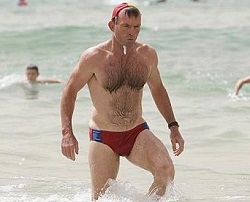
Tony Abbott is going to disappear from our screens for five weeks. That’s probably paywalled; here’s the important bit:

408941-9d5c2496-7955-11e4-bd72-4f1c38aa3a9f_500

My prediction is that Abbott will improve his position in the polls if he goes away for a while!

I’ll come back to Abbott, first the Victorian election.

Labor won by a small but comfortable margin. The best comment I’ve seen is from Dr Kevin Bonham (see the section Predictable Result). Bonham says that many factors were at work, so it is silly to place too much emphasis on first term governments usually being re-elected, for example. He points out that in fact first-term state governments lose often enough (22% in the past 60 years nationwide prior to this election).

Another myth is that voters distinguish between state and federal elections. He says his research indicates that voters tend to like a government of a different hue at each level, so that the state government will stick up for them. It also matters if the federal government is unpopular.

Being of the same party as the party in power in Canberra is a massive weight around the neck of any incumbent state government, especially if that federal government is unpopular. The article showed that a very simple linear model using just the age of a state government and whether the same party is in power federally predicted, without any polling input at all, that the government would lose about six seats (it has obliged).

So the result was very much as expected on those grounds alone.

Since that the federal government is unpopular as well, it can be argued that the Liberals did well to be merely beaten and not thrashed. Their first-term status contributed to that, as perhaps did risky ALP policy tactics, and as in my view did the strong Victorian economy and the better-than-expected leadership of Denis Napthine. But on the other side we find high unemployment and severe internal party turbulence. The Victorian Liberals need to review their candidate screening practices after the enormously damaging Shaw debacle and two embarrassing disendorsements during the current campaign.

Bonham says there were other factors, but federal-state drag was probably the biggest one.

There has been some commentary that Labor turned union links into a positive in the campaign. Given Bomham’s analysis I’m agnostic on that one. At least it was not electoral poison.

Laura Tingle thinks

the bottom line is that the state election turned the psychology of federal politics on its head, as well as force all politicians to reflect on the “givens” of the political discourse.

Until the last couple of weeks, the ALP had settled in for six years in the wilderness of federal opposition.

Tony Abbott and his colleagues came to office presuming they would have a minimum of two terms to implement any tough reforms before enjoying a more loving relationship with the electorate, simply because no federal government in living memory has got less than two terms in office.

Victorians’ decision to turf out the Coalition after just one term has changed all that.

Bill Shorten is now a man in a hurry. Tony Abbott is a man who may run out of time.

She thinks Abbott shows no signs of understanding the way the land lies. Everyone knows he should recast his budget. Half the measures will not see the light of day, but he is determined to plough on. It’s also obvious that he should recast his cabinet. That should be fun!

Also:

The Victorian result suggests you don’t need any great vision, or leader’s charisma, to win an election.

You just need a jaded electorate where browned-off voters can’t think of a persuasive enough reason to give an uninspiring government another chance.

The Victorian result suggests that promoting your disciplined fiscal policy isn’t necessarily a winner; that big roads projects don’t seal the deal; and neither does union bashing.

People want to have services – and a government – that works.

We go into the last week of Parliament with no cunning plan in sight for delivering the clean finish to the year the Prime Minister keeps promising his troops.

In fact Abbott has been spruiking his government’s achievements and is exhorting his troops to keep reminding us how good they are over Christmas.

He’d be better advised to let us be!

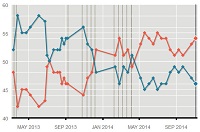
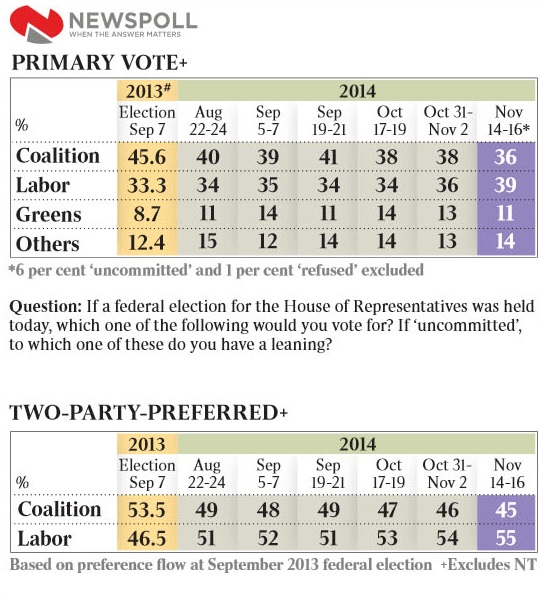
Two opinion polls have the LNP improving slightly, but still in a land-slide losing position. Newspoll has Labor 54-46, closing from 55-45. At Morgan the story is exactly the same, but half a point better for the LNP. That is, it is now 53.5-46.5 to Labor.

Meanwhile Campbell Newman in Queensland is unlikely to invite Abbott to help him campaign in the upcoming election. His strategy of being boring and keeping his head down seemed to work for a while, but ReachTEL now has Labor in front 51-49.

Saturday salon 29/11

voltaire_230

An open thread where, at your leisure, you can discuss anything you like, well, within reason and the Comments Policy. Include here news and views, plus any notable personal experiences from the week and the weekend.

For climate topics please use the most recent Climate clippings.

The gentleman in the image is Voltaire, who for a time graced the court of Frederick II of Prussia, known as Frederick the Great. King Fred loved to talk about the universe and everything at the end of a day’s work. He also used the salons of Berlin to get feedback in the development of public policy.

Fred would only talk in French; he regarded German as barbaric. Here we’ll use English.

The thread will be a stoush-free zone. The Comments Policy says:

The aim [of this site] is to provide a venue for people to contribute and to engage in a civil and respectful manner.

Here are a few bits and pieces that came to my attention last week.

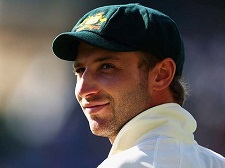
1. Vale Phillip Hughes

Hughes_Phil_17_225From The World Today:

Cricket will go on, but when we’re ready.

That’s the message from the game’s leaders today as grief envelops the sport here and abroad.

Teams and individuals are paying tribute to Philip Hughes in their own ways and will continue to do so at games this weekend.

Some clubs will paint 63 on their ovals – marking that he was 63 not out when he was hit by that ball.

The outpouring has also been extended to bowler, Sean Abbott.

A test is due to get underway next week but at this stage cricket administrators say no one is in a position to make a decision as to if or how that will proceed.

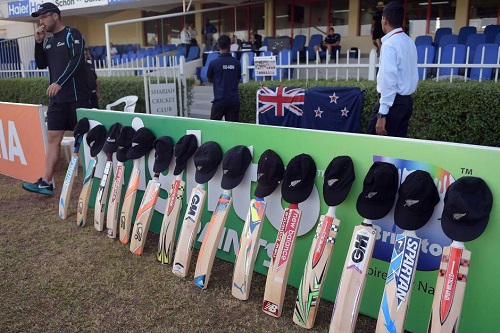
Various sporting codes are honouring him in their own way. A state memorial service will be held at the Sydney Cricket Ground, with date and other details to be confirmed. The notion of putting out your bats has gone viral:

Hughes_5926770-3x2-500

Like Steve Waugh, I think he should have never been dropped. He was dropped five times in 26 tests. Waugh points out that he, Waugh, took 26 tests to score his first ton.

Our sympathies to his family and all who knew him. He obviously touched many hearts in a positive way.

2. Sturm und Drang in Brisbane

That’s “storm and stress” BTW.

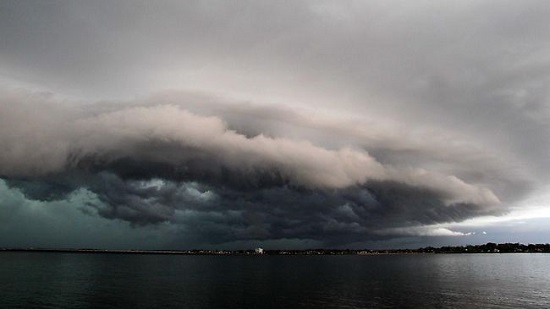
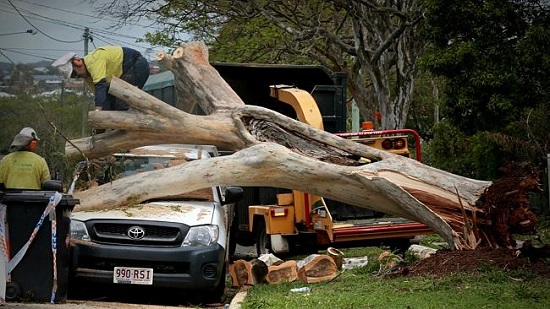
A savage storm lashed Brisbane City on Thursday afternoon. Here it is as captured on social media. More images of the aftermath here.

storm_766838-storm_550

Storm_334189-7936209a-76b1-11e4-a7f2-87cba13b8c8b_550

I was 11 floors up in the T&G building when it struck. There was a roar as the hail, some say as big as oranges, bounced off the rooves below.

The cleanup bill of up to $150 million compares to the storm of 1985, which is said to have cost $300 million. Certainly it was not as severe as the tornado-like storm that hit The Gap in 2008.

I heard today that 208 Energex crews were out re-establishing power. We were just fine in Ashgrove. Wind and rain, but no hail.

See also Brisbane storm: why was it so bad?

3. Victoria’s election

Most pundits and the polls suggest Labor will win, but Morgan has the LNP in a late surge and it could come down to a handful of votes in a handful of seats.

There is also interest in the upper house with Labor and The Greens playing silly buggers with preferences:

Complex tactical preference deals struck by Labor and the Greens have angered some progressive minor parties, which feel votes should rightfully flow to them.

The Greens have preferenced the Palmer United party relatively highly in some regions, while Labor has preferenced Family First above a selection of left-wing candidates in some regions and has placed the pro-hunting Country Alliance above all other parties in eastern Victoria.

The Shooters and Fishers party could win a seat in Victoria’s eastern division, due to favourable preferences, while the Greens have preferenced the Sex party highly in the northern metropolitan division, despite the party’s stated support in the past for the controversial East West toll road, which the Greens oppose.

The final makeup of the upper house is likely to prove an interesting negotiating challenge for Labor if it does manage to oust the Coalition government.

4. Right wing warriors turn on Abbott

Andrew Elder had some interesting things to say about politics and the media with special reference to the ABC. The adults are definitely not in charge.

Now Janet Albrechtsen, Andrew Bolt and Alan Jones have all turned on Abbott.

Abbott just can’t put a foot right. Laura Tingle on Thursday:

Prime Minister Tony Abbott finds himself defending the indefensible, or the already mortally-wounded, on three different fronts.

First, the government’s budget strategy is dead, a seriously ex-parrot, and we are left just going through the excruciating process of seeing how it is brought to account in next month’s mid-year budget review.

Yet the government persists – for now – with the fiction that it will all come good in the end.

Second, the prime minister’s credibility has been shattered, not just by a series of broken promises that have emerged through the year but by what one of his own backbenchers described as Abbott’s “verbal gymnastics” in trying to suggest that he had not broken any promises. The cut to ABC funding has crystallised voter disgust at such gymnastics.

Finally, the only thing that stopped an increasingly confident attack by the Opposition on the collapsing edifice of the budget bottom line and the Prime Minister’s trust deficit with voters was the spontaneous combustion of Defence Minister David Johnston when he declared on Tuesday that he would not trust the Australian Submarine Corporation to “build a canoe” . This opened up a whole new front of Labor attack on ministerial competence.

Since then the status of the $7 Medicare co-payment has depended on which minister you ask. What is definite is that they want sick people to go to the doctor less and they’ll try to find a way of making that happen!

When the photographers start piling in on you, you know you’re in trouble!

e246ef1e-7559-11e4-8166-fea23de4bee6_886003199--550

ABC cuts run deep – over 400 jobs to go

The ABC has announced that more than 400 ABC staff could lose their jobs as the public broadcaster moves to implement the $254 million the Federal Government will cut over the next five years. That’s $254 million out of an otherwise projected budget of $5.5 billion.

I’d like someone to do an historical perspective on this. My memory is that in the 1980s the ABC had 6000 staff. There were cuts during the Hawke-Keating years. I heard yesterday that Costello’s first budget saw cuts of 12%. The Howard years were not kind to the ABC, not receiving any of the largesse distributed in the good years. The Rudd-Gillard years actually saw some improvement in the ABC budget, mostly through negotiated support for additional services. Supporting a strong and vibrant public broadcaster was part of ALP policy. At the same time the ABC did Labor no favours in its reporting.

That’s from memory. I’d like to see a proper study.

I’ll come to broken promises later. First some detail on the cuts:

  • Adelaide TV production studios to close
  • State-based 7.30 programs on Friday to be scrapped and replaced with national 7.30 program
  • Lateline moved to a new timeslot on ABC News 24
  • Foreign bureaux will be restructured to create “multiplatform hubs” in London, Washington, Jakarta and Beijing, although the number of correspondents will stay the same
  • The Auckland bureau will close down and a new Beirut post will be opened
  • Regional radio posts in Wagin, Morwell, Gladstone, Port Augusta and Nowra to close
  • ABC Local, Radio National and ABC Classic FM programming changed, with some programs scrapped
  • State-based local sports coverage scrapped
  • The creation of a new regional division and ABC Digital Network, to begin in mid-2015, and a $20 million digital investment fund.

Radio National’s Bush Telegraph will be scrapped. I used to listen to it to keep in contact with happenings in the bush. In recent years I’ve favoured Richard Fidler’s excellent and compelling Conversations, which clashes in the timeslot.

In another blow against the bush, Local Radio Afternoons programs will go state-wide. In Queensland that will likely be Kelly Higgins-Devine, who has lived in the far north and will do a good job. It’s just not the same. There is a lack of localism, evident at times when Brisbane has had to be combined on a temporary basis with the Gold Coast and the Sunshine Coast.

Apparently 100 internet sites are to be closed, which sounds like a real blow to ABC’s generally excellent internet presence. Presumably there will be fewer transcripts of radio and TV programs, which will be a loss.

Managing Director Mark Scott told Leigh Sales that at least 10% of the 10% would be administrative or support staff. As to why a 5% cut translates into a 10% staff cut, Scott didn’t answer very well but I think the story lies in fixed infrastructure costs.

As to broken promises, the only thing worse that breaking a promise is pretending that you didn’t. ABC’s FactCheck verdict is This promise is broken. It was all very clear:

During a live interview with SBS from Penrith football stadium, Mr Abbott said: “No cuts to education, no cuts to health, no change to pensions, no change to the GST and no cuts to the ABC or SBS.”

Turnbull has been saying:

“Prior – prior to the election, I said on a number of occasions, I think possibly on this show, certainly on Lateline, that while we weren’t planning to make, you know, massive, slashing cuts to the ABC to cut their programming resources, as some people were urging us to do so, we would be looking to make… savings and cut waste right across government and ABC and SBS would not be exempt,” he said.

To be honest, unless he can provide an actual quote I think that is a flat out lie. Certainly he said something along those lines after the election.

Overwhelmingly, I think Ben Eltham is right, it’s about revenge – punishing the perceived enemies of the right.

There has been an appalling associated decision – Janet Albrechtson has been appointed to a panel to oversee the appointment of board members. There can be no clearer sign of a desire to domesticate the ABC.

Scott himself is apparently too much of a leftie. Turnbull has suggested that he relinquish the role of editor-in-chief. I think overall editorial and resource allocation roles are not usefully separated.

This attack on the ABC was of course expected. In it’s conception and execution, however, it has exceeded my expectations of brazenness and perfidy.

Saturday salon 22/11

voltaire_230

An open thread where, at your leisure, you can discuss anything you like, well, within reason and the Comments Policy. Include here news and views, plus any notable personal experiences from the week and the weekend.

For climate topics please use the most recent Climate clippings.

The gentleman in the image is Voltaire, who for a time graced the court of Frederick II of Prussia, known as Frederick the Great. King Fred loved to talk about the universe and everything at the end of a day’s work. He also used the salons of Berlin to get feedback in the development of public policy.

Fred would only talk in French; he regarded German as barbaric. Here we’ll use English.

The thread will be a stoush-free zone. The Comments Policy says:

The aim [of this site] is to provide a venue for people to contribute and to engage in a civil and respectful manner.

Here are a few bits and pieces that came to my attention last week.

1. PUP politics

Unless you were under a rock you’d know that PUP politics got worse.

After PUP expelled Jacqui Lambie’s chief of staff Rob Messenger from party Lambie and Ricky Muir broke ranks to join a ‘coalition of common sense’ against the financial advice laws.

Then Lambie was removed as deputy Senate leader and deputy whip of the party for failing to attend three party meetings.

The slanging match continued with Palmer calling Lambie a liar.

Now the ABC says Clive Palmer stormed out of an interview with Emma Alberici when she got onto the Chinese court matter. I watched the interview and would say Palmer terminated it rather that stormed out. As Palmer says, wait for the court judgement.

The bottom line is that it looks as though Jacqui Lambie is on her way out, but this still leaves PUP with the balance of power in the senate if the arrangement with Ricky Muir hold up.

2. Authorisms

‘Authorisms’ are neologisms coined by authors which have entered the wider language. Did you know that Billy Shakespeare invented words like bump, hurry, critical, and road? Now Paul Dickson chooses his top 10.

    1. Banana Republic invented by O. Henry (William Sidney Porter) in 1904.
    2. Beatnik – columnist Herb Caen in 1958.
    3. Bedazzled – Shakespeare in Taming of the shrew.
    4. Catch-22 – Joseph Heller 1961.
    5. Cyberspace – novelist William Gibson in 1982.
    6. Freelance – Sir Walter Scott in Ivanhoe.
    7. Hard-Boiled – Mark Twain in 1886.
    8. Malapropism – Richard Brinsley Sheridan in 1775.
    9. Serendipity – Horace Walpole in 1754.
    10. Whodunit – book critic Donald Gordon in 1930.

3. The LNP government shoots itself in the foot, and the ABC

Also SBS, of course. The cuts to the ABC amount to around 5% over four years. Barrie Cassidy points out that big C conservatives will be pleased, but they’ll thank Abbott rather than Turnbull.

Turnbull looks a goose on two counts. Firstly, he defends Abbott for saying very directly before the election that there would be no cuts to the ABC and SBS. So he’s defending the indefensible.

Secondly, he says the cuts won’t amount to anything that matters.

And in any case collectively, they only had in mind cuts that would not reduce services. Clean cuts. Nice cuts. Cuts that can’t be seen with the naked eye.

If you believe that I’ve got a bridge you might like to buy.

Mark at The Monthly writes that any leftie love of Turnbull will now be over.

It should have been when Turnbull dicovered Godwin Grech. I’ll say more when we have the ABC response.

Ben Eltham says it’s revenge, pure and simple.

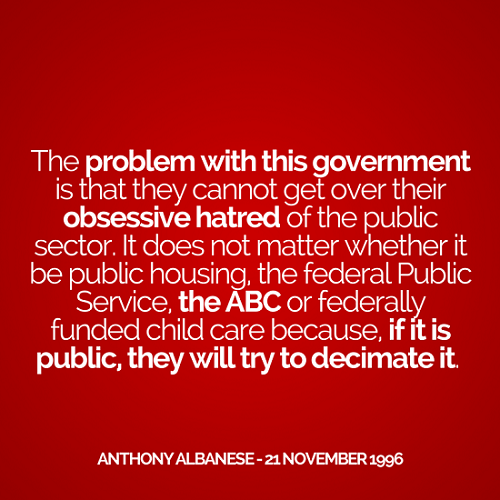
4. Anthony Albanese said it in 1996

Courtesy of Mark’s Facebook:

Albanese_10409258_849199868447460_2136219768888249167_n_500

5. Remembering Wayne Goss

Hundreds of people have turned out to pay tribute to former ‘hero’ Queensland Labor premier Wayne Goss at a public memorial service in Brisbane.

Mr Goss was known as ‘Mr 70 Per Cent’ for his high public approval rating during his time as Queensland premier.

He died at the age of 63 at home in Brisbane in the early hours of November 10 from a recurrent brain tumour.

David Barbagallo pays tribute.

6. ALP competitive in two states

Galaxy poll has the ALP and the LNP at 50-50 in Queensland, 52-48 in Victoria.

G20 goodness

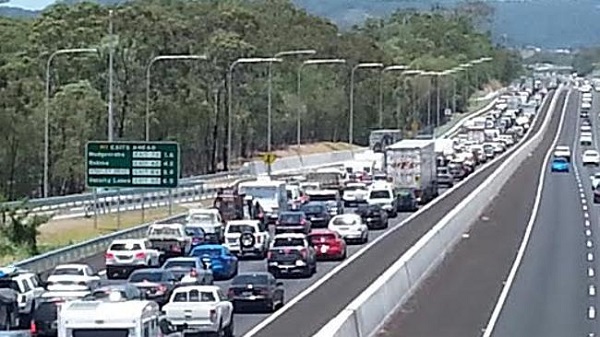
Overall when I think about the Brisbane G20 I’ll think about Putin not being shirt-fronted and leaving the instant the conference was over, about president Obama putting climate change front and centre in peoples minds, deserted streets and empty cafes, masses of coppers, 6000 of them, and traffic gridlock from here to the Gold Coast as people took advantage of the long weekend.

Yes, Brisbane welcomed the pollies and thousands of journalists by getting the hell out of here.

G20_002790-a117de80-6ba0-11e4-915b-4759357bb584_600

As to Abbott’s role in the G20, Paul Syvret in the Courier Mail summed it up perfectly (thankyou John D!):

TAKE a bow ’Straya. You showed the world, when given the opportunity to shine on a global stage of grand ideas, just how small-minded and insular we can be.

Sure, we hosted a meeting of G20 leaders that went off without a logistic hitch or any ugly civil unrest or security incidents. Well done us.

The vision and inspirational leadership side of the equation though left a bit to be desired.

Less than a week after the United States and China announced a landmark agreement to tackle climate change, Australian Prime Minister Tony Abbott opened proceedings at the G20 summit by boasting how Australia had abandoned its carbon-pricing scheme.

He also, literally, thanked God that we have stopped the “illegal boats” – in the company of people like Italian Prime Minister Matteo Renzi, whose navy earlier this year rescued more than 3500 seaborne asylum seekers in one 48-hour period.

Then for good measure, he moaned to the world’s most-powerful leaders about his failure to get a $7 Medicare co-payment through the Senate; parish pump pissantery in front of the likes of US President Barack Obama, whose administration went to the brink of international debt default thanks to a gridlocked Congress.

A columnist for the LA Times described it as “an awkward, pimply youth moment so embarrassing that it does sting”.

Australia, she wrote, is “the adolescent country. The bit player. The shrimp of the schoolyard.”

“The Group of 20 summit could have been Australia’s moment, signalling its arrival as a global player … but in all, the summit had Australians cringing more than cheering.”

Bill Shorten dubbed Abbott as “weird and graceless”.

Compare Barack Obama’s visionary eloquence, laying down the gauntlet on climate change and announcing a US$3 billion contribution to the Green Climate Fund. His speech if you missed it is here.

Ironically there was a point to Abbott’s whingeing about the $7 Medicare co-payment. If you ask Joe Hockey, he’ll tell you G20 was about growth, 2 trillion dollars of it, in 862 concrete proposals put forward by the G20 countries. Apparently Australia’s bright ideas for growth included wrecking Medicare and ripping 20% of funding out of our universities. Fair dinkum! Makes you wonder about the other 860 ideas!

Another point is that the ideas for growth were supposed to be ideas that the governments would not otherwise have done. However, I understand the gun went off in February in preparation for the G20 finance ministers meeting in Cairns in September. Are we really to believe that the Abbott government would have left Medicare and universities alone in the 2014 budget, but for G20?

It must be said that the Brisbane G20 was well organised from every viewpoint. The G20 Leaders’ Communiqué, 21 points in three pages of text, plus lists of supporting documents, is mercifully succinct. Of course it was written and circulated beforehand. Climate change was always going to be there (para 19) because a Climate Finance Study Group had been set up at an earlier meeting.

By the way the Abbott government does not support the Green Climate Fund, designed to assist developing countries, and apparently won’t contribute. Our share, pro rata, should be a mere $200,000 or so.

The G20 spawns a large number of sub-groups. Apart from the finance ministers and central bankers, trade ministers have met and now energy ministers will follow suit. There is a Financial Stability Board and a G20 Food Security and Nutrition Framework, for example. As a decision of this meeting a Global Infrastructure Hub will be established in Sydney to facilitate infrastructure planning.

Around the G20 sit an alphabet soup of meetings hoping to influence the G20. The B20 meeting of business leaders is inside the tent in formal collaboration with the G20. By contrast an L20 group, I gather of labour unions, is ignored. A ‘women in leadership’ group was luckier. The G20 responded by (para 9) agreeing to a goal of

reducing the gap in participation rates between men and women in our countries by 25 per cent by 2025, taking into account national circumstances, to bring more than 100 million women into the labour force, significantly increase global growth and reduce poverty and inequality.

There was also a T20 organised by think tanks. In addition there was a Global Cafe, I think organised by the Brisbane City Council, which brought together “futurists and thought leasers”.

There were plenty of protests. For example, refugee advocates released paper boats on the Brisbane River and were ignored. I think Turkey, the next host, is going to put refugees on the agenda.

Aborigines shouted angry words and burnt effigies of Noel Pearson, Marcia Langton and Warren Mundine.

The police set up formal lines of communication with groups planning to protest and facilitated how they might do it. As a result there were only 14 arrests, compared I believe with 1300 in Toronto. It was unusual to see protesters praised by police on the telly. There was no property damage.

Those who thought that Vladimir Putin was comprehensively roasted by other leaders missed an informal meeting of BRICS (Brazil, Russia, India, China, South Africa) where Putin was supported and the sanctions declared illegal.

On climate change, Laura Tingle reckoned Obama delivered Abbott a lesson in power. Within the meeting according to The Age Abbott carried on like a pork chop, giving an impassioned defence of coal and opposing the goal of eliminating fossil fuel subsidies.

Enough said!

Elsewhere John Quiggin thinks hosting the G20 did nothing for Brisbane and was a waste of money. The notion that events like this “put Brisbane on the map” is silly.

I dunno! Perhaps Angela Merkel taking selfies in a Caxton Street pub will bring her many Tweet followers flocking to Brisbane!

ALP extends lead

They say that all politics is local. In any case Abbott’s ventures into international politics in APEC and the G20 seem to have done him no good. Newspoll has the ALP 10 points ahead (55-45) on a two-party-preferred basis, with Labor’s primary vote ahead of the LNP for the first time since July. Shorten has edged ahead in the better prime minister stakes 43-39 with 20% uncommitted. For the tables go here.

Newspoll 17  Nov_cropped

It’s the gap and the trend that is interesting. Morgan has a similar pattern, coming out at 55.5 – 44.5 for the ALP.

The only demographic where the LNP is ahead is now the over 65 year olds. The ALP leads in all states, even WA, but by less than the margin for error.

Morgan has PUP on a mere 2.5% nationwide and only 1.5 in Victoria.

Saturday salon 15/11

voltaire_230

An open thread where, at your leisure, you can discuss anything you like, well, within reason and the Comments Policy. Include here news and views, plus any notable personal experiences from the week and the weekend.

For climate topics please use the most recent Climate clippings.

The gentleman in the image is Voltaire, who for a time graced the court of Frederick II of Prussia, known as Frederick the Great. King Fred loved to talk about the universe and everything at the end of a day’s work. He also used the salons of Berlin to get feedback in the development of public policy.

Fred would only talk in French; he regarded German as barbaric. Here we’ll use English.

The thread will be a stoush-free zone. The Comments Policy says:

The aim [of this site] is to provide a venue for people to contribute and to engage in a civil and respectful manner.

Here are a few bits and pieces that came to my attention last week.

1. Abbott puts his foot in his mouth

Yesterday David Cameron made a speech in Parliament about freedom and democracy. At an international business breakfast attended by David Cameron Abbott said there was ‘nothing but bush’ in Australia before white settlement.

The self-appointed “Prime Minister for Aboriginal Affairs” Tony Abbott has reiterated the legal fiction of “terra nullius” stating that Australia was “nothing but bush” before British invasion and called pre-colonisation civilisation “extraordinarily basic and raw”.

Will someone please take this embarrassing man away and give us a real prime minister?

2. Palmer DisUnited Party

Clive Palmer and Jacqui Lambie have been engaging in a colourful slanging match. Lambie says she won’t resign unless she’s kicked out, but she might have to distance herself from the party. Palmer says she won’t answer the phone or return his calls and that she raises no issues when the party meets. It’s hard to see this fracture being patched up.

According to a vox pop conducted in Tasmania, she has a bit of support, but many are scathing and find her embarrassing. Her attitude may make things harder for the LNP to get legislation through the senate, but will reduce Palmer’s leverage.

3. Rundle on Palmer

Meanwhile Guy Rundle has been studying the mercurial Clive Palmer’s politics. He finds the politics of Clive Palmer:

a mildly centre-right politics, grounded in Australian Catholic traditions and social movement doctrine, and tracing their lineage back to the party whose name he wanted to adopt, the United Australia Party.

Rundle identifies a doctrine on which the Australian political and social settlement is based.

Because the arbitration system and the Harvester judgement that inaugurated it took their moral language from Rerum Novarum, the 1891 encyclical that sparked off the Catholic social movements, we can say that it is this doctrine, and its secular variants, that sits at the very centre of Australian political values, and major parties depart too far from it at their peril. It consists not merely of a set of social rules, but of an idea of what it is to be human, an idea of depth, and of selfhood as achieved in the exercise of mutual obligation.

Such a doctrine, drawing also from nineteenth-century social liberalism and classical and Christian notions of freedom as flourishing within communal life, is a world away from the atomised and content-less self of classical liberal doctrine, and the neoliberal political-economic movement that derives from it.

He locates Palmer’s politics within this tradition. Abbott promised to govern within this tradition, but he lied.

4. Wayne Goss in memoriam

Former Queensland premier Wayne Goss died during the week. Goss is noted for bringing the ALP back to power after 32 years of conservative rule and implementing the reforms recommended by Tony Fitzgerald in his inquiry into police corruption which flourished under Joh Bjelke Petersen. Fitzgerald described Goss as a man of “uncompromising integrity”.

The other Fitzgerald, Professor Ross Fitzgerald, described Goss as a “steady hand, but he really wasn’t a radical reformer”.

There was nothing steady about the way Goss’s government turned the public service inside out. In fact I left in 1991 in large measure because of the hypocrisy the Education Department displayed in ‘valuing people’. Ironically schooling in Queensland was modernised and humanised in the 1970s and 1980s under Joh, possibly because Joh himself took little direct interest in it and always handed education to a junior minister.

It’s astonishing to think that the magnificent Cultural Centre complex was built during the Joh years.

Still, the joint certainly needed cleaning up and Goss certainly did it.

5. Remembering the Berlin wall

“Die Mauer muss weg!” (“Away with the wall!”)

We also had the 25th anniversary of the destruction of the Berlin Wall during the week.

Originally it was assumed that the West would take over the East. Der Spiegel suggests that in fact there has been movement the other way and what has happened is that a genuinely new Germany has emerged.

6. WA plans to close Aboriginal communities

I couldn’t believe this when I heard it. The West Australian Government will close as many as 150 remote Aboriginal communities in the next three years.

The threat of US style managed health care

I’ve been cracking my brain over one of Getup’s latest campaigns – keeping medical insurers out of the direct provision of primary health care.

The issue has come to a head with the federal government’s review of the $1.8 billion Medicare Local scheme. In brief, the 61 existing Medicare Locals are to be consolidated into 30 Primary Health Networks (PHNs), with geographic boundaries aligned with the existing Local Hospital Networks. The Government is about to call tenders for the provision of PHN services, with private medical insurance companies able to tender.

The Government does appear to have crossed a line, which is a concern, but my question is what does it mean to me, my relationship with my GP, and will it constrain her in pathways to care and access to specialist services? Getup’s concerns:

This means insurance companies, and not your GP, could end up making critical decisions about who gets treatment and how we’re treated, with health groups already raising the alarm. It’s the very system that’s crippled American healthcare, driving up costs and leading to less care for fewer people.

Profit-driven healthcare threatens the very foundation of our universal Medicare system, restricting access and quality of care, especially in areas where insurers don’t stand to make money.

Frankly, I can’t see that Medicare Local meant anything to my healthcare and I doubt that anything will change with the introduction of PHNs in July next year.

I’m struggling to understand what a Medicare Local does. This is from Professor John Horvath’s review (p. 8):

As part of the Council of Australian Governments’ (COAG) National Health Reform Agreement (2011), the Commonwealth Government agreed to fund Medicare Locals to improve coordination and integration of primary health care in local communities, address service gaps, and make it easier for patients to navigate their local health care system. Medicare Locals are expected to fully engage with the primary health care sector, communities, the Aboriginal Community Controlled Health Service (ACCHS) sector, and Local Hospital Networks (LHNs). Their establishment was built on the foundations of Divisions of General Practice (DGPs).

According to Horvath Medicare Locals also struggled to know what their role was. A critical phrase is “address service gaps”. Horvath says Medicare Locals were never intended to offer services in competition with existing services, but in fact that is what many did.

Medicare Locals were established in three tranches from 2011 as not-for-profit companies. Horvath says the PHNs should be contestable, transparent and accountable. He says that they should be be companies incorporated under the Corporations Act 2001, have skills based boards and should “establish a Clinical Council and a Community Advisory Committee in each LHNs (or clusters of LHNs) with which they are aligned as ‘operational units’” (p.17 of his Review). I suspect the involvement of for-profit health insurance companies would surprise him.

In Horvath’s “vision and design principles” statement (p.16) the closest PHNs would come to the direct provision of services is this:

Not all regions across Australia are equally serviced. The role of the PHO is to work with the GPs, Commonwealth and state health authorities, LHNs, and communities to identify gaps in health services and work in partnership with these organisations to source the appropriate services.

Yet in this article it is clear that Medicare Locals are providing services in remote areas that otherwise would be unserviced. And then this:

The Federal Assistant Minister for Health, Fiona Nash, said Primary Health Networks will not be providers of services, as some Medicare Locals have been.

The Young based Senator said a problem with Medicare Locals was a lack of direction but PHNs will have a clear set of guidelines.

“They’re going to be regional purchasers of health services and providers only in the exceptional circumstances,” Senator Nash said.

I remain confused.

It seems to me that Horvath saw PHNs as supportive rather than supervisory. Yet purchasing services does put them in the authority line in the provision of services. If so, there is a conflict of interest problem with the involvement of for-profit medical insurance companies.

Contra Getup, I don’t have an objection to for-profit companies providing health care. We have shares in a company called Ramsay Health Care which owns and runs hospitals. The provision of quality service seems to be their niche. As it happens I’ve had operations in two Ramsay hospitals as well as one owned by a bunch of specialist doctors, plus The Wesley, which is Uniting Church. Only in the one owned by doctors did I have concerns about the service, and then not all that serious.

Nevertheless we need to be alert and perhaps alarmed about situations where bean counters have undue influence on the provision of medical services. That can happen in the public sphere as well as the private.

Certainly in this case alarm is not confined to Getup. Nurses are also concerned.

Elsewhere Croakey consults the experts.