Whitlam’s economic performance: time to think again!

The Whitlam years were certainly tempestuous years. There is a tendency, even by acolyte’s, to think that the economic turmoil of those years was made in Australia, by EGW, his treasurers and his ministers.
Whitlam_3960008-3x2-600

Who can forget the Khemlani loans affair, where Minister for Minerals and Energy, Rex Connor, was seeking to borrow US$4 billion, a lot of loot for the time, for resources projects without going through Treasury. My understanding is that the scheme was hatched by Connor, Whitlam and a small kitchen cabinet, perhaps including Lionel Murphy. After it became public and Cabinet put the kybosh on the scheme, Connor was still found to be liaising with the shadowy Tirath Khemlani. Whitlam dismissed Connor.

Khemlani, it is said, never made a loan in his life, and perhaps had contacts with the CIA.

Cairns was dismissed a few months later over a separate loans affair, where he (as claimed) unknowingly signed a letter and misled parliament by saying he hadn’t.

For these and other reasons, the Whitlam government at times looked highly shambolic.

Yet economic turmoil was not confined to Australia. That first Khemlani link reminds us that the price of oil quadrupled between 1973 and 1974. That’s why the Middle East was awash with petro dollars and a Khemlani figure could exist. Ian Verrender, the ABC’s busianess editor, now invites us to think again.

Verrender riffs off a piece in the AFR by John Stone, former treasury secretary and National Party senator, plus “outspoken critic of multiculturalism and a supporter of the Samuel Griffith Society, which he helped found”. Stone was also at one time John Howard’s finance spokesman in opposition. In his piece The economic policy madness of the Whitlam era Stone outlines a tale of woe. But:

As Stone rightly points out, Australia did not go into recession. What he fails to mention is that America did. So did the UK. And they were no ordinary recessions.

Both our northern hemisphere allies endured long and painful slumps, the chaotic fallout from which reverberated through the global economy, including Australia.

Not only that, inflation ran wild in both the northern hemisphere economic superpowers and throughout the developed world. It was a global recession that marked the dramatic end of the post-war boom.

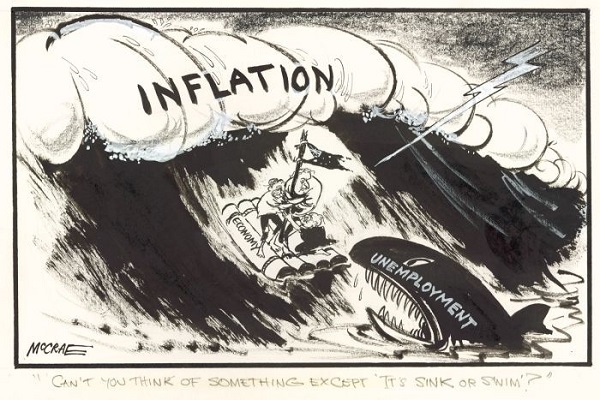
This was the time of rampant stagflation, a rare phenomenon in economics where inflation and unemployment rise simultaneously. It’s a nightmare scenario for policymakers. Raise rates to dampen inflation and you exacerbate unemployment. Try to fix the jobs crisis and you fuel inflation.

There were a number of factors behind the global recession.

The Bretton-Woods financial system – instituted after the war that tied the US dollar to the price of gold – collapsed in the early ’70s, itself enough to engineer a significant slump in global activity. This followed attacks on the currency as the US ran up a constant series of balance of payments deficits.

The sudden collapse of the system and the immediate devaluation of the US dollar, which from then on became a fiat currency valued against other currencies, created havoc on trade and current account balances throughout the developed world.

Add to this that the Arab world had formed the Organisation of Petroleum Exporting Countries and in 1973 deliberately squeezed supplies.

The price of oil quadrupled between October 1973 and the following January. That’s correct, energy prices rose 400 per cent in four months, sending shockwaves through developed world economies, underscoring the dramatic price rises that, in turn, fed through to wage demands.

Between 1973 and 1975, the Whitlam era, inflation in the UK grew from 7.4 per cent to 24.89 per cent – vastly higher than anything experienced in Australia.

Great Britain was wracked by industrial disputes. Miners walked off the job, coal supplies dwindled. So dire was the energy situation, UK prime minister Edward Heath instituted the three day week as commercial electricity users were restricted. Food queues formed.

America, meanwhile, endured its worst recession since the Great Depression between November 1973 and March 1975. While the unemployment spike was relatively short-lived inflation soared from a relatively modest 3.65 per cent in early 1973 to a 12.34 per cent peak at the end of 1974 before tapering off during 1975.

Certainly under Jim Cairns stewardship the money flowed. Verrender says:

Gough Whitlam’s first two treasurers, Frank Crean and Jim Cairns, were widely criticised for their performances. Cairns, especially, appeared to be distracted by assets of another kind, and spending during his reign blew out spectacularly.

But Bill Hayden’s budget, delivered shortly before The Dismissal, had many in the Opposition worried. It was a responsible document designed to bring inflation and unemployment under control.

Personally I had a couple of long conversations with Bill Hayden when he was Treasurer and was impressed. The Whitlam Government had a further 18 months to run and things may have settled down.

It should be remembered that Malcolm Fraser only had the capacity to block supply courtesy of highly unorthodox senate replacements. First, in March 1975 the independent Cleaver Bunton was appointed by NSW Premier Tom Lewis to replace Lional Murphy who Whitlam had appointed to the High Court. Secondly Albert Patrick (Pat) Field was appointed by Queensland under Joh Bjelke-Petersen following the death on 30 June of Queensland ALP Senator Bert Milliner. Field had been an ALP member, but offered himself, promising never to support Gough Whitlam.

These were highly improper and undemocratic acts that were accepted by Malcolm Fraser.

Back to the economy, it could be that Cairns’ profligacy acted like a massive Keynesian stimulus package, saving Australia from recession.

More generally, figures like Immanuel Wallerstein see capitalism in its main centres doing it tough from the early 1970s. Capitalists sought to maintain their profits by beating down wages, by outsourcing, by financialisation, including increasing privatisation of human activities and experience. It’s well-known that American workers struggled to maintain real wages from the 1970s onwards. The modern manifestation of neoliberalism seems to date from about this time.

Thomas Piketty’s work on inequality is startling. This graph shows the rise in inequality in the US by charting the top decile’s share of income:
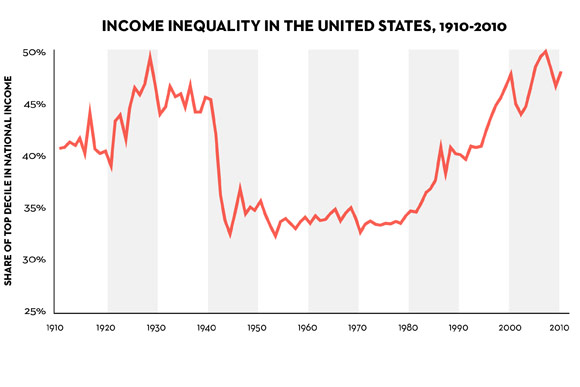
chart-01

The 2012 data, too late for inclusion in the book, sees a new high of over 50%.

There’s a similar pattern if you look at the top 1% in the Anglo-Saxon economies:
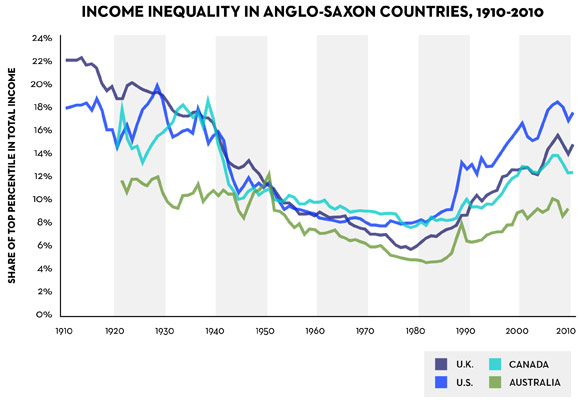
chart-03

Clearly something broader and deeper is going on that Whitlam’s whole program of social investment perhaps helped to protect us from. Certainly as Verrender says, Stone “still fails to grasp the impact the global economic upheaval had on Australia.”
Climate clippings 111

1. Record warmth

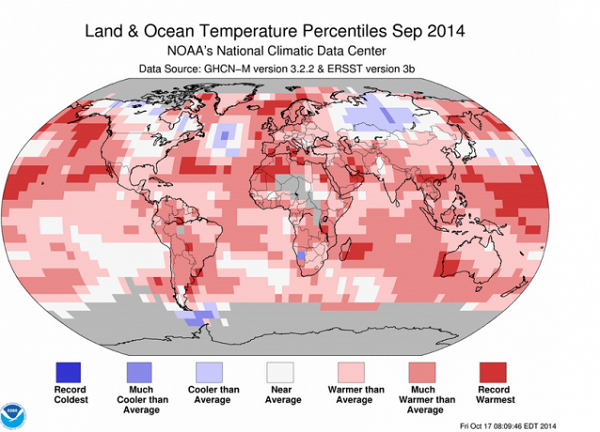
September followed August as record heat for the month worldwide. The period January-September was equal hottest with 1998 and 2010. The 12 months from October 2013 to September 2014 was the hottest 12-month period on record. The heat was just about everywhere, except for central Russia, some areas in eastern and northern Canada, and a small region in Namibia:

Screen-shot-Sept 2014-AM-600

2. Coal is good for humanity!

Thus spake Tony Abbott, repeating lines imprinted on his mind by coal industry lobbyists.

In an important post Graham Readfearn tells how big coal is hijacking the energy poverty issue

telling the world that the only way the poorest nations can pull themselves out of poverty is by purchasing lots of their product.

The point that those same people will likely be hit earliest and hardest from the impacts of climate change being driven by that same product, is neatly swerved or underplayed.

So we have Peabody Energy “fueling the world with energy essential to sustain life”.

Pardon me while I have a quiet chunder!

3. New 2030 climate targets for the EU

On the whole climate campaigners are disappointed with the new emissions targets set by the EU – 40% reduction in emissions, 27% cut in energy use and 27% of energy must be from renewables.

The ETS is seen as essential in reaching these targets, so it will be reformed in an as yet undesignated way.

Rich countries like Germany, the UK and France will have to do better than the designated cuts to compensate for the continued reliance on coal by the likes of Poland, Bulgaria and Romania.

At Climate Progress it seems the American reaction is more favourable. They point out that the targets are the first substantive offer from any member of the international community ahead of the UN climate talks to be held in Paris in 2015. The Americans and the Chinese are unlikely to go so far.

Personally when they aim for net zero emissions by 2030 and aim for 350 CO2e ppm by 2050 I’ll say they are reconnecting politics with reality.

4. Arctic sea ice escalator

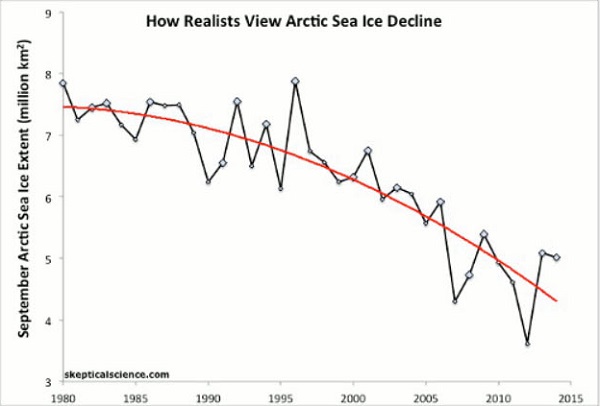
BilB drew attention to Skeptical Science’s Arctic sea ice escalator:

Sea ice 2014_cropped

He’s right, the next break downwards could shock some doubters.

Perhaps enough to shake pollies of all stripes out of their torpor.

If you look at the trend from the late 1990s it looks even more dramatic.

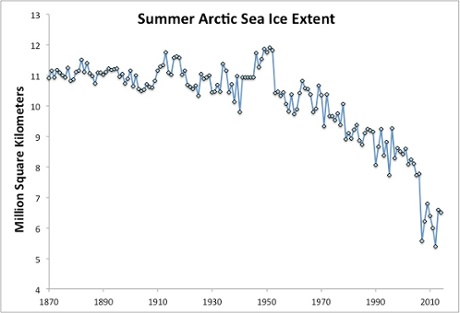
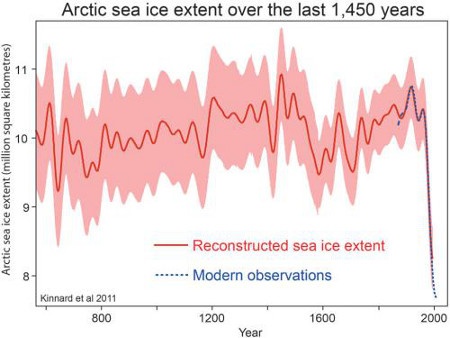
The full article has two further graphs:

00c36199-0fac-468c-86d4-76d93ce98cba-460x313

120afee8-e360-4a99-ab75-cabf94d6b08c-bestSizeAvailable

Actually there’s something wrong with both. The y axis should go below 4. It’s like where you have a graph on a wall and the line falls off the graph and onto the wall.

5. Pacific warriors blockade Newcastle

Climate Change Warriors from 12 Pacific Island nations paddled canoes into the world’s largest coal port in Newcastle, Australia, Friday to bring attention to their grave fears about the consequences of climate change on their home countries.

The 30 warriors joined a flotilla of hundreds of Australians in kayaks and on surfboards to delay eight of the 12 ships scheduled to pass through the port during the nine-hour blockade, which was organised with support from the U.S.-based environmental group 350.org.

The warriors came from 12 Pacific Island countries, including Fiji, Tuvalu, Tokelau, Micronesia, Vanuatu, The Solomon Islands, Tonga,
Samoa, Papua New Guinea and Niue.

6. Norway takes to electric cars

Norway, not a member of the EU, now has 15% electric cars. Since 2011 Nissan LEAF has become the nation’s third best-selling car.

Norway is not a member of the EU. It gets 98% of its power from renewables. Presumably it doesn’t go around preaching that oil is good for humanity!

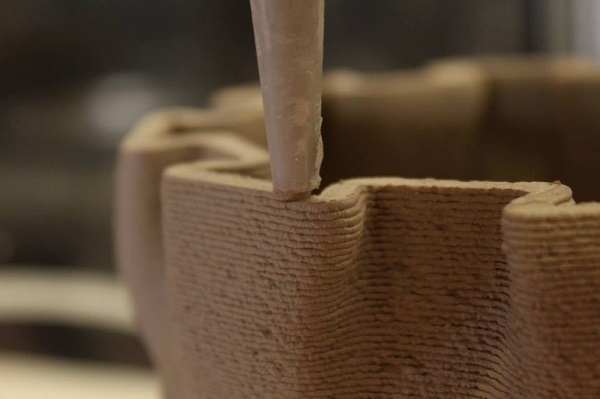
7. How to build without bricks and cement

Just print houses out of mud!

wasp_3d_printed_mud_homes-3_600

Thanks to John Davidson for those last two items.

Saturday salon 25/10

voltaire_230

An open thread where, at your leisure, you can discuss anything you like, well, within reason and the Comments Policy. Include here news and views, plus any notable personal experiences from the week and the weekend.

For climate topics please use the most recent Climate clippings.

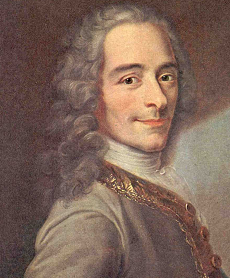
The gentleman in the image is Voltaire, who for a time graced the court of Frederick II of Prussia, known as Frederick the Great. King Fred loved to talk about the universe and everything at the end of a day’s work. He also used the salons of Berlin to get feedback in the development of public policy.

Fred would only talk in French; he regarded German as barbaric. Here we’ll use English.

The thread will be a stoush-free zone. The Comments Policy says:

The aim [of this site] is to provide a venue for people to contribute and to engage in a civil and respectful manner.

Here are a few bits and pieces that came to my attention last week.

1. Jacqui Lambie refuses an invitation to visit a Sydney mosque

“I’m a Catholic; I’m religious,” she said.

“It’s not my moral upbringing. I’m Australian. I simply believe in the church.

“… I wouldn’t be comfortable with that.”

No comment!

2. $4 billion hit to Queensland schools

Queensland schools are set to take a $4 billion hit to their revenues over the next decade due to cuts announced in the federal budget in May, according to the state’s education department.

Education Queensland’s analysis, obtained by the ABC in a Right to Information request, revealed Education Minister John-Paul Langbroek was advised that over the 10 years from 2014, state schools would be $1.66 billion worse off.

Non-government schools fared worse, with cuts totalling $2.284 billion.

The revenue reduction formed part of $80 billion in savings announced by the Federal Government in the areas of health and education.

Other states would be similarly placed, and comparable cuts in health funding are in the budget.

The good news is that the cuts apply from 2017 and there will have to be an election by 2016. So we’ll get what we vote for!

3. New York doctor diagnosed with Ebola

A harlem doctor returning from Guinea has contracted Ebola.

He took several trips on the subway in the past week, visited a bowling alley and took a cab before he began to display symptoms. His fiancée and two friends have been isolated.

Questions arise, I think, as to whether precautions were adequate. He was taking his temperature twice each day.

Contra the article, I heard on the radio that New Yorkers were calm, trusting their public institutions.

4. New president of Indonesia

Joko Widodo, Indonesia’s new president, is a reform-minded technocrat who will need to make tough decisions if he wants to realise his grand ambitions to improve Indonesia’s creaking infrastructure, healthcare and education systems, analysts say.

He seems a man of principle who will take no nonsense. I wonder how he will view the funny games we play with asylum seekers.

I believe Al Jazeera has been airing an investigative report into the horrors of Australian offshore detention of asylum seekers.

5. Run silent, run deep in Canberra’s naval battles

The AFR has been severely hollowed out in Fairfax’s effort to make a buck, but Laura Tingle is still there. Recently she took a look at how we are going about acquiring submarines.

She reckons the politics wavers between regional concern for jobs and wanting to be mates with the Japanese. When senior LNP politicians were spruiking the possibility of saving billions by buying Japanese subs off the shelf, she says the subs were too slow and lacked the range to be useful in our context. Apparently there is no such thing as an off-the-shelf sub.

She has the impression that while the political talk “wobbles wildly” the Defence technocrats are moving “stealthily but relentlessly forward based on assessments of the best option from a Defence perspective.”

That’s a mercy, say I, once a bureaucrat!

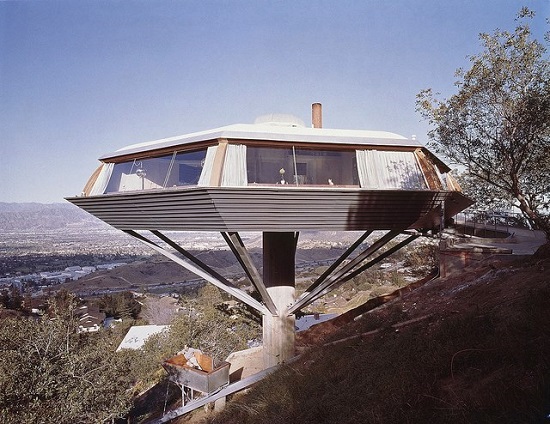
6. Interesting houses

Via Mark’s Facebook, Los Angeles 1960:

10348290_10152393879591120_5708361107307885719_n_550

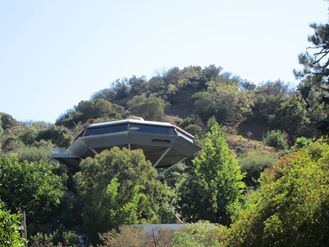
From the road:

65565_843304512354593_8784921791314625353_n

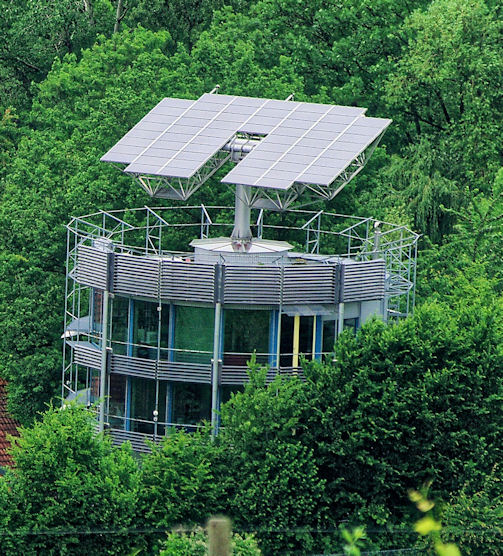
“Heliotrop”, University of Stuttgart’s “sunflower”-house which produces energy using a large photovoltaic sail on its roof:

trarch011234

RET: the battle lines are drawn

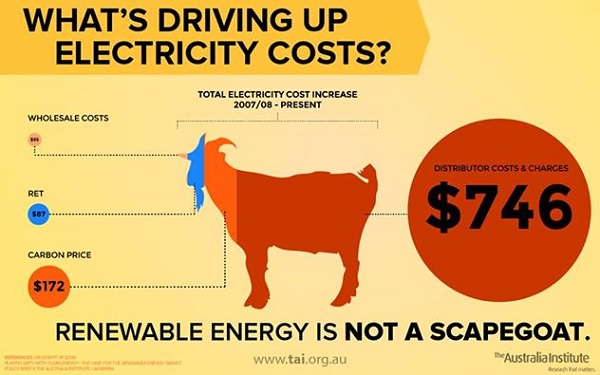
The Renewable Energy target (RET) has been severely scapegoated on electricity prices according to The Australia Institute Facebook:

TAI_10712743_10152423558294397_2440449757786334261_n_600

The Tea Party LNP Government and Labor have agreed to talk, to find a bipartisan position on the RET. The LNP has now set out what must be an ambit claim:

  • The RET will constitute a so-called “real 20 per cent” of Australia’s electricity production.
  • Emissions from intensives industries, including aluminium, copper, zinc and cement will be exempt.
  • The small-scale solar panel scheme will remain untouched.
  • Biannual reviews of the target will cease.

As background, the RET was legislated in 2009 as 41,000 gigawatt hours, representing 20% of the electricity estimated to be produced in Australia in 2020.

Since then electricity demand has collapsed, meaning the 41,000 gigawatt hour target is now closer to 27%.

This was Bill Shorten’s response:

“The government say they want a real 20 per cent, I call it a fraud 20 per cent, a fake 20 per cent. The truth of the matter is that renewable energy is part of our energy mix. It’s had a great benefit for a whole lot of consumers,” Mr Shorten said.

“We’ve seen thousands of jobs created…and we’ve seen billions of dollars of investment. The real damage that this government’s doing in renewable energy cannot be overstated.”

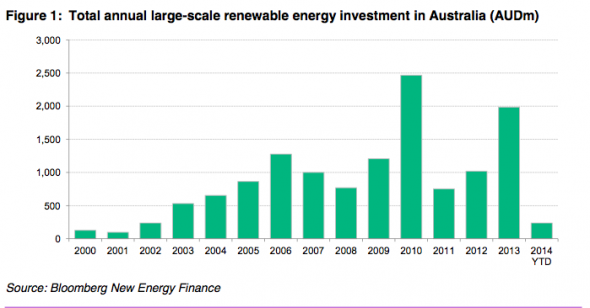
As John Davidson has been saying repeatedly, the damage is already very evident, as shown in this graph:

bnef-investment-590x308

The renewables industry reaction:

But the renewable energy industry said the target as proposed would devastate the industry and jeopardise millions of dollars in investment.

Lane Crockett, general manager of PacificHydro, said: “What reason can there be [for this cut] other than to protect the coal industry?”

Ironically the LNP position would be seen as something of a win internally for Greg Hunt in the face of the climate scepticism that infects the governing parties.

On the matter of reviews, the LNP have been saying that the Warburton Review was required by legislation. I think the truth is that by law the review should be done by The Climate Authority, which still exists. According to Lenore Taylor at The Guardian:

The Climate Change Authority announced this week it was conducting its own review of the RET before December, as required under law.

I wonder who is paying their bills.

Giles Parkinson points out that The Climate Authority will look at the RET in terms of its contribution to reducing emissions rather than consumer prices. That is novel in the current environment – reviewing the RET in the light of its original purpose!

In that article Christine Milne in estimates hearings chewed out the PMs Department which ran the Warburton review for allowing the review to go beyond its terms of reference and recommending the most expensive options.

The Government is clearly in thrall of the fossil power lobbyists. Giles Parkinson again:

The Abbott government has confirmed that its opening position in talks with the Labor Party is for a “real” 20 per cent target, meaning that the amount of large scale renewable energy being built in Australia over the next 5 years could be cut by two thirds from the current target.

This was one of the key recommendations of the Warburton Review, which made the recommendation despite finding that the cost to consumers would be far less if it left the target at the current level of 41,000GWh by 2020, or made it a 30 per cent target by 2030. (Emphasis added)

Dick Warburton ended up as a very confused puppy. As John Davidson said:

Climate Spectator had this post on Dick Warburton, the Chair of the RET review committee and his performance on a Fran Kelly interview after his review had been released. It gives a picture of a man who doesn’t understand his own report or anything much else apart from the need to recommend the destruction of the RET and all the jobs it has created.

But the LNP are also responding to the popularity of rooftop solar where around “15,000 Australian households add rooftop solar each month, despite the disappearance of state-based feed in tariffs.” After all nine out of 10 households have considered or would consider installing roof-top solar.

Large scale investments are for decades rather than for years. Genuine bipartisanship to a long term commitment is needed. Even if an agreement can be cobbled together in the talks, there is a real question as to whether investors in large scale renewables in Australia will consider it worth the risk.

Abbott not rewarded for behaving badly

I heard the headline on the ABC news on Tuesday morning. The latest Newspoll showed that Australians overwhelmingly approved of Abbott’s statement about shirt-fronting Vladimir Putin. So I bought the Australian while I was out, and indeed they did – 63% in favour and only 27% against. They approved in all demographics – women 60%, the young 57% and Labor voters 51%. The headline was:

Abbott wins backing for Putin face-off

Actually, the story was almost relegated from the front page. It occupied one column on the far right. There was nothing positive about Labor on the front page, nothing at all. Nor in the headings and subheadings on page 2.

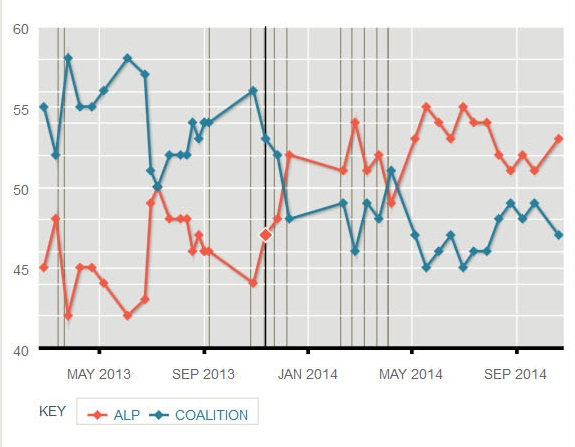
It’s something of a surprise to find, therefore, that this was the two-party preferred result:

Newspoll 17-19 Oct 14_cropped

In TPP terms Labor had increased two points to be 53-47 ahead. That’s landslide territory, and a stunning result.

Curiously Labor’s primary vote had stayed the same at 34% while the LNP had lost 3 points to reside at 38%. Ostensibly their loss had gone to the Greens who were now at 14%.

Everyone understood that Abbott was playing to a domestic audience, most of all the Russians, where Julie Bishop and Putin have since had what seemed a sensible and calm chat about things that concern Australians. So far, at least, Abboitt has not been rewarded politically at home.

It’s true that the Morgan Poll had the TPP gap narrowing by a point to 52-48 in favour of Labor. Curiously the LNP primary vote was down half a point, while Labor was up by the same amount and the Greens and others remained the same. The difference was in the flow of preferences.

But the bottom line is that Morgan too saw no great move to the LNP and Labor is still in a comfortable winning position.

As an aside, Abbott would be well advised to keep his shirt-fronting to the metaphorical level. Putin is said to be a black belt in judo. As such he would have umpteen ways of ensuring that Abbott’s body momentum towards him would result in Abbott literally biting the dust.

Honouring Gough Whitlam

“Gough Whitlam changed the way Australia thought about itself and gave the country a new destiny. A more inclusive and compassionate society at home – a more engaged and relevant country abroad.

“He snapped Australia out of the Menzian torpor – the orthodoxy that had rocked the country asleep, giving it new vitality and focus. But more than that, bringing Australia to terms with its geography and place in the region.

“Along his journey he also renovated the Labor Party, making it useful again as an instrument of reform to Australian society.

“He will be missed by all who identified with his values and determination to see Australia a better place. But no one will miss him more than his family.”

From the SMH, that was Paul Keating’s summary. That will do me. If you start listing how he changed Australia, you are bound to miss something important, no matter how long the list. He was like no other. Comparison’s are pointless.

This morning I woke to Gerard Henderson on local ABC being mean-spirited about Whitlam’s “incompetence” and a prime minister. The ABC’s idea of ‘balance’. Other than that comments have been universally positive. Certainly politics was always interesting when Whitlam was in power, and he had some wild men in his cabinet.

For my own experience, two things stand out.

Firstly, early in 1975 I was separated from my wife and about 20 months later we had an amicably arranged no-fault divorce. Before Whitlam that would not have been possible. What often happened was that one partner engaged a private eye to catch the other in a compromising situation. Someone had to be at fault. In our case there was nothing to see. The marriage had simply ceased to work.

Secondly, when Whitlam was elected I was the first ever Supervisor, School Library Service, for the Queensland Government. School libraries had been in a dreadful state, but some progress had been made with the Commonwealth funded Secondary Schools Libraries Program. For primary schools we were trying to improve things but there was a desperate lack of resources.

Come the Whitlam government and we soon had a primary schools library program, plus lots of special needs programs and massive general funds for schools generally. I remember visiting Catholic parish primary schools that were literally falling down. I remember talking to a private school headmaster who said that he had always assumed that private school facilities were better. Not now. Government schools were building facilities as good or better than anything the private schools had to offer.

Overall, I recall for the first time feeling proud to be an Australian. We no longer had to apologise on multiple fronts.

This morning I learned something new about Whitlam. Susan Mitchell, who has a biography of Margaret Whitlam coming out soon, said he was actually a very shy man. And absolutely hopeless at small talk. Margaret had to cover that department for him.

My favourite story about Gough was the time he took the press gallery down to Manly beach. Gough strode out upon the waters, turned around, waved to the gallery and strode back to land without getting his feet wet. The headlines next day?

    GOUGH WHITLAM CAN’T SWIM!

May he rest in peace. We will never see his like again.

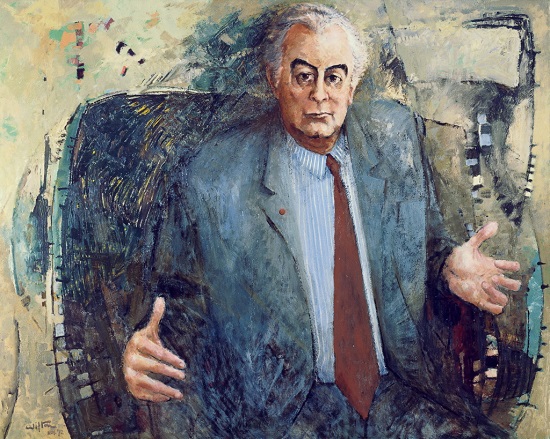
Here’s Clifton Pugh’s 1972 portrait:

*** Local Caption *** Archibald Portrait Prize winner.

Update: Be sure to check out wpd’s list of achievements @ 2.

Update 2:

John Quiggin has done an excellent assessment of Gough Whitlam.

More than any other Australian political leader, and arguably more than any other political figure, Gough Whitlam embodied social democracy in its ascendancy after World War II, its high water mark around 1970 and its defeat by what became known as neoliberalism in the wake of the crises of the 1970s.

In all of this Whitlam is emblematic of the social democratic era of the mid-20th century. Despite the resurgence of financialised capitalism, which now saturates the thinking of all mainstream political parties, the achievements of social democracy remain central to our way of life, and politicians who attack those achievements risk disaster even now.

With the failure of the global financial system now evident to all, social democratic parties have found themselves largely unable to respond. We need a renewed movement for a fairer society and a more functional economy. We can only hope for a new Whitlam to lead that movement.

Elsewhere there’s Phillip Adams’ repeat of the 20th anniversary of the Dismissal.

Climate clippings 110

1. 25 climate change disasters

Business Insider, Australia tells us that 25 disasters may befall us from climate change. The assumptions are conservative – 2°C and half a metre of sea level rise by 2100, though the text sometimes specifies more. Some of the predictions are disturbing: Continue reading Climate clippings 110

Simpson Desert crossing 1: Mt Dare to Purni Bore

It was a long day, our first day in the desert, with some severe landscapes and four bodies of water. Within the first hour we had our first technical hitch (see earlier post) where a tap on our largest water container turned itself on, watering the road with about 17 litres of water before we remedied the situation: Continue reading Simpson Desert crossing 1: Mt Dare to Purni Bore

Saturday salon 18/10

voltaire_230

An open thread where, at your leisure, you can discuss anything you like, well, within reason and the Comments Policy. Include here news and views, plus any notable personal experiences from the week and the weekend.

For climate topics please use the most recent Climate clippings.

The gentleman in the image is Voltaire, who for a time graced the court of Frederick II of Prussia, known as Frederick the Great. King Fred loved to talk about the universe and everything at the end of a day’s work. He also used the salons of Berlin to get feedback in the development of public policy.

Fred would only talk in French; he regarded German as barbaric. Here we’ll use English.

The thread will be a stoush-free zone. The Comments Policy says:

The aim [of this site] is to provide a venue for people to contribute and to engage in a civil and respectful manner.

Here are a few bits and pieces that came to my attention last week.

1. National curriculum review

The Conversation asked several experts to comment on the Review of the Australian Curriculum conducted by Dr Kevin Donnelly and Professor Ken Wiltshire. As far as I can make out, the Government will make a final response by early next year and hopes that changes can be implemented by the states in 2016.

This is insane.

The Review seems to call for a rewriting of the entire curriculum, a task which would take years.

Moreover, the Review calls for a restructuring of the Australian Curriculum Assessment and Reporting Authority (ACARA), the body which would do the rewriting, which will take time. It seems unlikely that the states will have the capacity to undertake the necessary curriculum development themselves.

The Review itself seems to be based on opinion rather than research.

2. Calls to sack curriculum reviewer

One such opinion is that of Professor Barry Spurr of Sydney University, who was used as a consultant to review the teaching of English. Spurr has been suspended while the university investigates calls for his sacking. As reported on PM calls for his sacking:

follow the publication of a series of emails in which Professor Barry Spurr described Aboriginal people as “human rubbish tips” and reminisced about the 1950s, when there weren’t so many “bogans”, “fatsoes”, “Mussies” and “Chinky-poos” around.

In his review, Professor Spurr advised the Government to focus less on teaching Aboriginal and Torres Strait Islander literature and place greater emphasis on western Judeo-Christian culture.

On reading the original New Matilda report it’s hard to accept that his racist, sexist ranting is merely whimsical word games. See also here and here.

3. Classics in the English curriculum

While we are at it, Stewart Riddle and Eileen Honan took a look at the curriculum review and English literature. Remember that the Review

advised the Government to focus less on teaching Aboriginal and Torres Strait Islander literature and place greater emphasis on western Judeo-Christian culture.

They found that the national curriculum leaves the selection of texts entirely up to the schools. In fact as a result students already get a steady diet of the classics. But they probably don’t read the Bible or as six year-olds commit mediaeval verse to memory as suggested by the reviewers.

4. Five new growth centres for science and innovation

The Federal Government’s adding an extra $400 million to the science and technology budget. Five new “growth centres” are at the heart of the plan – mining, oil and gas, medical, food and advanced manufacturing.

The Government says that should boost growth and create jobs by encouraging co-operation between those sectors and the scientific community.

Sounds wonderful if you stop right there. But then this:

But the new centres will replace some existing co-operative research centres and it’s not clear what it will mean for the nation’s top research body, the CSIRO.

Opposition spokesman Kim Carr is allowed a very general criticism. I heard him later on RN’s Drive. Apparently Labor had instituted 12 such centres, which were slashed by the LNP. Also the cutbacks to research, science and innovation total a whopping $9 billion.

The headline says $400 million, but the article specifies only $188 million of government funds.

Hockey’s plan to shrink Australia continues apace!

Hiccup Hockey fluffs his lines on the BBC

Hockey_269829-2d088adc-535c-11e4-a40d-833ddda6a9b8_550

On one view Treasurer Joe Hockey made an absolute goose of himself on the BBC’s HARDtalk program the other day.

A kinder view is that Hockey and the interviewer, Stephen Sackur, were simply talking past each other. Sackur was talking about greenhouse emissions, Hockey was talking about coal exports. The question remains open as to whether Hockey understands the difference. In terms of the question he was actually asked, he was talking gibberish.

You can see the segment here or here. There are reports here and here. This is from the Australian Government transcript:

STEPHEN SACKUR:

Right, you sell an awful lot of coal in Asia and that raises questions about Australia’s commitment to cleaning up its act. You are one of the dirtiest, most greenhouse emitting countries in the OECD group of developed countries. Is your Government prepared to do anything to clean up its act?

TREASURER:

Well firstly, the comment you just made is absolutely ridiculous.

STEPHEN SACKUR:

Why?

TREASURER:

Well, Australia is a significant exporter of energy and in fact, when it comes to coal, we produce some of the cleanest coal, if that term can be used – the cleanest coal.

STEPHEN SACKUR:

(Inaudible) Highest per capita emitter of greenhouse gases of any nation in the OECD. So, what is wrong with what I am telling you? You are a very polluting nation and you have got a decision to make as a Government about whether you are prepared to do anything serious to change that.

TREASURER:

Stephen, I don’t accept the basis of your question, and why? Because we’ve got a small population and very large land mass and we are an exporter of energy, so that measurement is a falsehood in a sense because it does not properly reflect exactly what our economy is. We are on the threshold of becoming the biggest exporter of gas in the world. We are a major producer and exporter of coal. We are now selling uranium to India. We are an exporter – a trustworthy, reliable, predictable exporter of energy that is helping to drive the emergence of the middle-class in Asia. Now, that should be welcomed.

He goes on to say that the best way of tackling climate change is to help developing countries become richer, and to do this they need to burn more coal.

Greens will also be interested in Hockey’s reasoning as to why we need to increase the fuel excise:

The fundamental point is this: that we are asking Australians to pay an extra 40 cents a week in fuel taxes on average, in order to deliver the biggest road building program in Australian history.

Didn’t he promise Christine Milne that the extra funds would go on public transport? Seems she was right not to believe him.

I borrowed from Laurie Oakes’ story When Joe Hockey talks, Coalition colleagues wince for the title of this post. The story started:

HICCUP Hockey strikes again! Just when colleagues were starting to think the Treasurer might be getting his act together he produces another gaffe.

Oakes’ story was written before the BBC interview. Hockey’s was attempting to use national security to pressure Bill Shorten over Hockey’s stalled budget bills. Oakes termed this an appalling misjudgement.

“If Bill Shorten truly is honest about his commitment to deliver bipartisan support in relation to our defence efforts in the Middle East, he’ll provide bipartisan support to pay for it,” he said.

That time Abbott hastened to distance himself and to set the matter straight. Shorten was a true patriot, he said. This time, well you never know, he may agree with Hockey, being ignorant about climate change himself. Or perhaps he hoped we didn’t hear.

I think Laura Tingle got it right back in 2010, when she concluded Hockey and Andrew Robb were liars, clunkheads or both, but “whatever the combination, they are not fit to govern.”

That applies to the whole pack of them, Abbott and his front bench, with perhaps one or two notable exceptions.

Climate change, sustainability, plus sundry other stuff