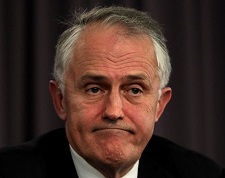
Prime Minster Malcolm Turnbull has offered the Senate crossbench a stay of execution by promising not to hold a double dissolution election if they pass two bills cracking down on unions.
Using a new model, researchers from the University of Queensland and Griffith University, predict the global average temperature could rise by 1.5°C as early as 2020. The model is based on forecasts of population and economic growth combined with rising per capita energy consumption. Continue reading Climate clippings 166→
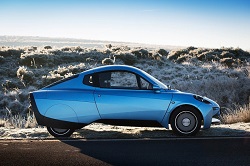
Welch company Riversimple is developing a hydrogen car, the Rasa, as in tabula rasa, which means clean slate. Rather than a design which modifies the basic layout of the internal combustion car, Rasa has a powertrain designed from scratch.
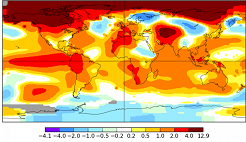
There’s been a story around that February was the hottest single month ever, and I think the ABC segment quoting Professor David Karoly may have added to the confusion. They spoke of:
preliminary analysis of surface air temperature and comprehensive analysis of satellite-based temperature observations, showing February 2016 had set a new record for the hottest ever February and the hottest ever month in long-term observation. (Emphasis added)
As we head towards an election Huffington Post reports that the Minor Party Alliance convened by “preference whisperer” Glenn Druery formulated a plan on the weekend to mount an assault in the lower house on marginal Coalition and Green seats.
1. Cyclone Winston the second strongest to make landfall
Cyclone Winston, which hit Fiji with winds of almost 300 kph, was the second strongest to make landfall, the strongest being Taiphoon Haiyan, which hit the Philippines in 2013.
Everyone seems to have an opinion about Cardinal Pell’s evidence in Rome to the child sexual abuse royal commission. Most opinions are damning in various ways. I’d recommend ABC RN’s report on their PM program for a detached report, which is not unfairly selective in the pieces it quotes.
Radio National also covered the victims before and after they met with Pell.
Some of them, including David Ridsdale, were positive about the meeting, and Pell agreed to help them further their case for changes in the Catholic Church. Continue reading Saturday salon 5/3→
In this post I’d like to identify a few technologies that are under development which go beyond the standard wind and solar. However, first I’ll link to a Climate Institute report prepared around the time of the Paris climate talks last year, which showed that in 2013 for the first time more new energy capacity was created in the form of renewables, rather than coal, gas, oil or nuclear. Back in 2001 renewables only accounted for 19% of new capacity. Now the proportion has reached 58% and is climbing steeply: Continue reading Clean power for the future→
Last week Newspoll with a 50-50 two party preferred vote looked like an outlier. This week it has been joined by the Essential Report.
The Essential Report averages the past two weeks for its new result each week. Last week it had the LNP ahead 52-48, which indicates a strong underlying shift may be at play. Continue reading Poll stuff: is the worm turning?→
At the Paris climate conference a surprise result was for the world to aim to hold “the increase in … temperature to well below 2°C … and to pursue efforts to limit the temperature increase to 1.5°C”.