NSW election winnable by Labor

The LNP appear to be cruising in NSW with opinion polls giving them 53 to 54% of the two-party preferred (TPP) vote. Yet Antony Green says they are vulnerable in the forthcoming election, just over two weeks away on 28 March.

One reason is the pattern of preference flows may emulate the recent Queensland experience. NSW and Qld use the same optional preferential voting system.

…the recent Queensland election saw a 20% decline in exhausted preferences and a similar size increase in preference flows to Labor. This factor alone was enough to add another 3% to Labor’s state wide 2-party preferred vote compared to polls. If the Queensland experience is repeated in NSW, then the published polls are over-stating the Coalition’s 2-party preferred vote.

Green gives a couple of other complicated technical reasons why the Baird Government may get a fright.

Also, as in 1991 when Greiner was forced into a minority government against the odds, Baird’s policies may play well to the Liberal heartland, but not so well in the marginal seats. Apparently the Liberals are promising to sell electricity assets, which may not go down well in the marginals.

Meanwhile Labor has announced a saleable array of policies with a focus on education, health, privatisation and coal seam gas.

  • Electricity supply would be kept in public hands. A Labor government would use the profits from the electricity network to improve services and invest in hospitals and schools.
  • Every new school will include child care or before- and after-school care facilities on site.
  • There will be funding for 200 specialist maths and science teachers in primary schools.
  • On the health front, the major promise is to abolish the co-payment for chemotherapy drugs.
  • There will be a moratorium on coal seam gas activity in NSW, with a permanent ban on the north coast and the special areas of the Sydney drinking water catchment.

Furthermore on health:

Mr Foley also promised an additional $1.7 billion for health infrastructure.

Mr Foley said Labor would introduce nurse-led walk-in medical centres to take pressure of emergency departments.

They would also build a new public hospital at Maitland and complete major redevelopments at St George and Westmead hospitals, he said.

On corruption, apparently the answer is Jodi Mckay who came through the ICAC hearings with her reputation intact and has become the party’s “pin-up girl”.

“People ask has NSW Labor learned, has NSW Labor changed,” Mr Foley said.

“I say four words: look at Jodi McKay.

“That is the face of the Labor Party I lead – bright and brave and honest.”

According to Wikipedia there are 93 seats in the Legislative Assembly, so 47 is the magic number. According to Antony Green’s election pendulum, 69 seats are LNP, 20 Labor, two Greens and two Liberal voting independents. The TPP vote in 2011 favoured the LNP 64-36 approximately, a bigger thumping for Labor than Qld in 2012.

So Labor could do it, just, but anything other than a comfortable LNP win will generate tremors in Canberra.
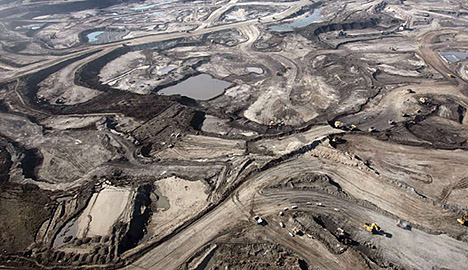
Keystone XL pipeline bill vetoed

20081104-alberta-tar-sands

President Obama has vetoed a bill to approve construction of the controversial Keystone XL pipeline, which would bring tar sands oil from Canada down to Texas refineries on the Gulf coast.

It’s important to note that the pipeline bill has been vetoed, not the pipeline.

For starters, pretty much everyone has noted that Keystone is not dead. All the veto means is that Congress isn’t able to force the pipeline’s construction through legislation — the process is just going back to being centered on the State Department’s administrative review procedure, as it largely has been for the last six years.

The State Department will consider the proposal and in their own good time make a recommendation to John Kerry as Secretary of State.

The bill was a political Tea party move to pre-empt State Department approval.

Meanwhile important court proceedings are taking place in Nebraska and South Dakota. The pipeline authority TransCanada is claiming ’eminent domain’ giving then the right to drive the pipeline through properties. About 90 Nebraska landowners claim that state law giving TransCanada the right to seize land under eminent domain is unconstitutional.

If the landowners succeed TransCanada does not have a route for the pipeline.

At Climate Central we learn that

the energy required to process tar sands oil is so great that oil piped through the Keystone XL will emit 1.3 billion more tons of greenhouse gas emissions over the pipeline’s 50-year lifespan than if it were carrying conventional crude oil.

President Obama has said he would only approve Keystone XL if it didn’t significantly increase carbon emissions. To me that makes the decision quite straightforward, but the argument is being put that the tar sands will be developed anyway, so the pipeline makes no difference.

Obama has said also that there is no need for the US to use oil from tar sands. Apparently energy security is a factor in his thinking.

A new study suggests that the majority of the oil will be used in the US.

My guess is that Obama does not want a tar sands pipeline approval as part of his legacy.

Brandis – doing his job?

Graeme Innes was a human rights commissioner under five attorneys-general from both sides of politics. He writes that George Brandis was the only one to question his integrity.

Innes was appointed in 2005 under Philip Ruddock, who said he must do the job “without fear or favour”.

I disagreed many times on policy issues with Howard ministers and staffers. Our discussions were sometimes “free and frank”, usually civil and never personal. My views were regularly questioned, my integrity was not.

Under Rudd Robert McClelland became attorney general. He said to commissioners:

Sometimes you’ll give us a kicking. Sometimes you’ll support us. That’s your job.

He took the Ruddock approach, sometimes questioning our recommendations, but never our integrity, as did attorneys-general Nicola Roxon and Mark Dreyfus.

Things changed under Brandis, he says. Now on the Triggs matter, Innes says:

Part of our democratic system, and the rule of law, provides that a key duty of any attorney general is to defend judges and statutory officers doing their jobs, because they are not in a position to easily defend themselves.

In attacking her, Brandis is not doing his job. Innes told The World Today:

“It changed under that of George Brandis, where the officers ourselves, the commissioners ourselves, the statutory officers ourselves were questioned, rather than what we were putting to the Government and the attorney from the perspective of the Human Rights Commission.

“Our integrity was questioned in the same way that Gillian Triggs’ integrity has been questioned in the last month.”

Yesterday Brandis’s peers in the Senate passed a no confidence motion in him, declaring him “unfit to hold the office of Attorney-General”.

The motion was supported by Labor, the Greens, the Palmer United Party’s two senators and Tasmanian independent Jacqui Lambie. South Australian independent Nick Xenophon and Family First Senator Bob Day both sided with the Government.

Brandis argued that the Human Rights Commission is not a court and not protected like the judiciary:

It should never be above criticism. No institution of the executive Government should be beyond criticism and beyond scrutiny. Not the ministry, not the public service, not agencies within the executive Government.

This Parliament should be a guardian, a fierce guardian of its rights to call members of the executive, and agencies of the executive Government into account.

On that basis it is the duty of politicians under parliamentary privilege to attack public servants who can’t defend themselves.

Michael Bradley, the managing partner of Marque Lawyers, says that Brandis has trampled all over the conventions that govern his own role as first law officer. In the the Westminster system the Attorney-General is supposed to have a higher duty, beyond politics, as the primary defender of the rule of law and our system of justice. He sees the HRC as included in the system of justice. It’s important that the HRC should be free to say what the Government does not want to hear. His bottom line:

If Triggs’s testimony is correct, the fact that Brandis sought to remove her from her position by offering her another job raises serious questions about his integrity. Where his actions leave us is in the untenable situation that his working relationship with Professor Triggs is irretrievably broken.

Consequently, one of them will have to go. It shouldn’t be her.

Denis Muller at The Conversation argues that The Australian newspaper has been running a concerted campaign on the Triggs issue. The paper’s position is ideological, he says, and inappropriate for the fourth estate.

ABC FactCheck has found Gillian Triggs’ assertion that in the first months of the Coalition Government the time children spent in immigration detention “was reaching quite exceptional levels” is correct.

Innes also criticised Tim Wilson’s appointment as human rights commissioner without a selection process and fresh from the Institute of Public Affairs, whose policy was to abolish the Commission. This left Susan Ryan covering disabilities as well as age discrimination, an unfair burden.

My earlier post is here.

Climate clippings 128

1. Hot and cold

My sister in Toronto tells us how cold it has been. She can’t remember the last time it reached -5°C.

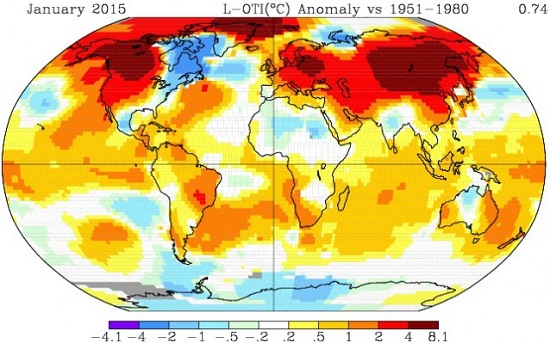
Yet NASA finds that Feb 2014 to Jan 2015 was the hottest 12 months on record. The picture tells the story:

NASA1-15-550

2. Record megadroughts predicted

The American Southwest and the great Plains could experience the worst megadroughts in ancient and modern times.

According to the findings, future droughts in both regions will be more severe than even the hottest, driest megadroughts of the 12th and 13th centuries, which are believed to have contributed to the fall of ancient Native American civilizations that inhabited the Southwest, such as the Pueblo Indians.

Climate Central gives the odds.

The chances of a megadrought (lasting 35 years or longer) are up to 50%.

The odds of a decade-long drought are around 90%.

There’s also a 5-10 percent chance that parts of the region could see a state of “permanent” megadrought lasting 50 years or longer under the highest-warming scenario, a greenhouse gas emissions path we’re currently on.

3. New era of climate action and hope

Christiana Figueres reckons 2015 is going to be a transformational year in climate change action. She of course is the boss-person of the United Nations Framework Convention on Climate Change (UNFCCC) which is sponsoring the Paris talks in December.

Amongst other things she mentions the June Live Earth concerts initiated by Al Gore and Kevin Wall (reviving their 2007 effort) to be held in New York, South Africa, Australia, China, Brazil and Paris.

She also plugs the UNFCCC’s Momentum for Change initiative, including Lighthouse Activities.

4. UK parties in pact on climate change

David Cameron, Nick Clegg and Ed Miliband have agreed to work together to tackle climate change, as they warned it posed a threat to national security and economic prosperity.

In what might be seen as a surprising move in the run-up to the general election, the three party leaders have pledged to work “across party lines” to agree cuts to the UK’s carbon emissions.

They have also signed up to seeking a “fair, strong, legally binding” international climate deal, set to be negotiated in Paris at the end of the year, to limit global temperature rises to below 2C – the level beyond which “dangerous” climate change is expected.

And they pledged to move to a low-carbon economy, ending the use of coal without technology to capture and store its emissions for power generation. (Emphasis added)

5. Tesla’s fancy home battery

Tesla will start production in about six months, all going well.

“We are going to unveil the Tesla home battery, the consumer battery that would be for use in people’s houses or businesses fairly soon.”

“Some will be like the Model S pack: something flat, 5 inches off the wall, wall mounted, with a beautiful cover, an integrated bi-directional inverter, and plug and play.”

Thanks to Geoff Henderson who linked to this one recently at Saturday Salon. Yes, it could indeed be a game changer.

6. Laser ignition to replace spark plugs

A team at Princeton Optronics working on replacing conventional spark plugs with laser igniters has produced a running engine and they claim that replacing spark ignition with lasers could improve the efficiency of gasoline powered engines by 27%. Considering that the basic design of the spark plug hasn’t really changed in over a century, this would be a revolutionary step, frickin’ lasers or not.

Because the spark plug is located on the edge of the combustion chamber, not all of the fuel is combusted. Laser ignition can be directed to the centre of the chamber, or in fact to multiple parts of the chamber in extremely rapid succession. Ignition can also be more accurately timed in relation to the movement of the piston. The result is a more complete burn and greater fuel efficiency.

7. Climate oscillations and the global warming faux pause

Michael Mann posts on research he was conducted, with others, on multidecadal climate oscillations in the Pacific and the Atlantic Oceans. They found that the Pacific dominates and was the predominant cause of a slight slowing in predicted warming over the past decade-and-a-half or so.

It is possible that the downturn in the PMO [Pacific Multidecadal Oscillation] itself reflects a “dynamical response” of the climate to global warming. Indeed, I have suggested this possibility before. But the state-of-the-art climate model simulations analyzed in our current study suggest that this phenomenon is a manifestation of purely random, internal oscillations in the climate system.

This has implications for the future.

Given the pattern of past historical variation, this trend will likely reverse with internal variability, instead adding to anthropogenic warming in the coming decades.

The “false pause” may simply have been a cause for false complacency, when it comes to averting dangerous climate change.

Reminder Climate clippings is an open thread and can be used for exchanging news and views on climate.

Seeing is believing

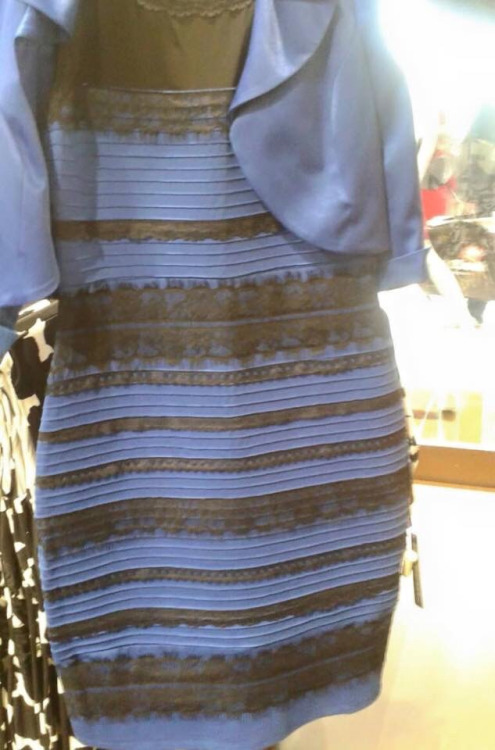
You may have seen this dress from tumblr:

Dress_tumblr_nkcjuq8Tdr1tnacy1o1_500

It’s meant to be black and blue, or white and gold. Some can see it both ways and some see it differently after going for a walk.

I think it’s blue and gold – definitely!

For different reactions, see Business Insider.

I’ve heard two different academics explain what’s going on. I’d say that colour comes to us through light waves, but is constructed subjectively by each of our brains.

I think the clue on this one is that they used blue and black and ran a yellow light filter over it.

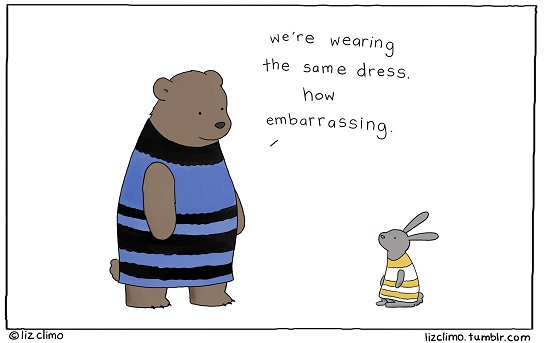
From Mark’s Facebook here are a couple of pics riffing off the original:

11004632_866503820081241_2100077878764959895_o_550

10996047_10153066530092808_2495256040498996279_n_500

By the way, we used to have a carpet at our place until we ripped it up. I saw it as grey, my wife saw it as green. She was right, of course!

Abbott shoots himself in the foot – again

Chris Uhlmann and Sabra Lane say that pressure is building in the Liberal Party to remove Prime Minister Tony Abbott and that backbenchers and ministers say the Malcolm Turnbull now has the numbers. The leadership issue has risen again because of the brutal attack launched on Gillian Triggs as President of the Human Rights Commission. Ben Eltham says:

In a show of belligerence that has stunned seasoned political observers, the Abbott government has declared a personal vendetta against one of the most respected lawyers in the land. Triggs’ personal ethics have been questioned, her competence and impartiality attacked, and her conduct impugned.

Turnbull has certainly put some distance between himself and Abbott on the matter. He says that criticism of Triggs “misses the point” the point being the children in detention. Further, he said that Triggs was “a very distinguished international legal academic”.

Eltham again:

The findings of The Forgotten Children report should shame us all. Triggs found that children have been sexually and physically assaulted in federal care. Some children have been detained for more than 27 months. Many are denied education. Unaccompanied children are locked up in adult compounds. They are mentally and emotionally traumatised. There have been multiple instances of attempted suicide and self-harm.

A government with a scintilla of compassion would have welcomed the report, and redoubled its efforts to get children out of these hell-holes. And, if the Abbott government had wanted to, it could have spun the findings in its favour. For instance, the report found that there are fewer children in detention now than under the previous Labor government.

Instead the Government advised her that it had lost confidence in her and suggested that her legal talents might otherwise be employed by the Government. She declined. It then launched a public attack, bringing up also her finding in the Basikbasik matter.

A galaxy of legal scholars has signed a letter supporting Triggs, pointing out, inter alia, that the Government is not obliged to take her advice, a point she understands well.

Distinguished retired lawyer Hal Wooten tells why he signed up. He respects Triggs personally and professionally, the facts of the report speak for themselves.

Once again Mr Abbott has proved a loose cannon, but this time his wild firing threatens grave pain and injustice to a courageous and honourable public servant, and the undermining of a much needed national institution, as well as obscuring the terrible effect of detention on innocent children.

Richard Flanagan says that some day a PM will apologise for what it is now doing. He thinks:

The only accusation of Gillian Triggs with the ring of truth is that she has lost the confidence of the government – but then so too has Tony Abbott. Gillian Triggs’s real crime is that as human rights commissioner she spoke up for human rights with a government that has no respect for them.

He also sees women and children as being at the bottom of the pile, as it were. Triggs is being attacked as a woman speaking up for children.

Bill Shorten says Tony Abbott sank to ‘a new low’ over Gillian Triggs’s treatment and that Abbott was ‘psychologically unsuited’ to the prime ministership.

Annabel Crabb says the Government is thumping Triggs when it could/should be thumping Labor. It has also presented Labor with the moral high ground.

Jonathon Green has written the speech Abbott could have made about Triggs’ report, with Triggs at his side.

One point is that there were 1500 children in detention when the LNP took over. Now there are 126.

For the record, from Berard Keane at Crikey, this is what Chris Moraitis from Brandis’s department told the Senate hearings:

“There were essentially three points that I was asked to make. One was that the Attorney had lost confidence in Professor Triggs as chairperson. He retained significant goodwill towards her and had high regard for her legal skills. In that respect, he was asking me to formally put on the table or mention that there would be a senior legal role, a specific senior role, that her skills could be used for.”

Brandis later quibbled over the word “position” being tossed around, emphasising that the offer was for a role. But an offer there surely was, later denied by Julie Bishop representing Brandis in the House of Representatives.

Meanwhile much of importance, such as the McClure report on social security, is not being discussed.

Abbott’s war on terror

TONY ABBOTT NATIONAL SECURITY ADDRESS

The tricky thing about Man Haron Monis and the Lindt Café siege, is that he acted alone and was taken rather as a harmless buffoon by the security agencies. The terror threat from random actors is very real. Annabel Crabb says that

It’s clearly an escalating threat situation. Anyone carrying on today about how Tony Abbott is just cooking it all up to save his own skin is thinking wishfully.

She says that there are now:

Four hundred current investigations by ASIO, sixty-two new biometric screening gates to catch people travelling on false passports, forty-nine extra AFP officers across Sydney, Melbourne and Canberra working on the problem of Aussie jihadists abroad, and so on.

Certainly Abbott is playing to a political strength. Newspoll tells us that 51% think Abbott is best at handling the nation’s security, whereas 31% go for Shorten. 7% say neither, and 11% are uncommitted.

What the Government intends to do was spelt out on Radio National’s PM:

  • There will be a national counter-terrorism co-ordinator “to bring the same drive and focus to this as we’ve brought to Operation Sovereign Borders.”
  • On immigration a harder line will be taken to “keep out people with security questions over them.”
  • “The Government will develop amendments to the Australian Citizenship Act so that we can revoke or suspend Australian Citizenship in the case of dual nationals.”
  • The Government is looking at “suspending some of the privileges of citizenship for individuals involved in terrorism.” Privileges susceptible to suspension could include “the ability to leave or return to Australia”, “access to consular services overseas” and “access to welfare payments”.
  • The Government will take action against hate preachers by “enforcing our strengthened terrorism advocacy laws” including “new programs to challenge terrorist propaganda and to provide alternative online material based on Australian values, and it will include stronger prohibitions on vilifying, intimidating or inciting hatred.”
  • Muslim community leaders should speak up more. When they talk about Islam being a religion of peace that they should mean it.

All this doesn’t actually amount to much, according to Annabel Crabb, apart from enforcing existing laws and some blowhard (my term) urging.

Bill Shorten offered bipartisanship, saying that Labor would “engage constructively” with the government but counselled:

Haste and confusion is never the friend of good, sensible security in the future.

Abbott had also said quite explicitly that individual liberties might have to be sacrificed to ensure the safety of the community.

According to Grattan:

Shorten said there always should be a strong presumption in favour of individual liberty. “This presumption should only be reduced, rebutted or offset to the extent that current arrangements are proven to be inadequate.”

I’m concerned about what Abbott and Brandis might do in returning to section 18C of the Racial Discrimination Act. Frankly I’m concerned about anything Brandis does after getting out of bed.

I’m concerned about revoking citizenship. Once people are Australians, we should take responsibility for them rather than shunt them to a different jurisdiction, or virtually render them stateless.

Sangeetha Pillai argues that there’s more to be lost than gained in stripping citizenship. She says that most of what is proposed that is achievable can already be achieved by other means. In other words existing laws suffice. She says “commentators have been quick to note that amendments along these lines carry the risk of exacerbating feelings of social disaffection that can underpin extremism.” Her bottom line:

The limited potential effectiveness of the proposed measures, combined with the challenges of implementation and the possibility for them to be counter-productive, suggests that the losses may outweigh the gains.

I’m concerned also that there might be hassling of Muslim’s and consequent increased radicalisation.

Abbott’s words about Muslim community leaders were, according to Michelle Grattan:

“I’ve often heard Western leaders describe Islam as a ‘religion of peace’. I wish more Muslim leaders would say that more often, and mean it.”

Shorten and Julie Bishop were quick to distance themselves from these remarks. One Muslin community leader suggested that Abbott should engage in anything he chose except politics. I understand that some community leaders declined to attend a special briefing.

Randa Abdel-Fattah has a fine piece on the ABC religion and Ethics site:

Flanked by a row of Australian flags, Tony Abbott, like a priest performing a rite of passage, formally inducted Australian Muslims into the category of Australia’s primary Other.

The Prime Minister’s stated intention was to provide the nation with clarity and reassurance – just in case the decade-long stream of moral panic, manufactured fear and Islamophobic sentiment had left Australians in any doubt as to who successive governments deem as “un-Australian.”

In a way, the Prime Minister has done Muslims a favour. For he has made explicit what is at the heart of this government’s war on terror (picking up where previous governments left off). It has never been about targeting a radical minority or national security per se. The real struggle is to re-configure our social, discursive and symbolic relations around a politics of us and them.

There are many tragic consequences to this state of affairs. But at least the government has now laid bare the fact that it is prepared to hold social cohesion, justice and national security to ransom in its war on terror.

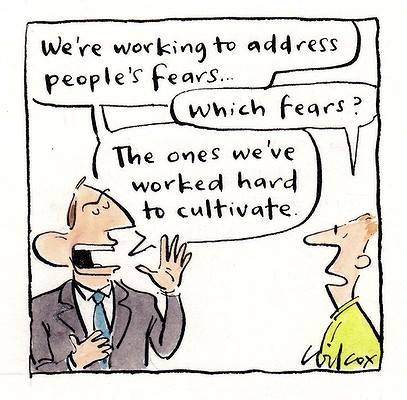
I’ll finish with this Wilcox cartoon from August last year:

10385377_10152391991503191_5473164664640791266_n

I’m sorry, Annabel Crabb, the problem’s for real, but Abbott isn’t – not entirely. Guy Rundle says Abbott should act like a statesman. It seems to be beyond him.

Abbott’s battles back, but will he make it?

Abbott has two big challenges right now. One is to settle his party, organisational and political, down and the other is to cream Labor in the polls.

On the latter it was one step forward with a long way to go. Morgan saw the LNP improve from 43-57 to 44-56. Still in wipe-out territory. The only demographic were the LNP heads Labor in the TPP vote is the 65+ group.

In Newspoll the LNP improved from 43-57 to 47-53, a difference worth writing about. Nevertheless it leaves Labor with a comfortable winning position.

The Greens were unchanged at 12 per cent.

The papers are making much of Bill Shorten’s net approval rating, which dipped from +2 to -14. Abbott’s ‘improved’ from -44 to -43.

Shorten still heads Abbott as preferred prime minister 43 to 35, with Abbott closing from a hopeless 48 to 30 thumping last time.

In personality terms Abbott is a shocker. The Abbott-Shorten scores are:

    Understands the major issues 52-68

    Cares for people 55-71

    Arrogant 77-46

    Likeable 40-64

    In touch with voters 33-63

    Trustworthy 43-59

They were remarkably similar on Experienced, Decisive and strong and Vision for Australia.

On handling issues they stack up Abbott-Shorten as follows:

Australia’s economy 45-37

National security 51-31

Health and Medicare 30-56

Education 33-53

Asylum seekers 51-32

Climate change 24-55

With that one the scores should add up to 100, with the shortfall made up of Neither and Uncommitted. These totalled from 14 to 21%.

Politically Abbott is playing to his strength with his ‘war on terror’ which I hope to post on soon.

It is possible to battle back from a desperately losing position, as Howard did in 2001, largely on the back of a war on asylum seekers.

He did have his party behind him.

True, after the liberals had lost the blue ribbon seat of Ryan in a by-election and party president Shane Stone sent him a memo accusing the government of being “mean and tricky”. Essentially Howard took notice.

The “mean and tricky” leak is now being compared to Fairfax’s publication of excerpts from two candid and blunt emails from party treasurer Phil Higginson. RN’s PM reporter James Glenday:

it’s now obvious the Prime Minister’s grasp on power is being actively undermined by a steady stream of leaks.

Abbott:

Plainly there is this desire on the part of some to damage and destroy this government.

But who? The Drum looks at the leaks that rocked Australian politics politics. All were damaging and the leakers were never discovered. Could be one of the seven ministers who are said to have Abbott on notice.

Guy Rundle in a delicious (for lefties) article at Crikey (paywalled, unfortunately) says we are we are watching the throes of a dying government:

Like Howard in 2007, Abbott is politically dead — he just doesn’t seem to have noticed yet.

How good is this? Seriously, how good is it? I know I should start a piece about the Abbott government in some more serious vein, about the new stuff about redrawing the line between security and freedom being the desperate act of a dying government but no less dangerous for that, but ehhhh …

frontbench555x295

They tell us lies, but are they clunkheads?

Back in 2010 just after the election and before the Gillard minority government had been formed, Laura Tingle wrote:

There are two possible explanations for how an opposition presenting itself as an alternative government could end up with an $11 billion hole in the cost of its election commitments.

One is that they are liars, the other is that they are clunkheads. Actually there is a third explanation: they are liars and clunkheads.

But whatever the combination, they are not fit to govern. (Emphasis added)

I visited this theme again in 2013 before the election, when Tingle took a look:

at where the PEFO numbers leave the LNPs budget task and finds that, at best, $25 billion more in ‘saves’ will be required.

She was commenting on the competence of the Joe Hockey/Andrew Robb team. Robb has of course since been replaced by Mathias Cormann.

Peter Martin has now written a searing critique of the Abbott government’s economic performance against what they tell us. Cormann told the ABC

the economy was “heading in the right direction”. He wanted “to build on the achievements we made in 2014”.

Martin comments:

That year began with a quarterly rate of economic growth of 1 per cent. After the budget, it slid to 0.5 per cent, and then to 0.3 per cent. It’s falling, rather than rising. The direction is down. (Ignore the through-the-year figures Cormann quoted. They make the budget look good by including the very strong economic growth that preceded it.)

Here’s what the Reserve bank said:

“In Australia the available information suggests that growth is continuing at a below-trend pace, with domestic demand growth overall quite weak.”

It’s weak and it’s bleak. It isn’t heading “in the right direction”.

Hockey and Cormann will tell you that while unemployment is growing, employment is too.

The Reserve Bank points out that monthly hours worked have scarcely changed since December 2011 despite three years of population growth. They barely moved at all in 2014.

Hockey told us the poorest Australians “either don’t have cars or actually don’t drive very far in many cases.” They do. Petrol is a bigger part their budget than it is for the rich.

Hockey said:

his own wealthy electorate of North Sydney had “one of the highest bulk-billing rates in Australia”.

Make that one of the lowest in Sydney.

Hockey said that typical Australians pay nearly half their income in tax. They don’t. Even those on $200,000 pay only 36%.

Then this:

Hockey said Australia was on track to run out of money to pay for its health, welfare and education systems. The figures put forward by his then health minister suggested otherwise. In ten years the cost of Medicare had climbed 124 per cent, the cost of the Pharmaceutical Benefits Scheme 90 per cent and the cost of public hospitals 83 per cent. But Australia’s gross domestic product – the money we would use to pay for these things – climbed 94 per cent.

Trust has evaporated, and without trust consumers and business lack confidence, which has been sliding since September.

Specific businesses are at a standstill. Universities don’t know what fees they will be allowed to charge, students enrolling don’t know what fees they will eventually be asked to pay, doctors don’t know what will happen to their incomes, electricity generators don’t know what will happen to the renewable energy target, big businesses don’t know whether they will be hit with the 1.5 per cent paid parental leave levy and what it will be used for.

Hockey_1423723802102_500

Focussing on the budget, Alan Austin at Independent Australia finds a revenue megafail, all of the government’s own making.

Failures in revenue include:

    1. Closing off $7.6 billion in annual revenue from the carbon tax

    2. Closing off $3.4 billion revenue from the mining tax

    3. Closing off $3.6 billion from changes to tax and superannuation rules

    4. Failing to pursue $1.1 billion shifted by multinational companies to offshore tax havens

    5. Failing to pursue other tax avoidance schemes

    6. Failing to pursue tax evasion

    7. Failing to forecast resources revenue write-down

    8. Failing to anticipate falling revenue from corporate sector

This comes on top of the earlier post in which Austin found 40 expenditure items where money was wasted. Such as the Italian Carrara marble panelling Defence is putting in a Canberra building, to take one at random.

On the revenue megafail, Austin says, all were Coalition decisions, the deterioration has been dramatic, we got precisely the opposite of what was promised, it will take a treasurer and finance minister with a high level of competence, courage and authority to restore the situation, and finally, as the experiences of Spain, Ireland, Hong Kong, Venezuela and other countries show, damage done to an economy in a short time can take decades to repair.

On debt Austin says:

The Abbott Government inherited the best-performed economy in the world in 2013. Some say the best the world has seen since data collection began. Within nine months, however, ABC Fact Check confirmed deficits for the forward estimate period had doubled over Labor’s level. Now, after 17 months, net government debt has increased over Labor’s by 34.6%. It’s on track to have doubled by this time next year.

I think the initial question about liars and clunkheads answers itself.

Chris Bowen promises us a warts and all budget narrative. We’ll have to wait and see. Meanwhile Hockey is setting up to scare us to death with the intergenerational report.

See also

Hockey’s debt and deficit mess.

Abbott explodes his economic credibility

Welcome to the the Green Tea Coalition

Traditionally, doubting climate science has been an article of faith for the US Tea Party.  Imagine my surprise at seeing this New Yorker  report that sections of the Tea Party are now actively supporting rooftop solar and teaming up with the Sierra Club to form the “Green Tea Coalition.  Coalition action includes:

helping defeat an effort by Georgia Power to impose heavy fees on customers with rooftop solar systems.”

So what is going on and are there implications for climate action in Australia?

The Tea party leader behind these moves is Debbie Dooley.  Debbie is definitely not someone from the Tea party fringe. She is

one of the twenty-two organizers of the first nationwide Tea Party protest, in 2009…. a co-founder of the Atlanta Tea Party, on the board of directors of the national Tea Party Patriots, and, since 2012, has been a fierce solar-power advocate.

In addition, much of what she says in support of solar is pure Tea Party:

“I thought that the regulated (utility) monopoly in Georgia had far too much power…” Solar, …. promised to give people energy autonomy. “The average person cannot build a power plant, but they can install solar panels on their rooftop, and they should be able to sell that energy to friends and neighbors if they wish.”

She also talks about:

solar energy, the free market, consumer choice, and national security. “Rooftop solar makes it harder for terrorists to render a devastating blow to our power grid,” she said. “There’s nothing more centralized in our nation. If terrorists were able to take down nine key substations, it would cause a blackout coast to coast.”….

and actions such as leading

a major ballot initiative that would amend that state’s (Florida) constitution to allow individuals and businesses with solar panels to sell the power that they generate directly to their tenants or neighbors. (Current law permits only utility companies to sell electricity.)

The key things here are a growing aversion to big business trying to limit the freedom of individuals in addition in addition to the traditional Tea Party aversion to big government.  There is no suggestion that the Tea party side of the coalition has suddenly decided to become climate change believers.

So what are the lessons for Australia given that the Tea party is an artifact of US culture?   For me there a few key reminders:

  1. You don’t have to believe in climate science to do things that help slow climate change.
  2. In some cases ideological things like individualism. aversion to big business/government will help with things like rooftop solar, household recycling, urban farming etc.
  3. In other cases the fracking companies are helping build the case against fossil gas while helping to build the regional Greens vote.
  4. Then there is finance.  The thing that is most likely to kill thermal coal projects and fossil power stations these days is the banks perception that these have become very risky investments.
  5. Then there is the economy.   What the world economy needs right now is a big drive against Greenhouse emissions – You don’t need to believe in climate science – Just sensible economics.

No, I haven’t gone over to the Tea party but it is worth reading the rest of the New Yorker article on the fights that Dooley has fought and won against the likes of the Koch Bros and more.

If you want to find out even more, admire the picture, imagine Abbott stewing in the Tea Cup and go to:  Green Tea Coalition

Green Tea Coalition

Bi-partisan Coalition of Environmentalists and tea party activists seeking common ground on common sense energy solutions for a stronger American economy.

Climate change, sustainability, plus sundry other stuff