Tag Archives: renewable energy

Climate clippings 114

1. Ocean acidification charted

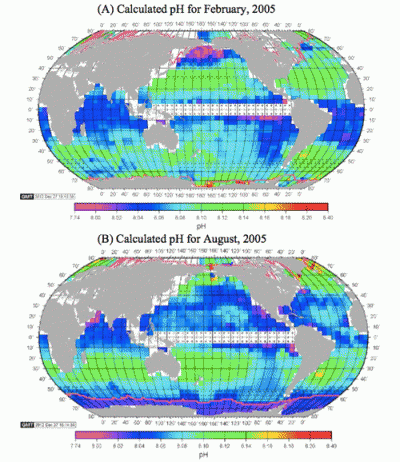
Apparently there has been no baseline data for ocean acidification, which varies around the world. Now a database of the current state of the ocean has been compiled. Here is a map showing the rough state of play:
11_18_14_Brian_OceanAcidificationBaseline_400_462_s_c1_c_c

The current rate of acidification for the ocean is the greatest seen in the past 300 million years. 25% of co2 emitted ends up in the ocean.

This article offers some hope that some species may adapt.

2. Warmest October

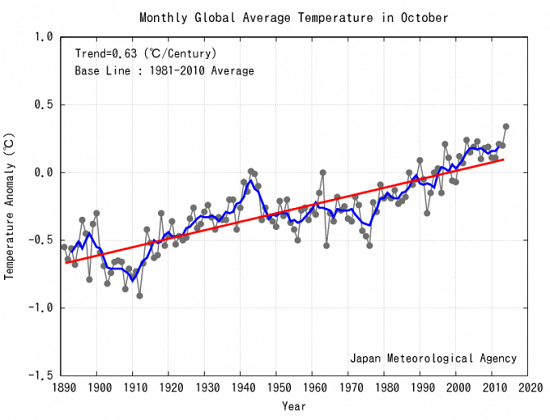
NASA has October as the warmest since 1880 along with 2005. The Japanese Meteorological Agency has it as the warmest ever:
11_14_14_Brian_JMAOctTemp_679_519_s_c1_c_c_550

No warming pause there!

So far an El Niño still has not developed, which would make things warmer.

3. Climate Council report fingers us

The Climate Council has published a new report Lagging Behind: Australia and the Global Response to Climate Change. The key findings are:

  • China and the US have firmly moved from laggards to global leaders on climate change.
  • In the last five years most countries around the world have accelerated action on climate change as the consequences have become more and more clear.
  • Australia, a crucial player in global climate action, moves from leader to laggard.
  • Global action must accelerate to protect Australia and the world from the consequences of a changing climate, sea level rise and more frequent and intense extreme weather.

Now, 39 countries and over 20 sub-national jurisdictions are putting a price on carbon. China has the world’s second largest carbon market with 250 million people covered. In the US 10 states have carbon markets, covering 79 million people.

Germany has decoupled growth from carbon pollution. Since 1990 GDP has increased 37% while emissions have fallen 25%.

According to the IEA and the OECD for every $1 spent to support renewable energy, another $6 is spent on fossil fuel subsidies, but investment in renewable energy at US$192 billion now exceeds that in fossil fuel energy at US$102 billion.

Australia is the 15th largest emitter out of 186 countries. We emit roughly the same as France, Italy and Turkey, each with three times the population.

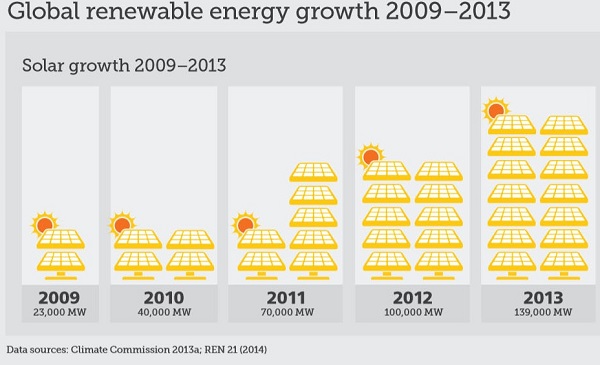
Here’s the world wide solar growth:
Solar_cropped_600

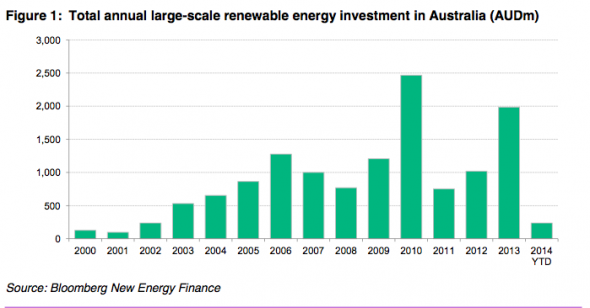
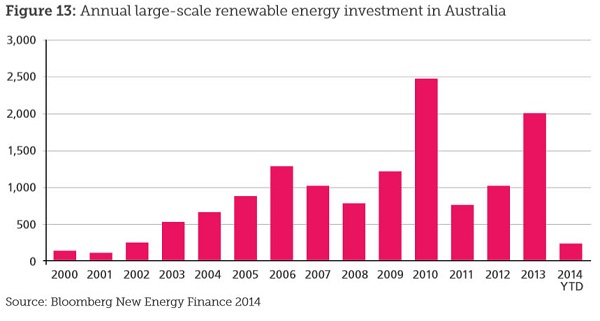
Our record on large scale renewables:
Aust renewables_cropped 600

Time to get on our bike!

4. Climate Council on renewables

The Climate Council report finds that around the world important initiatives on renewables are often taken at the sub-national level. In Australia:

  • South Australia is striding forward leading the Australian States on renewable energy.
  • Victoria and NSW have moved from leaders to laggards in Australia’s renewable energy race.
  • Australia has substantial opportunities for renewable energy. A lack of clear federal policy has led to a drop in renewable energy investment.

Only SA and the ACT have renewable energy targets – SA 50% of electricity by 2025, the ACT 90% by 2020. The current state of play is:
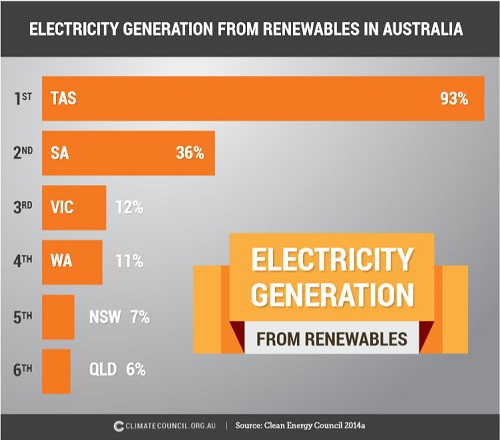
Renewable energy generation_cropped_500

SA narrowly pips QLD in terms of percentage of dwellings with solar PV:
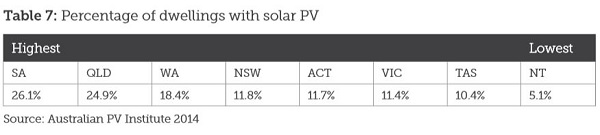
Solar PV_cropped_600

Both have roughly a quarter.

The potential for renewables in Australia is huge – some 500 times current electricity generation.

Australia produces per capita 23.96 tCO2e as against an OECD average of 12.47. As I said, time to get on our bike!

5. China caps coal use by 2020

From Climate Progress

The Chinese government announced Wednesday it would cap coal use by 2020. The Chinese State Council, or cabinet, said the peak would be 4.2 billion tonnes, a one-sixth increase over current consumption.

This is a staggering reversal of Chinese energy policy, which for two decades has been centered around building a coal plant or more a week. Now they’ll be building the equivalent in carbon-free power every week for decades, while the construction rate of new coal plants decelerates like a crash-test dummy.

The 2020 coal peak utterly refutes the GOP claim that China’s recent climate pledge “requires the Chinese to do nothing at all for 16 years.” Indeed, independent analyses make clear a 2020 coal peak announcement was the inevitable outcome of China’s game-changing climate deal deal with the U.S. last week, where China agreed to peak its total carbon pollution emissions in 2030 — or earlier.

6. Australia a pariah

Giles Parkinson thinks other nations are deliberately trying to embarrass Australia on climate change. Certainly Obama’s remarks can be interpreted that way. Then he (Giles) really gets stuck in:

We are, quite possibly, witnessing the most incompetent and ideologically blind government ever to hold power in Canberra. It’s effectively the Tea Party of Australia, pretending to be something else.
RET: the battle lines are drawn

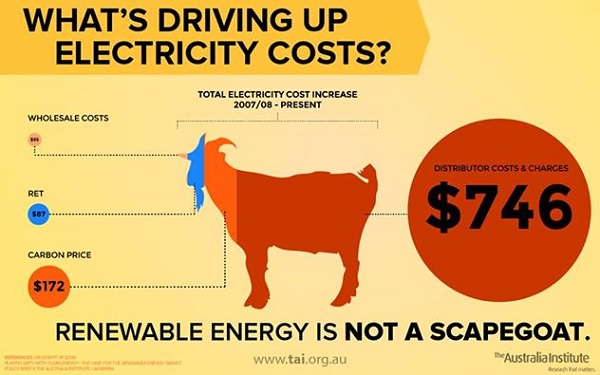
The Renewable Energy target (RET) has been severely scapegoated on electricity prices according to The Australia Institute Facebook:

TAI_10712743_10152423558294397_2440449757786334261_n_600

The Tea Party LNP Government and Labor have agreed to talk, to find a bipartisan position on the RET. The LNP has now set out what must be an ambit claim:

  • The RET will constitute a so-called “real 20 per cent” of Australia’s electricity production.
  • Emissions from intensives industries, including aluminium, copper, zinc and cement will be exempt.
  • The small-scale solar panel scheme will remain untouched.
  • Biannual reviews of the target will cease.

As background, the RET was legislated in 2009 as 41,000 gigawatt hours, representing 20% of the electricity estimated to be produced in Australia in 2020.

Since then electricity demand has collapsed, meaning the 41,000 gigawatt hour target is now closer to 27%.

This was Bill Shorten’s response:

“The government say they want a real 20 per cent, I call it a fraud 20 per cent, a fake 20 per cent. The truth of the matter is that renewable energy is part of our energy mix. It’s had a great benefit for a whole lot of consumers,” Mr Shorten said.

“We’ve seen thousands of jobs created…and we’ve seen billions of dollars of investment. The real damage that this government’s doing in renewable energy cannot be overstated.”

As John Davidson has been saying repeatedly, the damage is already very evident, as shown in this graph:

bnef-investment-590x308

The renewables industry reaction:

But the renewable energy industry said the target as proposed would devastate the industry and jeopardise millions of dollars in investment.

Lane Crockett, general manager of PacificHydro, said: “What reason can there be [for this cut] other than to protect the coal industry?”

Ironically the LNP position would be seen as something of a win internally for Greg Hunt in the face of the climate scepticism that infects the governing parties.

On the matter of reviews, the LNP have been saying that the Warburton Review was required by legislation. I think the truth is that by law the review should be done by The Climate Authority, which still exists. According to Lenore Taylor at The Guardian:

The Climate Change Authority announced this week it was conducting its own review of the RET before December, as required under law.

I wonder who is paying their bills.

Giles Parkinson points out that The Climate Authority will look at the RET in terms of its contribution to reducing emissions rather than consumer prices. That is novel in the current environment – reviewing the RET in the light of its original purpose!

In that article Christine Milne in estimates hearings chewed out the PMs Department which ran the Warburton review for allowing the review to go beyond its terms of reference and recommending the most expensive options.

The Government is clearly in thrall of the fossil power lobbyists. Giles Parkinson again:

The Abbott government has confirmed that its opening position in talks with the Labor Party is for a “real” 20 per cent target, meaning that the amount of large scale renewable energy being built in Australia over the next 5 years could be cut by two thirds from the current target.

This was one of the key recommendations of the Warburton Review, which made the recommendation despite finding that the cost to consumers would be far less if it left the target at the current level of 41,000GWh by 2020, or made it a 30 per cent target by 2030. (Emphasis added)

Dick Warburton ended up as a very confused puppy. As John Davidson said:

Climate Spectator had this post on Dick Warburton, the Chair of the RET review committee and his performance on a Fran Kelly interview after his review had been released. It gives a picture of a man who doesn’t understand his own report or anything much else apart from the need to recommend the destruction of the RET and all the jobs it has created.

But the LNP are also responding to the popularity of rooftop solar where around “15,000 Australian households add rooftop solar each month, despite the disappearance of state-based feed in tariffs.” After all nine out of 10 households have considered or would consider installing roof-top solar.

Large scale investments are for decades rather than for years. Genuine bipartisanship to a long term commitment is needed. Even if an agreement can be cobbled together in the talks, there is a real question as to whether investors in large scale renewables in Australia will consider it worth the risk.

Australia trashes its renewables industry

Climate Progress has picked up on the story:Australia’s clean energy development plummets below Algeria, Myanmar, Thailand, and Uruguay .

Large scale clean energy development is basically dead in Australia, thanks to the Abbott Government’s negativity and delays. Giles Parkinson says that the Government is effectively trashing the industry:

Bloomberg New Energy Finance data shows that Australia is on track to record its lowest level of asset financing for large-scale renewables since 2002 – as just $193 million was committed in the third quarter of the year. From ranking No 11, in the world in 2013, Australia has fallen behind Algeria and even Myanmar.

This graph tells the story:

bnef-investment-590x308

Australia, which should be one of the world’s leaders in the industry, is seeing its industry collapse. The three biggest Australian investors in renewable energy are in deep trouble.

Industry Funds Management is being forced to write down the value of Pacific Hydro, the largest specialised investor in renewables in the country, by $685 million, according to the Australian Financial Review. This from a business that was to have been floated a year or so ago with a value of more than $2 billion.

Infigen Energy, the largest listed investor in renewables, has said it is facing massive writedowns, and potentially taking dramatic action to protect shareholder funds. It has brought Australian investments to a halt. So has Silex Systems, which has effectively abandoned the solar industry.

International investors have also made clear that their investment in Australia will end soon un less policy stability is restored. These include First Solar, Chinese wind turbine leader Goldwind, and numerous others. The US-based Recurrent Energy has already packed its bags, Spanish based FRV has said its $1.5 billion pipeline is at risk.

Australia’s year-to-date investment of $238 million in large-scale renewables development so far this year compares to Canada’s $3.1 billion.

The world leaders are now China and Japan.

China may add more than 14 gigawatts of solar capacity this year — almost a third of the global total, according to BNEF.

China is fast approaching its goal of installing 35 gigawatts of solar by the end of 2015.

Apparently they believe in picking winners and subsidies, as does Japan:

Japan, the world’s second-largest solar market, increased spending 17 percent to $8.6 billion in the third quarter. Japan has approved about 72,000 megawatts of clean energy projects since the country’s feed-in tariff program started in 2012, with about 96 percent being solar projects.

Meanwhile the LNP have entered into negotiations with Labor on the Renewable Energy Target, presumably having given up on PUP and the cross bench. Labor seems to favour a numerical target similar to the status quo, whereas the LNP favours an actual 20% target, which would be a reduction and disastrous for the industry. Labor seems to be prevailing. There is talk of an exemption for aluminium processing.

We’ll have to wait and see whether what comes out is too little too late, and whether the LNP plays fast and loose with yet another industry sector.

The RET Needs Bipartisanship- Contract Based Alternatives Don’t

Tony Abbott has already killed the Howard government’s RET scheme. No new large scale energy projects directly justified by the RET have been committed to since the start of 2013. In addition, since the Abbott government was elected, the price of large-scale renewable energy certificates had nearly halved to $26.00 per MWh by 11 Aug 14.  To make things worse, the RET is not going to be resurrected by a change of government or action by the Senate.

Continue reading The RET Needs Bipartisanship- Contract Based Alternatives Don’t

Power To The People

That’s the title of Four Corners tonight.

It’s advertised as being about renewable energy. According to reporter Stephen Long on local radio, he and a photographer went to the United States and looked at developments, not just in alternative technologies in power production, storage etc, but also in new models of distributed energy production.

He likened what’s happening to the challenge of the new media to traditional newspapers. Old energy systems will have to adapt or shrink and die.

Newspapers, telecommunications and the entertainment industry have all felt the chill winds of change brought on by new technology. Now science is revolutionising power generation. Technology is making alternative sources of energy cheaper, more user-friendly and, crucially, it’s decentralising production to the rooftops of homes and commercial buildings across Australia.

So why is the Federal Government moving away from its commitment to renewable sources of energy? Why would it consider reducing renewable energy targets, favouring greenhouse-gas emitting coal and gas?

He also looks at new electric cars.

Climate clippings 101

A miscellany this week, with an emphasis on Australian policy and opinion.

The main links for each item is in the heading.

1. Kiribati buys land in Fiji

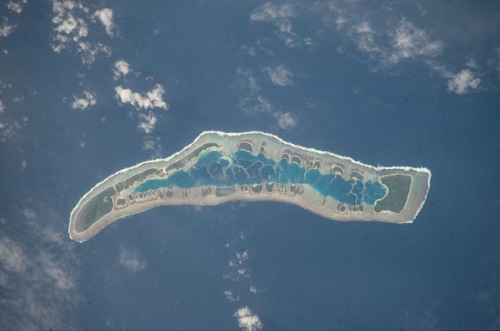
Millenium Island_9459385804_0e30488a67_k1-500

That’s Millenium Island in Kiribati which tops out at six metres above sea level. In parts of Kiribati the sea level is rising by 1.2 cm a year, about four times more than the global average.

Kiribati recently purchased eight square miles of land about 1,200 miles away on Vanua Levu, Fiji’s second-largest island. The immediate intention relates to food security. They will use the land for agriculture and aquatic farming.

That’s not a lot of land but Kiribati itself comprises just over 100,000 people scattered across 33 low-lying coral atolls totalling about 313 square miles.

The article notes that Kiribati’s reef structure can grow at 10 to 15 mm a year, faster than the IPCC expects sea level to rise, but it is not certain such growth in coral reefs translates to habitable land. My expectation is that later in this century sea level rise will far outstrip any coral growth.

2. Australians unhappy over Coalition’s response to climate challenge

JWS Research on behalf of the Climate Institute found that 70% of Australians accept the mainstream scientific position that climate change is occurring, up 10% since 2012.

while more than half of respondents felt the federal government was the primary body which should address climate change, there was a negative rating of -18 when people were asked to rank the government’s performance.

This compares to a -1 rating from last year.

A mere 20% of those questioned said they are convinced that Tony Abbott is concerned about climate change, with 53% feeling that he isn’t. Nearly a third of people believe opposition leader Bill Shorten is worried about the problem, with around the same proportion of people thinking the reverse is true.

In a further blow to the Coalition, for the first time more people support carbon pricing than oppose it. According to the poll, 34% back the carbon pricing laws, up 6% on 2012. Public opposition to carbon pricing has collapsed by 22% since 2012, when the Coalition was repeatedly attacking the then Labor government over the policy, the poll found.

According to the poll, 47% of people think that carbon pricing is preferable to no climate change policy, with just 22% supporting the government’s alternative Direct Action policy…

3. Shorten vows to ‘re-litigate’ case for carbon pricing

He didn’t expect to have to but he’s prepared to argue the case from first principles. He says:

The real test of political leadership is a willingness to build consensus, to earn agreement, not just to yank the bell at the Downton Abbey political college and expect a servant class of obedient Australians to carry out your will.

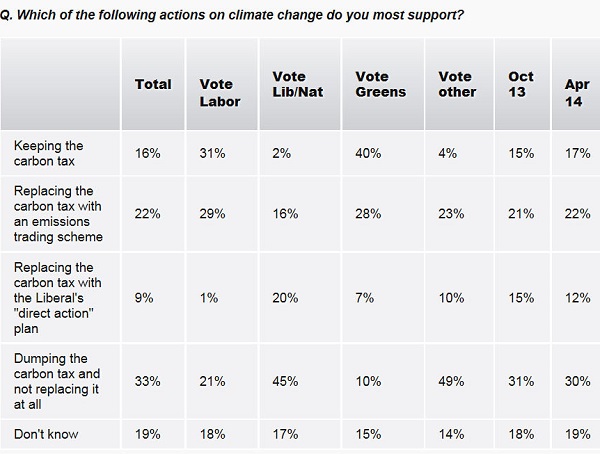
Meanwhile confusion reigns in the public mind, so I wish Bill the best of luck. Essential Research found:

Essential report_cropped_600

Support for Direct action is thin and fading in this survey at 9%. Doing nothing rates at 33% (up 3%), nearly matching the total of 38% favouring carbon pricing.

4. Great Barrier Reef tougher than thought

Scientists have put together temperatures from the Great Barrier Reef for the last 20,000 years and found that the reef has survived a range of temperatures.

They found that corals survived a 5°C rise between 20,000 years ago and 13,000 years ago. The reef is more resilient to temperature change than previously thought.

Nevertheless there are a few caveat’s to consider before a general outbreak of optimism,

Dr Helen McGregor, a Research Fellow at the Australian National University and a member of the research team:

“The Great Barrier Reef has coped with temperature changes that have occurred over a few thousand years, but now we are looking at a four degrees Celsius temperature change occurring in 100 to 150 years, so it is much more rapid.”

Then there is the small matter of ocean acidification and other human-caused impacts.

5. Abbott slams green power industry

That was the headline on the front page of the Australian Financial Review on Wednesday. On the front page we read the Abbott spiel:

“The RET is very significantly driving up power prices,” Mr Abbott said.

This, he said. posed a threat to domestic budgets and industry competitiveness, especially energy-intensive industries.

“We should be the affordable energy capital of the world, not the unaffordable energy capital of the world and that’s why the carbon tax must go and that’s why we’re reviewing the RET.”

Then over on page four we read the truth:

ACIL modelling for the Warburton review finds keeping the RET will cut average household power bills by $56 per year by 2021-2030 [sic] and extending it to 30 per cent will save householders $158. Source ACIL Allen

Andrew Richards, head of external affairs at Pacific Hydro, said recently approved gas price rises in NSW will add up to $240 a year to the average household bill. There are bigger fish to fry.

It’s a pity that the AFR can’t tell the truth on the front page – that Tony Abbott is telling porkies again.

Reminder: Use this thread as an open thread on climate change.

Saving the CEFC

Sophie Vorrath at RenewEconomy reports that both Senators Xenephon and Madigan spoke against the bill to abolish the Clean Energy Finance Corporation (CEFC). The Abbott government may not be able to complete their destructive war against renewable energy, even with the new senate next July. My understanding is that they need six votes from the cross benches. These may be hard to find.

However, Vorrath gave prize for best and most impassioned Senate speech in defence of the CEFC to WA Greens Senator Scott Ludlam, who repeatedly pointed out the lack of Coalition Senate representatives to argue their side of the debate. I’ve republished here her selection of highlights in plain text rather than italics. Continue reading Saving the CEFC

Climate clippings 88

Climate clippings_175These posts are intended to share information and ideas about climate change and hence act as a roundtable. Again, I do not want to spend time in comments rehashing whether human activity causes climate change.
This edition is completely about implementation issues and is largely based on a number of links drawn to my attention by John D, for which gratitude and thanks. I’ve restricted the offering to six items to make it more digestible.

1. The battery storage system that could close down coal power

A German company is developing relatively large scale battery storage (up to 10MW-sized battery parks) which could “stabilise the grid faster, cheaper and with greater precision that conventional generation.”

Screen-Shot-2013-11-21-at-3.48.40-am_450

It says that these systems can substitute 10 times the capacity from conventional generation – coal, nuclear and gas – and at a fraction of the cost. According to Younicos spokesman Philip Hiersemenzel, each battery park can be installed at around € 15 million, which means that for an investment of €3 billion, conventional generation in Germany’s 80GW would no longer be needed – at least for frequency and stability purposes. Continue reading Climate clippings 88

Numbers add up to keep Clean Energy Finance

This article from Climate Spectator tells us that shutting down the Clean Energy Finance Corporation (CEFC) will actually cost the government $200 million each year in lost revenues.

The article refers to an article (by Laura Tingle) in the AFR. Apparently my $3 per day subscription doesn’t entitle me to see the article online – the first time I’ve encountered this problem.

In the dead tree version we are told that the CEFC is making 7% on funds invested, as against their benchmark of 3%, being the five-year bond rate. Other than being a good Labor idea, I think the Government’s objection may be that the CEFC adds to gross debt. The fact that it adds nothing to net debt is apparently irrelevant.

The dividend stream more than covers the cost of administration. The Direct Action alternative is to pay public servants to hand out taxpayers’ money without a return.

Each dollar spent by the CEFC leverages $2.90 in private capital expenditure. So far over $500 has been spent leveraging $1.55 billion of private capital investment.

Apparently the CEFC operates in a niche that would not happen without it.

It has been able to do deals that are too small, too complicated, or not previously done in Australia. In other words, deals that bankers can’t get past their own credit committees which prefer easier propositions.

Perhaps the CEFC’s real crime is to offend Big Coal.

Queensland power generation at the crossroads

Giles Parkinson at RenewEconomy tolls the bell for fossil fuel energy producers pretty much on a daily basis. Recently he posted that Energex’ business model was broken, according to its annual report.

To explain the set-up, Energex is the state-owned electricity wholesaler and distributor for South East Queensland. It doesn’t generate power or retail power to the customers. It services 1.3 residences and other customers in an area with a population of 3.1 million:

Energex area_cropped_449

Power is generated by power stations and delivered to Energex through a high-voltage transmission network that is owned and operated by Powerlink Queensland, also a government owned corporation. Go here for brief industry structure. The network that delivers power to residences and other customers is owned and operated by Energex.

In our house we buy power from AGL. I’m not sure they do anything other than send us a bill. They probably outsource their metre reading. Certainly they outsource marketing as became clear when I asked a question of a sales representative.

Ergon Energy, also state-owned, is the equivalent company for the rest of the State. Actually it is a cluster of operating companies with several joint ventures, including SPARQ Solutions Pty Ltd, which provides information and communications technology (ICT) solutions and services to both Ergon and Energex. Ergon owns and operates 33 stand-alone power stations in remote off-grid locations selling directly to customers. The shaded area on this map shows the extent of the grid: Continue reading Queensland power generation at the crossroads

Climate clippings 78

????????????????????????? These posts are intended to share information and ideas about climate change and hence act as an open thread. This post has emphasised adaptation and mitigation, essentially what we need to do to achieve a safe climate.

Comments, about science, observations, impacts, and future predictions are welcome. I do not, however, want a rehash of whether human activity causes climate change.

1. Mining company donations to political parties

Bernard Keane Looked at the astonishing trend in mining company donations to political parties:

Mining-Donations-mine

Sandi Keane adds some value in her two part series on the cartelisation of the major parties. Bernard wrote:

The sheer scale of mining company generosity illustrates why Tony Abbott remains committed to repealing the carbon pricing package and the mining tax.

Sandi added:

He might also have added that if Abbott wins office on September 14, we will no longer have a democracy but an oligarchy – a government run by powerful mining and media magnates looking for a return on their investment – with George Pell as spiritual adviser. As Keane tweeted recently:

“Australians are a bunch of sheep about to hand themselves over to a pack of wolves”.

Continue reading Climate clippings 78

Climate clippings 76

?????????????????????????This week I’ve concentrated on the practical side of Climate change – mitigation and adaptation and the relevant policies.

1. China to cap emissions

According to Giles Parkinson news reports from China indicate that the powerful National Development and Reform Commission (NDRC) has proposed a cap on emissions from 2016, from RenewEconomy, picked up at Clean Technica.

What’s more it looks as though China will cease to be an importer of coal within a few years (please note Gina, Clive et al).

Please note also, Tony Abbott and Greg Hunt. The coalition will be phasing out the carbon price just as China is phasing it in. The LNP reckoned a price on carbon was unnecessary because the rest of the world was not going there, remember?

[Update: indigo @ 8 advises that this story is based on a passing comment from a delegate of the NDRC and that no proposal has yet gone forward.]

2. Carbon markets have to take Abbott seriously!

Two weeks ago Giles Parkinson attended a day hosted by the Carbon Market Institute looking at the future of carbon markets in Australia. It seems that the audience of bankers and such had never taken the Direct Action thing seriously, they thought was just a bit of politicking. Now they are having to face the fact that Greg Hunt, former champion debater, will almost certainly be tasked to implement whatever it turns out to be.

Antony Green’s session was the best attended. The only serious question to be resolved on September 15 is whether the LNP can get the numbers in the Senate. The final numbers, Green explained, can be a lottery, with the balance of power possibly finally held by fringe candidates no-one has heard of. Still markets have to deal with the possibilities and this is how they sit:

The forward curve of the carbon market – such as it is – is pricing odds of 60 per cent that the carbon price will no longer exist by July next year, analysts say. The market odds for it to be gone by 2016 are 80 per cent.

The forward curve for contracts in the National Electricity Market is pricing the odds around the same level. Even Bloomberg New Energy Finance, which said earlier this year that there was just a 30 per cent chance of repeal, is now reviewing that assessment and is likely to lift the odds to above 50 per cent.

And yes, there is an issue of compensation, which doesn’t figure so far in LNP budgeting.

3. No more money for adaptation research

I was intrigued to find a blogger from Knoxville, Tennessee listing five policy briefs released by Australia’s National Climate Change Adaptation Research Facility (NCCARF), with seven more to come by June 30 this year. On closer investigation, I found this speech by Yvette D’Ath officially launching their research portfolio, a portfolio of more than 140 peer-reviewed research projects across 33 universities around Australia. D’Ath praised the work of the scientists and appealed to them for help in countering climate denialism.

Ironic really as the NCCARF is to be wound up by the end of June as there was no more money coming from the Government. More than 100 researchers will be affected nationally.

Instead NCCARF2 will be funded at $3 million per annum for two years as a dissemination project.

The same Knoxville blogger notes the release of the EU Strategy on Climate Change Adaptation which was produced by the Directorate-General for Climate Action, which is a program, not a project, of the European Commission. Their 2013 program of work is worth €20.75 million and the employ 160 people internally and externally.

4. Quick charging buses come to Geneva

European technology giant ABB has developed a new technology that will help power the world’s first high-capacity flash charging electric bus system, where buses will receive top up charges in 15 seconds at selected bus stops. A pilot project termed TOSA (Trolleybus Optimisation Système Alimentation) is planned in conjunction with Geneva’s public transport company.

An arm connects with an electricity outlet in the roof of the bus shelter. At the end of the run three to four minutes gives a complete charge. It’s like a trolley bus without overhead wires.

I’m wondering how electric vehicles go with heart pacemakers. I’ve just learned that you can’t use electric hand tools with a pacemaker.

This link has a video showing roughly how the bus shelter connection is made.

5. ‘Black Carbon’ flows from soil to oceans

It was thought that ‘black carbon’ created by the burning of organic matter such as grass or forests stayed in the soil for millions of years.

By examining carbon in rivers it is now thought that up to 40% of such black carbon dissolves and flows into the oceans.

6. Soil carbon farming

I gather that soil carbon farming is a different issue, but seems similarly fraught. Di Martin investigated the soil carbon conundrum.

The shorter story is that some exceptional farmers have demonstrated that soil carbon can be increased dramatically. One farmer did this by ‘pasture cropping’. Native grasses were encouraged and the crop was sown directly into the pasture, rather than plowing, harrowing etc.

Another used ‘cell grazing’, which involves high intensity and high rotation grazing, with long rest periods for pasture.

There are problems in measurement, which may be resolvable with new technology. What is not resolvable, however, is the 100-year guarantee required by international protocols if the activity is deemed to benefit the planet.

Bernard Keane, following Lenore Taylor, was rather scathing about Direct Action soil magic.

7. Renewable energy in the wars

The fossil fuel incumbents are rolling out a campaign to damage the solar industry. One nasty trick being considered in Queensland is the following:

Gross metering – a proposal made in Queensland which would force households to sell all the output from their rooftop systems to the grid operators, and buy it back at a higher price

Campbell Newman keeps saying that feed-in tariffs PV solar are “just ridiculous”.

The campaign seems to be extending to the whole Coalition policy on renewables, if there is one.

There is increasing concern in the [renewables] industry that the Opposition will pave way for the Renewable Energy Target to be diluted, under pressure from state governments, utilities and generators worried about sliding profits from their coal and gas generators, and noisy anti-renewable lobbies promoted by the likes of [Alan] Jones.

Please note the note at the end of the piece:

it seems the biggest problem the [coal] industry faces is a lack of demand. We’ve noted this before, but this week, this was reinforced by reports from China that imported coal is sitting unwanted and clogging up the country’s biggest ports.

Deutsche Bank energy analysts said this was due to “weak coal demand all over China” which had been apparent since late last year. Indeed, half the coal companies in one region of Mongolia had ceased production of thermal coal because of falling prices, and most small coal mines in Shanxi Province had also closed, Deutsche Bank reported.

8. Solar panel art

Now for something lighter: solar panel art.

SolarForestBrianBorelloPortlandOregon