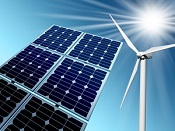
South Australia’s brave new energy plan may not have been the biggest energy news on Tuesday. The gong may go to Zen Energy‘s plan in cahoots with Santos to provide renewable baseload power.
It works this way. Solar is now the cheapest form of power when the sun is shining. So you supply solar during the day, but store some in a grid-scale battery to provide power when people are up and about at night. Then the battery gets recharged overnight from wind to provide power for the morning start until the sun takes over. The whole thing is backed up by gas. Gas is the backup of the backup. Continue reading Zen Energy’s renewable baseload power→
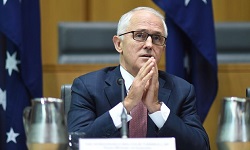
Malcolm Turnbull has now, for reasons best known to himself, elevated “energy crisis” to a “national security” issue. Ben Potter puts the situation well:
A decade of fighting over renewable energy, carbon prices and fossil fuels has left Australia with some of the world’s dirtiest and costliest energy – a bitter yield from historical abundance.
Three years ago, manufacturers began complaining they couldn’t get gas, and 18 months ago the South Australian grid started to wobble.
Now, electricity and gas prices across the eastern states are two to three times their levels only a couple of years ago.
Gas exporters overcommitted to foreign buyers; the federal government mismanaged renewable energy and the regulatory apparatus – and politicians responsible for it – are frozen in the headlights.
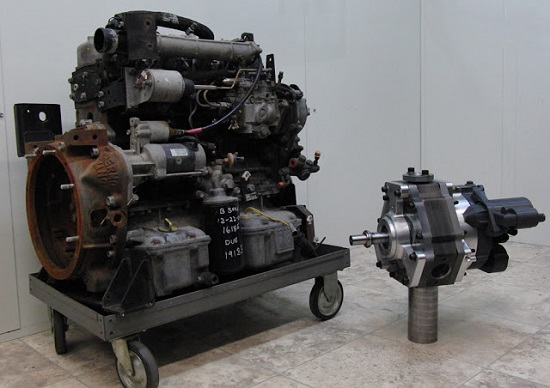
The innovative LiquidPiston engine, mentioned by BilB, is targetting a global market worth $460 billion. It has a power to weight ratio more than ten times better than a regular engine:
APRA, the Australian Prudential Regulation Authority, has warned company directors and other decision-makers that they may be held personally responsible for dumb investment decisions in relation to a transition to a low emissions economy. If a coal-fired power station with or without CCS becomes a stranded asset, whoever approved the funds could be in the gun.
That is the title of an article by Jay Weatherill as we suffered the recent heatwave. He believes that electricity supply is a public good and should be in public hands. However, the article is really a plea to Malcolm Turnbull to keep an emissions intensity scheme (EIS) on the table.
Weatherill says that we do indeed have an impending crisis, with the planned closing of Hazelwood, and another nine coal-fired power stations closing across the country: Continue reading This toxic energy row must end→
A number of reasons are being given for what was a relatively minor power blackout in South Australia, for example in Giles Parkinson’s excellent article, dud forecasts, lousy software, failing gas plants. However, the reason is actually more simple than that – no-one gets paid for despatchable standby power, only power actually used. South Australia needed standby despatchable power when record demand was forecast, and didn’t have it.
In the AFR Mark Ludlow tells us that the second unit at the Pelican Point gas-fired power station has not operated since April 2015, so it was effectively mothballed. When the need for extra power became obvious and the Australian Energy Market Operator (AEMO) approached Engie, the owners of Pelican Point, there was simply no time for a cold start. Continue reading What really happened in the SA February blackouts→
Craig Emerson says we can get the gas we need, but is it necessary?
Craig Emerson has an article in the AFR, also on his site, suggesting that politicians need to urgently turn their minds to gas supply in east Australia. Emerson had warned them back in 2014, but they took no notice, and AEMO assured everyone there was no problem.
His speech set out Turnbull’s vision for Australia’s energy future – covering renewable energy, “clean” coal, gas, power prices and electricity security. He talked up coal, saying Australia as a big exporter needs to show we are using state-of-the-art clean coal-fired technology.
The Climate Council ran a Fact Check and found clean coal is NOT A THING.
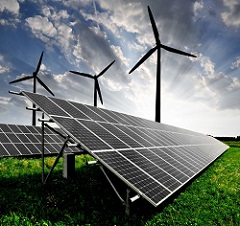
Large-scale wind and solar plants are already cheaper than new “more efficient” coal plants, and waaaay cheaper than coal plants with CCS.
Start stopping now, is the short answer. No new coal mines, oil wells or gas fields, and start decommissioning existing ones now. “Managed decline” is the new imperative.
A new study released by Oil Change International, in partnership with 14 organizations from around the world, scientifically grounds the growing movement to keep carbon in the ground by revealing the need to stop all new fossil fuel infrastructure and industry expansion. It focuses on the potential carbon emissions from developed reserves – where the wells are already drilled, the pits dug, and the pipelines, processing facilities, railways, and export terminals constructed.
A bit further down I’m going to look at what Tristan Edis has to say about electricity pricing, but first what the whole affair is doing to Turnbull.
Mark Di Stefano at Buzzfeed has a detailed account of Turnbull’s year in 2016: The Year That Broke Malcolm Turnbull, and the pictures follow the story. Turnbull starts out as a confident leader, full of hope and bright ideas, and ends as just another politician that people don’t like very much. And there is rising anger about him within the conservatives of his own party.

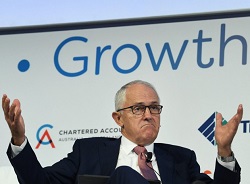 Malcolm Turnbull has now, for reasons best known to himself, elevated “energy crisis” to a “national security” issue. Ben Potter
 That’s
 A number of reasons are being given for what was a relatively minor power blackout in South Australia, for example in Giles Parkinson’s excellent article,