Category Archives: Climate Science

Sizzling summers presage a global future

Back in 2003 a heatwave centred in France killed over 70,000 people. Another which struck Moscow in 2010 killed 10,000. During the 2009 Black Saturday bushfires in Victoria 173 people tragically lost their lives from the fire. However, health authorities believe Victoria’s record-breaking heatwave may have contributed to the deaths of about another 374 people with the state’s death toll 62% higher than at same time in the previous year.

The elderly were worst affected, but the very young and those in frail health are also typically affected in events like this. Continue reading Sizzling summers presage a global future
Climate change: the end of civilisation as we know it

James Hansen said in his book Storms for my Grandchildren that if we burnt all the available coal, tars, and oil then the ‘Venus Syndrome’ would be a dead certainty, extinguishing life as we know it on the planet. He has now thought further and says that is not going to happen, the time-scales make it impossible. It would take 100 million years to get enough carbon into the atmosphere, and by that time much of it would be back on the sea floor.

However we are on a path to make living at low latitudes impossible, plus more than half the major cities in the world cling to the coastline and are subject to sea level rise. The world, he says, would become ungovernable.

How likely is this? The short answer is that we appear to be on a path to achieve an ungovernable world within a century. Continue reading Climate change: the end of civilisation as we know it

Abbott’s ‘Daring to doubt’ – how does the science stand up?

Not well at all, according to the scientists. Actually it is a travesty of language to call Abbott’s position “science”. In this piece I’ll highlight the kind of thinking that unfortunately cannot be dismissed as an Abbott aberration, but has the Turnbull government in it’s thrall. Let’s start with David Rowe’s amazing cartoon from the AFR:

Continue reading Abbott’s ‘Daring to doubt’ – how does the science stand up?

Climate clippings 117

On Monday and Tuesday this week we are going to have the AFR national Energy Summit in Sydney with everyone there, including Josh, Jay, Bill, Andrew Vesey and a different Malcolm Roberts (Chief Executive, APPEA). Should be fun.

The Weekend AFR had about half a dozen articles, led off by an article by Ben Potter, Angela Macdonald-Smith and Mark Ludlow (no doubt pay-walled) which said our energy has become dirty, expensive and annoyingly unreliable. They reckon something has to be done, it’s just that:

the causes identified by Prime Minister Malcolm Turnbull – or unofficial backbench energy spokesman Tony Abbott – are not the same as the causes power industry experts and regulators highlight. Continue reading Climate clippings 117

Storms for our grandchildren

For me the main point of George Monbiot’s article about Hurricane Harvey is that the course we are currently on to achieve 3.5 to 4°C of warming by the end of the century is equivalent in magnitude to the change between the last ice age and the balmy times of the Holocene. To talk about whether this or that extreme weather event was caused by anthropogenically induced climate change seems beside the point.
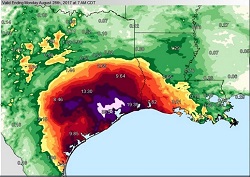
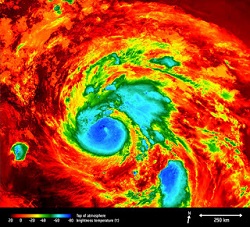
The short answer is that everything about the climate has changed, so we are experiencing a climate that is different from how it would have been, and it will change much more during the life spans of the next few generations. Generally speaking, as Climate Central’s Climate Extremes Index indicates, extreme weather events are on the increase: Continue reading Storms for our grandchildren

Climate clippings 214

1. Trump’s climate vandalism continues

Trump has picked a Republican politician, Rep. Jim Bridenstine of Oklahoma to oversee NASA, a job that often goes to astronauts or scientists.

    Bridenstine, who is the former executive director of the Tulsa Air and Space Museum and Planetarium, said in a 2013 speech on the House floor: “Global temperatures stopped rising 10 years ago. Global temperature changes, when they exist, correlate with sun output and ocean cycles.”

Continue reading Climate clippings 214

Water, water everywhere

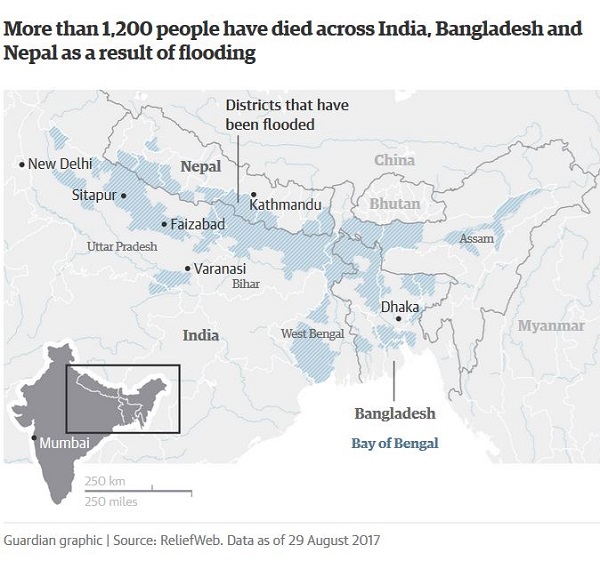
Well, not everywhere, it’s dry here this winter, but definitely in Texas, and in India, Nepal, Bangladesh and now Pakistan. In fact, in the Indian subcontinent more than 1,400 people are dead since the recent rains started, and more than 45 million are directly affected, many having had their livelihoods destroyed. Mumbai, a city of some 20 million people, had a month’s rain in a single day. Two-thirds of Bangladesh was said to be under water. Here’s an early map from August 29:

Continue reading Water, water everywhere

Climate clippings 211

1. Planting nearly 100,000 trees per day with drones

We plant about 9 billion trees each year. Unfortunately we also clear about 15 billion, leaving a deficit of 6 billion.

A system of using drones is being developed which could plant trees at 10 times the rate of hand planting and at 20 per cent of the cost by firing germinated seeds into the ground. Continue reading Climate clippings 211

Can we get to 350ppm?

Quiggin says, yes we can.

I can’t comment on his blog, because the Askimet software has got me marked as a pest, and my comments go straight to spam. There is no facility for telling Askimet I’m OK, so there it is, I’m as good as banned. So I’ll make my comments here, which are in any case longer than is form for comments there.

I’d have to say I agree with Fran Bailey’s comment, the analysis seems entirely too optimistic. Continue reading Can we get to 350ppm?