The Powerwall is a 7 kilowatt hour (kWh) lithium-ion-battery system that stores electricity generated from rooftop solar panels (or PV panels) during the day so that electricity can be used at night during the peak-usage times.
Dr Larry Marshall, former venture capitalist and now head of the CSIRO, has a brief and a vision to turn the organisation into an innovation catalyst. Climate science simply no longer fits, according to him.
The issue for us in all of our business units is we have to be aware of changes in global markets.
So if you look at the climate market, I think after Paris the argument for climate change is pretty much decided, I think that question has been answered.
So that begs the next question, what do we do about climate change? How do we adapt to it? How do we mitigate it?
And it’s inevitable that people who are gifted at you know measuring and modelling climate may not be the same people who are gifted at figuring out what to do about it, or how to mitigate it.
Bob Carter, known to many Australian geoscientists as a former professor and head of the School of Earth Sciences at James Cook University, died on 19 January at age 74. For most of his life he was known to geologists for his work in marine stratigraphy. In recent years he was known to just about everyone for his views on climate change. Here’s what the Australian Institute of Geoscientists said about his scientific contribution: Continue reading Vale Bob Carter→
China exponentially increased its use of coal in the early part of this century, so that 64% of its energy comes from coal. Now studies suggest that coal use in China declined in 2014 and may have peaked in 2013. No new mines will be approved in the next three years. Continue reading Climate clippings 162→
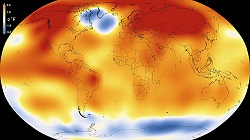
The figures are now official, 2015 was the hottest year on record:
Global surface temperature in 2015 was +0.87°C (~1.6°F) warmer than the 1951-1980 base period in the GISTEMP analysis, making 2015 the warmest year in the period of instrumental data.
Global temperature in 2015 was +1.13°C (~2.03°F) relative to the 1880-1920 mean.
It hasn’t happened yet, not officially. The final decision rests with an august scientific body called the International Commission on Stratigraphy, which has a 36-person Working Group on the Anthropocene. Now 24 scientists, including some from the Working Group, have produced a paper advocating for the Anthropocene to be recognised as having begun in the mid-20th century. Continue reading Goodbye Holocene, hello Anthropocene?→
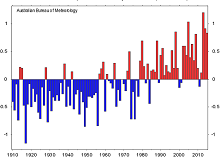
Subjectively 2015 seemed like a very hot year, so there may be some surprise to find that according to the BOM’s Annual climate statement 2015 it was only the fifth hottest year. That’s possibly because the October-December period was the hottest on record. There was exceptional heat early in October, with parts of Victoria being 7°C above normal. Nationally October was 2.89°C above the 1961-90 average, a record monthly anomaly. Continue reading Australia’s annual climate statement 2015→
The most important number in climate science is not 400 ppm or 2ºC. It’s climate sensitivity, the amount of warming we’ll get from doubling CO2 concentrations in the atmosphere. Curiously the IPCC AR5 report declined to give a number. Continue reading Reconciling estimates of climate sensitivity→
Courtesy of John D, from Gizmag, an item that has implications for algal blooms, health of species, food and methane emissions.
Specifically, the results show that the average temperature in the lakes has been rising by 0.61 degrees Fahrenheit every 10 years. While that might not seem too significant, it’s a higher rate of warming than witnessed in either the atmosphere or the ocean, and the long-term effects could be pronounced… Continue reading Climate clippings 161→
Climate change, sustainability, plus sundry other stuff


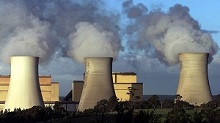 The US Supreme Court has just given the finger to the EPA’s Clean Power Plan, with implications for US democracy as well as the planet.
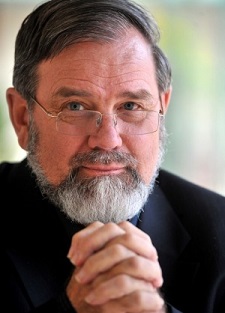 Bob Carter, known to many Australian geoscientists as a former professor and head of the School of Earth Sciences at James Cook University, died on 19 January at age 74. For most of his life he was known to geologists for his work in marine stratigraphy. In recent years he was known to just about everyone for his views on climate change. Here’s what the Australian Institute of Geoscientists said about his scientific contribution: