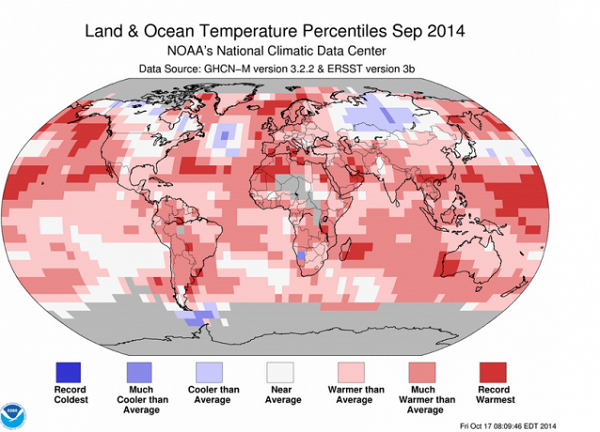
September followed August as record heat for the month worldwide. The period January-September was equal hottest with 1998 and 2010. The 12 months from October 2013 to September 2014 was the hottest 12-month period on record. The heat was just about everywhere, except for central Russia, some areas in eastern and northern Canada, and a small region in Namibia:
2. Coal is good for humanity!
Thus spake Tony Abbott, repeating lines imprinted on his mind by coal industry lobbyists.
In an important post Graham Readfearn tells how big coal is hijacking the energy poverty issue
telling the world that the only way the poorest nations can pull themselves out of poverty is by purchasing lots of their product.
The point that those same people will likely be hit earliest and hardest from the impacts of climate change being driven by that same product, is neatly swerved or underplayed.
So we have Peabody Energy “fueling the world with energy essential to sustain life”.
On the whole climate campaigners are disappointed with the new emissions targets set by the EU – 40% reduction in emissions, 27% cut in energy use and 27% of energy must be from renewables.
The ETS is seen as essential in reaching these targets, so it will be reformed in an as yet undesignated way.
Rich countries like Germany, the UK and France will have to do better than the designated cuts to compensate for the continued reliance on coal by the likes of Poland, Bulgaria and Romania.
At Climate Progress it seems the American reaction is more favourable. They point out that the targets are the first substantive offer from any member of the international community ahead of the UN climate talks to be held in Paris in 2015. The Americans and the Chinese are unlikely to go so far.
Personally when they aim for net zero emissions by 2030 and aim for 350 CO2e ppm by 2050 I’ll say they are reconnecting politics with reality.
4. Arctic sea ice escalator
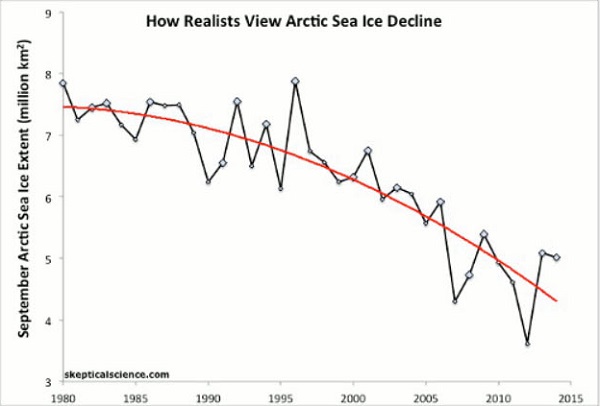
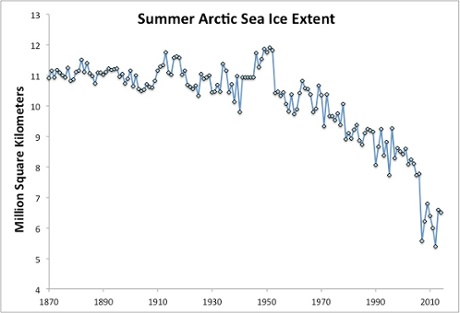
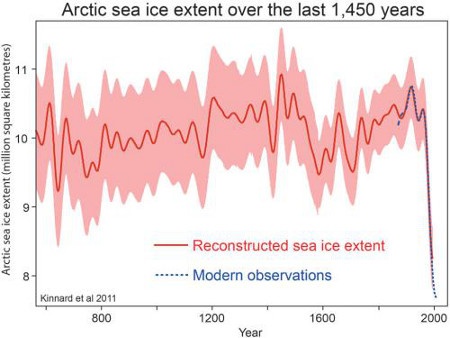
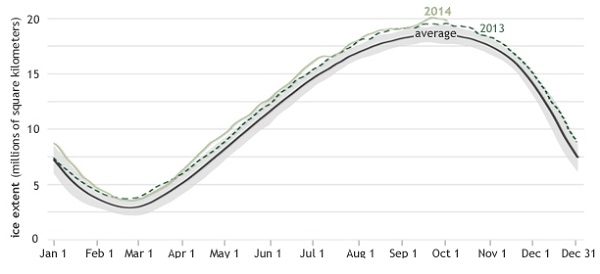
BilB drew attention to Skeptical Science’s Arctic sea ice escalator:
He’s right, the next break downwards could shock some doubters.
Perhaps enough to shake pollies of all stripes out of their torpor.
If you look at the trend from the late 1990s it looks even more dramatic.
Actually there’s something wrong with both. The y axis should go below 4. It’s like where you have a graph on a wall and the line falls off the graph and onto the wall.
Climate Change Warriors from 12 Pacific Island nations paddled canoes into the world’s largest coal port in Newcastle, Australia, Friday to bring attention to their grave fears about the consequences of climate change on their home countries.
The 30 warriors joined a flotilla of hundreds of Australians in kayaks and on surfboards to delay eight of the 12 ships scheduled to pass through the port during the nine-hour blockade, which was organised with support from the U.S.-based environmental group 350.org.
The warriors came from 12 Pacific Island countries, including Fiji, Tuvalu, Tokelau, Micronesia, Vanuatu, The Solomon Islands, Tonga,
Samoa, Papua New Guinea and Niue.
6. Norway takes to electric cars
Norway, not a member of the EU, now has 15% electric cars. Since 2011 Nissan LEAF has become the nation’s third best-selling car.
Norway is not a member of the EU. It gets 98% of its power from renewables. Presumably it doesn’t go around preaching that oil is good for humanity!
The Tea Party LNP Government and Labor have agreed to talk, to find a bipartisan position on the RET. The LNP has now set out what must be an ambit claim:
The RET will constitute a so-called “real 20 per cent” of Australia’s electricity production.
Emissions from intensives industries, including aluminium, copper, zinc and cement will be exempt.
The small-scale solar panel scheme will remain untouched.
Biannual reviews of the target will cease.
As background, the RET was legislated in 2009 as 41,000 gigawatt hours, representing 20% of the electricity estimated to be produced in Australia in 2020.
Since then electricity demand has collapsed, meaning the 41,000 gigawatt hour target is now closer to 27%.
This was Bill Shorten’s response:
“The government say they want a real 20 per cent, I call it a fraud 20 per cent, a fake 20 per cent. The truth of the matter is that renewable energy is part of our energy mix. It’s had a great benefit for a whole lot of consumers,” Mr Shorten said.
“We’ve seen thousands of jobs created…and we’ve seen billions of dollars of investment. The real damage that this government’s doing in renewable energy cannot be overstated.”
As John Davidson has been saying repeatedly, the damage is already very evident, as shown in this graph:
The renewables industry reaction:
But the renewable energy industry said the target as proposed would devastate the industry and jeopardise millions of dollars in investment.
Lane Crockett, general manager of PacificHydro, said: “What reason can there be [for this cut] other than to protect the coal industry?”
Ironically the LNP position would be seen as something of a win internally for Greg Hunt in the face of the climate scepticism that infects the governing parties.
On the matter of reviews, the LNP have been saying that the Warburton Review was required by legislation. I think the truth is that by law the review should be done by The Climate Authority, which still exists. According to Lenore Taylor at The Guardian:
The Climate Change Authority announced this week it was conducting its own review of the RET before December, as required under law.
I wonder who is paying their bills.
Giles Parkinson points out that The Climate Authority will look at the RET in terms of its contribution to reducing emissions rather than consumer prices. That is novel in the current environment – reviewing the RET in the light of its original purpose!
In that article Christine Milne in estimates hearings chewed out the PMs Department which ran the Warburton review for allowing the review to go beyond its terms of reference and recommending the most expensive options.
The Government is clearly in thrall of the fossil power lobbyists. Giles Parkinson again:
The Abbott government has confirmed that its opening position in talks with the Labor Party is for a “real” 20 per cent target, meaning that the amount of large scale renewable energy being built in Australia over the next 5 years could be cut by two thirds from the current target.
This was one of the key recommendations of the Warburton Review, which made the recommendation despite finding that the cost to consumers would be far less if it left the target at the current level of 41,000GWh by 2020, or made it a 30 per cent target by 2030. (Emphasis added)
Dick Warburton ended up as a very confused puppy. As John Davidson said:
Climate Spectator had this post on Dick Warburton, the Chair of the RET review committee and his performance on a Fran Kelly interview after his review had been released. It gives a picture of a man who doesn’t understand his own report or anything much else apart from the need to recommend the destruction of the RET and all the jobs it has created.
But the LNP are also responding to the popularity of rooftop solar where around “15,000 Australian households add rooftop solar each month, despite the disappearance of state-based feed in tariffs.” After all nine out of 10 households have considered or would consider installing roof-top solar.
Large scale investments are for decades rather than for years. Genuine bipartisanship to a long term commitment is needed. Even if an agreement can be cobbled together in the talks, there is a real question as to whether investors in large scale renewables in Australia will consider it worth the risk.
Business Insider, Australia tells us that 25 disasters may befall us from climate change. The assumptions are conservative – 2°C and half a metre of sea level rise by 2100, though the text sometimes specifies more. Some of the predictions are disturbing: Continue reading Climate clippings 110→
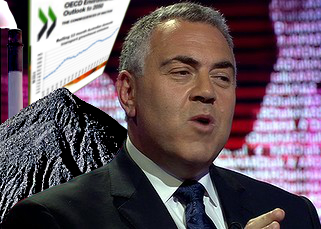
On one view Treasurer Joe Hockey made an absolute goose of himself on the BBC’s HARDtalk program the other day.
A kinder view is that Hockey and the interviewer, Stephen Sackur, were simply talking past each other. Sackur was talking about greenhouse emissions, Hockey was talking about coal exports. The question remains open as to whether Hockey understands the difference. In terms of the question he was actually asked, he was talking gibberish.
Right, you sell an awful lot of coal in Asia and that raises questions about Australia’s commitment to cleaning up its act. You are one of the dirtiest, most greenhouse emitting countries in the OECD group of developed countries. Is your Government prepared to do anything to clean up its act?
TREASURER:
Well firstly, the comment you just made is absolutely ridiculous.
STEPHEN SACKUR:
Why?
TREASURER:
Well, Australia is a significant exporter of energy and in fact, when it comes to coal, we produce some of the cleanest coal, if that term can be used – the cleanest coal.
STEPHEN SACKUR:
(Inaudible) Highest per capita emitter of greenhouse gases of any nation in the OECD. So, what is wrong with what I am telling you? You are a very polluting nation and you have got a decision to make as a Government about whether you are prepared to do anything serious to change that.
TREASURER:
Stephen, I don’t accept the basis of your question, and why? Because we’ve got a small population and very large land mass and we are an exporter of energy, so that measurement is a falsehood in a sense because it does not properly reflect exactly what our economy is. We are on the threshold of becoming the biggest exporter of gas in the world. We are a major producer and exporter of coal. We are now selling uranium to India. We are an exporter – a trustworthy, reliable, predictable exporter of energy that is helping to drive the emergence of the middle-class in Asia. Now, that should be welcomed.
He goes on to say that the best way of tackling climate change is to help developing countries become richer, and to do this they need to burn more coal.
Greens will also be interested in Hockey’s reasoning as to why we need to increase the fuel excise:
The fundamental point is this: that we are asking Australians to pay an extra 40 cents a week in fuel taxes on average, in order to deliver the biggest road building program in Australian history.
Didn’t he promise Christine Milne that the extra funds would go on public transport? Seems she was right not to believe him.
HICCUP Hockey strikes again! Just when colleagues were starting to think the Treasurer might be getting his act together he produces another gaffe.
Oakes’ story was written before the BBC interview. Hockey’s was attempting to use national security to pressure Bill Shorten over Hockey’s stalled budget bills. Oakes termed this an appalling misjudgement.
“If Bill Shorten truly is honest about his commitment to deliver bipartisan support in relation to our defence efforts in the Middle East, he’ll provide bipartisan support to pay for it,” he said.
That time Abbott hastened to distance himself and to set the matter straight. Shorten was a true patriot, he said. This time, well you never know, he may agree with Hockey, being ignorant about climate change himself. Or perhaps he hoped we didn’t hear.
I think Laura Tingle got it right back in 2010, when she concluded Hockey and Andrew Robb were liars, clunkheads or both, but “whatever the combination, they are not fit to govern.”
That applies to the whole pack of them, Abbott and his front bench, with perhaps one or two notable exceptions.
This post looks at claims that 9 out of 10 Australian households are considering going solar and the implications this has for the upcoming state elections. It also touches on some related issues such as the power industries attempts to block solar.
In Climate clippings 106, item 6 I linked to Joe Romm’s part review of Naomi Klein’s new book, This Changes Everything: Capitalism Vs The Climate. Romm promised to look at Klein’s program for action in a second post. I’m still waiting. I’ll recap here Romm’s exposition of Klein.
Romm on Klein
Klein, he says, makes three essential points:
1. Because we have ignored the increasingly urgent warnings and pleas for action from climate scientists for a quarter century (!) now, the incremental or evolutionary paths to avert catastrophic global warming that we might have been able to take in the past are closed to us.
2. Humanity faces a stark choice as a result: The end of civilization as we know it or the end of capitalism as we know it.
3. Choosing “unregulated capitalism” over human civilization would be a “morally monstrous” choice — and so the winning message for the climate movement is a moral one.
The time for ‘evolutionary’ strategies is long past. Now only ‘revolutionary’ strategies will get us there. Unregulated capitalism is a Ponzi scheme, which must collapse. The real choice facing us is a moral one.
Unchecked capitalism is immoral and will destroy civilisation as we know it.
Gareth at Hot Topic
Across the ditch Gareth at Hot topichas reviewed Klein’s book. Ultimately, he says, Klein’s vision is a moral one. She seeks
“an alternative worldview to rival the one at the heart of the ecological crisis— embedded in interdependence rather than hyper-individualism, reciprocity rather than dominance, and cooperation rather than hierarchy.”
In summary:
We need this not only to create a political context to drastically lower emissions but also to help us through the disasters now unavoidable, where respect for human rights and deep compassion will be all that stands between civilisation and barbarism.
Klein seems to be saying that with a mass movement, as with the abolition of slavery, we can prevail.
She’s really saying, however, that to change capitalism we need to change ourselves. But capitalism has shaped us powerfully to suit it’s needs. Weber’s iron cage comes to mind.
I think the problem is a step up from that faced by the slavery abolitionists. Slavery was only about how the new world acquired labour for farming. When slavery was abolished the price of food may have gone up a bit, but I suspect not much. It has been pointed out that with slavery the landowner kept the whole family. Now farm workers in the New World and elsewhere often work for less than a living wage. Farming in Africa is often practiced by women, whereas the men go off to work in the mines and elsewhere.
Yuval Harari in his book Sapiens: a brief history of humankind reckons that the core concept of modern capitalism is growth. Prior to capitalism, in the first millennium for example, economics was a zero sum game. It was assumed that if you wanted to increase your wealth you would do it by diminishing someone else’s, through plunder, or a landowner screwing more out of the peasants. One’s assumption was generally speaking that the future would be worse than the past.
To skip a bit, by the 19th century we had the industrial revolution and a belief in science and progress. The belief that the future would be better than the past was pervasive. At the same time there were also worlds to being conquered through colonialism and imperialism.
Harari says that obviously exponential growth using more energy and materials must stop somewhere. But, he says, capitalists will tell you that only capitalists can run the world they have created and no-one has much stomach for new versions of communism. Just wait a bit, they say, and goodies will flow to all.
I’ve said elsewhere that our future will not be constrained by a limit on energy. Ultimately we will have access to as much as we need or want. With nanotechnology the same may be true of materials. There is a limit, however, on the goods and services provided by nature.
To cut a long story short, capitalism will I think stay. Our only option is to civilise it. Two of the elements will have to be greater democracy and an expansion of the public sector, the things we do collectively for the good of all. And there will need to be limits to wealth.
We must re-imagine the future. Meanwhile the Scandinavians could be nearer the mark than we are.
She’s not a raving revolutionary. She wants to keep markets with greater government intervention and regulation. We are in an existential crisis; she doesn’t know what the next step is, just that we should all take it very seriously and engage. She intends to spend the rest of her life on the problem.
It’s on the way, according to reports in Climate Progressand RenewEconomy. They are reporting on reports emerging from HBSC, Citigroup and UBS, so the big end of town is taking notice.
Initial interest is in short storage to cater for the peaks, but it seems that full storage systems will become competitive before the end of the decade.
For the next ten years battery technology is likely to remain lithium ion, with newer technologies introduced later.
The top 700 metres of the ocean have been warming 24 to 55% faster since 1970 than previously thought. The problem has been poor sampling in the Southern Ocean.
Of course this means that the whole planet has been warming faster than previously thought, since over 90% of the extra heat goes into the ocean.
3. Human hands caused 2013 heat
To me 2013 seems like a long time ago, but it is remembered for breaking a lot of heat records in Australia.
January 7 was our hottest day on record – 40.3°C.
January was the hottest month on record.
The 2012-13 summer was the hottest on record.
September was the hottest on record, exceeding the previous record by more than a degree; this was the largest temperature anomaly for any month yet recorded.
September-November was the hottest on record.
The whole year of 2013 was the hottest on record.
Five studies have now been done establishing human agency in these events. We don’t just need to be concerned about our grandchildren. Climate change caused by humans is happening now.
First of all the record does not represent a dramatic increase on the recent average:
By comparison the loss of land ice has tripled in the last five years alone.
NOAA have now given a more detailed explanation of how the increase, counterintuitively, may be related to global warming. Firstly, it’s the wind:
NOAA first points out that “much of this year’s sea ice growth occurred late in the winter season, and weather records indicate that strong southerly winds blew over the Weddell Sea in mid-September 2014.”
Secondly, the melting land ice itself may have an effect:
Most of Antarctica’s ice lies in the ice sheets that cover the continent, and in recent decades, that ice has been melting. Along the coastline, ice shelves float on the ocean surface, and much of the recent melt may be driven by warm water from the deep ocean rising and making contact with ice shelf undersides.
How does the melting of land ice matter to sea ice formation? The resulting meltwater is fresher than the seawater. As it mixes with the seawater, the meltwater makes the nearby seawater slightly less dense, and slightly closer to the freezing point than the ocean water below. This less dense seawater spreads out across the ocean surface surrounding the continent, forming a stable pool of surface water that is close to the freezing point, and close to the ice onto which it could freeze.
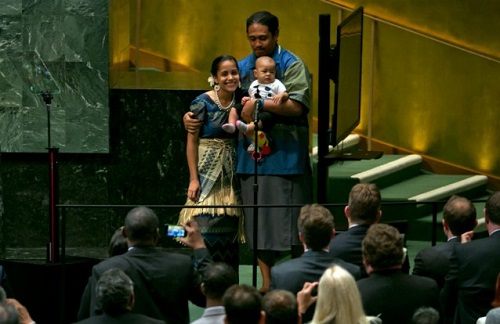
The United Nations chose 26-year-old Marshall Islands poet and mother Kathy Jetnil-Kijiner to be among the keynote speakers at the UN’s climate summit in New York recently. Here she is at the mike with her husband and child:
Marshall Islands sits on average about 2 metres above sea level. Already she’s seen waves crashing into their homes and their breadfruit trees wither from salt and droughts.
Jetnil-Kijiner was confident in her speech that, no matter how difficult, climate change would be solved, and her daughter would be able to go on living in the Marshall Islands.
“No one’s drowning, baby,” she said. “No one’s moving. No one’s losing their homeland. No one’s becoming a climate change refugee…We are drawing the line here.”
She said, accurately I think, that saving the Marshall Islands meant “ending carbon pollution within my lifetime.”
Some 125 world leaders were present. Some, like ours stayed away, having more important things to do. Anyone present with half a brain must have known that is not going to happen. The Marshall Islands is expendable.
6. Climate outlook, October to December
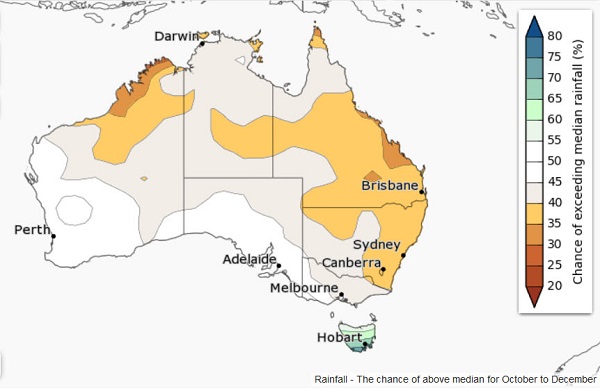
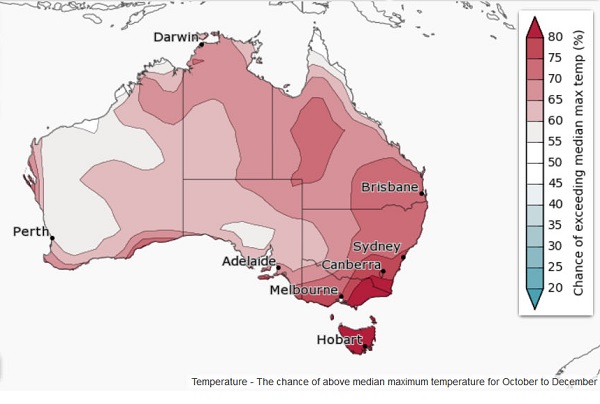
In brief, warmer and drier than average, apart from Tasmania, which looks good for rain. There’s more detail and maps here.
This is what the rainfall prospect looks like:
And maximum temperature:
Six of eight international climate models suggest a late season El Niño, or near El Niño, ENSO state is likely.
The Australia Institute is a progressive think tank that produces credible, fact based economic reports on the issues facing Australia. What I have copied here is a short article from their periodic email on recent decisions by the ANU and others to divest the shares they held of companies whose business and/or behaviour is unacceptable on social, environmental etc. grounds.
It is just part of the pressure being encouraged by organizations such as 350.org to encourage banks, super funds etc. to stop investing in and financing unethical activities such as extracting fossil fuels:
Divestment movement hits a nerve
The fossil fuel divestment movement seemed to hit a particularly sensitive nerve this week. The Australian Financial Review has published a litany of critical front page stories, editorial and opinion pieces. In particular, special outrage flowed over divestment decisions taken by the Australian National University (ANU).
ANU announced last week it would divest from seven resources companies on environmental, social and governance (ESG) grounds. ANU is home to a long running student campaign calling on them to divest from fossil fuels. Under pressure, ANU sought professional ESG research and declared it would knock out the companies that ranked worst. The companies impacted include gas giant Santos, Oil Search and other miners extracting copper, nickel and a range of other minerals.
ANU’s decision has drawn ire, not only from the companies themselves, but also from SA Premier Jay Weatherall, previous Resources and Energy Minister Gary Gray and some Indigenous groups. There have been all manner of complaints: the companies say they weren’t consulted; they have won ESG awards; Santos is a proud Australian “pioneer”; fossil fuels cure poverty “whatever the effects of carbon dioxide emissions on climate”; mining is essential to modern life, and so on. One company is talking about legal action.
Others have baulked at the unusual enthusiasm in the reactions and coverage. A Canberra Times editorial said it “verged on hysterical”. Clean energy commentator Giles Parkinson, himself an ex-AFR deputy editor, said the reaction was “as though someone had committed treason against Team Australia. Or at the very least against Team Coal.”
At first glance, coal has nothing to do with it. ANU is not divesting from coal companies – unlike Stanford, which is divesting from all big coal companies, and Glasgow University which this week said it would divest from fossil fuels. Indeed, without a sector wide screen, ANU is likely to reinvest in fossil fuels. But when ABC’s Lateline covered ANU’s decision this week, theMinerals Council sent the head of their Coal Division into bat for the miners. Maybe that’s because coal is most at risk from the reputational effects of divestment campaigns. Coal is the heaviest emitter, cheapest to substitute with renewables and at most risk of being displaced by new clean energy.
as “a major researcher in environment and alternative energy, we need to be able to put our hand on our heart when we talk to our students and to our alumni and to our researchers and be able to say that we’re confident that the sort of companies that we’re investing in are consistent with the broad themes that drive this university.”
ANU economist Warrick McKibbIn did not agree, saying “you need proper, clear, transparent policies such as carbon pricing… You don’t get the sort of adjustment we need by these token gestures by institutions like a university.”
“many of those engaged in the debate are the consumers, voters and leaders of the next several decades. In our view, this single fact carries more weight than any other data point on the planet for this issue: time, youthful energy and stamina are on the side of the fossil fuel divestment campaign.”
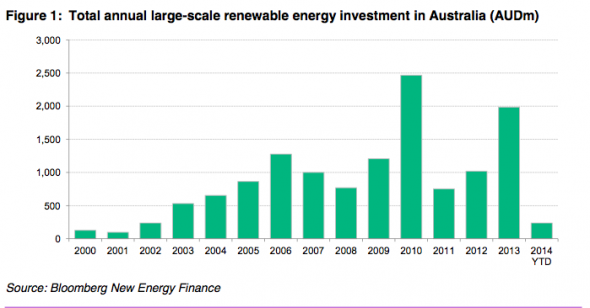
Large scale clean energy development is basically dead in Australia, thanks to the Abbott Government’s negativity and delays. Giles Parkinson says that the Government is effectively trashing the industry:
Bloomberg New Energy Finance data shows that Australia is on track to record its lowest level of asset financing for large-scale renewables since 2002 – as just $193 million was committed in the third quarter of the year. From ranking No 11, in the world in 2013, Australia has fallen behind Algeria and even Myanmar.
This graph tells the story:
Australia, which should be one of the world’s leaders in the industry, is seeing its industry collapse. The three biggest Australian investors in renewable energy are in deep trouble.
Industry Funds Management is being forced to write down the value of Pacific Hydro, the largest specialised investor in renewables in the country, by $685 million, according to the Australian Financial Review. This from a business that was to have been floated a year or so ago with a value of more than $2 billion.
Infigen Energy, the largest listed investor in renewables, has said it is facing massive writedowns, and potentially taking dramatic action to protect shareholder funds. It has brought Australian investments to a halt. So has Silex Systems, which has effectively abandoned the solar industry.
International investors have also made clear that their investment in Australia will end soon un less policy stability is restored. These include First Solar, Chinese wind turbine leader Goldwind, and numerous others. The US-based Recurrent Energy has already packed its bags, Spanish based FRV has said its $1.5 billion pipeline is at risk.
Australia’s year-to-date investment of $238 million in large-scale renewables development so far this year compares to Canada’s $3.1 billion.
The world leaders are now China and Japan.
China may add more than 14 gigawatts of solar capacity this year — almost a third of the global total, according to BNEF.
China is fast approaching its goal of installing 35 gigawatts of solar by the end of 2015.
Apparently they believe in picking winners and subsidies, as does Japan:
Japan, the world’s second-largest solar market, increased spending 17 percent to $8.6 billion in the third quarter. Japan has approved about 72,000 megawatts of clean energy projects since the country’s feed-in tariff program started in 2012, with about 96 percent being solar projects.
Meanwhile the LNP have entered into negotiations with Labor on the Renewable Energy Target, presumably having given up on PUP and the cross bench. Labor seems to favour a numerical target similar to the status quo, whereas the LNP favours an actual 20% target, which would be a reduction and disastrous for the industry. Labor seems to be prevailing. There is talk of an exemption for aluminium processing.
We’ll have to wait and see whether what comes out is too little too late, and whether the LNP plays fast and loose with yet another industry sector.
New Zealand has just had a general election. Gareth at Hot Topic tells us that
The National Party has won itself another three years in government. With a probable overall majority and the support of three fringe MPs, prime minister John Key and his cabinet will be able to do more or less what they like. Given the government’s performance on climate matters over the last six years — turning the Emissions Trading Scheme into little more than a corporate welfare handout while senior cabinet ministers flirt with outright climate denial — and with signals that they intend to modify the Resource Management Act to make it easier to drill, mine and pollute, it’s hard to avoid the conclusion that the next three years are going to see New Zealand’s climate policies slip even further out of touch with what’s really necessary.
2. China most at risk from sea level rise
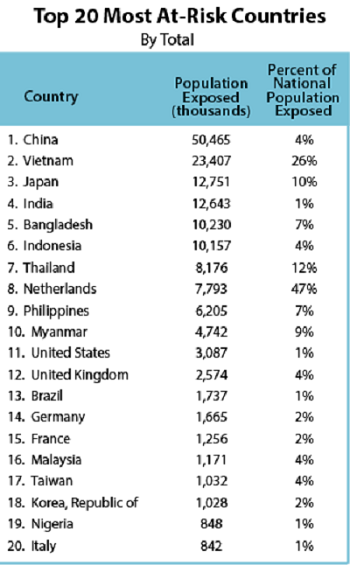
An analysis of global vulnerability to sea level rise has been done (see at Climate Central and The Carbon Brief).
China is the standout in terms of people affected, but Japan, India and Indonesia also figure prominently. This may assist international climate action negotiations, though recalcitrants like Canada and Australia don’t figure. Here’s the top 20:
Worldwide they found that “147 to 216 million people live on land that will be below sea level or regular flood levels by the end of the century, assuming emissions of heat-trapping gases continue on their current trend.”
The numbers ultimately depend on the sensitivity of sea level to warming. They say the figures may be two to three times too low, meaning as many as 650 million people may be threatened. Also population increase is not taken into account.
According to a new report, the Earth has lost half its vertebrate species — mammals, birds, fish, reptiles, and amphibians — since 1970.
The latest Living Planet Report, put out by a joint research effort between the World Wildlife Fund and the Zoological Society of London, found a stunning drop of 52 percent in the population of wild animals on the planet over the last 40 years. The most catastrophic drop was among the inhabitants of freshwater ecosystems — the last stop for much of the world’s pollution from road run-off, farming, and emissions — whose numbers declined 75 percent. Oceanic and land species both dropped roughly 40 percent.
It’s also all interconnected; land-use change can affect climate change and animal species both, then the altered climate can in turn affect the animals, and the animals’ effect on their ecosystem can in turn alter the climate again. Animals and humans both are inherent parts of the ecological fabrics they inhabit.
4. The science is clear: act now
Roger Jones and Roger Bodman have an article at The Conversation, republished at Understanding Climate Risk commenting on an article by Steven Koonin, New York University theoretical physicist and former US Under Secretary of Energy for Science, published in the Wall Street Journal and The Australian. Koonin accepts that the climate is changing and that human activity is having an effect, but:
Rather, the crucial, unsettled scientific question for policy is, “How will the climate change over the next century under both natural and human influences?” Answers to that question at the global and regional levels, as well as to equally complex questions of how ecosystems and human activities will be affected, should inform our choices about energy and infrastructure.
Koonin’s argument is technical, but he amplifies the uncertainties and does not properly attend to risk. Details which have no great relevance, such as the failure of models to explain why Antarctic sea ice cover is expanding, are amplified. His conclusion is that the science is urgent, but the uncertainty is such that there is no proper basis for action.
To answer in detail would require a volume. Jones and Bodman address his use of the concepts of doubt, uncertainty, confidence and risk and find his argument lacks an appreciation of how scientists use these concepts. Crucially, “acting now and learning as we go is a better way to manage uncertainty than waiting and learning.” On the main issue,s while uncertainty can be reduced at the margins with observations over time, overall the science is clear, we must act now!
%. No cash flows as Louisiana coast slides into the sea
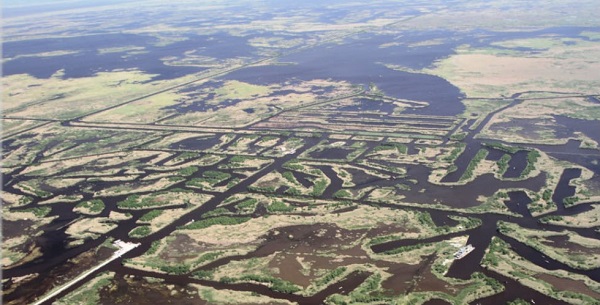
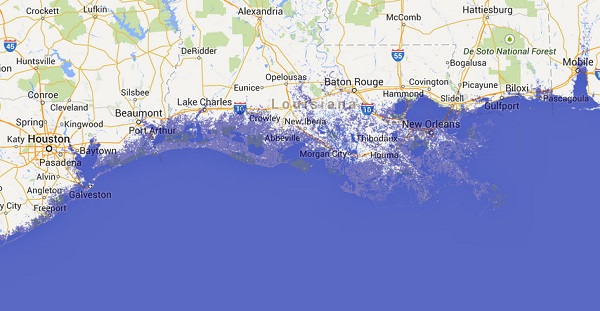
While the issue is mired in legal wrangles, the Louisiana weltands are sliding into the sea at the rate of 75 square kilometres and saltwater increasingly penetrates. In 2012 a $50 billion repair plane was formulated, but the prospects of adequate funding are remote.
I’ve extracted an image of the flood map showing what 5 metres of sea level rise would look like, which is what I think we are looking at in the next 200 years:
Mind you according to paleoclimate data the long-term effect of 400ppm of CO2 is 25m plus or minus 5. A rise of just one metre badly shreds the coastline.
if the UK cut its carbon emissions by 60 per cent from 1990 levels by 2030, as it has promised, its GDP would be 1.1 per cent bigger than if it stuck with fossil fuels, says a study by consultants at Cambridge Econometrics.
About half the gain would come from cheap running costs for fuel-efficient cars, with 190,000 new green jobs and higher wages also helping. The average household would be £565 a year better off.
I find each report has limitations in its own way, so at the end I remain agnostic.
The fourth, the IMF study, looks at carbon pricing in the top 20 emitters. As far as I can make out it comes up with two propositions. First, each country can act on its own, with benefit, no-one has to wait for the world to act. Secondly, it identifies a sweet spot, which varies quite a lot from one country to the next, where net benefits accrue from carbon pricing. In Australia’s case it’s only $11.50 per tonne.
This is all very promising but is not as such a plan for climate stabilisation at safe levels.
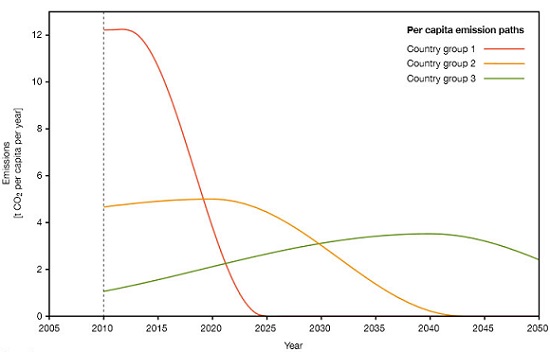
The third, the American study, finds the aim of reducing emissions by 40% from 2005 levels by 2035 doable and beneficial. The problem here is in the task identification. The study assumes that the US should decarbonise at the same rate as the rest of the world. It ignores the ‘carbon budgeting approach’ whereby high per capita emitters need to decarbonise rapidly to make space for developing countries to grow their economies. See Figure 5 of this post on the IPCC report. The United States is a Group 1 country, which must decarbonise rapidly:
Figure 5: The climate budget approach
As we saw in this post, two thirds of increased emissions are now coming from emerging and less developed countries. In other words in reality increases from Group 2 and 3 countries are not being offset by cuts in Group 1 countries. Until we get our heads around this issue and address it we’ll stumble along on the road to perdition!
The problem facing Group 1 countries is impossible. The way around it lies in emissions trading between rich and poor countries, as per Figure 6 in that post. This would entail considerable wealth transfer, which could be mandated to be used in greening developing country economies.
Also 40% by 2035 overall is not a recipe for a safe climate, as shown below.
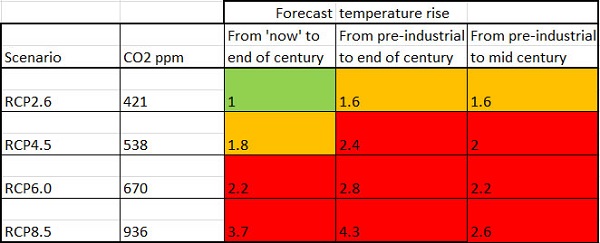
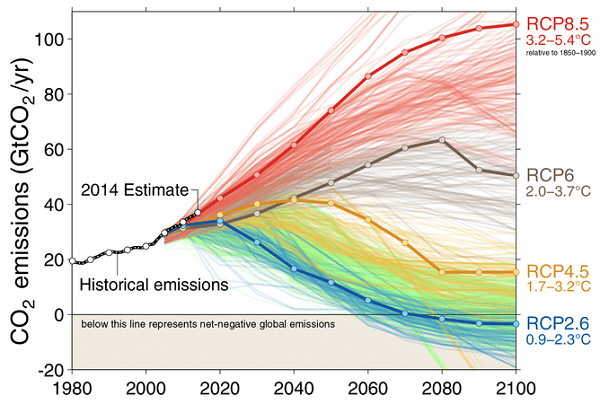
The first study, has two limitations. Firstly it simply does not address the issues of economic costs and social implications. Secondly, it simply accepts the stabilisation pathway for a 2°C temperature increase which sees zero worldwide emissions about 2070. In looking at the IPCC report (same as linked above), I developed this table to relate concentrations to temperature rise. RCPs are Representative Concentration Pathways (RCPs) which are expressed in terms of watts per square metre of radiative forcing (W m-2). Roughly, RCP2.6 represents the 2°C pathway, while RCP8.5 represents our present path.
Figure 1: RCP temperature scenarios
Green indicates a comparatively ‘safe’ climate, orange indicates the increasingly contested zone which clearly carries some danger, and red to indicate breaching the 2°C guardrail which everyone with half a brain accepts as dangerous.
Strictly speaking the green box should be orange, because it sits on top of ‘now’ which is an 0.6°C increase, and the orange box below it should be red, for the same reason.
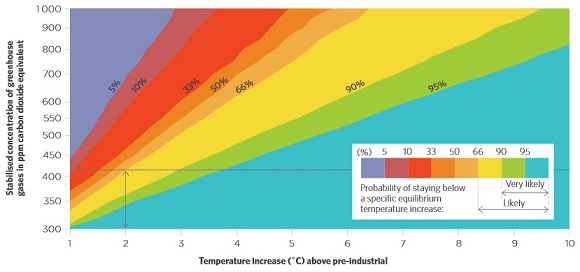
On the orange zone, the Climate Change Authority in its Review published this wondrous graph, showing that they were well aware of the inadequacies of a 2°C target:
As I said then, in terms of CO2 equivalents we are now at 480. This gives us less than 33% chance of staying below 2°C and about a 10% chance of exceeding a civilisation threatening 4°C. These odds are unacceptable. We are already in an overshoot situation.
This is old information – very old. James Hansen told us at an American Physical Union meeting in December 2007 that we needed to aim for 350ppm in the first instance and then decide where we go from there.
The RCP2.6 path involves a 33% chance of ending up with more than 2°C, odds that should be completely unacceptable.
Turning to the third report, which specifically addresses the financial implications, it too is on 2°C path. The costs numbers when taken in isolation look large (US$45 trillion will be required in 2015–2030 for key categories of energy infrastructure), but in context are trivial:
costs of this magnitude look like “background noise” when compared with the strong underlying growth that the global economy is likely to experience.
These costs will go up if mitigation is delayed:
Costs are also likely to rise sharply with delay. If global action to reduce emissions is delayed until 2030, global CO2 emissions would have to decrease by 6-7% per year between 2030 and 2050 in order to have a reasonable chance of staying on a 2°C path. Such rates of reduction are unprecedented historically and are likely to be expensive (estimates of delay suggest an average annual consumption growth loss of around 0.3% in the decade 2030 to 2040, compared to a loss of less than 0.1% over the same period if we act now).
Fine, and perhaps not yet serious, but I’m afraid completely out of date. In 2011 the Climate Commission published this graph to illustrate the implications of delay:
Figure 4: Emissions reduction options
Under the ‘climate budget approach’ the area under the line must remain constant.
That too would have been based on a 2°C target, but it illustrates that if we delay peaking emissions worldwide, even to 2020, we’ll be in completely uncharted territory.
Chapter Five of the third report gives enormous detail of the policy work that needs to be done. It may be summarised as strong leadership, consistent policy over decades, structural change and perhaps unprecedented international co-operation, even if we start now on a task that is eminently doable and inexpensive; so more than “a bit of political will” is required.
Frankly, our best hope lies in the prospect that solar technology with storage will simply become the cheapest form of new energy, and has the advantage that it doesn’t need a large grid. Nevertheless there will be residual problems – land use and agriculture, transport, ocean acidification etc. Zero emissions transport will require planning and subsidies.
One thing we should realise, however, is that further out our future will be energy rich, not energy-constrained. Saving energy is not a reason for localism and changing the way we live.
So where does that leave Val’s second option?
Firstly, concerted long-term action and international co-operation of the kind we need is not in our DNA. We are designed to co-operate in bands of up to 150 people, the number that our big brains can cope with in terms of knowing in any detail. We are told Fukuyama, Harari for example that bands were relatively egalitarian with a leader answerable to the people. Beyond that we can co-operate in amazing ways, but at the price of setting up hierarchies and privileges, coercive elites. This occurred in general with agriculture and owning stuff, even herds. These problems can be ameliorated in a modern democratic nation-state, with it’s formal mechanisms for election, administration, justice and accountability, but we are still apt to act in the self-interest of that larger entity.
What we need is an infusion of new values and ways of perceiving, thinking and feeling. While not sacrificing individualism we need to feel and act as social beings. We also need to revalue ourselves in relation to the biological and physical systems of the planet, so that we stop acting like the top rapacious predator, the one that has decimated the wild animal kingdom by 52% since 1970. Along the way, we need to challenge a Chain of Being, that sees elite mostly European males as next to the gods and women, children, other races, other social classes, slaves, asylum seekers etc in subordinate positions.
We need to live in nature, not over nature.
While localism and social participation are necessary, the required cultural and existential changes are hard work will happen over generations if at all. The planet can’t wait. That last reference tells us:
Efforts have been made to economically quantify the world’s “stock” of natural capital and the yearly “flow” of ecosystem services they provide. The latest numbers are $142.7 trillion and $48.7 trillion, respectively. By comparison, the flow of incomes through the global economy is currently about $71.8 trillion per year. The research suggests that by 2013 we were eliminating that stock of natural capital at a rate of about $7.3 trillion per year, and that the flow of ecosystem services would be $23 trillion higher if not for human practices like deforestation, burning fossil fuels, and the like.
And underneath all this, there is the point that these creatures and the ecologies they inhabitant have an intrinsic moral worth irrespective of the dollar sign that markets can place on them. “Wildlife is and should be useless in the same way art, music, poetry and even sports are useless,” author Richard Coniff recently wrote in the New York Times.
And the climate can’t wait.
We need hierarchies to get things done, a collective will not build a battleship, but we need to civilise them and render them accountable. We even need coercive powers, to counter the selfishness of states. The only supra-national entity that the major powers take notice of is the World Trade Organisation, not the UN. We need it to police international agreements, to oversee international carbon trading, and what Quiggin’s third report calls “border carbon adjustments”.
I never thought I’d say that!
The bottom line is that we must act if we want a future for our grandchildren, and cost, the only certain Armageddon is if we do nothing or not enough. We are heading into uncharted territory but indications are that there will be benefits and the net costs are unlikely to be as bad as pessimists might think. We just don’t know. And the groupie, local stuff, well there are reasons for doing that, but it won’t solve climate change as such.
Temperatures are likely to rise dynamically for the rest of the century, according to two separate studies.
Masahiro Watanabe of the University of Tokyo colleagues found that over the past three decades natural influences are diminishing.
In the 1980s, natural variability accounted for almost half of the temperature changes seen. That fell to 38 per cent in the 1990s and just 27 per cent in the 2000s.
The implication is that temperature rises will respond more directly to emissions with fewer pauses.
Matthew England and associates used 31 climate models to chart future temperatures. He found that if emissions keep rising the chances of a pause of 10 years or more fall to practically zero. If emissions peak by 2040 we might get a pause by the end of the century.
If we wait until 2040 for peak emissions we’ll be cooked.
The Rockefeller family is turning its back on the industry that made it its vast fortune.
As more than 120 heads of state gather in New York for a UN summit on climate change, the Rockefeller Brothers Fund is pledging to move $50 billion worth of investment in fossil fuels into clean energy.
3. War and Peace revisited
At Fair Green Planet Val has reproduced her talk at the Australian Climate Action Summit 2014. It’s about organisational form in relation to climate change action and sustainability. Val suggests we need to change from forms based on competition, hierarchy and exploitation to forms based on co-operation, egalitarianism and sustainability:
From both my research and my lived experience, it seems clear to me that the approach we need to address climate change will not be produced by the hierarchical, top down, unequal organisations that are dominant in society today – but rather by an approach like this:
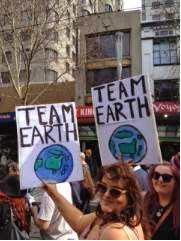
These “Team Earth” posters were of course produced in response to Tony Abbott’s “Team Australia”. The posters express to me the values we really need to address climate change: a recognition that we’re all in it together, and an inclusive approach.
We need:
to go beyond climate change and live in sustainable communities – communities that are flatter, networked, egalitarian and inclusive, and recognise themselves as part of an ecosystem.
In other words, we need to change ourselves.
4. Arctic sea ice report
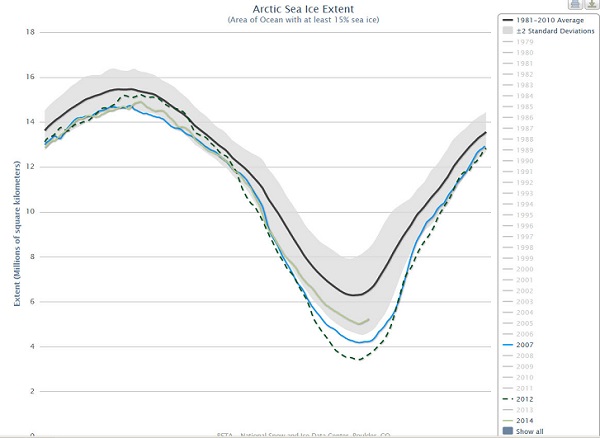
Arctic sea ice melting has now reached its maximum extent. This year was almost exactly the same as 2013, and the sixth lowest on record.
The black line is the 1981-2010 average, the dotted line the 2012 record and the blue line the former 2007 record. Shading represents plus or minus 2 standard deviations.
Volume was also up a bit but still in trend decline.
What this masks is a continued decline in the proportion of older, thicker ice. An increasing proportion is first year ice. At Carbon Brief:
During the 1980s or 1990s, in an average year, around 54 to 58 per cent of ice in the Arctic would be first-year ice. Last year it was 77 per cent.
5. New York UN meeting
Last week some 125 leaders met with the UN Secretary General and each other in New York to indicate what their post 2020 emissions reduction targets might be. I reported on the outcomes here, but it seems that readers of this blog are put off by titles like the one I used.
Problem is, the bad news is getting worse and is not being addressed sufficiently by world leaders. Emissions increased by 2.5% in 2013. Every year the emissions increase the harder the problem becomes. It’s not a case that action is just delayed; we are using up a carbon budget that by some estimates is already in the red.
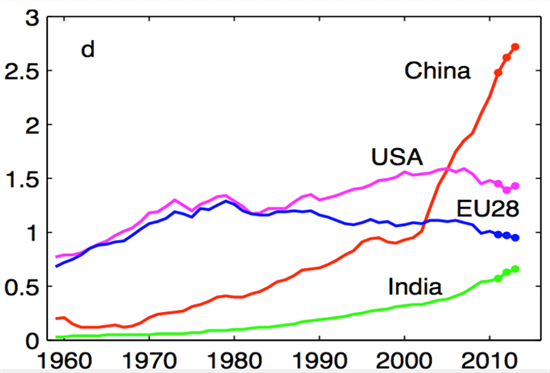
Of the major emitters only the EU was specific, nominating 40% by 2030, subject to confirmation. Not enough. There were indications that China will give concrete numbers when formal proposals are submitted next March. However, their current rate of increase is quite dramatic, as this graph shows:
My expectation is that at best, when the bids are in, our path will match the RCP4.5 scenario (the scenarios are numbered according to the climate forcing pertaining to CO2 levels with the forcing expressed in watts per square metre).
Nevertheless, the report said there is still a “gigatonne gap” between governments’ current carbon-reduction pledges and what will be needed to limit overall warming to 2C.
Delivering on current policies would only succeed in reining warming back from 4C to 3C, it predicted. The United Nations’ New York 2014 and Paris 2015 climate summits will be crucial in securing an improved deal, the report said. (Emphasis added)
Indeed. In New York on our behalf Ms J Bishop said the Government would consider what post-2020 emissions might be, but consistent with the need for economic growth. I think in her mind this means banking on cheap coal as our dominant power source.
I believe that Australia should put on the table for the 2015 negotiations a trajectory of 40 to 60 per cent below 2000 levels by 2030 and net carbon zero by 2050.
Climate change, sustainability, plus sundry other stuff