Posts on sundry matters of life the universe and everything: Culture, Environment, Life, Politics & Government, Science, Social Science and Society, Technology etc.
An open thread where, at your leisure, you can discuss anything you like, well, within reason and the Comments Policy. Include here news and views, plus any notable personal experiences from the week and the weekend.
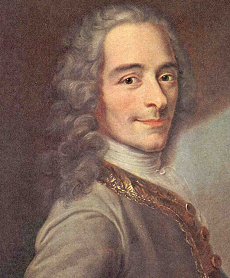
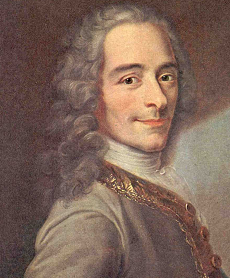
The gentleman in the image is Voltaire, who for a time graced the court of Frederick II of Prussia, known as Frederick the Great. King Fred loved to talk about the universe and everything at the end of a day’s work. He also used the salons of Berlin to get feedback in the development of public policy.
Fred would only talk in French; he regarded German as barbaric. Here we’ll use English.
The thread will be a stoush-free zone. The Comments Policy says:
The aim [of this site] is to provide a venue for people to contribute and to engage in a civil and respectful manner.
Here are a few bits and pieces that came to my attention last week.
Dunno about ReachTEL, it was pretty erratic on individual seats before the last federal election.
In other shenanigans long-standing LNP member Dr Bruce Flegg has been given the flick by party bosses and will be prevented from recontesting Moggill. Flegg has now tipped a bucket on them, saying they have written Newman off in Ashgrove, and it’s about factional manoeuvring as to who will be the new leader.
The Group of Eight universities have warned that the long-term shift away from basic research towards applied research could rob Australia of the fundamental knowledge base it needs to capitalise on new discoveries.
Back in 1992-93 basic research accounted for 28% of gross expenditure on research and development. In 2010-11 this had fallen to 21%.
Other countries are ramping up expenditure. South Korea, for example, is increasing research funding from 4% of GDP in 2011 to 5% in 2017. Europe is aiming at 3% of GDP.
Not sure of the number here, but if it’s $9 billion then it’s less than 1% of GDP. Our government’s strategy is to “massively” increase research funding by cutting grants and university funding, and ‘liberating’ universities to charge higher fees. And then of course there’s the 7% doctors visit co-payment.
“Frankly, I wish it was not worn. But we are a free country, we are a free society and it is not the business of Government to tell people what they should and shouldn’t wear,” he said.
Tanya Plibersek:
“I’d prefer if Tony Abbott didn’t get about in his Speedos either, but it’s a free country,” she said.
The inquiry will be in the form of a select committee, chaired by Glenn Lazarus, consisting of five members but only one from the Coalition, has a reporting date on or before March 27 next year, very close to the date of the next Queensland election.
the committee will examine Queensland’s use of Commonwealth funds, the administration of the state’s judicial system, and questions around development and environmental approvals.
It’s hard to see how the administration of justice is the Commonwealth’s business. I’m with Nick Xenephon in thinking it’s inappropriate for one government in the federation to be inquiring into another. For Labor, presumably it’s payback, but politically probably not a good idea.
The world never really recovered from the GFC. Now:
Global debts have reached a record high despite efforts by governments to reduce public and private borrowing, according to a report that warns the “poisonous combination” of spiralling debts and low growth could trigger another crisis.
Modest falls in household debt in the UK and the rest of Europe have been offset by a credit binge in Asia that has pushed global private and public debt to a new high in the past year, according to the 16th annual Geneva report.
The total burden of world debt, excluding the financial sector, has risen from 180% of global output in 2008 to 212% last year, according to the report.
if the UK cut its carbon emissions by 60 per cent from 1990 levels by 2030, as it has promised, its GDP would be 1.1 per cent bigger than if it stuck with fossil fuels, says a study by consultants at Cambridge Econometrics.
About half the gain would come from cheap running costs for fuel-efficient cars, with 190,000 new green jobs and higher wages also helping. The average household would be £565 a year better off.
I find each report has limitations in its own way, so at the end I remain agnostic.
The fourth, the IMF study, looks at carbon pricing in the top 20 emitters. As far as I can make out it comes up with two propositions. First, each country can act on its own, with benefit, no-one has to wait for the world to act. Secondly, it identifies a sweet spot, which varies quite a lot from one country to the next, where net benefits accrue from carbon pricing. In Australia’s case it’s only $11.50 per tonne.
This is all very promising but is not as such a plan for climate stabilisation at safe levels.
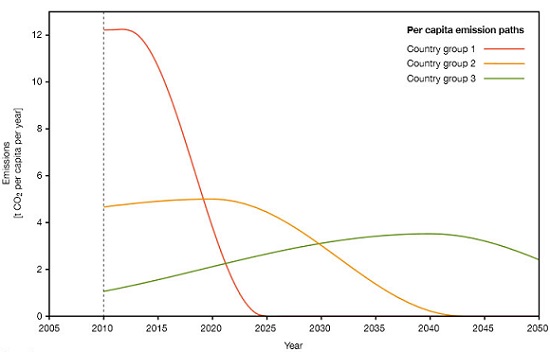
The third, the American study, finds the aim of reducing emissions by 40% from 2005 levels by 2035 doable and beneficial. The problem here is in the task identification. The study assumes that the US should decarbonise at the same rate as the rest of the world. It ignores the ‘carbon budgeting approach’ whereby high per capita emitters need to decarbonise rapidly to make space for developing countries to grow their economies. See Figure 5 of this post on the IPCC report. The United States is a Group 1 country, which must decarbonise rapidly:
Figure 5: The climate budget approach
As we saw in this post, two thirds of increased emissions are now coming from emerging and less developed countries. In other words in reality increases from Group 2 and 3 countries are not being offset by cuts in Group 1 countries. Until we get our heads around this issue and address it we’ll stumble along on the road to perdition!
The problem facing Group 1 countries is impossible. The way around it lies in emissions trading between rich and poor countries, as per Figure 6 in that post. This would entail considerable wealth transfer, which could be mandated to be used in greening developing country economies.
Also 40% by 2035 overall is not a recipe for a safe climate, as shown below.
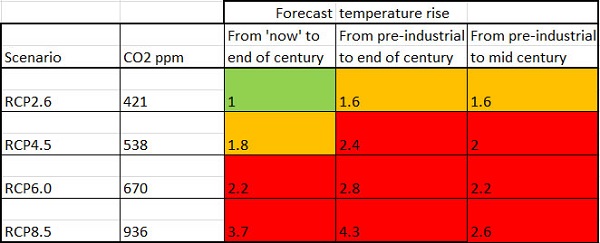
The first study, has two limitations. Firstly it simply does not address the issues of economic costs and social implications. Secondly, it simply accepts the stabilisation pathway for a 2°C temperature increase which sees zero worldwide emissions about 2070. In looking at the IPCC report (same as linked above), I developed this table to relate concentrations to temperature rise. RCPs are Representative Concentration Pathways (RCPs) which are expressed in terms of watts per square metre of radiative forcing (W m-2). Roughly, RCP2.6 represents the 2°C pathway, while RCP8.5 represents our present path.
Figure 1: RCP temperature scenarios
Green indicates a comparatively ‘safe’ climate, orange indicates the increasingly contested zone which clearly carries some danger, and red to indicate breaching the 2°C guardrail which everyone with half a brain accepts as dangerous.
Strictly speaking the green box should be orange, because it sits on top of ‘now’ which is an 0.6°C increase, and the orange box below it should be red, for the same reason.
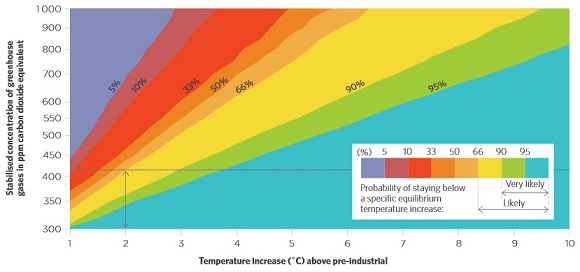
On the orange zone, the Climate Change Authority in its Review published this wondrous graph, showing that they were well aware of the inadequacies of a 2°C target:
As I said then, in terms of CO2 equivalents we are now at 480. This gives us less than 33% chance of staying below 2°C and about a 10% chance of exceeding a civilisation threatening 4°C. These odds are unacceptable. We are already in an overshoot situation.
This is old information – very old. James Hansen told us at an American Physical Union meeting in December 2007 that we needed to aim for 350ppm in the first instance and then decide where we go from there.
The RCP2.6 path involves a 33% chance of ending up with more than 2°C, odds that should be completely unacceptable.
Turning to the third report, which specifically addresses the financial implications, it too is on 2°C path. The costs numbers when taken in isolation look large (US$45 trillion will be required in 2015–2030 for key categories of energy infrastructure), but in context are trivial:
costs of this magnitude look like “background noise” when compared with the strong underlying growth that the global economy is likely to experience.
These costs will go up if mitigation is delayed:
Costs are also likely to rise sharply with delay. If global action to reduce emissions is delayed until 2030, global CO2 emissions would have to decrease by 6-7% per year between 2030 and 2050 in order to have a reasonable chance of staying on a 2°C path. Such rates of reduction are unprecedented historically and are likely to be expensive (estimates of delay suggest an average annual consumption growth loss of around 0.3% in the decade 2030 to 2040, compared to a loss of less than 0.1% over the same period if we act now).
Fine, and perhaps not yet serious, but I’m afraid completely out of date. In 2011 the Climate Commission published this graph to illustrate the implications of delay:
Figure 4: Emissions reduction options
Under the ‘climate budget approach’ the area under the line must remain constant.
That too would have been based on a 2°C target, but it illustrates that if we delay peaking emissions worldwide, even to 2020, we’ll be in completely uncharted territory.
Chapter Five of the third report gives enormous detail of the policy work that needs to be done. It may be summarised as strong leadership, consistent policy over decades, structural change and perhaps unprecedented international co-operation, even if we start now on a task that is eminently doable and inexpensive; so more than “a bit of political will” is required.
Frankly, our best hope lies in the prospect that solar technology with storage will simply become the cheapest form of new energy, and has the advantage that it doesn’t need a large grid. Nevertheless there will be residual problems – land use and agriculture, transport, ocean acidification etc. Zero emissions transport will require planning and subsidies.
One thing we should realise, however, is that further out our future will be energy rich, not energy-constrained. Saving energy is not a reason for localism and changing the way we live.
So where does that leave Val’s second option?
Firstly, concerted long-term action and international co-operation of the kind we need is not in our DNA. We are designed to co-operate in bands of up to 150 people, the number that our big brains can cope with in terms of knowing in any detail. We are told Fukuyama, Harari for example that bands were relatively egalitarian with a leader answerable to the people. Beyond that we can co-operate in amazing ways, but at the price of setting up hierarchies and privileges, coercive elites. This occurred in general with agriculture and owning stuff, even herds. These problems can be ameliorated in a modern democratic nation-state, with it’s formal mechanisms for election, administration, justice and accountability, but we are still apt to act in the self-interest of that larger entity.
What we need is an infusion of new values and ways of perceiving, thinking and feeling. While not sacrificing individualism we need to feel and act as social beings. We also need to revalue ourselves in relation to the biological and physical systems of the planet, so that we stop acting like the top rapacious predator, the one that has decimated the wild animal kingdom by 52% since 1970. Along the way, we need to challenge a Chain of Being, that sees elite mostly European males as next to the gods and women, children, other races, other social classes, slaves, asylum seekers etc in subordinate positions.
We need to live in nature, not over nature.
While localism and social participation are necessary, the required cultural and existential changes are hard work will happen over generations if at all. The planet can’t wait. That last reference tells us:
Efforts have been made to economically quantify the world’s “stock” of natural capital and the yearly “flow” of ecosystem services they provide. The latest numbers are $142.7 trillion and $48.7 trillion, respectively. By comparison, the flow of incomes through the global economy is currently about $71.8 trillion per year. The research suggests that by 2013 we were eliminating that stock of natural capital at a rate of about $7.3 trillion per year, and that the flow of ecosystem services would be $23 trillion higher if not for human practices like deforestation, burning fossil fuels, and the like.
And underneath all this, there is the point that these creatures and the ecologies they inhabitant have an intrinsic moral worth irrespective of the dollar sign that markets can place on them. “Wildlife is and should be useless in the same way art, music, poetry and even sports are useless,” author Richard Coniff recently wrote in the New York Times.
And the climate can’t wait.
We need hierarchies to get things done, a collective will not build a battleship, but we need to civilise them and render them accountable. We even need coercive powers, to counter the selfishness of states. The only supra-national entity that the major powers take notice of is the World Trade Organisation, not the UN. We need it to police international agreements, to oversee international carbon trading, and what Quiggin’s third report calls “border carbon adjustments”.
I never thought I’d say that!
The bottom line is that we must act if we want a future for our grandchildren, and cost, the only certain Armageddon is if we do nothing or not enough. We are heading into uncharted territory but indications are that there will be benefits and the net costs are unlikely to be as bad as pessimists might think. We just don’t know. And the groupie, local stuff, well there are reasons for doing that, but it won’t solve climate change as such.
It may be Abbott’s but it is not a solution. The numbers will be negligible.
Cambodia’s Interior Ministry spokesman Khieu Sopheak said his country wants to take far fewer refugees than expected after an initial pilot program that could involve only a handful of people.
“It would be 20 or 10 or 50 or 100 or something like this. Not 1000 as people have said,” Mr Khieu Sopheak told the Phnom Penh Post.
Only people willing to go will be shipped to Cambodia.
Long Visalo, secretary of state at Cambodia’s foreign ministry, told journalists that before refugees slated for resettlement on the Pacific island of Nauru are selected, Cambodian officials will go there to brief them on the country’s difficulties and traditions.
Cambodia is one of the world’s poorest nations.
“We will explain to them about Cambodia … the country is like this or this, a lecture for them and then they will decide if they want to come or not,” he said.
Cambodia certainly is poor ranking 183rd in the world in terms of per capita GDP. While a signatory to the UN convention Cambodia currently hosts only 70 refugees and 20 asylum-seekers. It has not always been exemplary in the treatment of its own minorities.
Immigration Minister Scott Morrison told RN’s AM that four or five would be resettled at first. It seems altogether possible that volunteers will be found given the horrific stories coming out of the Nauru detention centre:
Greens senator Sarah Hanson-Young said women inside the centre were regularly required to strip and exchange sexual favours with guards so they could have access to the showers.
She said there were also allegations children had been forced to have sex in front of guards at the centre.
The UNHCR is not happy. They are deeply concerned at the precedent set by the Cambodian agreement:
“This is a worrying departure from international norms. We are seeing record forced displacement globally, with 87 per cent of refugees now being hosted in developing countries. It’s crucial that countries do not shift their refugee responsibilities elsewhere,” said UN High Commissioner for Refugees António Guterres. “International responsibility sharing is the basis on which the whole global refugee system works. I hope that the Australian government will reconsider its approach.”
UNHCR has consistently advocated for asylum-seekers to have their claims assessed and to benefit from protection in the territory of the State where they arrive, or which has jurisdiction over them.
“Refugees are persons who are fleeing persecution or the life-threatening effects of armed conflict. They are entitled to better treatment than being shipped from one country to the next,” Guterres added.
It’s over 6 million who are internally displaced, approaching to 7 million people, and over 3 million who have fled over the borders – and, of course, these are known numbers. There’s always some leeway with this but we know of at least that many people. So it’s a severe humanitarian crisis.
The UNHCR are looking for another $1.8 billion to deal with the Syrian refugee problem. Abbott might give a damn if he’s honestly concerned about humanitarian issues.
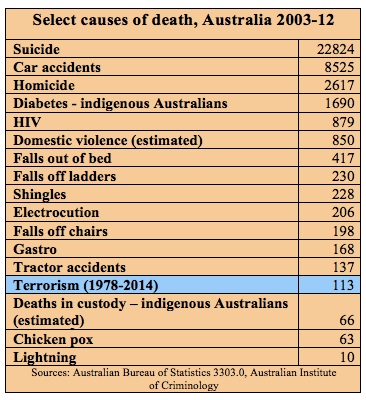
Bernard Keane has been tracking the numbers at Crikey. Since the Hilton Hotel bombing in Sydney in 1978 a total of 113 Australians, at home and abroad, have died from terrorism.
In a New Matilda exclusive Chris Graham brings us the shocking death toll of Australians on Australian soil at the hands of Muslim terrorists – zero!
In the 10 years from 2003 to 2012 a total of 417 people in Australia died from falling out of bed, 230 from falling off ladders and 198 from falling off chairs. Rational analysis tells us that we are more at risk from ourselves and our loved ones than from terrorists. Suicides come in at 22,800 and homicides at 2,617. Somewhere between 700 and 1000 women and children have been killed by their parents or partners.
The toll from car accidents (excluding pedestrians and other vehicles) was 8,500 in the 10 years.
As of mid-September, 129 Australians have been killed at work, compared to 125 people killed to the equivalent point in 2013, Safe Work Australia statistics show. The mining sector has already exceeded the death toll for the whole of 2013, with 12 people killed, and the construction industry has already claimed 18 lives, already one more than for the whole of 2013. Transport, the biggest sector for workplace deaths, is also performing worse than 2013, while agriculture, second biggest, is tracking around the same as last year.
The rise in workplace deaths this year defies years of improved workplace safety data: the incidence of workplace deaths rose from 2003-04, peaked in 2007-08 and has fallen dramatically since then, with an overall incidence rate in 2011-12 nearly half of what it was in 2002. Even so, 186 Australians went to work in 2013 and didn’t come home…
Here’s a graphic of select causes of death in 2003-12:
There are some preventable health and social justice issues that jump out of the statistics. Indigenous Australians, for example, are seven times more likely to die from diabetes than are other Australians. Keane questions our resource allocation priorities.
Problem is that many causes of death are ‘normal’ in terms of our emotional reaction, unless someone near to us is involved or there is emotional engagement for some other reason. Terrorism is, of course, designed to strike fear.
Our spooks have used this fear to gain ‘improvements’ to the security laws. Matthew Knott has an excellent explainer at the SMH:
So what’s in the new laws? They cover four main areas:
greater protection for intelligence officers who commit crimes while conducting operations;
cracking down on the leaking and publication of information about secret operations;
expanding ASIO’s access to computer networks;
making it easier for Australia’s spying agencies to work together.
The second is likely to have a chilling effect on reporting. For example, if a reporter was tipped off that surveillance equipment was being installed in the East Timor cabinet room under an Australian aid project, he or she would be reluctant to report it and risk up to 10 years jail.
On the third, it seems the spooks will be able to go anywhere they choose on the internet.
Labor has waved these laws through in the Senate, leaving critique to the Greens and some of the cross-bench:
The bill passed the Senate, 44 votes to 12. The Government, Opposition and Palmer United Party voted for the legislation, along with the Motoring Enthusiasts Party Senator Ricky Muir, and Family First’s Bob Day.
The Greens, Senators Xenophon, Leyonhjelm, and Senator John Madigan were all opposed.
This spineless approach from Labor bespeaks political pragmatism rather than principle.
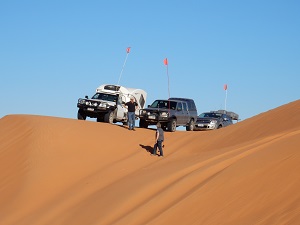
To cross the Simpson Desert you need a pass which cost us $150 per vehicle. I understand that about 15 vehicles a day* do the trip, so it is not an entirely exceptional thing to do. However, it is not routine either and requires careful planning. Continue reading Red Centre holiday: the challenge of the Simpson Desert crossing→
An open thread where, at your leisure, you can discuss anything you like, well, within reason and the Comments Policy. Include here news and views, plus any notable personal experiences from the week and the weekend.
The gentleman in the image is Voltaire, who for a time graced the court of Frederick II of Prussia, known as Frederick the Great. King Fred loved to talk about the universe and everything at the end of a day’s work. He also used the salons of Berlin to get feedback in the development of public policy.
Fred would only talk in French; he regarded German as barbaric. Here we’ll use English.
The thread will be a stoush-free zone. The Comments Policy says:
The aim [of this site] is to provide a venue for people to contribute and to engage in a civil and respectful manner.
Here are a few bits and pieces that came to my attention last week.
1. Jacqui Lambie blows herself up
Jacqui Lambie will be forever known as an anti-Muslim bigot after her comments on Sharia law on Insiders last weekend. She said that anyone who followed sharia law could get out of the country. Since then she has stuck to her guns, insisting it involves terorism.
While the outbreaks in Senegal and Nigeria were “pretty much contained” and the situation in Guinea had appeared to be stabilising according to the WHO, there appears no indication of a reversal in Sierra Leone and Liberia.
Transmission is continuing in urban areas, with the surge in Liberia driven mainly by a sharp increase in the number of cases reported in the capital, Monrovia.
The situation in Sierra Leone also continues to deteriorate with a sharp increase in the number of newly-reported cases in the capital, Freetown, and its neighbouring districts of Port Loko, Bombali, and Moyamba, which are under quarantine.
A vaccine is being developed in Oxford and another in the USA. Both could be fast-tracked and used experimentally in the field in West Africa by the end of the year.
3. Polls stay roughly the same
Newspoll came out on Tuesday showing the ALP in a winning position at 51-49 TPP (two party preferred), compared to 52-48 two weeks earlier, essentially within the margin of error, with the trend starting to flatline.
Abbott has now edged ahead of Shorten as preferred PM 41-37. Abbott’s performance rating has improved from 35-54 to 41-52 for a net -11. Shorten is 38-43 for -5, but more people seem to be unsure about him.
Roy Morgan always favours Labor and has Labor up at 54.5-45.5. Morgan says they ask people about their preferences, whereas Newspoll allocate them on the basis of voting at the last election. We’re dealing with about 25% of the vote here, so the difference could be substantial.
So Morgan see no gain for Abbott from his decision to ‘send in the troops’.
Morgan’s demographics are interesting. Only the 65+ group favour the LNP whereas the 18-24yr olds favour the Labor by a staggering 76.5 to 23.5. In Qld the parties are even, Morgan has the ALP ahead everywhere else.
4. Slight medical issue
I’m having a colonoscopy early on Monday, so I’ll be having an ordinary 24 hours. Expect no posts. I think my GP is just curious but it’s been a while. I’m still traumatised from the last one!
Rob Oakeshott tells us he “poked power in the eye and got an almighty punch on the nose in return.” He laments the influence of the monied class in politics, which he sees as subverting democracy.
Swan is very clear about how a small but growing number of very rich people penetrate the political system in a reflective chapter of his book, The Good Fight. There is a negative review in Newscorp and an amazingly positive one in Fairfax. Who would have thought! I’m not sure they read the same book! I’ll not attempt a review here. Rather, I’m focussing mainly on his chapter Enemies worth having and his paper The 0.01 per cent: the rising influence of vested interests in Australia originally published in The Monthly, now included in an appendix.
Swan accepts the market economy and the value of entrepreneurship, and accepts that many business leaders are concerned about the national interest as well as the welfare of their corporations. Unfortunately a growing number, he says, suffer from ‘the blindness of affluence’ based on materialism and selfish individualism, and are aggressive and ruthless in pursuing their ends. He says:
Many of the winners from our prosperity just don’t see poverty and injustice any more, let alone the persuasive case that a fairer society produces an even more prosperous economy. The logic and the economics put forward by Joseph Stiglitz and Thomas Piketty, and in Australia by people such as Andrew Leigh, are ignored. And in their world, higher quality universal education and health services are a drain on the budget, not a platform for a fairer and more prosperous economy. (Emphasis added)
Such selfish corporates preach competitiveness and productivity for the economy as a whole, but in practice are only interested in the short-term benefits to their own corporations. What they are seeking is wealth transfer to them from consumers and taxpayers.
This small but growing group throw their weight around quite directly. The classic case was the public campaign over the mining super tax, where they sought to destroy a government rather than offer up one cent. They blatantly lied about consultations that had been held with them and mounted a $20 million media blitz against the Government.
In this case their bluff was called by Gillard when she attained power. She told the miners that the tax would be implemented in spite of them. They had a choice of entering discussions to have an input, but only on condition that they withdrew their campaign. This worked and the discussions were amicable.
I’ll leave it to others to judge whether the miners nevertheless got much of what they wanted. I’ll just note that it is a super profits tax and that the industry pays considerable normal royalties and taxation. Nevertheless the point in question is that the minerals are owned by the people, not the companies, and the people should get a fair reward.
This example encouraged the club industry, where the independents, Oakeshott and Windsor, were certainly spooked by their campaigning against the proposed pokies legislation. The extent to which the Labor Government was similarly spooked is not clear.
The tobacco industry is one case where the Labor Government stared the industry down.
A case where the industry won hands down was the superannuation industry. The fees accruing to the funds management industry are in the range of $20 to $40 billion each year. The industry can thank Labor for creating the industry and Labor had just approved a graduated increase from 9 to 12%, thus increasing the size of the industry by a third through that decision alone. Swan details how he planned to close the super tax loophole for the very wealthy, looking for funds to pay for the NDIS (National Disability Insurance Scheme).
John Brogden, head of the Financial Services Council, requested a meeting, which was arranged with Swan, Shorten and advisors. Brogden advised that his industry had a media campaign against the Government ready to go, and if they altered super in any way at all they would launch it.
Swan told Brogden he didn’t play that way and terminated the meeting, but in fact in the end he soaked the universities instead.
In looking at the Henry tax review a Business Tax Working Group was formed. When considering reducing the corporate tax rate, Swan wanted to pay for it by rescinding a raft of business tax concessions. The BTWG insisted that it be paid for by consumers with an increased GST. The BWTG subverted the consultations by backgrounding the media, producing negative press commentary. In the end nothing happened.
Business too lined up against carbon pricing and the greenhouse mafia appear alive and well in the current consideration of the Renewable Energy Target.
Swan sees the conservative political parties as tools of business with sections of the media playing their part.
Swan says you enter politics to make a difference and if you forget the little people you sacrifice part of your nation’s soul. Strange he doesn’t mention what happened to unmarried mothers under his watch, but he does regret that fiscal discipline is a brutal game and often brings into play what he would call Labor values.
In the end he gives himself a tick. A bit over a month after he resigned as Treasurer the ABS Household Income and Income Distribution data was published showing that inequality had fallen again between 2009-10 and 2011-12.
According to Swan, Obama described income inequality as the defining issue of our time. I wonder whether he too would get a koala stamp!
Ray Martin’s interview with Julia Gillard is being broadcast on Channel Nine at 7pm tonight (Tuesday), promising bombshell after bombshell and the whole truth. Unlikely!
For the record, I agree with Wayne Swan and Stephen Smith that Rudd had become dysfunctional and needed to be replaced. They say, however, he should have been left in the chair until after the 2010 election, which he would have won. If history had taken that course Gillard would still be prime minister, we’d have the full version of the NBN, Gonski, NDIS and health would be funded into the future and we’d be heading for a surplus. Abbott would be historical detritus.
But that didn’t happen and Gillard took over. Then Rudd should have left politics. If so, Gillard would still be PM we’d have the NBN, Gonski etc etc.
Given that Rudd didn’t go away, early in 2013 after it became clear that Gillard couldn’t show her face in Western Sydney, she should have resigned for the good of the party. Probably we’d still have Abbott as PM, but it would have been the honourable thing to do.
But what happened happened and we as Australians have to come to terms with it. The way we, the media, the Abbott led Opposition and yes, Kevin Rudd treated Julia Gillard is simply not acceptable in a mature, civilised society. We are all implicated in some way.
That’s why I’ll be watching. The wound is still open.
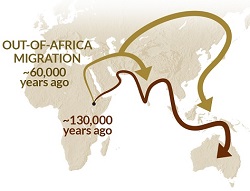
Back in January 2011 I wrote about contact between Homo sapiens and Homo neanderthalensis in Neanderthals r us as modern humans moved out of Africa about 45,000 years ago. I was troubled by the lack of mention of Australian Aborigines in the article the post was based on. At the time, from memory, it was thought that Australian Aborigines had been here 10,000 years earlier than that. Continue reading Pushing back the African exodus→
Last year, Eoin, a friend of my brother Len’s from university days, being newly retired, hatched a plan to drive across the Simpson Desert, as you do! Eoin’s wife Betty is not a camper, but agreed to go. Len was keen also, but his Nissan X-trail doesn’t do deserts. Len’s son Geoff offered his 15 year-old Nissan Navara twin cab, so the trip became a possibility for Len. Len recalled my wife Margot saying she’d like to see Simpson Desert before she turned 70, so he invited her. Since Len’s wife Nola doesn’t do camping, then yes there would be room for me, should I so desire, although it was well known that I was a very reluctant camper at best and had mostly avoided it in my 70-plus years.
An open thread where, at your leisure, you can discuss anything you like, well, within reason and the Comments Policy. Include here news and views, plus any notable personal experiences from the week and the weekend.
The gentleman in the image is Voltaire, who for a time graced the court of Frederick II of Prussia, known as Frederick the Great. King Fred loved to talk about the universe and everything at the end of a day’s work. He also used the salons of Berlin to get feedback in the development of public policy.
Fred would only talk in French; he regarded German as barbaric. Here we’ll use English.
The thread will be a stoush-free zone. The Comments Policy says:
The aim [of this site] is to provide a venue for people to contribute and to engage in a civil and respectful manner.
Here are a few bits and pieces that came to my attention last week.
Today’s New Zealand Roy Morgan Poll shows National (46.5%, up 1.5%) set to win a third term in Government on Saturday as support for a potential Labour/Greens alliance slumps to 37.5% (down 4.5% – the lowest since November 2011). Support for both main opposition parties has slipped – Labour (24%, down 2%) and the Greens (13.5%, down 2.5%) less than a week before Saturday’s NZ Election.
New Zealand First (8%, up 2%) appears to be the biggest beneficiary of the Labour/ Greens slump as the election approaches and former Deputy Prime Minister and New Zealand First Leader Winston Peters looks set to have a prominent role in the new Parliament with NZ First projected to win as many as 10 seats. This is the highest support for NZ first for nearly ten years since August 2005.
4. Vlad will attend the G20
A couple of weeks ago Abbott, Julie Bishop and others, Bill Shorten too, were calling for the banning of Russian president Vladimir Putin from the G20 leaders summit in Brisbane later this year. But it’s not our call. The Fin Review says the feeling from other G20 leaders is, let him come so we can tell him what we think of him. Anyway China says he should be allowed to come, so I guess that settles it.
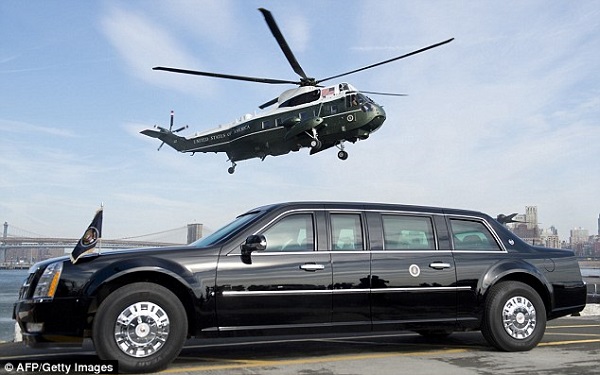
Meanwhile Obama’s security arrangements should be quite spectacular. The Daily Mail tells us he might use a bunch of helicopters to fly from the airport to his hotel. Will Hagon said the other day that the Americans would be bringing 50 cars, using their own rather than the high security BMWs we are leasing. That may include The Beast, which weighs about 3.5 tonnes, can turn within its own length and take off in any direction like you wouldn’t believe.
5. Meanwhile our politicians are talking
To each other, in a new mood of reasonableness and bipartisanship, according to Laura Tingle.
Talking about terrorism, about dealing with Islamic State, about renewable energy, about a referendum on indigenous recognition, and possibly even the budget.
We’ll have to see where all this leads, but for Abbott dealing with Labor emerges as an alternative to talking with Clive Palmer and the cross bench. Even Christine Milne is talking about talking about renewable energy and direct action.
Shorten, however, is laying down markers where (he says) he will not go, for example he’s OK with attacking ISIL in Iraq, but not in Syria.
On that score Bernard Keane and Guy Rundle are questioning whether our support of the Americans exposes us to more terrorist attention, and whether the action is calling the caliphate into being, plus whether it really has much chance of success. It’s all very troubling. From the outset it was clear that ISIL would do whatever it takes to get the West involved.
“As a friend of Britain, as an observer from afar, it’s hard to see how the world would be helped by an independent Scotland.
“I think that the people who would like to see the break-up of the United Kingdom are not the friends of justice, the friends of freedom, and the countries that would cheer at the prospect … are not the countries whose company one would like to keep.”
No doubt we should invade Scotland, or bomb them into submission!
That was last month. Next Tuesday 125 world leaders including US president Barack Obama and UK prime minister David Cameron will attend the UN secretary-general’s Climate Summit in New York. Tony Abbott will not be one of them. Yet the very next day he will be in New York to attend a UN Security Council meeting. He says he has more important things to do in the Australian parliament early next week.
While the New York meeting has no formal part of the climate talks leading up to the preliminary commitments countries will be asked to make by next March leading to the formal renegotiation of the Kyoto treaty in Paris in December next year, when the UN Secretary General says, “Come to New York, the planet is in trouble and needs you”, normally you would go, unless you want to make a statement about how you view the talks. In this regard Connie Hedegaard, the EU climate supremo, said:
“At least 125 heads of state have sent a strong signal to the rest of the world that … climate change is important, and they know they have a role to play and a responsibility to take in order for the world to address climate change.
“I do not know what the reasons would be behind it, but, of course, the world will interpret who is showing up and who will not be showing up.
“So that’s for your Prime Minister and your government to decide, what kind of profile they want in this.”
Hedegaard counsels us not to make too much of the fact that the Indian and Chinese leaders won’t be there. We know they are taking climate change seriously. We know, however, that Stephen Harper of Canada, Abbott’s ideological soul mate, has similar views to Abbott’s and also won’t be there although he too will be in New York a couple of days later. We know that Abbott is smugly satisfied with our pathetic 5% reduction target by 2020. He doesn’t appear to understand that this is about post 2020. His vision is clouded by denialism and the coal lobby.
The Pedestrian laments the fact that we are not the slightest bit surprised – Abbott is running true to form.
Bernard Keane at Crikey finds that Abbott’s form is changing. He’s shedding the carefully scripted, softer-spoken persona he presented before the election and is returning to the more pugilistic Abbott of the Gillard years.
If you are not a Crikey subscriber but are on Facebook you might be able to read the piece here, courtesy of Mark. It begins:
“Tony Abbott is a man in a hurry. There’s a blue on, and he wants in. The Prime Minister has regressed from statesman to pugilist. He’s back to Punchy Tony, the Rocky of the Right, a bloke who’s up for any fight, even if he has to start it himself, the former boxing “blue” and front rower ready to deck anyone (including a young Joe Hockey), if they get in his way. Or even if they don’t.
Keane is speaking of Abbott’s statements hyping the terrorist threats:
But they also reflect Tony Abbott’s aggression, a trait he laboured hard to keep under wraps as opposition leader and harder still in his early days as Prime Minister—remember that parliamentary transition to the soft-voiced Prime Minister from the often shrill Abbott of the Gillard years.
But bit by bit it has re-emerged—the boyish grin sitting in the cockpit of a mocked-up F-35 (appropriately, on the ground, where the F-35s spend all of their time), the near-hysterical rhetoric about the threat of Islamic militants, and now dispatching tonnes of military hardware and some of our best troops to the United Arab Emirates, there to await whatever America wants them to do.
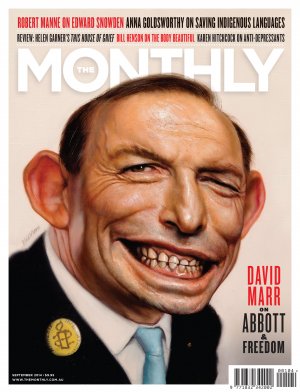
For a truly scathing assessment of the first year of the Abbott government, however, take a look at Nick Feik, the editor of The Monthly.
Feik says he’s passed six pieces of legislation and
After almost a year, the Abbott government has repealed one tax, a move that left the nation without a climate-change policy but had no discernible impact on prices, and implemented an increasingly inhumane, secretive and quite possibly illegal asylum-seeker regime designed in large part by the ALP.
And it has been good at undoing things:
It has cut funding to social, educational, health, research and advisory bodies. Any and every environmental action, movement, organisation or legislation has been made a permanent target.
Feik sees incompetence and incoherence everywhere. He concludes:
Beyond the budget, it’s unclear whether the government has a legislative agenda of any kind. Perhaps this explains recent efforts to reposition Abbott as an international statesman, in charge of keeping Islamic terrorism, Russian tyranny and Scottish independence at bay. He needs to be above the fray, because domestically his troops are stuck in the trenches, and they’re starting to turn on one another. They must be relieved the Opposition is showing no stomach for a fight.
I’ve used the cover image from The Monthly as the featured image on the home page.
Climate change, sustainability, plus sundry other stuff