Climate clippings 121

1. Denmark winds up wind

In January of 2014, Denmark got just over 61% of its power from wind. For the whole of 2014 it was 39.1%, a world record.

Their leadership is working well for them. Nine out of ten offshore turbines installed globally are made in Denmark. They plan to be fossil fuel free by 2050.

Elsewhere Germany and the UK smash records for wind power generation. Scotland hopes to be fossil fuel free by 2050.

On Boxing day rooftop solar met one third of South Australia’s demand and at least 30% from 11.30am to 3.30pm. Bonaire (pop. 14,500), a small island off the coast of Venezuela, said goodbye diesel and hello 100% renewable electricity.

California Gov. Jerry Brown last week called for

the state’s electric utilities to boost their renewable energy procurements to 50% of retail electric sales and discussed future initiatives to support rooftop solar, battery storage, grid infrastructure and electric vehicles.

As Bill Lawry would say, “It’s all happening!”

2. 2014 the hottest year

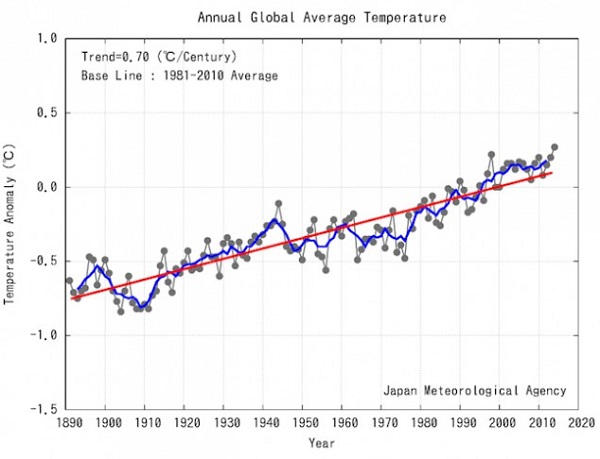
The first set of figures is in, this time from the Japan Meteorological Agency, showing 2014 as the hottest year so far:
JMA2014-cropped_600

The red line is the long-term linear trend.

The blue line is the 5-year running mean.

Australia had the third hottest year on record.

3. Chinese three-wheeler is for real!

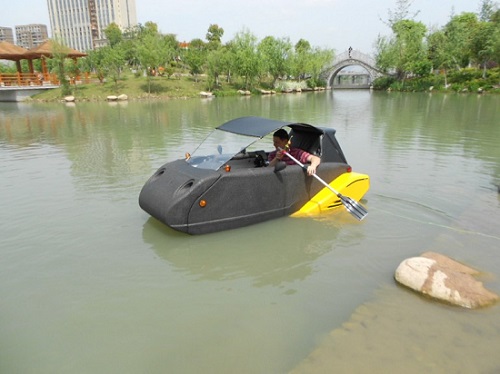
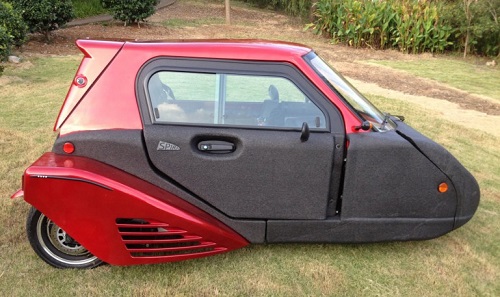
From John D’s Gizmag collection we have the Spira4u three-wheeler car:
spira-production-version-2_500

It’s not a toy, it’s a serious car which has gone into pilot production as a 10 kW electric or a fuel-injected 150 cc version with an economy of 2.94 l/100km (80 mpg).

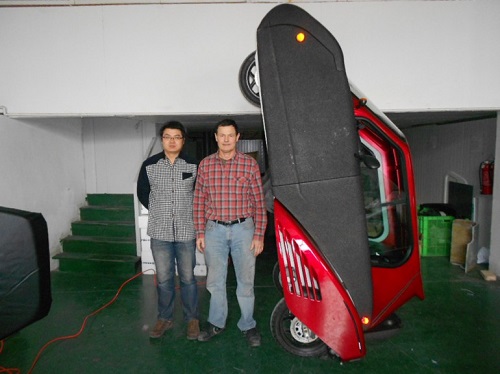
It has a handy parking option:
spira-production-version-14_500

And it floats:

spira-production-version-11_500

An amphibious version is under development.

4. California starts to build a high-speed rail system

The first phase of California’s high-speed rail system will be a 29-mile stretch from Fresno slightly north to the town of Madera. From there the project will link up with urban centers like Los Angeles and San Francisco, eventually allowing commuters to travel between those two cities at 220 mph and cutting the trip from nearly six hours to less than three. The system will eventually extend to Sacramento and San Diego, totaling 800 miles with up to 24 stations.

The full rail system should be in use by 2028.

5. Solar at grid parity in most of world by 2017

At RenewEconomy:

Investment bank Deutsche Bank is predicting that solar systems will be at grid parity in up to 80 per cent of the global market within 2 years, and says the collapse in the oil price will do little to slow down the solar juggernaut.

Quiggin at The Conversation and his place: Only a mug punter would bet on carbon storage over renewables.

6. When you are in a hole, stop digging!

From a study in the journal Nature:

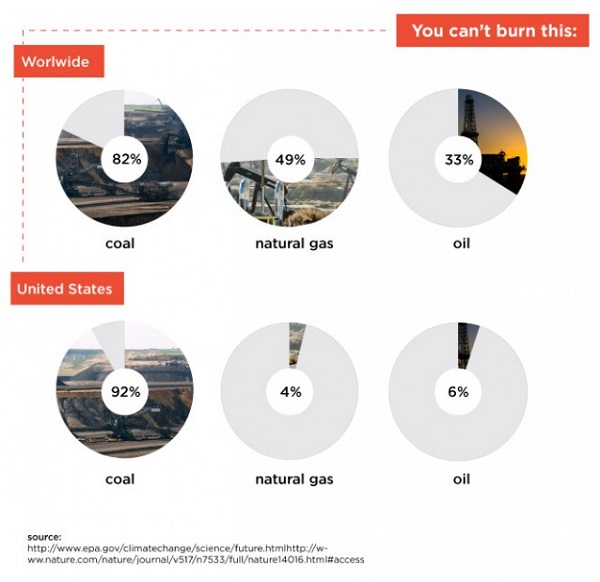
“Our results suggest that, globally, a third of oil reserves, half of gas reserves, and over 80 percent of current coal reserves should remain unused from 2010 to 2050 in order to meet the target of 2°C,” write authors Christophe McGlade and Paul Ekins of University College London.
stay-in-the-ground-cropped_600

Keeping the increase in global temperatures under 2°C will require vast amounts of fossil fuels to be kept in the ground, including 92 percent of U.S. coal, most of Canada’s tar sands, and all of the Arctic’s oil and gas…

In 2013, fossil fuel companies spent some $670bn on exploring for new oil and gas resources. The figure should be zero.

7. Climate change will create more environmental refugees

Natural disasters like Typhoon Haiyan—which devastated the Philippines in 2013 displace more people than war, according to the Internal Displacement Monitoring Center in Geneva. And as climate change sets off increasingly lethal natural disasters, so will the numbers of environmental refugees increase, Reuters reported.

It is a reality that governments must prepare themselves for. In 2013, some 22 million people were displaced by extreme natural disasters like typhoons, earthquakes and tsunamis, a number three times the number of those who were forced to migrate because of war, according to the IDMC.

Earlier this summer New Zealand accepted a family who cited climate change as the reason why they had to flee their homeland, thought to be the world’s first official environmental refugees.
LNP to win with a small majority

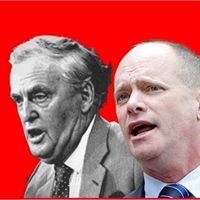
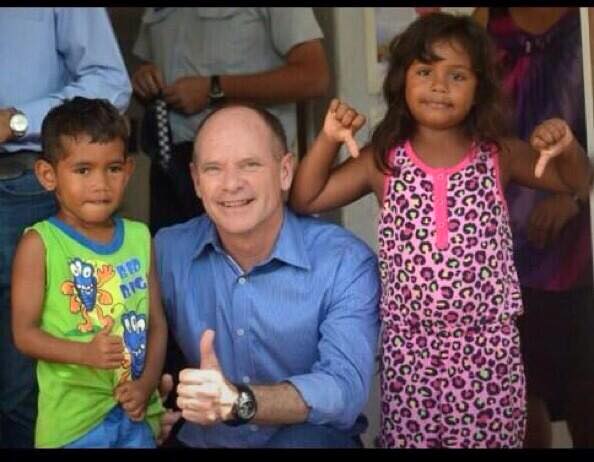
You won’t get a better photo than this during the election campaign!

Newman_10917454_10155103591410613_3879205671262139641_n

Dr Kevin Bonham looks at the recent polls and gives the Queensland election to the LNP 47 to 37, with 5 others.

He has the LNP on 41.4, the ALP 37.9, the Greens 7, PUP on 4.6, and Others 9. In two-party-preferred terms he has the LNP on 51.8.

The puff seems to have gone out of PUP, but The Greens are also not doing well.

There’s no single seat polling, but on this basis Newman would lose Ashgrove.

Mark will be writing a few articles during the election. He wrote this one for The Monthly. It’s an excellent read. He says it doesn’t really matter precisely why Queenslanders are facing a snap election.

We may be as ignorant as the several senior ministers who were relaxing on holidays when the premier’s office leaked the news of the impending campaign to the Courier-Mail. What we can infer is that far from the orderly progress towards a triumphant second term, the Queensland conservatives fear defeat.

In part, it’s a tribute to ALP leader Annastacia Palaszczuk and her (now) eight parliamentary Labor colleagues, who have refocused the shattered ALP, and held the government to account despite the very limited opportunities available to an Opposition in both a unicameral parliament and a state with a one-paper town as its capital.

But, even more so, it’s a commentary on how hard it is for right-wing parties to govern in Australia – or anywhere – in the mid 2010s. It’s hard for left-wing parties to govern, too, but that’s another story.

The LNP won in 2012 largely because it wasn’t Labor and promised an “adult”, “no surprises” approach. In policy terms it was a small target strategy.

Holding an electoral coalition together in government, and governing cohesively and in the public interest, rather than throwing raw steak to the dogs of the “base” and the conservatariat, though: that’s a different, and more difficult game.

Campbell Newman won, not by projecting an ideological face, but the exact opposite. Yet he leads a government that seems obsessed with humiliating its enemies, with starting fights, with indulging in flights of fancy, such as removing the requirement for water fluoridation and dressing imprisoned bikies in pink jumpsuits. The government disdained both evidence and consultation as it careered from crisis to crisis, and from absurdity to absurdity. Unemployment has surged, jobs have disappeared, and the economy tastes increasingly sour.

This week it looks as though we are going to get some policies. Labor is going to reduce the ministry from 19 to 14 to save $27 million.

The LNP has announced plans to support apprenticeship training to the tune of $91 million.

Saturday salon 10/1

voltaire_230

An open thread where, at your leisure, you can discuss anything you like, well, within reason and the Comments Policy. Include here news and views, plus any notable personal experiences from the week and the weekend.

For climate topics please use the most recent Climate clippings.

The gentleman in the image is Voltaire, who for a time graced the court of Frederick II of Prussia, known as Frederick the Great. King Fred loved to talk about the universe and everything at the end of a day’s work. He also used the salons of Berlin to get feedback in the development of public policy.

Fred would only talk in French; he regarded German as barbaric. Here we’ll use English.

The thread will be a stoush-free zone. The Comments Policy says:

The aim [of this site] is to provide a venue for people to contribute and to engage in a civil and respectful manner.

Here are a few bits and pieces that came to my attention last week.

1. Somewhat distracted

For one reason or another I’ve been more than usually separated from my computer lately.

Last night I had to go to bed early so that I could drive down to Coolangatta airport to pick up Mark and his partner. They finally made it back from Surat Thani in Thailand after they decided they didn’t want to get on their booked flight with Asia Airlines after the plane hit the drink during a storm. Dealing with travel agents who would sell you a train ticket to somewhere even though you knew the line was cut by floods was not fun.

My sister and brother-in-law are also down from the country. Unfortunately it’s not a social visit, rather accessing medical facilities only available in the big smoke.

Then we’ve had about average rain for this time of the year, so the grass is as high as the elephant’s eye on some of the properties where I work. Well almost.

meanwhile there’s nothing but cricket on the radio, which I don’t half mind, and repeats of QI for the umpteenth time on the TV, which I do!

So apart from terrorist action in France and the Queensland election I haven’t been aware of too much that’s topical.

2. Charlie Hebdo attack

Speaking of which, the BBC has a detailed outline of what happened. They end up with the brothers Said and Cherif Kouachi holed up in a printing firm called Creation Tendance Decouverte on an industrial estate on the outskirts of at Dammartin-en-Goele, 35km (22 miles) from Paris. Apparently a hostage is involved.

Also from The Telegraph:

A second hostage situation was underway in France on Friday as a gunman linked to the killing of a policewoman a day earlier took five hostages at a grocery in eastern Paris.

Shooting was heard and one person reported wounded at the kosher grocery in the eastern suburb of Porte de Vincennes early on Friday afternoon.

Also from The Telegraph:

The man suspected of killing a policewoman in a southern suburb of Paris on Thursday before fleeing the scene was a member of the same jihadist group as the two suspects in the attack at weekly newspaper Charlie Hebdo, a police source told Reuters.

The Economist reflects on the underlying issues.

Brisbane Times has a running commentary.

3. Smoke taint in wine

The Australian Financial Review ran an article on the problem of smoke taint in wine grapes from bushfires and burning off. Smoke impregnates the skin which affects the taste of the wine in fermentation.

Tasters commonly liken the resulting wine to an ashtray, burnt rubber and hospital disinfectant.

It can ruin a whole harvest.

This article from last year talks about research but the Fin Review article says that the Abbott government has no funds for such trivial stuff and a modest grant from the Victorian government runs out in 2015.

4. When too much sport is barely enough

Ange Postecoglou’s record with the Australian soccer team is about 2 wins out of 11, from memory. He’s tried out about 50 different players. It may be a sign that he’s finally got it right, but the 4-1 win over Kuwait is a welcome surprise.

Emotional style: the concept

When I looked up the word “emotion” in my Australian Oxford Dictionary the explanation referred to strong feelings. The word “feeling” has several meanings, but the relevant one gave an explanation in terms of emotions. So we all know what it means, right? In our binary habits of thinking we know that it is pretty much the opposite of reason, that emotions disrupt rational thought, that reasoning takes place in the pre-frontal and cerebral cortex while emotion bursts forth from the limbic system and the hypothalamus.

Wrong, says brain researcher Richard Davidson, who with help from science writer Sharon Begley has written a book The emotional life of your brain.

Climate clippings 120

1. Pope Francis becomes active on climate change

Pope Francis is going to give climate change action a red hot go in 2015:

In 2015, the pope will issue a lengthy message on the subject to the world’s 1.2 billion Catholics, give an address to the UN general assembly and call a summit of the world’s main religions.

The reason for such frenetic activity, says Bishop Marcelo Sorondo, chancellor of the Vatican’s Pontifical Academy of Sciences, is the pope’s wish to directly influence next year’s crucial UN climate meeting in Paris, when countries will try to conclude 20 years of fraught negotiations with a universal commitment to reduce emissions.

He also wants to change the financial system from one based on raw consumerist exploitation to one based on ethics which respect ecological principles. He should have a chat with Naomi Klein!

Giles Parkinson has more at RenewEconomy, including the note that Pope Benedict kicked things off by buying carbon credits in the form of a Hungarian forest to make the Vatican carbon neutral, and the possibility that the Catholic church may divest funds invested in the fossil fuel industry.

2. 2014: the year climate change undeniably arrived

John H. Cushman Jr. at InsideClimate News in reviewing the year thinks 2014 was the year climate change undeniably arrived. It was the hottest year ever, the science became conclusive, and a mushrooming climate movement pressed world leaders to act, which to some extent they did.

On the science, he was referring mainly to the IPCC report where already in 2013 the Physical Science Working Group moved the probability of human causation up a notch from “very likely” (>90%) to “extremely likely” (>95%) which is about as good as it gets. In the Synthesis Report of 2014 the language was ramped up saying that harm from greater warming if we stay on the current course could be “severe, pervasive and irreversible.”

Action looked promising with mitigation pledges by the EU, China and the US, also the UN climate talks at Lima.

On the “mushrooming climate movement he is talking about a:

phenomenon that emerged in a spectacular way in September, on the eve of Ban Ki-moon’s UN summit—the coming of age of a new popular movement demanding climate action now.

Hundreds of thousands of marchers filled the streets of Manhattan, curb to curb for 50 blocks or more. Their presence attested to a new dynamic in which inside-the-beltway lobbyists and well-heeled think tanks joined forces with grassroots anti-fracking and anti-pipeline protestors, in which labor unions and school kids found common cause.

A fine effort, but then, you see, sensible voters stayed at home and allowed the Republicans to take over Congress.

3. Precarious Climate

Climate and political blogger James Wight at Precarious Climate reviews the year, kind of, mostly by listing his best posts.

The last, Australia continues climate obstructionism in Lima, was an excellent wrap of the Lima talks. I was not aware (I’d wondered) that Julie Bishop is a climate denier, along with Andrew Robb, just the pair we needed to represent us at international climate talks.

4. Utility scale solar surges

But not in Australia:

image3-570x374

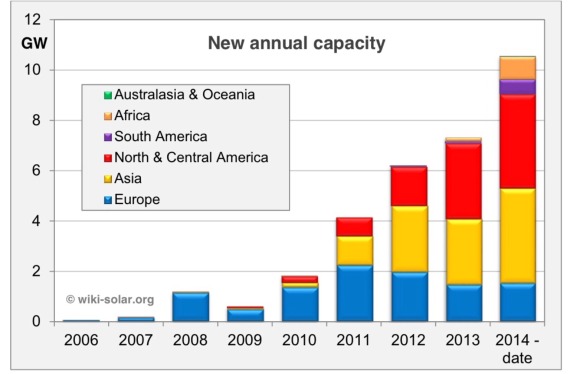
The big surge is in Asia and North America, but other continents have come to life through installations in Chile and South Africa.

5. Production of shale oil increases

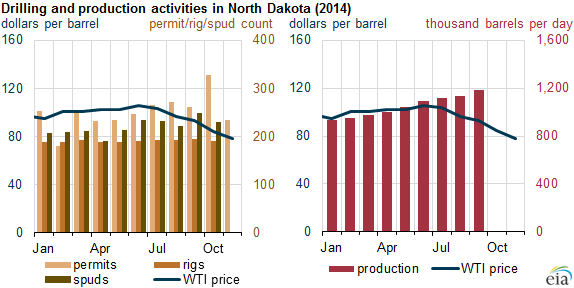
The production of shale oil in North Dakota has increased month by month in 2014, in spite of falling prices.

ndoil

Meanwhile falling oil prices have hidden a new global warming fee on the purchase of gasoline in California.

6. Compressed air technology

Not everyone reads the discussion threads, so I’m repeating here some links made by Jumpy to compressed-air technology.

Danielle Fong with her company LightSail Energy is bringing compressed-air energy storage technology to the market.

Both Peugot and Citroën are developing compressed-air hybrid cars that use 2 litres per 100 kilometres of fuel. Apart from the hybrid compressed-air powertrain both cars are using light-weight materials and aerodynamics to improve economy. The also have narrow tyres pumped up high.

Of course these cars use twice as much fuel as the electric hybrid Volkswagen XL1 which plans to put 250 cars on the road, at a price. That article is from July 2013 – not sure how they are going.

Saturday salon 3/1

voltaire_230

An open thread where, at your leisure, you can discuss anything you like, well, within reason and the Comments Policy. Include here news and views, plus any notable personal experiences from the week and the weekend.

For climate topics please use the most recent Climate clippings.

The gentleman in the image is Voltaire, who for a time graced the court of Frederick II of Prussia, known as Frederick the Great. King Fred loved to talk about the universe and everything at the end of a day’s work. He also used the salons of Berlin to get feedback in the development of public policy.

Fred would only talk in French; he regarded German as barbaric. Here we’ll use English.

The thread will be a stoush-free zone. The Comments Policy says:

The aim [of this site] is to provide a venue for people to contribute and to engage in a civil and respectful manner.

Here are a few bits and pieces that came to my attention last week.

1. Changing skivvies on the Wiggles

Tim Dunlop has done a great piece on the reshuffle. He reckons it’s

like changing who wears which colour skivvy in the Wiggles: it doesn’t make any difference, and they all end up singing the same old tunes.

Tony Abbott is still the Prime Minister. Joe Hockey is still the Treasurer. They are still committed to their budget and its underlying philosophy of market liberalism and a wholesale attack on the pillars of the welfare state.

Let’s focus on that, not which Wiggle is wearing which skivvy.

Dunlop’s big idea, though is that “both major parties have drained the office of prime minister of authority by converging on an economic program that subsumes economic sovereignty into the vagaries of a globalised economy.” Hence:

The office of prime minister is thus less about leading the country than about managing the electorate’s disappointments within that system, and Mr Abbott inherited an electorate hip to the tricks of a political class who have been selling us moonshine – privatisation, deregulation and the rest of it – for the best part of four decades now.

Given that structural issue, though, Abbott has brought his own particular brand of stupid to the role, says Dunlop.

2. 2015 will be basically grim

Mungo MacCallum looks at the political/policy prospects for 2015, and doesn’t like what he sees.

What seems inevitable is that 2015 is unlikely to be any better than 2014: basically grim. The only real question is just who ends up bearing the cost. It may be Abbott himself and it may be the government as a whole. But one way or another we are all going to cop at least a bit of collateral damage.

It all depends on the next budget. If it is verse 2 of the last budget then Abbott is in trouble. He needs a fix “which is dramatic, equitable and above all plausible.” Problem is he won’t shirtfront the rich and powerful. So the rest of us cop it, while being encouraged to spend like blazes to save the economy from recession. Before Christmas they announced cuts in the area of the homeless. Morrison reckons he needs to make welfare sustainable by cutting the bejesus out of it.

So the result is confusion, and pain.

3. Child shoots mum in Idaho Walmart

This has already been linked to elsewhere by Geoff Genderson and zoot, but in case you missed it, a two year-old child has shot and killed his mum in an Idaho Walmart. The boy unzippered her purse, a Christmas gift from her husband with a special pocket to conceal the weapon.

4. Carmichael mine to go ahead

Those hoping that falling coal prices will put an end to the development of the Galilee Basin mega-mine Carmichael will be disappointed.

Sydney-based engineering firm Downer EDI announced late last month it had received two Letters of Award from Adani to build and operate the Carmichael mine.

“The contracts are expected to have a combined value in excess of $2 billion over seven years,” Downer EDI said in a statement.

Adani expects to start building the rail line within the next few months despite not having a mining lease.

Adani reckon that cash costs would fall below $US50 a tonne, making Carmichael one of the cheapest mines in the world.

The mine has:

attracted a conditional debt funding of $1 billion from the State Bank of India and a promise of equity funding of up to $300 million from the Queensland Government for the rail line to Abbot Point.

Adani has also recently attracted an equity partner, POSCO, a Korean company that will build its railway and port as well as hold a stake in the infrastructure.

5. Civil society – more activity, less effect

Michael Edwards is pessimistic about the effect of civil society organisations. The numbers of organisations is impressive and continues to grow, but he thinks civil society organisations are becoming less effective. Problems include co-option, the corporatisation of civil society groups themselves and a lack of carry-through to the structures of power and influence in society.

Some progress is being made around the edges of poverty and injustice.

But there’s no sign that the underlying structures of social, political and economic violence and oppression are being shaken to their roots.

As a result, fewer people in the world are dying young, and basic indicators of health and education, income and employment are getting slightly better – at least for most people in most countries. However, economic inequality is rising, democracies are being hollowed out, climate change is worsening, and discrimination based on race, gender, ability and sexual orientation remains endemic.

Participation in voting and labour unions is falling. Social media and professional advocacy groups have strong messages, but less purchase where it counts.

Sorry!

Sorry about the gloomy line-up above. Maybe I should just pull a blanket over my head and wait the year out!

I did hear today on our ABC a riveting discussion about whether the meat pie typified the Australian cuisine!

Charting the progress of Sapiens

Vivek Menezes puts the question:

    In 1974, a grey-haired indigenous leader of Papua New Guinea asked a visiting American ornithologist something like, “How come you people dominate the world, while we have so little?”

Jared Diamond has been answering that question ever since. Israeli historian Yuval Noah Harari has moved into the space opened up by Diamond, essentially asking why a seemingly inconsequential ape that divided from chimpanzees some six million years ago ended up with a species of Homo, namely Sapiens, which has come to dominate the planet. Harari’s book Sapiens: A Brief History Of Humankind concentrates on the last 70,000 years, which as Galen Strawson points out, is more than enough for a mere 400 pages. Continue reading Charting the progress of Sapiens

Friedman’s top five events of 2014

In a season of lists, George Friedman, Chairman of the global intelligence company Stratfor, has made a list of his top five events for 2104.

1: Europe’s Persistent Decline

    The single most important event in 2014 was one that did not occur: Europe did not solve its longstanding economic, political and social problems.

Europe, taken together, remains the world’s largest economy and a centre of global commerce, science and culture. It’s inability to solve its problems or make any significant progress has the potential to disrupt the world system. There is general economic malaise and huge unemployment in the south. Continue reading Friedman’s top five events of 2014

The price of oil

Recently John Quiggin in The fossil fuel crash of 2014 asked what should we make of the fact that oil prices have fallen from more than $100/barrel in mid-2014 to around $60/barrel today? He also looked at coal, I’ll stick with oil. Quiggin poses the questions:

The big questions are
(i) to what extent does the price collapse reflect weak demand and to what extent growing supply
(ii) will these low prices be sustained, and if so, what will be the outcome?

Quiggin says:

The answer to the first question seems to be, a mixture of the two, with some complicated lags.

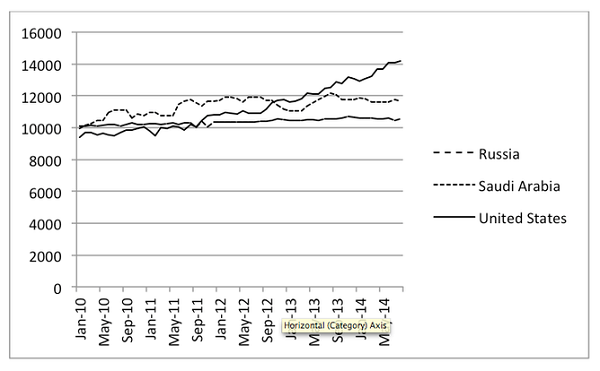
I thought it was the Saudis increasing supply to put the American frackers out of business. This turns out not to be the case. Richard Heaney gives us this graph on monthly oil production:

image-20141219-31034-s3o1c6_600

So it is the Americans who have largely increased supply. The Saudis have simply decided not to reduce supply, the usual tactic to increase the price. I’m sure they are hoping the American frackers will feel the squeeze.


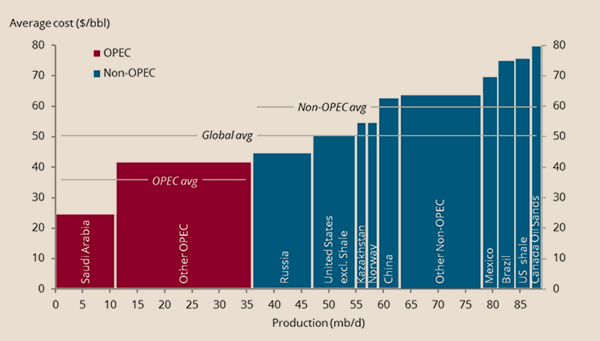
Anjli Raval gives
this graph of costs:

f9c2521e-8058-11e4-872b-00144feabdc0.img

Raval says that most at risk are the Canadian oil sands, US shale plays and other areas of “tight oil”. Also vulnerable are Brazil’s deepwater fields and some Mexican projects. Crude at $70 puts at risk projects for 2016 to the extent of 1.5 million barrels per day.

Raval has perhaps the best discussion of what might happen in the future. The short answer is that we don’t know. A pull-back in investment could lay the basis for the next price surge. There may also be a switch to cleaner energy sources.

Much of the discussion, including a Financial Times editorial arguing that the fall in the price of oil was good for the economy (the concern was over deflation), ignores climate change.

John Quiggin says, inter alia that:

if we are to reduce emissions of CO2, a necessary precondition is that the price of fossil fuels should fall to the point where it is uneconomic to extract them.

I’m confused. I thought the aim of carbon pricing was to make fossil fuels more expensive to discourage use and to make the use of renewable alternatives competitive.

Adair Turner in a piece Please Steal Our Fossil Fuels goes into considerable detail about the transition to renewables. If all the fossil fuels were stolen we would not be stuck (or not for long) and it would in the long run cost a negligible amount more. However, the assumption is that the transition will depend on price. Unfortunately electric cars may not be cheaper until the late 2020s. There is plenty of oil in the ground and whilst it is available we will keep using it.

Turner says “we should commit to leaving most fossil fuels forever in the ground” and no great harm would befall us economically if we did, but we won’t. Miracles would be required.

At this point I’ll state my case that we should act out of policy, not rely on markets or miracles. If Germany can forswear nukes because they are dangerous and evil, why can’t we do the same in relation to fossil fuels, which are even more dangerous? Sooner or later we’ll have to ignore the fossil fuel mafia.

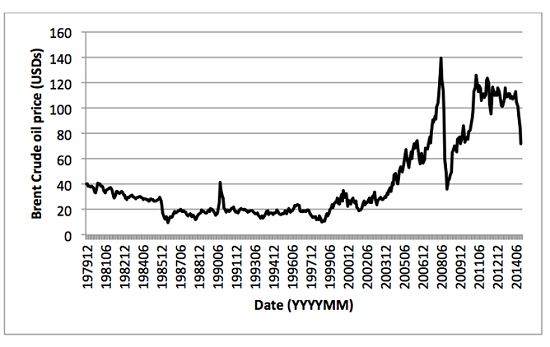
Before I go, Heaney has this graph of the oil price in recent years:

image-20141219-31034-wl7wo0_550

It demonstrates that oil can be extremely volatile. There is no way of telling where the current crash will end, but my guess is that it will more or less stabilise soon. After that we are in uncharted territory.

Elsewhere Jeffrey Frankel makes several interesting points.

Firstly most dollar denominated commodities have fallen in price, including iron ore, silver, gold, platinum, sugar, cotton and soybeans. So something general is going on beyond the vagaries of specific commodities.

Secondly, The Economist’s euro-denominated Commodity Price Index has actually risen over the last year.

Third, and most importantly, it seems, there is a link between commodity prices and interest rates. When interest rates go up, commodity prices fall. Frankel suggests that traders are anticipating a rise in interest rates in the US next year. It’s not the whole story, but perhaps an important factor overlooked elsewhere.

Climate clippings 119

1. Abbott appoints fruitcake to assist Greg Hunt

baldwin_220

He says he’s not a denier or a sceptic, so let’s just call him a fruitcake. In the recent ministerial reshuffle Bob Baldwin has been moved from Parliamentary Secretary to the Minister for Industry to Parliamentary Secretary to the Environment Minister.

Baldwin told the Chinese that the climate had been changing for millions of years and we wouldn’t have coal, oil or gas without climate change. That’s a typical denialist tack. Elsewhere he quoted that well-known authority on everything, Queensland radio shock-jock Michael Smith. If the atmosphere was a bridge a kilometre long, he said, the first 770 metres would be nitrogen, the next 210 metres oxygen, and so on until you come to CO2. Australia’s contribution of CO2 is the equivalent to 0.18 millimetres, the width of a human hair.

2. Bernie Fraser sends a Christmas message to Abbott

Bernie

Basically, keep the Renewable Energy Target (RET), it all you’ve got, and the Emissions Reduction Fund (ERF) may not meet its initial target of 5% emissions reductions by 2020. In any case it is not scalable to meet the targets we are likely to be committed to post 2020.

The Climate Change Authority has just completed its review of the RET and a review of the Carbon Farming Initiative (CFI), as mandated in the establishing legislation. I’d recommend reading Bernie’s Chairman’s Statement.

The CCA recommends extending the achievement date of the RET by up to three years, but this is the big picture:

The Authority has argued consistently throughout its short life that an effective policy response to the risks of climate change requires favourable winds on at least two fronts:

• first, a broad community consensus that climate change poses real risks to the community; and

• secondly, a well-stocked toolbox to be able to tap into opportunities to reduce emissions wherever they occur.

Neither exists today. The earlier broad political consensus has ruptured in recent years, and no early repair is in prospect. And the tool box is feeling less weighty, with the removal of the carbon pricing mechanism, an unproven ERF, and an uncertain outlook for the RET.

There’s more from Giles Parkinson who calls it “a damming assessment of Abbott government climate policy” and from Sophie Vorrath.

3. Harper flags carbon price rethink for Canada

Abbott-Harper-144x144

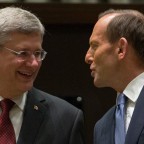
Before Christmas when Tony Abbott was asked what he’d achieved as Minister for Women he nominated dumping the carbon tax. At the same time the Canadian PM Stephen Harper, Abbott’s soul-mate on climate policy, suggested that he was open to a country-wide carbon pricing scheme similar to the one implemented in Alberta.

In Alberta, energy heavy polluting companies are required to reduce their energy intensity, or improve their energy efficiency, annually. If they don’t, they must contribute to a technology fund at $15 a tonne for carbon emissions.

“I think it’s a model on which you could, on which you could go broader,” Harper said in Wednesday’s interview.

4. Tesla pilots battery swap

Tesla is opening a battery swap station between Los Angeles and San Francisco on a pilot basis to see whether the idea goes anywhere. Zachary Shahan, the author of the linked piece, suggests perhaps not. The swap must be done by appointment and although it may be completed in less than a minute it would cost almost as much as a tank of premium. The alternative is free Supercharging for Tesla owners.

5. Technology on the move

In the same issue of RenewEconomy as the Tesla battery swap item above were three other technology announcements.

First, the ASX listed company Algae.Tec has issued rights to raise capital to build an algae biofuel plant in India.

Second, the ADF is looking to replace diesel generation with renewable energy to power Bathurst Island, north of Darwin, probably wind and solar.

Third, a solar plant that floats on water is being launched in South Korea.

6. Banks begin to take climate risk seriously

The large investor Australian Super has been asking banks about their climate change risk policies. It sounds as though banks are pretending to be more active than they really are, but it is clear that the investment landscape has changed forever. If the banks have not been actively concerned, they soon will.

Former Coalition opposition leader John Hewson, who chairs the Asset Owners Disclosure Project

is considering “naming and shaming” how the world’s 1000 biggest banks are responding to carbon risk, something it already does for pension funds.

Saturday salon 27/12 late edition

voltaire_230

An open thread where, at your leisure, you can discuss anything you like, well, within reason and the Comments Policy. Include here news and views, plus any notable personal experiences from the week and the weekend.

For climate topics please use the most recent Climate clippings.

The gentleman in the image is Voltaire, who for a time graced the court of Frederick II of Prussia, known as Frederick the Great. King Fred loved to talk about the universe and everything at the end of a day’s work. He also used the salons of Berlin to get feedback in the development of public policy.

Fred would only talk in French; he regarded German as barbaric. Here we’ll use English.

The thread will be a stoush-free zone. The Comments Policy says:

The aim [of this site] is to provide a venue for people to contribute and to engage in a civil and respectful manner.

Here are a few bits and pieces that came to my attention last week.

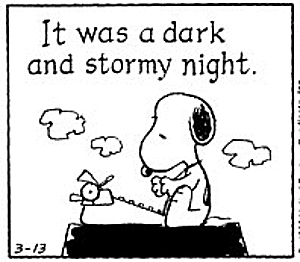
1. It was a dark and stormy night

darkandstormy_5013

Actually we’ve had gentle rain tonight, easing. Probably about 15 to 20 mm. Enough to keep the grass, shrubs and trees interested, but not enough to run water into any of the dams on properties where I work.

Other than Christmas, not too much has happened that impinged on my consciousness, but then we’ve intentionally missed the news on telly a couple of times. With Christmas midweek I lost a sense of what day it was. Tomorrow’s Sunday, when I normally work on a 50-acre property with possibly an acre of kept gardens. If it’s raining in the morning I’ll put the cue in the rack which means for sure the sun will come out to a bright shiny day!

The idea of the image above came from son Mark’s Facebook. He’s holidaying in southern Thailand where I gather the weather is bad!

2. Tsunami anniversary

Mark will be here next week. I must ask him whether Koh Samui was affected by the Boxing Day tsunami.

Of course, Boxing Day was the tenth anniversary of the tsunami that destroyed large tracts of Aceh province in Sumatra, also affecting Thailand and Sri Lanka, killing some 230,000 people. See reports at the the ABC and the BBC.

3. Putin needs new annexations

Looking further abroad the German magazine Der Spiegel ran an interview with the Ukrainian Prime Minister Arseniy Yatsenyuk, who thinks that Putin needs new annexations to feed his popularity at home. Yatsenyuk is plainly pessimistic about any resolution of the situation, which is a worry for the whole world in 2015.

This article by Anatole Kaletsky is reasonably optimistic, pointing out that the formal truce struck in September is holding and that the situation should evolve into

a broadly stable “frozen conflict,” similar to the stalemates that have prevailed for years, even decades, in Georgia, Moldova, Armenia, Azerbaijan, Kosovo, Cyprus and Israel, to name just the frozen conflicts closest to Europe.

Kaletsky thinks Ukraine will never make it into the EU or NATO. He thinks:

an EU association agreement, similar to Turkey’s, could help reduce corruption and encourage economic reform. A dual trading relationship with both Europe and Russia could ultimately offer Ukraine the only possible route to economic viability. This sort of relationship should become possible once this year’s conflict is definitively “frozen.”

4. Heightened terrorist “chatter”

There is always a possibility that Abbott’s warning of heightened terrorist chatter is playing politics. I’d be inclined to give him the benefit of the doubt.

Professor Jeff Lewis, terrorism expert at RMIT, said:

predictions were “very, very difficult” but believed an attack would occur in the following year.

“While we engage in war against ISIS it makes us vulnerable,” he said.
Advertisement

“I wouldn’t want to put a percentage on it, but I think in the next 12 months something else will happen, either in Australia or in Indonesia directed at Australians.”

Not good!

Explaining the pause that wasn’t

4732500-3x2-220

We’ve only just seen that statistically there never was a recent ‘pause’ or ‘hiatus’ in warming when two articles show up explaining the pause that wasn’t. A key word here is statistically. No-one is suggesting that there may not be variations from time to time that do not breach the trend.

Also climatologists are always interested in understanding the physical mechanisms behind both short-term variability and longer term trends.

First, via Carbon Brief there has been a new study examining the impact of aerosols from volcanoes.

Virtually all research into the climate influence of volcanic aerosols has used satellite measurements of particulates in the upper atmosphere (the stratosphere). These satellite measurements only monitor the volcanic aerosol at heights of 15 km and above. The new paper by David Ridley and colleagues studied the amount of volcanic aerosols in portions of the stratosphere that lie below 15 km.

They found that 30 to 70% of aerosols from recent eruptions lodged below the 15 km mark. Further, these lower level aerosols had been responsible for significant cooling since 2000. Taken together with additional heat being stored in the deep oceans, the slowdown is “both fully accounted for and temporary.”

Estimated volcanic cooling from this source is not included in climate models.

A second study looks at the influence of Pacific winds on warming since the 1890s. They did this by analysing the chemical make-up of corals.

The coral record suggests, for example, that trade winds were weak between 1910 and 1940 when the Earth warmed by 0.4 degrees, and were strong from 1940 to 1970, during a period of relatively little increase in global temperatures.

Apparently the winds have been very strong since the turn of the century.

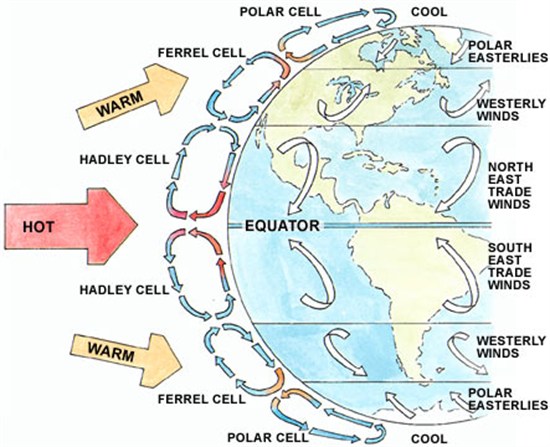
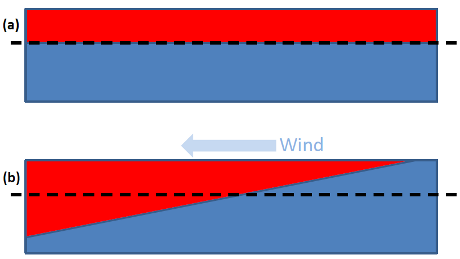
The winds in question are the trade winds that move tropical surface water from east to west. This two-dimensional image attempts to illustrate the complex pattern. Trade winds just north and south of the equator drive warm surface water westwards:

edu13-image_550x447

The water is replaced by cool water rising from the deep, which is known to affect global average surface temperatures. A simplified mechanism of how this works is given in the following:

thermocline

Knowledge of the influence of the wind on temperature variations is not new. For example, Matthew England of the University of NSW and others published a paper early in 2014 on the subject. England says of the new paper:

“This is a really important study: it confirms the crucial role of the Pacific Ocean in driving decadal climate variability at a global scale.”

The strength of the trade winds is associated with a natural climate phenomenon called the Interdecadal Pacific Oscillation (IPO). The IPO has positive and negative phases, which switch every few decades. Lead author Professor Diane Thompson says:

“We do know that the typical lifetime of a phase of this cycle is less than 30 years, and the current one began about 15 years ago. So although the timing of that switch remains difficult to anticipate, it would be most likely to happen within the next one to two decades.”

We don’t know the future of volcanic activity, nor when the Pacific wind pattern is going to switch. What we do know is that both have been inhibiting warming in recent years.

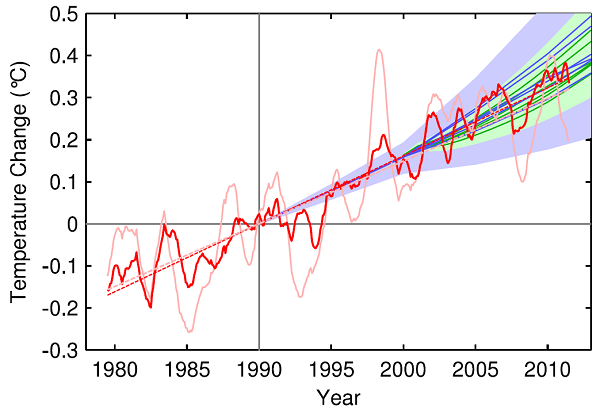
Of course Pacific wind patterns are also associated with ENSO where El Niño years are warmer and La Niña years are cooler. A year ago Stefan Rahmstorf looked at The global temperature jigsaw where he identified a variety of influences at work. It included a graph from a 2012 paper which used a multivariate correlation analysis to take out the influence of ENSO, volcanoes and solar activity. The pink line shows observed data and the red line with those three factors removed:

Rah2012_600

The ‘pause’ effectively goes away.

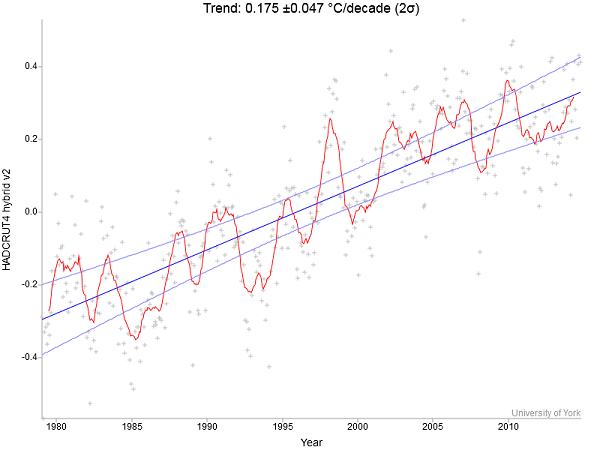
The observed data (pink line) in the above graph is an average of five data sets. It is likely that two of them, HadCRUT and NOAA omitted the Arctic entirely. I’ll post again the recent HadCRUT4 hybrid data from the satellite era which Rahmstorf suggests is now the best:

trend1_600

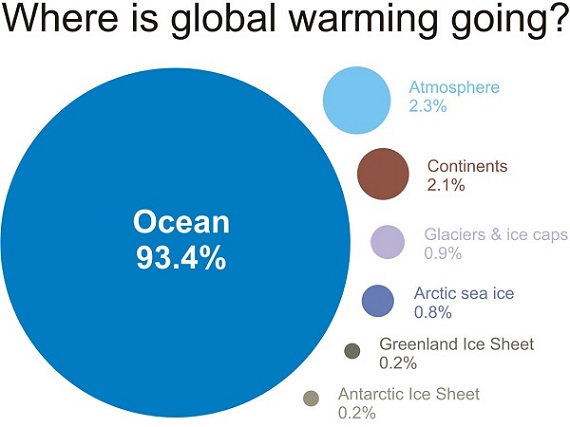
Again a pause is pretty hard to find, especially if you ignore 1998 as a outlier year. Of course 1998 should not be ignored as it appears to have had a crucial role in transferring stored heat from the ocean to the surface. It’s worth remembering just how little of the planet’s energy is stored on the surface compared to the ocean:

GW_Components_570

Rahmstorf did predict that when we had another El Niño year a new record would be set. 2014-15 is not an El Niño, not yet, but is being heralded as the warmest ever. I’ll wait for it to actually happen before reporting on it further. Meanwhile it’s a fair bet that we will have strong warming in the next few decades.

Climate change, sustainability, plus sundry other stuff