1. January-April hottest ever
We’ve just broken some more global warming records. January-April was the hottest on record and May 2014–April 2015 was the hottest 12-month period on record. Continue reading Climate clippings 140

We’ve just broken some more global warming records. January-April was the hottest on record and May 2014–April 2015 was the hottest 12-month period on record. Continue reading Climate clippings 140
As noted in Climate Clippings 139 (Item 5) the new Queensland Labor Government has committed to a 50% renewable energy target by 2030 so I was interested to attend a public forum last week on the future of electricity in Queensland, chaired by John Davidson as convenor of the West Brisbane Branch of the Queensland Greens. Speakers were John Foster, Professor of Economics at Queensland University, Murray Craig, Managing Director of Solar Centre and Charles Worringham, spokesperson for the Queensland Greens. Continue reading The future of electricity in Queensland
1. Quiggin reckons Tesla battery can solve climate change Continue reading Climate clippings 138
1. Unburnable Carbon: Why we need to leave fossil fuels in the ground
That’s the title of a new report from the Climate Council.
To have a 75% chance of meeting the 2°C warming limit, at least 77% of the world’s fossil fuels cannot be burned.
When I heard Greg Hunt spruiking the first auction under the Emissions Reduction Fund (ERF) last week, he sounded like a used car salesman. He has form on cherry picking statistics and imaginative accounting, so it’s best to ignore what he said and look to other sources (please note, there is other commentary in the link, including from Tim Flannery).
In the broad we need 236 million tonnes of CO2 equivalent emissions reduction to meet a 5% target. The Government has just spent $660 million (25.9%) of the $2.55 billion fund to purchase 47 million tonnes (19.9%) of abatement. Continue reading Emissions reduction auctions: Dodgy Bros or the best thing since sliced bread
1. Will Hillary Clinton be too weak on climate change?

Campaign chair John Podesta tweeted:
Helping working families succeed, building small businesses, tackling climate change & clean energy. Top of the agenda.
Yet she herself has mentioned it only obliquely since announcing that she’s running. From the past we have this:
At the National Clean Energy Summit in September of last year, in her first major domestic policy address since stepping down from the state department, Clinton described global warming as “the most consequential, urgent, sweeping collection of challenges we face as a nation and a world”. Continue reading Climate clippings 136
1. Closing down dirty power
From Climate Code Red, a recent Oxford University report:
identified the most-polluting, least-efficient and oldest “sub-critical” coal-fired power stations. It found 89% of Australia’s coal power station fleet is sub-critical, “by far” the most carbon-intensive sub-critical fleet in world.
The International Energy Association, within a framework that itself is probably inadequate, says that one in four sub-critical power stations should close within five years. Hence 22% of our power stations should close within five years if we are to do our part. Continue reading Climate clippings 135
There are lots of good health, environmental and economic reasons for using bikes as replacement for other forms of transport and recreation. However, on average, your chances of being killed or injured are much higher when riding a bike than travelling by car. This post looks at some of the advantages and disadvantages of riding a bike instead of travelling by car. Continue reading Parking Spaces to Protected Bike Lanes
Switching to 100% renewables by 2050 would save major economies $500 billion and save the lives of 1.3 million people.
The study looked at how fossil fuel use and greenhouse gas emissions were linked to the economy, health and job market of the US, the EU and China, and then assessed how their current climate change commitments would benefit those areas.
According to the study:
if the US, the European Union and China started taking the steps towards using 100 percent renewable energy by 2050, they’d save a combined US$500 billion per year.
On top of that, moving in that direction would save the lives of around 1.3 million people who are killed prematurely by air pollution, and also create 3 million new jobs by 2030. And if that’s not enough reason, the study also predicted that if all countries started moving towards the 100 percent renewable target, global warming would not cross the 2 degrees Celsius threshold that many scientists believes is the ‘point of no return’ for climate change. (Emphasis added)
Here are the savings:
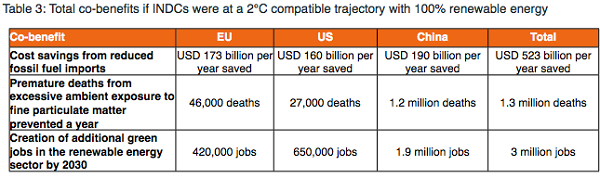
Notice most of the lives saved and the jobs would be in China, which has a major stake in global warming. The following image derived from the Firetree flood maps, shows eastern China with 9 metres of sea level rise:
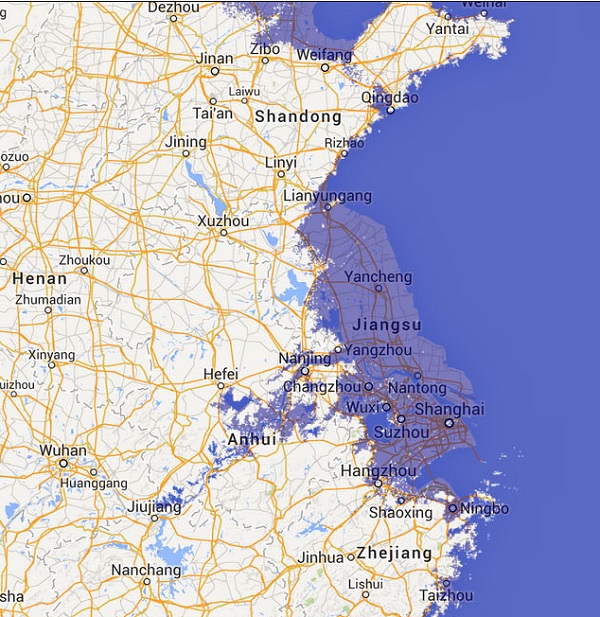
That whole Shanghai and Jiangsu basin goes squishy with only one metre rise. At 2 or 3 metres the area would become unlivable. From about 5 metres the sea would start to penetrate deep into Anhui Province.
The linked article contains information about other developments in renewable energy.
Costa Rica powered the whole country with renewable energy for 75 days straight.
If California covered its houses, buildings and urban spaces with small-scale solar installations, it would generate enough electricity to power the state three to five times over.
Meanwhile, fossil fuels are way more expensive than the immediate dollar costs would indicate. As noted in this article:
Experts in these fields who have published research on the subject have found that fossil fuels are incredibly expensive, when we account for all of their costs. For example, one recent study conservatively estimated that including pollution costs, coal is about 4 times more expensive than wind and 3 times more expensive than solar energy in the USA today.
I’m confident the Greens appreciate the true situation, not sure that Labor really get it. Meanwhile as posted recently in Climate clippings, the Abbott government has its head completely buried in the sand:

1. Abbott’s energy white paper focuses on fossil fuel favourites
We should take a longer look at the Abbott government’s energy white paper, but from what Giles Parkinson says it would be a waste of time. As expected it ignores climate change and sees our future based on fossil fuels. Here’s Tones peering into our energy future:
The world will pass him by!
2. Solar news
RenewEconomy was a flood of articles about solar.
A company based in the world’s largest oil exporting nation, Saudi Arabia, has become the new owner of Australia’s second-largest solar plant – the under-construction 72MW Moree PV project – after buying Spanish solar developer Fotowatio Renewable Ventures (FRV) and its 3.8GW global development pipeline.
Abdul Latif Jameel Energy and Environmental Services – a conglomerate that also has a base in the United Arab Emirates – announced its purchase of FRV on Wednesday, describing it as a major development of its energy business, and part of its on-going strategy to be the Gulf’s largest solar power plant developer.
Giles Parkinson says the prospects for big solar in WA are bright.
James Mandel and Leia Guccione take a look at a Rocky Mountain Institute report that analyzes how grid-connected solar-plus-battery systems will become cost competitive with traditional retail electric service and why it matters to financiers, regulators, utilities, and other electricity system stakeholders.
Paul McArdle reports on the benefits of tracking systems in solar PV from a seminar hosted by the UQ Energy Initiative and the Global Change Institute.
And more, as the Abbottistas fade into irrelevance, except that they are presently running (ruining?) the country.
3. Aluminium battery charges in one minute
US scientists say they have invented a cheap, long-lasting and flexible battery made of aluminium for use in smartphones that can be charged in as little as one minute.
The researchers, who detailed their discovery in the journal Nature, said the new aluminium-ion battery had the potential to replace lithium-ion batteries, used in millions of laptops and mobile phones.
Besides recharging much faster, the new aluminium battery is safer than existing lithium-ion batteries, which occasionally burst into flames, they added.
While lithium-ion batteries last about 1,000 cycles, the new aluminium battery was able to continue after more than 7,500 cycles without loss of capacity. It also can be bent or folded.
Larger aluminium batteries could also be used to store renewable energy on the electrical grid, Professor Dai said.
Meanwhile the US market for energy storage management systems, that is the software suites designed to increase the operating efficiency and overall value of energy storage, will grow tenfold between 2014 and 2019.
5. French banks rule out funding Galilee basin coal project
France’s three biggest banks have ruled out funding the controversial multi-billion dollar Galilee basin coal mining, rail and port development in Queensland. Eleven major international lenders have now publically stated that they won’t finance the $16.5 billion dollar project and one analyst says more delays could see the Indian company behind the project ultimately scrap the development.
6. Rising sea levels to force the largest exodus in history
Scientists calculate that within the next three decades a substantial area along the Bay of Bengal, a region of delta approximately 200 delta islands in India and Bangladesh called the Sundarbans, will be underwater due to climate change and rising sea levels. If that happens, the millions of people living there now will be forced to abandon their homes and lands, making their displacement the largest exodus in modern history.
Estimates predict that the region will be underwater within the next 10-25 years, forcing 8 million Bangladeshis and 5 million Indians inland.
That makes 13 million displaced. Other large movements cited include 10 million during the 1947 India-Pakistan partition and 7 million African Americans move from the southern states northward during the period 1916-1970. The one he missed was the movement of Germans from Eastern Europe towards the end and after World War II. Tony Judt reckons 13 million.
7. Contrarian climate scientists
Dana Nuccitelli reviews an interview with top contrarian climate scientists Roy Spencer and John Christy. You can read his analysis of their flawed thinking and erratic statements. I’d like to pull out three points.
First, John Cook et al’s survey that established the 97% consensus in the peer-reviewed literature on human-caused global warming does not categorise the 3% as complete denialists. The 3% includes papers by scientists, such as Spencer and Christy, who minimise human influence on global warming. Complete denialists amongst climate scientists are rare if they exist at all.
Second, the American Meteorological Society (AMS) and Yale University conducted a survey of meteorologists in relation to climate science and global warming. Only 13 percent of survey participants described climate as their field of expertise. I was surprised at how low the number is.
Third, on the cost of renewables:
Experts in these fields who have published research on the subject have found that fossil fuels are incredibly expensive, when we account for all of their costs. For example, one recent study conservatively estimated that including pollution costs, coal is about 4 times more expensive than wind and 3 times more expensive than solar energy in the USA today.
Every year climbers of Mt Everest leave behind 26,500 pounds of poo. I make that about 12 tonnes.
Sherpas pick it up, bring it down in blue barrels, dig a hole and dump it. Now the proposal is to build an anaerobic digester in a small village near Everest’s base to create biogas to produce power. Apparently human poo is not the best, but it works.
2. Arctic sea ice record
I think it’s time to call it. The Arctic sea ice winter maximum is the lowest on record. This graph shows 2015 ice against the previous record of 2011 and the 1981-2010 average:
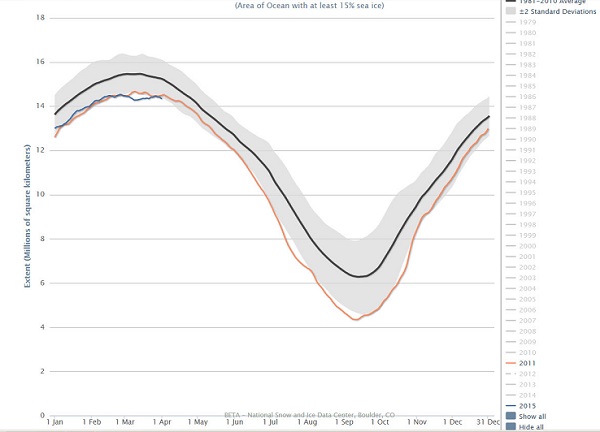
Also the maximum extent was reached on February 25, the second earliest on record.
According to a recent survey, thinning has been quite dramatic:
… annual mean ice thickness has decreased from 3.59 meters [11.8 feet] in 1975 to 1.25 m [4.1 feet] in 2012, a 65% reduction. This is nearly double the 36% decline reported by an earlier study….
In September the mean ice thickness has declined from 3.01 to 0.44 m [from 9.9 to 1.4 feet!], an 85 % decline.
Climate Central has a graphic showing the loss of ‘old’ ice. In 1987 it used to be 26% of the ice pack, now it’s down to 10%.
Polar bears will struggle to adapt.
3. Shell looks to drill in Arctic
Shell hopes to drill in the Chukchi Sea in the Arctic this summer. It looks as though Obama’s Department of the Interior will allow it, even though an Environmental Impact Report released by the Bureau of Ocean Energy Management (BOEM) noted a 75% chance of one or more large spills occurring under the current plan. In 1989 the Exxon Valdez disaster spilled nearly 11 million gallons of crude oil into the Alaskan Gulf, polluting over 1300 miles of coastline. It is estimated that only 14% of the oil was cleaned up.
By comparison BP’s Deepwater Horizon oil rig spilled 168 million gallons of oil into the Gulf of Mexico off the Louisiana coast.
Yet Obama himself stresses the need to move early on climate change. More than half of Republican politicians deny or question the science. Voter pressue will change that eventually.
A recent Stanford University poll found that two-thirds of voters were more likely to vote for a candidate that campaigned on a platform of fighting climate change, and were less likely to vote for a candidate that outright denies climate change.
4. Land, ocean carbon sinks are weakening
We are destroying nature’s ability to help us stave off catastrophic climate change. That’s the bombshell conclusion of an under-reported 2014 study, “The declining uptake rate of atmospheric CO2 by land and ocean sinks,”…
Based on actual observations and measurements, the world’s top carbon-cycle experts have determined that the land and ocean are becoming steadily less effective at removing excess carbon dioxide from the atmosphere. This makes it more urgent for us to start cutting carbon pollution ASAP, since it will become progressively harder and harder for us to do so effectively in the coming decades.
Joe Romm calls the study “one of the most consequential recent findings by climatologists”
More than half of emissions are currently absorbed by land and ocean-based carbon sinks. Increasingly these emissions will stay in the air.
5. Reasons the Australian solar market is so interesting
Clean Technica has found 7 reasons the Australian solar market is so interesting republished at RenewEconomy.
One reason is that we have so much sunlight, as shown below:
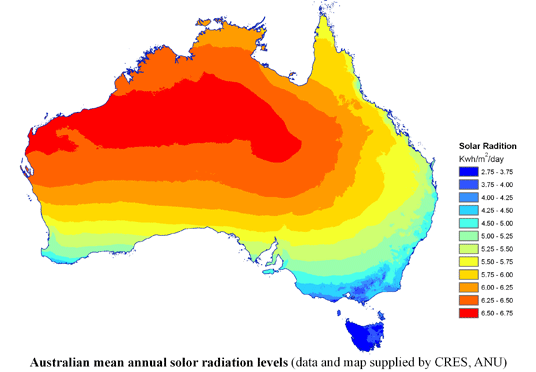
However, most of us live in the more cloudy parts in big cities and along the south-east edge. A commenter pointed out that for insolation Ney York lies between Melbourne and Sydney.
A second reason is that we are enthusiastic about roof-top solar, with over 20% of houses now with panels installed.
A third is that, along with Germany, Italy and The Netherlands, we reached socket (aka grid) parity in 2013.
1. Accelerating ice loss from Antarctica shelves
Some ice shelves in Antarctica are thickening and some are thinning. The pattern between east and west is obvious from this image:
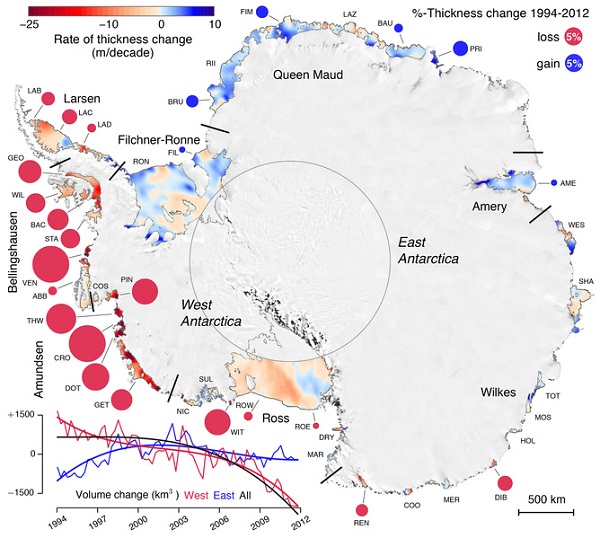
When we sum up losses around Antarctica, we find that the change in volume of all the ice shelves was almost zero in the first decade of our record (1994-2003) but, on average, over 300 cubic kilometers per year were lost between 2003 and 2012.
According to the ABC story, some shelves lost almost 20% of their thickness.
Melting ice shelves does not itself cause sea level rise, but the shelves buttress land ice, which then becomes more mobile. The graph in the bottom corner of the image shows that East Antarctica is now also experiencing a net loss of ice from ice shelves.
2. Top polluters to set own limits virtually penalty free
ANU economist Frank Jotzo said the system is designed so no-one gets caught by it – a toothless tiger. Tony Wood of the Grattan Institute said the ideas proposed in the paper simply would not work. They were commenting on a Government consultation paper outlining “safeguards” to ensure the big polluters do not offset emissions saved through the Emission Reduction Fund (ERF), a flagship component of Direct Action.
Australia’s 140 top polluters will set their own limits for future pollution virtually penalty free, according to the Government’s latest Direct Action policy paper.
Companies subject to the safeguards will select a baseline, or limit, for future pollution.
That baseline will be set according to the highest peak of emissions from the past five years.
Just plain stoopid!
3. What’s going on in the North Atlantic?
Stefan Rahmstorf asks the question at RealClimate. There is a large patch in the North Atlantic which has cooled in the last century.
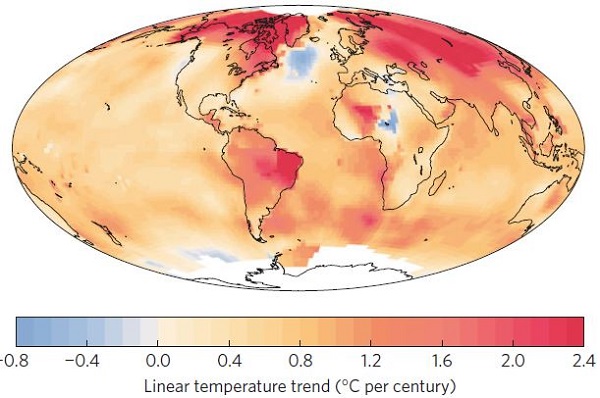
Rahmstorf explains:
Our recent study (Rahmstorf et al. 2015) attributes this to a weakening of the Gulf Stream System, which is apparently unique in the last thousand years.
In fact during last winter, which was the warmest on record for the planet overall, this patch had the coldest temperatures on record.
Chief suspect has to be the increasing freshwater coming off Greenland. There will be consequences.
The consequences of a large reduction in ocean overturning would look nothing like the Hollywood film The Day After Tomorrow. But they would not be harmless either – e.g. for sea level (Levermann et al. 2005) particularly along the US east coast (Yin et al. 2009), marine ecosystems, fisheries and possibly even storminess in Europe (Woollings et al. 2012).
A complete breakdown of the current was given up to a 10% chance this century in the IPCC report. This may have been an underestimate.
4. Rapid Arctic warming is changing the Jetstream and the weather
Another study, also involving Rahmstorf, looks at changing atmospheric circulation patterns due to Arctic warming.
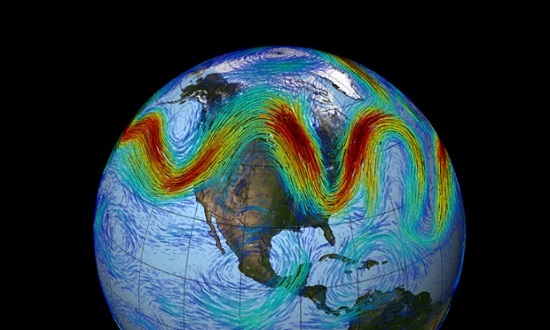
The Arctic is warming faster than lower latitudes. The Jetstream velocity depends on temperature difference, hence it is slowing. It is also more wavy and has a tendency to get stuck, so heat or cold persists over a large area. Ironically, there is less storminess. Storms transport water onto land and break up persistent weather patterns.
The jet stream that circles Earth’s north pole travels west to east. But when the jet stream interacts with a Rossby wave, as shown here, the winds can wander far north and south.
5. Brisbane EV charging technology takes on the world
Brisbane-based electric vehicle infrastructure company, Tritium, has done a deal to supply its award-winning Veefil DC fast charging stations to America’s ChargePoint company. ChargePoint has 21,000 EV chargers around the US.
The Australian-made stations will be installed on major routes across the country, including the express charging corridors on both the east and west coasts of the US that are being built as part of a recent deal between ChargePoint, Volkswagen and BMW.
The 50kW Veefil stations – which in the US will be called DC Fast stations and will be ChargePoint branded – are able to deliver up to 80 miles or 128 kilometers of charge in just 20 minutes, thus removing one of the key barriers to EV uptake: range anxiety.