Category Archives: Climate Action

Carbon pricing: a dangerous distraction?

It is almost axiomatic to say that the mitigation necessary for 2°C limit to warming is best delivered through market-based instruments (MBIs) – where a price is placed on each tonne of carbon dioxide emitted.

Dissenter-in-chief is Kevin Anderson, professor of energy and climate change at the University of Manchester and deputy director of the Tyndall Centre, the UK’s leading academic climate change research organisation:

I hold that such an approach is doomed to failure and is a dangerous distraction from a comprehensive regulatory and standard based framework (within which price mechanisms may play a niche role).

Crucial in making this judgement is the notion that the mitigation rates are not marginal. We don’t need to knock off just one or two percent of emissions each year. We need, says Anderson, a whopping 10% per annum.

That seems extraordinary, but I’ll repeat here three graphs I’ve used before. They all come from 2009, the last two from The Copenhagen Diagnosis.

First we have Hans Joachim Schellnhuber’s estimate of the reductions needed using the ‘budget approach’, whereby the budget of permissible emissions is divided between countries on a per capita basis, and then the stabilisation path plotted given their existing per capita emissions levels:
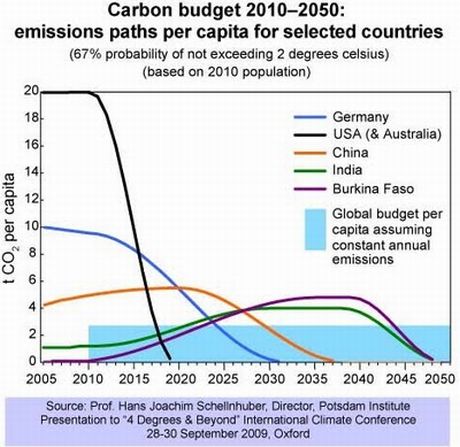
2C trajectories Schellnhuber

Anderson variously says the ‘we’ need to reduce emissions by 80 to 90% by 2030 and to zero soon thereafter. I think he is referring to the UK, which would have a similar stabilisation path to Germany. Note that Schellnhuber is basing these trajectories on only a 67% chance of keeping warming within the 2°C limit.

In the second graph the stabilisation path for the whole world is calculated, given different peaking dates:
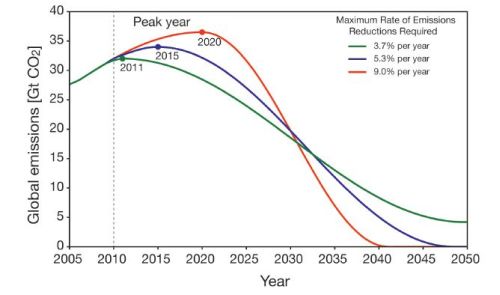
Copenhagen diagnosis Fig 22 n

That shows a 9% per annum reduction required to reach zero about 2040 with peaking in 2020. In those terms Anderson’s 10% figure is in the ball park.

The third graph shows how the trajectories could be varied if countries were grouped into three categories, roughly advanced industrial countries, developing countries and in the middle newly industrialising countries. Carbon trading between them is assumed:
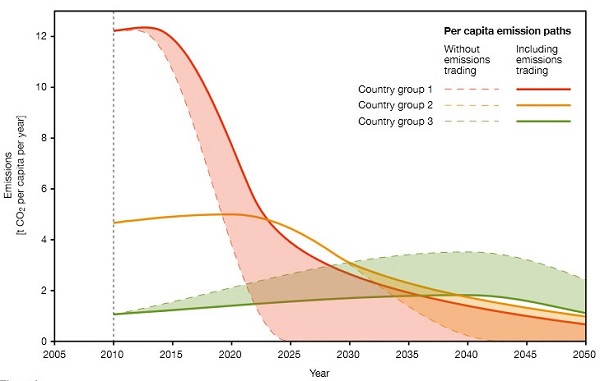
Budget approach with emissions trading_cropped_600

This too is a dangerous distraction. While rational it assumes that China, India and the US will commit themselves to definite reduction paths through international agreement. It’s simply not politically feasible.

I think Anderson is in the right ball park. His argument is that MBIs work fine when the reductions required are marginal. If you crank them up to get the result required a very high price will result. The rich will pay and continue to pollute while the poor will be devastated.

Anderson doesn’t discuss compensation, as was built into the Australian scheme, but pricing and compensation on the scale required is probably not politically feasible.

Anderson favours a regulatory or standards-based approach and gives these examples:

  • Strict energy/emission standards for appliances with a clear long-term market signal of the amount by which the standards would annually tighten; e.g. 100gCO2/km for all new cars commencing 2015 and reducing at 10% each year through to 2030
  • Strict energy supply standards; e.g. for electricity 350gCO2/kWh as the mean emissions level of a suppliers’ portfolio of power stations; tightened at ~10% p.a.
  • A programme of rolling out stringent energy/emission standards for industry equipment
  • Stringent minimum efficiency standards for all properties for sale or rent
  • World leading low-energy standards for all new-build houses, offices etc.
  • Moratorium on airport expansion
  • Technological and operational standards for shipping operating in UK waters
  • A suite of iterative mechanisms to counter, or at least alleviate, issues of rebound; this may include price mechanisms, progressive metering tariffs, etc.
  • Revisit the viability of Personal Carbon Trading as a mechanism for improving societal engagement in non-marginal change
  • Appoint a senior minister with the principal responsibility for maintaining an equitable transition to a low-carbon society

Taking the first two, rather than standards for appliances, I would focus on making stationary electricity supply renewable as an urgent task through direct action. Other than that all the ideas are grist to the mill, but I like John Wiseman’s approach as outlined in the post Climate change: reconnecting politics with reality which concentrates on the necessary political and institutional actions to be taken. After a priministerial announcement he recommends:

Then we would need an Australian Climate Solutions Act which set up the targets, the structures and the priority actions. Principal amongst these would be an Australian Climate Solutions Taskforce chaired by the Prime Minister and drawing from state and local governments, business, trade unions and community organisations.

Then we would need six key action plans.

First, an Australian Renewable Energy Plan to achieve 100 per cent renewable energy within 10 years.

Second, an Australian Economic Electrification Plan with initial priorities including a modal shift in passenger and freight transport from road to rail; the rapid replacement of fossil fuel based cars with electric vehicles; and the full electrification of household and industry heating and cooling.

Third, an Australian Energy Efficiency Plan that identifies the regulatory, planning, educational and financial initiatives that could achieve the overall goal of a rapid transition to a zero waste economy.

Fourth, an Australian Sustainable Consumption Strategy.

Fifth, an Australian Sustainable Agriculture and Forestry Plan designed to reduce land-based emissions and increase carbon sequestration.

Finally, state and local governments, community sector and business organisations would collaborate to develop and implement a comprehensive, long-term Australian Climate Change Adaptation and Resilience Plan.

I applaud the priority Wiseman gives to an Australian Renewable Energy Plan to achieve 100 per cent renewable energy within 10 years.

Carbon pricing similar to the Australian scheme may be one of a suite of actions to send a message and raise funds, but climate action on the scale now required compels us to address the issues much more directly. Overall my aim for the planet would be to reduce atmospheric CO2 to 350 ppm by 2050, for a safe climate. Well, as safe as it ever gets.

Climate clippings 121

1. Denmark winds up wind

In January of 2014, Denmark got just over 61% of its power from wind. For the whole of 2014 it was 39.1%, a world record.

Their leadership is working well for them. Nine out of ten offshore turbines installed globally are made in Denmark. They plan to be fossil fuel free by 2050.

Elsewhere Germany and the UK smash records for wind power generation. Scotland hopes to be fossil fuel free by 2050.

On Boxing day rooftop solar met one third of South Australia’s demand and at least 30% from 11.30am to 3.30pm. Bonaire (pop. 14,500), a small island off the coast of Venezuela, said goodbye diesel and hello 100% renewable electricity.

California Gov. Jerry Brown last week called for

the state’s electric utilities to boost their renewable energy procurements to 50% of retail electric sales and discussed future initiatives to support rooftop solar, battery storage, grid infrastructure and electric vehicles.

As Bill Lawry would say, “It’s all happening!”

2. 2014 the hottest year

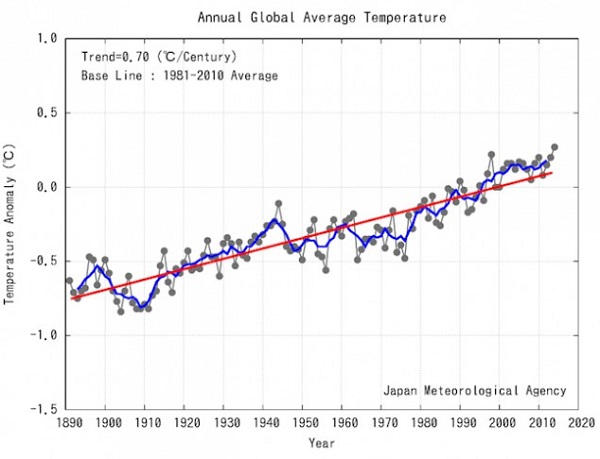
The first set of figures is in, this time from the Japan Meteorological Agency, showing 2014 as the hottest year so far:

JMA2014-cropped_600

The red line is the long-term linear trend.

The blue line is the 5-year running mean.

Australia had the third hottest year on record.

3. Chinese three-wheeler is for real!

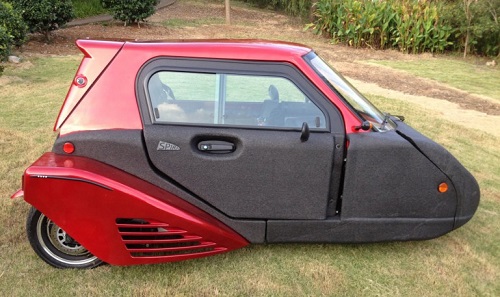
From John D’s Gizmag collection we have the Spira4u three-wheeler car:

spira-production-version-2_500

It’s not a toy, it’s a serious car which has gone into pilot production as a 10 kW electric or a fuel-injected 150 cc version with an economy of 2.94 l/100km (80 mpg).

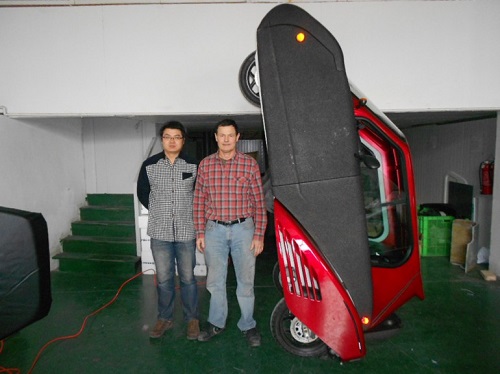
It has a handy parking option:

spira-production-version-14_500

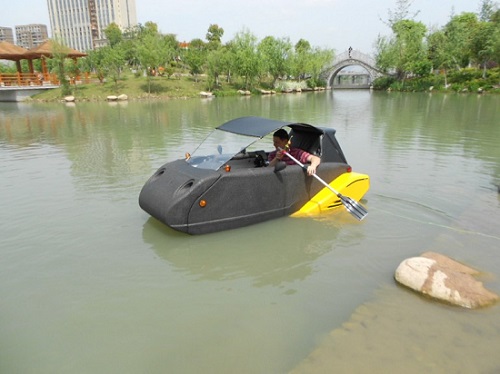
And it floats:

spira-production-version-11_500

An amphibious version is under development.

4. California starts to build a high-speed rail system

The first phase of California’s high-speed rail system will be a 29-mile stretch from Fresno slightly north to the town of Madera. From there the project will link up with urban centers like Los Angeles and San Francisco, eventually allowing commuters to travel between those two cities at 220 mph and cutting the trip from nearly six hours to less than three. The system will eventually extend to Sacramento and San Diego, totaling 800 miles with up to 24 stations.

The full rail system should be in use by 2028.

5. Solar at grid parity in most of world by 2017

At RenewEconomy:

Investment bank Deutsche Bank is predicting that solar systems will be at grid parity in up to 80 per cent of the global market within 2 years, and says the collapse in the oil price will do little to slow down the solar juggernaut.

Quiggin at The Conversation and his place: Only a mug punter would bet on carbon storage over renewables.

6. When you are in a hole, stop digging!

From a study in the journal Nature:

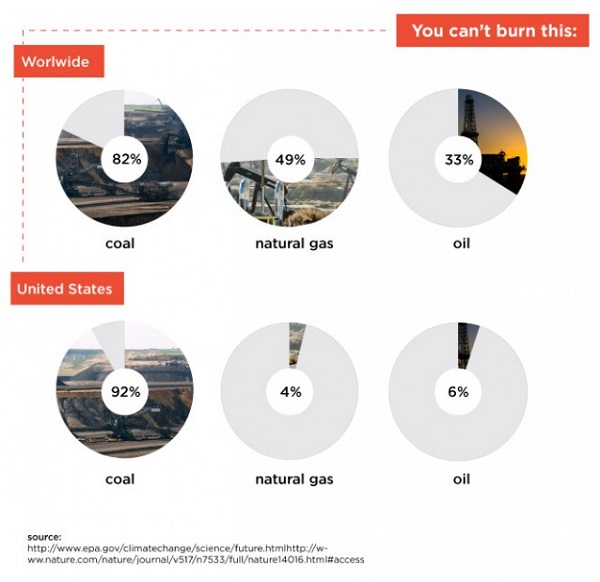
“Our results suggest that, globally, a third of oil reserves, half of gas reserves, and over 80 percent of current coal reserves should remain unused from 2010 to 2050 in order to meet the target of 2°C,” write authors Christophe McGlade and Paul Ekins of University College London.

stay-in-the-ground-cropped_600

Keeping the increase in global temperatures under 2°C will require vast amounts of fossil fuels to be kept in the ground, including 92 percent of U.S. coal, most of Canada’s tar sands, and all of the Arctic’s oil and gas…

In 2013, fossil fuel companies spent some $670bn on exploring for new oil and gas resources. The figure should be zero.

7. Climate change will create more environmental refugees

Natural disasters like Typhoon Haiyan—which devastated the Philippines in 2013 displace more people than war, according to the Internal Displacement Monitoring Center in Geneva. And as climate change sets off increasingly lethal natural disasters, so will the numbers of environmental refugees increase, Reuters reported.

It is a reality that governments must prepare themselves for. In 2013, some 22 million people were displaced by extreme natural disasters like typhoons, earthquakes and tsunamis, a number three times the number of those who were forced to migrate because of war, according to the IDMC.

Earlier this summer New Zealand accepted a family who cited climate change as the reason why they had to flee their homeland, thought to be the world’s first official environmental refugees.

Climate clippings 120

1. Pope Francis becomes active on climate change

Pope Francis is going to give climate change action a red hot go in 2015:

In 2015, the pope will issue a lengthy message on the subject to the world’s 1.2 billion Catholics, give an address to the UN general assembly and call a summit of the world’s main religions.

The reason for such frenetic activity, says Bishop Marcelo Sorondo, chancellor of the Vatican’s Pontifical Academy of Sciences, is the pope’s wish to directly influence next year’s crucial UN climate meeting in Paris, when countries will try to conclude 20 years of fraught negotiations with a universal commitment to reduce emissions.

He also wants to change the financial system from one based on raw consumerist exploitation to one based on ethics which respect ecological principles. He should have a chat with Naomi Klein!

Giles Parkinson has more at RenewEconomy, including the note that Pope Benedict kicked things off by buying carbon credits in the form of a Hungarian forest to make the Vatican carbon neutral, and the possibility that the Catholic church may divest funds invested in the fossil fuel industry.

2. 2014: the year climate change undeniably arrived

John H. Cushman Jr. at InsideClimate News in reviewing the year thinks 2014 was the year climate change undeniably arrived. It was the hottest year ever, the science became conclusive, and a mushrooming climate movement pressed world leaders to act, which to some extent they did.

On the science, he was referring mainly to the IPCC report where already in 2013 the Physical Science Working Group moved the probability of human causation up a notch from “very likely” (>90%) to “extremely likely” (>95%) which is about as good as it gets. In the Synthesis Report of 2014 the language was ramped up saying that harm from greater warming if we stay on the current course could be “severe, pervasive and irreversible.”

Action looked promising with mitigation pledges by the EU, China and the US, also the UN climate talks at Lima.

On the “mushrooming climate movement he is talking about a:

phenomenon that emerged in a spectacular way in September, on the eve of Ban Ki-moon’s UN summit—the coming of age of a new popular movement demanding climate action now.

Hundreds of thousands of marchers filled the streets of Manhattan, curb to curb for 50 blocks or more. Their presence attested to a new dynamic in which inside-the-beltway lobbyists and well-heeled think tanks joined forces with grassroots anti-fracking and anti-pipeline protestors, in which labor unions and school kids found common cause.

A fine effort, but then, you see, sensible voters stayed at home and allowed the Republicans to take over Congress.

3. Precarious Climate

Climate and political blogger James Wight at Precarious Climate reviews the year, kind of, mostly by listing his best posts.

The last, Australia continues climate obstructionism in Lima, was an excellent wrap of the Lima talks. I was not aware (I’d wondered) that Julie Bishop is a climate denier, along with Andrew Robb, just the pair we needed to represent us at international climate talks.

4. Utility scale solar surges

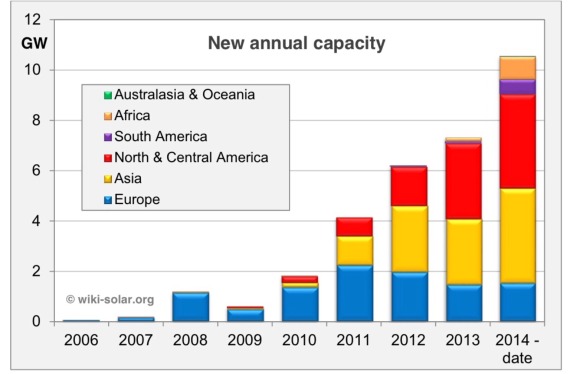
But not in Australia:

image3-570x374

The big surge is in Asia and North America, but other continents have come to life through installations in Chile and South Africa.

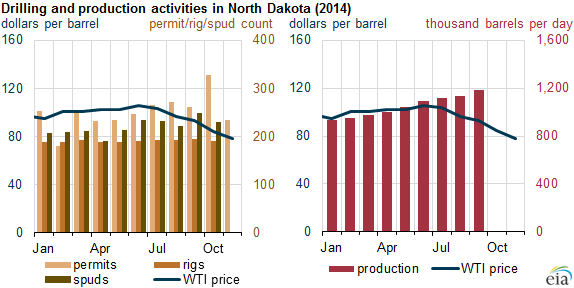
5. Production of shale oil increases

The production of shale oil in North Dakota has increased month by month in 2014, in spite of falling prices.

ndoil

Meanwhile falling oil prices have hidden a new global warming fee on the purchase of gasoline in California.

6. Compressed air technology

Not everyone reads the discussion threads, so I’m repeating here some links made by Jumpy to compressed-air technology.

Danielle Fong with her company LightSail Energy is bringing compressed-air energy storage technology to the market.

Both Peugot and Citroën are developing compressed-air hybrid cars that use 2 litres per 100 kilometres of fuel. Apart from the hybrid compressed-air powertrain both cars are using light-weight materials and aerodynamics to improve economy. The also have narrow tyres pumped up high.

Of course these cars use twice as much fuel as the electric hybrid Volkswagen XL1 which plans to put 250 cars on the road, at a price. That article is from July 2013 – not sure how they are going.

Climate clippings 119

1. Abbott appoints fruitcake to assist Greg Hunt

baldwin_220

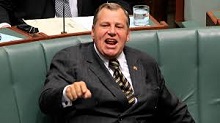
He says he’s not a denier or a sceptic, so let’s just call him a fruitcake. In the recent ministerial reshuffle Bob Baldwin has been moved from Parliamentary Secretary to the Minister for Industry to Parliamentary Secretary to the Environment Minister.

Baldwin told the Chinese that the climate had been changing for millions of years and we wouldn’t have coal, oil or gas without climate change. That’s a typical denialist tack. Elsewhere he quoted that well-known authority on everything, Queensland radio shock-jock Michael Smith. If the atmosphere was a bridge a kilometre long, he said, the first 770 metres would be nitrogen, the next 210 metres oxygen, and so on until you come to CO2. Australia’s contribution of CO2 is the equivalent to 0.18 millimetres, the width of a human hair.

2. Bernie Fraser sends a Christmas message to Abbott

Bernie

Basically, keep the Renewable Energy Target (RET), it all you’ve got, and the Emissions Reduction Fund (ERF) may not meet its initial target of 5% emissions reductions by 2020. In any case it is not scalable to meet the targets we are likely to be committed to post 2020.

The Climate Change Authority has just completed its review of the RET and a review of the Carbon Farming Initiative (CFI), as mandated in the establishing legislation. I’d recommend reading Bernie’s Chairman’s Statement.

The CCA recommends extending the achievement date of the RET by up to three years, but this is the big picture:

The Authority has argued consistently throughout its short life that an effective policy response to the risks of climate change requires favourable winds on at least two fronts:

• first, a broad community consensus that climate change poses real risks to the community; and

• secondly, a well-stocked toolbox to be able to tap into opportunities to reduce emissions wherever they occur.

Neither exists today. The earlier broad political consensus has ruptured in recent years, and no early repair is in prospect. And the tool box is feeling less weighty, with the removal of the carbon pricing mechanism, an unproven ERF, and an uncertain outlook for the RET.

There’s more from Giles Parkinson who calls it “a damming assessment of Abbott government climate policy” and from Sophie Vorrath.

3. Harper flags carbon price rethink for Canada

Abbott-Harper-144x144

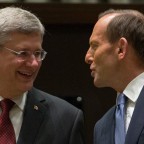
Before Christmas when Tony Abbott was asked what he’d achieved as Minister for Women he nominated dumping the carbon tax. At the same time the Canadian PM Stephen Harper, Abbott’s soul-mate on climate policy, suggested that he was open to a country-wide carbon pricing scheme similar to the one implemented in Alberta.

In Alberta, energy heavy polluting companies are required to reduce their energy intensity, or improve their energy efficiency, annually. If they don’t, they must contribute to a technology fund at $15 a tonne for carbon emissions.

“I think it’s a model on which you could, on which you could go broader,” Harper said in Wednesday’s interview.

4. Tesla pilots battery swap

Tesla is opening a battery swap station between Los Angeles and San Francisco on a pilot basis to see whether the idea goes anywhere. Zachary Shahan, the author of the linked piece, suggests perhaps not. The swap must be done by appointment and although it may be completed in less than a minute it would cost almost as much as a tank of premium. The alternative is free Supercharging for Tesla owners.

5. Technology on the move

In the same issue of RenewEconomy as the Tesla battery swap item above were three other technology announcements.

First, the ASX listed company Algae.Tec has issued rights to raise capital to build an algae biofuel plant in India.

Second, the ADF is looking to replace diesel generation with renewable energy to power Bathurst Island, north of Darwin, probably wind and solar.

Third, a solar plant that floats on water is being launched in South Korea.

6. Banks begin to take climate risk seriously

The large investor Australian Super has been asking banks about their climate change risk policies. It sounds as though banks are pretending to be more active than they really are, but it is clear that the investment landscape has changed forever. If the banks have not been actively concerned, they soon will.

Former Coalition opposition leader John Hewson, who chairs the Asset Owners Disclosure Project

is considering “naming and shaming” how the world’s 1000 biggest banks are responding to carbon risk, something it already does for pension funds.

Weak climate deal salvaged in Lima

Seems the most important thing that can be said about the Lima climate change conference (earlier post here) was that it did not fail. The prospect is still there for a deal in Paris next December, but it looks like being a weak deal – a deal that does not limit warming to two degrees, a deal that will not be legally binding, and a deal that may lack some of the major participants.

The most exciting thing about the conference was that the reference to ensuring the world has net-zero emissions by 2050 is still there:

The mitigation section of the draft text states countries must aim for “a long-term zero emissions sustainable development pathway” that is “consistent with carbon neutrality / net zero emissions by 2050, or full decarbonization by 2050 and/or negative emissions by 2100.”

Giles Parkinson says this was explicitly supported by over 100 countries. Julie Bishop was not bloody-minded enough to insist that it be removed.

The phasing out of fossil fuels as a reality is now part of the conversation and capital for fossil fuel exploration and development should begin to dry up.

Once again The Carbon Brief provides a handy summary:

  • Lima Call for Climate Action outlines main aspects of a new global climate deal.
  • Keeps goal of limiting global warming to less than two degrees.
  • Contains reference to ensuring the world has net-zero emissions by 2050.
  • Doesn’t clarify if a new deal will be legally binding.
  • Doesn’t give countries the power to alter other country commitments.
  • Doesn’t offer new assurances on the flow of climate finance.
  • Leaves all options on the table regarding compensation for countries worst hit by climate change.

Ambition

The principle of ‘common but differentiated responsibility’ is enshrined by the United Nations Framework Convention on Climate Change. Accordingly in the Kyoto deal only the developed countries were required to limit emissions.

This time everyone is going to have to front with a climate mitigation plan, but

countries must work to ensure a 2015 deal “reflects the principle of common but differentiated responsibilities and respective capabilities, in light of different national circumstances.”

Initial plans should be submitted by March. Australia has said that we will submit ours by June. Work has not yet begun, but it is clear that Tony Abbott himself is going to take control of the process.

The UN will do an analysis and report on the overall impact of the country targets by November. There is no chance that it will add up to a plan to limit warming to two degrees.

The EU wants ‘contributions’, once established to stand for 10 years. Some other countries favour five years, for greater flexibility.

Legally binding

The EU, some of the smaller countries and Australia want targets, once set, to be legally binding. There seems no chance that this will happen. Luke Kemp at The Conversation says that for the US to agree two-thirds of the Senate have to vote in favour. They won’t vote for a legally binding agreement and China won’t sign up unless the US does.

Frankly, I can’t see the US Senate agreeing to any kind of a climate deal in the foreseeable future, so the Paris deal, like Kyoto, may have to start without some of the major players.

Kemp says that Australia was softening its stance, so fears that Australia was playing a game to torpedo the talks seem to be misplaced.

Accountability

Each country’s official plan to cut emissions and tackle climate change will be known as an ‘intended nationally determined contribution’ (INDC). The conference could not agree whether INDCs should be scrutinised.

The EU is willing to agree to the INDC system if governments can scrutinise each country’s INDCs, and suggest how they may need to change to increase ambition. Other countries, such as China and India, are very much against such scrutiny, known in the process as ‘ex-ante review’.

Lima’s draft text doesn’t determine whether the INDCs will be subjected to official review.

I’d say forget it.

What next?

There was more, of course, including financial assistance (never satisfactory). The draft document contains as many as 11 alternative versions of the text. There is masses of work to do.

Work will continue in various working parties and in a major conference in Bonn in June. No doubt discussions will continue in other forums, such as the G20 in Turkey. The next step is to submit INDCs by March. We’ll cheat by looking at everyone else’s homework. So will the Abbottistas be proudly recalcitrant, or will we track near the back of the peloton but try to pretend we are in the middle?

Elsewhere Graham Readfearn has annotated Julie Bishop’s speech.

Two degrees

Carbon Brief has compiled a series of three posts on the so-called 2°C ‘guardrail’ used in global warming discourse:

This post will pick out some of the highlights, but is not a substitute for reading the posts. Continue reading Two degrees

Climate clippings 117

1. Australia targeted as climate change obstacle

I pointed out that Australia is the dunce of the class on climate change according to the Climate Change Performance Index 2015.

Elsewhere the French are already considering how to cope with Australia’s and Canada’s negativity at the Paris conference next December.

2. Seeney in denial on sea level rise

That dipstick Jeff Seeney, Deputy Premier in Queensland, has directed the Moreton Council to remove all reference to sea level rise from, its planning documents:

“I direct council to amend its draft planning scheme to remove any assumption about a theoretical projected sea level rise from all and any provision of the scheme.”

The council had made provision for a possible 0.8-metre rise in sea level by the year 2100. Seeney says:

“I am prepared to protect the property rights of Queenslanders in other council areas should this issue arise again.”

Who is going to protect them from him? The Local Government Association of Queensland (LGAQ) is seeking legal advice.

Seeney claims the issue has nothing to do with climate change! Denial doesn’t come clearer than that!

3. West Antarctic melt rate has tripled

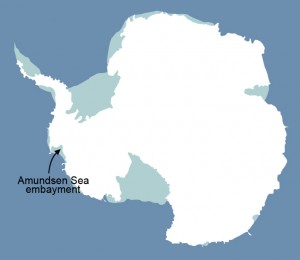
A NASA study has done a thorough analysis of the land ice melting in the Amundsen Sea Embayment where the glaciers are melting faster than any other area of Antarctica.

SuppA-W-Ant-300x260

The rate of loss accelerated an average of 6.1 gigatons per year since 1992, but now the rate is increasing by 16.3 gigatons per year.

The total amount of loss averaged 83 gigatons each year over the whole period, that’s the equivalent of losing the weight of Mt Everest (not just the ice on it) every two years.

4. Warmer seas could cause faster melting of Antarctic ice

A separate study has found that the seas around Antarctica are warming, which could increase ice shelf melting.

Ice shelves float, so the melting does not cause sea level rise, but they buttress the land glaciers. Take away the ice shelves and the glaciers flow faster.

5. New large scale battery storage in Germany

Belectric and Vattenfall have opened new large-scale battery energy storage system at the Alt Daber solar power plant in Germany. The facility uses lead-acid batteries.

For the system to be economical without any financial support, costs will have to come down by around a third.

6. Solar and wind energy backed by huge majority of Australians

Solar and wind energy enjoy strong support from the Australian public, with 80% of people putting them both among their top three energy choices in a poll for the Australia Institute.

By contrast, coal and coal seam gas were chosen by 35% and 38% of those polled as being among the best three future energy sources.

A separate review of medical literature by the Australia Institute debunked the fear that wind power damaged people’s health, finding “no credible evidence” directly linking exposure to turbines with negative health effects.

Nine out of 10 people said they wanted more solar energy.

Six in 10 people said they were concerned about the impact of coal and coal seam gas on the landscape.

7. UNSW researchers set world record in solar energy efficiency

Solar researchers working at the University of New South Wales (UNSW) claim to have produced a system that converts over 40 percent of incoming sunlight into electricity, thereby taking the title of highest solar efficiency for a photovoltaic system ever reported.

“This is the highest efficiency ever reported for sunlight conversion into electricity,” said UNSW Professor Professor Martin Green, Director of the Australian Centre for Advanced Photovoltaics (ACAP).

8. The end of coal as we know it

And oil for that matter.

Graham Readfearn in Lima at the climate Conference of Parties has found these items in the negotiating text:

Parties’ efforts to take the form of:

a. A long-term zero emissions sustainable development pathway:

Consistent with emissions peaking for developed countries in 2015, with an aim of zero net emissions by 2050; in the context of equitable access to sustainable development;…

Consistent with carbon neutrality/net zero emissions by 2050, or full decarbonization by 2050 and/or negative emissions by 2100;….

He understands they were put there by Norway, the Marshall Islands, Sweden and the AILAC grouping of countries consisting of Chile, Colombia, Costa Rica, Guatemala, Peru and Panama.

Andrew Robb Bishop have noticed and are complaining. It will be interesting to see whether the statements stay.

Readfearn finds that a move for a zero emissions target is growing and Malte Meinshausen explains that it is inevitable if we are serious about staying within two degrees.

Australia the dunce of the class on climate change

Australia ranks 57 out of 58 countries in the The Climate Change Performance Index 2015, heading only Saudi Arabia, which is not classified as an industrial country. Australia has dropped 21 places since the last survey a year ago.

There are reports in The Age and The Guardian. From the latter:

Australia has been named the worst-performing industrial country in the world on climate change in a report released at international negotiations in Peru.

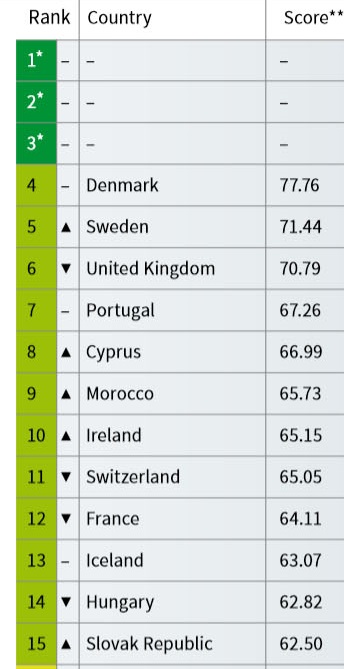
The climate change performance index ranked Denmark as the best-performing country in the world, followed by Sweden and Britain.

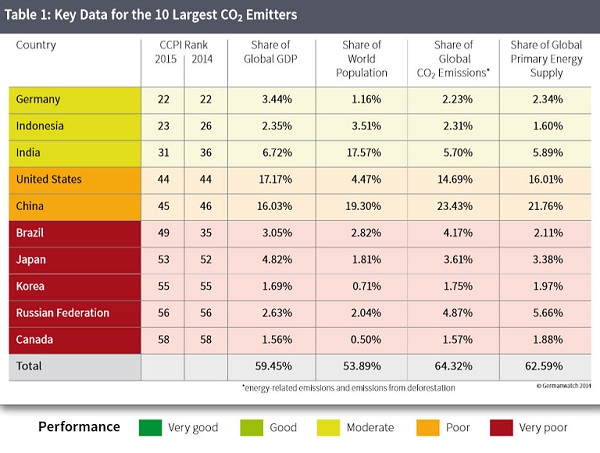
Among the world’s top 10 emitters, Germany was ranked the highest at 22. Australia was second bottom overall, above Saudi Arabia – which was not classified as industrial.

The report states: “The new conservative Australian government has apparently made good on last year’s announcement and reversed the climate policies previously in effect. As a result, the country lost a further 21 positions in the policy evaluation compared to last year, thus replacing Canada as the worst-performing industrial country.”

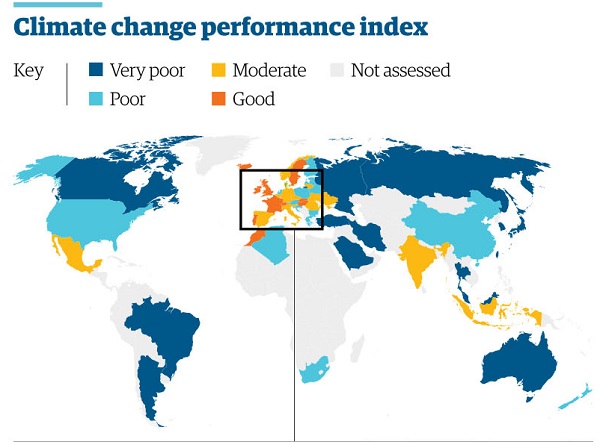
This map from The Guardian gives an overview:

World map_cropped_600

Clearly Europe is the best performing region. Here are the top dozen ranked countries:

Country rankings_cropped

No countries were coded dark green for “very good”. This means according to the report’s criteria that no countries are performing well enough to limit global emissions to two degrees. Because the top three places were left vacant you have to subtract three from each ranking to find the actual rank placing. Eleven of the twelve countries coded “good” were European.

Here are the 10 heaviest emitters in order of ranking:

Large emitters_cropped_600

The ten worst countries are, from the bottom, Saudi Arabia, Australia, Kazakhstan, Canada, Iran, Russia, Korea, Chinese Taipei, Japan and Malaysia.

The index covers the performance of countries across five areas – the level of emissions, the trends in emissions, energy efficiency, renewable energy policies and the approach to climate change at national and international levels.

The report has been compiled each year since 2005 by Climate Action Network Europe and Germanwatch. The Australian Conservation Foundation assisted with the Australian information.

Lima climate change conference update

The UNFCCC Conference of Parties (now 194 countries, I think) has reached the midway point. I’ve compiled some news coming out of the conference in the style of Climate clippings.

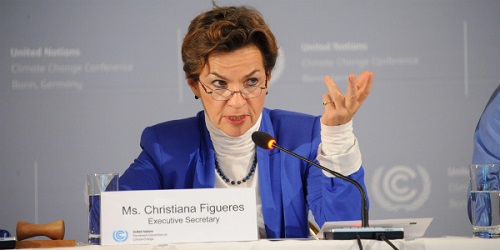
Here’s the UNFCCC executive secretary Christiana Figueres in action:

Figueres speaks_500

1. The first five days of the Lima climate change conference

Mat Hope sums up at The Carbon Brief.

    1) The need to get a deal is being talked up

There is an upbeat feel as the Paris conference next December looms, where a deal is scheduled to be cut.

    2) Expectations are being managed

They hope to complete a draft text at Lima, but it is only a stepping stone.

    3) The US-China climate deal means the spotlight is on India

With the US, China and the EU making positive pledges, eyes now turn to India. So far they have been true to form, grumbling that the developed countries should do more and provide finance for adaptation.

    4) Record temperatures and typhoon threat are framing the conference

In Copenhagen in 2009 it was freezing. At Lima the atmospherics a quite different with looming record world temperatures and typhoon Hagupit making its way towards the Philippines.

    5) Old divisions persist

The EU wants countries’ pledges to cut emissions to be legally binding. The US is adamant that this can’t be the case as it would then have to ask Congress to ratify the deal.

A group comprising Saudi Arabia, China, India and 30 other ‘like minded nations’ continues to call for more transparency in the process. The group has used such pleas as a delaying and blocking tactic at previous negotiations.

2. Australia drags the chain at Lima

Australia has distanced itself from the Cartagena Dialogue, a group of 30 or so “progressive” countries Australia helped found five years ago seeking an “ambitious, comprehensive, and legally binding regime in the UNFCCC, and committed, domestically, to becoming or remaining low carbon economies.” You’re right, that’s not Australia now.

Giles Parkinson thinks that Australia’s main aim is to keep selling coal. That’s why Andrew Robb is there as Minister for Trade.

Effectively and, from Robb’s tweets and other evidence, in fact Australia is channelling the thoughts of their favourite thinker, Bjorn Lomborg:

who as others have pointed out has made quite a nice career casting doubt on the seriousness of climate change, arguing the problem is overstated, and concluding that on a cost-benefit analysis there is no need to do anything. That pretty much sums up current Coalition government policy.

3. China fingers Australia

One point of permanent discontent has been that developing countries would like more effort to be put into the Green Climate Fund designed to help them to adapt and mitigate climate change. China has called the $9.7 billion contributed so far by 22 countries as “far from adequate”.

In doing so China has fingered Australia as a climate bludger. Australia’s policy is to contribute nothing. So far the GFC

has received funding pledges of $3 billion from the United States, $1.5 billion from Japan, $1 billion from the UK and France, $900m from Germany as well as pledges of at least $100m from Sweden, Italy, Norway, Holland, South Korea, Switzerland and Finland. It has even received a small contribution from New Zealand.

Even Canada has stumped up $300 million.

The original pledge at Copenhagen in 2009 had been $100 billion per year by 2020 from public and private sources.

4. Newsweek report

One thing they are discussing is the form of each country’s pledge of climate action to be submitted in draft by march 2015. The only way they will agree on anything is to use the principle of ‘common but differentiated responsibilities’ adopted in Copenhagen. This leaves countries to make it up as they wish, which means different base and target dates.

This makes comparisons difficult.

They also have yet to decide whether the basic division of Annexe 1 used in the Kyoto agreement will be retained. With Kyoto only the developed Annexe 1 countries made pledges. The US wants to eliminate subcategories. Brazil has proposed three concentric circles:

In the innermost circle, developed and Annex I Parties would commit to absolute, economy-wide mitigation targets. In the next ring, developing countries would commit to economy-wide targets that are relative to national gross domestic product, business-as-usual emissions trends or population size. In the outermost ring, the least-developed countries would commit to objectives on reducing emissions that are not economy-wide.

I’m betting on one undifferentiated blob, because they won’t all agree on anything else.

Similarly on whether pledges should be legally binding, they’ll never agree, because the US will point blank never agree to it, and all countries must agree for a decision to stand. Perhaps the New Zealand option of making reporting legally binding, but not the content of the contributions themselves, will get up.

5. Ban Ki-moon singles out Canada

Meanwhile UN Secretary General Ban Ki-moon has told Canada to get its finger out and start setting goals. Leadership is expected of G7 countries.

6. The bottom line

Emily Williams writing in the Santa Barbera Independent points to the sad truth – the proposals coming forward, the US-China announcement notwithstanding, “would mean ‘game over’ for the planet and the most vulnerable communities.”

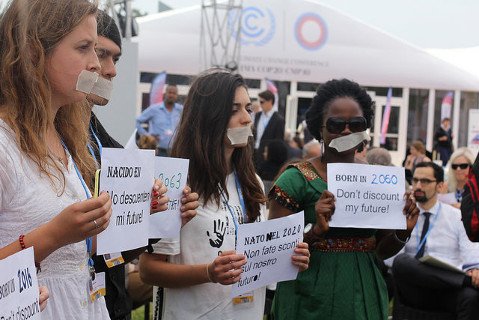
The pressure is for an agreement, any agreement, to avoid “Nopenhagen” in Paris. Her article carries this image of young protestors in Lima:

protesters_Lima_COP2014_t479

Perhaps this image would be more appropriate:

Head_in_Sand_500

Climate clippings 116

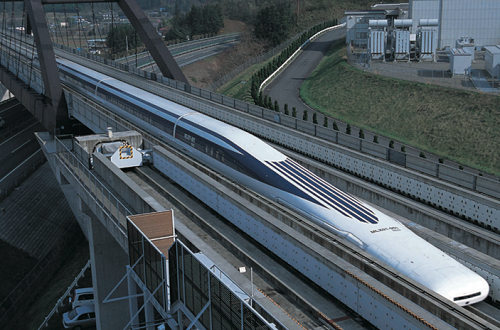
1. Super high speed rail

train_japan_maglev_500

The Japanese have run an actual train with people in it at 500 km/h. The Chinese have built a train which can theoretically run at 1800 mph by encasing it in a vacuum tube.

It looks as though high speed rail could become a real alternative to air for intercity travel.

Thanks to John D for the headsup.

2. World’s first power-to-liquids production plant opens

The world’s first power-to-liquids (PtL) demonstration production plant was opened in Dresden on 14 November. The new rig uses PtL technology to transform water and CO2 to high-purity synthetic fuels (petrol, diesel, kerosene) with the aid of renewable electricity.

The article does not say how efficient the process is, but presumably less so than using the electricity directly.

3. World Bank focus on clean energy

The World Bank has traditionally been one of the world’s largest funders of fossil fuel projects. Now it:

will invest heavily in clean energy and only fund coal projects in “circumstances of extreme need”…

No doubt this policy stems from the bank’s commissioned report Turning down the heat.

4. Why the Peru climate summit matters

Hope has been injected into the Climate Change Conference in Lima, Peru, scheduled to run from 1 to 12 December by the recent US/China agreement. The optimism stems as much from the fact that the two largest emitters in the world are finally working together as the level of ambition. The EU has also recently pledged to cut emissions by 40 percent from 1990 levels by 2030.

Countries will be working on the text of the draft agreement for Paris in 2015.

Countries are expected to put forward their contributions towards the 2015 agreement in the form of Intended Nationally Determined Contributions (INDCs) by the end of March [2015]. These will then be used to craft the Paris treaty. The Lima gathering will help provide guidelines and clarity for what these INDCs must entail, especially for developing countries still reliant on fossil fuels to meet fast-growing energy demand needed to achieve developmental goals. These options could range from sector-wide emissions cuts to energy intensity goals to renewable energy targets.

We’ll be represented during the second week by Julie Bishop and Andrew Robb, a climate change denier. Seems Bishop went bananas when she found out, and Robb doesn’t want to be there anyway.

Giles Parkinson reports that we’ve sent a delegation of 14, the smallest in 20 years and probably not enough to be actively obstructive as we were in Warsaw last year.

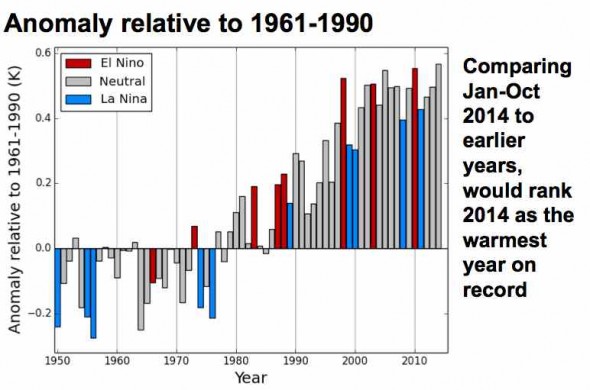
5. 2014 looks like hottest on record

This is how it’s shaping:

wmo-years-590x390

Record hot years are often El Niño years. This year is a neutral ENSO year so far.

That’s so far; there is at least a 70% chance that El Niño will be declared in the coming months, according to the BOM. Looks like a hot, dry summer.

6. Germany’s largest utility gets out of the fossil fuel business

On Sunday, Germany’s biggest utility E.ON announced plans to split into two companies and focus on renewables in a major shift that could be an indicator of broader changes to come across the utility sector. E.ON will spin off its nuclear, oil, coal, and gas operations in an effort to confront a drastically altered energy market, especially under the pressure of Germany’s Energiewende — the country’s move away from nuclear to renewables. The company told shareholders that it will place “a particular emphasis on expanding its wind business in Europe and in other selected target markets,” and that it will also “strengthen its solar business.”

E.ON will also focus on smart grids and distributed generation in an effort to improve energy efficiency and increase customer engagement and opportunity.

“With its decision, E.ON is the first company to take the necessary steps from the completely changed world of energy supply,” German Economy Minister Sigmar Gabriel, said Monday.

7. The inconvenient truth of EU emissions

The Commission and European Environment Agency’s Progress Report on climate action says:

according to latest estimates, EU greenhouse gas emissions in 2013 fell by 1.8% compared to 2012 and reached the lowest levels since 1990. So not only is the EU well on track to reach the 2020 target, it is also well on track to overachieve it.

Kevin Anderson is not impressed:

The consumption-based emissions (i.e. where emissions associated with imports and exports are considered) of the EU 28 were 2% higher in 2008 than in 1990[1]. By 2013 emissions had marginally reduced to 4% lower than 1990 – but not as a consequence of judicious climate change strategies, but rather the financial fallout of the bankers’ reckless greed – egged on by complicit governments and pliant regulation.

Then he really gets stuck in:

In the quarter of a century since the first IPCC report we have achieved nothing of any significant merit relative to the scale of the climate challenge. All we have to show for our ongoing oratory is a burgeoning industry of bureaucrats, well meaning NGOs, academics and naysayers who collectively have overseen a 60+% rise in global emissions.

The folly of two degrees

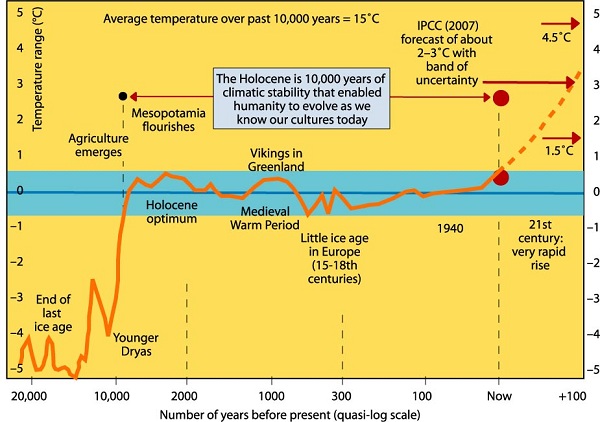
Back in 2011 David Spratt took a look at where we were in relation to temperature rise and the Holocene. At 2000 we were at 0.7°C above the pre-industrial temperature. This happens to coincide with the Holocene maximum:

Holocene_thin-blue-line 600

Spratt says James Hansen warns that at 0.7°C the ice sheets start to become unstable, so in terms of sea level rise alone we are entering a danger zone. Since then the temperature has risen ~ 0.15°C.

From this point of view the 2°C guardrail looks hazardous in the extreme. Continue reading The folly of two degrees

Turn down the heat : confronting the new climate normal

Turn down the heat : confronting the new climate normal is a massive 320 page report prepared for the World Bank by the Potsdam Institute for Climate Impact Research and Climate Analytics, and hence highly authoritative. Continue reading Turn down the heat : confronting the new climate normal