Category Archives: Climate Policy & Planning

Climate clippings 114

1. Ocean acidification charted

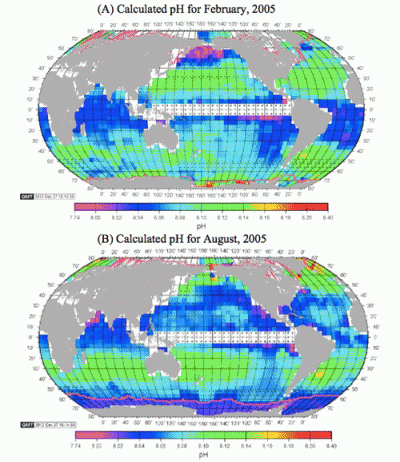
Apparently there has been no baseline data for ocean acidification, which varies around the world. Now a database of the current state of the ocean has been compiled. Here is a map showing the rough state of play:

11_18_14_Brian_OceanAcidificationBaseline_400_462_s_c1_c_c

The current rate of acidification for the ocean is the greatest seen in the past 300 million years. 25% of co2 emitted ends up in the ocean.

This article offers some hope that some species may adapt.

2. Warmest October

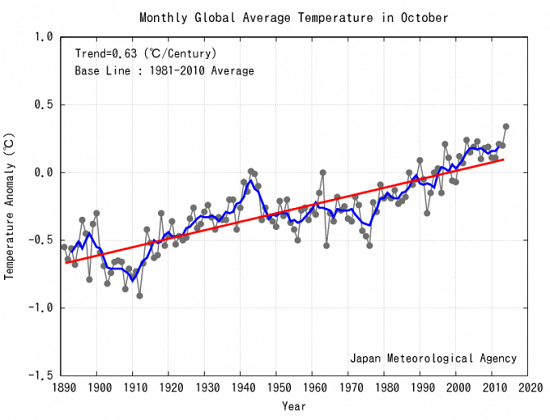
NASA has October as the warmest since 1880 along with 2005. The Japanese Meteorological Agency has it as the warmest ever:

11_14_14_Brian_JMAOctTemp_679_519_s_c1_c_c_550

No warming pause there!

So far an El Niño still has not developed, which would make things warmer.

3. Climate Council report fingers us

The Climate Council has published a new report Lagging Behind: Australia and the Global Response to Climate Change. The key findings are:

  • China and the US have firmly moved from laggards to global leaders on climate change.
  • In the last five years most countries around the world have accelerated action on climate change as the consequences have become more and more clear.
  • Australia, a crucial player in global climate action, moves from leader to laggard.
  • Global action must accelerate to protect Australia and the world from the consequences of a changing climate, sea level rise and more frequent and intense extreme weather.

Now, 39 countries and over 20 sub-national jurisdictions are putting a price on carbon. China has the world’s second largest carbon market with 250 million people covered. In the US 10 states have carbon markets, covering 79 million people.

Germany has decoupled growth from carbon pollution. Since 1990 GDP has increased 37% while emissions have fallen 25%.

According to the IEA and the OECD for every $1 spent to support renewable energy, another $6 is spent on fossil fuel subsidies, but investment in renewable energy at US$192 billion now exceeds that in fossil fuel energy at US$102 billion.

Australia is the 15th largest emitter out of 186 countries. We emit roughly the same as France, Italy and Turkey, each with three times the population.

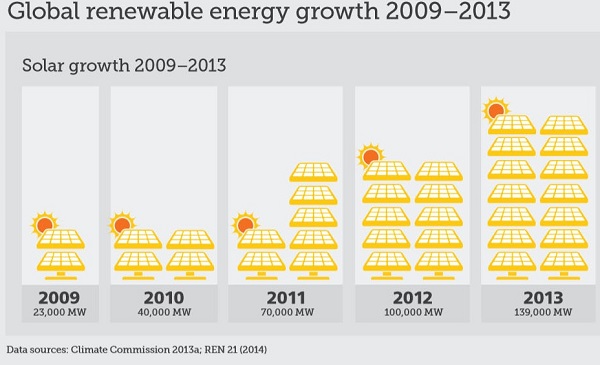
Here’s the world wide solar growth:

Solar_cropped_600

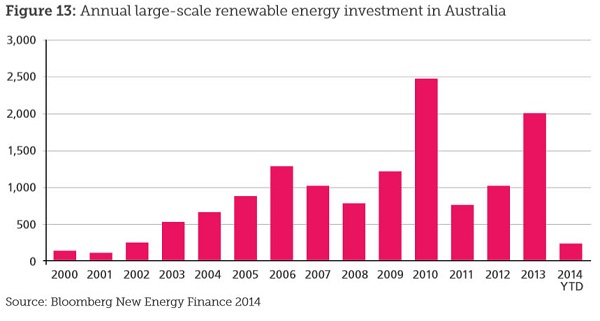
Our record on large scale renewables:

Aust renewables_cropped 600

Time to get on our bike!

4. Climate Council on renewables

The Climate Council report finds that around the world important initiatives on renewables are often taken at the sub-national level. In Australia:

  • South Australia is striding forward leading the Australian States on renewable energy.
  • Victoria and NSW have moved from leaders to laggards in Australia’s renewable energy race.
  • Australia has substantial opportunities for renewable energy. A lack of clear federal policy has led to a drop in renewable energy investment.

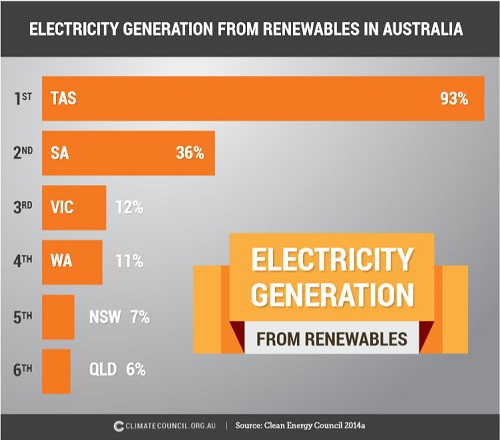
Only SA and the ACT have renewable energy targets – SA 50% of electricity by 2025, the ACT 90% by 2020. The current state of play is:

Renewable energy generation_cropped_500

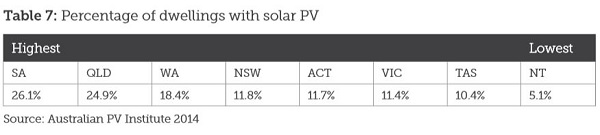
SA narrowly pips QLD in terms of percentage of dwellings with solar PV:

Solar PV_cropped_600

Both have roughly a quarter.

The potential for renewables in Australia is huge – some 500 times current electricity generation.

Australia produces per capita 23.96 tCO2e as against an OECD average of 12.47. As I said, time to get on our bike!

5. China caps coal use by 2020

From Climate Progress

The Chinese government announced Wednesday it would cap coal use by 2020. The Chinese State Council, or cabinet, said the peak would be 4.2 billion tonnes, a one-sixth increase over current consumption.

This is a staggering reversal of Chinese energy policy, which for two decades has been centered around building a coal plant or more a week. Now they’ll be building the equivalent in carbon-free power every week for decades, while the construction rate of new coal plants decelerates like a crash-test dummy.

The 2020 coal peak utterly refutes the GOP claim that China’s recent climate pledge “requires the Chinese to do nothing at all for 16 years.” Indeed, independent analyses make clear a 2020 coal peak announcement was the inevitable outcome of China’s game-changing climate deal deal with the U.S. last week, where China agreed to peak its total carbon pollution emissions in 2030 — or earlier.

6. Australia a pariah

Giles Parkinson thinks other nations are deliberately trying to embarrass Australia on climate change. Certainly Obama’s remarks can be interpreted that way. Then he (Giles) really gets stuck in:

We are, quite possibly, witnessing the most incompetent and ideologically blind government ever to hold power in Canberra. It’s effectively the Tea Party of Australia, pretending to be something else.

G20 goodness

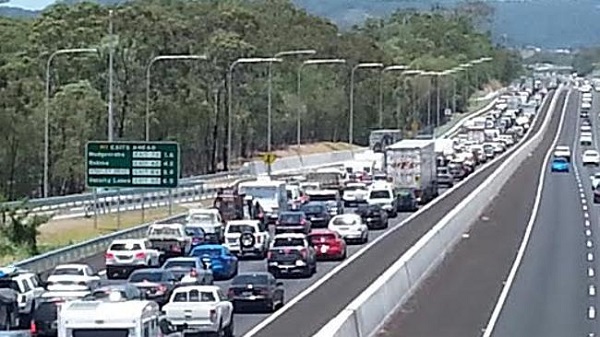
Overall when I think about the Brisbane G20 I’ll think about Putin not being shirt-fronted and leaving the instant the conference was over, about president Obama putting climate change front and centre in peoples minds, deserted streets and empty cafes, masses of coppers, 6000 of them, and traffic gridlock from here to the Gold Coast as people took advantage of the long weekend.

Yes, Brisbane welcomed the pollies and thousands of journalists by getting the hell out of here.

G20_002790-a117de80-6ba0-11e4-915b-4759357bb584_600

As to Abbott’s role in the G20, Paul Syvret in the Courier Mail summed it up perfectly (thankyou John D!):

TAKE a bow ’Straya. You showed the world, when given the opportunity to shine on a global stage of grand ideas, just how small-minded and insular we can be.

Sure, we hosted a meeting of G20 leaders that went off without a logistic hitch or any ugly civil unrest or security incidents. Well done us.

The vision and inspirational leadership side of the equation though left a bit to be desired.

Less than a week after the United States and China announced a landmark agreement to tackle climate change, Australian Prime Minister Tony Abbott opened proceedings at the G20 summit by boasting how Australia had abandoned its carbon-pricing scheme.

He also, literally, thanked God that we have stopped the “illegal boats” – in the company of people like Italian Prime Minister Matteo Renzi, whose navy earlier this year rescued more than 3500 seaborne asylum seekers in one 48-hour period.

Then for good measure, he moaned to the world’s most-powerful leaders about his failure to get a $7 Medicare co-payment through the Senate; parish pump pissantery in front of the likes of US President Barack Obama, whose administration went to the brink of international debt default thanks to a gridlocked Congress.

A columnist for the LA Times described it as “an awkward, pimply youth moment so embarrassing that it does sting”.

Australia, she wrote, is “the adolescent country. The bit player. The shrimp of the schoolyard.”

“The Group of 20 summit could have been Australia’s moment, signalling its arrival as a global player … but in all, the summit had Australians cringing more than cheering.”

Bill Shorten dubbed Abbott as “weird and graceless”.

Compare Barack Obama’s visionary eloquence, laying down the gauntlet on climate change and announcing a US$3 billion contribution to the Green Climate Fund. His speech if you missed it is here.

Ironically there was a point to Abbott’s whingeing about the $7 Medicare co-payment. If you ask Joe Hockey, he’ll tell you G20 was about growth, 2 trillion dollars of it, in 862 concrete proposals put forward by the G20 countries. Apparently Australia’s bright ideas for growth included wrecking Medicare and ripping 20% of funding out of our universities. Fair dinkum! Makes you wonder about the other 860 ideas!

Another point is that the ideas for growth were supposed to be ideas that the governments would not otherwise have done. However, I understand the gun went off in February in preparation for the G20 finance ministers meeting in Cairns in September. Are we really to believe that the Abbott government would have left Medicare and universities alone in the 2014 budget, but for G20?

It must be said that the Brisbane G20 was well organised from every viewpoint. The G20 Leaders’ Communiqué, 21 points in three pages of text, plus lists of supporting documents, is mercifully succinct. Of course it was written and circulated beforehand. Climate change was always going to be there (para 19) because a Climate Finance Study Group had been set up at an earlier meeting.

By the way the Abbott government does not support the Green Climate Fund, designed to assist developing countries, and apparently won’t contribute. Our share, pro rata, should be a mere $200,000 or so.

The G20 spawns a large number of sub-groups. Apart from the finance ministers and central bankers, trade ministers have met and now energy ministers will follow suit. There is a Financial Stability Board and a G20 Food Security and Nutrition Framework, for example. As a decision of this meeting a Global Infrastructure Hub will be established in Sydney to facilitate infrastructure planning.

Around the G20 sit an alphabet soup of meetings hoping to influence the G20. The B20 meeting of business leaders is inside the tent in formal collaboration with the G20. By contrast an L20 group, I gather of labour unions, is ignored. A ‘women in leadership’ group was luckier. The G20 responded by (para 9) agreeing to a goal of

reducing the gap in participation rates between men and women in our countries by 25 per cent by 2025, taking into account national circumstances, to bring more than 100 million women into the labour force, significantly increase global growth and reduce poverty and inequality.

There was also a T20 organised by think tanks. In addition there was a Global Cafe, I think organised by the Brisbane City Council, which brought together “futurists and thought leasers”.

There were plenty of protests. For example, refugee advocates released paper boats on the Brisbane River and were ignored. I think Turkey, the next host, is going to put refugees on the agenda.

Aborigines shouted angry words and burnt effigies of Noel Pearson, Marcia Langton and Warren Mundine.

The police set up formal lines of communication with groups planning to protest and facilitated how they might do it. As a result there were only 14 arrests, compared I believe with 1300 in Toronto. It was unusual to see protesters praised by police on the telly. There was no property damage.

Those who thought that Vladimir Putin was comprehensively roasted by other leaders missed an informal meeting of BRICS (Brazil, Russia, India, China, South Africa) where Putin was supported and the sanctions declared illegal.

On climate change, Laura Tingle reckoned Obama delivered Abbott a lesson in power. Within the meeting according to The Age Abbott carried on like a pork chop, giving an impassioned defence of coal and opposing the goal of eliminating fossil fuel subsidies.

Enough said!

Elsewhere John Quiggin thinks hosting the G20 did nothing for Brisbane and was a waste of money. The notion that events like this “put Brisbane on the map” is silly.

I dunno! Perhaps Angela Merkel taking selfies in a Caxton Street pub will bring her many Tweet followers flocking to Brisbane!

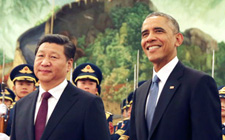
A game changer? The US-China climate deal

Mother Jones thinks the deal is a game changer, so does Joe Romm at Climate Progress. Climate scientists what agree with some cautions, including the big one that it’s not nearly enough.

In the broad, China has agreed to peak emissions by 2030, the US will reduce emissions by 26 to 28% by 2025, relative to 2005.

Yet China will still be getting 80% of its power from fossil fuels in 2030.

They said China would never do a deal of significance, and the US could not make significant reductions politically while China did nothing. That’s why the deal is a game changer.

Now Republicans are saying that China is doing nothing for 16 years. That’s not true. China will install 800-1,000 gigawatts of nuclear, wind, solar and other zero emission generation capacity by 2030.

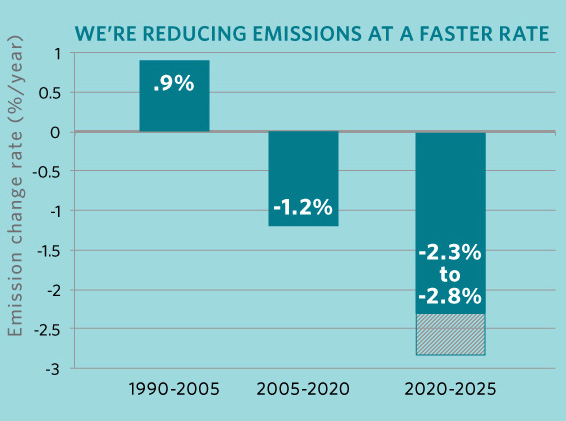
Joe Hockey implied that Obama will not deliver, because of an unfriendly Congress. Obama said on Sunday specifically that he is not relying on Congress for anything – he’ll do it without their help. Republicans are freaking out and will no doubt destroy the deal if they reclaim the presidency.

Given the unhelpfulness of Congress Obama’s plan is surprisingly ambitious, roughly doubling the pace of reductions:

carbon_pollution_target_U.S

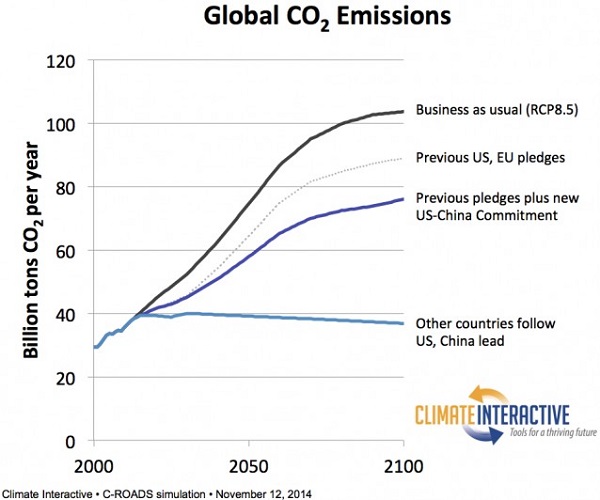
The overall impact is portrayed by this graph from Climate Interactive:

China-deal-600

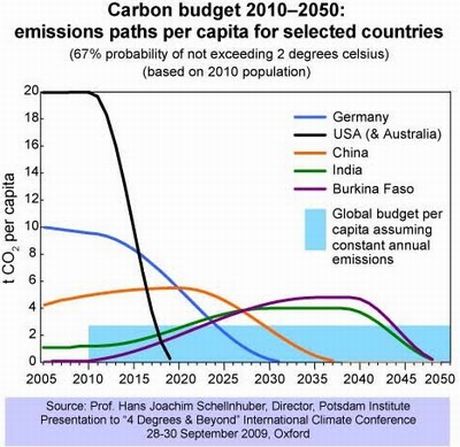
That would see emissions in 2100 roughly the same as they are now. According to the recent IPCC Synthesis Report most of the stabilisation scenarios you’d want to follow see zero emissions some time before 2100. You can get a rough idea of what’s required from this graph by Prof Hans Joachim Schellnhuber:

2C trajectories Schellnhuber

That is for a 67% chance of not exceeding 2°C.

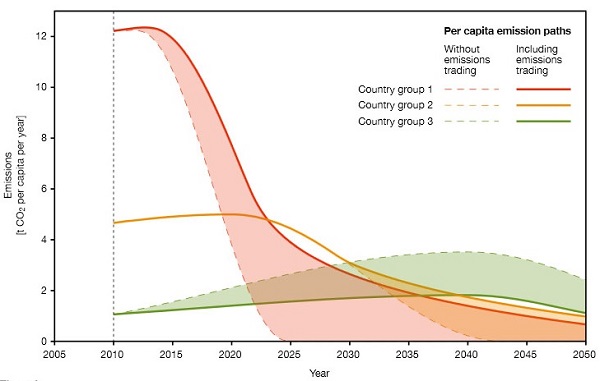
With emissions trading that would be modified thus:

Budget approach with emissions trading_cropped_600

I would assume that China is a Group 2 country in this scenario.

At a rough guess, then, I suspect that China and the US are doing no more than half what they really should, if we assume that 2°C is OK, which I don’t.

Mother Jones lists some of the detailed items covered in the agreement:

  • Expanding funding for clean energy technology research at the US-China Clean Energy Research Center, a think tank Obama created in 2009 with Xi’s predecessor Hu Jintao.
  • Launching a large-scale pilot project in China to study carbon capture and sequestration.
  • A push to further limit the use of hydroflourocarbons, a potent greenhouse gas found in refrigerants.
  • A federal framework for cities in both countries to share experiences and best practices for low-carbon economic growth and adaptation to the impacts of climate change at the municipal level.
  • A call to boost trade in “green” goods, including energy efficiency technology and resilient infrastructure, kicked off by a tour of China next spring by Commerce Secretary Penny Pritzker and Energy Secretary Ernest Moniz.

All good stuff. One valid criticism is that the agreement neglects the issue of adaptation, necessary because under the implied scenario warming will continue.

Our government has chosen to be a follower rather than a leader. It is now time to follow. But in doing so they should take a look at Prof Schellnhuber’s graphs to understand their true responsibility – and why buying carbon credits offshore is not such a bad idea.

To take the politics out of the issue they could even flick it to The Climate Change Authority. That’s what it was set up for.

Climate clippings 113

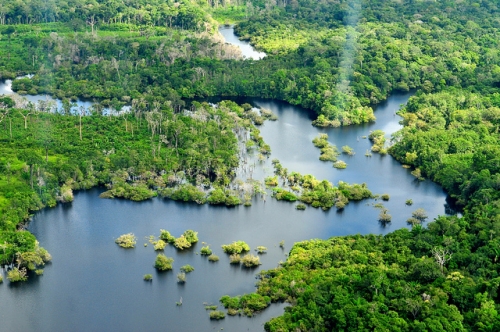
1. The Amazon is drying

AmazonRainforest_500_332_s_c1_c_c

Since 2000, rainfall has decreased by up to 25% across a vast swath of the southeastern Amazon, according to a new satellite analysis.

The area of concern is 12 times the size of California. The Amazon overall takes up 25% of the global carbon cycle that vegetation is responsible for, so it’s a significant carbon sink. With further drying the Amazon could become a carbon source rather than a sink.

Causes are not clear, but it’s possible that rainfall patterns have moved further north with global warming.

In related news, the re-election of Dilma Rousseff as president is seen as a significant negative for the environment in Brazil.

2. Great Barrier Reef protection plan ‘ignores the threat of climate change’

In its formal response to the Reef 2050 long-term sustainability plan, which was drawn up by the Australian and Queensland governments, the Australian Academy of Science states the strategy is “inadequate to achieve the goal of restoring or even maintaining the diminished outstanding universal value of the reef.”

There is “no adequate recognition” in the 2050 plan of the importance of curbing greenhouse gases.

Professor Terry Hughes, director of the Australian Research Council Center of Excellence for Coral Reef Studies and an academy fellow, said the plan was focused on the sustainable development of four “mega ports” adjacent to the reef, rather than conservation of the reef itself.

The Great Barrier Reef has lost around half its coral cover in the past 30 years. The question now is whether UNESCO will list the GBR as endangered.

3. Limiting global warming to 2°C is unlikely to save most coral reefs

In this recent post I mentioned that “preserving more than 10 per cent of coral reefs worldwide would require limiting warming to below +1.5°C (atmosphere–ocean general circulation models (AOGCMs) range: 1.3–1.8°C) relative to pre-industrial levels”. Following the links, the paper by K. Frieler at al is here.

It annoys me that the dangers to reefs from temperature change and ocean acidification are almost never mentioned, even by greenies. Opposition pollies should be speaking up too! That paper has been around since 2011.

4. Carbon capture and storage research budget slashed

The government has cut almost half a billion dollars from research into carbon capture and storage – which the Intergovernmental Panel on Climate Change (IPCC) deems crucial for continued use of coal – despite the prime minister insisting coal is the “foundation of our prosperity”.

In the budget the government cut $459.3m over three years from its carbon capture and storage flagship program, leaving $191.7m to continue existing projects for the next seven years. The program had already been cut by the previous Labor government and much of the funding remained unallocated.

John Connor, the chief executive of the Climate Institute, said CCS “has to be one of the clean energy options available because all the modelling says that to avoid temperature rises of more than two degrees, we have to take carbon dioxide out of the atmosphere”.

The first full-scale CCS power plant, the Boundary Dam Carbon Capture and Storage Project in Canada, opened last month.

5. Poland rejects zero coal by 2100

Poland and a bunch of eastern Europe countries “have categorically rejected the target put forward by the world’s top climate scientists to reduce carbon emissions to zero by 2100 to avoid dangerous global warming…”

You might recall that when Poland hosted the UNFCCC Conference of Parties in 2013 it was positively promoting coal.

The EU has not yet apportioned the effort between countries in planning to meet recently announced emissions reduction targets. The fun is about to begin!

6. Roof top solar in San Francisco

New regulations in San Francisco will require new buildings to have roof top solar or gardens or both.

7. Tesla solar supercharging network

Tesla is rolling out a solar supercharging network for electric vehicles throughout the world eventually. Soon they will make a beginning in Australia.

The superchargers provide half a full charge in as little as 20 minutes, and are usually located near amenities like roadside restaurants, cafes, and shopping centers. Usually they have between 4 and 10 stalls.

The $5 billion “giagfactory” to be built in Nevada will generate more than 100% of its electricity needs with wind and solar.

The world is changing!

8. News of energy storage is a big, big deal

So says Sophie Vorrath at RenewEconomy:

The big announcements keep coming from the energy storage sector, with news this week that US behind-the-meter startup, Stem, has been tapped to provide 85MW of distributed energy storage to households in the West Los Angeles Basin.

The deal, a multi-year agreement awarded to Stem by Southern California Edison (SCE), marks America’s largest distributed energy storage project to date, and the first time energy storage has competed with traditional energy sources like natural gas at this scale.

For its part of the deal, Stem will deploy its advanced, behind-the-meter energy storage technology at customer locations in the Western LA Basin to act as dispatchable capacity to enhance the local reliability of the region.

In other words, using the combination of storage and its proprietary software platform, Stem will allow customers to monitor and manage energy use, which in turn will provide additional capacity to SCE.

9. Billboard banned

You may have heard that Brisbane Airport banned a billboard suggesting to incoming G20 delegates that climate change should be on their agenda. Apparently the billboard was “too political”.

image_6531_full_600

Getup and a bunch of other NGOs are campaigning to have the decision reversed.

The billboard was based on the experience of South Australian grape grower David Bruer, a farmer from South Australia who lost $25,000 worth of grapes in one day when temperatures soared to 45°C last year.

IPCC Synthesis Report: you’ve been told!

Damian Carrington at The Guardian:

    Climate change is set to inflict “severe, widespread, and irreversible impacts” on people and the natural world unless carbon emissions are cut sharply and rapidly, according to the most important assessment of global warming yet published.

    The stark report states that climate change has already increased the risk of severe heatwaves and other extreme weather and warns of worse to come, including food shortages and violent conflicts. But it also found that ways to avoid dangerous global warming are both available and affordable.

    “Science has spoken. There is no ambiguity in the message,” said the UN secretary general, Ban Ki-moon…(Emphasis added)

The IPCC Fifth Assessment Report (AR5) is found here.

Roger Jones at The Conversation:

    acting on climate is ultimately an ethical, not an economic, consideration. Insufficient policy action is a declaration of self-interest, condemning our children, grandchildren and the planetary system that supports them, to a dystopian future. That’s what the report should say.

Ban Ki-moon:

    “Leaders must act. Time is not on our side.” He said that quick, decisive action would build a better and sustainable future, while inaction would be costly.

Tony (‘coal is good for humanity’) Abbott still refuses to address climate change at the G20 meeting as it would distract from discussion on growth. Nicholas Stern says climate change is core business if you’re concerned about growth:

    The G20 is the most effective forum for the discussion of the growth story of the future, the transition to the low-carbon economy.

    Yet the local politics of a country of less than 25 million is being allowed to prevent essential strategic discussions of an issue that is of fundamental importance to the prosperity and well-being of the world’s population of 7 billion people.

As Giles Parkinson told radio National

    essentially what the IPCC is saying to Australia is, on its current policy settings, ‘wrong way, go back’.

Here’s Abbott in visionary mode:
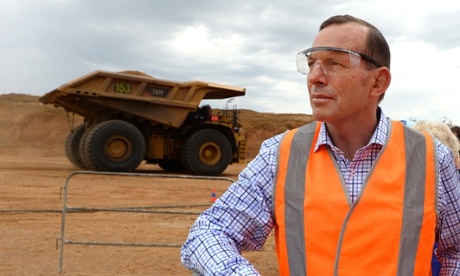
2749d2c2-02b0-4301-8523-763518db0449-460x276

Carrington above provides a useful summary of the IPCC report. Jones identifies a change in approach:

    Instead of dealing largely in forecasts and responses, as in previous syntheses, it now frames the climate problem squarely in terms of risk management.

Jones then identifies some of the myths the report busts. Roz Pidcock at The Carbon Brief identifies what’s new and interesting about the report.

C. Forbes Tompkins and Kelly Levin at Climate Code Red list 9 significant scientific findings too recent to be included in the new IPCC report. Two of them relate to sea level rise, an increased fragility of both the Greenland and Antarctica ice sheets.

There are more links at the end of the post. I wish to comment on the appropriateness of the 2°C guardrail, the view of risk taken in relation to the 2°C and then some conclusions.

Is a 2°C temperature rise safe?

David Spratt addressed this issue in September 2013. To summarise some of what he said:

  • The tipping point for Greenland Ice Sheet has been revised down to +1.6ºC (uncertainty range of +0.8 to +3.2ºC) above pre-industrial. We are likely to hit +1.6ºC within a decade or two.
  • It has been shown that “preserving more than 10 per cent of coral reefs worldwide would require limiting warming to below +1.5°C (atmosphere–ocean general circulation models (AOGCMs) range: 1.3–1.8°C) relative to pre-industrial levels”.
  • Large-scale thawing of permafrost may have already started, but a 1.5ºC global rise in temperature compared to pre-industrial should be enough to start a general permafrost melt.
  • Current levels of CO2 at about 400 ppm place us in the Middle Pliocene epoch (3.0–3.5 Myr ago) when sea levels were 25m plus or minus 5 higher than now.
  • During the Eemian 123,000 years ago sea-level rises of 3 metres occurred within 50 years due to the rapid melting of ice sheets, when the energy imbalance in the climate system was less than at present.

On sea level rise, here are the projections given in the Long Report p. 60:
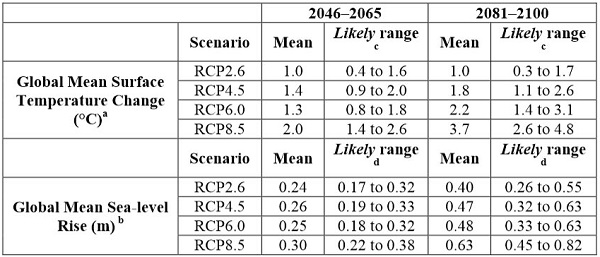
Temperature and sea level_cropped_600

In a footnote we are told:

    Based on current understanding (from observations, physical understanding and modelling), only the collapse of marine-based sectors of the Antarctic ice sheet, if initiated, could cause global mean sea level to rise substantially above the likely range during the 21st century. There is medium confidence that this additional contribution would not exceed several tenths of a metre of sea-level rise during the 21st century.

They’ve covered themselves on Antarctica, but missed the fragility of Greenland. On page 30, they say this:

    There is low confidence in the available models’ ability to project solid ice discharge from the Antarctic ice sheet. Hence, these models likely underestimate the Antarctica ice sheet contribution, resulting in an underestimation of projected sea-level rise beyond 2100. (p30, Long report)

On sea level rise unfortunately for the next seven years we will be quoted the means given in the tables, without the qualifications, which themselves are inadequate in the late of the latest science. So the talk will be about half a metre, or up to a metre maximum.

For these and the other reasons quoted, plus a few I didn’t highlight, a 2°C guardrail looks foolhardy to say the least.

View of risk taken in relation to the 2°C

This table gives some overview of the relationship between the emissions levels, RCP scenarios, temperature change and the likelihood of staying below various temperature levels. I’ve actually taken the table from Working Group 3 and adapted it by taking out four columns (relating to quantums of CO2 and emissions reduction targets for 2050 and 2100) to highlight the broad relationships:
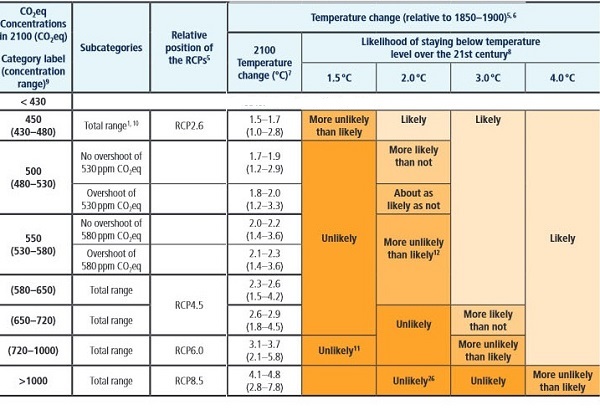
Implications of scenarios_cropped_modified

Much of the same information is given in the table on p23 (Short Report) and footnotes.

In the Short Report (p15) we are told that CO2e levels in 2011 were 430 ppm. Unfortunately the CSIRO/BOM State of the climate report says that in 2014 we are at 480 ppm of CO2 equivalent. So realistically the best on offer is the 500 zone with overshoot. This sees us with a likely as not chance of staying below 2°C. Here’s what the official language means:
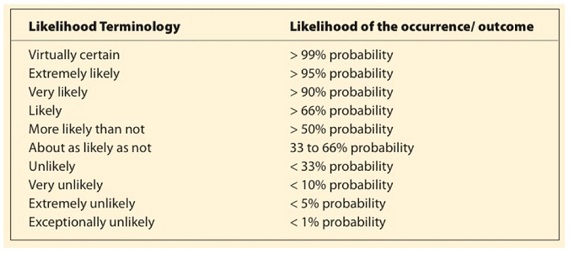
kbwvscpc-1379916947_570

In other words a 33 to 66% chance of staying below 2°C, or if we act quickly and drastically a 66% chance. When you consider the implications even of a 1.5°C climate, this is desperately insane and simply not acceptable.

David Spratt suggests a risk-averse (pro-safety) approach, say, of less than 10% probability of whatever target we deem appropriate. I’d suggest a less than 5% probability of a 1.5°C temperature rise and then see whether that is doable. Are we game to talk about what really needs to be done for a livable, sustainable ecosystem for future generations? Or are we going to continue eating our children’s future?

Conclusions

Back in 2007 environmentalist Bill McKibbin asked James Hansen what the appropriate levels of CO2 should be. Hansen gave his answer in December 2007 at the American Geophysical Union meeting. At that very time the UNFCCC Conference of Parties was meeting in Bali. Hansen’s response was that we had overshot and that we should aim at 350 ppm by taking CO2 out of the atmosphere. To clarify, Hansen’s answer assumed that we would achieve net zero in other greenhouse gases, so he was really talking about CO2e. McKibbin went off and started up 350.org.

In a strict sense the IPCC Report is agnostic about a 2°C guardrail. It simply identifies risks, vulnerabilities and impacts at various temperature levels. However, when it comes to mitigation scenarios, it deals with what is out there in the scientific literature. Here it seems the vast bulk of the modelling contemplates scenarios where the 2°C guardrail is simply part of the furniture. Yet what has been called CCS (carbon capture and storage) and the report (see Short Report p.15 for example) re-badges as CDR (carbon dioxide removal) is also part of the furniture.

It seems to me that the scientific community is struggling to catch up with where Hansen was seven years ago. Perhaps they are concentrating on what’s doable, but at the same time they are holding out false hope. While the world’s scientists and governments have issued their bluntest warning yet, we seem to be letting go the idea of a safe climate. I heard head honcho Rajendra K Pachauri on the radio saying that we only had a budget of 275Gt of carbon (that’s about 1000GT of CO2) left that could be used. In fact, rationally, we don’t have a budget at all, we are in the red. Rationally, all the fossil fuel reserves should be left in the ground – all of them, unless offset with CCS or CDR, for which our visionary PM has just slashed the research budget.

Update:

Al Jazzeera rounds up some of the opinion warning that 2°C is foolhardy and dangerous.

    “There is no such thing as a safe rise,” said Bob Watson, who was the chair of the IPCC from 1997 to 2002. “You will see food and water insecurity, human health problems, and sea level rise even with a 2 C rise.”

And so on.

See also:

UN Climate Report Rings Alarm, Offers Guidance

World’s Scientists Warn: We Have ‘High Confidence’ In The ‘Irreversible Impacts’ Of Climate Inaction

Media round-up: The IPCC synthesis report

That last link from The Carbon Brief is quite comprehensive and includes a list of their six posts.

Related IPCC posts, in chronological order:

Crisis or catastrophe? What will the IPCC say?


A choice of catastrophes: the IPCC budget approach

Commentary on IPCC WG1: Part 1

Commentary on IPCC WG1: Part 2

Climate change impacts: IPCC Working Party 2 report

Adding to the muddle? The IPCC climate change mitigation report

Climate mitigation costs and strategies

Climate clippings 112

1. Will Australia be to world climate talks what Poland is to Europe?

That’s the question asked by Giles Parkinson.

On the international stage Australia plays a similar role to Poland in Europe. The two countries have much in common: their leaders share a tenuous hold on climate science, a grim determination to extract coal and use it for electricity, don’t like carbon pricing and are trying to keep a lid on renewables.

From what he says, there does seem a difference. Poland gained free carbon permits from the EU negotiations “worth more than $1 billion and promises for funds to help it “modernize” is coal-fired plants after 2020.”

Prime Minister Ewa Kopacz said after the summit that the threat of veto was simply a “tool” to get the best conditions for Poland’s economy. “Nobody got compensated like we did,” she boasted after the meeting.

In other words they were out for what they could get.

On the basis of the Abbott Government’s form in the UNFCCC Conference of Parties in Warsaw last December and actions since, we can expect Australia to be actively hostile to positive outcomes. Not just lead in the saddle bag, an active saboteur.

2. The prospect of a Republican US Senate

There is a 68% chance that the Republicans will control the US Senate after the mid-term elections. For the climate this could be a disaster.

Certainly they are unlikely to control the 60 votes they would need to avoid a Democrat filibuster, and the President has the power of veto over bills. So anti-climate legislation is not so much the worry.

However, the Republicans could block appropriate appointments to various agency positions and regulatory posts.

Secondly, any treaty coming out of the 2015 UNFCCC talks in Paris next year would need to be legislated. This would be impossible and could affect the tenor of the entire negotiations, with one large lame duck at the table.

Third, the US contributions to the IPCC and the UNFCCC could be pulled, making life for those bodies impossible.

Fourth,

a GOP majority in that house of Congress would flip several key committees into Republican hands. In particular, Sen. Jim Inhofe (R-OK) is up to take over the Environment and Public Works Committee, Sen. Ted Cruz (R-TX) would head the Subcommittee on Science and Space, Sen. Ron Johnson (R-WI) is in line to take control of the Homeland Security and Governmental Reform Committee, and Sen. Mike Enzi (R-WY) would head up the Budget Committee.

All except Enzi are avowed climate denialists.

Then there’s scary budget negotiations, and more.

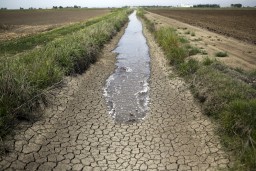
3. Global groundwater crisis

AP190188023717-256x171

A NASA study has found that major groundwater aquifers are being depleted faster than the rate of replenishment, threatening food supplies and security.

The groundwater at some of the world’s largest aquifers — in the U.S. High Plains, California’s Central Valley, China, India, and elsewhere — is being pumped out “at far greater rates than it can be naturally replenished.”

The most worrisome fact: “nearly all of these underlie the word’s great agricultural regions and are primarily responsible for their high productivity.”

4. Geoff Cousins heads the ACF

You’ll probably recognise the gravel-voiced tones of Geoff Cousins from his campaign against the Gunns paper mill. He used 20,000 signatures from ANZ customers to pressure the bank to withdraw the project’s funds.

From the SMH:

His business credentials include heading the country’s largest advertising company and heading Optus Vision when it slugged it out with News Ltd over rugby league broadcasting rights. He is a director of the Telstra board.

He is now President of the Australian Conservation Foundation, so expect to hear more from him. Now he’s lashed out at the Direct Action legislation and given the BCA (Business Council of Australia) a whack around the ears for supporting the legislation which he says individual companies would have rejected.

If somebody had brought a business case to the boards of one of those public companies for this program, no responsible board would have given it the time of day.

You would have asked first of all how cost efficient it was, you would have asked what was world’s best practice in all of these areas, these sorts of questions, and none of them would have been able to be answered positively in regard to this program.

The ACF are now embarking on a public education campaign about the legislation.

5. Food, Fossil Fuels and Filthy Finance

That’s the title of a report from Oxfam, summarised at Hot Topic.

On current trends, the world will be 4–6ºC hotter by the end of the century, exceeding 2ºC within the lifetimes of most people reading this report. This could put up to 400 million people in some of the poorest countries at risk of severe food and water shortages by the middle of the century.

This paper shows how, despite some steps in the right direction to tackle climate change, a ‘toxic triangle’ of political inertia, financial short-termism and vested fossil fuel interests is blocking the transition that is needed. To help break this, governments must commit to phase out fossil fuel emissions by early in the second half of this century, with rich countries leading the way.

In 2012 fossil fuel companies spent $674bn on exploration and development projects. The industry is supported by $1.9 trillion of subsidies public finance, incentives and tax breaks, including the costs of paying for its widespread damage.

Quite simply, most of the stuff should be left in the ground:

Fossil fuel reserves_cropped_600

In truth, that’s generous!

PUP does a deal on Direct Action

Palmer_Article Lead - wide6279022411dszqimage.related.articleLeadwide.729x410.11dt8w.png1414570114131.jpg-620x349

If we didn’t know before, we know now that Clive Palmer will do a deal with the devil. He’s going to vote for a scheme that he comprehensively rubbished, said was a complete waste of money and he would never vote for it.

His price?

Clive Palmer won a Government commitment to salvage the Climate Change Authority and to ask it to conduct an 18-month review of the PUP plan to legislate an emissions trading scheme (ETS) at a zero rate.

This is of course a good thing. I understand that the Climate Change Authority will have something to say about targets before we have to make commitments in Paris next December. And the review can take into account Paris outcomes. The review and the work of the CCA may provide a road to redemption for the backsliders in the LNP. Bernie Fraser sees his task in this light, as he was quoted on PM:

What you’ve heard today is perhaps the beginning, the beginnings of an emerging broad, broader political consensus on climate change and the need to take effective action. Because that’s what this country needs more than anything else – the development of a broad political consensus.

Of course, the Government needs six votes from the cross bench.

Victorian senators Ricky Muir and John Madigan and South Australian senator Nick Xenophon have also given their vote to the Government after negotiations.

Xenephon was said to have won four out of five of his requirements. Included was his penalties for big emitters proposal.

To win the necessary support, the government has accepted a proposal by Senator Xenophon to put in place a “safeguard mechanism” to ensure companies comply with the scheme’s requirements.

Details of the safeguard mechanism will be mapped out later. Observers expect it to include some form of penalty for companies that fail to meet government-set benchmarks, although it remains uncertain what the penalties would be.

Uncertain too what the benchmarks will be.

Not included was Xenephon’s proposal to set aside $500 million to buy carbon offsets from abroad to ensure the target is met. No doubt that would be too much like carbon trading for the LNP to stomach.

Christine Milne slammed the direct action policy as “embarrassing”. She reminded us that Palmer helped the Government tear down the ETS. Here’s their Facebook entry.

Bill Shorten:

“Tony Abbott has once again sold his soul to Clive Palmer and Australia will pay the price,” he said.

“This is a dirty deal that will send our country backwards.”

The Climate Institute welcomed the preservation of the independent Climate Change Authority but wanted to see more details about the review.

“Moreover, we are deeply concerned that the amendments to the CFI Bill fail to establish a climate policy that gives a reasonable chance of achieving even the lowest level of Australia’s 5-25 per cent 2020 target range, let along the deeper decarbonisation of the economy that will be needed beyond 2020. The Climate Change Authority has recommended Australia adopt a 2030 emission reduction target of 40-60 per cent below 2000 levels.”

“Without access to international carbon permits, stronger domestic regulations will be needed to meet Australia’s emission goals. The ‘safeguard mechanisms’ in the legislation—the emission limits that companies will have to adhere to—will need to be very strong and get more stringent over time, and regulations to limit emissions and tighten energy efficiency standards across the economy will also be needed.”

Greg Jericho made the excellent point that the Abbott Government “has been extremely successful in making climate change policy more about electricity prices than about climate change.” Maybe Bernie Fraser and the CCA can gently nudge it in a different direction!

There’s more at The Conversation.

Update: Bret Harper and Hugh Grossman give the detail of the agreement on Direct Action. They include:

The government will also withdraw its Clean Energy Finance Corporation (Abolition) Bill 2014 and the Australian Renewable Energy Agency (Repeal) Bill 2014 during the Spring 2014 parliamentary sittings.

The CCA will produce three reports, going into targets for Copenhagen as well as emissions trading schemes.

Climate clippings 111

1. Record warmth

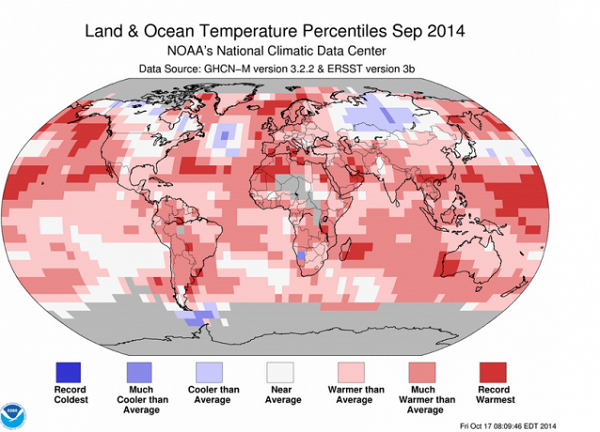
September followed August as record heat for the month worldwide. The period January-September was equal hottest with 1998 and 2010. The 12 months from October 2013 to September 2014 was the hottest 12-month period on record. The heat was just about everywhere, except for central Russia, some areas in eastern and northern Canada, and a small region in Namibia:

Screen-shot-Sept 2014-AM-600

2. Coal is good for humanity!

Thus spake Tony Abbott, repeating lines imprinted on his mind by coal industry lobbyists.

In an important post Graham Readfearn tells how big coal is hijacking the energy poverty issue

telling the world that the only way the poorest nations can pull themselves out of poverty is by purchasing lots of their product.

The point that those same people will likely be hit earliest and hardest from the impacts of climate change being driven by that same product, is neatly swerved or underplayed.

So we have Peabody Energy “fueling the world with energy essential to sustain life”.

Pardon me while I have a quiet chunder!

3. New 2030 climate targets for the EU

On the whole climate campaigners are disappointed with the new emissions targets set by the EU – 40% reduction in emissions, 27% cut in energy use and 27% of energy must be from renewables.

The ETS is seen as essential in reaching these targets, so it will be reformed in an as yet undesignated way.

Rich countries like Germany, the UK and France will have to do better than the designated cuts to compensate for the continued reliance on coal by the likes of Poland, Bulgaria and Romania.

At Climate Progress it seems the American reaction is more favourable. They point out that the targets are the first substantive offer from any member of the international community ahead of the UN climate talks to be held in Paris in 2015. The Americans and the Chinese are unlikely to go so far.

Personally when they aim for net zero emissions by 2030 and aim for 350 CO2e ppm by 2050 I’ll say they are reconnecting politics with reality.

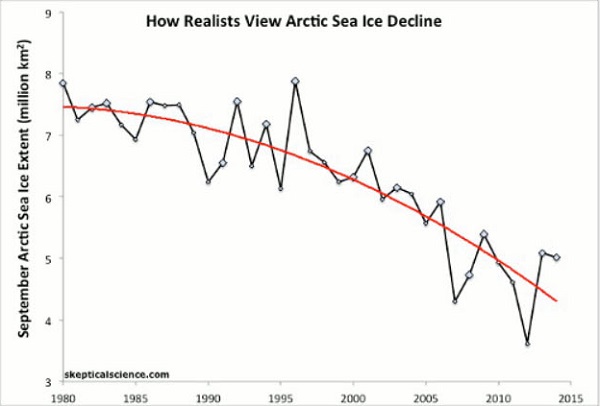
4. Arctic sea ice escalator

BilB drew attention to Skeptical Science’s Arctic sea ice escalator:

Sea ice 2014_cropped

He’s right, the next break downwards could shock some doubters.

Perhaps enough to shake pollies of all stripes out of their torpor.

If you look at the trend from the late 1990s it looks even more dramatic.

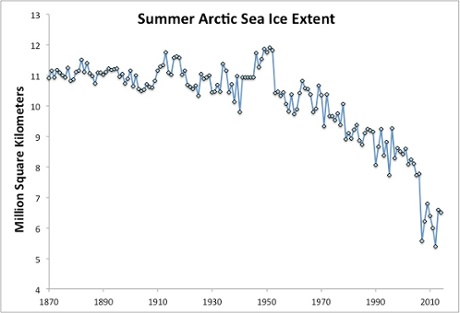
The full article has two further graphs:

00c36199-0fac-468c-86d4-76d93ce98cba-460x313

120afee8-e360-4a99-ab75-cabf94d6b08c-bestSizeAvailable

Actually there’s something wrong with both. The y axis should go below 4. It’s like where you have a graph on a wall and the line falls off the graph and onto the wall.

5. Pacific warriors blockade Newcastle

Climate Change Warriors from 12 Pacific Island nations paddled canoes into the world’s largest coal port in Newcastle, Australia, Friday to bring attention to their grave fears about the consequences of climate change on their home countries.

The 30 warriors joined a flotilla of hundreds of Australians in kayaks and on surfboards to delay eight of the 12 ships scheduled to pass through the port during the nine-hour blockade, which was organised with support from the U.S.-based environmental group 350.org.

The warriors came from 12 Pacific Island countries, including Fiji, Tuvalu, Tokelau, Micronesia, Vanuatu, The Solomon Islands, Tonga,
Samoa, Papua New Guinea and Niue.

6. Norway takes to electric cars

Norway, not a member of the EU, now has 15% electric cars. Since 2011 Nissan LEAF has become the nation’s third best-selling car.

Norway is not a member of the EU. It gets 98% of its power from renewables. Presumably it doesn’t go around preaching that oil is good for humanity!

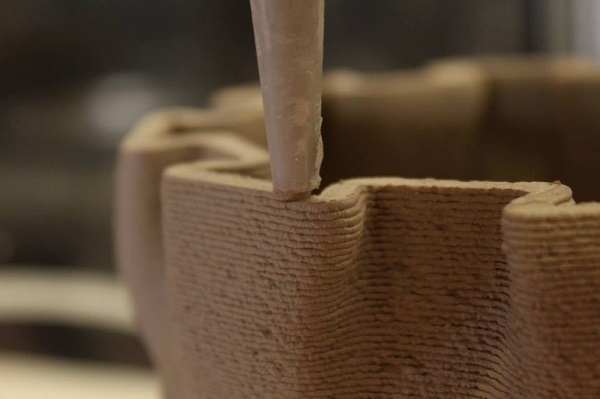
7. How to build without bricks and cement

Just print houses out of mud!

wasp_3d_printed_mud_homes-3_600

Thanks to John Davidson for those last two items.

RET: the battle lines are drawn

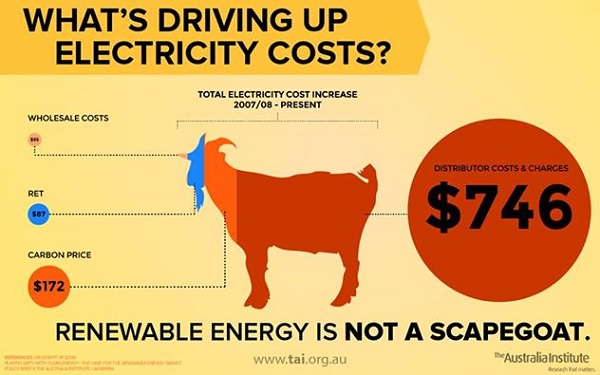
The Renewable Energy target (RET) has been severely scapegoated on electricity prices according to The Australia Institute Facebook:

TAI_10712743_10152423558294397_2440449757786334261_n_600

The Tea Party LNP Government and Labor have agreed to talk, to find a bipartisan position on the RET. The LNP has now set out what must be an ambit claim:

  • The RET will constitute a so-called “real 20 per cent” of Australia’s electricity production.
  • Emissions from intensives industries, including aluminium, copper, zinc and cement will be exempt.
  • The small-scale solar panel scheme will remain untouched.
  • Biannual reviews of the target will cease.

As background, the RET was legislated in 2009 as 41,000 gigawatt hours, representing 20% of the electricity estimated to be produced in Australia in 2020.

Since then electricity demand has collapsed, meaning the 41,000 gigawatt hour target is now closer to 27%.

This was Bill Shorten’s response:

“The government say they want a real 20 per cent, I call it a fraud 20 per cent, a fake 20 per cent. The truth of the matter is that renewable energy is part of our energy mix. It’s had a great benefit for a whole lot of consumers,” Mr Shorten said.

“We’ve seen thousands of jobs created…and we’ve seen billions of dollars of investment. The real damage that this government’s doing in renewable energy cannot be overstated.”

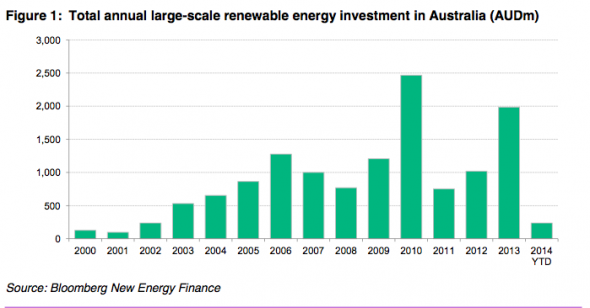
As John Davidson has been saying repeatedly, the damage is already very evident, as shown in this graph:

bnef-investment-590x308

The renewables industry reaction:

But the renewable energy industry said the target as proposed would devastate the industry and jeopardise millions of dollars in investment.

Lane Crockett, general manager of PacificHydro, said: “What reason can there be [for this cut] other than to protect the coal industry?”

Ironically the LNP position would be seen as something of a win internally for Greg Hunt in the face of the climate scepticism that infects the governing parties.

On the matter of reviews, the LNP have been saying that the Warburton Review was required by legislation. I think the truth is that by law the review should be done by The Climate Authority, which still exists. According to Lenore Taylor at The Guardian:

The Climate Change Authority announced this week it was conducting its own review of the RET before December, as required under law.

I wonder who is paying their bills.

Giles Parkinson points out that The Climate Authority will look at the RET in terms of its contribution to reducing emissions rather than consumer prices. That is novel in the current environment – reviewing the RET in the light of its original purpose!

In that article Christine Milne in estimates hearings chewed out the PMs Department which ran the Warburton review for allowing the review to go beyond its terms of reference and recommending the most expensive options.

The Government is clearly in thrall of the fossil power lobbyists. Giles Parkinson again:

The Abbott government has confirmed that its opening position in talks with the Labor Party is for a “real” 20 per cent target, meaning that the amount of large scale renewable energy being built in Australia over the next 5 years could be cut by two thirds from the current target.

This was one of the key recommendations of the Warburton Review, which made the recommendation despite finding that the cost to consumers would be far less if it left the target at the current level of 41,000GWh by 2020, or made it a 30 per cent target by 2030. (Emphasis added)

Dick Warburton ended up as a very confused puppy. As John Davidson said:

Climate Spectator had this post on Dick Warburton, the Chair of the RET review committee and his performance on a Fran Kelly interview after his review had been released. It gives a picture of a man who doesn’t understand his own report or anything much else apart from the need to recommend the destruction of the RET and all the jobs it has created.

But the LNP are also responding to the popularity of rooftop solar where around “15,000 Australian households add rooftop solar each month, despite the disappearance of state-based feed in tariffs.” After all nine out of 10 households have considered or would consider installing roof-top solar.

Large scale investments are for decades rather than for years. Genuine bipartisanship to a long term commitment is needed. Even if an agreement can be cobbled together in the talks, there is a real question as to whether investors in large scale renewables in Australia will consider it worth the risk.

Hiccup Hockey fluffs his lines on the BBC

Hockey_269829-2d088adc-535c-11e4-a40d-833ddda6a9b8_550

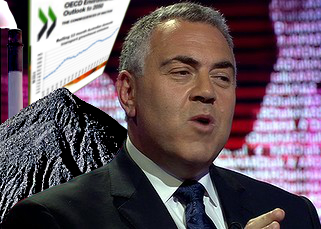
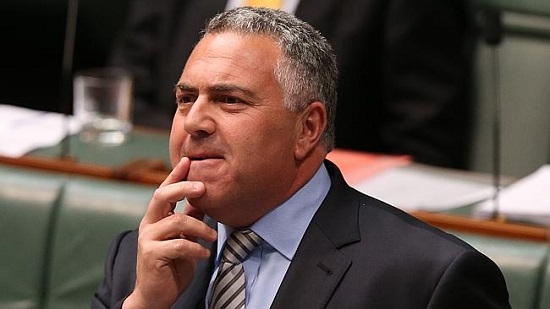
On one view Treasurer Joe Hockey made an absolute goose of himself on the BBC’s HARDtalk program the other day.

A kinder view is that Hockey and the interviewer, Stephen Sackur, were simply talking past each other. Sackur was talking about greenhouse emissions, Hockey was talking about coal exports. The question remains open as to whether Hockey understands the difference. In terms of the question he was actually asked, he was talking gibberish.

You can see the segment here or here. There are reports here and here. This is from the Australian Government transcript:

STEPHEN SACKUR:

Right, you sell an awful lot of coal in Asia and that raises questions about Australia’s commitment to cleaning up its act. You are one of the dirtiest, most greenhouse emitting countries in the OECD group of developed countries. Is your Government prepared to do anything to clean up its act?

TREASURER:

Well firstly, the comment you just made is absolutely ridiculous.

STEPHEN SACKUR:

Why?

TREASURER:

Well, Australia is a significant exporter of energy and in fact, when it comes to coal, we produce some of the cleanest coal, if that term can be used – the cleanest coal.

STEPHEN SACKUR:

(Inaudible) Highest per capita emitter of greenhouse gases of any nation in the OECD. So, what is wrong with what I am telling you? You are a very polluting nation and you have got a decision to make as a Government about whether you are prepared to do anything serious to change that.

TREASURER:

Stephen, I don’t accept the basis of your question, and why? Because we’ve got a small population and very large land mass and we are an exporter of energy, so that measurement is a falsehood in a sense because it does not properly reflect exactly what our economy is. We are on the threshold of becoming the biggest exporter of gas in the world. We are a major producer and exporter of coal. We are now selling uranium to India. We are an exporter – a trustworthy, reliable, predictable exporter of energy that is helping to drive the emergence of the middle-class in Asia. Now, that should be welcomed.

He goes on to say that the best way of tackling climate change is to help developing countries become richer, and to do this they need to burn more coal.

Greens will also be interested in Hockey’s reasoning as to why we need to increase the fuel excise:

The fundamental point is this: that we are asking Australians to pay an extra 40 cents a week in fuel taxes on average, in order to deliver the biggest road building program in Australian history.

Didn’t he promise Christine Milne that the extra funds would go on public transport? Seems she was right not to believe him.

I borrowed from Laurie Oakes’ story When Joe Hockey talks, Coalition colleagues wince for the title of this post. The story started:

HICCUP Hockey strikes again! Just when colleagues were starting to think the Treasurer might be getting his act together he produces another gaffe.

Oakes’ story was written before the BBC interview. Hockey’s was attempting to use national security to pressure Bill Shorten over Hockey’s stalled budget bills. Oakes termed this an appalling misjudgement.

“If Bill Shorten truly is honest about his commitment to deliver bipartisan support in relation to our defence efforts in the Middle East, he’ll provide bipartisan support to pay for it,” he said.

That time Abbott hastened to distance himself and to set the matter straight. Shorten was a true patriot, he said. This time, well you never know, he may agree with Hockey, being ignorant about climate change himself. Or perhaps he hoped we didn’t hear.

I think Laura Tingle got it right back in 2010, when she concluded Hockey and Andrew Robb were liars, clunkheads or both, but “whatever the combination, they are not fit to govern.”

That applies to the whole pack of them, Abbott and his front bench, with perhaps one or two notable exceptions.

Divesting Investments on Social, Environmental and Ethical Grounds

The Australia Institute is a progressive think tank that produces credible, fact based economic reports on the issues facing Australia.  What I have copied here is a short article from their periodic email on recent decisions by the ANU and others to divest the shares they held of companies whose business and/or behaviour is unacceptable on social, environmental etc. grounds.

It is just part of the pressure being encouraged by organizations such as 350.org to encourage banks, super funds etc. to stop investing in and financing unethical activities such as extracting fossil fuels:

Divestment movement hits a nerve

The fossil fuel divestment movement seemed to hit a particularly sensitive nerve this week. The Australian Financial Review has published a litany of critical front page stories, editorial and opinion pieces. In particular, special outrage flowed over divestment decisions taken by the Australian National University (ANU).

ANU announced last week it would divest from seven resources companies on environmental, social and governance (ESG) grounds. ANU is home to a long running student campaign calling on them to divest from fossil fuels. Under pressure, ANU sought professional ESG research and declared it would knock out the companies that ranked worst. The companies impacted include gas giant Santos, Oil Search and other miners extracting copper, nickel and a range of other minerals.

ANU’s decision has drawn ire, not only from the companies themselves, but also from SA Premier Jay Weatherall, previous Resources and Energy Minister Gary Gray and some Indigenous groups. There have been all manner of complaints: the companies say they weren’t consulted; they have won ESG awards; Santos is a proud Australian “pioneer”; fossil fuels cure poverty “whatever the effects of carbon dioxide ­emissions on climate”; mining is essential to modern life, and so on. One company is talking about legal action.

Others have baulked at the unusual enthusiasm in the reactions and coverage. A Canberra Times editorial said it “verged on hysterical”. Clean energy commentator Giles Parkinson, himself an ex-AFR deputy editor, said the reaction was “as though someone had committed treason against Team Australia. Or at the very least against Team Coal.”

At first glance, coal has nothing to do with it. ANU is not divesting from coal companies – unlike Stanford, which is divesting from all big coal companies, and Glasgow University which this week said it would divest from fossil fuels. Indeed, without a sector wide screen, ANU is likely to reinvest in fossil fuels. But when ABC’s Lateline covered ANU’s decision this week, theMinerals Council sent the head of their Coal Division into bat for the miners. Maybe that’s because coal is most at risk from the reputational effects of divestment campaigns. Coal is the heaviest emitter, cheapest to substitute with renewables and at most risk of being displaced by new clean energy.

ANU Vice Chancellor Prof. Ian Young defended the ANU’s move:

as “a major researcher in environment and alternative energy, we need to be able to put our hand on our heart when we talk to our students and to our alumni and to our researchers and be able to say that we’re confident that the sort of companies that we’re investing in are consistent with the broad themes that drive this university.

ANU economist Warrick McKibbIn did not agree, saying “you need proper, clear, transparent policies such as carbon pricing… You don’t get the sort of adjustment we need by these token gestures by institutions like a university.”

But Swiss investment bank UBS endorsed the strategy in a recent investor note. UBS said this was a “potentially effective campaign”, noting that:

“many of those engaged in the debate are the consumers, voters and leaders of the next several decades. In our view, this single fact carries more weight than any other data point on the planet for this issue: time, youthful energy and stamina are on the side of the fossil fuel divestment campaign.”