ABORIGINES: CONVERSATION STARTER
My future wife and I became actively interested in Aborigines and Aboriginal policy when we were members of ABSCOL. At that time, ABSCOL was a University based society that raised money for Aboriginal university scholarships. (It also provided Aboriginal policy advice to the National University Students Association. – I chaired the committee that drafted the NUSA policy in 1964.)
Since then my wife and I spent about 20 yrs in places with substantial Aboriginal populations. In these places we spent more time than most mining town residents interacting with Aborigines.
This post looks at some of the things we thought we learned from our interactions with Aborigines and some alternatives for the future.
DETAILS:
A few key dates:
1965: Charlie Perkins led a “freedom ride” that shocked a lot of Australians. Australians were not comfortable confronting things like Aboriginal kids not being allowed to use the Kempsey swimming pool.
1965: In the early 1960’s BHP negotiated a mining agreement that allowed BHP to mine some of the manganese ore deposits on Groote Eylandt. At the end of this process BHP agreed to a number of things including equal pay for Aboriginal workers and the payment of royalties. Radical stuff at the time.
1970’s: Davidson’s lived most of this decade on the Groote Eylandt Aboriginal reserve. (I worked for Groote Eylandt mining. My responsibilities included Aboriginal training at one stage.)
1976: Aboriginal Land Rights Act 1976 The Aboriginal Land Rights (Northern Territory) Act 1976 (ALRA) is Australian federal government legislation that provides the basis upon which Aboriginal Australian people in the Northern Territory can claim rights to land based on traditional occupation.
1980’s to early 1990’s: Davidson’s lived most of this time at the Pilbara town of Newman. During this time a large fringe dwellers camp grew at Newman.
Groote Eylandt and Bickerton Is: Home of the Warndilyagwa people. This group consisted of a number of clans who all use Enindilyagwa as their primary language. (They could also speak a number of mainland languages as well as English.)
Makassan trepang gatherers had been visiting Groote for hundreds of years. The Groote people were used to dealing with strange outsiders and not given to being pushed around.
Traditional culture and laws have a significant influence on the decisions that the Warndilyagwa make. Some features of the culture can cause difficulty for strangers. For example, Aborigines think it is bad manners to say “no.” They deal with unwanted requests by saying “yes” and then not doing what was wanted.
We both learned a bit of Enindilyagwa. The language provides a good example of how languages develop to satisfy needs. (There were about 100 prepositions – It was important not to make mistakes about who was being talked about.)
My wife commented that: “After 8 yrs I would think I had things worked out. Then something would happen and they would do something completely different to what I expected.”
We were impressed with how the Warndilyagwa could make decisions and then make things happen.
Newman Fringe Dwellers Camp: During our stay in Newman a fringe dwellers camp grew next to Newman. My wife had some dealings with these Aborigines as a result of working for the Dept of community services and being editor of the local newspaper.
At that time the camp was used by Aborigines passing through, those who were there because of the booze and people trying to avoid tribal law punishments. (Since we left some improvements have been made but the fringe township is apparently being shut down and the people being moved into state housing.)
Newman was unusual because there were no living traditional owners because they were wiped out by the Hamersley mob. Since we left the Martu desert people have taken some responsibility for this land.
The Davidson’s have had not much to do with Aborigines since leaving Newman.
Conclusions: At the end of our time with Aborigines I concluded that:
1. It is the Aborigines and often only the Aborigines that can fix many Aboriginal problems.
2. My wish was that both individuals and communities have the freedom to choose what they want to do.
3. A lot of progress had been made since 1964. In 1964 I believe I knew all the Aborigines with university degrees – Both of them.
Conversation questions?
1. In 1964 Australia was following an assimilation policy which was similar to our migrant assimilation policy. The idea was that Aborigines/migrants should be helped to become part of the broader population. ABSCOL scholarships were about helping this process by demonstrating to both Aborigines and other Australians that Aborigines could do well in the broader society. Stan Grant suggested recently that Aborigines may be better of if they looked at how immigrants had succeeded in becoming a successful part of broader Australia.
2. Later on we talked about using an integration policy which aimed at bringing the Aboriginal community into the broader community. At first this was about getting the support of older Aborigines for the movement of younger Aborigines into the broader community. Over time both Aboriginal and immigration policies became more about encouraging multiculturalism rather than assimilation. (Benefits both societies.)
3. At the moment some Aborigines are talking more and more about Aborigines becoming a nation that deals through its leaders with the government and is recognised in the constitution. This may go further to the next logical step where the constitution and the Australian government are ignored.
4. Jailing, treatment in jails, defacto differences in how the justice system treats Aborigines and other Australians are topics that also need discussion.
Morrison goes to Glasgow: what’s new?
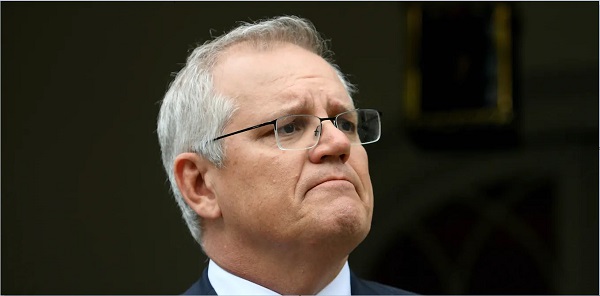
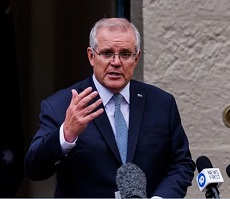
Last week our PM, one Scott (“Scotty from Marketing”) Morrison, scrambled to wrest control of our borders from a disruptive new Premier of NSW, one Dominic Perrottet, who effectively sidelined the PM, while announcing that he will indeed go to Glasgow to spruik our newly minted policy on climate change, that is, if his recalcitrant coalition partners, the Nationals, agree to have one.
Laura Tingle’s AFR opinion piece The most abject failure of leadership in living memory (published under a less pungent title at the ABC) asks “Who is in charge now?” since the states and the Nationals seem to be running the show. Continue reading Morrison goes to Glasgow: what’s new?
Gladys goes. What does that mean for us?
Michael McGowan and Anne Davies had the story on Friday 1 Oct 2021 NSW premier Gladys Berejiklian resigns after ICAC announces investigation:
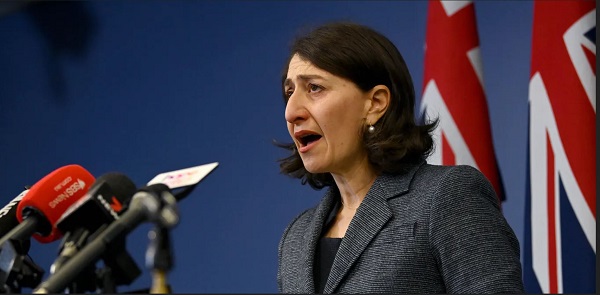
(Image from Michelle Grattan’s story at The Conversation.)
I think her greater misdemeanor lies elsewhere. However her demise has further trashed politicians and politics in the public mind, opening opportunities for independents, and minor parties in so far as they present as people who are not politicians.
This is not good for democracy. Continue reading Gladys goes. What does that mean for us?
To Deal With China First Learn to Play Go
Conversation Starter: Stan Grant wrote this interesting article on future relationships with China: “Despite what Joe Biden says, we’re not approaching a Cold War. China is not the Soviet Union, for one thing” The guts of his message is that: “China learnt well from Western powers. It has embraced multilateralism and global norms. The international order has underwritten China’s rise. Xi Jinping himself has presented China as a champion of globalization and multilateralism at the very time when America under Donald Trump was withdrawing from it.
The Rand Corporation think tank pointed out in a study in 2018 that there is nothing straightforward about China’s role in the world. China’s engagement with the global order, it says, is a “complex and contradictory work in progress. China sees “multilateral institutions as important, if not essential, for the achievement of its interests”.
This post provides a starting point for a conversation about dealing with China.
DETAILS:
In the past I have been a player of both chess and Go. So I was interested when Stan said: “If the West sees global politics as a chess game, the Chinese see it as Wei-Qi, or Go. Former US Secretary of State Henry Kissinger summed it up: “If chess is about the decisive battle, Wei-Qi is about the protracted campaign.
China wants to wear us down. As the rules of Wei-Qi point out, it is about “breaking the enemy’s resistance without fighting”. This concept is known as shi — creating a strategic advantage. Why would China overthrow an order when it can successfully work within it?”
Key points about chess: Chess uses a variety of pieces that are allowed to make different moves. The game starts with all the pieces on the board in the position prescribed by the rules. The players take turns at moving one piece with enemy pieces being “killed” when an opponent moves a piece to the place where an enemy piece is sitting. The game is won when the winner “kills” the opposing king.
WWI was something like a game of chess with the opponents in contact grinding each other down. The aim was to crush the enemy or convince them that they would be destroyed if they did not surrender.
Key points about Go: One of the players starts with black pebbles, the other white. At the start of the game there are no pebbles on the board. The players take turns to place pebbles on the board. Pebbles are not moved once placed. Pebbles/groups of pebbles are lost and removed from the board when they are surrounded in a particular way by enemy pebbles. The game is won by controlling most of the board. In many cases the final killing off of a group of pebbles is deferred while other groups of pebbles are attacked.
At the start of games it is common for players to start by spreading their pebbles over the board instead of getting into direct conflict. Once these direct conflicts start players may increase their chance of winning direct conflicts by linking with pebbles located somewhere else on the board.
Signs of Go influencing Chinese strategies? Think Chinese:
• Investment and loans to Pacific Islands and other countries that increase Chinese influence?
• China’s belt and road initiative?
• Buying or setting up business in other countries that depend on sales to China and/or parts etc. produced in China.
Your thoughts?

Australia must leave 95 per cent of coal in the ground
In March this year UN chief Antonio Guterres said he wanted:
- all OECD countries to commit to phasing out coal by 2030, and for non-OECD countries to do so by 2040. Science tells us this is essential to meet the Paris Agreement goals and protect future generations.
He wants the main emitters and coal users to announce their phase-out plans well before the Glasgow UNFCCC COP26 conference in November this year. Continue reading Australia must leave 95 per cent of coal in the ground
Test Post
Trying to get back to climate +
Just transition in the Hunter Valley region

At a LEAN (Labor Environment Action Network) Zoom meeting recently I was privileged to witness a presentation from Tim Lang, an environmental activist in Newcastle, active through the NSW branch of LEAN and a co-founder of the Hunter Jobs Alliance. This post of 03 November, 2020 on the National LEAN site recorded the Hunter Jobs Alliance Launch: Continue reading Just transition in the Hunter Valley region
Weekly salon 23/8
1. The cost of pests
I recall we had some discussion about feral pigs, which rate fifth in a research study by Corey J. A. Bradshaw of Flinders University and Andrew Hoskins of the CSIRO in Pest plants and animals cost Australia around $25 billion a year – and it will get worse:
Shamefully, Australia has one of the highest extinction rates in the world. And the number one threat to our species is invasive or “alien” plants and animals.
But invasive species don’t just cause extinctions and biodiversity loss – they also create a serious economic burden. Our research, published today, reveals invasive species have cost the Australian economy at least A$390 billion in the last 60 years alone. Continue reading Weekly salon 23/8

Trouble Down at t’Blog!
Please respond in comments with the user interface problems you are having and I will look into things.
Life is coming at me rather fast right now so I will be dipping in and out.
Will the IPCC finally come to terms with climate risk?


The IPCC Intergovernmental Panel on Climate Change) is planning to release the first of four reports in its 6th Assessment Report (6AR) on Monday, 9 August, 2021.
I believe the largest question will be whether the IPCC, this time, adequately accounts for risk. Continue reading Will the IPCC finally come to terms with climate risk?
Weekly salon 3/8
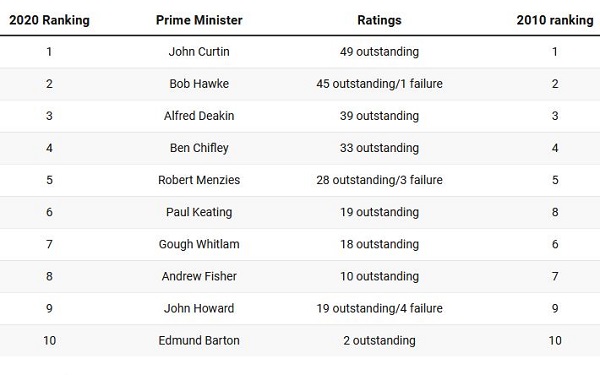
1. Who was best ever PM?
Paul Strangio asked the equestion Who were Australia’s best prime ministers? We asked the experts.
He and colleagues asked 66 political scientists and historians. Here’s the top 10: