Climate clippings 117

1. Australia targeted as climate change obstacle

I pointed out that Australia is the dunce of the class on climate change according to the Climate Change Performance Index 2015.

Elsewhere the French are already considering how to cope with Australia’s and Canada’s negativity at the Paris conference next December.

2. Seeney in denial on sea level rise

That dipstick Jeff Seeney, Deputy Premier in Queensland, has directed the Moreton Council to remove all reference to sea level rise from, its planning documents:

“I direct council to amend its draft planning scheme to remove any assumption about a theoretical projected sea level rise from all and any provision of the scheme.”

The council had made provision for a possible 0.8-metre rise in sea level by the year 2100. Seeney says:

“I am prepared to protect the property rights of Queenslanders in other council areas should this issue arise again.”

Who is going to protect them from him? The Local Government Association of Queensland (LGAQ) is seeking legal advice.

Seeney claims the issue has nothing to do with climate change! Denial doesn’t come clearer than that!

3. West Antarctic melt rate has tripled

A NASA study has done a thorough analysis of the land ice melting in the Amundsen Sea Embayment where the glaciers are melting faster than any other area of Antarctica.
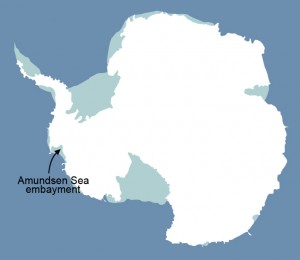
SuppA-W-Ant-300x260

The rate of loss accelerated an average of 6.1 gigatons per year since 1992, but now the rate is increasing by 16.3 gigatons per year.

The total amount of loss averaged 83 gigatons each year over the whole period, that’s the equivalent of losing the weight of Mt Everest (not just the ice on it) every two years.

4. Warmer seas could cause faster melting of Antarctic ice

A separate study has found that the seas around Antarctica are warming, which could increase ice shelf melting.

Ice shelves float, so the melting does not cause sea level rise, but they buttress the land glaciers. Take away the ice shelves and the glaciers flow faster.

5. New large scale battery storage in Germany

Belectric and Vattenfall have opened new large-scale battery energy storage system at the Alt Daber solar power plant in Germany. The facility uses lead-acid batteries.

For the system to be economical without any financial support, costs will have to come down by around a third.

6. Solar and wind energy backed by huge majority of Australians

Solar and wind energy enjoy strong support from the Australian public, with 80% of people putting them both among their top three energy choices in a poll for the Australia Institute.

By contrast, coal and coal seam gas were chosen by 35% and 38% of those polled as being among the best three future energy sources.

A separate review of medical literature by the Australia Institute debunked the fear that wind power damaged people’s health, finding “no credible evidence” directly linking exposure to turbines with negative health effects.

Nine out of 10 people said they wanted more solar energy.

Six in 10 people said they were concerned about the impact of coal and coal seam gas on the landscape.

7. UNSW researchers set world record in solar energy efficiency

Solar researchers working at the University of New South Wales (UNSW) claim to have produced a system that converts over 40 percent of incoming sunlight into electricity, thereby taking the title of highest solar efficiency for a photovoltaic system ever reported.

“This is the highest efficiency ever reported for sunlight conversion into electricity,” said UNSW Professor Professor Martin Green, Director of the Australian Centre for Advanced Photovoltaics (ACAP).

8. The end of coal as we know it

And oil for that matter.

Graham Readfearn in Lima at the climate Conference of Parties has found these items in the negotiating text:

Parties’ efforts to take the form of:

a. A long-term zero emissions sustainable development pathway:

Consistent with emissions peaking for developed countries in 2015, with an aim of zero net emissions by 2050; in the context of equitable access to sustainable development;…

Consistent with carbon neutrality/net zero emissions by 2050, or full decarbonization by 2050 and/or negative emissions by 2100;….

He understands they were put there by Norway, the Marshall Islands, Sweden and the AILAC grouping of countries consisting of Chile, Colombia, Costa Rica, Guatemala, Peru and Panama.

Andrew Robb Bishop have noticed and are complaining. It will be interesting to see whether the statements stay.

Readfearn finds that a move for a zero emissions target is growing and Malte Meinshausen explains that it is inevitable if we are serious about staying within two degrees.
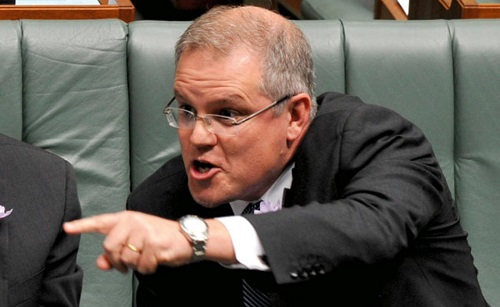
New low in human rights: the asylum seeker legislation

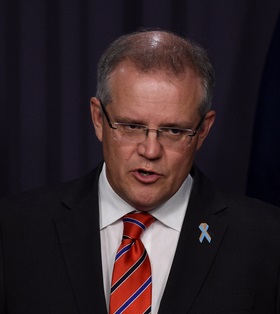
Morrison_Sowhothebloodyhellareyou _500

Ben Doherty at The Guardian has characterised the new asylum seeker legislation as “a seismic piece of legislation – one that destroys more than it creates.”

The passage of the Migration and Maritime Powers Legislation Amendment (Resolving the Asylum Legacy Caseload) Bill 2014 which “has given the immigration minister, while he holds that job, unprecedented, unchallengeable, and secret powers to control the lives of asylum seekers.”

In effect under the bill the minister can do anything he chooses, he can ignore the UN convention and avoid legal challenge – the courts have been sidelined.

With the passage of the new law, the minister can push any asylum seeker boat back into the sea and leave it there.

The minister can block an asylum seeker from ever making a protection claim on the ill-defined grounds of “character” or “national interest”. His reasons can be secret.

He can detain people without charge, or deport them to any country he chooses even if it is known they’ll be tortured there.

Morrison’s decisions cannot be challenged.

Boat arrivals will have no access to the Refugee Review Tribunal.

Instead, they will be classed as “fast track applicants” whose only appeal is to a new agency, the Immigration Assessment Authority, but they will not get a hearing, only a paper review.

“Excluded fast track applicants” will only have access to an internal review by Morrison’s own department.

Cross bench senators have been suckered by the promise that children will be released from detention, something the minister already had the power to do.

If we had a human rights charter the legislation would be struck out in a heart beat in a high court challenge. Since we don’t there is a fair chance the inevitable challenge will fail.

Critics – and they are a formidable group, including the United Nations High Commissioner for Refugees, the UN’s Committee Against Torture and parliament’s own human rights committee – say the bill strips the checks and balances that have always existed in Australia’s immigration system, and removes basic protections for those who arrive seeking asylum.

Australia now regards itself as free from the bonds of the Refugees Convention – a treaty Australia helped write, and willingly signed up to, more than half a century ago. All references to it have been removed from Australian law.

Max Chalmers at New Matilda reports on 25 children born in Australia who all had parents interned on Nauru but were flown back to Australia to give birth because of the poor medial conditions on the tiny Pacific Island. These children are the subject of a legel challenge being run by Maurice Blackburn’s social justice department. The legislation seems designed directly to alter the status of the children retrospectively and so prevent a favourable judgement.

It seems that children born in detention in Australia can now be deemed to have arrived by boat.

The UNHCR takes the view that Australia, as a signatory of the 1951 Refugee Convention cannot relieve itself of the obligations of the convention. The new law, however, creates an “new, independent and self-contained statutory framework” where Australia makes up its own rules. Australia now regards itself as free from the bonds of the Refugee Convention.

Especially egregious is the treatment of the principle of non-refoulement obligations under the legislation. Under this principle it is forbidden to return a person to a country where they may still be persecuted or tortured. Don McMaster at The Conversation points out that the Australian law states:

… it is irrelevant whether Australia has non-refoulement obligations in respect of an unlawful non-citizen.

The law seems designed to ensure that whole boatloads can be returned to Sri Lanka without legal challenge.

Malcolm Fraser has savaged Scott Morrison’s new asylum seeker laws and the senators who passed them.

Australia is now known around the world as the most inhumane, the most uncaring and the most selfish of all the wealthy countries, former prime minister Malcolm Fraser has declared.

Mr Fraser says migration legislation passed last week has given Immigration Minister Scott Morrison “dictatorial, tyrannical powers” over the lives of asylum seekers and “destroyed the rule of law as we know it”.

“The crossbench senators, Xenophon, Wang, Lazarus, Day, Leyonhjelm and Muir are wrong because their grievous political error has betrayed Australian democracy,” Mr Fraser said.

“They have co-operated by tearing up international conventions, practices of international law, all necessary if we are ever to establish a better and a safer world…

Paul Syvret in The Courier Mail says the legislation makes Australia a rogue state regarding international law and human rights. He terms it as “cruel, callous legislation that is arguably in breach of international law.”

Morrison effectively used children in detention as pawns to blackmail his legislation through the Senate, saying to the likes of Muir: “Pass my Bill and I’ll release the kids.”

This ignores the fact that he (and Labor before him) has the power at any time to release those children. It is hard to imagine a more cynically exploitative abuse of process and human life, and this from a man who professes to be a Christian. And here it is a shame Muir and others didn’t stand firm and say “Release the children first, and then we’ll negotiate”.

About 70% of the detainees languishing behind wire in the Manus Island and Nauru compounds who have had their claims processed have had positive determination of their refugee status, but both sides of politics have ensured that they have no place here.

It is a policy of deliberate cruelty perpetrated by both sides of politics, but taken to new — to use Senator Sarah Hanson-Young’s description — sociopathic depths by Morrison last week.

Future generations will look back on this dark period in Australian history with profound shame and regret. Many of us feel that way already.

Australia the dunce of the class on climate change

Australia ranks 57 out of 58 countries in the The Climate Change Performance Index 2015, heading only Saudi Arabia, which is not classified as an industrial country. Australia has dropped 21 places since the last survey a year ago.

There are reports in The Age and The Guardian. From the latter:

Australia has been named the worst-performing industrial country in the world on climate change in a report released at international negotiations in Peru.

The climate change performance index ranked Denmark as the best-performing country in the world, followed by Sweden and Britain.

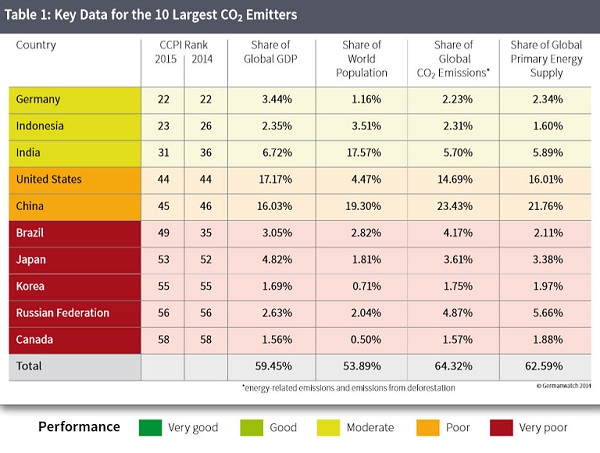
Among the world’s top 10 emitters, Germany was ranked the highest at 22. Australia was second bottom overall, above Saudi Arabia – which was not classified as industrial.

The report states: “The new conservative Australian government has apparently made good on last year’s announcement and reversed the climate policies previously in effect. As a result, the country lost a further 21 positions in the policy evaluation compared to last year, thus replacing Canada as the worst-performing industrial country.”

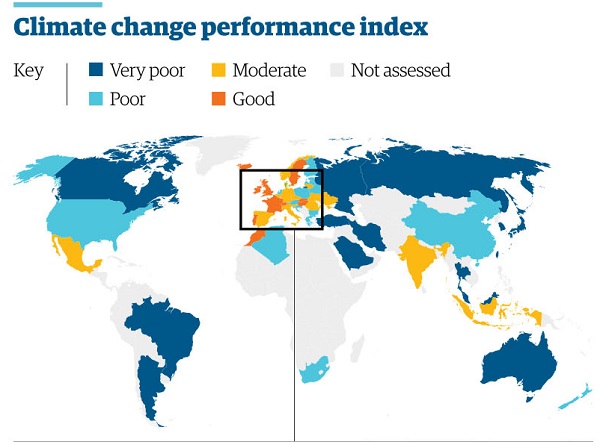
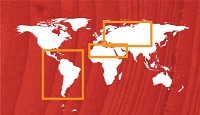
This map from The Guardian gives an overview:

World map_cropped_600

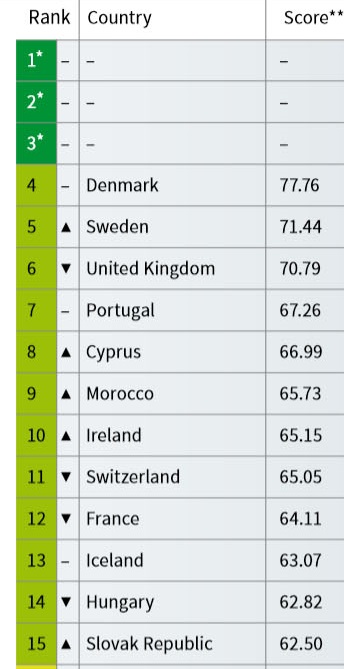
Clearly Europe is the best performing region. Here are the top dozen ranked countries:

Country rankings_cropped

No countries were coded dark green for “very good”. This means according to the report’s criteria that no countries are performing well enough to limit global emissions to two degrees. Because the top three places were left vacant you have to subtract three from each ranking to find the actual rank placing. Eleven of the twelve countries coded “good” were European.

Here are the 10 heaviest emitters in order of ranking:

Large emitters_cropped_600

The ten worst countries are, from the bottom, Saudi Arabia, Australia, Kazakhstan, Canada, Iran, Russia, Korea, Chinese Taipei, Japan and Malaysia.

The index covers the performance of countries across five areas – the level of emissions, the trends in emissions, energy efficiency, renewable energy policies and the approach to climate change at national and international levels.

The report has been compiled each year since 2005 by Climate Action Network Europe and Germanwatch. The Australian Conservation Foundation assisted with the Australian information.

PM’s stocks hit Gillard lows

That was the front page headline in the Australian Financial Review as a result of the new Ipsos-Fairfax poll.

Actually Abbott’s ratings were below Gillard’s in important attributes.

Overall the two party preferred vote was less bad than other recent polls at 52-48 to Labor or 53-47 if minor party preferences were allocated according to stated voter preference. The focus has been on the personal ratings and the attribute poll, which you can see in detail here.

In personal performance Shorten has improved 2 points to +5, whereas Abbott has slumped from -7 to -19. Shorten is now preferred prime minister 47-39 compared to 41-41 last month.

In his ability to make things happen Abbott at 48 is below any recent PM, below Keating, Howard, Gillard or Rudd. At the same time Shorten at 36 is below any recent opposition leader.

Is it any wonder that a snicker went around the party room when Abbott spoke of their ‘year of achievement’?

Of the eleven attributes, Bill Shorten has a statistically significant lead on six; being viewed as more competent (58%), having the confidence of his party (71%), being open to ideas (68%), being trustworthy (44%), and having a firm grasp of social policy (62%). He is also seen as being more easily influenced by minority groups (44%).

In contrast, Tony Abbott has a statistically significant lead on only two attributes; having a clear vision for Australia’s future (49%) and having the ability to make things happen (48%).

Opposition leaders don’t rate on making things happen, which leaves vision.

On vision, Abbott is roughly where Gillard was in April 2013. It must be said that Shorten is also low for an opposition leader.

In competence Abbott rates well below Keating, Howard, Gillard or Rudd, and below the Abbott of 12 months ago.

Ditto for the ‘strong leader’ category.

The question now is whether Abbott is being permanently written off as a dud by the electorate or whether he can recover. Abbott has already lost authority in the party room. If this performance in the polls carries on for a few months next year, how Bolshie will the troops become?

Peter Hartcher:

With the government’s support falling only marginally but Abbott’s precipitously, the people seem to be making a personal point.

This is about you, Prime Minister.

Abbott, seen by the people to be incompetent and untrustworthy, is a liability for his government and an asset for the Labor Party.

While most of Australia relaxes over the Christmas break, the Prime Minister will spend the time in serious self-reflection. If he’s in any way competent.

Lima climate change conference update

The UNFCCC Conference of Parties (now 194 countries, I think) has reached the midway point. I’ve compiled some news coming out of the conference in the style of Climate clippings.

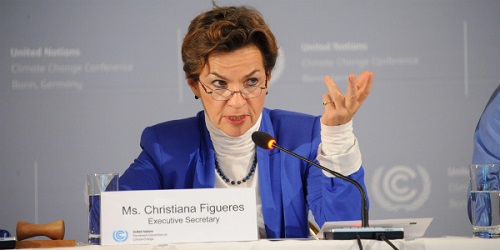
Here’s the UNFCCC executive secretary Christiana Figueres in action:

Figueres speaks_500

1. The first five days of the Lima climate change conference

Mat Hope sums up at The Carbon Brief.

    1) The need to get a deal is being talked up

There is an upbeat feel as the Paris conference next December looms, where a deal is scheduled to be cut.

    2) Expectations are being managed

They hope to complete a draft text at Lima, but it is only a stepping stone.

    3) The US-China climate deal means the spotlight is on India

With the US, China and the EU making positive pledges, eyes now turn to India. So far they have been true to form, grumbling that the developed countries should do more and provide finance for adaptation.

    4) Record temperatures and typhoon threat are framing the conference

In Copenhagen in 2009 it was freezing. At Lima the atmospherics a quite different with looming record world temperatures and typhoon Hagupit making its way towards the Philippines.

    5) Old divisions persist

The EU wants countries’ pledges to cut emissions to be legally binding. The US is adamant that this can’t be the case as it would then have to ask Congress to ratify the deal.

A group comprising Saudi Arabia, China, India and 30 other ‘like minded nations’ continues to call for more transparency in the process. The group has used such pleas as a delaying and blocking tactic at previous negotiations.

2. Australia drags the chain at Lima

Australia has distanced itself from the Cartagena Dialogue, a group of 30 or so “progressive” countries Australia helped found five years ago seeking an “ambitious, comprehensive, and legally binding regime in the UNFCCC, and committed, domestically, to becoming or remaining low carbon economies.” You’re right, that’s not Australia now.

Giles Parkinson thinks that Australia’s main aim is to keep selling coal. That’s why Andrew Robb is there as Minister for Trade.

Effectively and, from Robb’s tweets and other evidence, in fact Australia is channelling the thoughts of their favourite thinker, Bjorn Lomborg:

who as others have pointed out has made quite a nice career casting doubt on the seriousness of climate change, arguing the problem is overstated, and concluding that on a cost-benefit analysis there is no need to do anything. That pretty much sums up current Coalition government policy.

3. China fingers Australia

One point of permanent discontent has been that developing countries would like more effort to be put into the Green Climate Fund designed to help them to adapt and mitigate climate change. China has called the $9.7 billion contributed so far by 22 countries as “far from adequate”.

In doing so China has fingered Australia as a climate bludger. Australia’s policy is to contribute nothing. So far the GFC

has received funding pledges of $3 billion from the United States, $1.5 billion from Japan, $1 billion from the UK and France, $900m from Germany as well as pledges of at least $100m from Sweden, Italy, Norway, Holland, South Korea, Switzerland and Finland. It has even received a small contribution from New Zealand.

Even Canada has stumped up $300 million.

The original pledge at Copenhagen in 2009 had been $100 billion per year by 2020 from public and private sources.

4. Newsweek report

One thing they are discussing is the form of each country’s pledge of climate action to be submitted in draft by march 2015. The only way they will agree on anything is to use the principle of ‘common but differentiated responsibilities’ adopted in Copenhagen. This leaves countries to make it up as they wish, which means different base and target dates.

This makes comparisons difficult.

They also have yet to decide whether the basic division of Annexe 1 used in the Kyoto agreement will be retained. With Kyoto only the developed Annexe 1 countries made pledges. The US wants to eliminate subcategories. Brazil has proposed three concentric circles:

In the innermost circle, developed and Annex I Parties would commit to absolute, economy-wide mitigation targets. In the next ring, developing countries would commit to economy-wide targets that are relative to national gross domestic product, business-as-usual emissions trends or population size. In the outermost ring, the least-developed countries would commit to objectives on reducing emissions that are not economy-wide.

I’m betting on one undifferentiated blob, because they won’t all agree on anything else.

Similarly on whether pledges should be legally binding, they’ll never agree, because the US will point blank never agree to it, and all countries must agree for a decision to stand. Perhaps the New Zealand option of making reporting legally binding, but not the content of the contributions themselves, will get up.

5. Ban Ki-moon singles out Canada

Meanwhile UN Secretary General Ban Ki-moon has told Canada to get its finger out and start setting goals. Leadership is expected of G7 countries.

6. The bottom line

Emily Williams writing in the Santa Barbera Independent points to the sad truth – the proposals coming forward, the US-China announcement notwithstanding, “would mean ‘game over’ for the planet and the most vulnerable communities.”

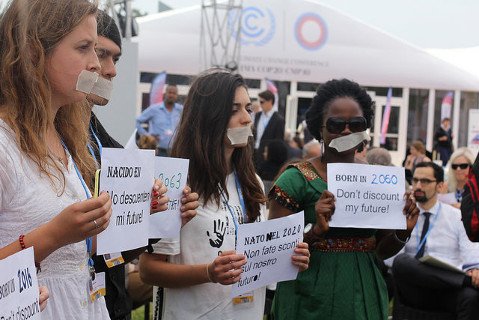
The pressure is for an agreement, any agreement, to avoid “Nopenhagen” in Paris. Her article carries this image of young protestors in Lima:

protesters_Lima_COP2014_t479

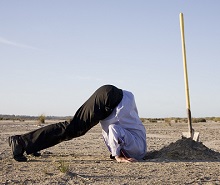
Perhaps this image would be more appropriate:

Head_in_Sand_500

Saturday salon 6/12

voltaire_230

An open thread where, at your leisure, you can discuss anything you like, well, within reason and the Comments Policy. Include here news and views, plus any notable personal experiences from the week and the weekend.

For climate topics please use the most recent Climate clippings.

The gentleman in the image is Voltaire, who for a time graced the court of Frederick II of Prussia, known as Frederick the Great. King Fred loved to talk about the universe and everything at the end of a day’s work. He also used the salons of Berlin to get feedback in the development of public policy.

Fred would only talk in French; he regarded German as barbaric. Here we’ll use English.

The thread will be a stoush-free zone. The Comments Policy says:

The aim [of this site] is to provide a venue for people to contribute and to engage in a civil and respectful manner.

Here are a few bits and pieces that came to my attention last week.

1. Minister now has untrammelled power over asylum seekers

The event of the week must be the passage of the Migration and Maritime Powers Legislation Amendment (Resolving the Asylum Legacy Caseload) Bill 2014 which “has given the immigration minister, while he holds that job, unprecedented, unchallengeable, and secret powers to control the lives of asylum seekers.”

In effect under the bill the minister can do anything he chooses, he can ignore the UN convention and avoid legal challenge – the courts have been sidelined.

I hope to do a separate post early next week but cross bench senators have been suckered by the promise that children will be released from detention, something the minister already had the power to do.

2. Lies, barnacles and headless chooks

As part of the service, here’s Labor’s little book of Abbott lies. Thanks to John D for the link.

I meant to link last week to Peter Hartcher’s commentary on barnacle scraping.

Back in Gillard’s time journalists would find some back-bench malcontent and then quote him or her as a “Labor source”. Now Hartcher quotes some LNP Howard era survivors. For example:

“It would be a luxury for Abbott to be able to knock off some barnacles. It supposes that he has a ship. This government has no purpose, no sense of direction. The prime minister’s office is so busy managing everything they manage nothing. It’s Rudd all over again.”

One complaint is that a series of slogans is not a narrative. Another is that Peta Credlin controls everything, including Abbott. Abbott, however, seems happy in his bondage, pointing out that Credlin’s strategies knocked off Rudd and eventually delivered them power.

Lenore Taylor takes a look at the Government’s morning memoranda, the song sheets issued to LNP pollies so that they can answer questions from the media.

Mark Textor says that

“Economic anxiety is number one, two and three on the issue agenda.”

Textor said the government needed to find “really greater clarity around what is the core to the economic strategy. Is it to diversify the economy? Is it to rekindle parts of the mining and resources community? Is it to release growth through greater productivity? … As I said, those questions, from an economic perspective, still have to be answered.”

Negotiating individual budget items through the cross-bench maze makes the Government look like headless chooks. Well, at least unstable and short-term.

3. Christopher Pyne’s deregulation crusade starts now

One barnacle still there is Pyne’s higher education ‘reform’ bill. The Government lost the senate vote, but immediately submitted a new bill to the lower hose, virtually the same but stripped of some of the nasties. As far as I can see allowing the universities to charge what they like will increase the cost of degrees, especially in the G08 sandstone universities, and lead to a greater variety in standards. Also 20% of government university funding will be stripped out.

Staff and students oppose it, VCs, especially of the G08, like it. One vice-chancellor compared the universities peak body to a flesh-eating disease!

To me, it’s pretty much the end of university education as a public good, and a complete marketisation of the sector. Pyne’s right, it probably will happen eventually, given the basic conservatism of the cross bench mob.

4. Tax payers to subsidise training priests and other religious workers

Taxpayers would subsidise the training of priests and other religious workers at private colleges for the first time under the Abbott government’s proposed higher education reforms.

As well as deregulating university fees and cutting university funding by 20 per cent, the government’s proposed higher education package extends federal funding to students at private universities, TAFES and associate degree programs.

5. Secular school ‘chaplains’ get the chop

The Government is moving to purify and cleanse the school chaplaincy program by excluding the class who are actually qualified to do the job – secular welfare workers.

This is an idealogical stance you’d expect from the Tea Party.

Peter Sherlock, Vice-Chancellor at the University of Divinity, says:

if the program continues, it must continue to fund secular as well as religious chaplains. It is blatant discrimination to require all school chaplains at state schools to be auspiced by religious organisations.

Climate clippings 116

1. Super high speed rail

train_japan_maglev_500

The Japanese have run an actual train with people in it at 500 km/h. The Chinese have built a train which can theoretically run at 1800 mph by encasing it in a vacuum tube.

It looks as though high speed rail could become a real alternative to air for intercity travel.

Thanks to John D for the headsup.

2. World’s first power-to-liquids production plant opens

The world’s first power-to-liquids (PtL) demonstration production plant was opened in Dresden on 14 November. The new rig uses PtL technology to transform water and CO2 to high-purity synthetic fuels (petrol, diesel, kerosene) with the aid of renewable electricity.

The article does not say how efficient the process is, but presumably less so than using the electricity directly.

3. World Bank focus on clean energy

The World Bank has traditionally been one of the world’s largest funders of fossil fuel projects. Now it:

will invest heavily in clean energy and only fund coal projects in “circumstances of extreme need”…

No doubt this policy stems from the bank’s commissioned report Turning down the heat.

4. Why the Peru climate summit matters

Hope has been injected into the Climate Change Conference in Lima, Peru, scheduled to run from 1 to 12 December by the recent US/China agreement. The optimism stems as much from the fact that the two largest emitters in the world are finally working together as the level of ambition. The EU has also recently pledged to cut emissions by 40 percent from 1990 levels by 2030.

Countries will be working on the text of the draft agreement for Paris in 2015.

Countries are expected to put forward their contributions towards the 2015 agreement in the form of Intended Nationally Determined Contributions (INDCs) by the end of March [2015]. These will then be used to craft the Paris treaty. The Lima gathering will help provide guidelines and clarity for what these INDCs must entail, especially for developing countries still reliant on fossil fuels to meet fast-growing energy demand needed to achieve developmental goals. These options could range from sector-wide emissions cuts to energy intensity goals to renewable energy targets.

We’ll be represented during the second week by Julie Bishop and Andrew Robb, a climate change denier. Seems Bishop went bananas when she found out, and Robb doesn’t want to be there anyway.

Giles Parkinson reports that we’ve sent a delegation of 14, the smallest in 20 years and probably not enough to be actively obstructive as we were in Warsaw last year.

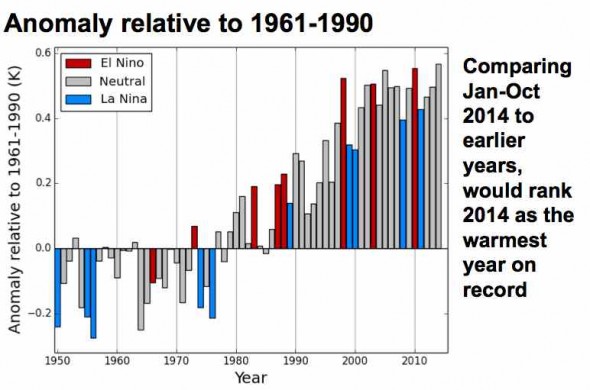
5. 2014 looks like hottest on record

This is how it’s shaping:

wmo-years-590x390

Record hot years are often El Niño years. This year is a neutral ENSO year so far.

That’s so far; there is at least a 70% chance that El Niño will be declared in the coming months, according to the BOM. Looks like a hot, dry summer.

6. Germany’s largest utility gets out of the fossil fuel business

On Sunday, Germany’s biggest utility E.ON announced plans to split into two companies and focus on renewables in a major shift that could be an indicator of broader changes to come across the utility sector. E.ON will spin off its nuclear, oil, coal, and gas operations in an effort to confront a drastically altered energy market, especially under the pressure of Germany’s Energiewende — the country’s move away from nuclear to renewables. The company told shareholders that it will place “a particular emphasis on expanding its wind business in Europe and in other selected target markets,” and that it will also “strengthen its solar business.”

E.ON will also focus on smart grids and distributed generation in an effort to improve energy efficiency and increase customer engagement and opportunity.

“With its decision, E.ON is the first company to take the necessary steps from the completely changed world of energy supply,” German Economy Minister Sigmar Gabriel, said Monday.

7. The inconvenient truth of EU emissions

The Commission and European Environment Agency’s Progress Report on climate action says:

according to latest estimates, EU greenhouse gas emissions in 2013 fell by 1.8% compared to 2012 and reached the lowest levels since 1990. So not only is the EU well on track to reach the 2020 target, it is also well on track to overachieve it.

Kevin Anderson is not impressed:

The consumption-based emissions (i.e. where emissions associated with imports and exports are considered) of the EU 28 were 2% higher in 2008 than in 1990[1]. By 2013 emissions had marginally reduced to 4% lower than 1990 – but not as a consequence of judicious climate change strategies, but rather the financial fallout of the bankers’ reckless greed – egged on by complicit governments and pliant regulation.

Then he really gets stuck in:

In the quarter of a century since the first IPCC report we have achieved nothing of any significant merit relative to the scale of the climate challenge. All we have to show for our ongoing oratory is a burgeoning industry of bureaucrats, well meaning NGOs, academics and naysayers who collectively have overseen a 60+% rise in global emissions.

The folly of two degrees

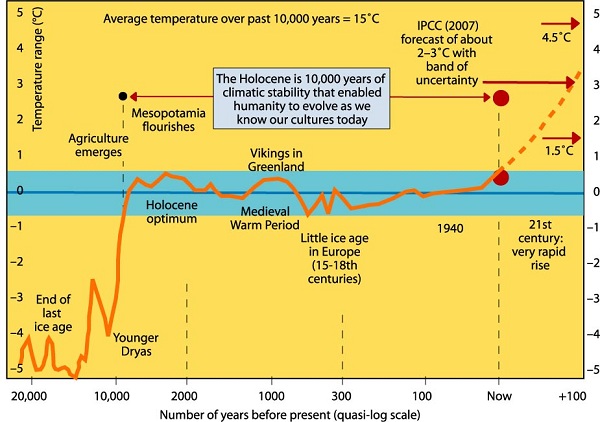
Back in 2011 David Spratt took a look at where we were in relation to temperature rise and the Holocene. At 2000 we were at 0.7°C above the pre-industrial temperature. This happens to coincide with the Holocene maximum:

Holocene_thin-blue-line 600

Spratt says James Hansen warns that at 0.7°C the ice sheets start to become unstable, so in terms of sea level rise alone we are entering a danger zone. Since then the temperature has risen ~ 0.15°C.

From this point of view the 2°C guardrail looks hazardous in the extreme. Continue reading The folly of two degrees

A ragged week in politics

Tony Abbott is going to disappear from our screens for five weeks. That’s probably paywalled; here’s the important bit:

408941-9d5c2496-7955-11e4-bd72-4f1c38aa3a9f_500

My prediction is that Abbott will improve his position in the polls if he goes away for a while!

I’ll come back to Abbott, first the Victorian election.

Labor won by a small but comfortable margin. The best comment I’ve seen is from Dr Kevin Bonham (see the section Predictable Result). Bonham says that many factors were at work, so it is silly to place too much emphasis on first term governments usually being re-elected, for example. He points out that in fact first-term state governments lose often enough (22% in the past 60 years nationwide prior to this election).

Another myth is that voters distinguish between state and federal elections. He says his research indicates that voters tend to like a government of a different hue at each level, so that the state government will stick up for them. It also matters if the federal government is unpopular.

Being of the same party as the party in power in Canberra is a massive weight around the neck of any incumbent state government, especially if that federal government is unpopular. The article showed that a very simple linear model using just the age of a state government and whether the same party is in power federally predicted, without any polling input at all, that the government would lose about six seats (it has obliged).

So the result was very much as expected on those grounds alone.

Since that the federal government is unpopular as well, it can be argued that the Liberals did well to be merely beaten and not thrashed. Their first-term status contributed to that, as perhaps did risky ALP policy tactics, and as in my view did the strong Victorian economy and the better-than-expected leadership of Denis Napthine. But on the other side we find high unemployment and severe internal party turbulence. The Victorian Liberals need to review their candidate screening practices after the enormously damaging Shaw debacle and two embarrassing disendorsements during the current campaign.

Bonham says there were other factors, but federal-state drag was probably the biggest one.

There has been some commentary that Labor turned union links into a positive in the campaign. Given Bomham’s analysis I’m agnostic on that one. At least it was not electoral poison.

Laura Tingle thinks

the bottom line is that the state election turned the psychology of federal politics on its head, as well as force all politicians to reflect on the “givens” of the political discourse.

Until the last couple of weeks, the ALP had settled in for six years in the wilderness of federal opposition.

Tony Abbott and his colleagues came to office presuming they would have a minimum of two terms to implement any tough reforms before enjoying a more loving relationship with the electorate, simply because no federal government in living memory has got less than two terms in office.

Victorians’ decision to turf out the Coalition after just one term has changed all that.

Bill Shorten is now a man in a hurry. Tony Abbott is a man who may run out of time.

She thinks Abbott shows no signs of understanding the way the land lies. Everyone knows he should recast his budget. Half the measures will not see the light of day, but he is determined to plough on. It’s also obvious that he should recast his cabinet. That should be fun!

Also:

The Victorian result suggests you don’t need any great vision, or leader’s charisma, to win an election.

You just need a jaded electorate where browned-off voters can’t think of a persuasive enough reason to give an uninspiring government another chance.

The Victorian result suggests that promoting your disciplined fiscal policy isn’t necessarily a winner; that big roads projects don’t seal the deal; and neither does union bashing.

People want to have services – and a government – that works.

We go into the last week of Parliament with no cunning plan in sight for delivering the clean finish to the year the Prime Minister keeps promising his troops.

In fact Abbott has been spruiking his government’s achievements and is exhorting his troops to keep reminding us how good they are over Christmas.

He’d be better advised to let us be!

Two opinion polls have the LNP improving slightly, but still in a land-slide losing position. Newspoll has Labor 54-46, closing from 55-45. At Morgan the story is exactly the same, but half a point better for the LNP. That is, it is now 53.5-46.5 to Labor.

Meanwhile Campbell Newman in Queensland is unlikely to invite Abbott to help him campaign in the upcoming election. His strategy of being boring and keeping his head down seemed to work for a while, but ReachTEL now has Labor in front 51-49.

The folly of Galilee basin coal

In Climate clippings 115 I cited an article from The Conversation which suggested that Australia’s coal and gas exports are being left stranded.

Just four countries account for 80% of Australia’s fossil fuel exports – China, Japan, Korea and India.

China is on the verge of “peak coal”, rebalancing the economy away from energy intensive industry and introducing a national emissions trading scheme.

Japan is on an energy efficiency drive to reduce its fuel import bill.

Korea has introduced a tax on coal of AU$18 per tonne and is finalising an emissions trading scheme.

India has doubled its tax on coal which funds renewable energy projects and has signalled its intention to stop importing coal within 2-3 years.

Yet the Queensland Government has signed off on a $16 billion development of a huge Galilee Basin mine and is prepared to chip in with a few hundred million to enable the infrastructure to be built.

Premier Campbell Newman said that “the State Government would work with resource companies to make strategic investments that could create up to 28,000 new Queensland jobs.”

At the same time the Queensland Government has introduced water reform legislation which seems squarely targeted at providing unlimited water to the Galilee Basin mining operation. This is being done in a reckless manner at the possible expense of graziers and towns in the area. Indeed careless disregard is being shown for the integrity of the Great Artesian Basin itself.

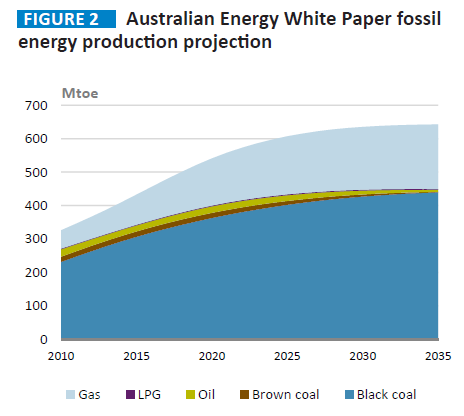
Tristan Edis at Climate Spectator has taken a look at the folly of official of the official Bureau of Resource and Energy Economics forecasts on fossil fuel energy production. Edis looks at the Australian Energy White Paper, a paper from BZE (Beyond Zero Emissions) entitled A fossil economy in a changing world and the IEA World Energy Outlook 2014. I recommend reading Edis’s article in full but two graphs tell much of the story. First the Australian Energy White Paper fossil energy production projection:

22_138

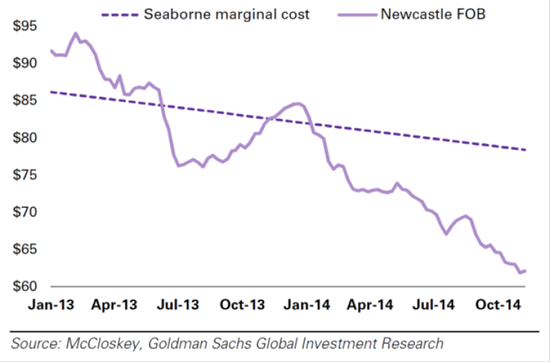
That is the glorious future envisioned by our Tea Party governments in Canberra and Brisbane. Here they are being mugged by reality. The dotted line represents the improved cost of coal production. The continuous line represents the price trajectory:

11_165_550

I would just point out that the author of the BZE report and the article from The Conversation linked at the top of the post is Stephen Bygrave, who is CEO of Beyond Zero Emissions and Adjunct Professor in the Faculty of Science at UNSW Australia.

Finally John Quiggin at The Conversation takes a look at the economic case for fossil fuel divestment. As he says at his blog, the bottom line is:

Leaving aside the ethics of divestment and pursuing a purely rational economic analysis, the cold hard numbers of putting money into fossil fuels don’t look good.

Unless universities are willing to bet on the destruction of the planet they have committed themselves to understanding and preserving, divestment from fossil fuels is the only choice they can make. Forward-thinking investors of all kinds would be wise to follow suit.

In blunt terms we are dealing with stranded assets here. Beyond that Abbott, Newman and their acolytes should be arrested for treason. Or something!

I’m wondering too whether Clive Palmer’s Galilee Basin holdings will prick his financial bubble.

Turn down the heat : confronting the new climate normal

Turn down the heat : confronting the new climate normal is a massive 320 page report prepared for the World Bank by the Potsdam Institute for Climate Impact Research and Climate Analytics, and hence highly authoritative. Continue reading Turn down the heat : confronting the new climate normal

Climate change, sustainability, plus sundry other stuff