Tag Archives: Climate Clippings

These posts are intended to share information and ideas about climate change and hence act as a roundtable. Comments rehashing whether human activity causes climate change are off-topic.

Climate clippings 110

1. 25 climate change disasters

Business Insider, Australia tells us that 25 disasters may befall us from climate change. The assumptions are conservative – 2°C and half a metre of sea level rise by 2100, though the text sometimes specifies more. Some of the predictions are disturbing: Continue reading Climate clippings 110

Climate clippings 109

1. Home solar power plus battery storage

It’s on the way, according to reports in Climate Progress and RenewEconomy. They are reporting on reports emerging from HBSC, Citigroup and UBS, so the big end of town is taking notice.

Initial interest is in short storage to cater for the peaks, but it seems that full storage systems will become competitive before the end of the decade.

For the next ten years battery technology is likely to remain lithium ion, with newer technologies introduced later.

2. Oceans warming faster than thought

The top 700 metres of the ocean have been warming 24 to 55% faster since 1970 than previously thought. The problem has been poor sampling in the Southern Ocean.

Of course this means that the whole planet has been warming faster than previously thought, since over 90% of the extra heat goes into the ocean.

3. Human hands caused 2013 heat

To me 2013 seems like a long time ago, but it is remembered for breaking a lot of heat records in Australia.

January 7 was our hottest day on record – 40.3°C.

January was the hottest month on record.

The 2012-13 summer was the hottest on record.

September was the hottest on record, exceeding the previous record by more than a degree; this was the largest temperature anomaly for any month yet recorded.

September-November was the hottest on record.

The whole year of 2013 was the hottest on record.

Five studies have now been done establishing human agency in these events. We don’t just need to be concerned about our grandchildren. Climate change caused by humans is happening now.

4. NOAA explains record Antarctic sea ice growth

First of all the record does not represent a dramatic increase on the recent average:
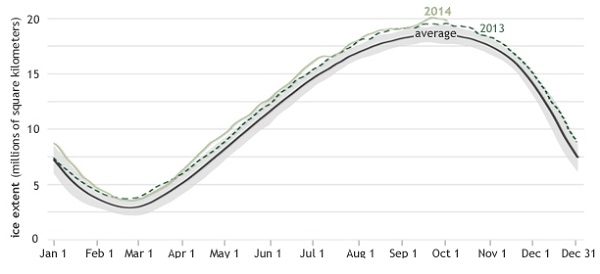
AntarcticSeaIceHistory_600

By comparison the loss of land ice has tripled in the last five years alone.

NOAA have now given a more detailed explanation of how the increase, counterintuitively, may be related to global warming. Firstly, it’s the wind:

NOAA first points out that “much of this year’s sea ice growth occurred late in the winter season, and weather records indicate that strong southerly winds blew over the Weddell Sea in mid-September 2014.”

Secondly, the melting land ice itself may have an effect:

Most of Antarctica’s ice lies in the ice sheets that cover the continent, and in recent decades, that ice has been melting. Along the coastline, ice shelves float on the ocean surface, and much of the recent melt may be driven by warm water from the deep ocean rising and making contact with ice shelf undersides.

How does the melting of land ice matter to sea ice formation? The resulting meltwater is fresher than the seawater. As it mixes with the seawater, the meltwater makes the nearby seawater slightly less dense, and slightly closer to the freezing point than the ocean water below. This less dense seawater spreads out across the ocean surface surrounding the continent, forming a stable pool of surface water that is close to the freezing point, and close to the ice onto which it could freeze.

5. Marshall Islands expendable

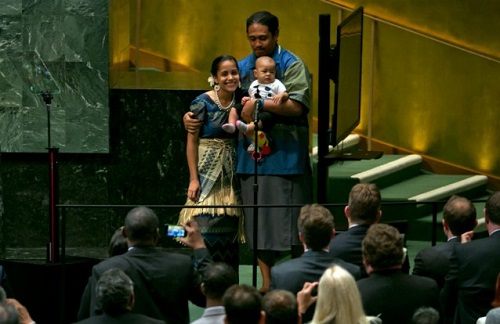
The United Nations chose 26-year-old Marshall Islands poet and mother Kathy Jetnil-Kijiner to be among the keynote speakers at the UN’s climate summit in New York recently. Here she is at the mike with her husband and child:
AP5150773745-500

Marshall Islands sits on average about 2 metres above sea level. Already she’s seen waves crashing into their homes and their breadfruit trees wither from salt and droughts.

Jetnil-Kijiner was confident in her speech that, no matter how difficult, climate change would be solved, and her daughter would be able to go on living in the Marshall Islands.

“No one’s drowning, baby,” she said. “No one’s moving. No one’s losing their homeland. No one’s becoming a climate change refugee…We are drawing the line here.”

She said, accurately I think, that saving the Marshall Islands meant “ending carbon pollution within my lifetime.”

Some 125 world leaders were present. Some, like ours stayed away, having more important things to do. Anyone present with half a brain must have known that is not going to happen. The Marshall Islands is expendable.

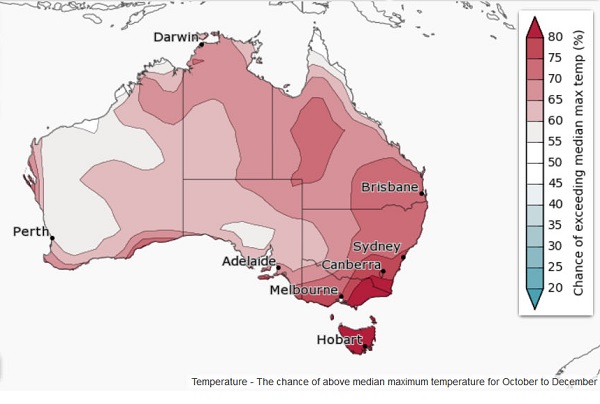
6. Climate outlook, October to December

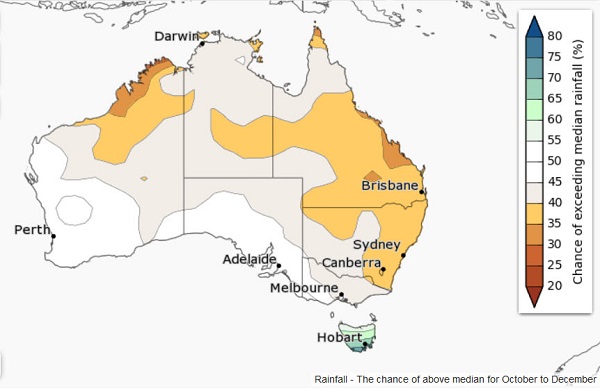
In brief, warmer and drier than average, apart from Tasmania, which looks good for rain. There’s more detail and maps here.

This is what the rainfall prospect looks like:
Oct-Dec 2014_cropped_600

And maximum temperature:

Temp Oct-Dec 2014_cropped_600

Six of eight international climate models suggest a late season El Niño, or near El Niño, ENSO state is likely.

Climate clippings 108

1. Across the ditch

New Zealand has just had a general election. Gareth at Hot Topic tells us that

The National Party has won itself another three years in government. With a probable overall majority and the support of three fringe MPs, prime minister John Key and his cabinet will be able to do more or less what they like. Given the government’s performance on climate matters over the last six years — turning the Emissions Trading Scheme into little more than a corporate welfare handout while senior cabinet ministers flirt with outright climate denial — and with signals that they intend to modify the Resource Management Act to make it easier to drill, mine and pollute, it’s hard to avoid the conclusion that the next three years are going to see New Zealand’s climate policies slip even further out of touch with what’s really necessary.

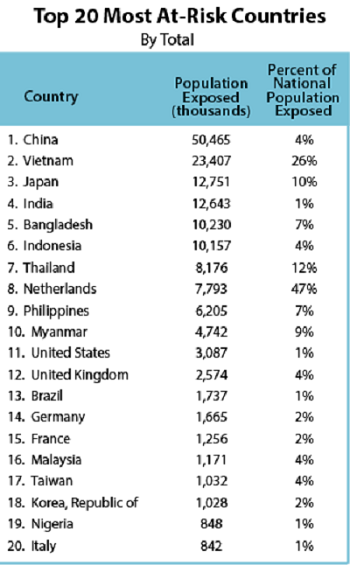
2. China most at risk from sea level rise

An analysis of global vulnerability to sea level rise has been done (see at Climate Central and The Carbon Brief).

China is the standout in terms of people affected, but Japan, India and Indonesia also figure prominently. This may assist international climate action negotiations, though recalcitrants like Canada and Australia don’t figure. Here’s the top 20:
assets-climatecentral-org-images-uploads-news-ssrf-Global-TableRCP85-smaller-nums-take5-670x519_cropped_350

Worldwide they found that “147 to 216 million people live on land that will be below sea level or regular flood levels by the end of the century, assuming emissions of heat-trapping gases continue on their current trend.”

The numbers ultimately depend on the sensitivity of sea level to warming. They say the figures may be two to three times too low, meaning as many as 650 million people may be threatened. Also population increase is not taken into account.

3. Human activities cut animal populations in half since 1970

shutterstock_120562819-e1412098764193-500

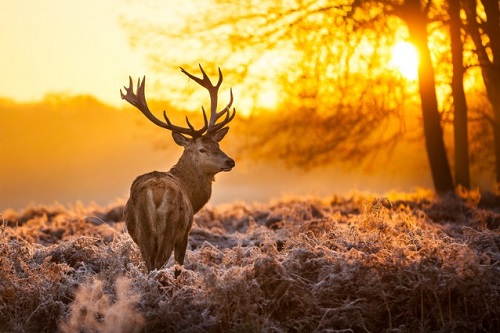
According to a new report, the Earth has lost half its vertebrate species — mammals, birds, fish, reptiles, and amphibians — since 1970.

The latest Living Planet Report, put out by a joint research effort between the World Wildlife Fund and the Zoological Society of London, found a stunning drop of 52 percent in the population of wild animals on the planet over the last 40 years. The most catastrophic drop was among the inhabitants of freshwater ecosystems — the last stop for much of the world’s pollution from road run-off, farming, and emissions — whose numbers declined 75 percent. Oceanic and land species both dropped roughly 40 percent.

It’s also all interconnected; land-use change can affect climate change and animal species both, then the altered climate can in turn affect the animals, and the animals’ effect on their ecosystem can in turn alter the climate again. Animals and humans both are inherent parts of the ecological fabrics they inhabit.

4. The science is clear: act now

Roger Jones and Roger Bodman have an article at The Conversation, republished at Understanding Climate Risk commenting on an article by Steven Koonin, New York University theoretical physicist and former US Under Secretary of Energy for Science, published in the Wall Street Journal and The Australian. Koonin accepts that the climate is changing and that human activity is having an effect, but:

Rather, the crucial, unsettled scientific question for policy is, “How will the climate change over the next century under both natural and human influences?” Answers to that question at the global and regional levels, as well as to equally complex questions of how ecosystems and human activities will be affected, should inform our choices about energy and infrastructure.

Koonin’s argument is technical, but he amplifies the uncertainties and does not properly attend to risk. Details which have no great relevance, such as the failure of models to explain why Antarctic sea ice cover is expanding, are amplified. His conclusion is that the science is urgent, but the uncertainty is such that there is no proper basis for action.

To answer in detail would require a volume. Jones and Bodman address his use of the concepts of doubt, uncertainty, confidence and risk and find his argument lacks an appreciation of how scientists use these concepts. Crucially, “acting now and learning as we go is a better way to manage uncertainty than waiting and learning.” On the main issue,s while uncertainty can be reduced at the margins with observations over time, overall the science is clear, we must act now!

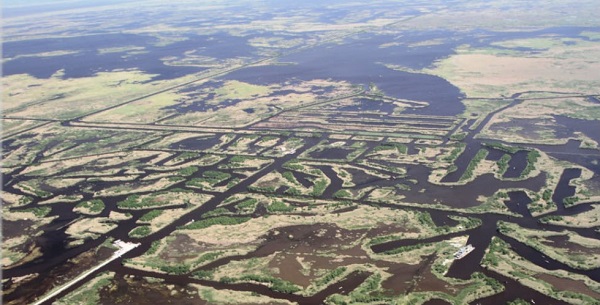
%. No cash flows as Louisiana coast slides into the sea

While the issue is mired in legal wrangles, the Louisiana weltands are sliding into the sea at the rate of 75 square kilometres and saltwater increasingly penetrates. In 2012 a $50 billion repair plane was formulated, but the prospects of adequate funding are remote.

Louisiana_cropped_600

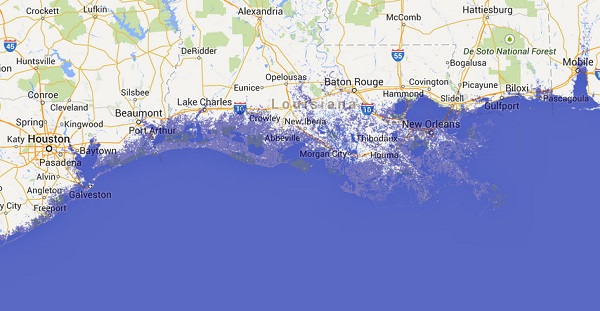
I’ve extracted an image of the flood map showing what 5 metres of sea level rise would look like, which is what I think we are looking at in the next 200 years:

Louisiana 5m_cropped_600

Mind you according to paleoclimate data the long-term effect of 400ppm of CO2 is 25m plus or minus 5. A rise of just one metre badly shreds the coastline.

Climate clippings 107

1. No more pauses in global warming

Temperatures are likely to rise dynamically for the rest of the century, according to two separate studies.

Masahiro Watanabe of the University of Tokyo colleagues found that over the past three decades natural influences are diminishing.

In the 1980s, natural variability accounted for almost half of the temperature changes seen. That fell to 38 per cent in the 1990s and just 27 per cent in the 2000s.

The implication is that temperature rises will respond more directly to emissions with fewer pauses.

Matthew England and associates used 31 climate models to chart future temperatures. He found that if emissions keep rising the chances of a pause of 10 years or more fall to practically zero. If emissions peak by 2040 we might get a pause by the end of the century.

If we wait until 2040 for peak emissions we’ll be cooked.
2. Rockefeller family moves from fossil fuels to clean energy

The Rockefeller family is turning its back on the industry that made it its vast fortune.

As more than 120 heads of state gather in New York for a UN summit on climate change, the Rockefeller Brothers Fund is pledging to move $50 billion worth of investment in fossil fuels into clean energy.

3. War and Peace revisited

At Fair Green Planet Val has reproduced her talk at the Australian Climate Action Summit 2014. It’s about organisational form in relation to climate change action and sustainability. Val suggests we need to change from forms based on competition, hierarchy and exploitation to forms based on co-operation, egalitarianism and sustainability:

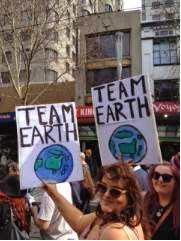
From both my research and my lived experience, it seems clear to me that the approach we need to address climate change will not be produced by the hierarchical, top down, unequal organisations that are dominant in society today – but rather by an approach like this:

team earth

These “Team Earth” posters were of course produced in response to Tony Abbott’s “Team Australia”. The posters express to me the values we really need to address climate change: a recognition that we’re all in it together, and an inclusive approach.

We need:

to go beyond climate change and live in sustainable communities – communities that are flatter, networked, egalitarian and inclusive, and recognise themselves as part of an ecosystem.

In other words, we need to change ourselves.

4. Arctic sea ice report

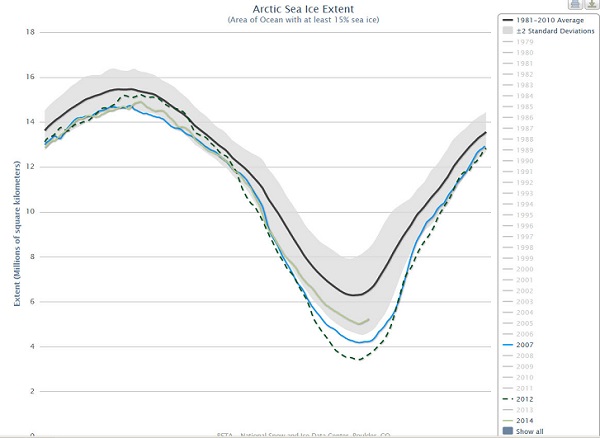
Arctic sea ice melting has now reached its maximum extent. This year was almost exactly the same as 2013, and the sixth lowest on record.

Sea ice Sept_cropped_600

The black line is the 1981-2010 average, the dotted line the 2012 record and the blue line the former 2007 record. Shading represents plus or minus 2 standard deviations.

Volume was also up a bit but still in trend decline.

What this masks is a continued decline in the proportion of older, thicker ice. An increasing proportion is first year ice. At Carbon Brief:

During the 1980s or 1990s, in an average year, around 54 to 58 per cent of ice in the Arctic would be first-year ice. Last year it was 77 per cent.

5. New York UN meeting

Last week some 125 leaders met with the UN Secretary General and each other in New York to indicate what their post 2020 emissions reduction targets might be. I reported on the outcomes here, but it seems that readers of this blog are put off by titles like the one I used.

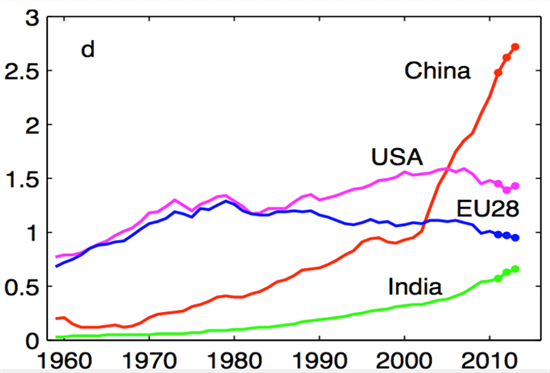
Problem is, the bad news is getting worse and is not being addressed sufficiently by world leaders. Emissions increased by 2.5% in 2013. Every year the emissions increase the harder the problem becomes. It’s not a case that action is just delayed; we are using up a carbon budget that by some estimates is already in the red.

Of the major emitters only the EU was specific, nominating 40% by 2030, subject to confirmation. Not enough. There were indications that China will give concrete numbers when formal proposals are submitted next March. However, their current rate of increase is quite dramatic, as this graph shows:

gcp-country-emissions-line_550x373.jpg

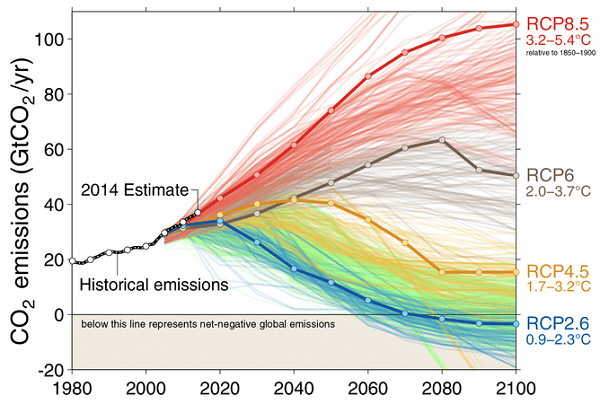
My expectation is that at best, when the bids are in, our path will match the RCP4.5 scenario (the scenarios are numbered according to the climate forcing pertaining to CO2 levels with the forcing expressed in watts per square metre).

84jyvk7k-1411262594_600

A new report puts the situation this way:

Nevertheless, the report said there is still a “gigatonne gap” between governments’ current carbon-reduction pledges and what will be needed to limit overall warming to 2C.

Delivering on current policies would only succeed in reining warming back from 4C to 3C, it predicted. The United Nations’ New York 2014 and Paris 2015 climate summits will be crucial in securing an improved deal, the report said. (Emphasis added)

Indeed. In New York on our behalf Ms J Bishop said the Government would consider what post-2020 emissions might be, but consistent with the need for economic growth. I think in her mind this means banking on cheap coal as our dominant power source.

For another view, see Christine Milne at the National Press Club:

I believe that Australia should put on the table for the 2015 negotiations a trajectory of 40 to 60 per cent below 2000 levels by 2030 and net carbon zero by 2050.

Climate clippings 106

1. Abbott adviser warns of threat of ‘global cooling’

Nevertheless with the certainty only possessed by fools, the Abbott government’s chief business adviser, Maurice Newman, has warned that Australia is ill prepared for global cooling owing to widespread “warming propaganda” in his latest critique of mainstream climate science.

The suggestion is that temperature change is due to changes in solar activity, cosmic rays and stuff. The science is heading in the opposite direction.

“The sun doesn’t have as much influence on the climate as we previously thought, the latest estimates are that it explains only 5% of the warming over the last 150 years,” he said.

How can the government be advised by someone who is so ill-informed about arguably the biggest single influence on business conditions over the next century.

2. August hottest ever

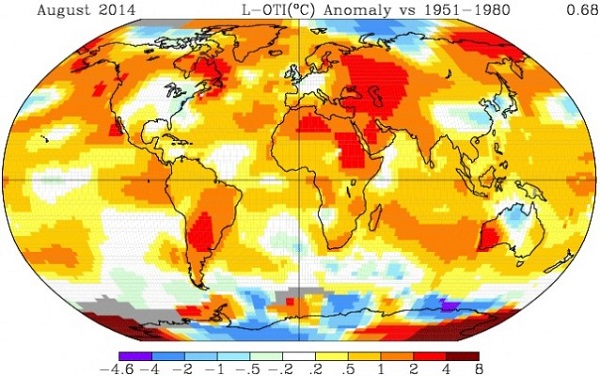
We’ve just had the hottest August globally since records began being kept in 1880, according to NASA. The year to date has been the fourth hottest on record. Hot years usually coincide with an El Niño either in the year concerned or the previous year. An El Niño has not yet arrived but does look likely according to the latest information.

NASA_ 2014_Ag_600

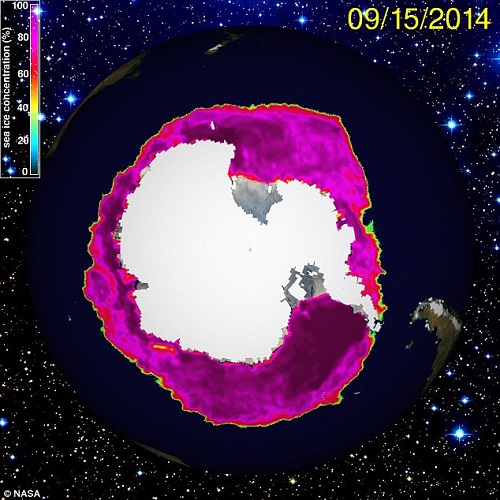
It has been especially hot in West Antarctica. Bear that in mind when you see stories of record sea ice around Antarctica:

seaice_2014_Ag_500

This is not incompatible with global warming and could in fact be caused by it. Melting ice produces cold water, and the tightening wind pattern tend to blow the ice further north.

There is no information as yet on ice volume.

3. Australian Climate Action Summit 2014

The Australian Climate Action Summit 2014 is on this weekend. Since my life is governed by work, the weather and medical appointments I am unable to go.

On Sunday there will be a People’s Climate March, organised by an outfit called Avaaz. Marches will be organised all around the world, and indeed, all around Australia, including, for example Mt Isa and the Gold Coast. If you click on Brisbane you get the Summit, but if you click on the Summit you don’t get a march. So if there is a march in Brisbane, I can guess where but I’d also need to guess when.

The march is meant to impress the leaders gathering in New York on Tuesday 23 September. That’s the UN Summit Tony Abbott will not attend although he’ll be in New York on Wednesday.

4. Surviving in hot, acidic oceans

I think this is a good news story.

More than 90% of the extra heat in global warming ends up in the oceans, as does 25% of the CO2 we create, which makes the oceans more acidic. Shell-making organisms such as plankton are expected to be in trouble. The good news is that it seems one species of plankton, the Emiliania huxleyi, can survive the changes underway.

5. Climate Council report on sea level

The Climate Council has taken another look at climate change and coastal flooding. The focus is on 1.1 metres sea level rise by 2100, all too possible if West Antarctica is in play, as it seems to be.

We are told that the frequency of flooding events can treble for every 10 cm of sea level rise. The risk multiplier depends where you are. In Sydney, Bundaberg and Hobart, for example a current 1 in 100 year event now could be happening every day by 2100. In Adelaide, the least at risk city, it would be only once every year.

At risk we have $87 billion worth of commercial and light industrial buildings, $72 billion worth of homes and $67 billion worth of roads and rail infrastructure.

6. Capitalism v The Climate

Joe Romm tells us about Naomi Klein’s new book, This Changes Everything: Capitalism Vs. The Climate. Klein, he says, makes three essential points:

1. Because we have ignored the increasingly urgent warnings and pleas for action from climate scientists for a quarter century (!) now, the incremental or evolutionary paths to avert catastrophic global warming that we might have been able to take in the past are closed to us.

2. Humanity faces a stark choice as a result: The end of civilization as we know it or the end of capitalism as we know it.

3. Choosing “unregulated capitalism” over human civilization would be a “morally monstrous” choice — and so the winning message for the climate movement is a moral one.

The time for ‘evolutionary’ strategies is long past. Now only ‘revolutionary’ strategies will get us there. Unregulated capitalism is a Ponzi scheme, which must collapse. The real choice facing us is a moral one.

Unchecked capitalism is immoral and will destroy civilisation as we know it. Just what Klein says we should do will be covered by Romm in a subsequent post.

Climate clippings 105

1. Atlantic Ocean important for heat storage

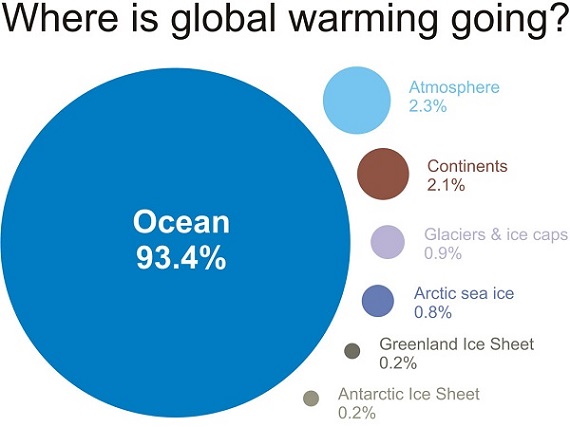
Most of the energy from global warming goes into the ocean as this graphic from Skeptical Science illustrates:

GW_Components_570

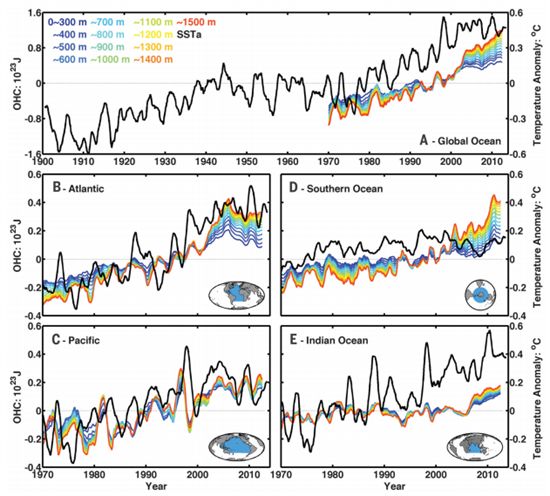
The linked paper stresses the role of the Atlantic in heat uptake. The following graph shows the heat uptake for the four main oceans. The black line is the sea surface temperature, the red line shows the heat below 1500 metres.

oceanheatuptake_chentung-2014-_550x496.jpg

All this is considered in relation to the socalled warming ‘hiatus’. The suggestion is that the Atlantic Meridional Overturning Circulation is the critical influence and it changes phase every 20 to 35 years. If so the ‘hiatus’ could last another decade or so.

Other scientists see the hiatus as multi-causal. It also depends which temperature series you are looking at. The HadCRUT temperatures always look flatter in recent years, as in this article. The Gistemp series from NASA has 1998 as about the third highest and shows a continuing upward trend, albeit slowed..

2. ‘Unprecedented’ ice loss in Greenland and Antarctica

Since 2009 the volume of ice loss has tripled in West Antarctica and more than doubled in Greenland, the highest rate of ice loss since satellite records began 20 years ago.

While it’s still early days, sea level rise this century could surprise on the upside.

3. El Niño watch

Carbon Brief also have the latest on the chances of an El Niño developing in 2014, which the Australian BOM now put at about 50%. Earlier there was talk of a super El Niño, which is still possible.

4. China gets into emissions trading

The Chinese national market will start in 2016.

The Chinese market, when fully functional, would dwarf the European emissions trading system, which is now the world’s biggest.

It would be the main carbon trading hub in Asia and the Pacific, where Kazakhstan and New Zealand already operate similar markets. South Korea will start a national market on Jan. 1, 2015, while Indonesia, Thailand and Vietnam are drawing up plans for markets of their own.

Looks like quite a trend. Time perhaps for Australia to join in!

5. World’s poor need grid power, not just solar panels

Small scale solar power is quite popular in Africa and supported by environmentalists. A few panels are able to run a few lights, a radio, charge the mobile phone but stop short of boiling a kettle. Critics see this as condemning the poor to a constrained future. Only 20% of Kenyans are connected to the grid.

Coal fired power is obviously not the answer. Dams take years to build, are typically over budget, inundate fertile lands or forest areas and interrupt natural stream flow.

In the Democratic Republic of Congo the mega project of the Inga 3 dam is due to start construction on the Congo River. If fully developed it will produce twice as much electricity as the world’s largest, the three Gorges in China. But will it be economically justified and what impacts will it have on the environment?

6. Emissions from energy generation jump after carbon price axed

Carbon emissions from the country’s main electricity grid have risen since the end of the carbon tax by the largest amount in nearly eight years.

Data from the National Electricity Market, which covers about 80 per cent of Australia’s population, shows that emissions from the sector rose by about 1 million tonnes, or 0.8 per cent, at an annualised rate last month compared with June.

That is the biggest two-month increase since the end of 2006, and came as a result of an increase in overall demand and a rise in the share of coal-fired power in the market, according to Pitt & Sherry’s monthly Cedex emissions index.

From what I can make of it, gas is increasingly going to export, there is some scaling back of hydro, presumably because of the weather. and large scale solar was killed off ages ago. The slack is being taken up by old coal, including brown coal.

Abbott’s strategy of saving the coal fired power industry seems to be working.

Building new more efficient coal would be his ultimate aim. This would involve investors and lenders having confidence in the future of coal. Surely they can’t be that stupid!

Reminder: Use this thread as an open thread on climate change.

Climate clippings 103

Climate clippings_175

I like to think that at Climate Plus we cover all the important issues and happenings. In this edition we look at two significant reports, one by Jeffrey Sachs to the UN Secretary General and the IEA’s World Energy Investment Outlook 2014.

As usual use Climate clippings as an open thread on climate change.

1. Deep Decarbonization Pathways

Renowned economist Jeffrey Sachs found that Australia could cut emissions from its energy sector to zero by 2050 and still grow GDP by an average of 2.4% over that period. That was in an interim report recently delivered to UN Secretary-General Ban Ki-moon plotting

specific measures for the world’s 15 largest economies, including China, India and the US, to cut their emissions quickly and deeply enough to meet an international agreed goal of limiting warming to two degrees above pre-industrial levels.

What we do matters!

The report

found that it’s technically possible for Australia to get almost all of its electricity from renewable sources by 2050 and to offset the rest by storing carbon in soil or planting more trees.

We can do that while GDP grows at 2.4% per annum, but it is interesting that our per capita growth rate is the lowest of the 15, India the highest.

There’s more about Sachs here.

2. Catalyst does sea level rise

It was scary, but could have, should have been scarier.

The program depended heavily on the last interglacial, the Eemian, as an analogue for now. It made the link through temperatures and probably got them a bit wrong. We’ll likely get more than 2°C this century, and the Eemian global average was possibly only 1°C higher than now.

Fundamentally the problem is this. CO2 levels during the Eemian which produced around 9 metres of sea level rise were never above 300 ppm. At 400 ppm, as we are now, the implied sea level rise is more like 20 to 25 metres, played out over the centuries.

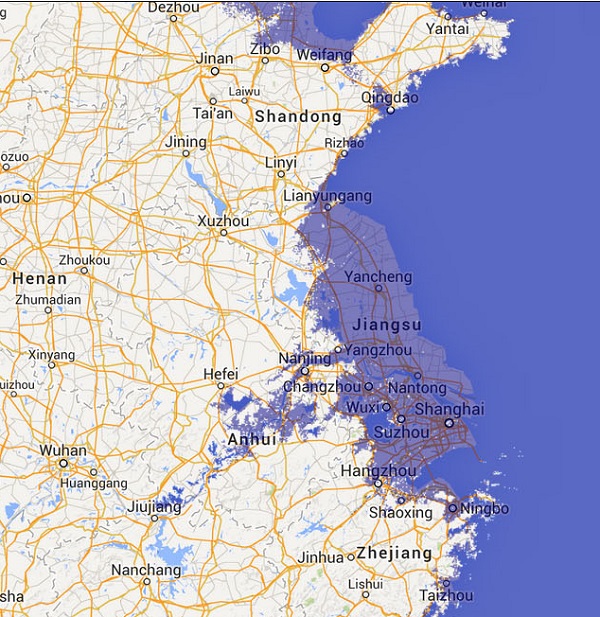
Still they could have pointed out just how horrendous a 9 metre rise would be, other than the throwaway comment about most mega cities being displaced. At 9 metres significant chunks disappear from continents as in China:

China_cropped_600

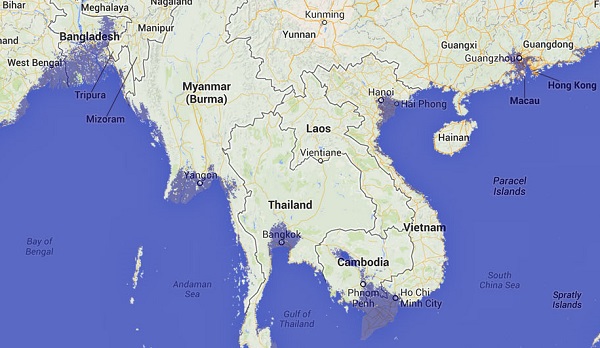
Here’s SE Asia courtesy of the Firetree flood map:

SE Asia_cropped_600

At the end it suggested that we could cope by building sea walls, except that it would be expensive. Sea walls are not going to cope with nine metres, let alone 20.

This Skeptical Science post gives useful information about the Eemian, although it too arguably needs updating. I think scientists are settling on a higher sea level rise for the Eemian than the 5 metres suggested, more like the 9 metres of the Catalyst program. Also at least some parts of Greenland are thought to have been 10°C warmer than now, rather than 5°C.

3. The search for the clean coal holy grail

Radio National’s generally excellent Background Briefing program has turned its guns on a ‘clean coal’ technology called DICE – Direct Injection Carbon Engine. Would you believe, a DICE engine runs on a slurry of finely ground coal and water? One purpose seems to be to make brown coal as emissions efficient as black coal – a pointless exercise in terms of current climate mitigation needs. Inherently significant energy must be spent to get the coal into the required state.

The history seems to be one of shonky technology projects run by shonks, but the CSIRO is now involved and our visionary government is throwing money at the venture.

4. World Energy Investment Outlook 2014

The International Energy Association’s latest report is billed as its first full update since the 2003 World Energy Investment Outlook. It’s been out since 3 June. So far I’ve failed in my ambition to do a separate post, so I’ll just do a brief note here.

This post from the Post Carbon Institute is a packet of joy. It says that the IEA report “should send policy makers screaming and running for the exits” or looking for early retirement. Seems we need a mere $48 trillion in investment through to 2035 to keep things on track. But:

The IEA forecasts that only 15 percent of the needed $48 trillion will go to renewable energy. All the rest is required just to patch up our current oil-coal-gas energy system so that it doesn’t run into the ditch for lack of fuel. But how much investment would be required if climate change were to be seriously addressed? Most estimates look only at electricity (that is, they gloss over the pivotal and problematic transportation sector) and ignore the question of energy returned on energy invested. Even when we artificially simplify the problem this way, $7.2 trillion spread out over twenty years simply doesn’t cut it. One researcher estimates that investments will have to ramp up to $1.5 to $2.5 trillion per year. In effect, the IEA is telling us that we don’t have what it takes to sustain our current energy regime, and we’re not likely to invest enough to switch to a different one.

If you look at the trends cited and ignore misleading explicit price forecasts, the IEA’s implicit message is clear: continued oil price stability looks problematic. And with fossil fuel prices high and volatile, governments will likely find it even more difficult to devote increasingly scarce investment capital toward the development of renewable energy capacity. (Emphasis added)

Climate clippings 102

This week we start with trouble at the top and bottom of the world and finish with trouble with our leading media magnate and politician.

1. Geenland at a tipping point?

THE cracks are beginning to show. Greenland’s ice sheets slid into the sea 400,000 years ago, when Earth was only a little warmer than it is today. That could mean we are set for a repeat performance.

If Greenland goes, West Antarctica also goes, giving 13 metres of sea level rise from those sources. If that happens there will also be a complete loss of other glaciers and ice caps, thermal expansion and some partial melting from East Antarctica. A mess!

The question is how soon and what can we do? The answer is we need more research and we need to think more in terms of centuries.

We should be thinking about the next 500-1000 years, how ice sheet decay can be minimised, stabilised and headed in the other direction. Our plans for the next 50-200 years should be made in the light of this.

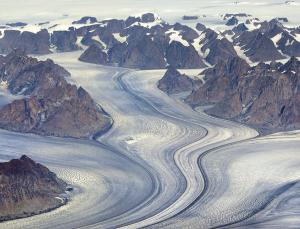
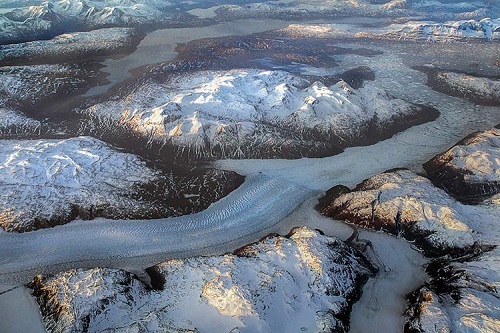
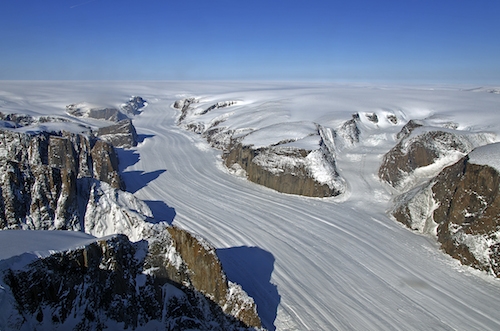
This image from the article shows a part of Greenland where the ice is quite dynamic.These areas are expected to grow.

New scientist_mg22229752.600-1_300

Here’s an image from another article:

greenland_cs_500

2. Big trouble in the Antarctic has been brewing for a long time

David Spratt at Climate Code Red:

“A game changer” is how climate scientist Dr Malte Meinshausen describes newly published research that West Antarctic glaciers have passed a tipping point much earlier than expected and their disintegration is now “unstoppable” at just the current level of global warming. The research findings have shocked the scientific community. “This Is What a Holy Shit Moment for Global Warming Looks Like,” ran a headline in Mother Jones magazine.

Meinshausen says this is new information. He says that the beaches we know and love all around the world will disappear. He also wonders what other nasty surprises lie this side of a 2°C temperature rise. Spratt says we told you ages ago it was coming, by James Hansen, for example and by himself and Philip Sutton in 2007.

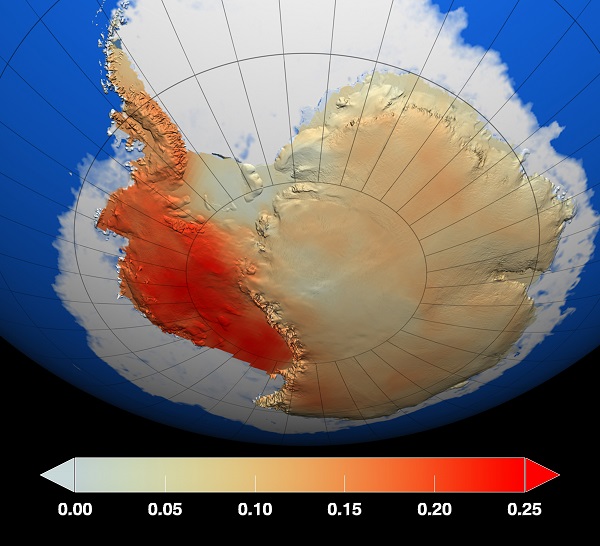
This NASA image shows the temperature changes from 1957 to 2006:

AntarcticaTemps_1957-2006_lrg_600

Hansen warned; Meinshausen says it’s happening. Spratt warns:

It’s par for the course for climate policy-makers to hope for the best, rather than plan for the worst. More than once this blog has warned that sea-level rises are being underestimated by Australian policy-makers, and that the tens of millions of dollars being put into adaptation planning for sea-level rises of no more than 1.1 metres by 2100 will be a waste of money, and all that work will have to be done again. And now that has come to pass.

3. Huge ‘whirlpools’ in the ocean are driving the weather

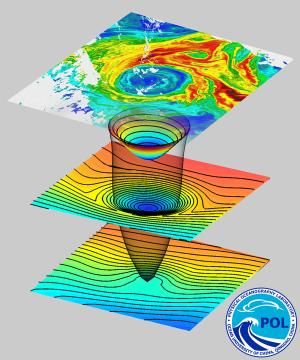
GIANT “whirlpools” in the ocean carry far more water than expected and have a big impact on the weather – though as yet we don’t know exactly what.

The areas of swirling water are 100 to 500 kilometres across. These “eddies” generally move west, driven by Earth’s rotation, until they stop spinning. Now, for the first time, the amount of water and heat they carry has been measured.

Article and image available also here.

dn25801_1_300

4. Gorgeous BioCasa_82

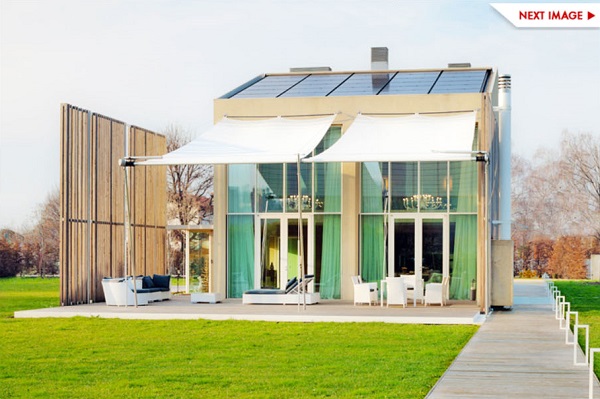
Nestled into the pastoral landscape of Treviso, Italy, BioCasa_82 is a beautiful home that boasts some seriously energy-efficient technologies.

BioCasa_82_cropped_600

The house is made from 99% recyclable materials and scores

117 points out of 136, according to the American protocol LEED Platinum, and 10 out of 11 points in regards to innovation in design, the building is a real gem in the European building practice.

According to the carbon footprint analysis, BioCasa_82 yields 60% less emissions than traditional buildings. Its photovoltaic system produces around 14kWh/mq of electricity, and a high-efficiency geothermal plant provides heat, hot water and cooling. These strategies are complemented by a rainwater harvesting system.

5. Rupert Murdoch doesn’t understand climate change basics

That is everyone’s problem since he owns a world-wide media empire.

Many of Murdoch’s news outlets are also among the worst when it comes to getting climate science wrong and disseminating climate myths and misinformation. Inaccurate media coverage is in turn the primary reason why the public is so misinformed about global warming.

I won’t go into the details, but Climate Progress observes that he ‘lowballed’ the numbers and minimized possible impacts. Here in Oz:

”We can be the low-cost energy country in the world,” he said. “We shouldn’t be building windmills and all that rubbish.”

Elsewhere Graham Readfearn finds that Tony Abbott’s views on climate are seriously crap.

Reminder: Use this thread as an open thread on climate change.

Climate clippings 101

A miscellany this week, with an emphasis on Australian policy and opinion.

The main links for each item is in the heading.

1. Kiribati buys land in Fiji

Millenium Island_9459385804_0e30488a67_k1-500

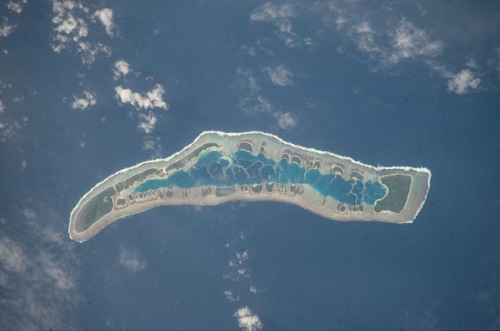
That’s Millenium Island in Kiribati which tops out at six metres above sea level. In parts of Kiribati the sea level is rising by 1.2 cm a year, about four times more than the global average.

Kiribati recently purchased eight square miles of land about 1,200 miles away on Vanua Levu, Fiji’s second-largest island. The immediate intention relates to food security. They will use the land for agriculture and aquatic farming.

That’s not a lot of land but Kiribati itself comprises just over 100,000 people scattered across 33 low-lying coral atolls totalling about 313 square miles.

The article notes that Kiribati’s reef structure can grow at 10 to 15 mm a year, faster than the IPCC expects sea level to rise, but it is not certain such growth in coral reefs translates to habitable land. My expectation is that later in this century sea level rise will far outstrip any coral growth.

2. Australians unhappy over Coalition’s response to climate challenge

JWS Research on behalf of the Climate Institute found that 70% of Australians accept the mainstream scientific position that climate change is occurring, up 10% since 2012.

while more than half of respondents felt the federal government was the primary body which should address climate change, there was a negative rating of -18 when people were asked to rank the government’s performance.

This compares to a -1 rating from last year.

A mere 20% of those questioned said they are convinced that Tony Abbott is concerned about climate change, with 53% feeling that he isn’t. Nearly a third of people believe opposition leader Bill Shorten is worried about the problem, with around the same proportion of people thinking the reverse is true.

In a further blow to the Coalition, for the first time more people support carbon pricing than oppose it. According to the poll, 34% back the carbon pricing laws, up 6% on 2012. Public opposition to carbon pricing has collapsed by 22% since 2012, when the Coalition was repeatedly attacking the then Labor government over the policy, the poll found.

According to the poll, 47% of people think that carbon pricing is preferable to no climate change policy, with just 22% supporting the government’s alternative Direct Action policy…

3. Shorten vows to ‘re-litigate’ case for carbon pricing

He didn’t expect to have to but he’s prepared to argue the case from first principles. He says:

The real test of political leadership is a willingness to build consensus, to earn agreement, not just to yank the bell at the Downton Abbey political college and expect a servant class of obedient Australians to carry out your will.

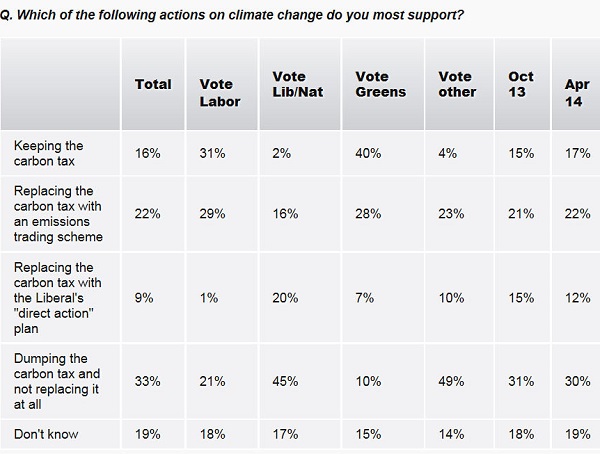
Meanwhile confusion reigns in the public mind, so I wish Bill the best of luck. Essential Research found:

Essential report_cropped_600

Support for Direct action is thin and fading in this survey at 9%. Doing nothing rates at 33% (up 3%), nearly matching the total of 38% favouring carbon pricing.

4. Great Barrier Reef tougher than thought

Scientists have put together temperatures from the Great Barrier Reef for the last 20,000 years and found that the reef has survived a range of temperatures.

They found that corals survived a 5°C rise between 20,000 years ago and 13,000 years ago. The reef is more resilient to temperature change than previously thought.

Nevertheless there are a few caveat’s to consider before a general outbreak of optimism,

Dr Helen McGregor, a Research Fellow at the Australian National University and a member of the research team:

“The Great Barrier Reef has coped with temperature changes that have occurred over a few thousand years, but now we are looking at a four degrees Celsius temperature change occurring in 100 to 150 years, so it is much more rapid.”

Then there is the small matter of ocean acidification and other human-caused impacts.

5. Abbott slams green power industry

That was the headline on the front page of the Australian Financial Review on Wednesday. On the front page we read the Abbott spiel:

“The RET is very significantly driving up power prices,” Mr Abbott said.

This, he said. posed a threat to domestic budgets and industry competitiveness, especially energy-intensive industries.

“We should be the affordable energy capital of the world, not the unaffordable energy capital of the world and that’s why the carbon tax must go and that’s why we’re reviewing the RET.”

Then over on page four we read the truth:

ACIL modelling for the Warburton review finds keeping the RET will cut average household power bills by $56 per year by 2021-2030 [sic] and extending it to 30 per cent will save householders $158. Source ACIL Allen

Andrew Richards, head of external affairs at Pacific Hydro, said recently approved gas price rises in NSW will add up to $240 a year to the average household bill. There are bigger fish to fry.

It’s a pity that the AFR can’t tell the truth on the front page – that Tony Abbott is telling porkies again.

Reminder: Use this thread as an open thread on climate change.

Climate clippings 100

Kiribati_Fanning Is_478950-3x2-340x227Climate clippings_1751. Climate clippings reaches 100

Generally speaking I don’t rate the number 100 much except that it’s the number after 99 and the number before 101. Which might be just as well because when I was going through all the posts after transporting them (thanks tigtog) from Larvatus Prodeo I found two with the same number. So the 100th edition was actually number 99!

If you like to laugh Graham Readfearn has assembled 11 climate change comedy video clips to celebrate his 50th post on Planet Oz. I can recommend John Oliver and Australians for Coal, for example. There’s a bad language warning on the latter.

Huffpost has 9 Political Cartoons That Put Climate Change In Perspective:

slide_352590_3821132_free_500_cropped

2. Dust increases Greenland’s ice melt

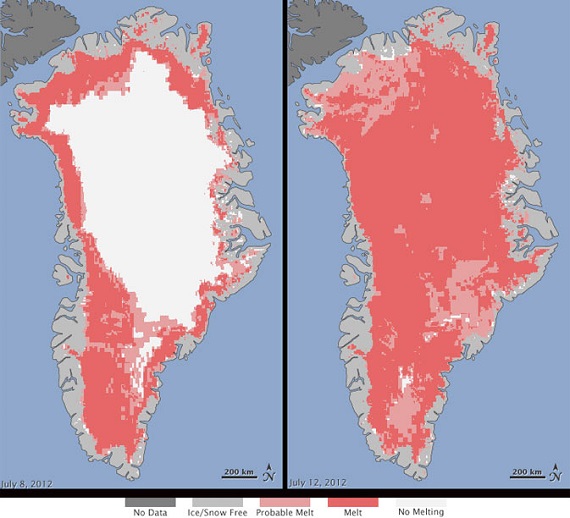
A ‘normal’ Greenland summer melt is illustrated by the left-hand panel taken at 8 July 2012, when about 40% of the ice sheet was subject to melting.

Figure 8

The right-hand panel shows what happened for about a week thereafter and is not relevant except as a harbinger of things to come.

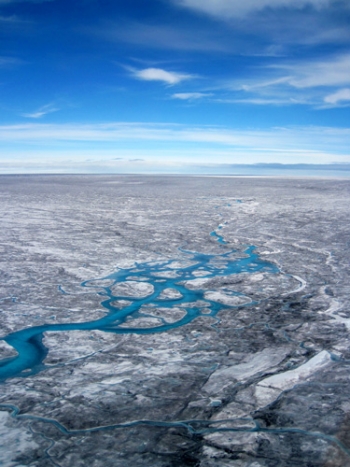
A new study looks at the increased melting from dust and soot. It found that a relatively minor decrease in the brightness of the ice sheet could cause double the average yearly rate of ice loss seen over the period 1992-2010.

assets-climatecentral-org-images-uploads-news-6_8_14_Brian_GreenlandDirtyIce-350x467

Soot resulting mainly from wildfires in North America and Russia has a greater melting impact than dust as such. However, increased dust is being produced in the Arctic and finding its way to the Greenland ice. Now 150 times as much dust as soot has been found at a site in the north-east.

While this can’t be extrapolated to the rest of the ice sheet, there is concern that Greenland melting could be greater than previously thought. See also Antarctic images for context.

3. Green jobs declining in Australia

Yes green jobs are declining in Australia:

Australia is one of the few places in the world where green jobs are decreasing according to figures released by the International Renewable Energy Agency.

Globally the sector now provides an estimated 6.6 million jobs, an increase of 800,000 from 2013 figures, but in Australia, jobs across solar photovoltaics and solar heating have declined, with up to 22 per cent of jobs lost in PV and 20 per cent in heating, according to Ethical Jobs general manager Michael Cebon.

This is happening:

entirely the result of government policy, both through loss of incentives at the federal level and backpedalling by state governments.

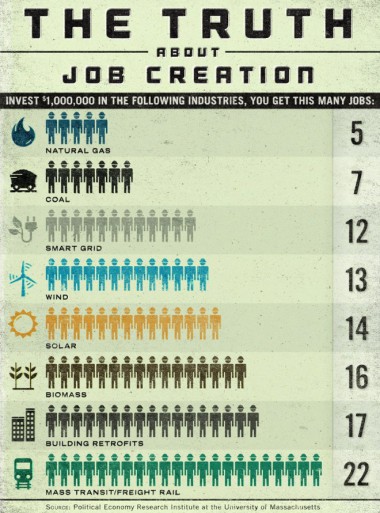
While a structural shift is occurring in the workforce elsewhere, Australia is regressing. The graphic shows the jobs potential of investment in various sectors:

comparison-fossil-and-renewable-380x513

4. Climate change impacts will ‘cost world far more than estimated’

That’s according to Lord Stern. He says that:

the economic models that have been used to calculate the fiscal fallout from climate change are woefully inadequate and severely underestimate the scale of the threat.

That includes those cited by the IPCC. They ignore the science, the full range of risks and simply assume away some of the worst economic impacts.

5. Historians will look back and ask ‘why didn’t they act?’

That’s the question asked by science historian Naomi Oreskes in her

latest book, The Collapse of Western Civilization: A View from the Future, [which] imagines a Chinese scholar in 2393 analysing the slow-motion disintegration of 21st-century democracies as they fail to tackle a growing environmental catastrophe.

It’s not a pretty picture.

By the end of the book, co-written with fellow historian Eric Conway, the Netherlands and Bangladesh are submerged, Australia and Africa are depopulated, and billions have perished in fires, floods, wars and pandemics. “A second dark age had fallen on Western civilisation,” Oreskes writes, “in which denial and self-deception, rooted in an ideological fixation on ‘free’ markets, disabled the world’s powerful nations in the face of tragedy.”

Oreskes and Conway say it’s a worst-case scenario, not a prediction.

One way or another, the game is up, we need to act with vigour and determination.

6. Coal to fuel human progress for decades – Tony Abbott

Our fearless leader has been strutting his stuff on the world stage, ignoring the science and embarrassing us all. He told Texan business leaders that:

we don’t believe in ostracising any particular fuel and we don’t believe in harming economic growth.

“For many decades at least, coal will continue to fuel human progress as an affordable energy source for wealthy and developing countries alike.”

Under the fig leaf of Direct Action anything goes.

Meanwhile Julie Bishop confirms that climate change won’t be high on the G20 agenda.

Once again they are out of tune with the nation. In a recent opinion poll 57% of those polled said the government should take climate change more seriously.

while more than half of respondents felt the federal government was the primary body which should address climate change, there was a negative rating of -18 when people were asked to rank the government’s performance.

This compares to a -1 rating from last year. These rankings are the differential between respondents’ “good” versus’ “poor” response to the government’s performance.

Reminder: Use this thread as an open thread on climate change.

7. Pacific presidents speak out against Australia’s stand on climate change

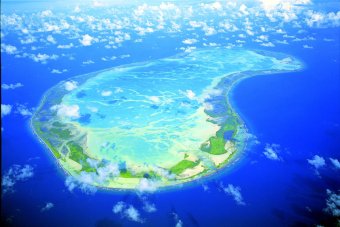
Out in the Pacific they are not happy with Abbott’s policy stance. The sea is coming up and they are going down. Here’s Fanning Island in Kiribati:

Kiribati_Fanning Is_478950-3x2-340x227

Climate clippings 99

This edition is somewhat themed around climate policy and planning in China, the US and Australia. It also includes items on puffins in Maine, the Lowy Institute poll and the warm weather we’ve been having in May.

1. Petey Puffin dies on camera

Puffin_maine_500

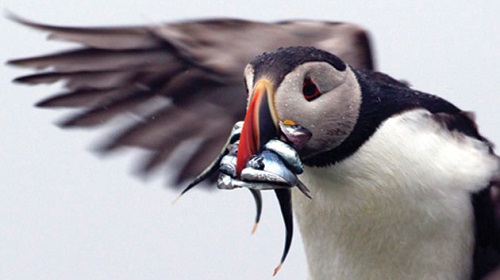
Puffins were once common on the coast off Maine but were eliminated by overhunting. In recent years there has been a project to repopulate the area, which was proceeding well accompanied by a cam project where children around the world could watch the birds in their habitat. Petey Puffin, a chick being fed by its parents became a popular focus. The only problem was that the parent birds kept bringing him butterfish which were just too large for him to swallow. This went on day after day until the chick died on camera.

The project co-ordinator then checked the 64 other burrows being monitored to find that only 30% of chicks survived.

Problem was that hake and herring normally abundant around Maine had moved north as the water warmed to be replaced by butterfish.

The warmer water brought many other changes to the waters off Maine.

Incidents such as these remind people that they are living in the midst of climate change.

Puffin_MAINE_B_300

2. President Obama gets serious on climate change

From John Abraham at Climate Consensus – the 97%:

President Obama just announced a major effort to reduce global-warming gases from United States power plants. These new rules, and his prior strong actions on climate change, signify a major shift for the United States. No longer is the U.S. the world laggard on dealing with climate change – we are quickly becoming the leader.

We finally have a president that understands science. We finally have a president that honestly includes scientists as decision makers – rather than effectively muzzle them. We finally have a president that recognizes the social and economic costs of climate change. We finally have a president who is charting a pathway that may lead us to bend the curve of emissions downward so that the most serious climate change consequences are avoided.

Most importantly, we finally have a president who is a world leader.

3. Not everyone is happy

John Podesta before rejoining the White House inner circle in an interview said history will not applaud the measures taken by Obama as it fails to meet what the science demands. It won’t limit us to a 2°C temperature rise, and 2°C is too dangerous.

A 30% reduction by 2030 from 2005 levels shrinks to 7.7% if you use the international baseline of 1990. Moreover, coal will be replaced by gas, where the ‘fugitive’ methane emissions are not counted.

Podesta says that in Obama’s first term his top aides never took climate change seriously. Ironically, Podesta as Obama’s transition director in 2008 helped select those aides.

4. China to cap emission

China will seek to cap fossil fuel emissions for the first time, we are told.

Reading carefully it seems that emissions will still grow, but not as fast as business as usual.

Pointing out that there are 1.6 billion people in the US and China, Amanda McKenzie CEO of Climate Council thinks the decisions are a game changer.

5. Time for Tony Abbott to admit his climate policy is crap

In case you missed it, that is Giles Parkinson’s advice to Abbott.

Parkinson says Australia should be embarrassed by its lack of action compared to the United States and China, which has indicated it will place a cap on its emissions as soon as 2016.

Ironically, Abbott could have a pretty good collection of climate and renewable energy policies just by doing nothing. Everything Labor put in place is still there, apart from Tim Flannery and the Climate Commission, which has morphed into the Climate Council with private money and public donations.

6. Lowy poll

The Lowy Institute Poll 2014 is now available.

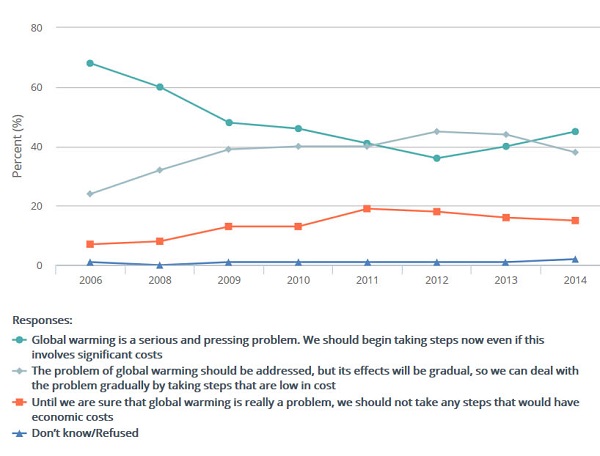
The number of Australians now saying global warming is a “serious and pressing problem” and that “we should begin taking steps now even if this involves significant costs” is now 45%.

Some 38% now say the the problem of global warming should be addressed, but its effects will be gradual, so we can deal with the problem gradually by taking steps that are low in cost. 15% think we should leave it until we are sure it’s a problem if costs are involved. Here’s the graph:

Lowy poll 1_cropped_600

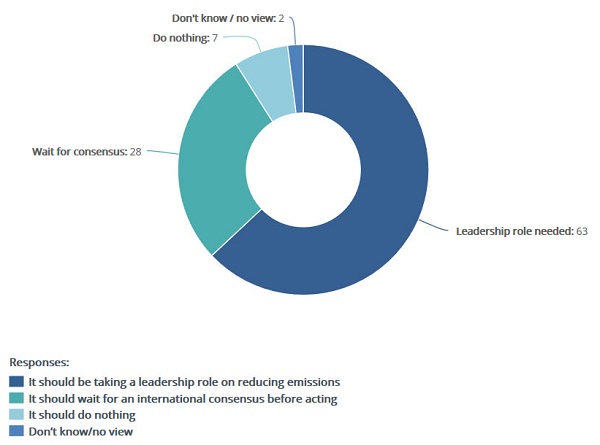
63% of people thought the government should be taking a leadership role in reducing emissions.

Lowy poll 2_cropped_600

I guess Abbott would claim that’s what they are doing.

7. Heat wave in May

Will Steffen talks here and here about the unusually warm period in May, which I believe officially rates as a heat wave.

A remarkable, prolonged warm spell occurred over the period 8-26 May, with daytime temperatures 4 to 6°C above normal over much of south-central Australia, extending from South Australia and northwest Victoria into Queensland and the Northern Territory.

The Scientific American noticed.

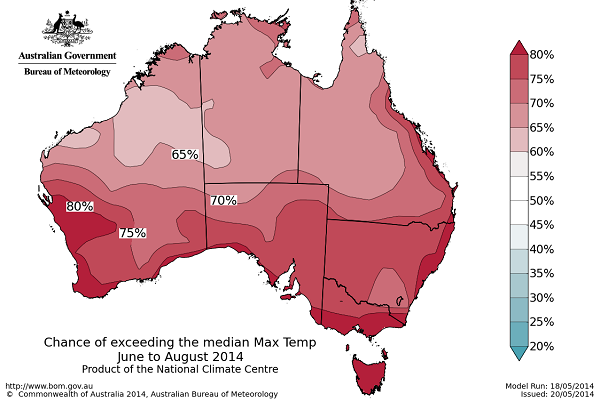
BOM think we are in for a warm winter:

max.national.hrweb_600

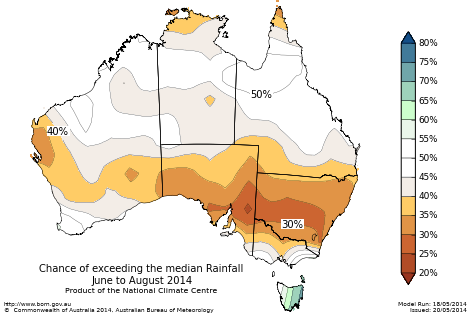
And drier for large parts of the southern mainland:

rain.national.lr

Reminder: Use this thread as an open thread on climate change.

Climate clippings 98

This edition includes important updates on Greenland and Antarctica, global food supply, CSIRO cuts, CO2 levels moving decisively past 400 ppm and CO2 compared to global temperature rise.

1. Greenland may melt faster than expected

You may recall from the post Arctic images I included an image of the underlying topography of Greenland (Figure 5). It is saucer-like with large areas inland below sea level. The glaciers tend to drain through narrow gateways in the external rim. So they tend to be narrow and fast-flowing:

Glacier_assets-climatecentral-org-images-uploads-news-5_16_14_Andrea_Greenlandglacier-500x331

The mouths of most glaciers are melting from contact with warmer seas. It was felt that as this process continued the ice would lose contact with the water, slowing the melting.

New studies of the topography have shown that many of these channels are below sea level.

Valleys underlying many of the glaciers stay below sea level and extend much farther inland than previously suggested, so warm ocean currents that have migrated northward with the changing climate could eat away at the ice for much longer than current climate models suggest. “It will take much longer for these glaciers to lose contact with the ocean,” study author Mathieu Morlighem, of the University of California, Irvine, told Climate Central.

2. Melting Antarctica could devastate global food supply

A new report is the “first to factor in the effects of the slow-motion collapse of the Western Antarctica ice sheet on future food security.”

About time, I’d say.

The report acknowledges recent findings that that the retreat of the Western Antarctica ice sheet was unstoppable – and could lead to sea-level rise of up to 4 metres over the coming centuries.

“That sea-level rise would take out half of Bangladesh and mostly wipe out productive rice regions in Vietnam,” Nelson told The Guardian. “It would have a major effect on Egyptian agricultural areas.”

“A sea level rise of 3 meters (10 feet) over the next 100 years is much more likely than the IPCC thought possible,” the report said.

In terms of absolute land loss, China would be at risk of losing more than 3 million hectares (7.4 million acres). Vietnam, India, Bangladesh, and Myanmar could lose more than 1 million hectares (2.5 million acres), the report said.

The report recommends a radical increase in expenditure on agricultural research, which has been in decline everywhere over recent decades.

3. CSIRO cuts

The federal government cut CSIRO’s funding by $111 million over four years, which will result in 500 job cuts.

Dr Borgas [president of the CSIRO Staff Association] said a plan to move the Aspendale Laboratories to the organisation’s larger site in Clayton had been previously discussed but had come to nothing.

He said it was unclear whether the relocation would reduce the research performed by the 130 staff, which includes ice core analysis, air quality and pollution research and climate and atmospheric modelling.

Most countries planning for a future increase their scientific research funding.

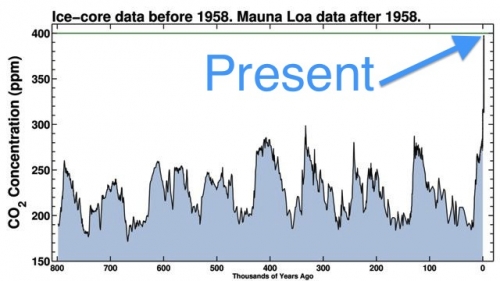
4. CO2 levels decisively pass 400 ppm

During April all 12 World Meteorological Organisation northern hemisphere monitoring stations passed the 400 ppm mark, the first time ever. This is how such a level compares to the 800,000 year ice core record:

assets-climatecentral-org-images-uploads-news-5_2_13_news_andrew_co2800000yrs-500x282

When was it last this high? Possibly 15 million years ago, when it was warmer and there wasn’t much ice around.

“This was a time when global temperatures were substantially warmer than today, and there was very little ice around anywhere on the planet. And so sea level was considerably higher — around 100 feet [30 metres] higher — than it is today,” said Pennsylvania State University climate scientist Michael Mann, in an email conversation. “It is for this reason that some climate scientists, like James Hansen, have argued that even current-day CO2 levels are too high. There is the possibility that we’ve already breached the threshold of truly dangerous human influence on our climate and planet.”

5. Global temperature and CO2

I came across this graph from the NOAA National Climatic Data Center plotting CO2 levels against temperature rise. While correlation does not mean causation there is simply no alternative explanation.

assets-climatecentral-org-images-uploads-gallery-TVM-Global_Temp_and_CO2_web-600

If you take out 1998, which can be regarded as an outlier, the socalled ‘pause’ is only apparent from 2005, which is too short a time to mean anything.

There is another view which sees temperature responding in step-wise fashion. On that basis we may be due for another step, and with an El Niño likely…

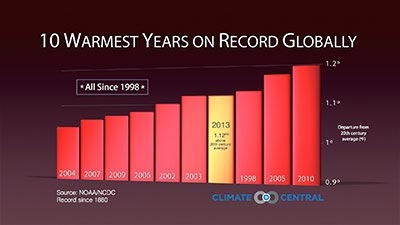
Here’s one showing the ten warmest years on record, all since 1998:

assets-climatecentral-org-images-uploads-gallery-climate-matters-GlobalRecapRanking_sm-400x225

Reminder: Use this thread as an open thread on climate change.