Tag Archives: Open Threads

Climate clippings 125

1. Paris climate talks won’t keep warming below the dangerous 2°C Limit

Joe Romm at Climate Progress believes the Paris climate talks should not be written off as a failure if they don’t do enough to keep warming below 2°C. He thinks the CFC ozone layer example is apt. The Montreal Protocol was concluded in 1987. Initially the protocol’s targets and timetables slowed the rate of growth of concentrations only slightly and would have still led to millions of extra cases of skin cancer by mid-century.

President Reagan endorsed the protocol, and the Senate ratified it. By the end of 1988, 29 countries and the European Economic Community — but not China or India — had ratified it. The treaty came into effect the next year. But it took many more years of negotiations, continuous strengthening of the scientific consensus, and significant concessions to developing countries before amendments to the treaty were strong enough and had enough support from both rich and poor countries to ensure that CFC concentrations in the air would be reduced.

Elsewhere 14 high-profile CEOs want to decarbonise the economy completely by 2050. They are the B Team led by Virgin founder Richard Branson. See also at The Guardian.

2. 2013 record heatwave ‘virtually impossible’ without climate change

That’s according to a new report from the Climate Council.

From The Guardian:

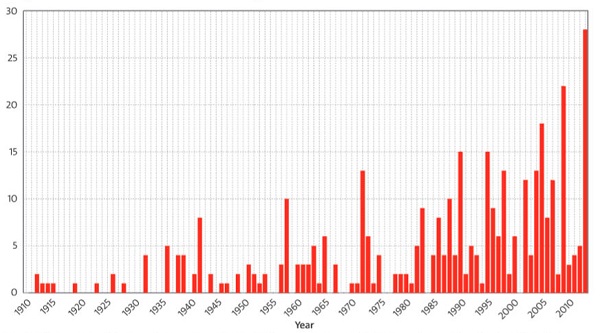
The country experienced its hottest day, month, season and calendar year in 2013, registering a mean temperature 1.2C above the 1961-90 average.

The Climate Council says recent studies show those heat events would have occurred only once every 12,300 years without greenhouse gas emissions from human activities.

Record hot days have doubled in Australia over the past 50 years. During the past decade heat weather records were set three times more often than cold ones.

Heatwaves across Australia are becoming hotter, lasting longer, occurring more often and starting earlier.

The ABC article has handy links to other sites.

The following graph shows the number of days each year where the Australian area-averaged daily mean temperature was above the 99th percentile for the period 1910-2013:
Hot days Australia_cropped_600

3. Two degrees by 2036

Michael Mann using an Earth energy balance model has calculated that we could reach 2°C of warming as early as 2036. To stay within the 2°C guardrail we need to limit CO2 concentrations to 405 ppm. It would be 450 ppm but for the aerosol issue. If we cease burning coal we lose the cooling effect of the crap that coal spews into the atmosphere along with CO2.

Mann has done the calculation on the basis of climate sensitivity of 3°C. Problem is, he says, that this modelling is based only on short term feedbacks.

David Spratt at Climate Code Red has done a long and thorough post based on Mann’s article. Spratt looks in some detail at the longer term climate sensitivity issue, drawing also on the work of James Hansen, Aradhna Tripati and others. Hansen found that climate sensitivity with long term feedbacks was considerably higher than 3°C; Tripati found that in the Miocene with CO2 concentrations similar to now “temperatures were ~3° to 6°C warmer and sea level was 25 to 40 meters higher than at present”.

Spratt also reminds us that 2°C warming is not safe.

4. Would turfing Abbott help climate change policy?

In short, yes, but perhaps not a lot. The conservative side of politics is still infested with climate change denialists.

Mother Jones in an article One of the World’s Worst Climate Villains Could Soon Be Booted From Office would clearly like to see the back of Abbott. Julie Bishop has a background of denialism, but is pragmatic and has understood from the Lima experience that our stance on climate is negatively affecting our international standing.

Turnbull stated back in 2009:

“I will not lead a party that is not as committed to effective action on climate change as I am.”

He would now, of course.

Tristan Edis looks at actions Turnbull might get away with. Giles Parkinson thinks he might rescue renewable energy and could adapt Direct Action into a baseline and credit scheme.

See also Lenore Taylor at The Guardian.
Saturday salon 7/2 (on Sunday)

voltaire_230

An open thread where, at your leisure, you can discuss anything you like, well, within reason and the Comments Policy. Include here news and views, plus any notable personal experiences from the week and the weekend.

For climate topics please use the most recent Climate clippings.

The gentleman in the image is Voltaire, who for a time graced the court of Frederick II of Prussia, known as Frederick the Great. King Fred loved to talk about the universe and everything at the end of a day’s work. He also used the salons of Berlin to get feedback in the development of public policy.

Fred would only talk in French; he regarded German as barbaric. Here we’ll use English.

The thread will be a stoush-free zone. The Comments Policy says:

The aim [of this site] is to provide a venue for people to contribute and to engage in a civil and respectful manner.

Here are a few bits and pieces that came to my attention last week.

SS delayed

It looks as though I didn’t hit the ‘publish’ button last night, although I’ll swear I did! Here goes!

1. Dead malls

By some estimates, half the shopping malls in the USA will close by 2030, suitable only for horror movie sets.

The big problem is oversupply. America has more retail space per capita than any other country.

The question is whether the same will happen in Australia. I tend to think not, at least I can’t detect any sign of it in Brisbane’s northern suburbs.

Thanks to John D for the link.

2. Rightwing rules rather than governs

Or you might say it’s government of the people rather than for. Jason Wilson peers into the rightwing mind and is horrified by what he sees. The article is a tour de force. Very impressive!

From Tony Abbott all the way down to pundits in the conservative press, the verdict is clear: elections are illegitimate when it returns a result they don’t like.

This extraordinary outpouring of contempt for the voting public is not simply a fit of rightwing pique. Rather, we can see that conservatives and a broader swathe of the political elite revealing some of their basic assumptions when put under pressure. To argue that democracy fails when it resists the imposition of fiscal austerity is simply to argue for our permanent subjection to the rule of property.

Apparently we are not competent to determine our own interests, or the kind of community we want to live in. Democracy becomes equated with disorder.

3. Growing brain drain as one young scientist chooses not to work here

Award-winning Dr Danielle Edwards applied for four years for work in Australia, but could only find it in the US. Eventually she was invited to apply for a position at the CSIRO, but the Abbott government was elected, a freeze was put on hiring and the job disappeared.

Then she was offered a Discovery Early Career Researcher Award, or DECRA, by the Australian Research Council.

Hugely competitive, her grant is worth $385,000, but Dr Edwards has chosen to turn it down.

She says the most recent round of funding cuts to science, and the prospect of university fee deregulation, means she sees no future in Australia.

The award-winning Dr Danielle Edwards has conducted research from the Greek Aegean to the Galapagos. She’s an evolutionary biologist specialising in reptiles, researching how genetic diversity is affected by factors like the environment.

Dr Edwards says her work feeds into important questions around what species can survive extinction, and why.

She’ll be doing her research, and raising her child, somewhere else.

4. No institution has the right to kill, whether it’s a nation state or Isis

That’s the view put by Gay Alcorn at The Guardian.

She points out Indonesia’s inconsistency in objecting to Saudi Arabia executing Indonesian nationals working there, and paying “blood money” to save them.

She points out our inconsistency in objecting to ISIS beheading sundry people, but ignoring Saudi Arabia where people can be put to death for such things as apostasy and witchcraft.

The death penalty is always brutal and violent and is never acceptable, no matter what the crime.

Elsewhere Greg Craven, Vice-chancellor of the Australian Catholic University and a campaigner against the death penalty warned staff at the ABC’s triple-j radio station that they’ll bear some responsibility if the Indonesian government executes the two Australians on death row in Bali.

The station conducted a survey showing a slim majority of those Australians who were polled support the death penalty for drug offences in other countries. The survey is being quoted in Indonesia to support its actions.

5. Mark is here

My son Mark is here, staying with us for a few days, which for me makes blogging difficult.

Catch his latest at The Monthly, telling us why Malcolm Turnbull gives him the irrits. People of the left who favour Malcolm should remember a few things!

Climate clippings 124

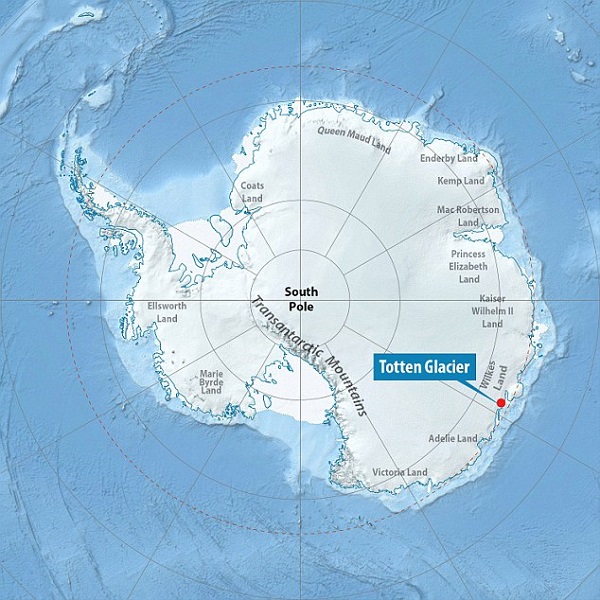
1. Totten Glacier melting from below

Scientists have found that waters around Totten Glacier are warmer than expected and that it is melting from below. Amazingly the glacier, in East Antarctica, has never been studied before.

Totten glacier_251552E400000578-2926354-image-a-31_1422281876786_600

A team of scientists on the Australian icebreaker Aurora Australis has recently taken a look. They don’t have comparative historical data to go by, but the concern is large. Totten is the biggest of the big and holds enough water to raise the sea level 6 metres. That’s somewhere between West Antarctica and Greenland!

2. State of the Climate 2014

The CSIRO and the Bureau of Meteorology have released their State of the Climate 2014 report. There is a summary at the ABC.

One thing that was new was a prediction of more extreme El Niño and La Niña events. They are talking here of extreme La Niña’s appearing once in 13 years rather than once in 23 years. So it’s not the garden variety events, rather the exceptional events.

For the rest of the report, it seems on a quick look to be much as expected – less rainfall in southern Australia, more extreme hot days, less snow, continued ocean acidification, more worries about sea level rise and so on. I’ll take a closer look if I get time.

Graham Readfearn points out that in 1995 at Amberley near Brisbane the mercury climbed above 35C on 12 days per year on average. That could become 55 days per year.

3. Australian sport needs to lift game on climate issues, Olympians and sport bosses say

It has been a year since extreme heat wreaked havoc at the Australian Open, with players forced to endure temperatures over 40 degrees Celsius on the courts.

Some athletes said the conditions were akin to “tap-dancing on a fry pan”.

Unfortunately Tennis Australia are not on their lonesome in forcing athletes to perform in dangerous conditions. There are concerns also for spectators and venues, for example subject to flooding. The Climate Institute has produced a report analysing the vulnerability amongst sports like AFL, tennis, cricket and cycling as well as winter snow sports.

Part of The Climate Institute’s ongoing research into climate risk and resilience, this report will form the basis of ongoing discussions in the sporting world, including with the newly formed Sports Environment Alliance, chaired by former International Cricket Council CEO Malcolm Speed.

4. Keystone showdown and American climate opinion

The Senate has passed legislation approving the controversial Keystone XL tar sands oil pipeline on a 62-36 vote.

asked Thursday about the vote, White House Press Secretary Josh Earnest reiterated that Obama would veto.

The Senate requires 67 votes to overturn a presidential veto.

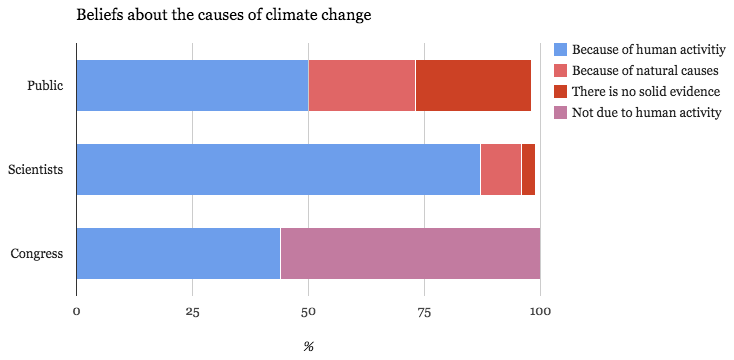
Meanwhile Carbon Brief takes a look at the gap in opinion between scientists, the public, and politicians on climate change from Pew Center research. This is how it pans out:

Screen Shot 2015-01-30 at 11.04.43

A case of the blind leading the partially sighted.

Across the ditch Hot Topic posts about a book that meticulously goes through the development of climate science from the time of Arrhenius. Seriously, there isn’t an argument any more about the basic science.

5. Economists begin to take climate change, and poverty, seriously

I find this surprising:

current economic models… generally conclude that the economically optimal pathway results in a global surface warming around 3–3.5°C.

Current economic models mainly treat economic growth as an external factor. In these models, global warming and its impacts via climate change don’t significantly affect the rate at which the economy grows.

A new study finds:

while the economies of rich countries continue to grow well in a warmer world, the economic growth of poor countries is significantly impaired.

That’s not so surprising.

The authors find that:

the best path for society would limit temperatures to between 1.6 and 2.8°C warming in 2100, with a best estimate of around 1.7°C warming.

Meanwhile the rulers of the world at the Davos World Economic Forum conference were given a straight message:

In particular, the nexus between climate protection and development is a striking conclusion of the World Bank analysis: without climate stabilization at still manageable levels, development advances, especially in the poorest countries, are set to be reversed. Indeed, development work of past decades (involving significant financial resources) is at risk and with it the well-being of the most vulnerable citizens on Earth.

The “World Bank analysis” is Turn down the heat : confronting the new climate normal, a report prepared for the World Bank by the Potsdam Institute for Climate Impact Research and Climate Analytics.

Saturday salon 31/1

voltaire_230

An open thread where, at your leisure, you can discuss anything you like, well, within reason and the Comments Policy. Include here news and views, plus any notable personal experiences from the week and the weekend.

For climate topics please use the most recent Climate clippings.

The gentleman in the image is Voltaire, who for a time graced the court of Frederick II of Prussia, known as Frederick the Great. King Fred loved to talk about the universe and everything at the end of a day’s work. He also used the salons of Berlin to get feedback in the development of public policy.

Fred would only talk in French; he regarded German as barbaric. Here we’ll use English.

The thread will be a stoush-free zone. The Comments Policy says:

The aim [of this site] is to provide a venue for people to contribute and to engage in a civil and respectful manner.

Here are a few bits and pieces that came to my attention last week.

1. Distracted by tennis

The second week of the Australian Open tennis is always interesting. Unfortunately watching it is incompatible with blogging.

Tonight Novak Djokovic prevailed 7-6 (7-1), 3-6, 6-4, 4-6, 6-0 over defending champion Stan Wawrinka and will now meet Andy Murray who beat the Czech Tomas Berdych in four sets on Thursday night.

Although Wawrinka’s game fell apart in the final set, prior to that he showed that he had the game to mix it with the top players. Berdych, ranked at seven in the world, still looks on the fringe. The old guard looks like running the show for a while longer. By the way Wawrinka and Berdych are both aged 29.

I’m tipping Murray for the final. Wawrinka broke Djokovic’s serve five times in all and I suspect he isn’t in prime physical condition. He looked vulnerable. Only a fool would write him off, however.

The women have been playing during the day in the quarters and semis, so I haven’t been able to follow them. Earlier I did see something of the young American Madison Keys, who looks one for the future.

2. Sydney siege update

The coroner was told that gunman Man Haron Monis executed Lindt Cafe manager Tori Johnson after making him kneel on the floor. The killing was witnessed by a police marksman who called the control centre. The police immediately stormed the cafe. Six fragments of a police bullet or bullets, which ricocheted from hard surfaces, hit Katrina Dawson, causing her death.

A former member of the Australian military’s elite domestic counter-terrorism unit has publicly suggested that police used the wrong rifles during the siege, with heavy bullets posing a high ricochet risk in the enclosed space.

Mitchell McAlister, writing in the American online journal SOFREP, a magazine presenting news and analysis from former special forces operatives, said he believed the choice of the M4A1 carbine may have contributed to the death of Ms Dawson.

3. Morgan poll

ALP support rose to 56.5% (up 2%) on Australia Day weekend, well ahead of the L-NP 43.5% (down 2%) on a two-party preferred basis. If a Federal Election were held now the ALP would win easily according to this week’s Morgan Poll on voting intention conducted with an Australia-wide cross-section of 2,057 Australian electors aged 18+.

Primary support for the ALP rose to 39.5% (up 1%) now ahead of the L-NP 37.5% (down 1%). Support for the other parties shows The Greens at 12% (up 2.5%), Palmer United Party (PUP) 3% (up 1%) while Independents/ Others were down 3.5% to 8%.

Support for PUP is highest in Clive Palmer’s home State of Queensland (7%) – which faces a State Election this weekend and Western Australia (4%) with negligible support for PUP in other States.

Some pundits are suggesting the Abbott has six months to turn things around. That makes the 2015 budget rather crucial.

The only demographic preferring the LNP is now the 65+ group.

4. Greek election

(Reuters) – Greek leftist leader Alexis Tsipras promised on Sunday that five years of austerity, “humiliation and suffering” imposed by international creditors were over after his Syriza party swept to victory in a snap election on Sunday.

With about 60 percent of votes counted, Syriza was set to win 149 seats in the 300 seat parliament, with 36.1 percent of the vote, around eight points ahead of the conservative New Democracy party of Prime Minister Antonis Samaras.

Paul Mason has the background in The Guardian: ‘Hope begins today’: the inside story of Syriza’s rise to power. He says:

Syriza’s victory has electrified the left in Europe – even moderate social democrats who have floundered in search of ideas and inspiration since the 2008 crisis. Now there is talk everywhere of “doing a Syriza” – and in Spain, where the leftist party Podemos is scoring 25% in the polls, more than talk.

I heard Tsipras say he wants discussion about Greece’s debts, not negotiations. The market’s have not taken fright, so I guess the sky won’t fall in. It is said that David Cameron’s hopes of achieving a “full-on” re-writing of the EU’s governing treaties have suffered a severe blow.

5. Birdman

On Australia Day we went to see the film Birdman, which I am informed was one of the better films of 2014.

Here’s a reviewer that liked it. The plot is unprepossessing – a washed up actor is directing and starring in a play, which in preview looks like one disaster after another.

It’s rivetting, funny and serious, with layers of meaning, beautifully acted and shot. Given the violence from time to time, it can’t end altogether well, but to tell would be a spoiler. Highly recommended.

Climate clippings 123

1. Mushroom packaging

mushrooms_3128266.large

Biodegradable packaging has been made from mushrooms for use as foam, insulation and the like.

The article doesn’t say whether it is cost competitive.

2. Climate’s threat to wheat

A new study finds that wheat yields drop on average by 6% for every degree Celsius rise in temperature.

Global production of wheat was 701 million tonnes in 2012, but most of this is consumed locally. Global trade is much smaller, at 147 tonnes in 2013.

The loss of production per degree equates to 42 million tonnes, with obvious implications for shortages and prices. Year-to-year variability is likely to increase.

An obvious strategy is to develop and use heat tolerant varieties. My understanding is that there has been a reduced research capacity generally in agriculture across the world.

3. Solar has done well

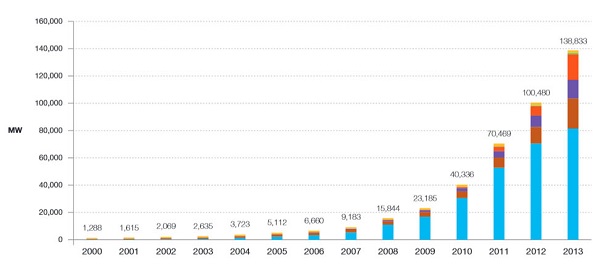
Worldwide, solar energy has continued to grow even when economies were shrinking. By 2013, almost 138.9 gigawatts (GW) of photovoltaic (PV) had been installed globally, states the European Photovoltaic Industry Association in the report Global Market Outlook for Photovoltaics 2014-2018.

Solar 2013_cropped_600

From the bottom, blue is Europe, brown is Asia Pacific, purple is the Americas and orange is China.

The pdf is here.

Europe added almost 11 GW, second only to wind.

In the US alone, there are now about 174,000 jobs linked to solar energy, with 36,000 new jobs expected by the end of this year.

India’s plans to build a solar PV modules manufacturing plant over the next three years worth US$4 billion and 20,000 new jobs.

Giles Parkinson tells how the costs of solar will fall a further 40% in the next two years, reaching grid parity in 80% of global markets.

4. Australia could become manufacturing hub of battery storage

The International Renewable Energy Agency (IRENA) met in Abu Dhabi last weekend, ahead of the World Energy Future Conference in the same venue. Australia thumbed its nose by sending an embassy staffer rather than a minister, as a country genuinely interested in renewables would have done.

Australia is increasingly being seen as a “no-hoper” and an “outlier” in terms of large scale renewable energy.

No-one seems to have told Donald Sadoway, a professor from the Massachusetts Institute of Technology, who is seeking to strike up research partnerships with Australian universities and secure funding of $50 million for a pilot manufacturing plant of the liquid flow batteries.

Sadoway thinks Australia would provide a strong home market, ideal for remoter population centres difficult to serve with a high quality grid.

The LMBs [liquid metal batteries] are being hailed as a potentially low cost option for utility-scale battery storage. That is because the nature of the technology means that they can cycle – or discharge – thousands of times without having its capacity reduced.

The batteries could last for 300 years.

No doubt the minister for industry will quietly tell him that we don’t do large scale renewables, or manufacturing, in Australia.

5. Inconvenient truths hit the cutting room floor

Inconvenient words about climate change and torture were snipped out of President Obama’s State of the Union speech when posted on the (Republican) Speaker’s official site. Words like this:

The best scientists in the world are all telling us that our activities are changing the climate, and if we do not act forcefully, we’ll continue to see rising oceans, longer, hotter heat waves, dangerous droughts and floods, and massive disruptions that can trigger greater migration, conflict, and hunger around the globe.

Pathetic!

6. Republican opinion on climate change

Meanwhile the Republican-controlled US Senate has voted 98-1 to say the climate change is real and not a hoax. However, that doesn’t mean that humans are the cause. After all the Bible tells of climate change and it’s just arrogance to think humans are the cause!

At least Mitt Romney thinks humans are the cause and thinks (again) that we should do something to stop it. How arrogant is that?!

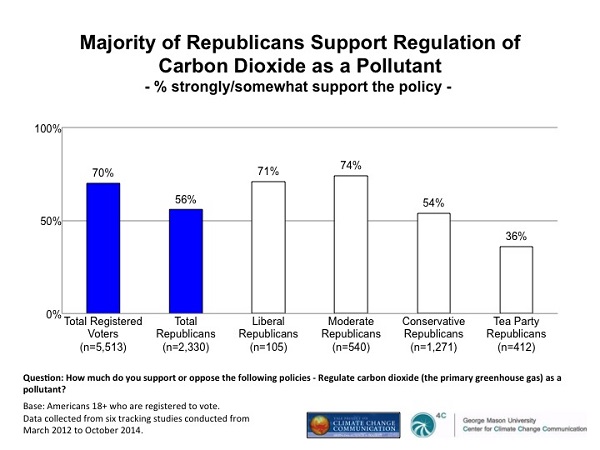
A recent Yale study identifies four different kinds of Republicans – liberal, moderate, conservative and Tea Party. While overall only 44% of Republicans think global warming is happening, the sub-groups vary considerably:

R-belief_600

Yet overall 56% think CO2 should be regulated as a pollutant, again with vast variations of opinion:

R-reg_as_pollutant_600

7. Ocean warming accelerating

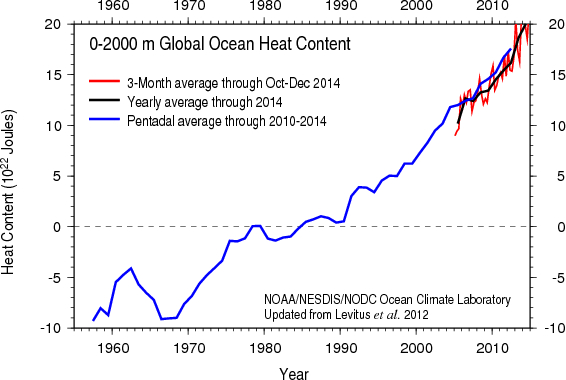
The story about 2014 being the hottest year has upstaged a more important fact – ocean warming is off the charts:

NOAA2014heat_content2000m

2014 heat referred to surface temperature. Since about 93% of additional heat resulting from global warming ends up in the oceans, they give a better indication of changes in the Earth’s energy system.

John Abraham at The Guardian links to a thorough review of ocean heat measurement methods.

Saturday salon 24/1

voltaire_230

An open thread where, at your leisure, you can discuss anything you like, well, within reason and the Comments Policy. Include here news and views, plus any notable personal experiences from the week and the weekend.

For climate topics please use the most recent Climate clippings.

The gentleman in the image is Voltaire, who for a time graced the court of Frederick II of Prussia, known as Frederick the Great. King Fred loved to talk about the universe and everything at the end of a day’s work. He also used the salons of Berlin to get feedback in the development of public policy.

Fred would only talk in French; he regarded German as barbaric. Here we’ll use English.

The thread will be a stoush-free zone. The Comments Policy says:

The aim [of this site] is to provide a venue for people to contribute and to engage in a civil and respectful manner.

Here are a few bits and pieces that came to my attention last week.

1. Stuart MacGill sues Cricket Australia

Stuart MacGill would have been among the greats as a test bowler, had his career not largely coincided with Shane Warne’s. Still 208 wickets in 44 tests at an average of 29.02 is far from shabby. Now he is making waves legally, suing Cricket Australia for $2.5 million:

In a writ filed in the Victorian Supreme Court, 43-year-old MacGill claims the sports body failed to pay him injury payments after his retirement from Test cricket in May 2008.

MacGill’s lawyers say the cricketer suffered multiple injuries during his career, including broken bones and had ongoing problems as a result.

MacGill claims numbness in his hands, swelling and pain in a knee as well as shoulder pain ended his Test career.

2. Now, n-n-n-now!

I’ve always been interested in time. The past doesn’t exist. It’s done with, except as remembered and represented in the present. The future only exists as a possibility, contained in the present. But then which nanosecond of the passing kaleidoscope is ‘now’?

It turns out to be a package, created by the brain, about 2.5 (2-3) seconds long. You might call it, the experienced moment.

According to Laura Spinney in the New Scientist (paywalled) the brain reacts in terms of milliseconds but organises what it sees in meaningful packages. If you take a movie of say a baton change in running and shuffle the images within a 2-3 second envelope your brain corrects them, rearranges them and smooths the movement out according to contextual meaning. You don’t notice the jumble, you ‘see’ a smooth baton change.

The contextual meaning is taken from what is held in short term memory up to 30 seconds.

So we all fudge it a bit at times – see what we want to see.

Our sense of self is an abstraction made up of a series of snapshots of imperfect self-observation.

Then there is this Yugoslav aphorism, which comes via Immanuel Wallerstein:

“The only absolutely certain thing is the future, since the past is constantly changing.”

3. Living to 150: a quick reality check

John Quiggin does some mental gymnastics on life expectancy in response to Joe Hockey’s brain fart concern about living to 150 and the affordability of Medicare.

The short story is that we are living longer, but not as much as the stats would superficially indicate. The average life expectancy at birth has improved in part because we are better at surviving the first five years.

Life expectancy is 80/84 (for men and women respectively) today. In 1910 it was 55/59. The improvement is 25 years.

But in 1910 at age 65 you could expect to live to 76/78. Now that has become 84/87, an improvement of only 8-9 years.

Hockey worries too much! Quiggin says the bigger worry underemployment of prime-age workers.

4. Wallerstein worries about 2015

Speaking of underemployment, sociologist Immanuel Wallerstein reckons that, in a world of pain, the best indicator to measure the well-being of the world-economy and the well-being of the vast majority of the world population is employment rates.

Unemployment, he says, has been abnormally high for some years and has steadily crept upwards over the last 30-40 years.

The reality is, he says, that we are living amidst a wildly oscillating world-system, and this is very painful. The world system is gradually self-destructing.

Certainly inequality is increasing according to a new Oxfam study. By next year the richest 1% will own more stuff than the other 99%.

The charity’s research, published on Monday, shows that the share of the world’s wealth owned by the best-off 1% has increased from 44% in 2009 to 48% in 2014, while the least well-off 80% currently own just 5.5%.

5. Russia’s plans for Arctic supremacy

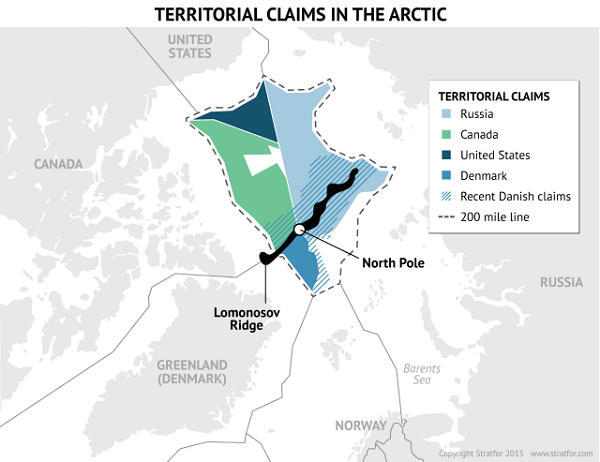
This map from Stratfor sketches in the claims:

arctic_territory_600

Remember that the U.N. Convention on the Law of the Sea regulates ownership of the Arctic, allowing for exclusive economic zones stretching 200 miles from land and even further if undersea resources sit on a continental shelf. The claims beyond this limit are becoming increasingly relevant, as the ice thins and clears in the summer.

Soviet-era bases in the Arctic are being reactivated. A third of the Russian navy is based there.

Going into 2015, it is estimated that the Russian armed forces have around 56 military aircraft and 122 helicopters in the Arctic region. Russian Defense Minister Sergei Shoigu stated that 14 military airfields on Russia’s Arctic seaboard would be operational by the end of the year. The Ministry of Defense also said some of the 50 modernized MiG-31BM Foxhound interceptors expected by 2019 will be charged with defense duties over the Arctic.

Defense spending was the only sector escaping budget cuts. In fact it increased by 20%.

Russia’s interest is in part economic. The region is said to host 30% of the world’s undiscovered oil and 13% of its gas.

On the political side, of the eight countries in the Arctic Council, five are members of NATO, fuelling Russia’s suspicion that opposing forces are massing against it.

Climate clippings 122

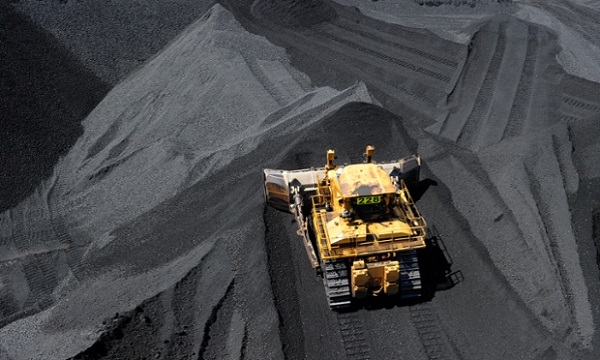
1. Court challenge will test coal mining’s climate culpability

A new legal challenge to the proposed Carmichael coal mine – Australia’s largest – will test in the federal court whether climate change caused by greenhouse gas emissions should be taken into account when assessing prospective coal licences in Australia.

The challenge, by the New South Wales Environmental Defenders Office on behalf of the Mackay Conservation Group, will argue that federal environment minister Greg Hunt failed to take into account the climate impact of greenhouse gases emitted by the burning of coal from the Carmichael mine when assessing whether to grant its licence.

It cites the impact of global warming on the Great Barrier reef, an area of world and national heritage, as a relevant consideration which the minister should have been taken into account.

The linked article cites some of the legal precedents, which show that this case is far from vexatious or frivolous.

Interesting!

2. Queensland Labor renews support for coal

0a0cf284-0505-4e4e-a7c3-4ec2c99d7884-600

Outgoing deputy Labor leader, Tim Mulherin, said coal remained “an important and vital energy source for Queensland and the rest of the world”.

Thermal coal from nine proposed projects in the Galilee, when burned in export markets such as China and India, would produce an estimated 705m tonnes of CO2, more than Australia’s total greenhouse gas emissions of 542m tonnes a year.

However, Labor in not going to spend hundreds of millions of dollars on building the railway line to the coast.

3. Humanity is in the existential danger zone

Back in 2009 a team lead by Johan Rockstrom of the Stockholm Resilience Centre identified nine planetary boundaries we should not cross if we are to avoid undermining the biophysical systems upon which our species depends. These nine boundaries are climate change, ocean acidification, stratospheric ozone depletion, alteration of nitrogen and phosphorus cycling, freshwater consumption, land use change, biodiversity loss, aerosol and chemical pollution.

A new paper led by Will Steffen of the ANU and the Stockholm Resilience Centre argues that climate change along with “biodiversity integrity” should be recognised as core elements of the Earth system. We are in trouble with both.

The world as we know it developed during the Holocene from which we are rapidly departing. We need urgently to get atmospheric concentrations of CO2 back to 350 ppm.

Background extinction rates without human impacts are thought to be about ten a year per million species.

Current extinction rates are anywhere between 100 to 1000 times higher than that.

4. Catholics in Australia join global movement to curb climate change

Australia’s Catholics are preparing to step up campaigns to address climate change ahead of an expected call to action by Pope Francis.

The Global Catholic Climate Movement, an international coalition of Catholic groups including Catholic Earthcare Australia, was launched on Thursday to bolster support for a global climate treaty at the Paris summit planned for December.

5. NOAA declares 2014 the hottest

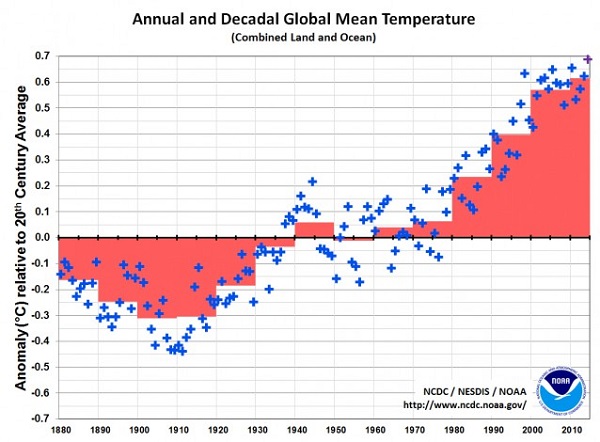
NOAA has declared 2014 the hottest year to date with this graphic:

decadal-NOAA 2014-600

If you drew parallel trend lines from about 1970 it would be full bore ahead with 1998 a slight outlier.

At Climate Central we are told that 13 of hottest 15 years on record have all occurred since 2000. The odds of that happening randomly without the boost of global warming are 1 in 27 million.

6. Sea level rise

There’s been some excitement about a new study of sea level rise. The difficulty in establishing long term trends is that prior to the satellite era (1979, I think) it has been very difficult to establish what happened. Data is globally patchy and incomplete. Tide gauge measurements suffer because the wind blows the water around, and the land that it is referenced to might be rising or sinking.

The clearest account of the new research by Carling Hay and others I’ve found is at Carbon Brief. Hay et al found sea levels from 1900 to 1990 to be 1.2 mm pa on average, lower than the 1.5 previously thought. This makes current sea level rise some two and a half times faster, with the implication that ice sheets a contributing more than previously thought.

Over at RealClimate Stefan Rahmstorf gives a technical review of the state of play. He regards the new research as important, but his bottom line is this:

Ultimately, it is not clear down to what level of accuracy we will ever know the sea level evolution over the past hundred years or so. But for practical purposes, I don’t think it matters whether the rise from 1900 AD has been 3 centimetres more or less. I do not think this changes our outlook for future sea-level rise in any significant way.

But if I understand him correctly, he would already have been considerably concerned about the decay of ice sheets and how that process could accelerate. However, he strikes me as wanting to be super careful not to run ahead of the data, which is entirely commendable.

One comment was that this research could add a metre to prospective sea level rise this century. I think Rahmstorf is suggesting that is premature.

Saturday salon 17/1

voltaire_230

An open thread where, at your leisure, you can discuss anything you like, well, within reason and the Comments Policy. Include here news and views, plus any notable personal experiences from the week and the weekend.

For climate topics please use the most recent Climate clippings.

The gentleman in the image is Voltaire, who for a time graced the court of Frederick II of Prussia, known as Frederick the Great. King Fred loved to talk about the universe and everything at the end of a day’s work. He also used the salons of Berlin to get feedback in the development of public policy.

Fred would only talk in French; he regarded German as barbaric. Here we’ll use English.

The thread will be a stoush-free zone. The Comments Policy says:

The aim [of this site] is to provide a venue for people to contribute and to engage in a civil and respectful manner.

Here are a few bits and pieces that came to my attention last week.

1. Australia’s internet speeds have slumped to 44th in the world

The State of the Internet Report from cloud service provider Akamai ranks Australia 44th for average connection speed.

One of the reasons why we’re falling down the list is that we’re moving towards utilising a copper based access network. Whereas previously, under the Labor government, we were moving towards an all fibre-based network, which is what most of our competitors are now doing. And we’re also seeing this drop because, as we keep changing direction with the NBN, we’re putting in large delays before the roll-out is actually occurring.

NetFlix which is meant to be coming online towards the end of March may not be able to be accessed everywhere and will be of poorer quality than in other countries. Many of our competitors are looking at gigabit broadband download speeds. Thanks to the Abbott government we’ll be in the Dark Ages.

2. Morgan poll

The Morgan poll ploughs on over the festive season. On LNP leadership:

Former Liberal Party Leader Malcolm Turnbull is preferred as Liberal Leader by 36% of electors (down 2% since September 30-October 2, 2014) but still well ahead of Deputy Leader Julie Bishop (26%, up 10%) and Prime Minister Tony Abbott (14%, down 5%). Bishop is now ahead of Abbott for the first time as preferred Liberal Leader. No other candidate has more than 4% support.

However, L-NP voters just narrowly prefer Prime Minister Tony Abbott (30%, down 11%) as Liberal Party Leader ahead of Deputy Leader Julie Bishop (28%, up 11%) and Malcolm Turnbull (26%, up 2%). Treasurer Joe Hockey has lost significant support and is now at only 4% (down 4%).

Hockey seems to have evaporated after announcing that poor people don’t drive cars. Meanwhile Bishop is surging.

3. MYEFO disappears

Speaking of Joe Hockey, the Mid-Year Economic and Fiscal Outlook, coinciding with the Sydney siege, has disappeared from view. John Quiggin has a neat summary of why it undercuts the LNP policy narrative:

Key elements of that narrative are:

* Debt and deficits are always bad, are now at catastrophic levels and are the product of Labor profligacy
* More labour market reform is needed to prevent a wages explosion resulting in higher unemployment
* The mining sector is the key to Australian prosperity and was unfairly burdened by the carbon and mineral resource rent taxes

Debt and deficits are growing as a result of weaker revenue, exactly as happened under Labor, and in any case do not constitute a serious problem.

As regards wages, not only does MYEFO note that wage growth (low and stable for many years) has been weaker than ever, this is noted as one of the main factors leading to the decline in revenue growth.

The mining industry was never a large employer and is now shedding jobs rapidly.

The good side of this is that the overvaluation of the $A driven by the mining boom is finally fading, with the result that the net impact of the end of the boom is forecast to be quite small. We have much more to fear from a renewed global financial crisis than from a decline in mineral prices.

4. The old guard still controls the grand slam court

Greg Jericho turns his analytical mind to tennis, well male tennis, suggesting that the old guard are still in control and don’t write Federer off – Jimmy Connors played until he was 39 and Andre Agassi until he was 36. Federer is only 33. He didn’t mention Ken “Muscles” Rosewall, who won his last tournament at the age of 43.

I’ve always thought that most grand slams are won by people in the age bracket 24-28. Jericho suggests 27 as the age beyond which winning becomes tough. Novak Djokovic and Andy Murray are 27, Nadal is 28. They are not true contemporaries of Federer.

I have no idea who is going to win, but I think it’s a bridge too far to expect Federer to win seven best-of-five matches in a row.

But Sarina Williams at age 33, you wouldn’t bet against her! Of course she only plays the best of three, but that’s another story!

I do think Djokovic, Nadal and Federer are a cut above the rest, with Andrew Murray also in the mix. They may stay in charge for another year or two.

Climate clippings 121

1. Denmark winds up wind

In January of 2014, Denmark got just over 61% of its power from wind. For the whole of 2014 it was 39.1%, a world record.

Their leadership is working well for them. Nine out of ten offshore turbines installed globally are made in Denmark. They plan to be fossil fuel free by 2050.

Elsewhere Germany and the UK smash records for wind power generation. Scotland hopes to be fossil fuel free by 2050.

On Boxing day rooftop solar met one third of South Australia’s demand and at least 30% from 11.30am to 3.30pm. Bonaire (pop. 14,500), a small island off the coast of Venezuela, said goodbye diesel and hello 100% renewable electricity.

California Gov. Jerry Brown last week called for

the state’s electric utilities to boost their renewable energy procurements to 50% of retail electric sales and discussed future initiatives to support rooftop solar, battery storage, grid infrastructure and electric vehicles.

As Bill Lawry would say, “It’s all happening!”

2. 2014 the hottest year

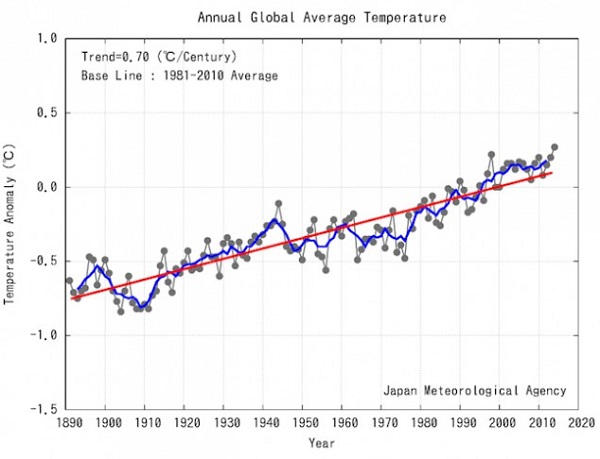
The first set of figures is in, this time from the Japan Meteorological Agency, showing 2014 as the hottest year so far:

JMA2014-cropped_600

The red line is the long-term linear trend.

The blue line is the 5-year running mean.

Australia had the third hottest year on record.

3. Chinese three-wheeler is for real!

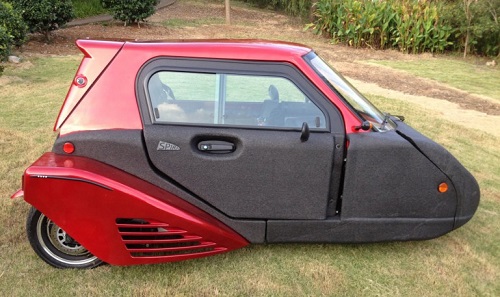
From John D’s Gizmag collection we have the Spira4u three-wheeler car:

spira-production-version-2_500

It’s not a toy, it’s a serious car which has gone into pilot production as a 10 kW electric or a fuel-injected 150 cc version with an economy of 2.94 l/100km (80 mpg).

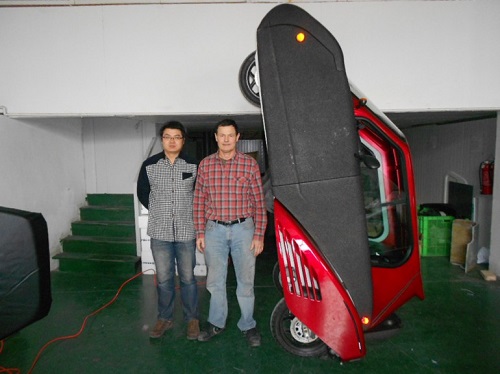
It has a handy parking option:

spira-production-version-14_500

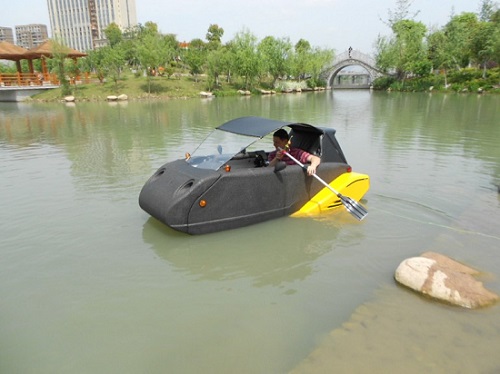
And it floats:

spira-production-version-11_500

An amphibious version is under development.

4. California starts to build a high-speed rail system

The first phase of California’s high-speed rail system will be a 29-mile stretch from Fresno slightly north to the town of Madera. From there the project will link up with urban centers like Los Angeles and San Francisco, eventually allowing commuters to travel between those two cities at 220 mph and cutting the trip from nearly six hours to less than three. The system will eventually extend to Sacramento and San Diego, totaling 800 miles with up to 24 stations.

The full rail system should be in use by 2028.

5. Solar at grid parity in most of world by 2017

At RenewEconomy:

Investment bank Deutsche Bank is predicting that solar systems will be at grid parity in up to 80 per cent of the global market within 2 years, and says the collapse in the oil price will do little to slow down the solar juggernaut.

Quiggin at The Conversation and his place: Only a mug punter would bet on carbon storage over renewables.

6. When you are in a hole, stop digging!

From a study in the journal Nature:

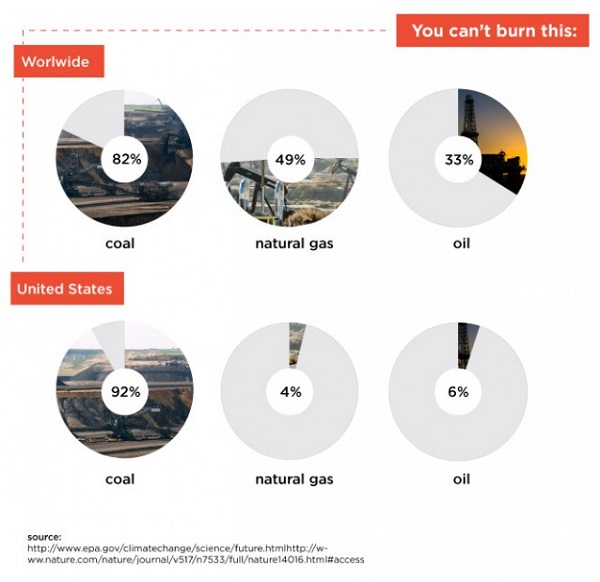
“Our results suggest that, globally, a third of oil reserves, half of gas reserves, and over 80 percent of current coal reserves should remain unused from 2010 to 2050 in order to meet the target of 2°C,” write authors Christophe McGlade and Paul Ekins of University College London.

stay-in-the-ground-cropped_600

Keeping the increase in global temperatures under 2°C will require vast amounts of fossil fuels to be kept in the ground, including 92 percent of U.S. coal, most of Canada’s tar sands, and all of the Arctic’s oil and gas…

In 2013, fossil fuel companies spent some $670bn on exploring for new oil and gas resources. The figure should be zero.

7. Climate change will create more environmental refugees

Natural disasters like Typhoon Haiyan—which devastated the Philippines in 2013 displace more people than war, according to the Internal Displacement Monitoring Center in Geneva. And as climate change sets off increasingly lethal natural disasters, so will the numbers of environmental refugees increase, Reuters reported.

It is a reality that governments must prepare themselves for. In 2013, some 22 million people were displaced by extreme natural disasters like typhoons, earthquakes and tsunamis, a number three times the number of those who were forced to migrate because of war, according to the IDMC.

Earlier this summer New Zealand accepted a family who cited climate change as the reason why they had to flee their homeland, thought to be the world’s first official environmental refugees.

Saturday salon 10/1

voltaire_230

An open thread where, at your leisure, you can discuss anything you like, well, within reason and the Comments Policy. Include here news and views, plus any notable personal experiences from the week and the weekend.

For climate topics please use the most recent Climate clippings.

The gentleman in the image is Voltaire, who for a time graced the court of Frederick II of Prussia, known as Frederick the Great. King Fred loved to talk about the universe and everything at the end of a day’s work. He also used the salons of Berlin to get feedback in the development of public policy.

Fred would only talk in French; he regarded German as barbaric. Here we’ll use English.

The thread will be a stoush-free zone. The Comments Policy says:

The aim [of this site] is to provide a venue for people to contribute and to engage in a civil and respectful manner.

Here are a few bits and pieces that came to my attention last week.

1. Somewhat distracted

For one reason or another I’ve been more than usually separated from my computer lately.

Last night I had to go to bed early so that I could drive down to Coolangatta airport to pick up Mark and his partner. They finally made it back from Surat Thani in Thailand after they decided they didn’t want to get on their booked flight with Asia Airlines after the plane hit the drink during a storm. Dealing with travel agents who would sell you a train ticket to somewhere even though you knew the line was cut by floods was not fun.

My sister and brother-in-law are also down from the country. Unfortunately it’s not a social visit, rather accessing medical facilities only available in the big smoke.

Then we’ve had about average rain for this time of the year, so the grass is as high as the elephant’s eye on some of the properties where I work. Well almost.

meanwhile there’s nothing but cricket on the radio, which I don’t half mind, and repeats of QI for the umpteenth time on the TV, which I do!

So apart from terrorist action in France and the Queensland election I haven’t been aware of too much that’s topical.

2. Charlie Hebdo attack

Speaking of which, the BBC has a detailed outline of what happened. They end up with the brothers Said and Cherif Kouachi holed up in a printing firm called Creation Tendance Decouverte on an industrial estate on the outskirts of at Dammartin-en-Goele, 35km (22 miles) from Paris. Apparently a hostage is involved.

Also from The Telegraph:

A second hostage situation was underway in France on Friday as a gunman linked to the killing of a policewoman a day earlier took five hostages at a grocery in eastern Paris.

Shooting was heard and one person reported wounded at the kosher grocery in the eastern suburb of Porte de Vincennes early on Friday afternoon.

Also from The Telegraph:

The man suspected of killing a policewoman in a southern suburb of Paris on Thursday before fleeing the scene was a member of the same jihadist group as the two suspects in the attack at weekly newspaper Charlie Hebdo, a police source told Reuters.

The Economist reflects on the underlying issues.

Brisbane Times has a running commentary.

3. Smoke taint in wine

The Australian Financial Review ran an article on the problem of smoke taint in wine grapes from bushfires and burning off. Smoke impregnates the skin which affects the taste of the wine in fermentation.

Tasters commonly liken the resulting wine to an ashtray, burnt rubber and hospital disinfectant.

It can ruin a whole harvest.

This article from last year talks about research but the Fin Review article says that the Abbott government has no funds for such trivial stuff and a modest grant from the Victorian government runs out in 2015.

4. When too much sport is barely enough

Ange Postecoglou’s record with the Australian soccer team is about 2 wins out of 11, from memory. He’s tried out about 50 different players. It may be a sign that he’s finally got it right, but the 4-1 win over Kuwait is a welcome surprise.

Climate clippings 120

1. Pope Francis becomes active on climate change

Pope Francis is going to give climate change action a red hot go in 2015:

In 2015, the pope will issue a lengthy message on the subject to the world’s 1.2 billion Catholics, give an address to the UN general assembly and call a summit of the world’s main religions.

The reason for such frenetic activity, says Bishop Marcelo Sorondo, chancellor of the Vatican’s Pontifical Academy of Sciences, is the pope’s wish to directly influence next year’s crucial UN climate meeting in Paris, when countries will try to conclude 20 years of fraught negotiations with a universal commitment to reduce emissions.

He also wants to change the financial system from one based on raw consumerist exploitation to one based on ethics which respect ecological principles. He should have a chat with Naomi Klein!

Giles Parkinson has more at RenewEconomy, including the note that Pope Benedict kicked things off by buying carbon credits in the form of a Hungarian forest to make the Vatican carbon neutral, and the possibility that the Catholic church may divest funds invested in the fossil fuel industry.

2. 2014: the year climate change undeniably arrived

John H. Cushman Jr. at InsideClimate News in reviewing the year thinks 2014 was the year climate change undeniably arrived. It was the hottest year ever, the science became conclusive, and a mushrooming climate movement pressed world leaders to act, which to some extent they did.

On the science, he was referring mainly to the IPCC report where already in 2013 the Physical Science Working Group moved the probability of human causation up a notch from “very likely” (>90%) to “extremely likely” (>95%) which is about as good as it gets. In the Synthesis Report of 2014 the language was ramped up saying that harm from greater warming if we stay on the current course could be “severe, pervasive and irreversible.”

Action looked promising with mitigation pledges by the EU, China and the US, also the UN climate talks at Lima.

On the “mushrooming climate movement he is talking about a:

phenomenon that emerged in a spectacular way in September, on the eve of Ban Ki-moon’s UN summit—the coming of age of a new popular movement demanding climate action now.

Hundreds of thousands of marchers filled the streets of Manhattan, curb to curb for 50 blocks or more. Their presence attested to a new dynamic in which inside-the-beltway lobbyists and well-heeled think tanks joined forces with grassroots anti-fracking and anti-pipeline protestors, in which labor unions and school kids found common cause.

A fine effort, but then, you see, sensible voters stayed at home and allowed the Republicans to take over Congress.

3. Precarious Climate

Climate and political blogger James Wight at Precarious Climate reviews the year, kind of, mostly by listing his best posts.

The last, Australia continues climate obstructionism in Lima, was an excellent wrap of the Lima talks. I was not aware (I’d wondered) that Julie Bishop is a climate denier, along with Andrew Robb, just the pair we needed to represent us at international climate talks.

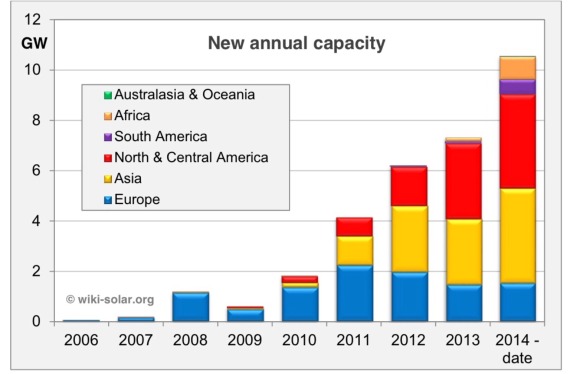
4. Utility scale solar surges

But not in Australia:

image3-570x374

The big surge is in Asia and North America, but other continents have come to life through installations in Chile and South Africa.

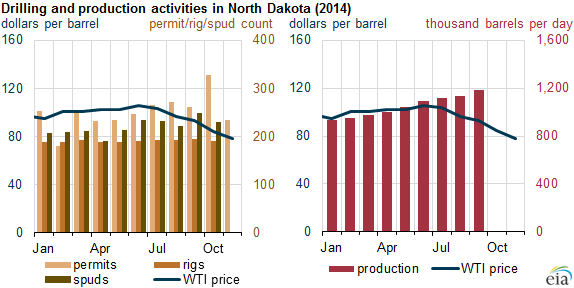
5. Production of shale oil increases

The production of shale oil in North Dakota has increased month by month in 2014, in spite of falling prices.

ndoil

Meanwhile falling oil prices have hidden a new global warming fee on the purchase of gasoline in California.

6. Compressed air technology

Not everyone reads the discussion threads, so I’m repeating here some links made by Jumpy to compressed-air technology.

Danielle Fong with her company LightSail Energy is bringing compressed-air energy storage technology to the market.

Both Peugot and Citroën are developing compressed-air hybrid cars that use 2 litres per 100 kilometres of fuel. Apart from the hybrid compressed-air powertrain both cars are using light-weight materials and aerodynamics to improve economy. The also have narrow tyres pumped up high.

Of course these cars use twice as much fuel as the electric hybrid Volkswagen XL1 which plans to put 250 cars on the road, at a price. That article is from July 2013 – not sure how they are going.

Saturday salon 3/1

voltaire_230

An open thread where, at your leisure, you can discuss anything you like, well, within reason and the Comments Policy. Include here news and views, plus any notable personal experiences from the week and the weekend.

For climate topics please use the most recent Climate clippings.

The gentleman in the image is Voltaire, who for a time graced the court of Frederick II of Prussia, known as Frederick the Great. King Fred loved to talk about the universe and everything at the end of a day’s work. He also used the salons of Berlin to get feedback in the development of public policy.

Fred would only talk in French; he regarded German as barbaric. Here we’ll use English.

The thread will be a stoush-free zone. The Comments Policy says:

The aim [of this site] is to provide a venue for people to contribute and to engage in a civil and respectful manner.

Here are a few bits and pieces that came to my attention last week.

1. Changing skivvies on the Wiggles

Tim Dunlop has done a great piece on the reshuffle. He reckons it’s

like changing who wears which colour skivvy in the Wiggles: it doesn’t make any difference, and they all end up singing the same old tunes.

Tony Abbott is still the Prime Minister. Joe Hockey is still the Treasurer. They are still committed to their budget and its underlying philosophy of market liberalism and a wholesale attack on the pillars of the welfare state.

Let’s focus on that, not which Wiggle is wearing which skivvy.

Dunlop’s big idea, though is that “both major parties have drained the office of prime minister of authority by converging on an economic program that subsumes economic sovereignty into the vagaries of a globalised economy.” Hence:

The office of prime minister is thus less about leading the country than about managing the electorate’s disappointments within that system, and Mr Abbott inherited an electorate hip to the tricks of a political class who have been selling us moonshine – privatisation, deregulation and the rest of it – for the best part of four decades now.

Given that structural issue, though, Abbott has brought his own particular brand of stupid to the role, says Dunlop.

2. 2015 will be basically grim

Mungo MacCallum looks at the political/policy prospects for 2015, and doesn’t like what he sees.

What seems inevitable is that 2015 is unlikely to be any better than 2014: basically grim. The only real question is just who ends up bearing the cost. It may be Abbott himself and it may be the government as a whole. But one way or another we are all going to cop at least a bit of collateral damage.

It all depends on the next budget. If it is verse 2 of the last budget then Abbott is in trouble. He needs a fix “which is dramatic, equitable and above all plausible.” Problem is he won’t shirtfront the rich and powerful. So the rest of us cop it, while being encouraged to spend like blazes to save the economy from recession. Before Christmas they announced cuts in the area of the homeless. Morrison reckons he needs to make welfare sustainable by cutting the bejesus out of it.

So the result is confusion, and pain.

3. Child shoots mum in Idaho Walmart

This has already been linked to elsewhere by Geoff Genderson and zoot, but in case you missed it, a two year-old child has shot and killed his mum in an Idaho Walmart. The boy unzippered her purse, a Christmas gift from her husband with a special pocket to conceal the weapon.

4. Carmichael mine to go ahead

Those hoping that falling coal prices will put an end to the development of the Galilee Basin mega-mine Carmichael will be disappointed.

Sydney-based engineering firm Downer EDI announced late last month it had received two Letters of Award from Adani to build and operate the Carmichael mine.

“The contracts are expected to have a combined value in excess of $2 billion over seven years,” Downer EDI said in a statement.

Adani expects to start building the rail line within the next few months despite not having a mining lease.

Adani reckon that cash costs would fall below $US50 a tonne, making Carmichael one of the cheapest mines in the world.

The mine has:

attracted a conditional debt funding of $1 billion from the State Bank of India and a promise of equity funding of up to $300 million from the Queensland Government for the rail line to Abbot Point.

Adani has also recently attracted an equity partner, POSCO, a Korean company that will build its railway and port as well as hold a stake in the infrastructure.

5. Civil society – more activity, less effect

Michael Edwards is pessimistic about the effect of civil society organisations. The numbers of organisations is impressive and continues to grow, but he thinks civil society organisations are becoming less effective. Problems include co-option, the corporatisation of civil society groups themselves and a lack of carry-through to the structures of power and influence in society.

Some progress is being made around the edges of poverty and injustice.

But there’s no sign that the underlying structures of social, political and economic violence and oppression are being shaken to their roots.

As a result, fewer people in the world are dying young, and basic indicators of health and education, income and employment are getting slightly better – at least for most people in most countries. However, economic inequality is rising, democracies are being hollowed out, climate change is worsening, and discrimination based on race, gender, ability and sexual orientation remains endemic.

Participation in voting and labour unions is falling. Social media and professional advocacy groups have strong messages, but less purchase where it counts.

Sorry!

Sorry about the gloomy line-up above. Maybe I should just pull a blanket over my head and wait the year out!

I did hear today on our ABC a riveting discussion about whether the meat pie typified the Australian cuisine!