Category Archives: Climate Action

Climate clippings 107

1. No more pauses in global warming

Temperatures are likely to rise dynamically for the rest of the century, according to two separate studies.

Masahiro Watanabe of the University of Tokyo colleagues found that over the past three decades natural influences are diminishing.

In the 1980s, natural variability accounted for almost half of the temperature changes seen. That fell to 38 per cent in the 1990s and just 27 per cent in the 2000s.

The implication is that temperature rises will respond more directly to emissions with fewer pauses.

Matthew England and associates used 31 climate models to chart future temperatures. He found that if emissions keep rising the chances of a pause of 10 years or more fall to practically zero. If emissions peak by 2040 we might get a pause by the end of the century.

If we wait until 2040 for peak emissions we’ll be cooked.

2. Rockefeller family moves from fossil fuels to clean energy

The Rockefeller family is turning its back on the industry that made it its vast fortune.

As more than 120 heads of state gather in New York for a UN summit on climate change, the Rockefeller Brothers Fund is pledging to move $50 billion worth of investment in fossil fuels into clean energy.

3. War and Peace revisited

At Fair Green Planet Val has reproduced her talk at the Australian Climate Action Summit 2014. It’s about organisational form in relation to climate change action and sustainability. Val suggests we need to change from forms based on competition, hierarchy and exploitation to forms based on co-operation, egalitarianism and sustainability:

From both my research and my lived experience, it seems clear to me that the approach we need to address climate change will not be produced by the hierarchical, top down, unequal organisations that are dominant in society today – but rather by an approach like this:
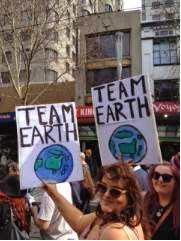
team earth

These “Team Earth” posters were of course produced in response to Tony Abbott’s “Team Australia”. The posters express to me the values we really need to address climate change: a recognition that we’re all in it together, and an inclusive approach.

We need:

to go beyond climate change and live in sustainable communities – communities that are flatter, networked, egalitarian and inclusive, and recognise themselves as part of an ecosystem.

In other words, we need to change ourselves.

4. Arctic sea ice report

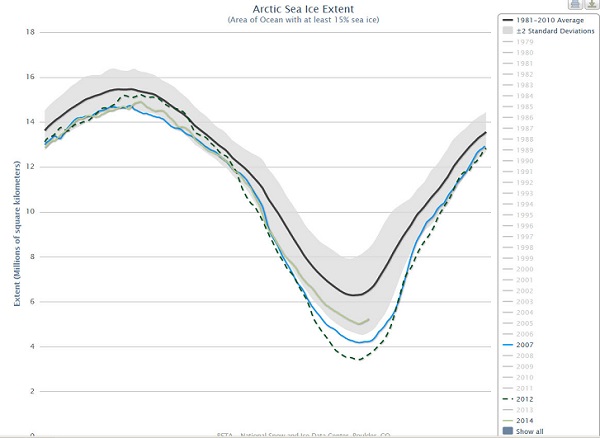
Arctic sea ice melting has now reached its maximum extent. This year was almost exactly the same as 2013, and the sixth lowest on record.
Sea ice Sept_cropped_600

The black line is the 1981-2010 average, the dotted line the 2012 record and the blue line the former 2007 record. Shading represents plus or minus 2 standard deviations.

Volume was also up a bit but still in trend decline.

What this masks is a continued decline in the proportion of older, thicker ice. An increasing proportion is first year ice. At Carbon Brief:

During the 1980s or 1990s, in an average year, around 54 to 58 per cent of ice in the Arctic would be first-year ice. Last year it was 77 per cent.

5. New York UN meeting

Last week some 125 leaders met with the UN Secretary General and each other in New York to indicate what their post 2020 emissions reduction targets might be. I reported on the outcomes here, but it seems that readers of this blog are put off by titles like the one I used.

Problem is, the bad news is getting worse and is not being addressed sufficiently by world leaders. Emissions increased by 2.5% in 2013. Every year the emissions increase the harder the problem becomes. It’s not a case that action is just delayed; we are using up a carbon budget that by some estimates is already in the red.

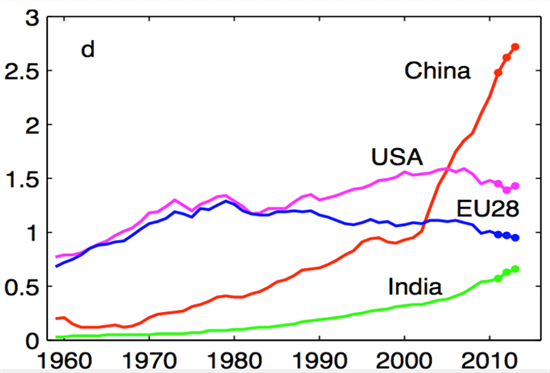
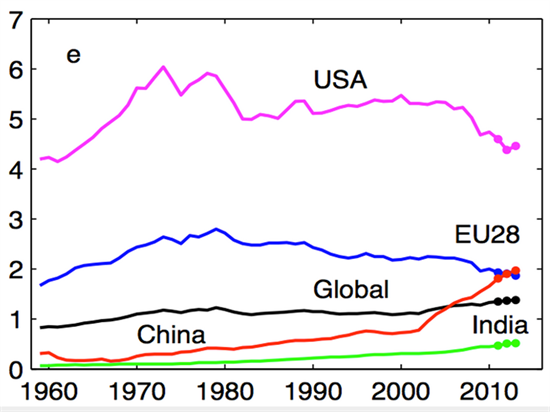
Of the major emitters only the EU was specific, nominating 40% by 2030, subject to confirmation. Not enough. There were indications that China will give concrete numbers when formal proposals are submitted next March. However, their current rate of increase is quite dramatic, as this graph shows:
gcp-country-emissions-line_550x373.jpg

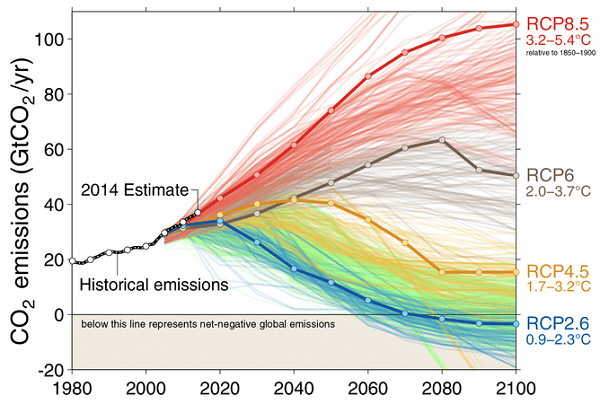
My expectation is that at best, when the bids are in, our path will match the RCP4.5 scenario (the scenarios are numbered according to the climate forcing pertaining to CO2 levels with the forcing expressed in watts per square metre).
84jyvk7k-1411262594_600

A new report puts the situation this way:

Nevertheless, the report said there is still a “gigatonne gap” between governments’ current carbon-reduction pledges and what will be needed to limit overall warming to 2C.

Delivering on current policies would only succeed in reining warming back from 4C to 3C, it predicted. The United Nations’ New York 2014 and Paris 2015 climate summits will be crucial in securing an improved deal, the report said. (Emphasis added)

Indeed. In New York on our behalf Ms J Bishop said the Government would consider what post-2020 emissions might be, but consistent with the need for economic growth. I think in her mind this means banking on cheap coal as our dominant power source.

For another view, see Christine Milne at the National Press Club:

I believe that Australia should put on the table for the 2015 negotiations a trajectory of 40 to 60 per cent below 2000 levels by 2030 and net carbon zero by 2050.
The road to Perdition

Six years ago I penned a post Last exit on the road to Perdition. It began like this:

    “Damn! I think we just passed the last exit for the Holocene!”

    “I’m sorry, honey, I wasn’t looking.”

    “We have to get off this highway. What’s the next exit?”

    “It’s a long way ahead. Goes to somewhere called Perdition.”

Those words were from a column by Gwynne Dyer, who had just spent a couple of months talking to leading climate scientists and security officials for his book Climate Wars (2009). He saw no happy outcomes.

Unfortunately the post falls in a gap in the Larvatus Prodeo record in 2008, but I was reminded of the analogy when I saw this graph from the Global Carbon Budget 2014 report (thanks to John D for the heads-up at Saturday Salon; there are articles by Canadell and Raupach at The Conversation and by Mat Hope at Carbon Brief):

84jyvk7k-1411262594_600

Armageddon is RCP8.5 and a 4°C climate. That’s where civilisation as we know it is in play. Also there is nothing to suggest that the climate would stabilise at that level. Vast beds of methane could be released, the tropical forests would likely burn off, fertile river deltas would be flooded, corals could disappear for a few million years and climate could head for 6°C or more.

Canadell and Raupach say that

    economic models can still come up with scenarios in which global warming is kept within 2C by 2100, while both population and per capita wealth continue to grow.

2°C is still attainable, which is at best borderline dangerous, but would require beyond zero emissions, that is:

    the deployment of “negative emissions” technologies during the second half of this century, which will be needed to mop up the overshoot of emissions between now and mid-century. This will involve removing CO2 from the atmosphere and storing it in safe places such as saline aquifers.

    These technologies are largely unavailable at present.

If we keep on growing emissions at 2.5% per annum for a few more years, the best on offer will be peaking by 2040, in other words RCP4.5. That’s the road to Perdition. On current form I suspect that’s where we are heading. The following graph shows that the EU was the only major emitter to reduce emissions in 2013:

gcp-country-emissions-line_550x373.jpg

In per capita terms China has now surpassed the EU:

gcp-per-capita-emissions-lines_550x412.jpg

Please note the y-axis is calibrated in tonnes of carbon. For CO2 multiply be 3.67.

As John D pointed out:

    There have been other striking changes in emissions profiles since climate negotiations began. In 1990, about two-thirds of CO2 emissions came from developed countries including the United States, Japan, Russia and the European Union (EU) nations. Today, only one-third of world emissions are from these countries; the rest come from the emerging economies and less-developed countries that account for 80% of the global population, suggesting a large potential further emissions growth.

    Continuation of current trends over the next five years alone will lead to a new world order on greenhouse gas emissions, with China emitting as much as the United States, Europe and India together.

For a couple of years now, the world had decided that we will make up our minds about what post-2020 targets we will aim for by Paris in December 2015, but the implementation phase does not begin until 2020. Kyoto was a top-down mitigation strategy. This time it will be bottom-up. Every country will set it’s own pace within a framework of “common and differentiated responsibility”. The worry is that the national interest trumps the common good. The UN meeting in New York gave some idea of the early form.

Carbon Brief tried to pick the eyes out of the announcements. Here’s a selection:

  • The US has directed federal agencies to consider climate resilience when designing programmes and allocating funds, and will share data from NASA and NOAA and help train developing countries’ scientists. Oxfam says it’s not revolutionary.
  • China will peak emissions “as early as possible”. That’s new for official language, perhaps they’ll put a date on it next year.
  • The EU will aim to cut emissions by 40% by 2030, subject to confirmation by the European Commission.
  • The Netherlands and Belgium both pledged to cut emissions in line with the EU’s regional goal of cutting emissions by 80 to 95 per cent by 2050, compared to 1990 levels. Denmark reminded the conference it aims to be fossil fuel free by 2050.
  • India did the usual – called on developed countries to show more leadership, said it would act on climate change, but on its own terms. It aims to double the amount of energy from wind and solar by 2020, they’ve said that before.
  • Indonesia said it will cut emissions by 26% by 2020, rising to 40% if it gets international help to do so.
  • Malaysia said it has a target to reduce emissions by 40% by 2020, and was on track to do so. Ethiopia said it was still committed to making its economy zero carbon by 2025.
  • Some money is flowing into the UN’s Green Climate Fund to help developing countries. France pledged $1 billion, Denmark $70 million, South Korea $100 million, Norway $33 million, Switzerland $100 million, Czech Republic $5.5 million and Mexico $10 million and Luxembourg $6.4 million. Before the summit, Germany had pledged $960m. The EU also announced it would channel $2.5 billion to developing countries during 2014-2015, with a focus on adaptation and mitigation.
  • One of the big announcements at the summit was the New York declaration on forests, signed by 27 nations, eight regional governments, 34 multinational corporations, 16 indigenous peoples’ groups and 45 NGOs. It builds on a range of existing agreements including the Warsaw framework for reduced deforestation agreed last year.

    The declaration is a voluntary commitment to “at least halve” loss of natural forest by 2020 and “strive to” end it by 2030. It is not legally binding and Brazil, one of the world’s largest rainforest nations, is not a signatory.

All that is fine and good, but frankly underwhelming. As I have already quoted David Spratt:

    We have to come to terms with two key facts: practically speaking, there is no longer a “carbon budget” for burning fossil fuels while still achieving a two-degree Celsius (2°C) future; and the 2°C cap is now known to be dangerously too high.

We dawdle towards 2015 and 2020 while options close off or become harder. Perdition looms.

Climate clippings 106

1. Abbott adviser warns of threat of ‘global cooling’

Nevertheless with the certainty only possessed by fools, the Abbott government’s chief business adviser, Maurice Newman, has warned that Australia is ill prepared for global cooling owing to widespread “warming propaganda” in his latest critique of mainstream climate science.

The suggestion is that temperature change is due to changes in solar activity, cosmic rays and stuff. The science is heading in the opposite direction.

“The sun doesn’t have as much influence on the climate as we previously thought, the latest estimates are that it explains only 5% of the warming over the last 150 years,” he said.

How can the government be advised by someone who is so ill-informed about arguably the biggest single influence on business conditions over the next century.

2. August hottest ever

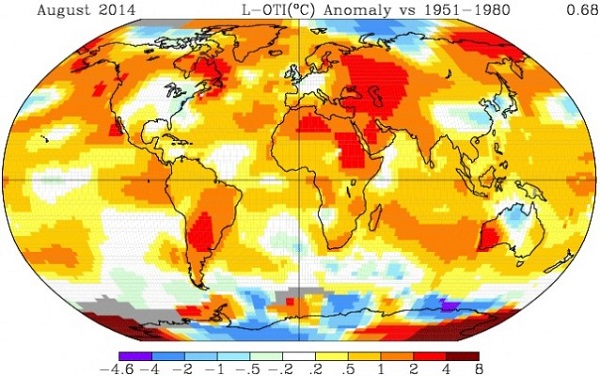
We’ve just had the hottest August globally since records began being kept in 1880, according to NASA. The year to date has been the fourth hottest on record. Hot years usually coincide with an El Niño either in the year concerned or the previous year. An El Niño has not yet arrived but does look likely according to the latest information.

NASA_ 2014_Ag_600

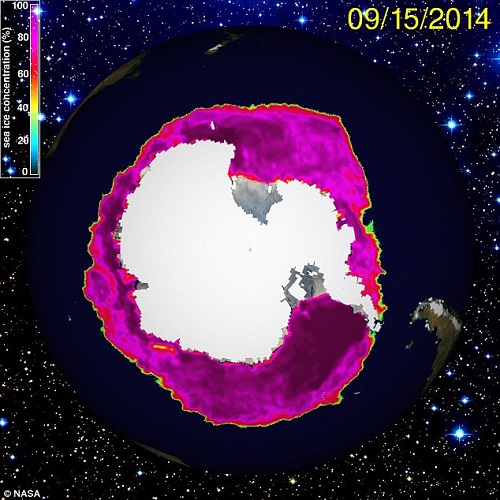
It has been especially hot in West Antarctica. Bear that in mind when you see stories of record sea ice around Antarctica:

seaice_2014_Ag_500

This is not incompatible with global warming and could in fact be caused by it. Melting ice produces cold water, and the tightening wind pattern tend to blow the ice further north.

There is no information as yet on ice volume.

3. Australian Climate Action Summit 2014

The Australian Climate Action Summit 2014 is on this weekend. Since my life is governed by work, the weather and medical appointments I am unable to go.

On Sunday there will be a People’s Climate March, organised by an outfit called Avaaz. Marches will be organised all around the world, and indeed, all around Australia, including, for example Mt Isa and the Gold Coast. If you click on Brisbane you get the Summit, but if you click on the Summit you don’t get a march. So if there is a march in Brisbane, I can guess where but I’d also need to guess when.

The march is meant to impress the leaders gathering in New York on Tuesday 23 September. That’s the UN Summit Tony Abbott will not attend although he’ll be in New York on Wednesday.

4. Surviving in hot, acidic oceans

I think this is a good news story.

More than 90% of the extra heat in global warming ends up in the oceans, as does 25% of the CO2 we create, which makes the oceans more acidic. Shell-making organisms such as plankton are expected to be in trouble. The good news is that it seems one species of plankton, the Emiliania huxleyi, can survive the changes underway.

5. Climate Council report on sea level

The Climate Council has taken another look at climate change and coastal flooding. The focus is on 1.1 metres sea level rise by 2100, all too possible if West Antarctica is in play, as it seems to be.

We are told that the frequency of flooding events can treble for every 10 cm of sea level rise. The risk multiplier depends where you are. In Sydney, Bundaberg and Hobart, for example a current 1 in 100 year event now could be happening every day by 2100. In Adelaide, the least at risk city, it would be only once every year.

At risk we have $87 billion worth of commercial and light industrial buildings, $72 billion worth of homes and $67 billion worth of roads and rail infrastructure.

6. Capitalism v The Climate

Joe Romm tells us about Naomi Klein’s new book, This Changes Everything: Capitalism Vs. The Climate. Klein, he says, makes three essential points:

1. Because we have ignored the increasingly urgent warnings and pleas for action from climate scientists for a quarter century (!) now, the incremental or evolutionary paths to avert catastrophic global warming that we might have been able to take in the past are closed to us.

2. Humanity faces a stark choice as a result: The end of civilization as we know it or the end of capitalism as we know it.

3. Choosing “unregulated capitalism” over human civilization would be a “morally monstrous” choice — and so the winning message for the climate movement is a moral one.

The time for ‘evolutionary’ strategies is long past. Now only ‘revolutionary’ strategies will get us there. Unregulated capitalism is a Ponzi scheme, which must collapse. The real choice facing us is a moral one.

Unchecked capitalism is immoral and will destroy civilisation as we know it. Just what Klein says we should do will be covered by Romm in a subsequent post.

Climate clippings 105

1. Atlantic Ocean important for heat storage

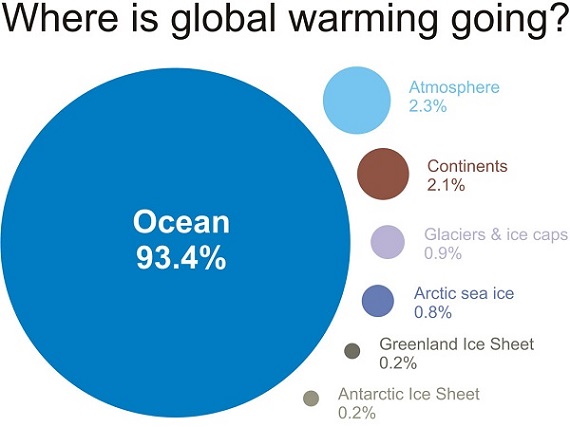
Most of the energy from global warming goes into the ocean as this graphic from Skeptical Science illustrates:

GW_Components_570

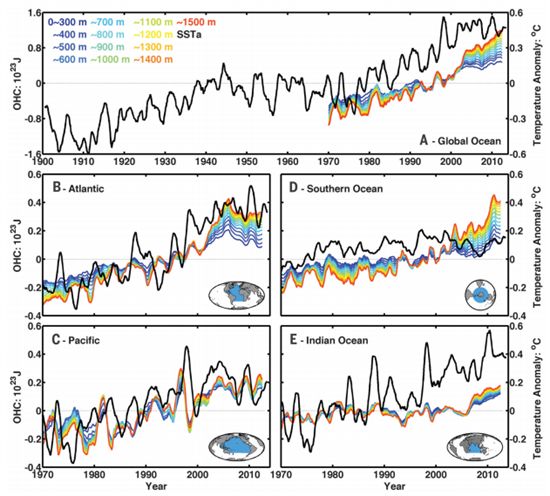
The linked paper stresses the role of the Atlantic in heat uptake. The following graph shows the heat uptake for the four main oceans. The black line is the sea surface temperature, the red line shows the heat below 1500 metres.

oceanheatuptake_chentung-2014-_550x496.jpg

All this is considered in relation to the socalled warming ‘hiatus’. The suggestion is that the Atlantic Meridional Overturning Circulation is the critical influence and it changes phase every 20 to 35 years. If so the ‘hiatus’ could last another decade or so.

Other scientists see the hiatus as multi-causal. It also depends which temperature series you are looking at. The HadCRUT temperatures always look flatter in recent years, as in this article. The Gistemp series from NASA has 1998 as about the third highest and shows a continuing upward trend, albeit slowed..

2. ‘Unprecedented’ ice loss in Greenland and Antarctica

Since 2009 the volume of ice loss has tripled in West Antarctica and more than doubled in Greenland, the highest rate of ice loss since satellite records began 20 years ago.

While it’s still early days, sea level rise this century could surprise on the upside.

3. El Niño watch

Carbon Brief also have the latest on the chances of an El Niño developing in 2014, which the Australian BOM now put at about 50%. Earlier there was talk of a super El Niño, which is still possible.

4. China gets into emissions trading

The Chinese national market will start in 2016.

The Chinese market, when fully functional, would dwarf the European emissions trading system, which is now the world’s biggest.

It would be the main carbon trading hub in Asia and the Pacific, where Kazakhstan and New Zealand already operate similar markets. South Korea will start a national market on Jan. 1, 2015, while Indonesia, Thailand and Vietnam are drawing up plans for markets of their own.

Looks like quite a trend. Time perhaps for Australia to join in!

5. World’s poor need grid power, not just solar panels

Small scale solar power is quite popular in Africa and supported by environmentalists. A few panels are able to run a few lights, a radio, charge the mobile phone but stop short of boiling a kettle. Critics see this as condemning the poor to a constrained future. Only 20% of Kenyans are connected to the grid.

Coal fired power is obviously not the answer. Dams take years to build, are typically over budget, inundate fertile lands or forest areas and interrupt natural stream flow.

In the Democratic Republic of Congo the mega project of the Inga 3 dam is due to start construction on the Congo River. If fully developed it will produce twice as much electricity as the world’s largest, the three Gorges in China. But will it be economically justified and what impacts will it have on the environment?

6. Emissions from energy generation jump after carbon price axed

Carbon emissions from the country’s main electricity grid have risen since the end of the carbon tax by the largest amount in nearly eight years.

Data from the National Electricity Market, which covers about 80 per cent of Australia’s population, shows that emissions from the sector rose by about 1 million tonnes, or 0.8 per cent, at an annualised rate last month compared with June.

That is the biggest two-month increase since the end of 2006, and came as a result of an increase in overall demand and a rise in the share of coal-fired power in the market, according to Pitt & Sherry’s monthly Cedex emissions index.

From what I can make of it, gas is increasingly going to export, there is some scaling back of hydro, presumably because of the weather. and large scale solar was killed off ages ago. The slack is being taken up by old coal, including brown coal.

Abbott’s strategy of saving the coal fired power industry seems to be working.

Building new more efficient coal would be his ultimate aim. This would involve investors and lenders having confidence in the future of coal. Surely they can’t be that stupid!

Reminder: Use this thread as an open thread on climate change.

Renewable Power – Sundry Items

This post brings together a number of items on renewable power including US windpower agreements setting the price as low as $US25 MWh (2.5 cents/kWh.  WA thinking of importing Indonesian coal for power generation while ignoring renewables and approval being given by the Pt Augusta council for a solar thermal installation that will be used to desalinate water and heat/cool 20 hectares of greenhouses for tomato growing.

Continue reading Renewable Power – Sundry Items

The RET Needs Bipartisanship- Contract Based Alternatives Don’t

Tony Abbott has already killed the Howard government’s RET scheme. No new large scale energy projects directly justified by the RET have been committed to since the start of 2013. In addition, since the Abbott government was elected, the price of large-scale renewable energy certificates had nearly halved to $26.00 per MWh by 11 Aug 14.  To make things worse, the RET is not going to be resurrected by a change of government or action by the Senate.

Continue reading The RET Needs Bipartisanship- Contract Based Alternatives Don’t

The future of emissions trading

While the Senate has not yet passed the bill to repeal the ETS the question arises as to when if ever carbon pricing will return. I’m not a psephologist but I suspect that the Palmer United Party are going to be in a similar position after the next election of having a stake in the balance of power, perhaps more so! Given that Labor appear set on retaining carbon pricing as part of their policy platform and the Greens will sign up to a reasonable scheme, the introduction of carbon pricing appears to depend on either the Liberals growing up or PUP.

Assuming PUP don’t change their mind they have said we won’t have emissions trading until India, China, the USA, Europe, Japan and South Korea do it. So the prospects of carbon pricing appear to depend on the US Tea Party losing a controlling position in the US Senate, or the Australian Tea Party turning into a mature modern party that respects the science.

The most likely to give I think is the PUP. Recall what Bernard Keane said at Crikey:

The key to understanding Palmer is that he’s always about what’s ahead. What’s in the past is irrelevant. The issue of consistency simply doesn’t arise, because Palmer eternally moves forward, toward the next announcement, the next stunt.

Palmer has said that PUP are going to be on the right side of history. The international scene is likely to be somewhat fluid leading up to the UNFCCC Conference of Parties in Paris in December 2015 where a legally binding post Kyoto deal will be attempted. Negotiations under the UNFCCC are almost continuous but the next big event is in September 2014 when UN Secretary-General Ban Ki-moon has invited world leaders to a Climate Summit Catalyzing Action:

This Summit will be a different kind of Climate Summit. It is aimed at catalyzing action by governments, business, finance, industry, and civil society in areas for new commitments and substantial, scalable and replicable contributions to the Summit that will help the world shift toward a low-carbon economy.

In preparation for the summit economist Jeffrey Sachs’s Deep Decarbonization Pathways Project has produced an interim report plotting specific measures for the world’s 15 largest economies “to cut their emissions quickly and deeply enough to meet an international agreed goal of limiting warming to two degrees above pre-industrial levels.”

The 15 economies are, in alphabetical order, Australia, Brazil, Canada, China, India, Indonesia, Japan, France, Germany, Mexico, Russia, South Africa, South Korea, the UK, the USA.

I’ve highlighted the ones nominated by Palmer.

The report

found that it’s technically possible for Australia to get almost all of its electricity from renewable sources by 2050 and to offset the rest by storing carbon in soil or planting more trees.

We can do this while growing our GDP at 2.4% pa.

The importance of Australia’s role in New York in September is possibly two-fold.

Firstly, will Abbott be embarrassing? Will he be negative and disruptive or just irrelevant? It’s extremely unlikely that he will show any vision or learn anything.

I did hear that he was going to be too busy at home destroying Labor’s legacy in climate change to attend. No doubt Julie Bishop will fill in since Greg Hunt is not allowed out alone.

Secondly, and of greater importance, will Palmer as a result of what other leaders say decide that Australia should ride at the head of the peloton and show a bit of leadership without breaking away?

Palmer saves the world!

Clive Palmer Addresses National Press Club

Meanwhile here on the local scene PUP are planning to introduce their ETS on trainer wheels as an amendment to the legislation proposing the demise of the Climate Change Authority.

Driving down new car emissions using offset credit trading

Most cars last for years.  This means that a failure to reduce the average emissions of new cars now will damage the environment for many years to come.  This post looks at the use of offset credit trading to drive down the average emissions of new cars as well as a few other actions that would help.  Continue reading Driving down new car emissions using offset credit trading

Climate clippings 102

This week we start with trouble at the top and bottom of the world and finish with trouble with our leading media magnate and politician.

1. Geenland at a tipping point?

THE cracks are beginning to show. Greenland’s ice sheets slid into the sea 400,000 years ago, when Earth was only a little warmer than it is today. That could mean we are set for a repeat performance.

If Greenland goes, West Antarctica also goes, giving 13 metres of sea level rise from those sources. If that happens there will also be a complete loss of other glaciers and ice caps, thermal expansion and some partial melting from East Antarctica. A mess!

The question is how soon and what can we do? The answer is we need more research and we need to think more in terms of centuries.

We should be thinking about the next 500-1000 years, how ice sheet decay can be minimised, stabilised and headed in the other direction. Our plans for the next 50-200 years should be made in the light of this.

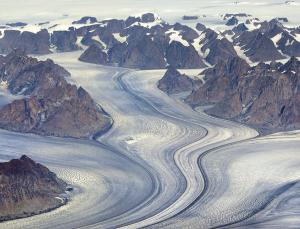
This image from the article shows a part of Greenland where the ice is quite dynamic.These areas are expected to grow.

New scientist_mg22229752.600-1_300

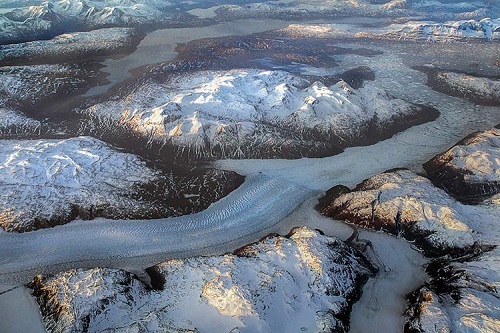
Here’s an image from another article:

greenland_cs_500

2. Big trouble in the Antarctic has been brewing for a long time

David Spratt at Climate Code Red:

“A game changer” is how climate scientist Dr Malte Meinshausen describes newly published research that West Antarctic glaciers have passed a tipping point much earlier than expected and their disintegration is now “unstoppable” at just the current level of global warming. The research findings have shocked the scientific community. “This Is What a Holy Shit Moment for Global Warming Looks Like,” ran a headline in Mother Jones magazine.

Meinshausen says this is new information. He says that the beaches we know and love all around the world will disappear. He also wonders what other nasty surprises lie this side of a 2°C temperature rise. Spratt says we told you ages ago it was coming, by James Hansen, for example and by himself and Philip Sutton in 2007.

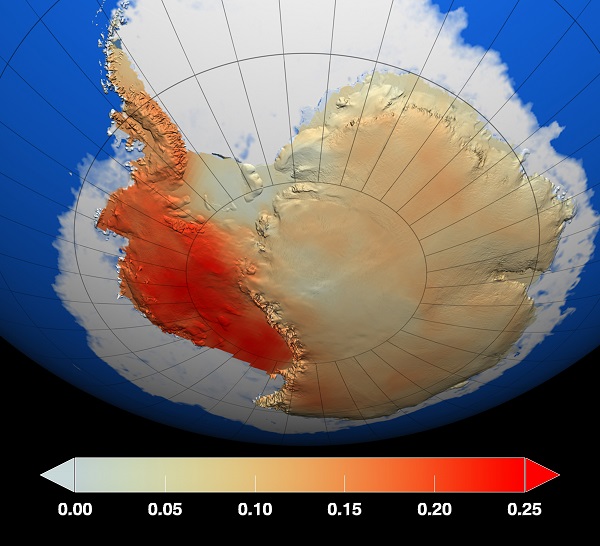
This NASA image shows the temperature changes from 1957 to 2006:

AntarcticaTemps_1957-2006_lrg_600

Hansen warned; Meinshausen says it’s happening. Spratt warns:

It’s par for the course for climate policy-makers to hope for the best, rather than plan for the worst. More than once this blog has warned that sea-level rises are being underestimated by Australian policy-makers, and that the tens of millions of dollars being put into adaptation planning for sea-level rises of no more than 1.1 metres by 2100 will be a waste of money, and all that work will have to be done again. And now that has come to pass.

3. Huge ‘whirlpools’ in the ocean are driving the weather

GIANT “whirlpools” in the ocean carry far more water than expected and have a big impact on the weather – though as yet we don’t know exactly what.

The areas of swirling water are 100 to 500 kilometres across. These “eddies” generally move west, driven by Earth’s rotation, until they stop spinning. Now, for the first time, the amount of water and heat they carry has been measured.

Article and image available also here.

dn25801_1_300

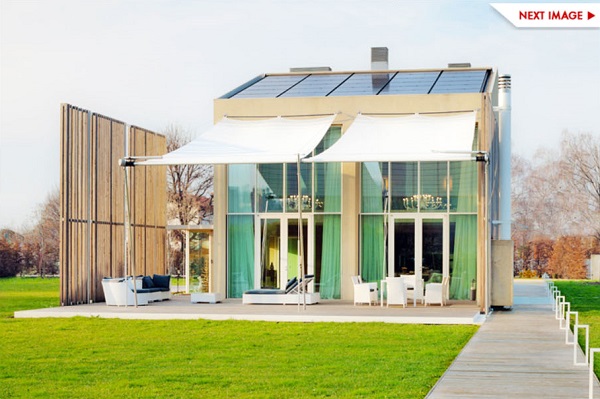
4. Gorgeous BioCasa_82

Nestled into the pastoral landscape of Treviso, Italy, BioCasa_82 is a beautiful home that boasts some seriously energy-efficient technologies.

BioCasa_82_cropped_600

The house is made from 99% recyclable materials and scores

117 points out of 136, according to the American protocol LEED Platinum, and 10 out of 11 points in regards to innovation in design, the building is a real gem in the European building practice.

According to the carbon footprint analysis, BioCasa_82 yields 60% less emissions than traditional buildings. Its photovoltaic system produces around 14kWh/mq of electricity, and a high-efficiency geothermal plant provides heat, hot water and cooling. These strategies are complemented by a rainwater harvesting system.

5. Rupert Murdoch doesn’t understand climate change basics

That is everyone’s problem since he owns a world-wide media empire.

Many of Murdoch’s news outlets are also among the worst when it comes to getting climate science wrong and disseminating climate myths and misinformation. Inaccurate media coverage is in turn the primary reason why the public is so misinformed about global warming.

I won’t go into the details, but Climate Progress observes that he ‘lowballed’ the numbers and minimized possible impacts. Here in Oz:

”We can be the low-cost energy country in the world,” he said. “We shouldn’t be building windmills and all that rubbish.”

Elsewhere Graham Readfearn finds that Tony Abbott’s views on climate are seriously crap.

Reminder: Use this thread as an open thread on climate change.

Recent articles on renewable power

1. Radical ideas for renewable energy policy

Investment bank UBS came up with this list:

1.  Mandate time of use meter roll out over remaining States in the NEM (NSW, QLD, SA, TAS)

2.  Reinstate the carbon tax with zero exemptions and zero compensation, but start it at a lower level, say  $10/t. This would raise around $5bn of revenue and continue to discourage electricity consumption. It would send a price signal to all carbon producers, however of itself it would not induce much fuel shifting.

3. Encourage the construction of distributed PV solar on any building where the majority of the electricity consumption is during the day or where the costs of being connected to the grid are high. Examples of the former category include many Federal and State Government owned buildings, factories and warehouses. All that flat Western Sydney metal roofing is ideal for solar.

4. We would use some of the funds raised to subsidise the take-up of onsite storage and encourage grid defection and the creation of micro grids, particularly in rural areas. Network investment and pricing models would need to be sharply revised.

5. Networks in general would have their monopoly pricing status revoked. In the world of the “Nu-tility”, the network is no longer a monopoly – it competes with distributed electricity and possibly with other distribution business models. If networks put prices up too much they will face competition of their own.

6. We would incentivise closure of some brown coal fired electricity in Victoria, possibly via means of environmental regulation, but possibly with a capacity closure auction.

7. Likely continue with the current renewables target.

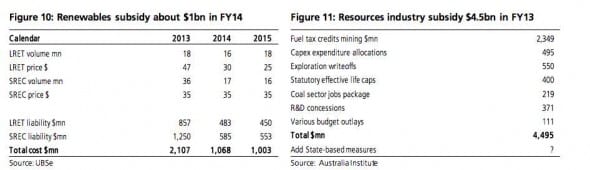
I can’t say I like all of these but they are a starting point for discussion.  The article also had this table comparing renewable and fossil “subsidies”.  (Excluding state subsidies which are quite significant.)

UBS subsidies

2.  Queensland power price goes negative in the middle of the day

Last week, for the first time in memory, the wholesale price of electricity in Queensland fell into negative territory – in the middle of the day.  For several days the price – normally around $40-$50 a megawatt hour – hovered in and around zero. Prices were deflated throughout the week.

There were several reasons for this. A restricted interconnector to NSW added to the volatile trading, as did uncertainty about the carbon price. But the overall softening of prices was primarily the result of the newest and one of the biggest power stations in the state – rooftop solar PV.

There is 1,100MW of it on more than 350,000 buildings in Queensland alone (3,400MW on 1.2 million building across the country), and  it is producing electricity just at the time that coal generators used to make hay (while the sun shines).

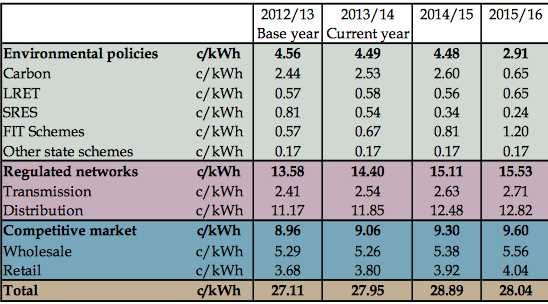
The article also had this table showing just how large the grid owners and retailers are costing consumers.

aemc electricity prices

3. Solar fuels exports from the Pilbara

This article argues that the Japan free trade agreement may hasten the production of solar fuels from the Pilbara.  A key argument is based around Japanese fears of LNG supplies being exposed to deteriorating relationships with China (as well as price uncertainty.)

Liquid ammonia is the logical solar fuel for production in the Pilbara.  Renewable ammonia can be produced from renewable power, water and nitrogen from the air.  Theoretical water consumption is 1.6 litres water per kg of ammonia so this shouldn’t be a problem even if desalination is required. (Other solar fuels such as gasoline require a source of CO2)

Liquid ammonia could be transported using LNG facilities.  The big disadvantage of liquid ammonia is that one kg of LNG has the same energy as 2.9 kg of liquid ammonia.   However, to some extent this disadvantage will be off set by the fact that ammonia can be used in fuel cells.

4. Turkey nest dams may be key to pumped storage in Australia

This article argues that “off river pumped storage” using small turkey nest dams overcomes the problems of using pumped storage systems with the dams in river valleys.

Off-river electricity storage has several advantages over typical on-river facilities:

– There are vastly more potential sites

– Sites can be selected that do not clash with environmental and other values

– The upper reservoir can be placed on top of a hill rather than in a valley, allowing the elevation difference to be maximised

– No provision needs to be made for floods (typically a major cost).

A system comprising twin 10ha reservoirs, each 30m deep, with a 750m elevation difference, can deliver about 1000 megawatts for five hours.

Between 20 and 40 of these systems would be enough to stabilise a 100 per cent renewable Australian electricity system.

How much does it cost?

As the reservoirs are tiny (just a few hectares) compared with typical hydro reservoirs, they are a minor component of the cost. Most of the cost is in the power components (pipes, pumps, turbines, transformers and transmission). Initial estimates suggest that the cost of an off-river system at a good site is around $1000 per kilowatt of installed capacity.

One m3/sec of water falling one m will generate 9.807 kW