Category Archives: Climate Action

Power To The People

That’s the title of Four Corners tonight.

It’s advertised as being about renewable energy. According to reporter Stephen Long on local radio, he and a photographer went to the United States and looked at developments, not just in alternative technologies in power production, storage etc, but also in new models of distributed energy production.

He likened what’s happening to the challenge of the new media to traditional newspapers. Old energy systems will have to adapt or shrink and die.

Newspapers, telecommunications and the entertainment industry have all felt the chill winds of change brought on by new technology. Now science is revolutionising power generation. Technology is making alternative sources of energy cheaper, more user-friendly and, crucially, it’s decentralising production to the rooftops of homes and commercial buildings across Australia.

So why is the Federal Government moving away from its commitment to renewable sources of energy? Why would it consider reducing renewable energy targets, favouring greenhouse-gas emitting coal and gas?

He also looks at new electric cars.

Another way to cook the planet

Around 80 to 85% of coal in the ground cannot be mined by conventional methods. That’s 18 trillion tonnes according to the International Energy Agency’s Clean Coal Centre – enough to supply the world for 1000 years, at current requirements. Fred Pearce in the New Scientist (paywalled) takes a look at efforts to liberate this potential by a process called underground coal gasification (UCG). Apparently that’s enough to add about 10°C to global warming, if the carbon is not sequestered.

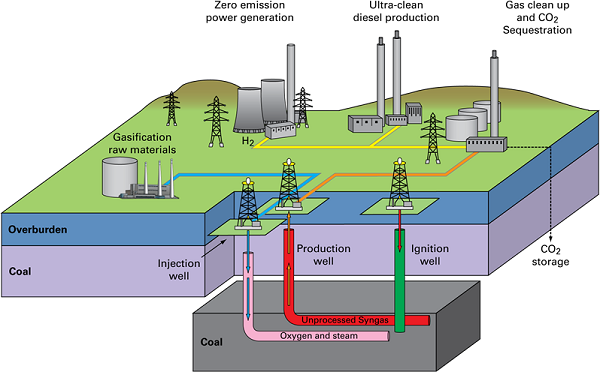
The process involves burning the coal in situ underground, bringing the gases thus created to the surface and then burning them in a conventional power station. This image from the British Geological Survey illustrates the process:

USG_Figure_03_001_600

The “Zero emissions power generation” is totally misleading (see below).

Stalin’s engineers and their successors have been doing it to a brown coal seam for 50 years near Angren, a town east of Tashkent in Uzbekistan. Air is piped 300 metres down one well, the gas comes up another. It is cooled, scrubbed of coal dust and compressed on site, then piped across the plain to Angren. Australians bought the operation seven years ago, with a view to scaling up the technology to transform the world’s energy markets.

A cocktail of gases is created when the coal is burned – methane (natural gas), CO2, which can be disposed of safely, carbon monoxide (CO), and hydrogen. There are four ways the gases can be used:

  • Gas to electricity. Methane is burned in a power station.
  • Gas to chemicals. Hydrogen, methane and CO have value as feedstock in the chemicals industry.
  • Gas to liquid. Methane can be liquified to LNG, or CO and hydrogen can be turned into synthetic diesel.
  • Gas to tech. Hydrogen can be used as a transport fuel.

As methane burns it oxidises to CO2 and water. Potentially, it is said, the same infrastructure of pipes can be used to pipe the CO2 from the power station back to the mine and insert it in the place vacated by the burnt coal. Obviously you’d have to double the pipeline for continuous operation. And obviously the process would add to the expense.

A second concern is that chemicals can leak to contaminate groundwater. If the rocks above the seam are impermeable before the process, they may not be after. Fracturing is estimated to occur up to 60 times the width of the seam. In fact fracturing the nearby rocks could release even more gas for use.

USG_cougar-energy_cropped

Australian engineers trialled an adapted process at Chinchilla in Queensland in the 1990s. Within two years UCG was shown to be feasible. But in 2011 benzene and toluene leaked into a nearby borehole in an operation near Kingaroy. Similar problems had emerged in the US, so Qld authorities shut the operation down for investigation. Last July ‘Can do’ Campbell’s mob came up with the idea that you could only operate if you successfully decommissioned a commercial scale operation to show that you could do it. So you had to start an operation, stop it, get your operating ticket, then start up again. Brilliant!

There were three companies involved in Qld – Linc Energy, Carbon Energy and Cougar Energy. They responded by shutting Chinchilla down after more than a decade of successful production, and relocating to China, the US, Argentina, Chile and Indonesia.

There are trials elsewhere, including Canada and South Africa. At Cook Inlet in Alaska and Swan Hills in Alberta, Canada, there are plans to go commercial as early as 2015. In Britain, they reckon 70% of coal has never been mined. Furthermore there is 10 billion tonnes of the stuff under 400 square kilometres in the North Sea. An Office for Unconventional Gas and Oil has been set up with £1 billion seed money to stimulate the industry. Half a dozen start-ups have been spawned. There is interest also in supplying feedstock to energise the flagging chemicals industry in Scotland.

All this momentum is a worry unless in practice ‘clean’ coal turns out to be completely clean. For example in Britain it is said that only 30% of CO2 could be sequestered. There they are throwing £1 billion at the problem.

Remember, for a safe climate we need to reduce the concentration of emissions initially to 350 ppm. Or you can go back and depress yourself by re-reading The game is up.

Our best chance lies in the possibility of renewables becoming cheaper than the fossil alternatives. If we rely on the human race acting rationally in its own longer term self interest our prospects are not good.

Food follies

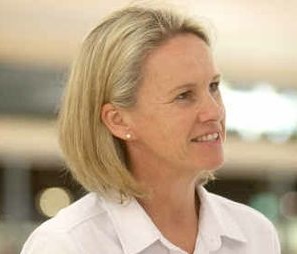
Nash_CCA_13-08-2010_EGN_04_a300410-08-01_t460_croppedFiona Nash is Deputy Leader of the Nationals in the Senate and Assistant Minister for Health. Back in mid-February there was a kerfuffle over taking down a food labelling site and the apparent conflict of interest of her then chief of staff, one Alastair Furnival.

The basic story is this. Food labelling has been under review for years by the Australia and New Zealand Food Regulation Ministerial Council. According to The Guardian back in Labor’s time the ministerial council approved a five star labelling system indicating food nutrition.

The website included a calculator that provided a star rating based on the ingredients and nutrient content of a food item, taking into account energy, saturated fat, total sugar, sodium, fibre, protein and fruit and vegetable content.

It’s a voluntary system. The website, specifically approved by the council, was to provide guidance to manufacturers and distributors who could then, if they wished, include the rating on the labelling. Meanwhile the site would be available to the public.

The staff of the department of health duly set up the site. Within hours Nash demanded that it be taken down. The public servants refused, saying they were working for the ministerial council. Furnival then intervened with their bosses, heavied them and the site came down. This shouldn’t happen.

Much of the controversy then was over Furnival’s former and possibly current links with sections of the food industry hostile to the project, what Nash told the senate about this, how she had to then provide ‘further information’ which was pretty much the opposite.

One bottom line is that Laura Tingle reckons Nash definitely misled the senate. On that basis she should have resigned or been sacked.

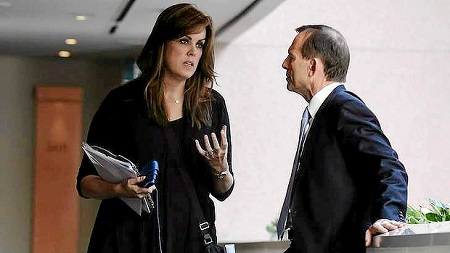
A side issue relates to the vetting of Furnival’s appointment in the PM’s Department. Andrew Elder points out that Peta Credlin, Abbott’s supremo, knew personally all about Furnival before he was appointed.

BTW who do you reckon is in charge here?

Abbott_ak_lead_credlin_20131204182638618280-450

Elder also points out how dunderheaded and useless your average gallery journalist is.

All these interesting aspects distract attention from what Nash was really up to. She claims the site was premature. She has initiated a cost-benefit analysis which she says needs to be completed first. Other ministers who are part of the Council say that this analysis is a Commonwealth initiative and as such has nothing to do with the Council.

The real agenda seems to be a delaying tactic. The vote in favour of the site was narrow and Nash is hoping to revisit the issue with the prospect of a different result after the elections in SA and Tasmania.

Mike Daube, Professor of Health Policy at Curtin University, speaking to Peter Lloyd, reckons that’s not all she’s done.

Look I think the major issue now is not about one staffer who is gone but about whether the Federal Minister responsible for prevention understands the importance of prevention and will take the action that’s needed.

You look at the three big prevention priorities – tobacco, alcohol, obesity – and they’re also the three big priorities or three of the biggest priorities if we want to close the Indigenous life expectancy gap, and this Minister so far does not have a good record.

She’s scuppered a food labelling system, she’s defunded the major peak national alcohol treatment organisation and her party still accepts tobacco funding. So I think it raises much bigger question marks about Senator Nash than it does about the Mr Furnival.

I couldn’t agree more.

Problem is, there could be a cost to Radio National in reporting inconvenient material like that. I’m expecting a major push to kill off RN coming out of the current reviews of the ABC. I suspect the LNP sees RN as an unseemly steaming cesspit of lefties.

Climate clippings 98

This edition includes important updates on Greenland and Antarctica, global food supply, CSIRO cuts, CO2 levels moving decisively past 400 ppm and CO2 compared to global temperature rise.

1. Greenland may melt faster than expected

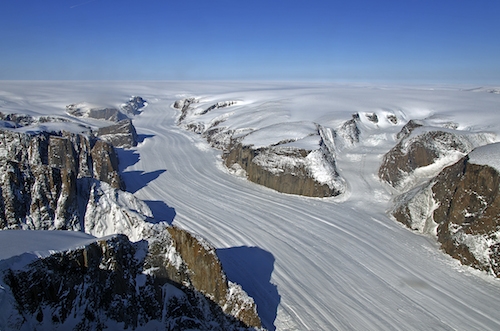
You may recall from the post Arctic images I included an image of the underlying topography of Greenland (Figure 5). It is saucer-like with large areas inland below sea level. The glaciers tend to drain through narrow gateways in the external rim. So they tend to be narrow and fast-flowing:

Glacier_assets-climatecentral-org-images-uploads-news-5_16_14_Andrea_Greenlandglacier-500x331

The mouths of most glaciers are melting from contact with warmer seas. It was felt that as this process continued the ice would lose contact with the water, slowing the melting.

New studies of the topography have shown that many of these channels are below sea level.

Valleys underlying many of the glaciers stay below sea level and extend much farther inland than previously suggested, so warm ocean currents that have migrated northward with the changing climate could eat away at the ice for much longer than current climate models suggest. “It will take much longer for these glaciers to lose contact with the ocean,” study author Mathieu Morlighem, of the University of California, Irvine, told Climate Central.

2. Melting Antarctica could devastate global food supply

A new report is the “first to factor in the effects of the slow-motion collapse of the Western Antarctica ice sheet on future food security.”

About time, I’d say.

The report acknowledges recent findings that that the retreat of the Western Antarctica ice sheet was unstoppable – and could lead to sea-level rise of up to 4 metres over the coming centuries.

“That sea-level rise would take out half of Bangladesh and mostly wipe out productive rice regions in Vietnam,” Nelson told The Guardian. “It would have a major effect on Egyptian agricultural areas.”

“A sea level rise of 3 meters (10 feet) over the next 100 years is much more likely than the IPCC thought possible,” the report said.

In terms of absolute land loss, China would be at risk of losing more than 3 million hectares (7.4 million acres). Vietnam, India, Bangladesh, and Myanmar could lose more than 1 million hectares (2.5 million acres), the report said.

The report recommends a radical increase in expenditure on agricultural research, which has been in decline everywhere over recent decades.

3. CSIRO cuts

The federal government cut CSIRO’s funding by $111 million over four years, which will result in 500 job cuts.

Dr Borgas [president of the CSIRO Staff Association] said a plan to move the Aspendale Laboratories to the organisation’s larger site in Clayton had been previously discussed but had come to nothing.

He said it was unclear whether the relocation would reduce the research performed by the 130 staff, which includes ice core analysis, air quality and pollution research and climate and atmospheric modelling.

Most countries planning for a future increase their scientific research funding.

4. CO2 levels decisively pass 400 ppm

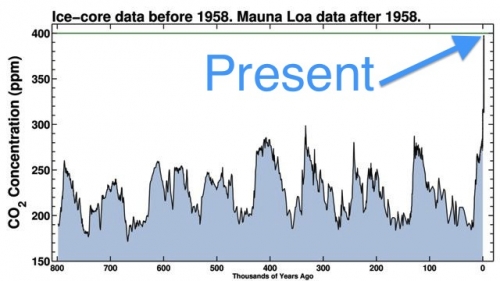
During April all 12 World Meteorological Organisation northern hemisphere monitoring stations passed the 400 ppm mark, the first time ever. This is how such a level compares to the 800,000 year ice core record:

assets-climatecentral-org-images-uploads-news-5_2_13_news_andrew_co2800000yrs-500x282

When was it last this high? Possibly 15 million years ago, when it was warmer and there wasn’t much ice around.

“This was a time when global temperatures were substantially warmer than today, and there was very little ice around anywhere on the planet. And so sea level was considerably higher — around 100 feet [30 metres] higher — than it is today,” said Pennsylvania State University climate scientist Michael Mann, in an email conversation. “It is for this reason that some climate scientists, like James Hansen, have argued that even current-day CO2 levels are too high. There is the possibility that we’ve already breached the threshold of truly dangerous human influence on our climate and planet.”

5. Global temperature and CO2

I came across this graph from the NOAA National Climatic Data Center plotting CO2 levels against temperature rise. While correlation does not mean causation there is simply no alternative explanation.

assets-climatecentral-org-images-uploads-gallery-TVM-Global_Temp_and_CO2_web-600

If you take out 1998, which can be regarded as an outlier, the socalled ‘pause’ is only apparent from 2005, which is too short a time to mean anything.

There is another view which sees temperature responding in step-wise fashion. On that basis we may be due for another step, and with an El Niño likely…

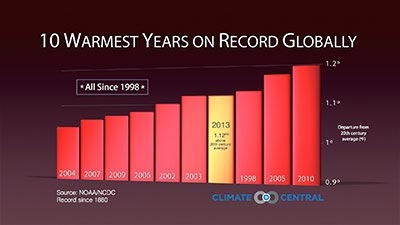
Here’s one showing the ten warmest years on record, all since 1998:

assets-climatecentral-org-images-uploads-gallery-climate-matters-GlobalRecapRanking_sm-400x225

Reminder: Use this thread as an open thread on climate change.

Climate clippings 97

Climate clippings_175 This edition contains a miscellany from the absolutely central scientific issue of climate sensitivity to adaptation in Bangladesh.

1. Sense about climate sensitivity

The fourth IPCC report in 2007 estimated that the planet will warm between 2 and 4.5°C warming in response to a doubling of the amount of CO2 in the atmosphere, with a best estimate of 3°C. Since then a number of studies suggested a lower sensitivity, leading the IPCC’s fifth report to extend the range to 1.5°C at the lower end and omit a best estimate entirely.

Dana Nuccitelli reports on a new paper by Kummer & Dessler which shows that recent studies suggesting an insensitive climate are flawed. Without going into the detail they converge on a value around 3°C.

2. CO2 fertilization won’t slow global warming

Some contend that increased CO2 in the atmosphere will enhance plant growth leading to an increase in soil carbon. A study of this issue found that any such gains were offset by increased microbial activity in soils. Along the way the researchers found that soil carbon was less stable than previously thought.

3. Bangladesh uncovers the crippling cost of climate change adaptation
Bangladesh_viewimage_500

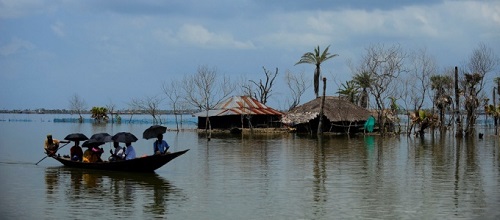
Bangladesh has found the cost of climate change adaptation quite crippling in a new report.

They are spending $1 billion a year, 6-7% of their annual budget, on climate change adaptation. Only a quarter comes from aid.

The irony of the finding will be lost on few people: the average European citizen emits as much carbon in 11 days as the average Bangladeshi in an entire year. Yet it is the government and the people of Bangladesh who are expected to pay for the escalating costs.

Within the country it is the poor who are most severely affected.

After the report Bangladesh sees climate adaptation expenditure as central to their development.

4. Deutsche Bank rules out funding for controversial Abbot Point coal terminal

Deutsche Bank:

said it would not finance an expansion without the assurance of both the Government and UNESCO that it would not damage the Great Barrier Reef.

“We observe that there is no consensus between UNESCO and the Australian Government regarding the expansion of Abbot Point,” it said.

“Since our guidance requires such a consensus as a minimum, we would not consider a financing request.”

Thanks to John Davidson for the heads-up.

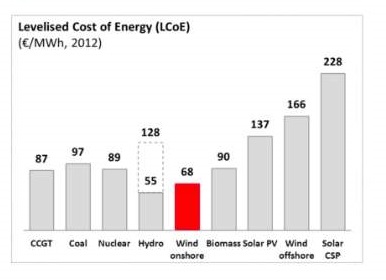
5. Onshore wind cheapest form of power


In Europe, that is
according to Portugal’s EDP, which has around 24GW of generation, of which around 8.7GW is in onshore wind.
EDP-wind-estimates_cropped

CCGT is baseload gas.

John D has more detail at Climate Action 04.

The same article tells us that Keith DeLacy, former Qld Labor treasurer who would do just about anything to turn a buck, said on the front page of the Oz that renewables had “no place in a modern society”.

Meanwhile economist Jeffrey Sachs, advisor to UN secretary general on the Millennium Development Goals, is in Australia telling us that we can’t mine all that coal unless we invest in carbon capture and sequestration technology. We just need to get serious:

Put in real money, probably $20 to $30 billion I would say, minimum, to get scaled, serious demonstration programs working in China, in India, in Australia, in Canada, in the United States and to test the geology and the engineering of this technology.

Sachs is a man who thinks big!

6. EU’s energy strategy

Not surprisingly, the EU has been taking another look at its energy security strategy in view of the political instability to their east.

The EU imports over half the energy it consumes at a cost of more than €1 billion per day. Two-thirds of its gas is imported, with nearly a third coming from Russia. Half of that is transported via Ukraine.

Russia has already twice pulled the plug on gas supplies to Europe arriving via Ukraine, in 2006 and 2009.

The bottom line is that there will be a continued dependence on Russia for the foreseeable future:

The EU energy security strategy doesn’t look like it’ll take a rifle to that Russian bear just yet. But with a tweak to address vulnerability here and a spotlight on energy dependence there it may just help the EU avoid a mauling – and drive an ambitious EU 2030 climate and energy deal too.

Shale gas and nuclear energy are being left as options that member states can explore if they wish.

Reminder: Use this thread as an open thread on climate change.

Offset credit trading

Australia’s successful RET emission trading scheme is an Offset Credit Trading Scheme (OCTS) that has been quietly driving investment in utility scale renewable energy since 2001.  Best of all, it has been doing this without causing any dramatic increase in power prices or political pain.  This quiet success  means that few Australian’s have heard of the RET scheme let alone understand what offset credit trading is.

Continue reading Offset credit trading

Shredding the fig leaf

Direct Action was always a fig leaf for a government pretending to have a climate policy. Now the climate change denialists in Abbott’s cabinet have taken the opportunity to shred the fig leaf to the complete embarrassment of Greg Hunt.

Giles Parkinson thinks the 2014 budget is Abbott settling old scores, and dumping clean energy in favour of the asphalt economy.

With proposals to repeal the carbon price, dismantle the Climate Change Authority and the Clean Energy Finance Corporation, and the dilution of the Renewable Energy Target already in train, these budget measures – which include the closure of ARENA, the dumping of the million solar roofs program (both contrary to election promises) and the research funding cuts at the CSIRO, Bureau of Meteorology and elsewhere – mean that the obliteration of the Clean Energy Future package will be complete, if it can get past the Senate.

Dumping ARENA is particularly stupid, as the fund was leveraging private investment at the rate of $2.50 to one and doing much to support the off-grid activities of the mining industry.

ARENA will maintain funds of $1 billion for around 190 projects – mostly R&D – that have already been contracted since its creation in 2012, but it will have a measly budget of just $15 million over each of the next two years for new projects.

Some 150 of its 180 projects already allocated are in support of research and development, a core competency not valued by the Government.

The Emissions Reduction Fund ($2.55 billion) has been spread over 10 years, rather than four. Tristan Edis explains that $2.55 billion will be allocated over the next four years, but the scheme only pays on completion. However, this does call into question the efficacy of the scheme.

Clive Palmer wants to divert the funds to pensions and is prepared to vote it down.

The million solar roofs scheme was a featured election promise.

The million solar roofs program, once a $1 billion centrepiece of Direct Action to bring solar to lower-income earners and renters, has sunk without trace — replaced by a derisory $2.1 million program to install solar on RSLs and bowling clubs in seven electorates, many of them marginal (yes, really).

But not to worry we still have “$525 million to pay up to 15,000 under-25s to pick up litter at below-award wages under the guise of the Green Army”.

Parkinson further reports

the abrupt closure of the Energy Efficiency Opportunities, as well as rejecting calls for the revival of Low Carbon Australia, which also supported investments in energy efficiency. It has also brought an end to support for ethanol and algae fuel programs.

The Energy Efficiency Opportunities program, which was to cost $20 million to run over the next five years, had helped deliver more than $1 billion a year in savings since 2006.

Alan Pears at The Conversation has more. He says the Clean Energy Finance Corporation which has already mobilised $2.5 billion of mostly private funding for low-emission energy and agriculture projects would make a profit for the government if allowed to continue. Like ARENA the CEFC will continue trading until stopped by legislation.

Pears says that leaves the Renewable Energy Target (RET) scheme as “the last major remaining piece of federal government policy that supports ongoing investment.” It has already led to $20 billion worth of investment, but is under review with climate sceptic Dick Warburton at the helm.

There’s more at The Guardian and at Planet Oz. There Graham Readfearn tells of the axing of a small $1.3 million program, which has been supporting more than a 150 local and state-based conservation groups across the country since 1973. Such is the depth and thoroughness of the attack on the environment.

Meanwhile global renewable energy jobs surged to almost 6.5 million in 2013. In Germany, where the government strategy was to take first mover advantage, renewable energy production reached 74% the other day.

We are striving to be last.