Category Archives: Climate Action

Climate clippings 203

Renewable energy news

I’m reminded of my school days when our German teacher on the last day of term used to read us tales of Baron Münchhausen, who on one occasion jumped on his horse and rode off madly in all directions. There is so much going on, fully covered at RenewEconomy, so it is difficult to select the most significant. I’ll try a couple of themes, and include some AFR coverage, which is trying to keep business informed.

1. Batteries

The South Australian tender for 100MW grid-scale storage has received 90 expressions of interest from 10 countries, demonstrating an established global industry. Continue reading Climate clippings 203
Climate clippings 201

1. Australian fund managers short Tesla and Elon Musk

When Elon Musk dramatically promised to build a grid-scale battery in South Australia, the media was enthralled. Share traders and a string of Australian fund managers smirked. They’d seen it all before, and were shorting him in the market.

In that very week he was in the market with plans to raise $US1.15 billion in equity and convertible notes. I understand also that Tesla has gone strangely quiet about SA since then. Continue reading Climate clippings 201

SA power plan: intervention, not going alone

Malcolm Turnbull and Josh Frydenberg have now added a second myth to the earlier one that South Australia had rushed madly and blindly into renewables without thought for the consequences. They say that South Australia is now “going it alone”. Unfortunately this meme was picked up in the media, so that Philip Clark on ABC Nightlife recently had SA “going it alone” as his topic of the day (most of the comment supported SA, but no-one, not a single one, had their facts right).

The fact is that the Australian Energy Market Operator (AEMO) runs the market, calls bids for supply on a 30-minute basis, and balances supply and consumption. That is what it has done every day for years, since 1 July 2009, and will continue to do so into the future. Except that 30-minute time-slots are bound to be reviewed in the Finkel report and may end up at five. The Australian Energy Market Commission is currently considering a request for such a change. Continue reading SA power plan: intervention, not going alone

Climate clippings 200

1. Murdoch media continues the energy wars

The Murdoch media continues to lay the blame on renewables, a notion specifically rejected by AEMO, leading to a Twitter battle between SA minister Tom Koutsantonis and The Australian’s Adelaide bureau chief, Michael Owen.

2. AEMO embraces change in the SA blackouts report

Continue reading Climate clippings 200

What the biffo between Weatherill and Frydenberg really means

“Ten years of brutal, opportunistic politics has left this nation with no credible energy policy.”

The money quote from Jay Weatherill’s outburst was this:

    “Josh Frydenberg was humiliated back in December. We were working with him to introduce an emissions intensity scheme. He knows that. It was well advanced. It was about to happen. Coal interests in the federal Coalition government basically cut him down before he even had a couple of hours explaining it.”

Continue reading What the biffo between Weatherill and Frydenberg really means

Retailers gouging electricity prices: Grattan

AGL, Origin and Energy Australia are gouging electricity retail prices, according to a report by The Grattan Institute titled Price shock: Is the retail electricity market failing consumers?.
The report which focusses on Victoria finds that electricity retailers charge a margin double what other retailers make, for doing little other than marketing a service we are going to buy anyway, and sending out a bill. Continue reading Retailers gouging electricity prices: Grattan

Climate clippings 199

1. Ballarat and Bendigo targetted for blackouts to keep lights on in NSW

It didn’t happen, but the phone call was made during the early February heatwave:

    Victorian Energy Minister Lily D’Ambrosio confirmed she was approached by the Australian Energy Market Operator (AEMO) with the suggestion that either Ballarat or Bendigo could potentially lose electricity for a period of time to assist NSW.

Victoria was not impressed and have demanded an explanation. Continue reading Climate clippings 199

Gas to burn

Jay Weatherill’s energy plan involves the construction of a government-owned 250MW gas-fired power plant to provide emergency back-up power and system stability services for South Australians, and power for his resources minister to instruct the owners of Pelican Point to turn it on. Yet his plans for cheaper gas, or any gas, will not work quickly and possibly will not work at all. Laura Tingle in an excellent article published under the title of Power sources: steaming Premiers and Pumped PMs tells us that on the futures market on Wednesday, the June contract for electricity in Victoria hit $147.50 per megawatt hour, compared to a price for the March contract of just $80 as energy traders put a price on the closure of Hazelwood in Victoria at the end of March.

Meanwhile a group of former BHP Billiton and BP executives is consulting with SA to build a private equity funded power station, using gas from a floating regasification plant sourcing gas from the North West Shelf and from Singapore, some of which may actually come from the Cooper Basin in the state’s north via Gladstone.

Is this for real, and how did we get into this ridiculous mess? Continue reading Gas to burn

Snowy hydro 2.0: nation-building game-changer or giant red herring?

Just after we had heard about 100 MW batteries being installed in South Australia to keep the lights on, Malcolm Turnbull announced a giant ‘battery’ in the form of pumped hydro in an expansion of the Snowy hydro scheme.

    “In one hour it could produce 20 times the 100MW per hour expected from the battery proposed by the South Australian government, but would deliver it constantly for almost a week, or 350,000 MWh over seven days.

Michelle Grattan reports that the media were dragged up to Talbingo in the Snowy Mountains for Thursday’s big Hydro announcement. But then his press conference couldn’t be beamed direct because there was no way of transmitting the signal.

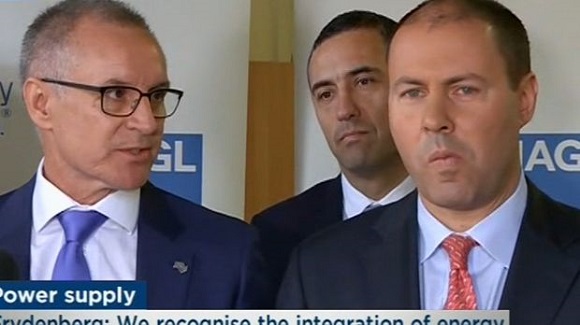
    Meanwhile the news cycle was taken up with the pictures of the extraordinary biffo between South Australian Premier Jay Weatherill and federal Energy Minister Josh Frydenberg when they appeared together in Adelaide.

    It was all a metaphor for the shambolic national energy debate, in which the process is chaotic and politics trumps policy.

Continue reading Snowy hydro 2.0: nation-building game-changer or giant red herring?

Zen Energy’s renewable baseload power

South Australia’s brave new energy plan may not have been the biggest energy news on Tuesday. The gong may go to Zen Energy‘s plan in cahoots with Santos to provide renewable baseload power.

It works this way. Solar is now the cheapest form of power when the sun is shining. So you supply solar during the day, but store some in a grid-scale battery to provide power when people are up and about at night. Then the battery gets recharged overnight from wind to provide power for the morning start until the sun takes over. The whole thing is backed up by gas. Gas is the backup of the backup. Continue reading Zen Energy’s renewable baseload power

Climate clippings 198

1. LiquidPiston engine

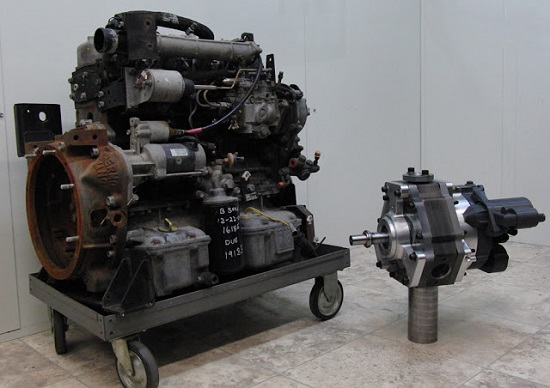
The innovative LiquidPiston engine, mentioned by BilB, is targetting a global market worth $460 billion. It has a power to weight ratio more than ten times better than a regular engine:

The big bruiser on the left puts out 35 HP, the one on the right 40 HP. Continue reading Climate clippings 198

Climate clippings 197

1. Global plan to save 10 per cent of coral reefs

A world-wide plane is being hatched a global plan says only 10 pc of coral reefs to save 10 per cent of coral reefs. The stark fact is that:

    Scientists estimate 90 per cent of the world’s coral reefs will disappear in the next 35 years due to coral bleaching induced by global warming, pollution and over-development.

The 50 Reefs initiative, recently launched at the World Ocean Summit in Bali, in a donor funded initiative to identify the 10% of reefs most likely to survive past 2050. Effectively it’s a triage operation. Continue reading Climate clippings 197