Category Archives: Climate Policy & Planning

Climate clippings 134

1. Abbott’s energy white paper focuses on fossil fuel favourites

We should take a longer look at the Abbott government’s energy white paper, but from what Giles Parkinson says it would be a waste of time. As expected it ignores climate change and sees our future based on fossil fuels. Here’s Tones peering into our energy future:

Head_in_Sand_500

The world will pass him by!

2. Solar news

RenewEconomy was a flood of articles about solar.

Sophie Vorrath:

A company based in the world’s largest oil exporting nation, Saudi Arabia, has become the new owner of Australia’s second-largest solar plant – the under-construction 72MW Moree PV project – after buying Spanish solar developer Fotowatio Renewable Ventures (FRV) and its 3.8GW global development pipeline.

Abdul Latif Jameel Energy and Environmental Services – a conglomerate that also has a base in the United Arab Emirates – announced its purchase of FRV on Wednesday, describing it as a major development of its energy business, and part of its on-going strategy to be the Gulf’s largest solar power plant developer.

Giles Parkinson says the prospects for big solar in WA are bright.

James Mandel and Leia Guccione take a look at a Rocky Mountain Institute report that analyzes how grid-connected solar-plus-battery systems will become cost competitive with traditional retail electric service and why it matters to financiers, regulators, utilities, and other electricity system stakeholders.

Paul McArdle reports on the benefits of tracking systems in solar PV from a seminar hosted by the UQ Energy Initiative and the Global Change Institute.

And more, as the Abbottistas fade into irrelevance, except that they are presently running (ruining?) the country.

3. Aluminium battery charges in one minute

US scientists say they have invented a cheap, long-lasting and flexible battery made of aluminium for use in smartphones that can be charged in as little as one minute.

The researchers, who detailed their discovery in the journal Nature, said the new aluminium-ion battery had the potential to replace lithium-ion batteries, used in millions of laptops and mobile phones.

Besides recharging much faster, the new aluminium battery is safer than existing lithium-ion batteries, which occasionally burst into flames, they added.

While lithium-ion batteries last about 1,000 cycles, the new aluminium battery was able to continue after more than 7,500 cycles without loss of capacity. It also can be bent or folded.

Larger aluminium batteries could also be used to store renewable energy on the electrical grid, Professor Dai said.

Meanwhile the US market for energy storage management systems, that is the software suites designed to increase the operating efficiency and overall value of energy storage, will grow tenfold between 2014 and 2019.

5. French banks rule out funding Galilee basin coal project

France’s three biggest banks have ruled out funding the controversial multi-billion dollar Galilee basin coal mining, rail and port development in Queensland. Eleven major international lenders have now publically stated that they won’t finance the $16.5 billion dollar project and one analyst says more delays could see the Indian company behind the project ultimately scrap the development.

6. Rising sea levels to force the largest exodus in history

Scientists calculate that within the next three decades a substantial area along the Bay of Bengal, a region of delta approximately 200 delta islands in India and Bangladesh called the Sundarbans, will be underwater due to climate change and rising sea levels. If that happens, the millions of people living there now will be forced to abandon their homes and lands, making their displacement the largest exodus in modern history.

Estimates predict that the region will be underwater within the next 10-25 years, forcing 8 million Bangladeshis and 5 million Indians inland.

That makes 13 million displaced. Other large movements cited include 10 million during the 1947 India-Pakistan partition and 7 million African Americans move from the southern states northward during the period 1916-1970. The one he missed was the movement of Germans from Eastern Europe towards the end and after World War II. Tony Judt reckons 13 million.

7. Contrarian climate scientists

Dana Nuccitelli reviews an interview with top contrarian climate scientists Roy Spencer and John Christy. You can read his analysis of their flawed thinking and erratic statements. I’d like to pull out three points.

First, John Cook et al’s survey that established the 97% consensus in the peer-reviewed literature on human-caused global warming does not categorise the 3% as complete denialists. The 3% includes papers by scientists, such as Spencer and Christy, who minimise human influence on global warming. Complete denialists amongst climate scientists are rare if they exist at all.

Second, the American Meteorological Society (AMS) and Yale University conducted a survey of meteorologists in relation to climate science and global warming. Only 13 percent of survey participants described climate as their field of expertise. I was surprised at how low the number is.

Third, on the cost of renewables:

Experts in these fields who have published research on the subject have found that fossil fuels are incredibly expensive, when we account for all of their costs. For example, one recent study conservatively estimated that including pollution costs, coal is about 4 times more expensive than wind and 3 times more expensive than solar energy in the USA today.
Emissions reduction the Abbott way

The Abbott government’s just-released discussion paper on emissions reductions makes no mention of the global goal to limit warming to 2°C. In fact it appears to aspire to a world where 3.6°C is acceptable.

Comment includes Giles Parkinson at RenewEconomy and Lenore Taylor at The Guardian.

The Government is reviewing it’s post-2020 emissions targets in the context of negotiations for a new global climate agreement to be concluded at the United Nations Framework Convention on Climate Change (UNFCCC) Conference of the Parties in Paris in late 2015 (30 November to 11 December). The paper calls for submissions by 24 April as to what our target should be, how it should be expressed, what the impact on Australia would be, and

“which further policies complementary to the Australian Government’s direct action approach should be considered to achieve Australia’s post-2020 target and why?”

The paper says that Australia’s target should be fair, ambitious, easy to understand and transparent. Also Australia’s target will be, it says, “consistent with continued strong economic growth, jobs growth and development in Australia.”

From The Guardian:

many observers are deeply alarmed that the discussion paper does not mention the 2C goal, but does mention a scenario that could result in almost 4C global warming.

Discussing Australia’s special “national circumstances”, the discussion paper says that “for the foreseeable future, Australia will continue to be a major supplier of crucial energy and raw materials to the rest of the world, especially Asian countries. At present, around 80% of the world’s primary energy needs are met through carbon-based fuels. By 2040, it is estimated that 74% will still be met by carbon-based sources because of growing demand in emerging economies.”

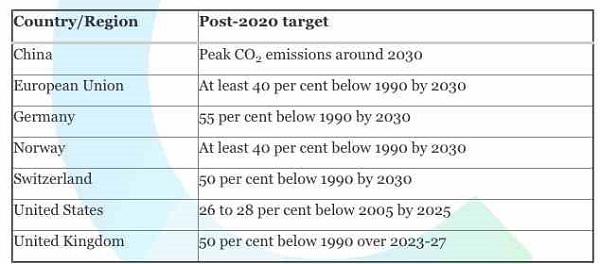
That scenario derives from the IEA world energy outlook 2014 whose “new policies scenario” was based on targets then adopted. The world has now moved on. RenewEconomy gives this table which reflects some of the recent targets announced:

CCA-targets-1_600

The Conversation has an interactive map to monitor countries’ contributions as they come in.

The discussion paper notes that Australia’s population is growing much faster than comparable countries, and that we have an economy more heavily dependent on coal. This sounds like a set-up for special pleading. The Climate Change Authority thoroughly examined our circumstances last year and argued for a reduction trajectory range of between 40 and 60% below 2000 levels by 2030.

Parkinson advises that the paper was prepared in the PM’s office, not the environment department, or the foreign affairs department which has carriage over international climate talks. Obviously the subject is too important to leave to people who know or care.

Climate clippings 132

1. Accelerating ice loss from Antarctica shelves

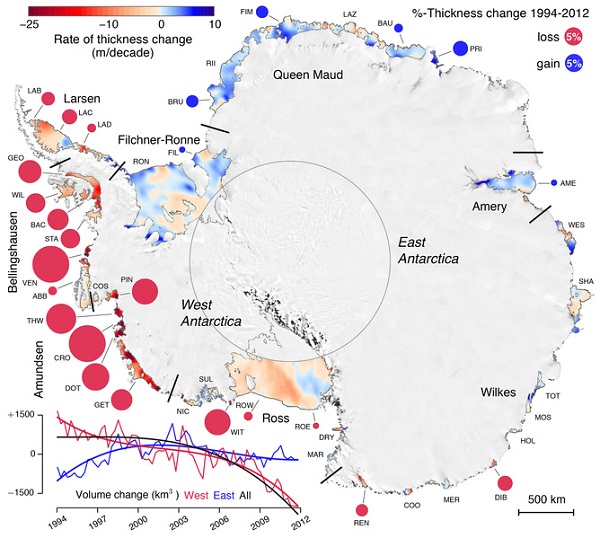
Some ice shelves in Antarctica are thickening and some are thinning. The pattern between east and west is obvious from this image:

ice shelves_image-20150326-8713-1fyzwcb_600

When we sum up losses around Antarctica, we find that the change in volume of all the ice shelves was almost zero in the first decade of our record (1994-2003) but, on average, over 300 cubic kilometers per year were lost between 2003 and 2012.

According to the ABC story, some shelves lost almost 20% of their thickness.

Melting ice shelves does not itself cause sea level rise, but the shelves buttress land ice, which then becomes more mobile. The graph in the bottom corner of the image shows that East Antarctica is now also experiencing a net loss of ice from ice shelves.

2. Top polluters to set own limits virtually penalty free

ANU economist Frank Jotzo said the system is designed so no-one gets caught by it – a toothless tiger. Tony Wood of the Grattan Institute said the ideas proposed in the paper simply would not work. They were commenting on a Government consultation paper outlining “safeguards” to ensure the big polluters do not offset emissions saved through the Emission Reduction Fund (ERF), a flagship component of Direct Action.

Australia’s 140 top polluters will set their own limits for future pollution virtually penalty free, according to the Government’s latest Direct Action policy paper.

Companies subject to the safeguards will select a baseline, or limit, for future pollution.

That baseline will be set according to the highest peak of emissions from the past five years.

Just plain stoopid!

3. What’s going on in the North Atlantic?

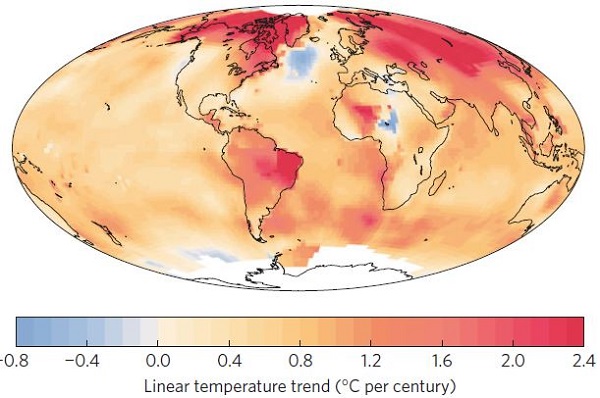
Stefan Rahmstorf asks the question at RealClimate. There is a large patch in the North Atlantic which has cooled in the last century.

Rahmstorf_2015_1rc_600

Rahmstorf explains:

Our recent study (Rahmstorf et al. 2015) attributes this to a weakening of the Gulf Stream System, which is apparently unique in the last thousand years.

In fact during last winter, which was the warmest on record for the planet overall, this patch had the coldest temperatures on record.

Chief suspect has to be the increasing freshwater coming off Greenland. There will be consequences.

The consequences of a large reduction in ocean overturning would look nothing like the Hollywood film The Day After Tomorrow. But they would not be harmless either – e.g. for sea level (Levermann et al. 2005) particularly along the US east coast (Yin et al. 2009), marine ecosystems, fisheries and possibly even storminess in Europe (Woollings et al. 2012).

A complete breakdown of the current was given up to a 10% chance this century in the IPCC report. This may have been an underestimate.

4. Rapid Arctic warming is changing the Jetstream and the weather

Another study, also involving Rahmstorf, looks at changing atmospheric circulation patterns due to Arctic warming.

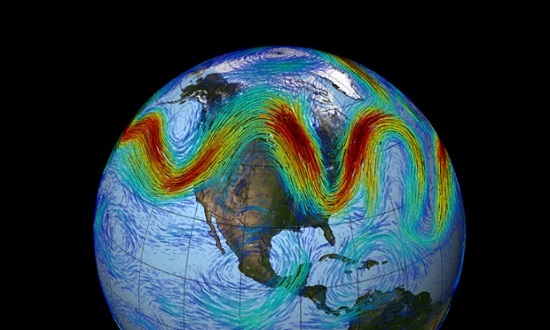
The Arctic is warming faster than lower latitudes. The Jetstream velocity depends on temperature difference, hence it is slowing. It is also more wavy and has a tendency to get stuck, so heat or cold persists over a large area. Ironically, there is less storminess. Storms transport water onto land and break up persistent weather patterns.

The jet stream that circles Earth’s north pole travels west to east. But when the jet stream interacts with a Rossby wave, as shown here, the winds can wander far north and south.

Jet stream_b7acb6bc-724d-4e2e-9078-17bb01ce052b-550

5. Brisbane EV charging technology takes on the world

Brisbane-based electric vehicle infrastructure company, Tritium, has done a deal to supply its award-winning Veefil DC fast charging stations to America’s ChargePoint company. ChargePoint has 21,000 EV chargers around the US.

The Australian-made stations will be installed on major routes across the country, including the express charging corridors on both the east and west coasts of the US that are being built as part of a recent deal between ChargePoint, Volkswagen and BMW.

The 50kW Veefil stations – which in the US will be called DC Fast stations and will be ChargePoint branded – are able to deliver up to 80 miles or 128 kilometers of charge in just 20 minutes, thus removing one of the key barriers to EV uptake: range anxiety.

IEA world energy outlook 2014

By 2040 three quarters of our energy will still come from fossil fuels, with global energy demand increasing by 37% and emissions increasing by 20%, according to the IEA world energy outlook 2014. IEA Chief Economist Fatih Birol:

The International Energy Agency estimates the planet is on track to warm by 3.6 degrees Celsius. Investment in renewables needs to quadruple to an average of $1.6 trillion every year through 2040 to meet the 2-degree target.

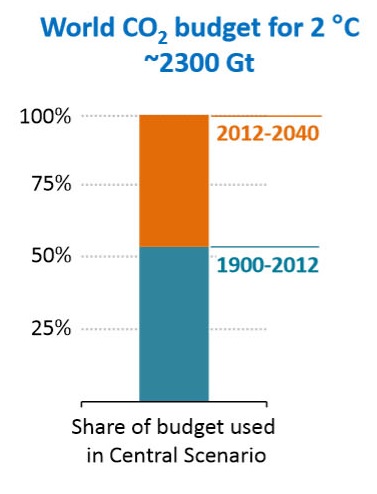
Taking the world’s CO2 budget to limit warming to 2°C as 2,300 Gt of CO2 from 1900, we have 1,000 Gt left from 2014, and are set to use all of it by 2040:

CO2 budget_dropped

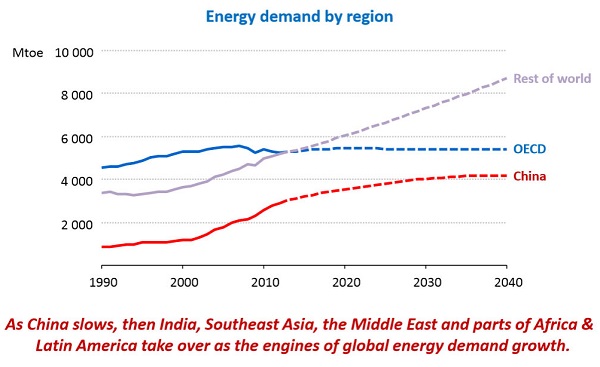
Overall energy demand is set to grow by 1% pa, about half the growth experienced in recent decades. Demand is flat in the OECD, slowing in China, but growing vigorously in the rest of the world:

Growth_cropped_600

By 2040, the world’s energy supply mix will divide into four almost-equal parts: oil, gas, coal and low-carbon sources, including renewables, hydro and nuclear. Growth in oil and coal will taper to nothing, but gas will grow vigorously, with demand increasing by 50% by 2040.

Oil

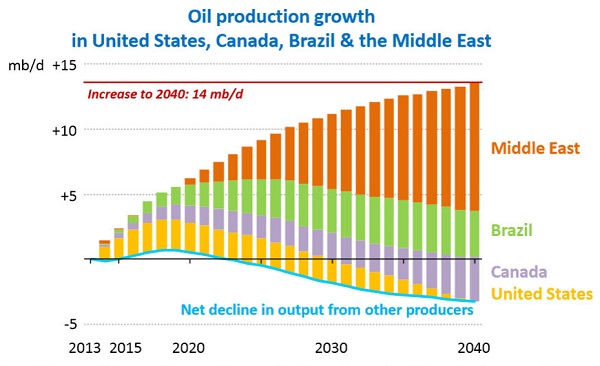
World oil supply rises to 104 million barrels per day (mb/d) in 2040, but hinges critically on investments in the Middle East. As tight oil output in the United States levels off, and non-OPEC supply falls back in the 2020s, the Middle East becomes the major source of supply growth. Growth in world oil demand slows to a near halt by 2040: demand in many of today’s largest consumers either already being in long-term decline by 2040 (the United States, European Union and Japan) or having essentially reached a plateau (China, Russia and Brazil). China overtakes the United States as the largest oil consumer around 2030 but, as its demand growth slows, India emerges as a key driver of growth, as do sub-Saharan Africa, the Middle East and Southeast Asia.

The changes in supply are shown graphically below:

Oil_cropped_600

Concern is expressed that ISIS is deterring investment in production in Iraq.

Oil prices are likely to rebound, averaging $82.50 a barrel in 2015 and rising to near $100 in the coming years.

Coal

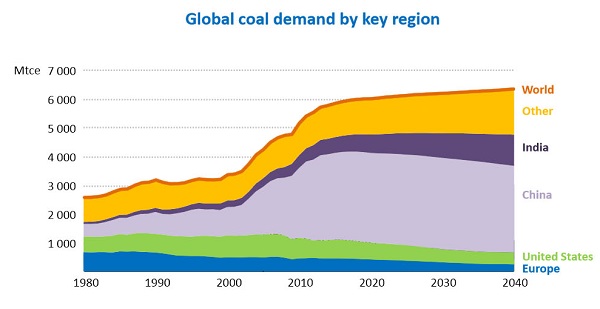
Global coal demand will grow by 15% to 2040, but almost two-thirds of the increase will occur over the next 10 years.

Chinese coal demand plateaus at just over 50% of global consumption, before falling back after 2030. Demand declines in the OECD, including the United States, where coal use for electricity generation plunges by more than one-third. India overtakes the United States as the world’s second-biggest coal consumer before 2020, and soon after surpasses China as the largest importer.

Australia will pass Indonesia to once again become the largest exporter by 2030.

The graph shows the importance of China in the global market:

Coal_scropped_600

The graph also highlights the folly of India and developing countries polluting their way to prosperity.

Gas

The key uncertainty – outside North America – is whether gas can be made available at prices that are attractive to consumers while still offering incentives for the necessary large capital-intensive investments in gas supply; this is an issue of domestic regulation in many of the emerging non-OECD markets, notably in India and across the Middle East, as well as a concern in international trade.

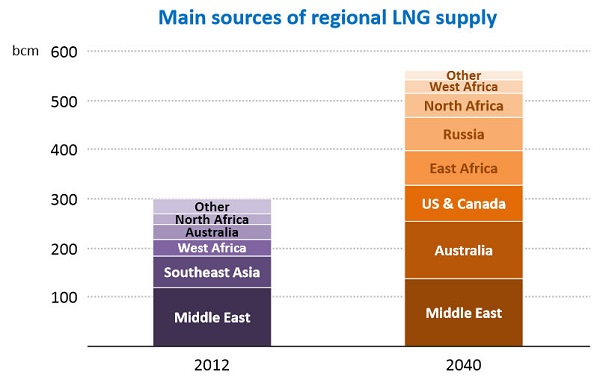
If these uncertainties are met the world gas market will be transformed with Australia a major beneficiary:

Gas_cropped_600

60% of gas will be ‘unconventional’, meaning shale and coal seam.

There is uncertainty about the $900 billion per year in upstream oil and gas development needed by the 2030s to meet projected demand.

Nuclear

The IEA sees global nuclear power capacity increasing by almost 60%. However, its share of global electricity generation will rise by just one percentage point to 12%.

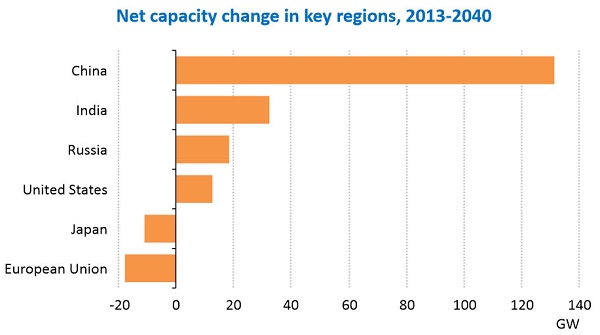
Some 38% of existing capacity will be retired. Once again the importance of China is seen in this graph of the changes in capacity of the key players:

Nuclear_cropped_600

Renewables

Renewables will account for almost half of the increase in total electricity generation to 2040.

The share of renewables in power generation increases most in OECD countries, reaching 37%, and their growth is equivalent to the entire net increase in OECD electricity supply. However, generation from renewables grows more than twice as much in non-OECD countries, led by China, India, Latin America and Africa. Globally, wind power accounts for the largest share of growth in renewables-based generation (34%), followed by hydropower (30%) and solar technologies (18%).

Global subsidies amount to $120 billion compared to $550 billion for fossil fuels.

The growth in hydropower is an ecological concern.

Paris and prices

The Executive Summary leads with a statement about the uncertainty of energy futures in very troubled times, so the IEA forecasts must be seen in this light. The IEA is urging strong intervention by decision makers in the UNFCCC conference in Paris in December, to avoid a climate catastrophe. They call it the last chance. Worth noting here is that the 2011 World Energy Outlook found that all new power supply built after 2017 would need to be zero carbon.

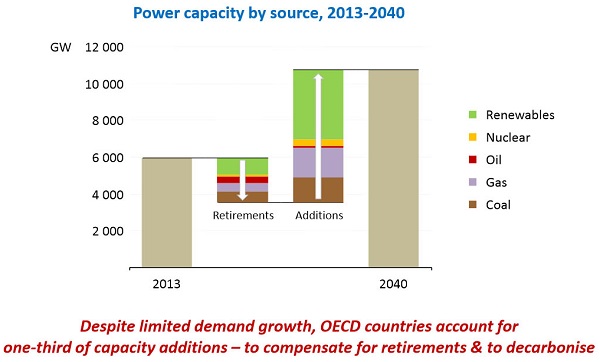
I’m not sure the IEA is fully aware of how cheap renewable technologies are becoming, and how disruptive these technologies will be. Nevertheless their mainstream future, dubbed the “central scenario”, already has renewables comprising about half of new capacity. The changing pattern in power supply is captured as follows:

Power capacity by source_cropped_600

Clearly we are relying too much on gas and coal for new supply, and we need to retire more dirty power, especially brown coal.

Sources

Unfortunately one can’t read the full report without buying it so I’ve had to make do with links, mostly from this page. The Executive Summary provides the story in words, the pictures all come from the London presentation.

See also Peter Hannam at the SMH, my 2011 post on the 2011 report and Climate clippings 103, Item 4 for a brief treatment of World Energy Investment Outlook 2014.

Also relevant is Mark Diesendorf’s plan for 100% renewable energy in Australia.

BP’s vision

Finally, BP has taken a look at the future. What they find is not dissimilar to the IEA, just heading down the crapper a bit faster. They see global energy consumption in 2035 as 37% greater than now and CO2 emissions 25% more. They see a clear role for themselves to make a buck while cooking the planet.

Climate clippings 129

1. Polar bears – uncertain future

The Mail on Sunday recently declared the polar bear in good shape on the basis of the opinion of biologist Dr Susan Crockford, who says:

“On almost every measure, things are looking good for polar bears … It really is time for the doom and gloom about polar bears to stop.”

It turns out that Crockford’s expertise is the archaeology of dead dogs and the identification of animal remains, and receives funding from the Heartland Institute to spread disinformation about human agency in climate change.

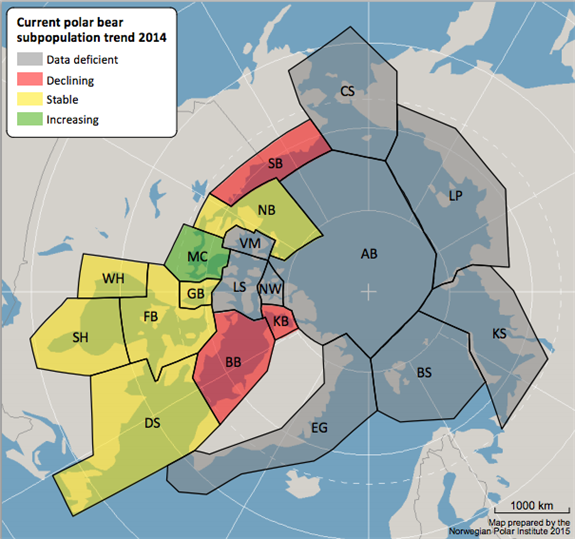
Information, reliable or not, is difficult to come by. This is a snapshot of one estimate of how the polar bear is travelling:

Polar bears_screenshot-2015-03-04-154610_575x539

In nine of the 19 populations of polar bears information is deficient.

On their future the best estimate is:

To keep polar numbers relatively healthy, though still lower than today, scientists suggest global temperatures should not exceed 1.25 degrees Celsius above the 1980-1999 average.

2. Arctic sea ice is getting thinner faster than expected

Measuring the thickness of the Arctic sea ice sheet is not a simple matter. data from disparate sources has been brought together for the first time.

in the central part of the Arctic Ocean basin, sea ice has thinned by 65% since 1975. During September, when the ice reaches its annual minimum, ice thickness is down by a stunning 85%.

3. UK auctions for renewables

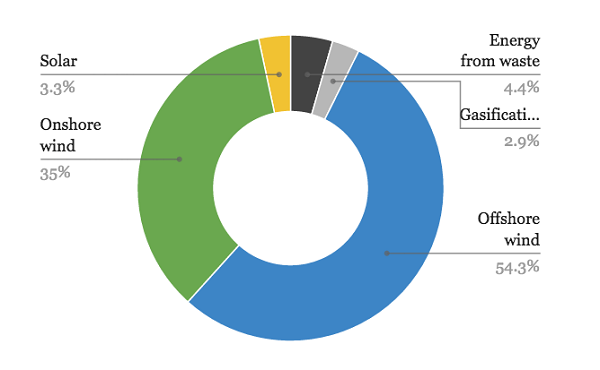
Contracts worth £315 million have been awarded to 27 renewable energy projects with a combined capacity of 2.1 gigawatts.

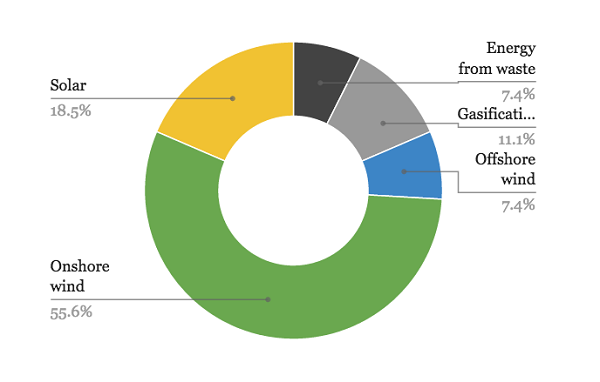
The majority of the 27 schemes are windfarms, including 15 onshore and two offshore schemes (the blue and green chunks below). The remaining contracts went to five solar farms (yellow) and five schemes that will burn or gasify waste to generate energy (black and grey).

UK_Screen Shot 2015-02-26 at 15.48.48_600

By peak capacity the outcome looks rather different:

UK_Screen Shot 2015-02-26 at 15.48.54_600

The auction was divided into two pots, with one pot reserved for “less established” technologies.

The big surprise was the prices, which were lower than expected.

4. Keystone XL pipeline bill vetoed

It’s important to note that the pipeline bill has been vetoed, not the pipeline.

Keystone is not dead. The bill was a political Tea party move to pre-empt State Department approval, which will now continue until a recommendation in made to John Kerry as Secretary of State.

Meanwhile Nebraska landowners are fighting a case in the courts. They claim state law giving TransCanada the right to drive the pipeline through their land under ’eminent domain’ is unconstitutional.

If the landowners succeed TransCanada does not have a route for the pipeline.

A longer post on the issue is here.

5. The IPCC reviews it’s processes

Every seven years the IPCC publishes three whopping reports followed by a Synthesis Report. Working Group 1 looks at the physical basis of climate change. Working Group 2 looks at impacts, adaptation and vulnerability. Working Group 3 looks at mitigation. Each of these whopping tomes has a Summary for Policy Makers of about 30 pages.

The main decision is that the program will continue with some minor modifications. They will try to link the second and third volumes more specifically to the first, while producing the whole series within about 18 months.

More special reports on specific issued will be produced during the interim years.

They will try to make the summaries for policy makers more readable.

6. NZ infestation of flat-earthers climate denialists

The Dominion Post is the newspaper of record for New Zealand’s capital city, Wellington. Last Friday it featured an opinion piece by high profile climate denialists Bob Carter and Bryan Leyland titled Hypothetical global warming: scepticism needed. Gareth Renownden at Hot topic calls it

a “Gish Gallop” of untruths, half-truths and misrepresentations — a piece so riddled with deliberate errors and gross misrepresentations that it beggars belief that any quality newspaper would give it space.

He then identifies 24 specific errors or misrepresentations.

7. EU adopts climate change targets for Paris conference

The EU formally adopted on Friday climate change targets for December’s Paris conference including a 40 percent cut in emissions by 2030, climate commissioner Miguel Arias Canete said.

The targets were agreed on by leaders of the 28 European Union member states at a summit in October, but the confirmed benchmarks have now been officially sent to the UN, Canete said.

The EU was the second after Switzerland to publish its submission.

In other EU news, the Commission is to spend €100 million on projects aimed at connecting energy networks across the continent.

8. El Niño finally arrives

El Niño has finally arrived at a time of the year when they usually decay. It’s weaker than usual and is unlikely to have much impact on world weather.

9. US weather conundrum

Last week I reported (Item 1) that the planet had just experienced the hottest 12 months, while it was freezing in eastern North America during January and February and into March.

Because winter includes December and December was mild, no state had a record low winter. In fact the East’s brutal cold was offset by record warmth in the West, which was caused by warmth in the Northern Pacific. The experts think this pushed the jet stream out of shape, bringing Arctic air further south in the east.

It seems the Northern Pacific warmth has now moved to the Central Pacific, causing the weak El Niño referred to above.

Reminder Climate clippings is an open thread and can be used for exchanging news and views on climate.

Climate clippings 128

1. Hot and cold

My sister in Toronto tells us how cold it has been. She can’t remember the last time it reached -5°C.

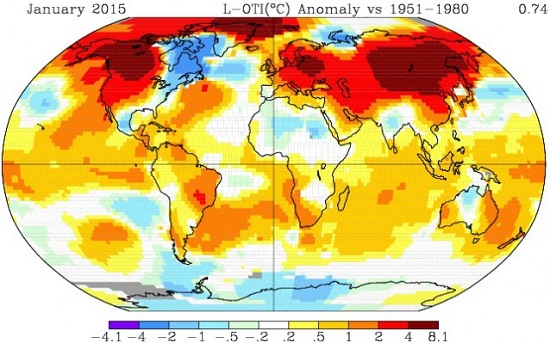
Yet NASA finds that Feb 2014 to Jan 2015 was the hottest 12 months on record. The picture tells the story:

NASA1-15-550

2. Record megadroughts predicted

The American Southwest and the great Plains could experience the worst megadroughts in ancient and modern times.

According to the findings, future droughts in both regions will be more severe than even the hottest, driest megadroughts of the 12th and 13th centuries, which are believed to have contributed to the fall of ancient Native American civilizations that inhabited the Southwest, such as the Pueblo Indians.

Climate Central gives the odds.

The chances of a megadrought (lasting 35 years or longer) are up to 50%.

The odds of a decade-long drought are around 90%.

There’s also a 5-10 percent chance that parts of the region could see a state of “permanent” megadrought lasting 50 years or longer under the highest-warming scenario, a greenhouse gas emissions path we’re currently on.

3. New era of climate action and hope

Christiana Figueres reckons 2015 is going to be a transformational year in climate change action. She of course is the boss-person of the United Nations Framework Convention on Climate Change (UNFCCC) which is sponsoring the Paris talks in December.

Amongst other things she mentions the June Live Earth concerts initiated by Al Gore and Kevin Wall (reviving their 2007 effort) to be held in New York, South Africa, Australia, China, Brazil and Paris.

She also plugs the UNFCCC’s Momentum for Change initiative, including Lighthouse Activities.

4. UK parties in pact on climate change

David Cameron, Nick Clegg and Ed Miliband have agreed to work together to tackle climate change, as they warned it posed a threat to national security and economic prosperity.

In what might be seen as a surprising move in the run-up to the general election, the three party leaders have pledged to work “across party lines” to agree cuts to the UK’s carbon emissions.

They have also signed up to seeking a “fair, strong, legally binding” international climate deal, set to be negotiated in Paris at the end of the year, to limit global temperature rises to below 2C – the level beyond which “dangerous” climate change is expected.

And they pledged to move to a low-carbon economy, ending the use of coal without technology to capture and store its emissions for power generation. (Emphasis added)

5. Tesla’s fancy home battery

Tesla will start production in about six months, all going well.

“We are going to unveil the Tesla home battery, the consumer battery that would be for use in people’s houses or businesses fairly soon.”

“Some will be like the Model S pack: something flat, 5 inches off the wall, wall mounted, with a beautiful cover, an integrated bi-directional inverter, and plug and play.”

Thanks to Geoff Henderson who linked to this one recently at Saturday Salon. Yes, it could indeed be a game changer.

6. Laser ignition to replace spark plugs

A team at Princeton Optronics working on replacing conventional spark plugs with laser igniters has produced a running engine and they claim that replacing spark ignition with lasers could improve the efficiency of gasoline powered engines by 27%. Considering that the basic design of the spark plug hasn’t really changed in over a century, this would be a revolutionary step, frickin’ lasers or not.

Because the spark plug is located on the edge of the combustion chamber, not all of the fuel is combusted. Laser ignition can be directed to the centre of the chamber, or in fact to multiple parts of the chamber in extremely rapid succession. Ignition can also be more accurately timed in relation to the movement of the piston. The result is a more complete burn and greater fuel efficiency.

7. Climate oscillations and the global warming faux pause

Michael Mann posts on research he was conducted, with others, on multidecadal climate oscillations in the Pacific and the Atlantic Oceans. They found that the Pacific dominates and was the predominant cause of a slight slowing in predicted warming over the past decade-and-a-half or so.

It is possible that the downturn in the PMO [Pacific Multidecadal Oscillation] itself reflects a “dynamical response” of the climate to global warming. Indeed, I have suggested this possibility before. But the state-of-the-art climate model simulations analyzed in our current study suggest that this phenomenon is a manifestation of purely random, internal oscillations in the climate system.

This has implications for the future.

Given the pattern of past historical variation, this trend will likely reverse with internal variability, instead adding to anthropogenic warming in the coming decades.

The “false pause” may simply have been a cause for false complacency, when it comes to averting dangerous climate change.

Reminder Climate clippings is an open thread and can be used for exchanging news and views on climate.

Welcome to the the Green Tea Coalition

Traditionally, doubting climate science has been an article of faith for the US Tea Party.  Imagine my surprise at seeing this New Yorker  report that sections of the Tea Party are now actively supporting rooftop solar and teaming up with the Sierra Club to form the “Green Tea Coalition.  Coalition action includes:

helping defeat an effort by Georgia Power to impose heavy fees on customers with rooftop solar systems.”

So what is going on and are there implications for climate action in Australia?

The Tea party leader behind these moves is Debbie Dooley.  Debbie is definitely not someone from the Tea party fringe. She is

one of the twenty-two organizers of the first nationwide Tea Party protest, in 2009…. a co-founder of the Atlanta Tea Party, on the board of directors of the national Tea Party Patriots, and, since 2012, has been a fierce solar-power advocate.

In addition, much of what she says in support of solar is pure Tea Party:

“I thought that the regulated (utility) monopoly in Georgia had far too much power…” Solar, …. promised to give people energy autonomy. “The average person cannot build a power plant, but they can install solar panels on their rooftop, and they should be able to sell that energy to friends and neighbors if they wish.”

She also talks about:

solar energy, the free market, consumer choice, and national security. “Rooftop solar makes it harder for terrorists to render a devastating blow to our power grid,” she said. “There’s nothing more centralized in our nation. If terrorists were able to take down nine key substations, it would cause a blackout coast to coast.”….

and actions such as leading

a major ballot initiative that would amend that state’s (Florida) constitution to allow individuals and businesses with solar panels to sell the power that they generate directly to their tenants or neighbors. (Current law permits only utility companies to sell electricity.)

The key things here are a growing aversion to big business trying to limit the freedom of individuals in addition in addition to the traditional Tea Party aversion to big government.  There is no suggestion that the Tea party side of the coalition has suddenly decided to become climate change believers.

So what are the lessons for Australia given that the Tea party is an artifact of US culture?   For me there a few key reminders:

  1. You don’t have to believe in climate science to do things that help slow climate change.
  2. In some cases ideological things like individualism. aversion to big business/government will help with things like rooftop solar, household recycling, urban farming etc.
  3. In other cases the fracking companies are helping build the case against fossil gas while helping to build the regional Greens vote.
  4. Then there is finance.  The thing that is most likely to kill thermal coal projects and fossil power stations these days is the banks perception that these have become very risky investments.
  5. Then there is the economy.   What the world economy needs right now is a big drive against Greenhouse emissions – You don’t need to believe in climate science – Just sensible economics.

No, I haven’t gone over to the Tea party but it is worth reading the rest of the New Yorker article on the fights that Dooley has fought and won against the likes of the Koch Bros and more.

If you want to find out even more, admire the picture, imagine Abbott stewing in the Tea Cup and go to:  Green Tea Coalition

Green Tea Coalition

Bi-partisan Coalition of Environmentalists and tea party activists seeking common ground on common sense energy solutions for a stronger American economy.

Climate clippings 127

1. Queensland’s minister for the reef

Premier Palaszczuk’s new ministry contained some surprises, including the appointment of Steven Miles as Minister for the Great Barrier Reef. His full handle is Minister for Environment and Heritage Protection, Minister for National Parks and the Great Barrier Reef.

According to the WWF, Minister Miles will be responsible for delivering ALP environmental commitments including: a ban on dumping dredge spoil in the Great Barrier Reef World Heritage Area; an 80 per cent reduction in pollution run-off into the Reef by 2025; and the reinstatement of key legal safeguards.

2. Japan now has more EV chargers than petrol stations

The number of EV charging points in Japan, including fast-chargers and those installed in homes, has reached 40,000, surpassing the nation’s 34,000 gas stations, a new report has found.

The surprising figures were reported last week by Japanese auto giant Nissan, whose fully electric car, the Leaf, has been one of the world’s big EV success stories, selling 160,000 cars globally since its 2011 launch date.

Mainly in Japan, the US and Europe.

It should be noted that some of the charging stations are in private homes. Also petrol stations have multiple pumps, not reflected in the figures.

Tesla has its own network of (solar powered) charging stations in the US – and has plans to build versions of this supercharge network in China, Europe and Australia.

In Australia, local fast-charge tech company, Tritium, installed its first public Veefil EV charger in Brisbane at a BMW dealership in Fortitude Valley – the first of a planned “electric super highway” of fast chargers along the east coast.

3. Temperature records vs trends

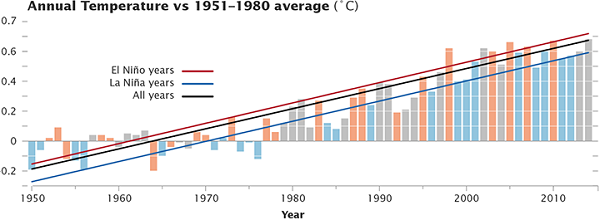
Gavin Schmidt, who has succeeded James Hansen as head of NASA GISS, has some Thoughts on 2014 and ongoing temperature trends. The shorter Schmidt is that while individual records grab the headlines, they don’t matter nearly as much as the underlying trend. This graph shows the overall trend in relation to El Niño and La Niña and years:

graph_gis_2014-1_600

The blue bars represent La Niña years, the orange El Niño and the grey neutral years. 2014 is bang on trend, but only marginally higher than 2005 and 2010. Yet it is grey to their orange.

Schmidt doesn’t mention this, but while 2014 was neutral it did feature anomalous warming in the northern Pacific, rather than the eastern equatorial Pacific warming associated with El Niños. This warming is said to have some of the same climatic effects as El Niño. Perhaps we need a new category with a fancy name.

4. Climate sensitivity conundrums

The term is “equilibrium climate sensitivity” (ECS). It represents “the global surface temperature change anticipated as a result of doubling atmospheric carbon dioxide concentrations.” John Fasullo has done a post on the current challenges and constraints in relation to the concept. It’s technical and I find it a bit boring, but ECS is an absolutely central concept to climate change discourse.

The basic problem is that the IPCC broadened the uncertainty range at the lower end from 2-4.5°C in IPCC4 to 1.5-4.5°C in IPCC5. The likely midpoint is still 3°C.

Fasullo has a lot of complex argument about the constraints arising from observations and models. What I think it comes down to is this.

The cut-off date for published papers for IPCC5 was July 2012. Prior to that date there had been several papers suggesting uncertainty at the lower end. Now the literature has swung back the other way. There was also the ‘warming pause’, which for a while back there was deemed by some to be real.

Fasullo makes it clear that the calculations are based largely on short-term effects. In Climate clippings 125 I referred to a David Spratt article which refers to the work of Hansen, Tripati and others which put longer term ECS at 4.5°C or more. And part of the point of the Michael Mann article was that we are starting to get into the longer term feedback zone.

I think they should all go back and read Hansen et al Earth’s Energy Imbalance and Implications (2011, I think) pages 4-18. The table on p17 gives ECS at 8°C or more, depending on certain definitions and circumstances.

5. Origin Energy to build Australia’s biggest rooftop solar array

Origin Energy and Zen Energy Systems are to build a 3MW solar system on the rooftop of the old Mitsubishi factory in Tonsley, Adelaide, in what will be the largest rooftop solar array in the country.

The awarding of the contracts was announced by the South Australian government this week. The intention to build the array was first announced late last year.

Origin Energy will own the rooftop array and sell the output to the tenants of the Tonsley high tech centre…, under a power purchase agreement that it is looking at replicating elsewhere in the country.

Here’s an artist’s impression of the site:

tonsley-solar-300x148

6. Origin shifts retail focus to rooftop solar and battery storage

Origin Energy has provided further details of its impending major push into the domestic solar market, saying that it expects rooftop solar to grow five-fold over the next 15 years, and battery storage will also emerge.

The Tonsley centre initiative is one example of this company reorientation. Seems AGL is looking to follow suit.

Climate clippings 125

1. Paris climate talks won’t keep warming below the dangerous 2°C Limit

Joe Romm at Climate Progress believes the Paris climate talks should not be written off as a failure if they don’t do enough to keep warming below 2°C. He thinks the CFC ozone layer example is apt. The Montreal Protocol was concluded in 1987. Initially the protocol’s targets and timetables slowed the rate of growth of concentrations only slightly and would have still led to millions of extra cases of skin cancer by mid-century.

President Reagan endorsed the protocol, and the Senate ratified it. By the end of 1988, 29 countries and the European Economic Community — but not China or India — had ratified it. The treaty came into effect the next year. But it took many more years of negotiations, continuous strengthening of the scientific consensus, and significant concessions to developing countries before amendments to the treaty were strong enough and had enough support from both rich and poor countries to ensure that CFC concentrations in the air would be reduced.

Elsewhere 14 high-profile CEOs want to decarbonise the economy completely by 2050. They are the B Team led by Virgin founder Richard Branson. See also at The Guardian.

2. 2013 record heatwave ‘virtually impossible’ without climate change

That’s according to a new report from the Climate Council.

From The Guardian:

The country experienced its hottest day, month, season and calendar year in 2013, registering a mean temperature 1.2C above the 1961-90 average.

The Climate Council says recent studies show those heat events would have occurred only once every 12,300 years without greenhouse gas emissions from human activities.

Record hot days have doubled in Australia over the past 50 years. During the past decade heat weather records were set three times more often than cold ones.

Heatwaves across Australia are becoming hotter, lasting longer, occurring more often and starting earlier.

The ABC article has handy links to other sites.

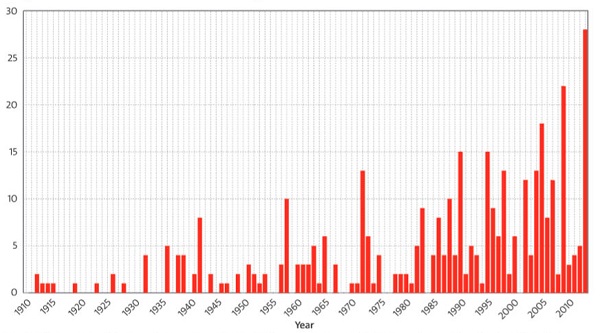
The following graph shows the number of days each year where the Australian area-averaged daily mean temperature was above the 99th percentile for the period 1910-2013:

Hot days Australia_cropped_600

3. Two degrees by 2036

Michael Mann using an Earth energy balance model has calculated that we could reach 2°C of warming as early as 2036. To stay within the 2°C guardrail we need to limit CO2 concentrations to 405 ppm. It would be 450 ppm but for the aerosol issue. If we cease burning coal we lose the cooling effect of the crap that coal spews into the atmosphere along with CO2.

Mann has done the calculation on the basis of climate sensitivity of 3°C. Problem is, he says, that this modelling is based only on short term feedbacks.

David Spratt at Climate Code Red has done a long and thorough post based on Mann’s article. Spratt looks in some detail at the longer term climate sensitivity issue, drawing also on the work of James Hansen, Aradhna Tripati and others. Hansen found that climate sensitivity with long term feedbacks was considerably higher than 3°C; Tripati found that in the Miocene with CO2 concentrations similar to now “temperatures were ~3° to 6°C warmer and sea level was 25 to 40 meters higher than at present”.

Spratt also reminds us that 2°C warming is not safe.

4. Would turfing Abbott help climate change policy?

In short, yes, but perhaps not a lot. The conservative side of politics is still infested with climate change denialists.

Mother Jones in an article One of the World’s Worst Climate Villains Could Soon Be Booted From Office would clearly like to see the back of Abbott. Julie Bishop has a background of denialism, but is pragmatic and has understood from the Lima experience that our stance on climate is negatively affecting our international standing.

Turnbull stated back in 2009:

“I will not lead a party that is not as committed to effective action on climate change as I am.”

He would now, of course.

Tristan Edis looks at actions Turnbull might get away with. Giles Parkinson thinks he might rescue renewable energy and could adapt Direct Action into a baseline and credit scheme.

See also Lenore Taylor at The Guardian.

Climate clippings 122

1. Court challenge will test coal mining’s climate culpability

A new legal challenge to the proposed Carmichael coal mine – Australia’s largest – will test in the federal court whether climate change caused by greenhouse gas emissions should be taken into account when assessing prospective coal licences in Australia.

The challenge, by the New South Wales Environmental Defenders Office on behalf of the Mackay Conservation Group, will argue that federal environment minister Greg Hunt failed to take into account the climate impact of greenhouse gases emitted by the burning of coal from the Carmichael mine when assessing whether to grant its licence.

It cites the impact of global warming on the Great Barrier reef, an area of world and national heritage, as a relevant consideration which the minister should have been taken into account.

The linked article cites some of the legal precedents, which show that this case is far from vexatious or frivolous.

Interesting!

2. Queensland Labor renews support for coal

0a0cf284-0505-4e4e-a7c3-4ec2c99d7884-600

Outgoing deputy Labor leader, Tim Mulherin, said coal remained “an important and vital energy source for Queensland and the rest of the world”.

Thermal coal from nine proposed projects in the Galilee, when burned in export markets such as China and India, would produce an estimated 705m tonnes of CO2, more than Australia’s total greenhouse gas emissions of 542m tonnes a year.

However, Labor in not going to spend hundreds of millions of dollars on building the railway line to the coast.

3. Humanity is in the existential danger zone

Back in 2009 a team lead by Johan Rockstrom of the Stockholm Resilience Centre identified nine planetary boundaries we should not cross if we are to avoid undermining the biophysical systems upon which our species depends. These nine boundaries are climate change, ocean acidification, stratospheric ozone depletion, alteration of nitrogen and phosphorus cycling, freshwater consumption, land use change, biodiversity loss, aerosol and chemical pollution.

A new paper led by Will Steffen of the ANU and the Stockholm Resilience Centre argues that climate change along with “biodiversity integrity” should be recognised as core elements of the Earth system. We are in trouble with both.

The world as we know it developed during the Holocene from which we are rapidly departing. We need urgently to get atmospheric concentrations of CO2 back to 350 ppm.

Background extinction rates without human impacts are thought to be about ten a year per million species.

Current extinction rates are anywhere between 100 to 1000 times higher than that.

4. Catholics in Australia join global movement to curb climate change

Australia’s Catholics are preparing to step up campaigns to address climate change ahead of an expected call to action by Pope Francis.

The Global Catholic Climate Movement, an international coalition of Catholic groups including Catholic Earthcare Australia, was launched on Thursday to bolster support for a global climate treaty at the Paris summit planned for December.

5. NOAA declares 2014 the hottest

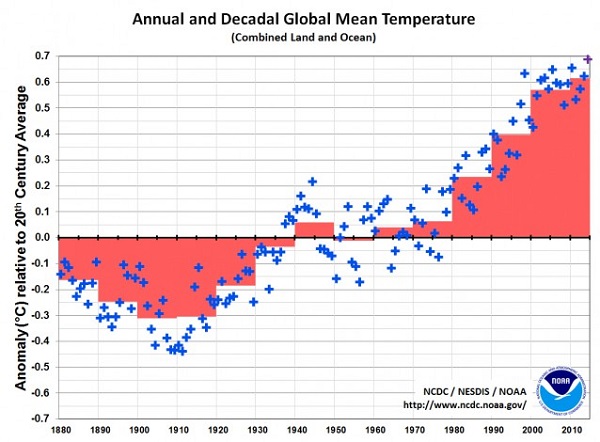
NOAA has declared 2014 the hottest year to date with this graphic:

decadal-NOAA 2014-600

If you drew parallel trend lines from about 1970 it would be full bore ahead with 1998 a slight outlier.

At Climate Central we are told that 13 of hottest 15 years on record have all occurred since 2000. The odds of that happening randomly without the boost of global warming are 1 in 27 million.

6. Sea level rise

There’s been some excitement about a new study of sea level rise. The difficulty in establishing long term trends is that prior to the satellite era (1979, I think) it has been very difficult to establish what happened. Data is globally patchy and incomplete. Tide gauge measurements suffer because the wind blows the water around, and the land that it is referenced to might be rising or sinking.

The clearest account of the new research by Carling Hay and others I’ve found is at Carbon Brief. Hay et al found sea levels from 1900 to 1990 to be 1.2 mm pa on average, lower than the 1.5 previously thought. This makes current sea level rise some two and a half times faster, with the implication that ice sheets a contributing more than previously thought.

Over at RealClimate Stefan Rahmstorf gives a technical review of the state of play. He regards the new research as important, but his bottom line is this:

Ultimately, it is not clear down to what level of accuracy we will ever know the sea level evolution over the past hundred years or so. But for practical purposes, I don’t think it matters whether the rise from 1900 AD has been 3 centimetres more or less. I do not think this changes our outlook for future sea-level rise in any significant way.

But if I understand him correctly, he would already have been considerably concerned about the decay of ice sheets and how that process could accelerate. However, he strikes me as wanting to be super careful not to run ahead of the data, which is entirely commendable.

One comment was that this research could add a metre to prospective sea level rise this century. I think Rahmstorf is suggesting that is premature.

Carbon pricing: a dangerous distraction?

It is almost axiomatic to say that the mitigation necessary for 2°C limit to warming is best delivered through market-based instruments (MBIs) – where a price is placed on each tonne of carbon dioxide emitted.

Dissenter-in-chief is Kevin Anderson, professor of energy and climate change at the University of Manchester and deputy director of the Tyndall Centre, the UK’s leading academic climate change research organisation:

I hold that such an approach is doomed to failure and is a dangerous distraction from a comprehensive regulatory and standard based framework (within which price mechanisms may play a niche role).

Crucial in making this judgement is the notion that the mitigation rates are not marginal. We don’t need to knock off just one or two percent of emissions each year. We need, says Anderson, a whopping 10% per annum.

That seems extraordinary, but I’ll repeat here three graphs I’ve used before. They all come from 2009, the last two from The Copenhagen Diagnosis.

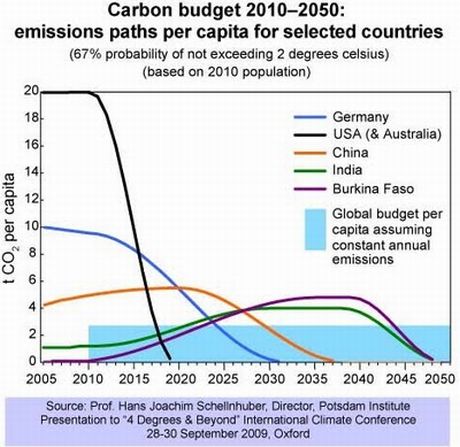
First we have Hans Joachim Schellnhuber’s estimate of the reductions needed using the ‘budget approach’, whereby the budget of permissible emissions is divided between countries on a per capita basis, and then the stabilisation path plotted given their existing per capita emissions levels:

2C trajectories Schellnhuber

Anderson variously says the ‘we’ need to reduce emissions by 80 to 90% by 2030 and to zero soon thereafter. I think he is referring to the UK, which would have a similar stabilisation path to Germany. Note that Schellnhuber is basing these trajectories on only a 67% chance of keeping warming within the 2°C limit.

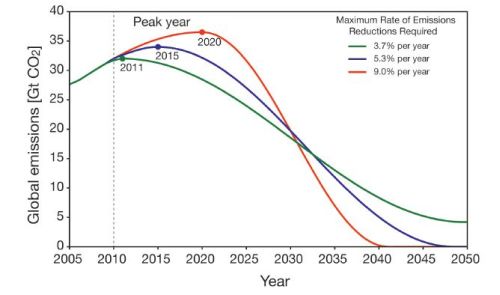
In the second graph the stabilisation path for the whole world is calculated, given different peaking dates:

Copenhagen diagnosis Fig 22 n

That shows a 9% per annum reduction required to reach zero about 2040 with peaking in 2020. In those terms Anderson’s 10% figure is in the ball park.

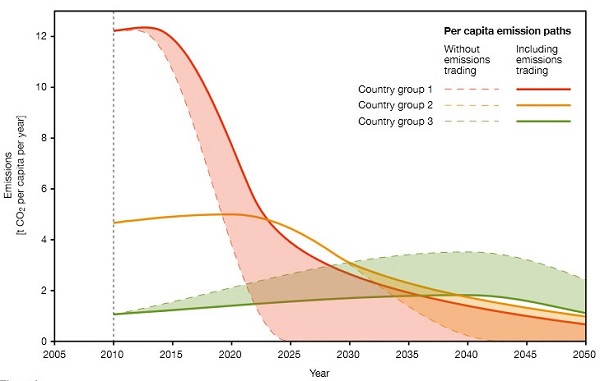
The third graph shows how the trajectories could be varied if countries were grouped into three categories, roughly advanced industrial countries, developing countries and in the middle newly industrialising countries. Carbon trading between them is assumed:

Budget approach with emissions trading_cropped_600

This too is a dangerous distraction. While rational it assumes that China, India and the US will commit themselves to definite reduction paths through international agreement. It’s simply not politically feasible.

I think Anderson is in the right ball park. His argument is that MBIs work fine when the reductions required are marginal. If you crank them up to get the result required a very high price will result. The rich will pay and continue to pollute while the poor will be devastated.

Anderson doesn’t discuss compensation, as was built into the Australian scheme, but pricing and compensation on the scale required is probably not politically feasible.

Anderson favours a regulatory or standards-based approach and gives these examples:

  • Strict energy/emission standards for appliances with a clear long-term market signal of the amount by which the standards would annually tighten; e.g. 100gCO2/km for all new cars commencing 2015 and reducing at 10% each year through to 2030
  • Strict energy supply standards; e.g. for electricity 350gCO2/kWh as the mean emissions level of a suppliers’ portfolio of power stations; tightened at ~10% p.a.
  • A programme of rolling out stringent energy/emission standards for industry equipment
  • Stringent minimum efficiency standards for all properties for sale or rent
  • World leading low-energy standards for all new-build houses, offices etc.
  • Moratorium on airport expansion
  • Technological and operational standards for shipping operating in UK waters
  • A suite of iterative mechanisms to counter, or at least alleviate, issues of rebound; this may include price mechanisms, progressive metering tariffs, etc.
  • Revisit the viability of Personal Carbon Trading as a mechanism for improving societal engagement in non-marginal change
  • Appoint a senior minister with the principal responsibility for maintaining an equitable transition to a low-carbon society

Taking the first two, rather than standards for appliances, I would focus on making stationary electricity supply renewable as an urgent task through direct action. Other than that all the ideas are grist to the mill, but I like John Wiseman’s approach as outlined in the post Climate change: reconnecting politics with reality which concentrates on the necessary political and institutional actions to be taken. After a priministerial announcement he recommends:

Then we would need an Australian Climate Solutions Act which set up the targets, the structures and the priority actions. Principal amongst these would be an Australian Climate Solutions Taskforce chaired by the Prime Minister and drawing from state and local governments, business, trade unions and community organisations.

Then we would need six key action plans.

First, an Australian Renewable Energy Plan to achieve 100 per cent renewable energy within 10 years.

Second, an Australian Economic Electrification Plan with initial priorities including a modal shift in passenger and freight transport from road to rail; the rapid replacement of fossil fuel based cars with electric vehicles; and the full electrification of household and industry heating and cooling.

Third, an Australian Energy Efficiency Plan that identifies the regulatory, planning, educational and financial initiatives that could achieve the overall goal of a rapid transition to a zero waste economy.

Fourth, an Australian Sustainable Consumption Strategy.

Fifth, an Australian Sustainable Agriculture and Forestry Plan designed to reduce land-based emissions and increase carbon sequestration.

Finally, state and local governments, community sector and business organisations would collaborate to develop and implement a comprehensive, long-term Australian Climate Change Adaptation and Resilience Plan.

I applaud the priority Wiseman gives to an Australian Renewable Energy Plan to achieve 100 per cent renewable energy within 10 years.

Carbon pricing similar to the Australian scheme may be one of a suite of actions to send a message and raise funds, but climate action on the scale now required compels us to address the issues much more directly. Overall my aim for the planet would be to reduce atmospheric CO2 to 350 ppm by 2050, for a safe climate. Well, as safe as it ever gets.

Climate clippings 121

1. Denmark winds up wind

In January of 2014, Denmark got just over 61% of its power from wind. For the whole of 2014 it was 39.1%, a world record.

Their leadership is working well for them. Nine out of ten offshore turbines installed globally are made in Denmark. They plan to be fossil fuel free by 2050.

Elsewhere Germany and the UK smash records for wind power generation. Scotland hopes to be fossil fuel free by 2050.

On Boxing day rooftop solar met one third of South Australia’s demand and at least 30% from 11.30am to 3.30pm. Bonaire (pop. 14,500), a small island off the coast of Venezuela, said goodbye diesel and hello 100% renewable electricity.

California Gov. Jerry Brown last week called for

the state’s electric utilities to boost their renewable energy procurements to 50% of retail electric sales and discussed future initiatives to support rooftop solar, battery storage, grid infrastructure and electric vehicles.

As Bill Lawry would say, “It’s all happening!”

2. 2014 the hottest year

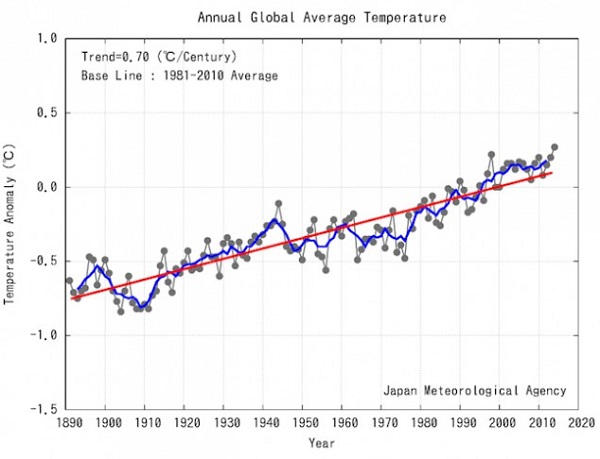
The first set of figures is in, this time from the Japan Meteorological Agency, showing 2014 as the hottest year so far:

JMA2014-cropped_600

The red line is the long-term linear trend.

The blue line is the 5-year running mean.

Australia had the third hottest year on record.

3. Chinese three-wheeler is for real!

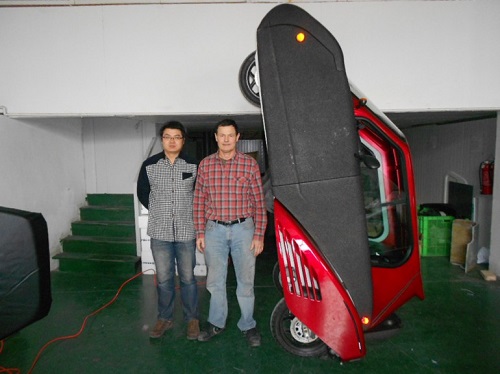
From John D’s Gizmag collection we have the Spira4u three-wheeler car:

spira-production-version-2_500

It’s not a toy, it’s a serious car which has gone into pilot production as a 10 kW electric or a fuel-injected 150 cc version with an economy of 2.94 l/100km (80 mpg).

It has a handy parking option:

spira-production-version-14_500

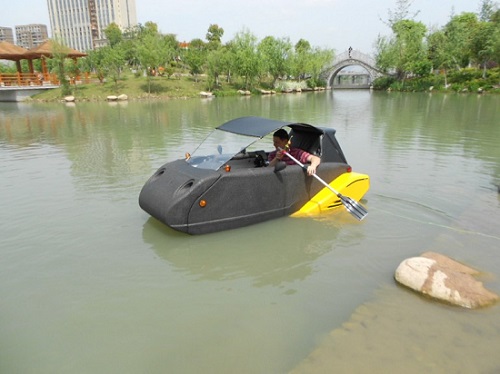
And it floats:

spira-production-version-11_500

An amphibious version is under development.

4. California starts to build a high-speed rail system

The first phase of California’s high-speed rail system will be a 29-mile stretch from Fresno slightly north to the town of Madera. From there the project will link up with urban centers like Los Angeles and San Francisco, eventually allowing commuters to travel between those two cities at 220 mph and cutting the trip from nearly six hours to less than three. The system will eventually extend to Sacramento and San Diego, totaling 800 miles with up to 24 stations.

The full rail system should be in use by 2028.

5. Solar at grid parity in most of world by 2017

At RenewEconomy:

Investment bank Deutsche Bank is predicting that solar systems will be at grid parity in up to 80 per cent of the global market within 2 years, and says the collapse in the oil price will do little to slow down the solar juggernaut.

Quiggin at The Conversation and his place: Only a mug punter would bet on carbon storage over renewables.

6. When you are in a hole, stop digging!

From a study in the journal Nature:

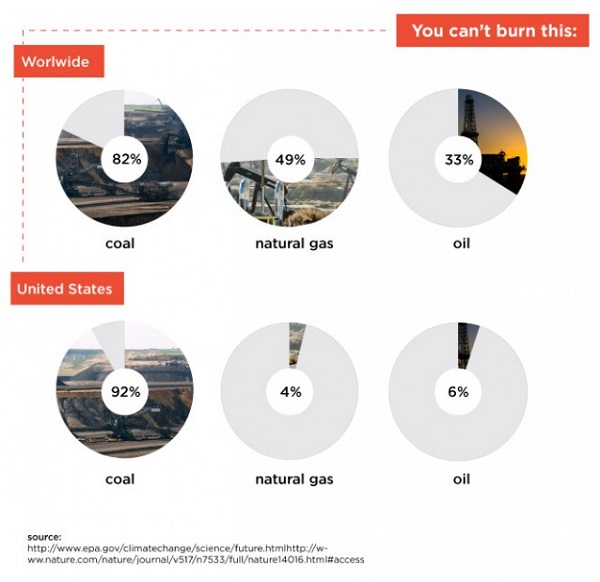
“Our results suggest that, globally, a third of oil reserves, half of gas reserves, and over 80 percent of current coal reserves should remain unused from 2010 to 2050 in order to meet the target of 2°C,” write authors Christophe McGlade and Paul Ekins of University College London.

stay-in-the-ground-cropped_600

Keeping the increase in global temperatures under 2°C will require vast amounts of fossil fuels to be kept in the ground, including 92 percent of U.S. coal, most of Canada’s tar sands, and all of the Arctic’s oil and gas…

In 2013, fossil fuel companies spent some $670bn on exploring for new oil and gas resources. The figure should be zero.

7. Climate change will create more environmental refugees

Natural disasters like Typhoon Haiyan—which devastated the Philippines in 2013 displace more people than war, according to the Internal Displacement Monitoring Center in Geneva. And as climate change sets off increasingly lethal natural disasters, so will the numbers of environmental refugees increase, Reuters reported.

It is a reality that governments must prepare themselves for. In 2013, some 22 million people were displaced by extreme natural disasters like typhoons, earthquakes and tsunamis, a number three times the number of those who were forced to migrate because of war, according to the IDMC.

Earlier this summer New Zealand accepted a family who cited climate change as the reason why they had to flee their homeland, thought to be the world’s first official environmental refugees.