Category Archives: Sundries

Posts on sundry matters of life the universe and everything: Culture, Environment, Life, Politics & Government, Science, Social Science and Society, Technology etc.

The consequences of vertical fiscal imbalance

This is belated, but I still think worthwhile.

Jess Hill’s cracking article in The Monthly (you can read a limited number of articles online per month without a subscription), and the recent Four Corners program on renewable energy, are required consumption for anybody interested in the history and future of electricity supply in Australia.

In short, the electricity distributors (who hold a natural monopoly over their corner of the market) predicted continued growth in electricity demand and then persuaded the energy regulators to let them increase their charges to pay for said infrastructure. This accounted for most of the growth in electricity prices, despite the nonsense about the carbon tax from the right of politics. The reasonableness of these predictions can be debated; the fact that they led to massive profits for the distributors is now clear. In the face of these increased prices, something amazing happened – absolute demand for electricity dropped substantially. Part of this can be attributed to rooftop solar, some to energy efficiency; regardless, the huge infrastructure spend has turned out to be almost completely unnecessary. Along the way, grid electricity generators have felt the squeeze between falling demand and mandated construction of renewable energy through the RET, and are now lobbying hard to prevent more renewable energy being connected to the grid.

The future is a topic for another post, but there is one point about the past and present that Hill’s excellent report hasn’t really gotten in to. Particularly in NSW and Queensland where the price increases have been greatest, the electricity distributors are state-owned, and the profits have gone to the state governments. Dividends from the distributors have filled a pretty substantial gap in those state budgets; however, they’ve done so in an extremely inefficient way. Billions of dollars has been wasted building unnecessary infrastructure so that the state governments could collect revenue from the monopoly profits. Hill’s article reports $45 billion dollars worth of infrastructure has been built nationally; in Victoria’s privately run grid, one third of the infrastructure spending went towards peak capacity augmentation, whereas in NSW and Queensland about two-thirds was spent on the same area. Based on this, my rough guess is that in those two states, at least $7-8 billion was spent on unnecessary capacity augmentation.

In a sane world, if state governments need more revenue, they would raise taxes. But because of Australia’s strange fiscal arrangements, where state governments spend a large fraction of total government revenue but only collect a fraction of it, it’s easier to whinge about the vicissitudes of the Commonwealth Grants Commission and raise this kind of hugely inefficient stealth tax.

So next time somebody mentions “vertical fiscal imbalance” and “narrow tax bases”, try not to let your eyes glaze over. It’s boring, but it’s important.

Senate wrangling as the budget gets mangled

Palmer spoiling Abbott’s party

That was the headline of the sensible Dennis Atkins’ opinion piece in the Courier Mail on Saturday.

Abbott now has to wait until next week and cede the centre stage in the House of Representatives to Clive Palmer, the pest who has become a nemesis while also being the guy the PM cannot ignore.

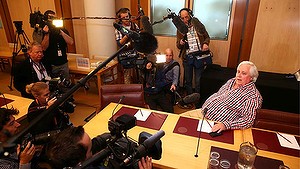
Tony Wright in the SMH describes Palmer as the emperor in the check shirt holding court upon a leather chaise longue at the entrance to the Senate chamber. There “the formerly mighty paid obeisance, begging his mercy”:

Here came Eric Abetz, leader of the government in the Senate; Mitch Fifield, manager of government business in the Senate; Simon Birmingham, parliamentary secretary to the Minister for Environment; all of them very nearly falling to their knees. A swirl of harried government advisers circled and whispered, knowing there was no escape for their masters.

Clive Palmer had no pity to dispense.

His eyes were dead to the presence of the supplicants, his ears closed to their pleading.

Repeal the carbon tax today? No chance.

He drew around him his little band of senators, instructing them on their duty.

And so on.

There is plenty at stake. Atkins article identifies the following:

  • Stopping Newstart for the young for 6 months – $2.1b
  • Changes to family tax benefit B – $1.9b
  • Axing seniors supplement $1.2b
  • Co-payment for pharmaceuticals – $1.2b
  • Higher education cuts – $5b
  • CPI petrol excise rise $4.1b
  • Medicare co-payments $3.6b
  • Freezing family tax benefit indexation – $2.6b
  • Axing family tax supplements $1.2b
  • Other measures – at least $2b.

Right there is $25 billion I assume over forward estimates. Surely Hockey will need a mini-budget to effect repairs, but I hate to think what he might cut in the process assuming he won’t increase taxes.

It’s important to remember, however, that Palmer only becomes potent when Labor and the Greens line up in opposition to the Abbottistas.

And then Palmer only controls three votes whereas Abbott needs six of the eight cross-benchers to line up.

Ricky Muir is stressing his autonomy. Again from the SMH:

Ricky Muir is moving out of the shadow of Clive Palmer, describing his agreement with the Palmer United Party as nothing more than a “loose alliance” and warning the government not to assume he will vote with PUP.

Senator Muir stressed his agreement with the bloc boiled down to being “together but autonomous”.

“The memorandum of understanding [signed with PUP] did say, and I stand by it, we will work together where practical. But we’re going to need to do our own research on every different topic and then work together where practical.”

Topics that interest Muir are:

The so-called ”rev-head senator” outlined personal passions that include organic food, which he grows and eats from his garden in rural Victoria, preventive healthcare, which he is interested in championing at a political level, and renewable energy, following his surprise intervention last week to protect the Australian Renewable Energy Agency from the government’s budget knife.

Giles Parkinson says Muir decided to make his mark in rescuing ARENA after the famous ‘brain freeze’ interview with Mike Willisee.

We’ll have to see whether that means the Government will stop playing hardball. The Guardian reported earlier that industry minister, Ian MacFarlane, had been refusing to renew the contracts of ARENA board members meaning that within a few weeks the secretary of the industry department would be the only remaining board member of the authority. Parkinson emphasises that no investment will flow until confidence is restored.

In this as with the senate generally the Government is struggling to appear in control. Abbott assured the faithful in Brisbane that all was “normal” which Shorten thought delusional. Greg Hunt huffed and puffed and said:

he was “sending a very, very, very clear message” to any crossbenchers who voted against repeal that they would have to “explain themselves” to the Australian people, saying he was “firming up [his] approach from diplomacy to send a very clear message”.

He only said that because he thinks he has PUP, Muir, David Leyonhjelm and Bob Day on board. There’s just one small problem. Clive has been relaxing in New Zealand:

The PUP leader, Clive Palmer, told Guardian Australia that he was on holidays and “oblivious” to any deal, the PUP senators are not scheduled to meet to consider any changes until Monday morning, and four other Senate crossbenchers refuse to guarantee their vote until they see the final form of the agreement.

Still the Government says they are going to call Palmer’s bluff and bring on the vote. I thought that was where they went wrong last week. That included them accepting Palmer’s amendment with all of 15 minutes consideration. Then it all fell apart again. Xenephon:

“I think if the government was asked to put red underpants on their heads in the Senate chamber, I reckon they probably would have done it.”

Still it might all go smoothly and the Government will succeed in stripping another $9 billion off the bottom line!

Last week Tony Wright says:

It was as if Labor’s 36 faceless men of 1963 had been revisited in reverse.

And while all around wore serious suits and smart little business frocks, the big man lounged in chinos and a checked shirt unbuttoned halfway to his belly. An emperor in clothes of his own choosing.

Here’s Palmer at a press conference looking relaxed:

Palmer_art-Palmer_presser-300x0

We wait to see whether the soapie continues!

Se also Disorder in the house.

Noel’s nostalgic trip down memory lane

Noel Cameron-Baehnisch took a trip to Poland in 2004, seeking out the places our ancestors emigrated from in the mid-19th century. Noel was the pathfinder for Len’s trip (see his A journey of ‘Bahnisch’ family discovery in Lower Silesia, Poland). Noel went on a tour with Homeland Tours, led by David Zweck and a Polish guide. Len found the same places with a hired car and a ‘Tom Tom’ with the help of notes supplied by Noel.

First some background on how it all hangs together, then a selection of Noel’s photos, together with edited comments he provided.

Len and Brian are brothers. Noel is the son of their oldest cousin, Mona, who married Jim Cameron.

In the paternal line, Wilhelm (“Willi”) Bähnisch left Motyczyn (then Möttig) as a 17 year old in 1848. He married Franziska Ruciak, who came from Dąbrówka Wielkopolska (then Groß Dammer) as a 15 year old in 1846. Here’s a photo (see Note 1) of Willi:
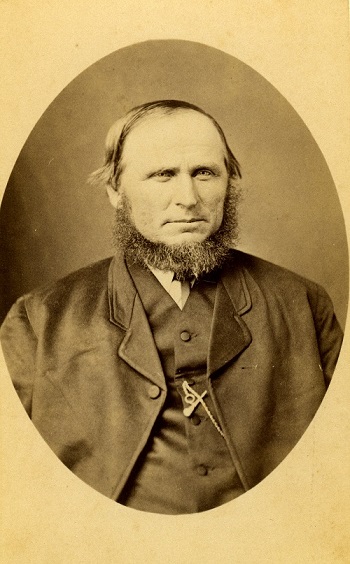
image0000029A_350

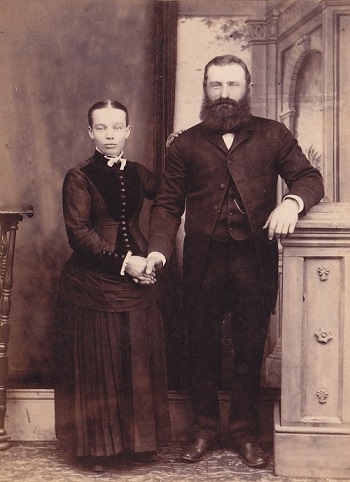
Willi and Franziska had 13 children. Their eighth was also named Wilhelm (“Willi Junior” or “Bill”), Len and Brian’s grandfather. Bill married Louise Gregor. We have a photo (see Note 2) of them also:
EWBjr and Louise GREGOR 1889_upright_cropped p_350

Louise’s parents were Wilhelm August Gregor, who came from Pawłowice Wielkie, formerly Pohlwitz bei Liegnitz or Groß-Pohlwitz, and Ernestine Pauline Schulz from Bielany, formerly Weißenleipe.

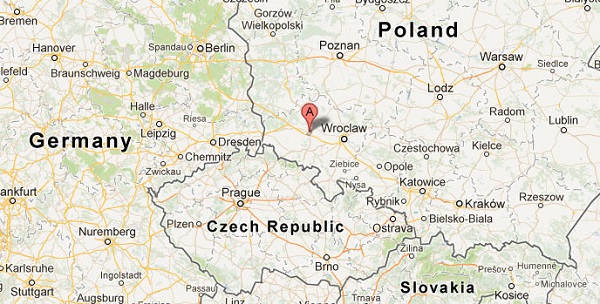
Motyczyn, Pawłowice Wielkie and Bielany are all near Legnica, formerly Liegnitz, a city of some 100,000 people and the main centre of Lower Silesia (Polish: Śląsk; German: Schlesien). It is marked “A” on this map:
Leignitz 2_cropped_again_600

Dąbrówka Wielkopolska is further north, almost due west of Poznań in the province of Posen. Both Posen and Silesia were provinces of the Kingdom of Prussia (German: Königreich Preußen) when our ancestors lived there.

The first photo, taken by Noel’s Polish guide, Bolek, shows Noel leaving Bielany and heading west to Pawłowice Wielkie: it seems to be exactly the same sign as the one in Len’s photos:
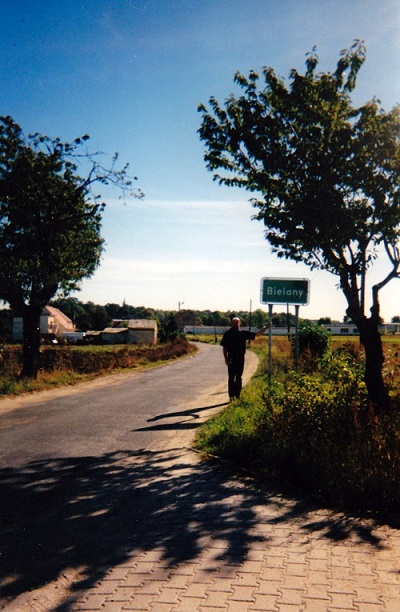
1. Leaving Bielany for Pawlowice_0003_400

Next we have Noel at Pawłowice Wielkie (southern entrance), again taken by Bolek:
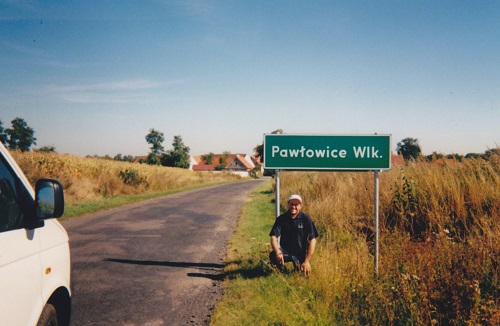
2. NDCB in PW 10 Sept 2004_500

The front of the VW tour van is in shot on the left.

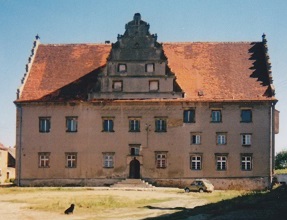
Next we have the Old Manor House in Pawłowice Wielkie, taken by Noel from inside the big courtyard. The little black dog in the photo was quiet but Noel says there was another dog barking at them as they were trespassing.
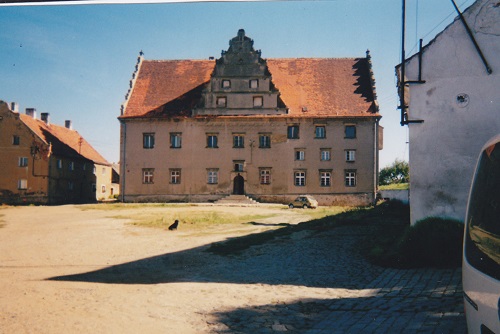
3. Big house in PW_0002_500

On the same day the tour went to Motyczyn:
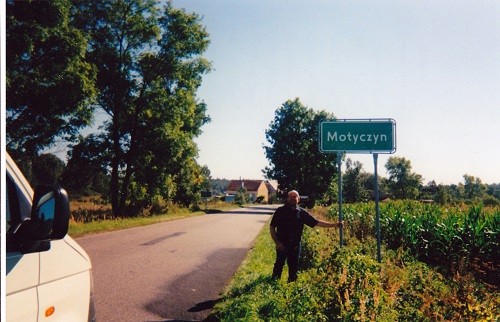
4. NDCB in Motyczyn 10 Sep 2004_500

Noel was grinning because his right foot had just gone down into a ditch hidden by the grass. He was balancing himself by clinging to the sign. Again Len took a photo from almost exactly the same spot at the northern entrance to Motyczyn. In Len’s photo the tree has grown in the last ten years and a new house has been added on the right.

There were maize crops everywhere. Bolek said the maize is winter-fodder. In September the light is so different to June’s light: winter is approaching and the crops have to be gathered in, for the severe winter.

The average minimum in mid-winter Legnica is a bracing -3°C with the maximum a miserly 4°C, reason enough to emigrate!

Noel found the next house the most interesting in the village: half-timbered, at south end of village, opposite the entrance to the South Wood:
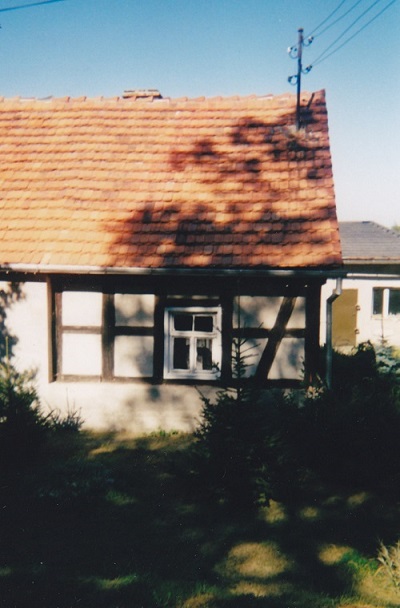
5. Moettig (half-timbered house)_0004_400

In all probability the house has been repeatedly renovated and extended over the centuries.

Noel’s photo caption said: “The village is somewhere between prosperous and dilapidated.” Len had a similar impression.

As Len said, the Ruciaks in Dąbrówka Wielkopolska worshipped in the tiny village of Chlastawa. Here’s Noel’s shot of the wooden church they attended:
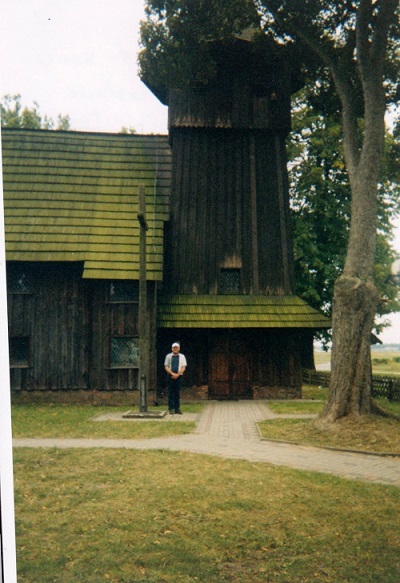
6. Chlastawa church (1639) 11 Sept_0007_400

This church was Pastor Fritschke’s church: he and some of his congregation migrated to SA, where he clashed with Pastor Kavel. In Len’s photo the lowest branch of the pine tree has been sawn off during the last ten years; or maybe it got ripped off in a winter storm. While the Ruciaks worshipped there as Lutherans the church is now Catholic. The yellow-green colour covering the shingle-roof is probably moss.

The church was built by the local nobility in 1639; during the Thirty Years War (1618-1648), which mostly raged further west.

Noel also photographed the “folkloric” Catholic church in Dąbrówka Wielkopolska, where a lot of money had just been spent.
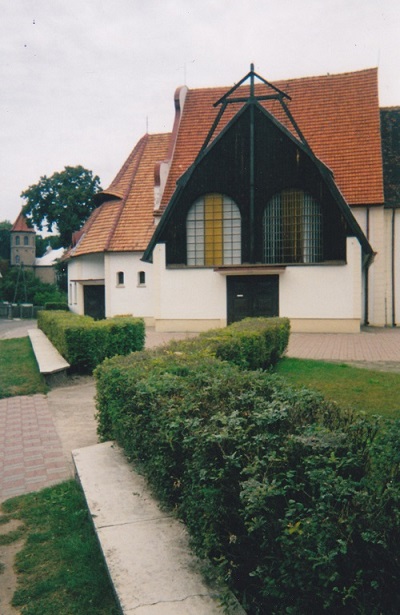
7. Church of Dabrowka Wlkp. 11 Sept_0005_400

The church which is heritage listed also dates from 1600s. The foundation stones were “glacial erratics”, left behind after the Great Ice Sheet retreated. The church has been repeatedly renovated and extended.

The low hedges in front are now gone. In the background, you can see one tower of the “Chateau” below:
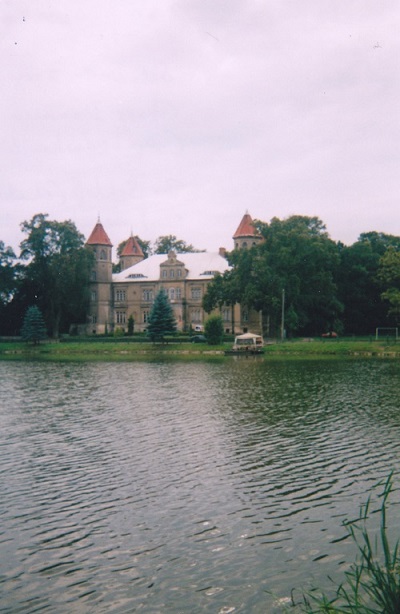
8. Chateau (1857) Dabrowka_0006_400

The chateau dates from 1859, after the Ruciaks left.

Here’s another photo from the internet in a different season.
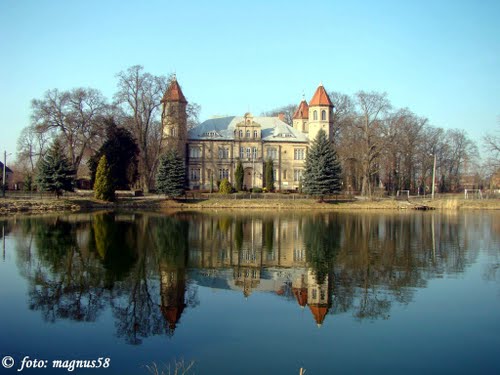
9. 33726230

The Polish Wikipedia has an excellent article on the village with this thumbnail image:

10. 160px-144_Dammer

As a final note this post has used three different versions of our surname – Bähnisch, Bahnisch and Baehnisch.

Willi’s birth certificate, if they got it right, would have shown Bähnisch. The umlaut ä was dropped in Australia, because typewriters couldn’t cope. The umlaut is often rendered in English by adding an ‘e’ to the vowel, hence Baehnisch. One branch of the Australian family has adopted this practice. If you look in the White Pages you’ll see Bahnisch and Baehnisch in approximately equal numbers.

The pronunciation follows the Silesian German dialect with Bay-nish. The ‘ay’ diphthong doesn’t exist in Standard German (German: Standarddeutsch, colloquially also Hochdeutsch) which would render the sound Bair-nish.

Notes:

1. This photo was in Brian’s possession, probably from a shoe box of photos left by his mother. It was scanned commercially by Kodak.

2. Scanned by Noel Cameron-Baehnisch 31 Dec 2012 AD, from Ellen Bahnisch’s Collection. It portrays Len and Brian’s paternal grandparents. Louise Gregor lost her father to gallstones before she was born at Bethel, near Kapunda. After her mother died of heart disease, Louise was fostered and became a servant in the Stiller household at Bethanien (Bethany), where she was courted by old Bertha Stiller’s first cousin, Ernst Wilhelm (“Willi” in German, “Bill” in English) Bahnisch Junior. They married in Langmeil Church, Tanunda, in 1889 when he was 25 and she was 5 months older than him! She is wearing a beautiful two-tone black dress (black was required of all brides and married women); she is probably wearing a corset to give her that fashionable but unhealthy hourglass look. Both have blue eyes, which is why their eyes look a bit blank. Her hair style is that of Old Queen Victoria. Tragically she died of childbirth on the 24 Nov 1900, leaving behind 3 healthy children. RIP, Louise. Sadly her grave is lost.

For related posts see the Bahnisch family history tag.

Saturday salon 12/7

voltaire_230

An open thread where, at your leisure, you can discuss anything you like, well, within reason and the Comments Policy. Include here news and views, plus any notable personal experiences from the week and the weekend.

For climate topics please use the most recent Climate clippings.

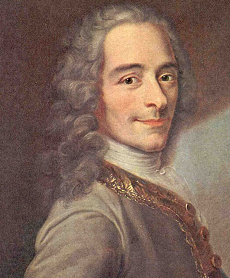
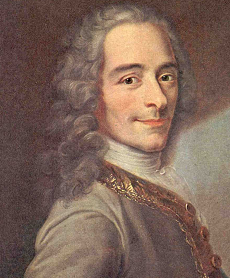
The gentleman in the image is Voltaire, who for a time graced the court of Frederick II of Prussia, known as Frederick the Great. King Fred loved to talk about the universe and everything at the end of a day’s work. He also used the salons of Berlin to get feedback in the development of public policy.

Fred would only talk in French; he regarded German as barbaric. Here we’ll use English.

The thread will be a stoush-free zone. The Comments Policy says:

The aim [of this site] is to provide a venue for people to contribute and to engage in a civil and respectful manner.

Here are a few bits and pieces that came to my attention last week.

1. Trust in institutions

The High Court is the most trusted institution in Australia, followed by the ABC and the Reserve Bank. They are the only ones with more than 50% trust. Political parties are the pits. Overall there doesn’t seem to be as much trust around as last year.

Courtesy of this post we have the Readers’ Digest Australia’s Most Trusted Professions 2013. The top six are firefighters, paramedics, rescue volunteers, nurses, pilots and doctors.

Journalists are 43rd out of 50, just ahead of talkback radio hosts, real estate agents and sex workers. Politicians are 49th only ahead of door-to-door salespeople.

2. Which side is God on?

Popes praying_10449976_816909721666770_8792909987461327130_n

Courtesy of Mark’s Facebook.

3. Seven Goals For Brazil (Through Street Art)

paulo_ito_0

Street art by Brazilian artist Paulo Ito on the entrance of a public schoolhouse in Sao Paulo. Image via the artist’s Facebook page.

Check the link for more. Also courtesy of Mark’s Facebook.

4. 20 Great Existential Films You Need To Watch

Akira Kurosawa and Ingmar Bergman had to be on the list, but I don’t know Ikiru and Shame. Through a Glass Darkly is one of my favourite Bergman films.

I missed Alain Resnais’ Last Year at Marienbad and perhaps Wim Wenders’ Wings of Desire

Others?

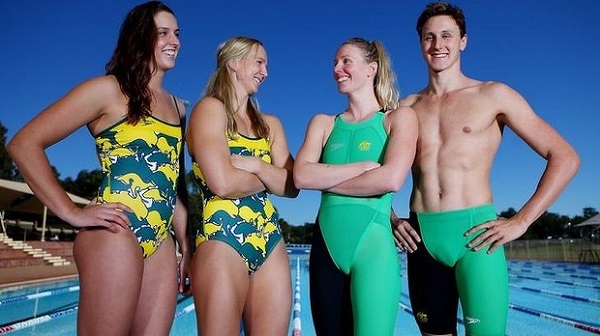
5. Commonwealth Games swimming uniforms

Surely this is a joke!

Swimming costumes_1404430855245.jpg-600

What do you think?

6. Palmer blows up budget

Clive Palmer has blown a fresh $9 billion hole in the Abbott government’s budget by torpedoing Coalition plans to abolish the Schoolkids Bonus, the low-income superannuation contribution scheme and a bonus for welfare recipients.

That’s nothing, Hockey is accusing Bill Shorten is of blocking $40bn of savings.

The Conversation has an explainer. Should be fun!

Disorder in the house

Palmer_clive_palmer_729-500

Mark Thursday 10 July as the day the Abbott government achieved the trifecta. They gagged discussion on the carbon price repeal legislation while filibustering so that negotiations could proceed with Clive Palmer’s PUP in the corridor. Then the legislation was voted down.

Why did the Government trip up and score an own goal?

To meet Abbott’s media schedule, that’s why. Penny Wong to the cross-bench:

“We are already having backgrounded to media…what the Senate will be doing. Media are already being told to prepare for the Prime Minister’s announcement, because gag-and-guillotine will be moved, here in this Chamber, to get the bills on and voted on. So I want the crossbench to be clear on what you are being asked to do — you are being asked to run this Chamber so as to accord with Mr Abbott’s media schedule.

Later she called it “a special blend of arrogance and incompetence”.

Apparently it was pre-ordained on Monday that the bills would be passed today, to fit in with Abbott’s media schedule.

As far as I can make out, the problem arose when the PUP looked at the latest amendment overnight and decided it didn’t go far enough. So they came up with a new one, the third version, essentially mandating a 250% penalty for firms and other entities not passing on to customers savings from the repeal of the carbon tax.

When this was sprung in the morning Palmer reckons there was a “violent reaction” from LNP pollies with lots of angry phone calls. Nevertheless the LNP leadership acceded to the new version, but it ran into trouble because it was deemed a money bill which must originate in the House of Representatives.

Somewhere along the line the Government decided to press on with the Mark 2 amendment without telling PUP. That’s according to Palmer:

It doesn’t look like the carbon tax is going to go through in the Senate today, right, because our party will most likely vote against the bill, right.

Of course, this morning at 8.30 we had an amendment which we discussed with the Government and we left with the clerk’s office. It was to be circulated by the time Parliament came down and it hadn’t been circulated.

And our senators hadn’t been told and they were left in the dark so when the gag motion was brought, their old amendment was in there, which they thought was the new amendment, and they would have voted for that and not the critical amendment which is critical in getting electricity and gas prices back to consumers, and then under the misapprehension they would have voted to repeal the carbon tax, right.

But fortunately we discovered that and they were able to become aware of it, so I just met with them down there and their view was that in no circumstances they wouldn’t be voting today for the carbon tax repeal.

Now, of course the matter may be sorted out, I don’t know, but that’s how it stands at the moment. I think you call it double-crossing people.

We went to lodge our amendment at the clerk’s office at 8.30 and we asked that it be distributed and we had a violent reaction from the Government and our amendment nearly…

Then in the final scramble, the LNP promised to originate Palmer’s desired changes next week in the HoR if the PUP would kindly pass the existing defective version. Palmer told the 7.30 Report that he simply didn’t trust them.

The bill will now go back to the HoR and could be back in the Senate on Monday. But will it be passed?

PUP’s amendment is actually problematic and there is no certainty that six cross-benchers will approve it.

Palmer sees the amendment as applying to entities selling electricity and gas:

The list proposed by PUP includes “an individual, a body corporate, a body politics, a partnership, any other incorporated association or body of entities, a trust or any party or entity which can or does buy or sell electricity or gas”.

There is concern that other entities may be drawn in. There is concern that some firms have absorbed the cost of the carbon tax in whole or in part.

There is concern as to whether the Commonwealth can legislate to control firms in the specific manner proposed.

But it seems the Abbott Government will do anything to axe the tax.

People are wondering what the politics of it all means.

Laura Tingle says it’s karma rather than Palmer. Abbott is getting his own medicine back in spades. But

The all or nothing Abbott modus operandi is simply not going to work any more.

Whatever Palmer’s unpredictability, the Coalition team has been exposed as woefully unprepared to deal with what it faces in the upper house.

This is true in both a tactical and strategic sense. Tony Abbott has to reconsider whether his Senate team is up to the job of handling Palmer.

Bernard Keane at Crikey says:

The key to understanding Palmer is that he’s always about what’s ahead. What’s in the past is irrelevant. The issue of consistency simply doesn’t arise, because Palmer eternally moves forward, toward the next announcement, the next stunt. Clive only ever stops moving so he can momentarily bask in the media spotlight. Then it’s onward again.

The Courier Mail has a biographical article on Palmer that everyone should read.

They say he plays a long game and he understands the media. He grew up on the Gold Coast where Russ Hinze was big. Already wealthy he became media director for the National Party in 1986. So he was there in the last days of Joh and during the Fitzgerald inquiry.

I think on the current issue he is genuinely concerned for consumers. But he doesn’t mind making the LNP look chaotic and shambolic. Abbott is going to have to, as Tingle suggests, look for 80% and 90% solutions.

Meanwhile Xenephon thinks the gaggle of cross-bench senators are part of the solution rather than the problem. I’m not sure Eric Abetz is up to handling the situation.

Recent articles on renewable power

1. Radical ideas for renewable energy policy

Investment bank UBS came up with this list:

1.  Mandate time of use meter roll out over remaining States in the NEM (NSW, QLD, SA, TAS)

2.  Reinstate the carbon tax with zero exemptions and zero compensation, but start it at a lower level, say  $10/t. This would raise around $5bn of revenue and continue to discourage electricity consumption. It would send a price signal to all carbon producers, however of itself it would not induce much fuel shifting.

3. Encourage the construction of distributed PV solar on any building where the majority of the electricity consumption is during the day or where the costs of being connected to the grid are high. Examples of the former category include many Federal and State Government owned buildings, factories and warehouses. All that flat Western Sydney metal roofing is ideal for solar.

4. We would use some of the funds raised to subsidise the take-up of onsite storage and encourage grid defection and the creation of micro grids, particularly in rural areas. Network investment and pricing models would need to be sharply revised.

5. Networks in general would have their monopoly pricing status revoked. In the world of the “Nu-tility”, the network is no longer a monopoly – it competes with distributed electricity and possibly with other distribution business models. If networks put prices up too much they will face competition of their own.

6. We would incentivise closure of some brown coal fired electricity in Victoria, possibly via means of environmental regulation, but possibly with a capacity closure auction.

7. Likely continue with the current renewables target.

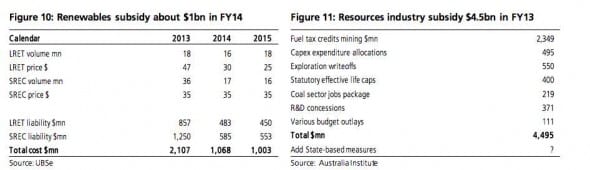
I can’t say I like all of these but they are a starting point for discussion.  The article also had this table comparing renewable and fossil “subsidies”.  (Excluding state subsidies which are quite significant.)

UBS subsidies

2.  Queensland power price goes negative in the middle of the day

Last week, for the first time in memory, the wholesale price of electricity in Queensland fell into negative territory – in the middle of the day.  For several days the price – normally around $40-$50 a megawatt hour – hovered in and around zero. Prices were deflated throughout the week.

There were several reasons for this. A restricted interconnector to NSW added to the volatile trading, as did uncertainty about the carbon price. But the overall softening of prices was primarily the result of the newest and one of the biggest power stations in the state – rooftop solar PV.

There is 1,100MW of it on more than 350,000 buildings in Queensland alone (3,400MW on 1.2 million building across the country), and  it is producing electricity just at the time that coal generators used to make hay (while the sun shines).

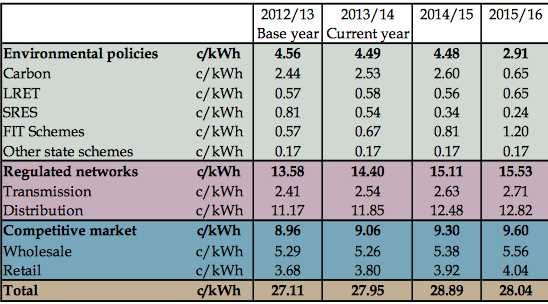
The article also had this table showing just how large the grid owners and retailers are costing consumers.

aemc electricity prices

3. Solar fuels exports from the Pilbara

This article argues that the Japan free trade agreement may hasten the production of solar fuels from the Pilbara.  A key argument is based around Japanese fears of LNG supplies being exposed to deteriorating relationships with China (as well as price uncertainty.)

Liquid ammonia is the logical solar fuel for production in the Pilbara.  Renewable ammonia can be produced from renewable power, water and nitrogen from the air.  Theoretical water consumption is 1.6 litres water per kg of ammonia so this shouldn’t be a problem even if desalination is required. (Other solar fuels such as gasoline require a source of CO2)

Liquid ammonia could be transported using LNG facilities.  The big disadvantage of liquid ammonia is that one kg of LNG has the same energy as 2.9 kg of liquid ammonia.   However, to some extent this disadvantage will be off set by the fact that ammonia can be used in fuel cells.

4. Turkey nest dams may be key to pumped storage in Australia

This article argues that “off river pumped storage” using small turkey nest dams overcomes the problems of using pumped storage systems with the dams in river valleys.

Off-river electricity storage has several advantages over typical on-river facilities:

– There are vastly more potential sites

– Sites can be selected that do not clash with environmental and other values

– The upper reservoir can be placed on top of a hill rather than in a valley, allowing the elevation difference to be maximised

– No provision needs to be made for floods (typically a major cost).

A system comprising twin 10ha reservoirs, each 30m deep, with a 750m elevation difference, can deliver about 1000 megawatts for five hours.

Between 20 and 40 of these systems would be enough to stabilise a 100 per cent renewable Australian electricity system.

How much does it cost?

As the reservoirs are tiny (just a few hectares) compared with typical hydro reservoirs, they are a minor component of the cost. Most of the cost is in the power components (pipes, pumps, turbines, transformers and transmission). Initial estimates suggest that the cost of an off-river system at a good site is around $1000 per kilowatt of installed capacity.

One m3/sec of water falling one m will generate 9.807 kW

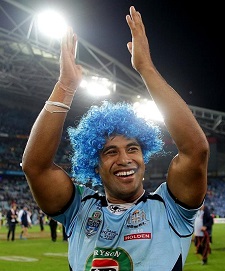
State of Origin: Blues triumph

Congratulations must go to NSW for their series victory in the second State of Origin. There’s a shorter account at Wikipedia.

608667-7df1d848-f846-11e3-9227-d59f5c5d579b_500

The match scores at 6-4 were close. The game statistics showed NSW edging Qld in most categories, except that penalties favoured the Blues 9-5 and missed tackles favoured them 29-13.

Experienced players have said that the series is the toughest they have played in. The injury carnage has been severe, with 15 players going down.

I’m not sure why the referees got the sack, except that it is what the NSW camp called for. I thought some penalties should have been blown early for extra work in the ruck. My maroon eyes saw two NSW high shots that were let go in the first 10 minutes. They probably were not sacked because they got the Thaiday no-try wrong.

Wrong? Yes, wrong.

From former referee and referee boss Bill Harrigan:

“On the Sam Thaiday incident, well … it’s a try,” Harrigan told Triple M on Friday night.

“I know people are saying he (Hayne) didn’t play at the ball — of course he played at the ball.

“He knocked it out of Thaiday’s hand. It means the ball is ‘live’, it’s not a knock-on, not a loose carry.

“If he didn’t touch the ball, Sam has it in his (arm) and he scores a try.”

Mal Meninga:

“I thought Sam’s was a try, seriously,” he said.

“He was stripped and here we go, whether he knocked the ball on … it was a strip.

“In Origin that can make a difference but we won’t offer any excuses.”

If Thaiday scores NSW have to score twice. Unlikely. They scored once, courtesy of us with poor discipline giving them five consecutive sets at the line.

The dead tree version of the Courier mail showed Hayne dislodging the ball from Thaiday’s grasp with a clenched fist punch as he threw his arm around.

Them’s the breaks and we have to suck it up.

The press gives the impression that the players hate each other, but there seems to be a lot of respect, as Reynolds showed when he told Thurston “I look up to you, man.”

Channel 9 won the night which was a ratings record.

For the third it should be a dry track so with the help of the referees we can hope for a bit more football.

Stiglitz on the budget changes to health and education

“A crime”, “absurd”. That’s what he said.

Asked by Fairfax Media to nominate the two biggest mistakes the government could make that would take it down the American path of widening inequality and economic stagnation, Professor Stiglitz chose the budget changes to university fees and Medicare. Each would make Australia more like the US.

Stiglitz_j

“Countries that imitate the American model are kidding themselves,” he said. “It seems that some people here would like to emulate the American model. I don’t fully understand the logic.”

In the lead-up to the budget Education Minister Christopher Pyne said Australia had much to learn about universities from overseas, “not least … from our friends in the United States”.

Professor Stiglitz said Australia had “a system that is really a model for the rest of the world”, and deregulating fees would move the entire system in the wrong direction.

“Trying to pretend that universities are like private markets is absurd. The worst-functioning part of the US educational market at the tertiary level is the private for-profit system,” he said. ”It is a disaster. It excels in one area, exploiting poor children.

“If you’re rich your parents can pay the fees, but if you are poor you are going to worry about how much debt you’re undertaking.

“It is a way of closing off opportunity and that’s why the US doesn’t have educational opportunity.

“While we in the US are trying to re-regulate universities, you are talking about deregulating them. It really is a crime.”

Similarly with the health system. We have one of the best systems in the world for access and outcomes. Yet we are trying to take it in the direction of the USA which sits at the bottom of the pile.

He said the typical inflation-adjusted income of a US household was lower than it was 25 years ago. The typical inflation-adjusted income of a male full-time worker was its lowest in 40 years.

“You have to say that the American market model has failed. It’s a very strong statement for someone who believes in a market economy. But at the bottom it’s even worse. The minimum wage is about where it was almost a half century ago.”

Asked what Australia had done right that the US had not, he said: “unions”.

“You have been able to maintain stronger trade unions than the United States. The absence of any protection for workers, any bargaining power, has had adverse effects in the United States.

“You have a minimum wage of around $15 an hour. We have a minimum wage of $8 an hour. That pulls down our entire wage structure.”

Saturday salon 5/7

voltaire_230

An open thread where, at your leisure, you can discuss anything you like, well, within reason and the Comments Policy. Include here news and views, plus any notable personal experiences from the week and the weekend.

For climate topics please use the most recent Climate clippings.

The gentleman in the image is Voltaire, who for a time graced the court of Frederick II of Prussia, known as Frederick the Great. King Fred loved to talk about the universe and everything at the end of a day’s work. He also used the salons of Berlin to get feedback in the development of public policy.

Fred would only talk in French; he regarded German as barbaric. Here we’ll use English.

The thread will be a stoush-free zone. The Comments Policy says:

The aim [of this site] is to provide a venue for people to contribute and to engage in a civil and respectful manner.

Here are a few bits and pieces that came to my attention last week.

1. ALP (57.5%) increases lead over L-NP (42.5%)

From Roy Morgan:

If a Federal Election were held today the ALP would win in a landslide (57.5%, up 2%) cf. L-NP (42.5%, down 2%) on a two-party preferred basis according to today’s multi-mode Morgan Poll conducted the last two weekends – June 21/22 & 28/29, 2014.

Morgan has the ALP primary vote at 36.5% and the LNP at 35%.

The Greens support is 12% (unchanged), support for the Palmer United Party (PUP) is 7% (up 1.5%) and support for Independents/Others is 9.5% (up 1.5%). PUP polled 13% in Qld.

2. Abbott falls further behind Shorten in latest Newspoll

Here’s the poll.

Shorten leads Abbott 44 to 34 as preferred prime minister.

Labor leads 55-45 TPP up from 53-47.

… the Coalition would attract 35% of the primary vote if an election were held now, compared with 37% for Labor, 13% for the Greens, and 15% for others.

3. First World War centenary

It seems we could be celebrating this one for the next four years.

Radio National has a series of special broadcasts.

Quiggin reckons we’ve learnt nothing and have been fighting ever since.

Kelly Higgins-Devine looked at some big battles held in July, mostly in Europe.

4. Battle of Leipzig

Did you know that the battle of Leipzig in 1813 which ended the Napoleonic Wars as such involved over 600,000 soldiers, making it the largest battle in Europe prior to World War I.

The French had around 160,000 soldiers along with 700 guns plus 15,000 Poles, 10,000 Italians, and 40,000 Germans belonging to the Confederation of the Rhine, totaling to 225,000 troops on the Napoleonic side. The coalition had some 380,000 troops[2] along with 1,500 guns, consisting of 145,000 Russians, 110,000 Austrians and Hungarians, 90,000 Prussians, and 30,000 Swedes. This made Leipzig the largest battle of the Napoleonic wars, surpassing all of the wars’ past battles of Borodino, Wagram, Jena and Auerstadt, Ulm and Dresden.

Bigger also than Waterloo.

Casualties on both sides were astoundingly high; estimates range from 80,000 to 110,000 total killed, wounded or missing. Napoleon lost about 45,000 killed and wounded.

Out of a total force of 430,000, the Allies suffered approximately 54,000 casualties. Schwarzenberg’s Bohemian Army lost 34,000, Blücher’s Silesian Army lost 12,000, while Bernadotte’s Army of the North and Bennigsen’s Army of Poland lost about 4,000 each.

There is every possibility that my ancestors would have fought in the battle. It was only 35 years later that my great grandfather left Silesia. Memories of the napoleonic wars would have still been very alive, and perhaps a reason for departing to safer climes after the revolutions of 1848.

From memory, the Prussian population was depleted by about 11% during the Napoleonic wars.

5. What you don’t want to read

I already knew that visitors to this site read climate posts in fewer than half the numbers reading political posts.

This week I found out that most people really don’t want to read about Gillard and Rudd any more.

The Heartbleed security vulnerability

Over the past couple of months, I have written a series of articles at The Conversation about one of the most serious software security flaws in history – the evocatively named “Heartbleed”.

The most recent article discusses the continued fallout from the event, and the tardy response of some system administrators and software developers. However, if you didn’t follow this story when it emerged in April, the first article explains the problem and the consequences in some detail, and the second article discusses how the discovery of the first bugs encouraged more scrutiny that found yet more problems.

Tomorrow, something on climate – a followup of sorts to Jess Hill’s cracking article in The Monthly about power prices.

Philip Nitschke crosses a line

Philip Nitschke has been accused of moving into uncharted territory.

Personally I think he has crossed a line. He helped Nigel Brayley, a troubled 45 year old who said he intended committing suicide Brayley implemented his plan by taking the euthanasia drug of choice, Nembutal, which he imported illegally. Brayley had an exchange of emails with Nitschke.

Exactly what Nitschke advised him is not clear, but he made no effort to suggest Brayley seek help for his suicide plans. Nitschke takes the view that Brayley had made a rational decision and to interfere would be curtailing his freedom. Nitschke saw his role as supporting Brayley in his decision.

if a 45-year-old comes to a rational decision to end his life, researches it in the way he does meticulously, and decides that now is the time of life, now is the time I wish to end my life, they should be supported, and we did support him in that.

This is wrong-headed on several counts. First, no decision is entirely rational. We never escape emotions and values.

Secondly, ‘rational’ is not always good. One could rationally come to the conclusion that humans are vermin in the planetary ecosystem and should be destroyed on sight.

It seems to me that being pro-life is a fundamental value position if we are to live as social beings. There are limits, though. I can’t, for example, wish the Ebola virus God’s speed in going about its business.

But assisting people in the dying process at the end of their natural lives is essentially pro-life. That’s my view.

My impression also is that Nitschke has become obsessive about helping people die and has lost his ethical bearings.

Asylum seekers returned directly to Sri Lanka?

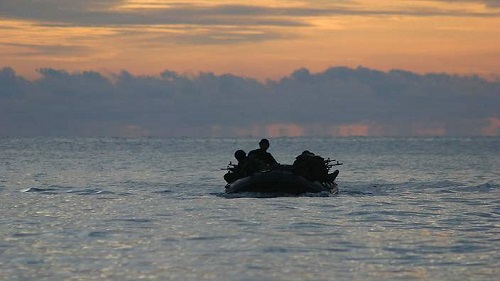
SRI LANKA NAVY SPECIAL BOAT SQUADRON

Refugee advocates and the Tamil community are increasingly concerned that a boat load of 153 Tamil asylum seekers has been handed over the the Sri Lankan navy.

There was regular contact with the boat from last Thursday to last Saturday morning, when communication ceased.

On Thursday the boat started leaking oil. On Friday they were almost running out of water and some of the younger people were not well. One adult also was “facing some physical conditions”.

The Government is refusing to comment on whether the boat even exists.

Daniel Webb, Director of the Human Rights Legal Centre, says that if refugees are returned directly to the place they are fleeing from without their claims being processed there can be no clearer breach of our obligations under the Refugee Convention.

The fact that the boat may be in international waters has no relevance. The idea that the asylum seekers’ claims could be assessed in transit is ludicrous.

Turning boats back to Sri Lanka is completely different to turning them back to Indonesia, which is a transit country and as such not the source of the fear of persecution or worse.

The Guardian says that:

Sri Lankan asylum seekers are subject to the “enhanced screening process” in Australia, which has been condemned by the UNHCR as an “unfair and unreliable” process for determining refugee claims as it involves short interviews, often without the presence of a lawyer.

But

In October, Morrison said he was “completely comfortable about the process”, adding: “If you’re coming here to try something on to get access to Australia from Sri Lanka, you’ll go straight back.”

Surely asylum seekers would not be subject to ‘enhanced screening’ in transit!

The Sri Lankan high commissioner in Canberra said he had not been informed by the Australian government of the boat’s existence and hence he was in no position to comment.

The boat actually departed from India and the nationality of all on board in unclear. India is not a signatory to the refugee convention.

The image above is from AAP courtesy of SBS who report that the Sri Lankan military says it’s unaware of any arrangements with Australia to return asylum seekers.

From the SMH on Monday:

Ian Rintoul, of the Refugee Action Coalition, said it had become apparent that Australia had intercepted the asylum seekers.

“It has been 48 hours and under Scott Morrison’s own rules he would have had to announce there had been an incident at sea by now, so you can assume they have been taken off their boat.”

More generally, I reported last week, the Government is introducing new rules for assessing asylum seekers:

  • People arriving without travel documents will be refused protection visas unless they can provide a “reasonable explanation” for not having identification.
  • A lower threshold for assessing harm to returning asylum seekers who have sought complementary protection, where the chance of harm is more than 50%.
  • Asylum seekers who have arrived by boat will be refused visas unless the minister determines “it is in the public interest to allow them to do so”.

As SBS highlights, this means that asylum seekers facing a 49% chance of death or torture could be sent home. Surely the cross bench in the Senate will vote the legislation down.

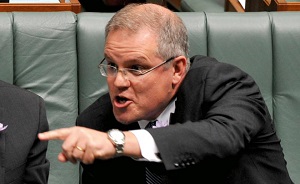
While it is too early to rush to judgement in the case of the Tamils, Scott Morrison never ceases to appal so nothing would surprise.

Morrison_Sowhothebloodyhellareyou _500

I’m not sure of the source of that image which I had on file, but it has the title Sowhothebloodyhellareyou!