Saturday salon 16/8

voltaire_230

An open thread where, at your leisure, you can discuss anything you like, well, within reason and the Comments Policy. Include here news and views, plus any notable personal experiences from the week and the weekend.

For climate topics please use the most recent Climate clippings.

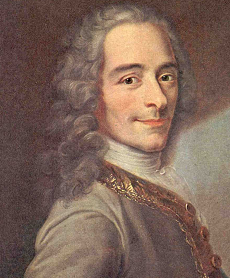
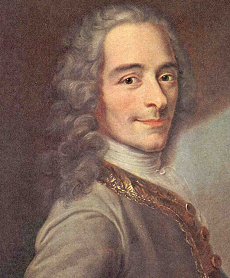
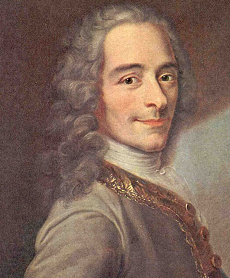
The gentleman in the image is Voltaire, who for a time graced the court of Frederick II of Prussia, known as Frederick the Great. King Fred loved to talk about the universe and everything at the end of a day’s work. He also used the salons of Berlin to get feedback in the development of public policy.

Fred would only talk in French; he regarded German as barbaric. Here we’ll use English.

The thread will be a stoush-free zone. The Comments Policy says:

The aim [of this site] is to provide a venue for people to contribute and to engage in a civil and respectful manner.

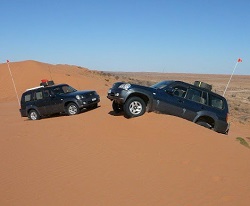
Alice Springs – Simpson’s Desert odyssey progress

Where we are depends on whether we needed to extra day in the schedule for the desert crossing. If we made it across (praise the Lord!) we could be travelling from Birdsville to Windorah or Windorah to Emerald.

Joe Hockey Puts His Foot in His Mouth Again

Joe Hockey’s claim that “Poor people don’t have cars, don’t drive far.” seriously failed the  ABC Factcheck test.  But what he said was an exercise in stupidity that went far beyond getting some facts wrong.  It reinforced the perception that Joe is a man on a class war against what he sees as the unentitled poor.  Worse still, Continue reading Joe Hockey Puts His Foot in His Mouth Again

The RET Needs Bipartisanship- Contract Based Alternatives Don’t

Tony Abbott has already killed the Howard government’s RET scheme. No new large scale energy projects directly justified by the RET have been committed to since the start of 2013. In addition, since the Abbott government was elected, the price of large-scale renewable energy certificates had nearly halved to $26.00 per MWh by 11 Aug 14.  To make things worse, the RET is not going to be resurrected by a change of government or action by the Senate.

Continue reading The RET Needs Bipartisanship- Contract Based Alternatives Don’t

Climate clippings 104

This edition begins with the weather and ends with a sad tale of revenge and tribalism as the basis for climate policy.

1. June the hottest on record

When we have some cooler than normal weather people are apt to say “So much for global warming!” They should realise how small a part of the globe we are.

The warmest May on record for the planet has been followed by the warmest June:
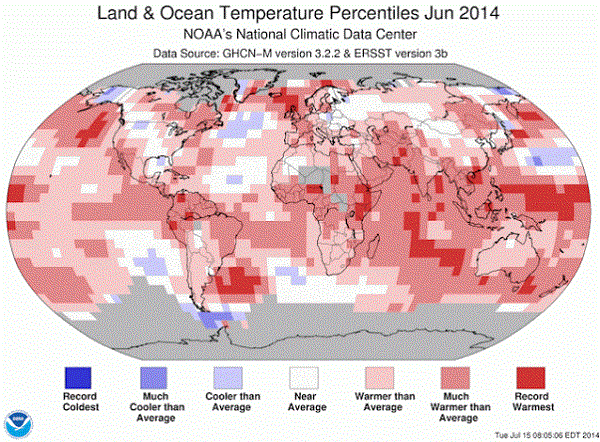
June 2014_201406-600

In fact June was the highest departure from average for any month on record.

The last below-average global temperature for any month was February 1985. The last below average June was in 1975 when Gough Whitlam was PM!

2. El Niño still favoured

The majority of models still favour a spring El Niño:

Warming in the tropical Pacific Ocean since the beginning of 2014 has primed the climate system for an El Niño in 2014, although an atmospheric response is yet to be observed. As a result, the transition towards El Niño conditions has slowed in recent weeks. While five out of eight climate models surveyed by the Bureau suggest El Niño will become established by October, all have eased their strength over the past few months. Three models suggest an El Niño will not occur in 2014, while another indicates only a brief period of El Niño-like conditions.

3. Temperatures poised to rise rapidly

El Niño years are often associated with a higher than average temperature rise. However, there’s another reason temperatures may be about to rise. You may recall that around 93% of the extra global warming goes into the ocean and only 2.3% into the atmosphere:
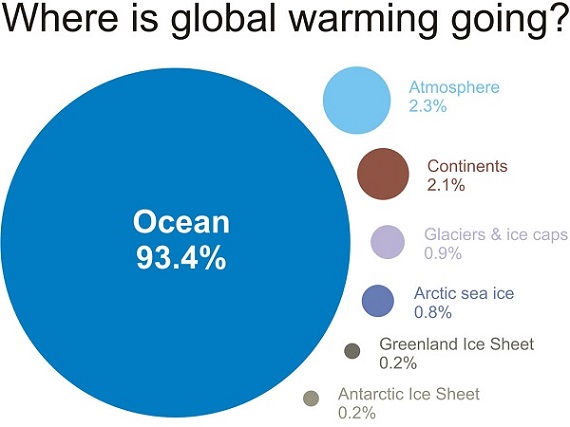
GW_Components_570

In recent years the trade winds have speeded up causing deep mixing in the ocean, taking warm water deeper displacing cooler water which rises to the surface to be warmed. Sooner or later this will stabilise, with more heat going into the atmosphere.

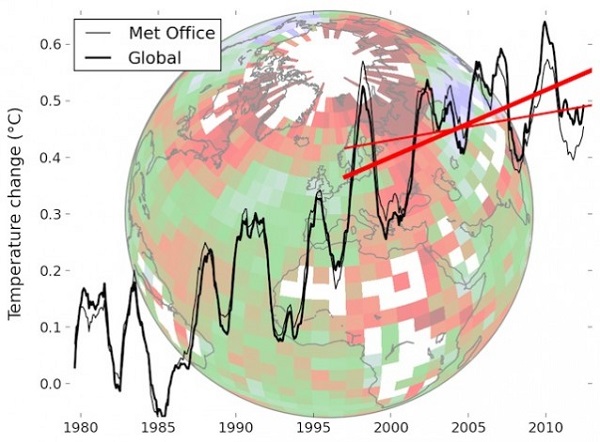
The article also points out the recent correction of the Hadley Centre temperature record, adding in an estimate for the polar regions, where there are no weather stations. This correction virtually eliminates the famous ‘pause’. The heavy lines show the corrected data:
Cowtan-600

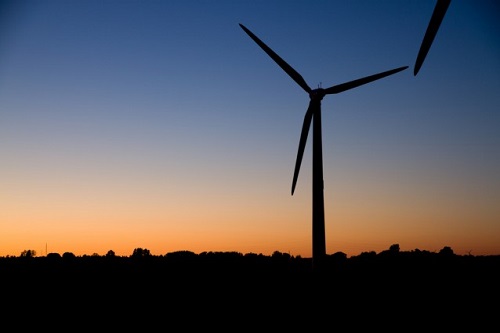
4. Onshore wind is now the cheapest form of new energy in Denmark
6250146831_ffa2f45d46_b-500

A new analysis from the government of Denmark found that wind power is by far the cheapest new form of electricity in the country. New onshore wind plants coming online in 2016 will provide energy for about half the price of coal and natural gas plants, according to the Danish Energy Agency (DEA), and will cost around five cents per kilowatt hour.

5. Abbott bets the house on coal

Meanwhile our visionary PM bets the house on coal as the world price is collapsing and countries turn to renewables.

The price for thermal coal has plunged more than 10 per cent in the last two months as the presumed major customers – China and India – make it clear that renewable energy is offering a competitive alternative to coal and gas.

The current spot market has been below the cost of production.

China may cease to import coal in a few years. The Europeans are talking about ramping up targets for emission reductions, energy efficiency and renewable energy. The Indians are

building of “mega” capacity solar farms, off-grid solar pumps for irrigators, solar installations over canals, cuts in tariffs for solar components and a doubling of the tax on coal – has been followed by an announcement that the country will look to expand a “rent-a-roof” program from solar installations initially begun in Gujarat, the home state of new PM Narendra Modi, who has promised a “saffron revolution” of solar power.

Tata Power is providing interest free loans up to $4,000 for rooftop solar.

Bloomberg New Energy Finance last week predicted solar would beat coal plants on costs by 2020. Chile has announced a whole series of large scale solar plants. On and on it goes.

Here in Sydney there was concern at the Clean Energy Week conference that Abbott can cripple renewables by doing nothing. According to one speaker

even if the 41,000GWh target was retained, and long term certainty provided, the removal of the carbon price will make it difficult to obtain financing for wind and solar farms from financial institutions.

That’s because the carbon price and the RET were designed to work together. If the carbon price is removed, then there is a massive shortfall in revenue when the certificates issued under the RET expire in 2030…

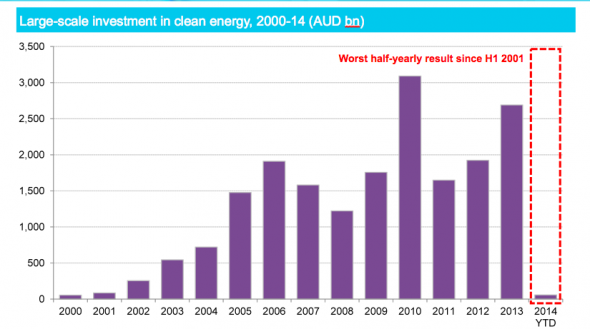
John D has been calling it but here’s a dramatic graph showing how large scale investment has stopped in its tracks:
bnef-finance-s-590x329

6. Tribal wars and revenge

I couldn’t find a decent review of Ian Chubb’s excellent book Power failure, which traces climate policy in Australia from before the 2007 election to the installation of the Abbott government. The link in the heading is to a revealing interview with the author by The Fifth Estate. Chubb:

“[Climate change denial] is a cultural issue for the Coalition. It’s nothing to do with rationality or reason or the future or business – it’s tribal. While this government is in power we can’t recreate the consensus.

“For this government burning coal to make electricity is the equivalent to eating red meat – if you don’t, you’re a sissy. So this government will never have sympathy for making renewable energy – only sissies do that. The government has attempted to shut down everything to do with renewable energy.”

He the goes on to talk about revenge, tribalism and well-flung mud.

He describes the current policy situation as current policy situation as a “ridiculous and expensive mess”. Two things might change it. One is leadership from the US. The other is that nasty things may have to happen from the climate itself.

My sense is that the damage to confidence wrought by this mob is such that a change of government with new policies may not be enough. We need the Tea Party to get real before confidence can be restored.

I need to say more about Chubb’s book which is clear-eyed about the strengths and weaknesses of both Rudd and Gillard. Anyone wondering why some of Rudd’s colleagues thought he had to go should read this extract in The Age.

An untrustworthy, unimaginative, incompetent dunderhead

That’s how voters see their prime minister Tony Abbott, says Laura Tingle of the most recent Nielsen Poll.

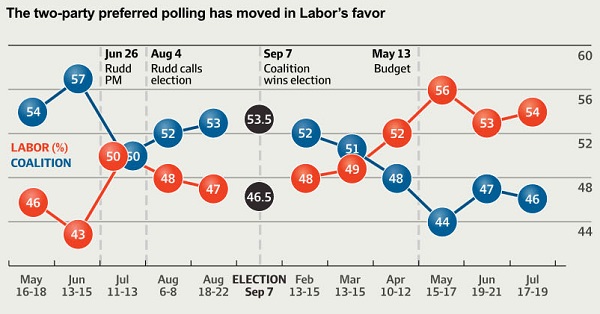
More of that later, but the poll sees the ruling LNP stabilise in landslide loss territory at 54-46:

Nielsen Jy 2014_cropped_600

The only demographics where the LNP has a clear lead in the primary vote are the 55+ group and WA. But in WA the TPP lead is only 52-48, well within the margin of error. Queensland has turned sour for the LNP at 45-55.

Abbott’s approval rating has improved from -25 to -18. Abbott’s overall personal rating may improve further due to his handling of the response to the Ukraine air tragedy but his real problem seems to lie in the voters’ view of his personal attributes. Abbott continually hammered the Gillard government over competency and trust. He fails on both counts.

According to Nielsen, voters now rate his competence as slightly lower than Gillard’s.

They do not rate him as being as strong a leader, believe him to be even less trustworthy, and have an even weaker grasp on economics.

At least the former prime minister had a majority of voters believing she had a firm grasp on foreign and social policy – only 43 per cent of voters rate Abbott on foreign policy and 34 per cent on social policy.

Abbott has strengths (above 50%) in his clear vision for Australia’s future and in his ability to make things happen. However, his weakness on social policy is severe, contrasting with Shorten’s strength. In context Abbott’s strengths may be problematic.

Shorten emerges as a more competent and trustworthy figure, but he is yet to be seen as a strong leader with a vision for the country and an ability to make things happen. Perhaps a problem of opposition.

Shorten still heads Abbott as preferred PM but has slipped slightly from 47-40 to 46-41.

On economic policy they are even, and not very good on 45%.

Prior to the budget Joe Hockey had a clear lead over Chris Bowen as preferred treasurer at 51-34. Now they are virtually even at 43-42.

Reading opinion polls is a bit like reading tea leaves, but the Abbott government’s problems appear fundamental.

Climate clippings 103

Climate clippings_175

I like to think that at Climate Plus we cover all the important issues and happenings. In this edition we look at two significant reports, one by Jeffrey Sachs to the UN Secretary General and the IEA’s World Energy Investment Outlook 2014.

As usual use Climate clippings as an open thread on climate change.

1. Deep Decarbonization Pathways

Renowned economist Jeffrey Sachs found that Australia could cut emissions from its energy sector to zero by 2050 and still grow GDP by an average of 2.4% over that period. That was in an interim report recently delivered to UN Secretary-General Ban Ki-moon plotting

specific measures for the world’s 15 largest economies, including China, India and the US, to cut their emissions quickly and deeply enough to meet an international agreed goal of limiting warming to two degrees above pre-industrial levels.

What we do matters!

The report

found that it’s technically possible for Australia to get almost all of its electricity from renewable sources by 2050 and to offset the rest by storing carbon in soil or planting more trees.

We can do that while GDP grows at 2.4% per annum, but it is interesting that our per capita growth rate is the lowest of the 15, India the highest.

There’s more about Sachs here.

2. Catalyst does sea level rise

It was scary, but could have, should have been scarier.

The program depended heavily on the last interglacial, the Eemian, as an analogue for now. It made the link through temperatures and probably got them a bit wrong. We’ll likely get more than 2°C this century, and the Eemian global average was possibly only 1°C higher than now.

Fundamentally the problem is this. CO2 levels during the Eemian which produced around 9 metres of sea level rise were never above 300 ppm. At 400 ppm, as we are now, the implied sea level rise is more like 20 to 25 metres, played out over the centuries.

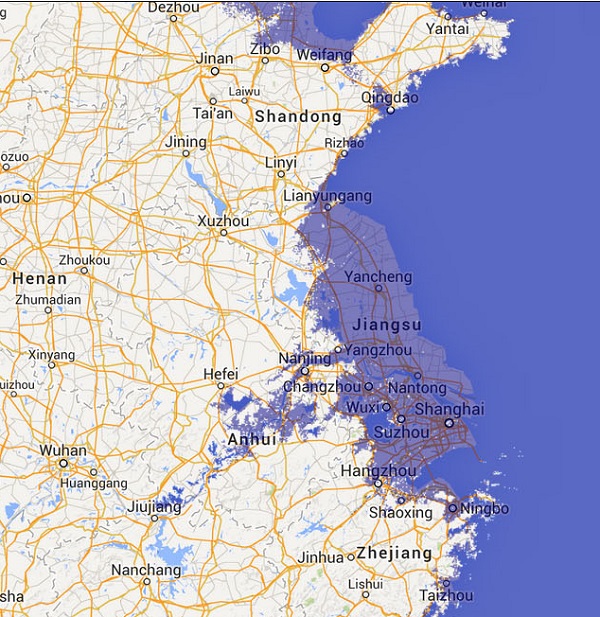
Still they could have pointed out just how horrendous a 9 metre rise would be, other than the throwaway comment about most mega cities being displaced. At 9 metres significant chunks disappear from continents as in China:

China_cropped_600

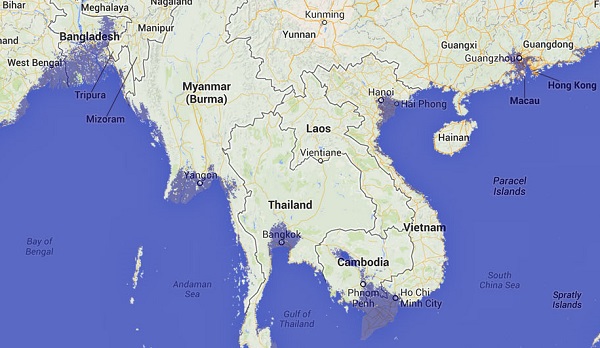
Here’s SE Asia courtesy of the Firetree flood map:

SE Asia_cropped_600

At the end it suggested that we could cope by building sea walls, except that it would be expensive. Sea walls are not going to cope with nine metres, let alone 20.

This Skeptical Science post gives useful information about the Eemian, although it too arguably needs updating. I think scientists are settling on a higher sea level rise for the Eemian than the 5 metres suggested, more like the 9 metres of the Catalyst program. Also at least some parts of Greenland are thought to have been 10°C warmer than now, rather than 5°C.

3. The search for the clean coal holy grail

Radio National’s generally excellent Background Briefing program has turned its guns on a ‘clean coal’ technology called DICE – Direct Injection Carbon Engine. Would you believe, a DICE engine runs on a slurry of finely ground coal and water? One purpose seems to be to make brown coal as emissions efficient as black coal – a pointless exercise in terms of current climate mitigation needs. Inherently significant energy must be spent to get the coal into the required state.

The history seems to be one of shonky technology projects run by shonks, but the CSIRO is now involved and our visionary government is throwing money at the venture.

4. World Energy Investment Outlook 2014

The International Energy Association’s latest report is billed as its first full update since the 2003 World Energy Investment Outlook. It’s been out since 3 June. So far I’ve failed in my ambition to do a separate post, so I’ll just do a brief note here.

This post from the Post Carbon Institute is a packet of joy. It says that the IEA report “should send policy makers screaming and running for the exits” or looking for early retirement. Seems we need a mere $48 trillion in investment through to 2035 to keep things on track. But:

The IEA forecasts that only 15 percent of the needed $48 trillion will go to renewable energy. All the rest is required just to patch up our current oil-coal-gas energy system so that it doesn’t run into the ditch for lack of fuel. But how much investment would be required if climate change were to be seriously addressed? Most estimates look only at electricity (that is, they gloss over the pivotal and problematic transportation sector) and ignore the question of energy returned on energy invested. Even when we artificially simplify the problem this way, $7.2 trillion spread out over twenty years simply doesn’t cut it. One researcher estimates that investments will have to ramp up to $1.5 to $2.5 trillion per year. In effect, the IEA is telling us that we don’t have what it takes to sustain our current energy regime, and we’re not likely to invest enough to switch to a different one.

If you look at the trends cited and ignore misleading explicit price forecasts, the IEA’s implicit message is clear: continued oil price stability looks problematic. And with fossil fuel prices high and volatile, governments will likely find it even more difficult to devote increasingly scarce investment capital toward the development of renewable energy capacity. (Emphasis added)

Nibali a shoo-in, but plenty to watch for in Tour’s last week

It’s the curse of the commentator, political or sporting, that they are required to find drama where little exists. And this Tour promised so much. In the last major lead-up race, the Criterium du Dauphine, 2013 Tour winner Chris Froome and 2009 winner Alberto Contador fought a see-sawing battle over several mountain stages, only to have the race taken from under them by an enterprising, tactically astute and lucky attack on the last stage by young American rider Andrew Talansky. Vincenzo Nibali, meanwhile, looked a step below the two favourites. But, still, it looked like a closely-fought Tour was at hand. Meanwhile, the battle for the Tour’s flat stages was almost as tantalizing – could the diminuitive Mark Cavendish regain his ascendancy over Ivan Drago Marcel Kittel?

Continue reading Nibali a shoo-in, but plenty to watch for in Tour’s last week

Blogging hiatus, again

On Saturday 26, July Len and I together with my wife are setting out for Alice Springs and points beyond, returning via the Simpson’s Desert. Len’s wife is doing the smart thing and flying out to the Alice to join us there. If we return it will be on 19 or 20 August. This week my thoughts are turning in that direction with increasing excitement and some trepidation. So blogging might be sporadic this week. After that I won’t be looking at a computer screen until we get back.

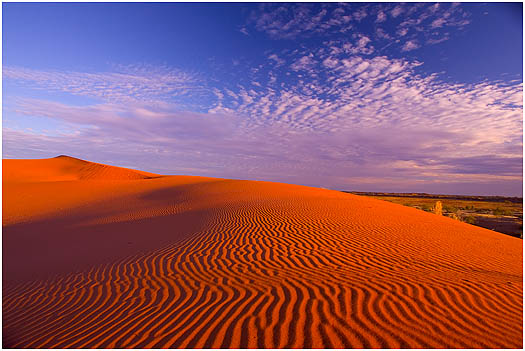
Deep Red sand dunes of the Strzelecki Desert in outback South Australia.

(Image from here.)

I will set up the Saturday Salon posts ahead of time, but with no topical input from me, as I’m not clairvoyant!

I’m not usually a happy camper, and have avoided it most of my life, but we’ve invested in modern gear including sleeping bags rated to -10°C. I think a howling westerly and a sand storm would be the most unpleasant. We’ll be doing the desert crossing in a convoy of five, with all sorts of emergency and recovery equipment. No-one in the group has actually done it before, but the detail of planning engenders a deal of confidence, so here’s hoping!

The ‘featured image’ on the front page is from here.

Keeping the score on PUP

In an earlier thread, I linked to Lenore Taylor’s article, which holds that the pattern with Palmer is to cause maximum drama then support government. Robert Merkel also linked to Taylor as well as to Ben Eltham who sees Palmer as following self interest.

For both of these to be true, the government must always act in Palmer’s interest, which seems unlikely.

According to Laura Tingle the Taylor view has become orthodoxy in the major parties:

Having sussed out the Palmer United Party, both sides of politics made pragmatic assessments that, for now at least, the PUP should be regarded as a noisy nuisance but one which would support the Coalition in most things.

She says this does not accord with the experience of the past two weeks:

Yes, the PUP ultimately supported the government’s carbon tax repeal bill with amendments. But it opposes the Coalition’s Climate Change Authority Abolition Bill, the Clean Energy Finance Corporation (Abolition) Bill and the bill to repeal the Australian Renewable Energy Agency.

It is also opposing moves to stop tax cuts associated with the carbon package, as well as opposing the abolition of the renewable energy target.

While it is supporting the repeal of the mining tax, it is opposing the repeal of the schoolkids bonus, an income support bonus and the low income superannuation contribution, which are all in the same bill.

It eventually supported changes to the Future of Financial Advice laws, but opposes a $435 million cut to higher education through an efficiency dividend, as well as the reintroduction of fuel excise indexation. It also supported Labor amendments to the asset recycling fund.

The net result is a cost to the budget of just over $13 billion before we even get to the contentious budget cuts.

To the casual observer Palmer’s back flip on the Future of Financial Advice (FoFA) looked capricious. In fact considerable work was put in by Cormann and Malcolm Turnbull who brokered the discussions at Cormann’s request.

Mr Turnbull’s involvement in the Future of Financial Advice (FoFA) matter was at the request of Senator Cormann, who did not know Mr Palmer very well. So he rang Mr Turnbull on Friday night last week asking him for help to convince Mr Palmer to talk and to set up a meeting.

Mr Turnbull spoke to Mr Palmer ­several times over the weekend and presented him with a briefing paper on the Coalition’s changes to the FoFA laws which Senator Cormann had his department prepare.

I understand Cormann and Palmer met five times in a short space of time. Presumably both gave some ground.

I think it’s too early to call a pattern in PUP voting. As to ideology, I think PUP would see itself as seeking a fair go for ordinary people. Beyond that we also have to wait and see.

Tingle’s article was mainly about pre-election positioning and selling the budget. Labor has definitely revealed its hand as supporting emissions trading. Shorten made clear that he meant an ETS rather than a tax.

Abbott is going to keep banging on about it’s really a tax and continue the scare campaign.

Labor may propose a much more modest scheme, more in line with business thinking. Business, Tingle says, is troubled by the current vacuum in real climate policy. They know the vacuum must be filled, but by what?

As to the budget, Tingle says it will need a fundamental rethink if voters are to change their opinion. Short of resolving the conflicting messages involved in, for example, plugging pensioner austerity while promoting a generous paid parental scheme, it’s hard to see what they might do.

But unless they do engage in a fundamental rethink we can expect more mayhem from PUP.

Saturday salon 19/7

voltaire_230

An open thread where, at your leisure, you can discuss anything you like, well, within reason and the Comments Policy. Include here news and views, plus any notable personal experiences from the week and the weekend.

For climate topics please use the most recent Climate clippings.

The gentleman in the image is Voltaire, who for a time graced the court of Frederick II of Prussia, known as Frederick the Great. King Fred loved to talk about the universe and everything at the end of a day’s work. He also used the salons of Berlin to get feedback in the development of public policy.

Fred would only talk in French; he regarded German as barbaric. Here we’ll use English.

The thread will be a stoush-free zone. The Comments Policy says:

The aim [of this site] is to provide a venue for people to contribute and to engage in a civil and respectful manner.

Here are a few bits and pieces that came to my attention last week.

1. National Library archives

The National Library of Australia plans to include the Climate Plus website in its PANDORA Archive, so our words here will be immortalised!

2. The Australian newspaper celebrates 50 years in print…

…with a glowing endorsement from Tony Abbott.

The Australian has celebrated 50 years in print with a glowing endorsement from Prime Minister Tony Abbott, who said John Howard had the newspaper to thank for his elevation to the nation’s top job.

Abbott apparently thinks it’s OK for a newspaper to play an active role in politics, in spite of his weasel words.

The article gives an account of the puke-making love-in between Tony Abbott and Rupert Murdoch.

On the same day Phillip Adams pointed out that the ABC had just said good-bye to some of its staff due to government funding cuts.

3. Melbourne language cacophony

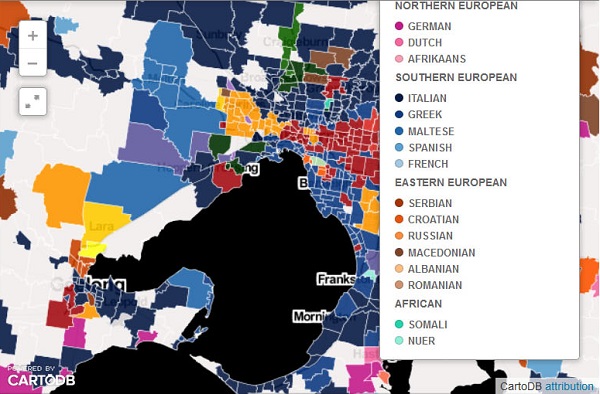
More languages are spoken in Melbourne than there are countries in the world, a cacophony of 251 tongues whose voices stretch to all corners of the city.

Melbourne languages_cropped_600

Across the city, three in 10 people speak a language other than English when they get home. In seven suburbs, English is not the dominant language. Arabic is the sixth-most commonly spoken language other than English in metropolitan Melbourne, behind Greek, Italian, Mandarin, Vietnamese and Cantonese.

The population is very mixed compared to American cities such as Chicago and Washington DC, which are very segregated. Italian is the most widely dispersed non-English language, followed by German and Dutch.

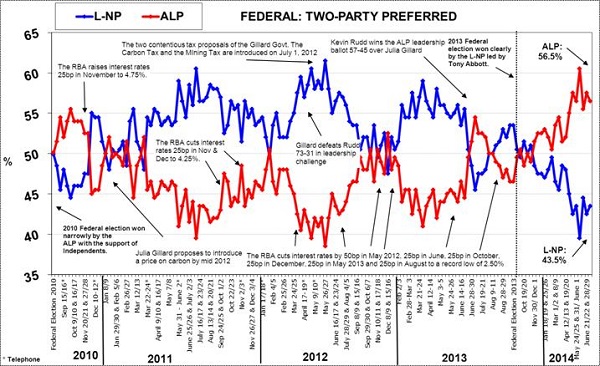
4. Morgan shows ALP at 56.5% down 1% as new senate blocks carbon tax repeal

f a Federal Election were held today the ALP would win easily (56.5%, down 1%) cf. L-NP (43.5%, up 1%) on a two-party preferred basis according to today’s multi-mode Morgan Poll conducted over the last two weekends – July 5/6 & 12/13, 2014.

Morgan Jy 2014_600

It would be too funny if passing the carbon ‘tax’ repeal saw the restoration of LNP fortunes.

Analysis by Gender

Analysis by Gender shows that ALP support remains strongest amongst women with the ALP 60.5% well ahead of the L-NP 39.5% on a two-party preferred basis. Support amongst men is closer with the ALP 52.5% just ahead of the L-NP on 47.5%.

Analysis by States

The ALP maintains a strong two-party preferred lead in all Australian States except Western Australia: L-NP 50.5% cf. ALP 49.5%. New South Wales: ALP 55% cf. L-NP 45%, Victoria: ALP 58.5% cf. L-NP 41.5%, Queensland: ALP 56.5% cf. L-NP 43.5%, South Australia: ALP 64.5% cf. L-NP 35.5% and Tasmania: ALP 61% cf. L-NP 39%.

5. Stafford by-election

We’ll keep an eye on this one. Antony Green says he expected a double digit swing in the polls for the inner-northern Brisbane seat, citing the 17 per cent swing against the LNP at the Redcliffe by-election earlier this year and recent opinion polls. Janine Walker told local radio that anything less than 20% and the LNP will reckon they’ve been let off easy.

Notably, PUP is not running. She says they know they won’t win so they want to maximise the protest vote for Labor. The idea is to bury the LNP as deep as possible.

Most south of the border reckon Palmer is about self-interest or revenge. Walker says all the above and more, but he thinks strategically and is focussed on power.

6. FIFA wins

Remember this?

Popes praying_10449976_816909721666770_8792909987461327130_n

Germany won, but did it?

John Oliver explains that soccer is a religion, FIFA is its church. It’s evil, even murderous and frankly appalling. Soccer excites the masses like no other sport, but FIFA takes the gold – literally!

Thanks to my friend in Erlangen for the heads-up!

Climate change, sustainability, plus sundry other stuff