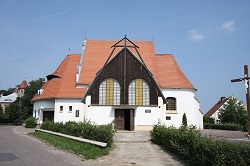
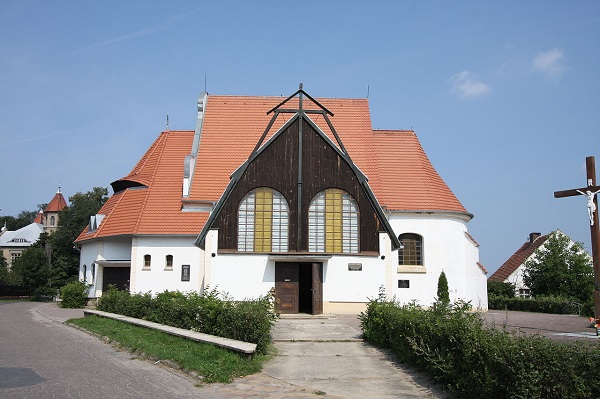
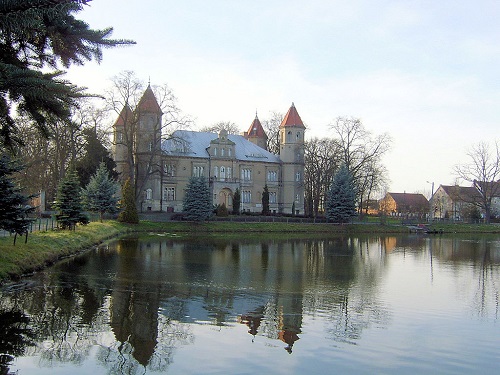
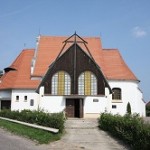
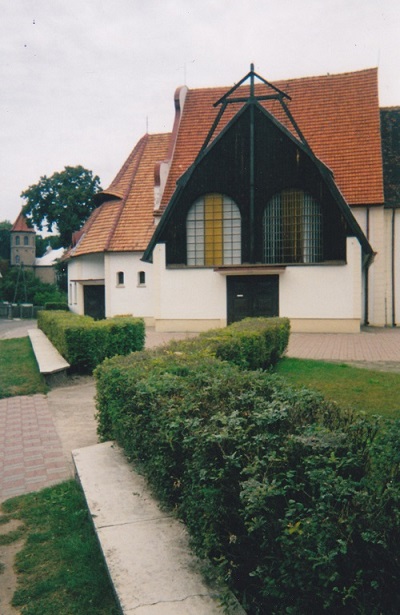
Noel Cameron-Baehnisch in a rush of enthusiasm has translated the Dąbrówka Wielkopolska (fmly Groß Dammer) article in Polish Wikipedia. This may mainly be of interest to specialists and enthusiasts but the persistent will be rewarded. I’ve added here some images from the article, first the famous folkloric church:
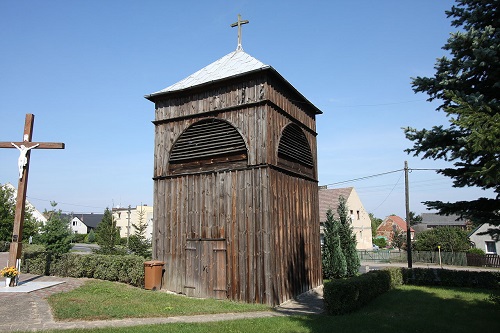
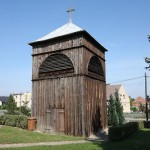
Next to the church stands a belfry:
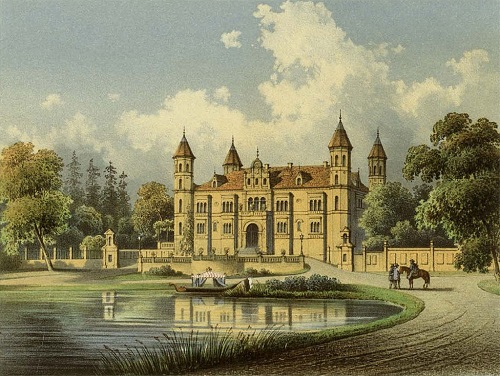
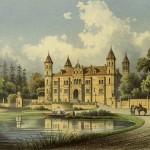
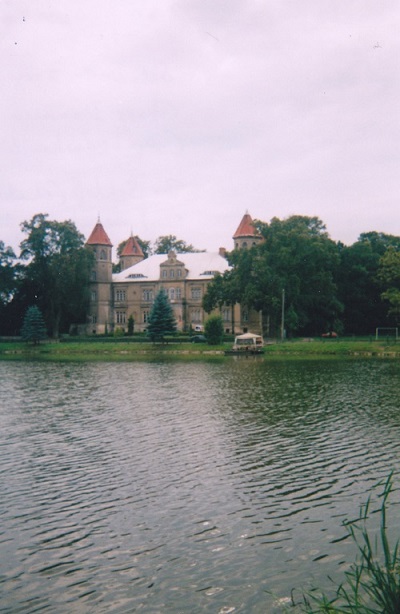
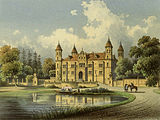
Here’s the famous chateau, apparently as it appeared in 1858:
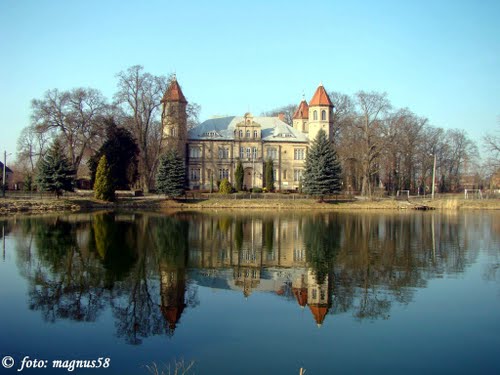
This is a more modern version, in a winter mood:
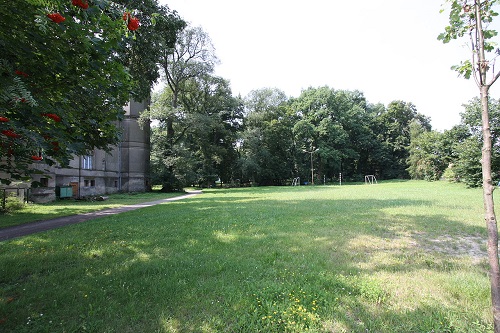
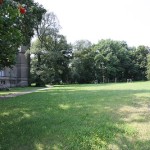
This is a park scene in the chateau complex:
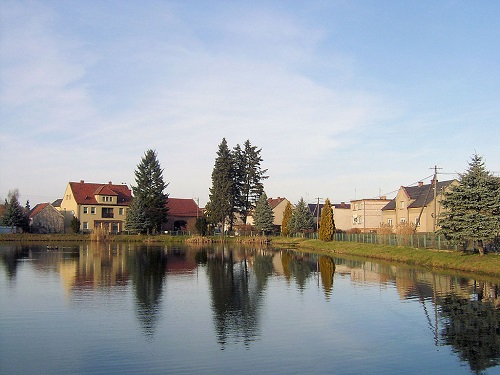
In the centre of the village we find an attractive pond:
My rough translation of the Polish WIKIPEDIA article: found 7/7/2014; translated word-by-word using the Internet on the 9 July 2014. Dabrowka (pronounced “dom-BROOF-kah”) is the village where my Polish ancestors, the Ruciaks (“ROO-chark”), came from; they were Prussian subjects but ethnically very Polish. I assume the information in this WIKIPEDIA article is accurate, though I know it consists of contributions from one person or several people, none of whom can be classified as professional historians. WIKIPEDIA is free; professional history is not.
Dąbrówka Wielkopolska (niem. Groß Dammer [2]) – wieś w Polsce położona w województwie lubuskim, w powiecie świebodzińskim, w gminie Zbąszynek.
Translation notes: Polish is a heavily inflected language; words typically consist of a stem followed by all sorts of complex “inflections” or case endings, like in Greek, Latin, Russian and German).
niem. (abbreviation) = German. wies = village (“-wice” in placenames; wsi = in the village). “w” is a preposition which means in, towards, to, etc.
Village on Polish territory, in the Lubuska Province, District of Swiebodzin, sub-district of Zbaszynek (the modern industrial and railway town just south of Dabrowka).
Państwo Polska [Nation of Poland]
Województwo lubuskie [Province of Lubuska]
Powiat świebodziński [District of Swiebodzin]
Gmina Zbąszynek [Sub-district of Zbaszynek]
Liczba ludności (2010) 1172 [1] [population in 2010]
Strefa numeracyjna (+48) 68 [telephone area code]
Tablice rejestracyjne FSW [car number-plate begins with “FSW”]
Spis treści [List of Contents]
1 Historia [history]
2 Zabytki [monuments]
3 Galeria
4 Przypisy [references]
[Brian – The above images appeared from nowhere. The aren’t in the Word file Noel sent me, or in the back-end copy that generates the post, so I can’t remove them!]
Historia
Miejscowość wzmiankowana była już w 1406 jako wieś szlachecka Dambrowca w dobrach zbąszyńskich. W XV w. osada była w posiadaniu rodziny Zbąskich. Niestety we wsi nie zachowała się stara kronika z XIV w. napisana po łacinie i po polsku przechowywana w miejscowym kościele św. Jakuba Apostoła, ponieważ wypożyczona została przez Uniwersytet Humboldta w Berlinie i nigdy już do Dąbrówki nie powróciła [3].
Zbaszyn = German Bentschen, an important town just SE of Dabrowka; many families left the Bentschen district for South Australia. Neubentschen (New Bentschen) = Zbanszynek.
This place was mentioned as early as 1406 as the wies szlachecka (noble village = village owned by an aristocrat) of DAMBROWCA in the Zbaszyn Town records. W XV. wieku (in the 15th century) this settlement (osada) was the possession of a Zbaszyn family. Unfortunately the village no longer has its stara kronika z XIV w. (14th-century Old Chronicle), written in Latin (po lacinie) and Polish (po polsku) and stored in the Church of Saint James the Apostle (Jakuba Apostola) – because it was borrowed (wypozyczona) by the Humboldt University in Berlin (the oldest and most prestigious university in Berlin) and nie powrocila (never returned)!!
Osada zbudowana na planie tzw. owalnicy z charakterystycznym placem wewnętrznym, zwanym nawsiem.
z = the preposition means with, from, about, out of, because of, in, etc.
Settlement built on a so-called oval (owalnicy) plan with characteristic … … [too difficult for me to translate the rest].
Mimo bezpośredniego sąsiedztwa z niemieckim obszarem etnicznym i procesów germanizacyjnych, polska ludność autochtoniczna stanowiła zawsze większość mieszkańców zachowując polską mowę i obyczaje. W 1905 we wsi mieszkało 1.038 osób, w tym 90,1% Polaków oraz 9,7% Niemców [4].
niemieckim = the stem niem plus a complex inflection and case ending = German.
Despite (mimo) the closeness of ethnically German territory and the process of Germanification (procesow germanizacyjnnych), the native population always (zawsze) preserved (zachowujac) its polska mowe i obyczaje (Polish language and customs). In 1905, we wsi (in the village) were 1038 people, of whom 90.1% were ethnically Polakow (Polish) and 9.7% ethnically Niemcow (German).
W 1910 jako dominium Gross Dammer miejscowość należała do Bernharda von Britzke. Mimo protestów polskiej ludności w 1919 pozostała w granicach Rzeszy na mocy decyzji komisji międzyalianckiej. W latach 1815-1945 Dąbrówka Wielkopolska należała do powiatu międzyrzeckiego (Kreis Meseritz).
In 1910, the “dominium” of Gross Dammer was owned by the aristocrat, Bernhard von Britzke (von is the aristocratic adjective and Britzke looks like a Slavic name; Bernharda is in the genitive case): in other words, the village was owned by Von Britzke, who obviously lived in the big palac (chateau). Despite (mimo) the protests of the Polish population in 1919, it remained inside the border of the Rzesz (Polish form of Reich), because of a decision by an international commission. In the years 1815-1945, Dabrowka belonged to Kreis Meseritz (the Prussian District of Meseritz Town).
W latach 1929–1939 we wsi działała polska szkoła, w której nauczało 3 nauczycieli, a uczyło się 140 dzieci [5]. Szkoła po raz pierwszy wzmiankowana była w 1640. W miejscowości istniało także przedszkole polskie założone w 1935 roku, z 70 dziećmi.
In the years 1929-1939, the village operated its own Polish school (polska szkola), in which 3 teachers (nauczycieli) taught about 140 dzieci (children). The school was pierwszy wzmiankowana (first mentioned) in the year 1640. There was also (takze) a Polish kindergarten (przed-szkole polskie), founded in 1935, with 70 youngsters (dziecmi).
W 1939 na 1.287 mieszkańców wsi Polaków było 986. We wsi w 1923 powstaje Polskie Towarzystwo Gimnastyczne Sokół założone przez Stanisława Mizernego, które posiadało męską i żeńską sekcję sportową. W miejscowości istniał także oddział regionalny Związku Polaków w Niemczech, Przysposobienie Rolnicze, Chór Polski oraz Kółko Rolnicze.
In 1939, of the 1287 village residents, 986 considered themselves to be Polakow (Poles). In the village, in 1923, was founded a branch of the POLSKIE TOWARZYSTWO GIMNASTYCZNE “SOKOL” by Stanislaw Mizern, which had male and female sporting sections. (This “Falcon” Polish Gymnastics Society was part of the Pan-Slavic Movement.) The village also (takze) had a regional branch (oddzial) of the non-political Zwiazku Polakow w Niemczech [Union of Poles in Germany], a Przysposobienie Rolnicze [agricultural college], a Chor Polski [Polish choir] and a Kolko Rolnicze [agricultural “circle” or club].
W 1934 roku, utworzono stały obóz Arbeitdienstu. W 1935 miasto Lipsk rozpoczęło tuż przy Dąbrówce budowę osady niemieckiej pod nazwą Limbach, dla uczczenia SA-manna Limbacha, zabitego w walce nazistów z komunistami. Wg oceny niemieckiej gazety “Deutsche Allgemeine Zeitung” osada ta powstała w celu wzmocnienia żywiołu niemieckiego “muszącego ciężko walczyć na Pograniczu z mniejszością polską”[6]. W lipcu 1938 roku, nastąpiło uroczyste poświęcenie 20 gospodarstw, wielkości 20 ha każde przeznaczonych dla niemieckich kolonistów-członków SA i SS [5].
[In 1933 Hitler ruthlessly grabbed power and strangled German Democracy.] In 1934, an Arbeit-dienst camp was set up. In 1935 the City of Leipzig (Lipsk) began to construct osady niemieckiej (German settlements), called Limbach after an SA soldier of that name, killed in Nazi action against German communists. (SA = Nazi Brownshirts.) According to the German newspaper (gazety) “Deutsche Allgemeine Zeitung”, the settlement was founded to strengthen the German presence in those border districts z mniejszoscia polska (with Polish minorities). In lipcu (July) 1938, there was a ceremony to dedicate 20 gospodstw (farms), each of 20 hectares, mainly for niemieckich kolonistow (German colonists) who were czlonkow (members) of the SA and SS. [You can be sure these colonists left quickly in 1944, of their own volition! Limbach is now called Samsonki, about 3 km east of Dabrowka.]
Podczas wojny, polskojęzyczna ludność Dąbrówki była przez Niemców wysiedlana i zsyłana do obozów koncentracyjnych, dotyczyło to szczególnie polskich działaczy społecznych i narodowych, np. Jana Budycha współorganizatora Banku Ludowego i jednego z organizatorów polskiej szkoły w Dąbrówce Wielkopolskiej. Łącznie zginęło 12 osób [7].
During the War (“wojn” is the stem for “war”), polskojezyczna (Polish-speaking) residents of Dabrowka were arrested by the Germans and sent to obozow koncentracyjnych (concentration camps), especially Polish social and nationalist activists (dzialaczy), such as Jan [John] Budych, managing-director of the local People’s Bank and one of the organizers of the local Polish schools (polskiej szkoly) in Dabrowka. Lacznie (in total) zginelo (were murdered) 12 osob (people), by the Nazis, including Jan.
(The surname Budych is significant because Carl Albert Budich [sic: “BOO-dik”] (1839-1911) married Franziska Naida (1845-1891) in 1863 in South Australia: Franziska was the niece and namesake of Franziska Baehnisch nee Ruciak (Ruciack); Fran Naida’s mother was Severina Ruciak, Fran Baehnisch’s sister. The Budich (Budick) surname is still found in South Australia. So are the surnames Naida (Nayda) and Ruciack. All these families left Dabrowka district and so missed out on the trauma and horrors of two idiotic ultra-nationalistic World Wars. Instead, they had the privilege of helping to destroy an out-of-control ultra-militaristic Germany, then watching from afar the formation of two new and peaceful Germanys, one free, one not free, next to a proud and independent, if not free, Poland.)
W 1945 wieś została przyłączona do Polski. W uznaniu zasług w zachowaniu polskości wieś, w 1973 została odznaczona Krzyżem Grunwaldu II klasy. W latach 1945-1954 siedziba gminy Dąbrówka Wielkopolska. W latach 1975-1998 miejscowość administracyjnie należała do województwa zielonogórskiego.
In 1945, the village (wies) was attached to Poland. In recognition of its meritorious behaviour as a polskosci wies (Polish village), in 1973 it was awarded the Grunwald Cross (Second Class). (In the battle of Grunwald, in 1410, the Poles crushed the Teutonic Knights.) From 1945-1954, it was in the sub-district (gminy) of Dabrowka. From 1975-1998, it was administered by the Province of Zielona Gora. [1998 marks the end of Communist Poland.]
Siedziba Parafii Niepokalanego Poczęcia Najświętszej Maryi Panny i św. Jakuba Apostoła.
Seat of the Parish of the Niepokalanego Poczecia (Immaculate Conception) Najswietszej Maryi Panny (of the Blessed Virgin Mary) and of Saint Jakub Apostol (James the Apostle).
Zabytki [Monuments]
Według rejestru Narodowego Instytutu Dziedzictwa na listę zabytków wpisane są [8]:
According to the National Heritage Institute’s list of registered monuments:
kościół parafialny rzymsko-katolicki pod wezwaniem Niepokalanego Poczęcia NMP, z połowy XVII-XVIII wieku
zespół pałacowy: pałac, neorenesansowy z lat. 1856-1859; park, z połowy XIX wieku.
kosciol (pronounced “KOSS-ya-choo-wa”) = church. parafialny = parish (adj.). rzymsko-katolicki = Roman Catholic. pod wezwaniem = called. z polowy XVII-XXIII wieku = [built in] mid-17th century to 18th century.
Chateau complex: the palac [“PAH-wah-ts”] or chateau, Neo-Renaissance, [built] in 1856-1859. And the chateau’s park, mid-19th century.
Galeria
1. Kościół par. pw. Niep. Poczęcia NMP [parish church called the IC of the BVM]
2. Pałac [palace or chateau]
3. Park w zespole pałacowym [park in chateau complex]
4. Staw w centrum wsi [pond in centre of village; staw is pronounced “STAH-ff”.]
5. Neorenesansowy pałac [Neo-Renaissance chateau]
6. Pałac na ilustracji z 1858 r. [chateau illustrated in 1858 year]
7. Dzwonnica przy kościele parafialnym [belfry beside the parish church]
[Brian – again the images appeared from nowhere. Curious because what we have here is not co-extensive with what appears in the linked article.
Przypisy [References]
Reference [4] is the most interesting one:
Na podstawie danych ze spisu powszechnego z 1905 r., wg deklarowanego języka ojczystego i religii; część ludności zadeklarowała inny język ojczysty. Gemeindelexikon für das Königreich Preußen. Heft V. Provinz Posen, Berlin 1908.
Based on data collected by the Census (spisu) of 1905, based on stated (deklarowanego = declared) jezyka ojczystego (native language = mother tongue) and religii (religions); segment of population declaring “other” (“inny”) native language. Parish Lexikon for the Prussian Kingdom. Volume 5. Province of Posen (Poznań in Polish). Berlin, 1908.
And finally, I must tackle the text of one of the 3 plaques I photographed in 2004 on the outside of the parish church. Our Polish guide Bolek told me the 12 listed people had died in WWII. I had always guessed that they were young men compulsorily drafted into Hitler’s armies and then killed in action. But I know better now. And I must apologize to the families of the 12 martyrs, who are my very distant cousins, for the misunderstanding. This is what happens when a family forgets how to speak Polish. Please pardon any bad transcription errors because it is very hard to read the beautifully carved text on the marble plaque. When I read about Jan Budych’s fate in the WIKIPEDIA article, I began to understand the following:
Boże zbaw Polskę. God bless Poland.
Bohaterom Dąbrówieckim. To the Martyrs of Dabrowka. (bohater = martyr.)
Milość. Wierność. Cześć. Love, Fidelity. Honour.
Jan Budych, Tomasz Budych, Marcin Bimek, Walenty Berent, Wojciech Berowicz, Jan Flejsierowicz, Wojciech Golek, Jan Golek, Antony Kwaśny, Stanisław Kędziera. Piotr Malysiak, Wojciech Młodystach.
Some of the surnames are Germanic or partly so (Flejsier = Fleischer?). Młodystach is very prominent in the South Australian Phone Book today: now spelt Modistach but unmistakably Polish; in modern Polish, the l-with-stroke ( ł ) is pronounced like the English ‘w’ sound – “m-WOR-dee-stah-k”.
Za Waszą Wiare i Wolność. For Your Faith and Freedom.
Życie Swe Oddali. They Gave Their Lives. (word-for-word, Lives Their They-Gave.)
This is an echo of Poland’s unofficial National Motto, which dates back to the disastrous 1830 Polish Insurrection: Za Naszą i Waszą Wolność (For Our and Your Freedom). The 12 Martyrs of Dabrowka not only fought for their own Freedom but for the Freedom of Everyone, then and now, for you and me.
Męczarniach Więzień i Obozów. Tortured to death in Prisons and Camps.
Miłosier Bądż ——-. Mercy Be ——–. Probably “upon their souls” or “upon all”.
And I can’t read the last line on the plaque.
Finally, Reference [2] makes reference to the “Rodło”. I GOOGLEd this and read a fascinating story of adaption and survival. Kaczmarek died in exile in Washington DC in 1977; Kłopocka died in Communist Warsaw in 1982. Prussia had long before banned the use of the White Eagle as a Polish symbol inside Prussia. Hitler seized power in early 1933, so it seems the symbol was adopted before he rose to dictatorial power, despite what the English WIKIPEDIA article implies. I have edited the text slightly. In Polish, the Vistula is called the Wisła (”VEE-s-wah”). Rodło = “ROR-dwor”.
The Rodło is a Polish emblem used since 1932 by the Union of Poles in Germany. It is a stylized representation of the Vistula River and Kraków as the wellsprings of Polish culture.
After Adolf Hitler had seized power in Germany, Nazi emblems were soon compulsory nationwide. The swastika became the national emblem of the Third Reich and Poles from the Union of Poles in Germany could not use their national symbols anymore, because they were prohibited. Dr. Jan Kaczmarek approached the supreme council with the following proposal:
“Our acceptance of the swastika and the German Greeting [the Nazi Salute] could only signify agreement to total Germanisation. Therefore we must find a way, without risking the accusation of anti-state activity, of not accepting Heil Hitler and the swastika (…) we should at last have our own national symbol, which would enable us publicly to set ourselves free from the Nazi swastika.”
The Rodło graphic was conceived by graphic designer Janina Kłopocka who sketched the course of the Vistula River, cradle of the Polish people, and Royal Kraków, cradle of Polish culture. The white emblem was placed on a red background – the Polish national colors. It was adopted in August 1932 by the leadership of the Union of Poles in Germany.
This clever modern image combines the Rodło on the right with an explanatory graphic on the left.
The Polish WIKIPEDIA article says in part:
… i zewnętrznie wyglądające jak pół zmodyfikowanej swastyki, a jednocześnie nią nie będące. W ten sprytny sposób, Polacy w Niemczech uniknęli przyjęcia symboliki nazistowskiej.
… and outwardly looked like half a modified swastika, whilst not actually being that. In this clever way, Poles in Germany avoided the adoption of Nazi symbols.
We all have so much to learn about our Polish ancestors!
Please correct any Polish typos, Polish Clerical Errors, etc.
By Noel David Cameron-Baehnisch, 7 Park Road, Angaston 5353 SA; ncameron@vtown.com.au.
Brian: I can’t find the above image in the current article. It seems to have been replaced by this one:
Two big lessons of economic research over the past 10 years are that inequality is not the result of inexorable laws of economics but rather of policy; and that countries that adopt policies that lead to high inequality pay a high price – inequality not only leads to a divided society and undermines democracy, but it weakens economic performance.
I think he [Piketty] is absolutely right to emphasise the increase in inequality that has occurred. I think he is absolutely right in his key idea that the period from World War II to 1980 was unusual in the history of capitalism, capitalism has typically been associated with high levels of inequality.
What I differ with is I don’t think it is the inexorable result of economic laws, of economic forces. It is a result of policies and politics, it is the result of rent-seeking behaviour, which the laws and regulations help create or don’t do enough to counter. There is almost a tone in his book that this is just the way of capitalism, and my view is that the kind of inequality that we’ve seen is really a result of the fact that we don’t have a well-functioning market economy.
So to Stiglitz markets are a human artefact and need regulation, and the nature of laws and regulations governing markets matters. As do state provisions and interventions.
Joe Hockey defended his budget saying you can’t expect equality of outcomes, only opportunities. Stiglitz has a more nuanced and interactive view:
While there are many dimensions to growing inequality, perhaps the most invidious is inequality of opportunity. Western democracies pride themselves in providing a level playing field, in which all who would work hard can prosper. But it’s a myth, and nowhere more so than in the US, in spite of the rhetoric about the American dream. The life prospects of a young American are more dependent on the income and education of his parents than is the case in other advanced countries. And there is a vicious circle: inequality of outcomes leads to inequality of opportunity which leads to further inequalities of outcome. The prospect for America’s future is thus still more inequality of outcomes and opportunity.
Stiglitz says that only about 8% of those in the bottom half of the income scale get a college education. He says our Australia’s HECS system works and is the envy of the rest of the world.
But Australia is neither the best nor the worst in terms of equality. In his article in The Guardian he compares our Gini coefficient unfavourably with that of Norway, a resource-rich country that has done a particularly good job of managing its wealth for the benefit of all citizens. He links to the OECDiLibrary. I can make more sense of the CIA Factbook which places Norway on 25 and Australia on 30.3, close to the European Union average of 30.6. The USA looks third world at 45.
On the one hand we are the best in the Anglosphere, with Canada on 32.1, the UK on 32.3 and New Zealand on 36.2. On the other, we are worse than half of Europe.
A third area where we do better is in “basic welfare support and systems of social protection.” In America with
almost one out of four children living in poverty, and with deficient public support, the prospects for their future are not rosy – and this will inevitably translate into weaker overall economic performance for the country.
In Stiglitz’s ideal world one’s opportunities are not constrained by the circumstances of birth. Society should help individuals to become whatever they can be, which is in turn better for society and the economy. In Hockey’s world society gets you to a mythical starting line from which reward is dependent on individual effort. Social support is not universal. The social safety net has holes in it through which fall the unworthy.
I sense that for Stiglitz freedom and equality are integrated through a sense of justice, as for John Rawls. Full individuality is attained in a cooperative and mutually supportive social context. This contrasts with the individualistic competitiveness which seems a leading feature of Hockey’s world.
One day listening to Radio National I did hear about research which purported to show that societies with a Gini coefficient of 33 or more tended to become socially dysfunctional and corrosive. Unfortunately I did not get a name or a link. It seems to me, however, that the sense of outrage felt towards Hockey’s budget stems from the sense that it is taking us as a society into territory where we feel that the social contract between the people and the state has been breached.
While the Senate has not yet passed the bill to repeal the ETS the question arises as to when if ever carbon pricing will return. I’m not a psephologist but I suspect that the Palmer United Party are going to be in a similar position after the next election of having a stake in the balance of power, perhaps more so! Given that Labor appear set on retaining carbon pricing as part of their policy platform and the Greens will sign up to a reasonable scheme, the introduction of carbon pricing appears to depend on either the Liberals growing up or PUP.
Assuming PUP don’t change their mind they have said we won’t have emissions trading until India, China, the USA, Europe, Japan and South Korea do it. So the prospects of carbon pricing appear to depend on the US Tea Party losing a controlling position in the US Senate, or the Australian Tea Party turning into a mature modern party that respects the science.
The key to understanding Palmer is that he’s always about what’s ahead. What’s in the past is irrelevant. The issue of consistency simply doesn’t arise, because Palmer eternally moves forward, toward the next announcement, the next stunt.
Palmer has said that PUP are going to be on the right side of history. The international scene is likely to be somewhat fluid leading up to the UNFCCC Conference of Parties in Paris in December 2015 where a legally binding post Kyoto deal will be attempted. Negotiations under the UNFCCC are almost continuous but the next big event is in September 2014 when UN Secretary-General Ban Ki-moon has invited world leaders to a Climate Summit Catalyzing Action:
This Summit will be a different kind of Climate Summit. It is aimed at catalyzing action by governments, business, finance, industry, and civil society in areas for new commitments and substantial, scalable and replicable contributions to the Summit that will help the world shift toward a low-carbon economy.
In preparation for the summit economist Jeffrey Sachs’s Deep Decarbonization Pathways Project has produced an interim report plotting specific measures for the world’s 15 largest economies “to cut their emissions quickly and deeply enough to meet an international agreed goal of limiting warming to two degrees above pre-industrial levels.”
The 15 economies are, in alphabetical order, Australia, Brazil, Canada, China, India, Indonesia, Japan, France, Germany, Mexico, Russia, South Africa, South Korea, the UK, the USA.
I’ve highlighted the ones nominated by Palmer.
The report
found that it’s technically possible for Australia to get almost all of its electricity from renewable sources by 2050 and to offset the rest by storing carbon in soil or planting more trees.
We can do this while growing our GDP at 2.4% pa.
The importance of Australia’s role in New York in September is possibly two-fold.
Firstly, will Abbott be embarrassing? Will he be negative and disruptive or just irrelevant? It’s extremely unlikely that he will show any vision or learn anything.
I did hear that he was going to be too busy at home destroying Labor’s legacy in climate change to attend. No doubt Julie Bishop will fill in since Greg Hunt is not allowed out alone.
Secondly, and of greater importance, will Palmer as a result of what other leaders say decide that Australia should ride at the head of the peloton and show a bit of leadership without breaking away?
Palmer saves the world!
Meanwhile here on the local scene PUP are planning to introduce their ETS on trainer wheels as an amendment to the legislation proposing the demise of the Climate Change Authority.
THE cracks are beginning to show. Greenland’s ice sheets slid into the sea 400,000 years ago, when Earth was only a little warmer than it is today. That could mean we are set for a repeat performance.
If Greenland goes, West Antarctica also goes, giving 13 metres of sea level rise from those sources. If that happens there will also be a complete loss of other glaciers and ice caps, thermal expansion and some partial melting from East Antarctica. A mess!
The question is how soon and what can we do? The answer is we need more research and we need to think more in terms of centuries.
We should be thinking about the next 500-1000 years, how ice sheet decay can be minimised, stabilised and headed in the other direction. Our plans for the next 50-200 years should be made in the light of this.
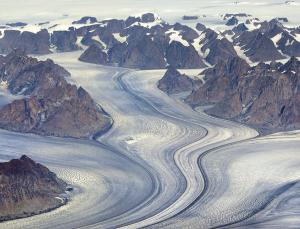
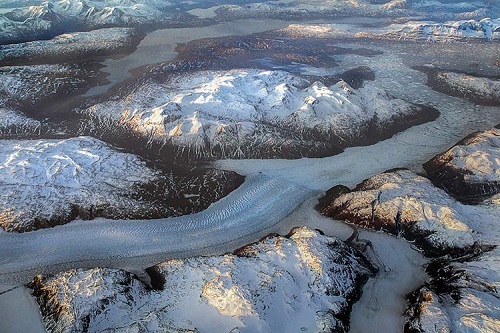
This image from the article shows a part of Greenland where the ice is quite dynamic.These areas are expected to grow.
“A game changer” is how climate scientist Dr Malte Meinshausen describes newly published research that West Antarctic glaciers have passed a tipping point much earlier than expected and their disintegration is now “unstoppable” at just the current level of global warming. The research findings have shocked the scientific community. “This Is What a Holy Shit Moment for Global Warming Looks Like,” ran a headline in Mother Jones magazine.
Meinshausen says this is new information. He says that the beaches we know and love all around the world will disappear. He also wonders what other nasty surprises lie this side of a 2°C temperature rise. Spratt says we told you ages ago it was coming, by James Hansen, for example and by himself and Philip Sutton in 2007.
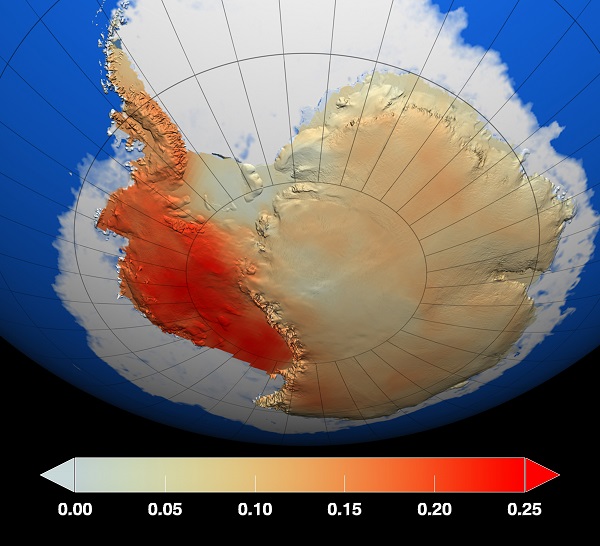
This NASA image shows the temperature changes from 1957 to 2006:
It’s par for the course for climate policy-makers to hope for the best, rather than plan for the worst. More than once this blog has warned that sea-level rises are being underestimated by Australian policy-makers, and that the tens of millions of dollars being put into adaptation planning for sea-level rises of no more than 1.1 metres by 2100 will be a waste of money, and all that work will have to be done again. And now that has come to pass.
GIANT “whirlpools” in the ocean carry far more water than expected and have a big impact on the weather – though as yet we don’t know exactly what.
The areas of swirling water are 100 to 500 kilometres across. These “eddies” generally move west, driven by Earth’s rotation, until they stop spinning. Now, for the first time, the amount of water and heat they carry has been measured.
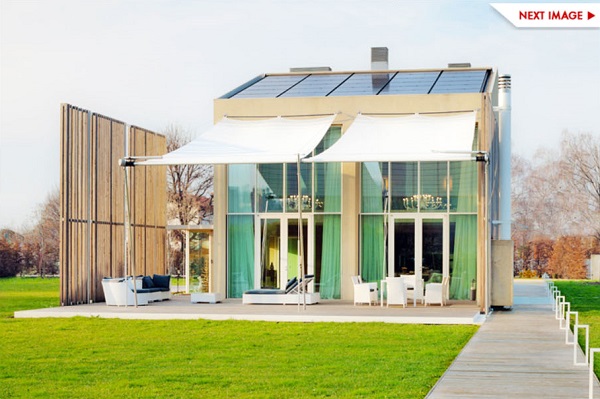
Nestled into the pastoral landscape of Treviso, Italy, BioCasa_82 is a beautiful home that boasts some seriously energy-efficient technologies.
The house is made from 99% recyclable materials and scores
117 points out of 136, according to the American protocol LEED Platinum, and 10 out of 11 points in regards to innovation in design, the building is a real gem in the European building practice.
According to the carbon footprint analysis, BioCasa_82 yields 60% less emissions than traditional buildings. Its photovoltaic system produces around 14kWh/mq of electricity, and a high-efficiency geothermal plant provides heat, hot water and cooling. These strategies are complemented by a rainwater harvesting system.
That is everyone’s problem since he owns a world-wide media empire.
Many of Murdoch’s news outlets are also among the worst when it comes to getting climate science wrong and disseminating climate myths and misinformation. Inaccurate media coverage is in turn the primary reason why the public is so misinformed about global warming.
I won’t go into the details, but Climate Progress observes that he ‘lowballed’ the numbers and minimized possible impacts. Here in Oz:
”We can be the low-cost energy country in the world,” he said. “We shouldn’t be building windmills and all that rubbish.”
Elsewhere Graham Readfearn finds that Tony Abbott’s views on climate are seriously crap.
Reminder: Use this thread as an open thread on climate change.
Jess Hill’s cracking article in The Monthly (you can read a limited number of articles online per month without a subscription), and the recent Four Corners program on renewable energy, are required consumption for anybody interested in the history and future of electricity supply in Australia.
In short, the electricity distributors (who hold a natural monopoly over their corner of the market) predicted continued growth in electricity demand and then persuaded the energy regulators to let them increase their charges to pay for said infrastructure. This accounted for most of the growth in electricity prices, despite the nonsense about the carbon tax from the right of politics. The reasonableness of these predictions can be debated; the fact that they led to massive profits for the distributors is now clear. In the face of these increased prices, something amazing happened – absolute demand for electricity dropped substantially. Part of this can be attributed to rooftop solar, some to energy efficiency; regardless, the huge infrastructure spend has turned out to be almost completely unnecessary. Along the way, grid electricity generators have felt the squeeze between falling demand and mandated construction of renewable energy through the RET, and are now lobbying hard to prevent more renewable energy being connected to the grid.
The future is a topic for another post, but there is one point about the past and present that Hill’s excellent report hasn’t really gotten in to. Particularly in NSW and Queensland where the price increases have been greatest, the electricity distributors are state-owned, and the profits have gone to the state governments. Dividends from the distributors have filled a pretty substantial gap in those state budgets; however, they’ve done so in an extremely inefficient way. Billions of dollars has been wasted building unnecessary infrastructure so that the state governments could collect revenue from the monopoly profits. Hill’s article reports $45 billion dollars worth of infrastructure has been built nationally; in Victoria’s privately run grid, one third of the infrastructure spending went towards peak capacity augmentation, whereas in NSW and Queensland about two-thirds was spent on the same area. Based on this, my rough guess is that in those two states, at least $7-8 billion was spent on unnecessary capacity augmentation.
In a sane world, if state governments need more revenue, they would raise taxes. But because of Australia’s strange fiscal arrangements, where state governments spend a large fraction of total government revenue but only collect a fraction of it, it’s easier to whinge about the vicissitudes of the Commonwealth Grants Commission and raise this kind of hugely inefficient stealth tax.
So next time somebody mentions “vertical fiscal imbalance” and “narrow tax bases”, try not to let your eyes glaze over. It’s boring, but it’s important.
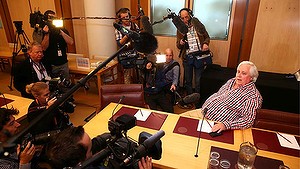
Abbott now has to wait until next week and cede the centre stage in the House of Representatives to Clive Palmer, the pest who has become a nemesis while also being the guy the PM cannot ignore.
Tony Wright in the SMH describes Palmer as the emperor in the check shirt holding court upon a leather chaise longue at the entrance to the Senate chamber. There “the formerly mighty paid obeisance, begging his mercy”:
Here came Eric Abetz, leader of the government in the Senate; Mitch Fifield, manager of government business in the Senate; Simon Birmingham, parliamentary secretary to the Minister for Environment; all of them very nearly falling to their knees. A swirl of harried government advisers circled and whispered, knowing there was no escape for their masters.
Clive Palmer had no pity to dispense.
His eyes were dead to the presence of the supplicants, his ears closed to their pleading.
Repeal the carbon tax today? No chance.
He drew around him his little band of senators, instructing them on their duty.
And so on.
There is plenty at stake. Atkins article identifies the following:
Stopping Newstart for the young for 6 months – $2.1b
Changes to family tax benefit B – $1.9b
Axing seniors supplement $1.2b
Co-payment for pharmaceuticals – $1.2b
Higher education cuts – $5b
CPI petrol excise rise $4.1b
Medicare co-payments $3.6b
Freezing family tax benefit indexation – $2.6b
Axing family tax supplements $1.2b
Other measures – at least $2b.
Right there is $25 billion I assume over forward estimates. Surely Hockey will need a mini-budget to effect repairs, but I hate to think what he might cut in the process assuming he won’t increase taxes.
It’s important to remember, however, that Palmer only becomes potent when Labor and the Greens line up in opposition to the Abbottistas.
And then Palmer only controls three votes whereas Abbott needs six of the eight cross-benchers to line up.
Ricky Muir is stressing his autonomy. Again from the SMH:
Ricky Muir is moving out of the shadow of Clive Palmer, describing his agreement with the Palmer United Party as nothing more than a “loose alliance” and warning the government not to assume he will vote with PUP.
Senator Muir stressed his agreement with the bloc boiled down to being “together but autonomous”.
“The memorandum of understanding [signed with PUP] did say, and I stand by it, we will work together where practical. But we’re going to need to do our own research on every different topic and then work together where practical.”
Topics that interest Muir are:
The so-called ”rev-head senator” outlined personal passions that include organic food, which he grows and eats from his garden in rural Victoria, preventive healthcare, which he is interested in championing at a political level, and renewable energy, following his surprise intervention last week to protect the Australian Renewable Energy Agency from the government’s budget knife.
Giles Parkinson says Muir decided to make his mark in rescuing ARENA after the famous ‘brain freeze’ interview with Mike Willisee.
We’ll have to see whether that means the Government will stop playing hardball. The Guardian reported earlier that industry minister, Ian MacFarlane, had been refusing to renew the contracts of ARENA board members meaning that within a few weeks the secretary of the industry department would be the only remaining board member of the authority. Parkinson emphasises that no investment will flow until confidence is restored.
In this as with the senate generally the Government is struggling to appear in control. Abbott assured the faithful in Brisbane that all was “normal” which Shorten thought delusional. Greg Hunt huffed and puffed and said:
he was “sending a very, very, very clear message” to any crossbenchers who voted against repeal that they would have to “explain themselves” to the Australian people, saying he was “firming up [his] approach from diplomacy to send a very clear message”.
He only said that because he thinks he has PUP, Muir, David Leyonhjelm and Bob Day on board. There’s just one small problem. Clive has been relaxing in New Zealand:
The PUP leader, Clive Palmer, told Guardian Australia that he was on holidays and “oblivious” to any deal, the PUP senators are not scheduled to meet to consider any changes until Monday morning, and four other Senate crossbenchers refuse to guarantee their vote until they see the final form of the agreement.
Still the Government says they are going to call Palmer’s bluff and bring on the vote. I thought that was where they went wrong last week. That included them accepting Palmer’s amendment with all of 15 minutes consideration. Then it all fell apart again. Xenephon:
“I think if the government was asked to put red underpants on their heads in the Senate chamber, I reckon they probably would have done it.”
Still it might all go smoothly and the Government will succeed in stripping another $9 billion off the bottom line!
Last week Tony Wright says:
It was as if Labor’s 36 faceless men of 1963 had been revisited in reverse.
And while all around wore serious suits and smart little business frocks, the big man lounged in chinos and a checked shirt unbuttoned halfway to his belly. An emperor in clothes of his own choosing.
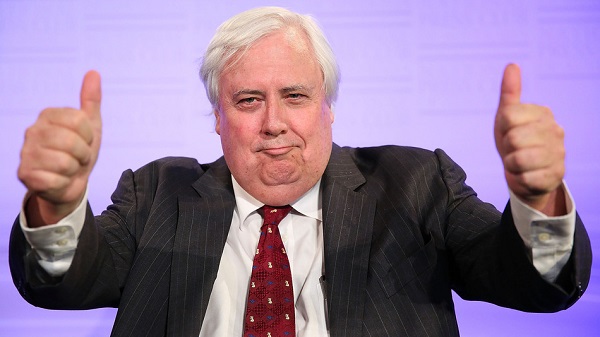
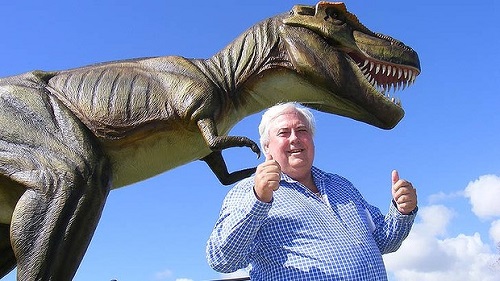
Here’s Palmer at a press conference looking relaxed:
Noel Cameron-Baehnisch took a trip to Poland in 2004, seeking out the places our ancestors emigrated from in the mid-19th century. Noel was the pathfinder for Len’s trip (see his A journey of ‘Bahnisch’ family discovery in Lower Silesia, Poland). Noel went on a tour with Homeland Tours, led by David Zweck and a Polish guide. Len found the same places with a hired car and a ‘Tom Tom’ with the help of notes supplied by Noel.
First some background on how it all hangs together, then a selection of Noel’s photos, together with edited comments he provided.
Len and Brian are brothers. Noel is the son of their oldest cousin, Mona, who married Jim Cameron.
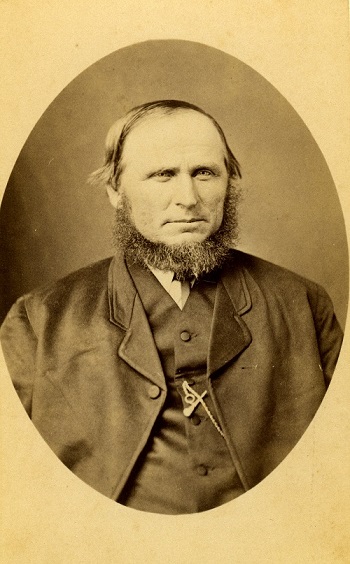
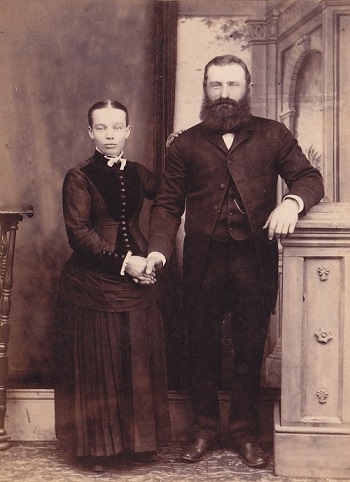
In the paternal line, Wilhelm (“Willi”) Bähnisch left Motyczyn (then Möttig) as a 17 year old in 1848. He married Franziska Ruciak, who came from Dąbrówka Wielkopolska (then Groß Dammer) as a 15 year old in 1846. Here’s a photo (see Note 1) of Willi:
Willi and Franziska had 13 children. Their eighth was also named Wilhelm (“Willi Junior” or “Bill”), Len and Brian’s grandfather. Bill married Louise Gregor. We have a photo (see Note 2) of them also:
Louise’s parents were Wilhelm August Gregor, who came from Pawłowice Wielkie, formerly Pohlwitz bei Liegnitz or Groß-Pohlwitz, and Ernestine Pauline Schulz from Bielany, formerly Weißenleipe.
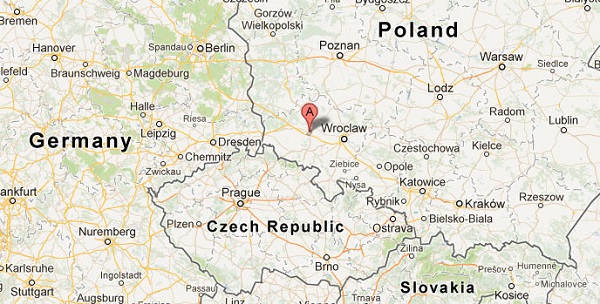
Motyczyn, Pawłowice Wielkie and Bielany are all near Legnica, formerly Liegnitz, a city of some 100,000 people and the main centre of Lower Silesia (Polish: Śląsk; German: Schlesien). It is marked “A” on this map:
Dąbrówka Wielkopolska is further north, almost due west of Poznań in the province of Posen. Both Posen and Silesia were provinces of the Kingdom of Prussia (German: Königreich Preußen) when our ancestors lived there.
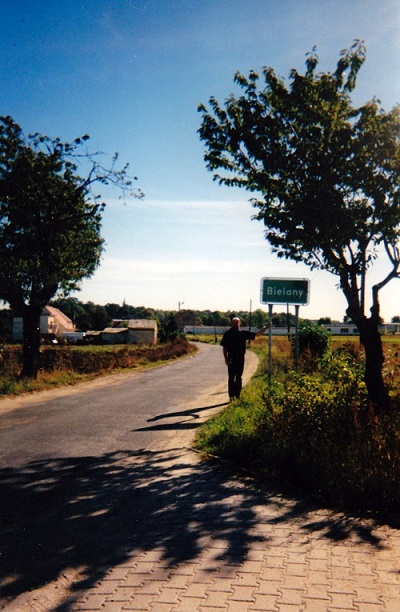
The first photo, taken by Noel’s Polish guide, Bolek, shows Noel leaving Bielany and heading west to Pawłowice Wielkie: it seems to be exactly the same sign as the one in Len’s photos:
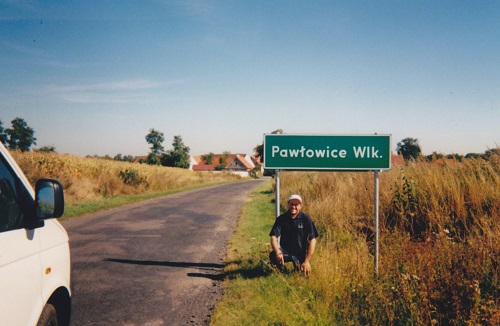
Next we have Noel at Pawłowice Wielkie (southern entrance), again taken by Bolek:
The front of the VW tour van is in shot on the left.
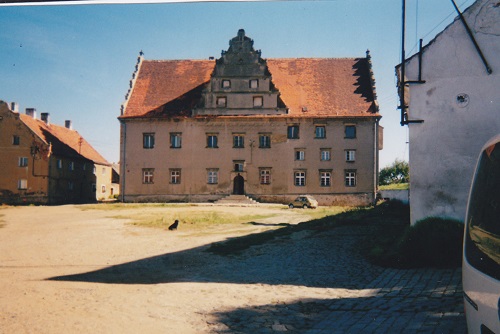
Next we have the Old Manor House in Pawłowice Wielkie, taken by Noel from inside the big courtyard. The little black dog in the photo was quiet but Noel says there was another dog barking at them as they were trespassing.
On the same day the tour went to Motyczyn:
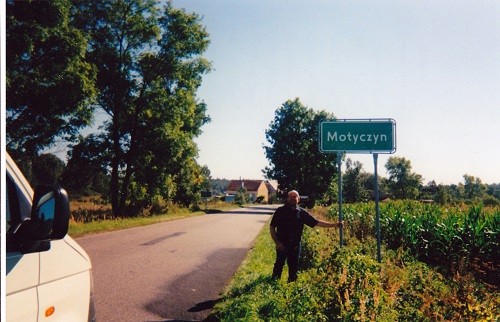
Noel was grinning because his right foot had just gone down into a ditch hidden by the grass. He was balancing himself by clinging to the sign. Again Len took a photo from almost exactly the same spot at the northern entrance to Motyczyn. In Len’s photo the tree has grown in the last ten years and a new house has been added on the right.
There were maize crops everywhere. Bolek said the maize is winter-fodder. In September the light is so different to June’s light: winter is approaching and the crops have to be gathered in, for the severe winter.
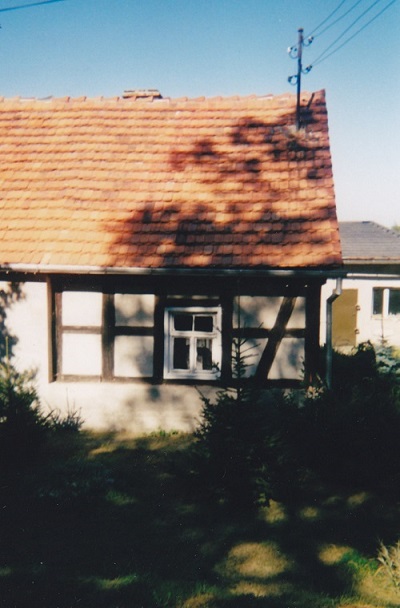
Noel found the next house the most interesting in the village: half-timbered, at south end of village, opposite the entrance to the South Wood:
In all probability the house has been repeatedly renovated and extended over the centuries.
Noel’s photo caption said: “The village is somewhere between prosperous and dilapidated.” Len had a similar impression.
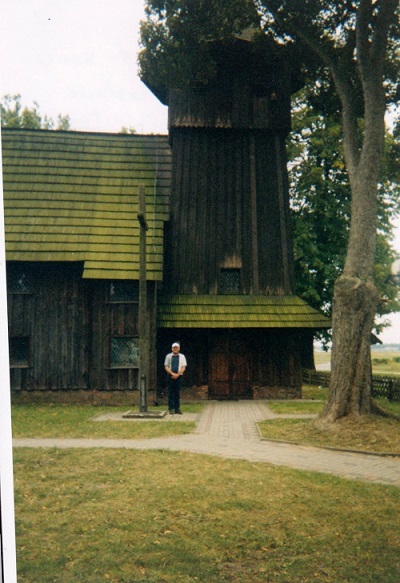
As Len said, the Ruciaks in Dąbrówka Wielkopolska worshipped in the tiny village of Chlastawa. Here’s Noel’s shot of the wooden church they attended:
This church was Pastor Fritschke’s church: he and some of his congregation migrated to SA, where he clashed with Pastor Kavel. In Len’s photo the lowest branch of the pine tree has been sawn off during the last ten years; or maybe it got ripped off in a winter storm. While the Ruciaks worshipped there as Lutherans the church is now Catholic. The yellow-green colour covering the shingle-roof is probably moss.
The church was built by the local nobility in 1639; during the Thirty Years War (1618-1648), which mostly raged further west.
Noel also photographed the “folkloric” Catholic church in Dąbrówka Wielkopolska, where a lot of money had just been spent.
The church which is heritage listed also dates from 1600s. The foundation stones were “glacial erratics”, left behind after the Great Ice Sheet retreated. The church has been repeatedly renovated and extended.
The low hedges in front are now gone. In the background, you can see one tower of the “Chateau” below:
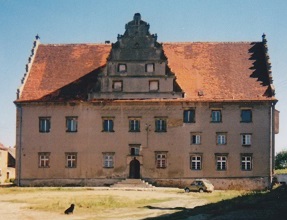
The chateau dates from 1859, after the Ruciaks left.
The Polish Wikipedia has an excellent article on the village with this thumbnail image:
As a final note this post has used three different versions of our surname – Bähnisch, Bahnisch and Baehnisch.
Willi’s birth certificate, if they got it right, would have shown Bähnisch. The umlaut ä was dropped in Australia, because typewriters couldn’t cope. The umlaut is often rendered in English by adding an ‘e’ to the vowel, hence Baehnisch. One branch of the Australian family has adopted this practice. If you look in the White Pages you’ll see Bahnisch and Baehnisch in approximately equal numbers.
The pronunciation follows the Silesian German dialect with Bay-nish. The ‘ay’ diphthong doesn’t exist in Standard German (German: Standarddeutsch, colloquially also Hochdeutsch) which would render the sound Bair-nish.
Notes:
1. This photo was in Brian’s possession, probably from a shoe box of photos left by his mother. It was scanned commercially by Kodak.
2. Scanned by Noel Cameron-Baehnisch 31 Dec 2012 AD, from Ellen Bahnisch’s Collection. It portrays Len and Brian’s paternal grandparents. Louise Gregor lost her father to gallstones before she was born at Bethel, near Kapunda. After her mother died of heart disease, Louise was fostered and became a servant in the Stiller household at Bethanien (Bethany), where she was courted by old Bertha Stiller’s first cousin, Ernst Wilhelm (“Willi” in German, “Bill” in English) Bahnisch Junior. They married in Langmeil Church, Tanunda, in 1889 when he was 25 and she was 5 months older than him! She is wearing a beautiful two-tone black dress (black was required of all brides and married women); she is probably wearing a corset to give her that fashionable but unhealthy hourglass look. Both have blue eyes, which is why their eyes look a bit blank. Her hair style is that of Old Queen Victoria. Tragically she died of childbirth on the 24 Nov 1900, leaving behind 3 healthy children. RIP, Louise. Sadly her grave is lost.
An open thread where, at your leisure, you can discuss anything you like, well, within reason and the Comments Policy. Include here news and views, plus any notable personal experiences from the week and the weekend.
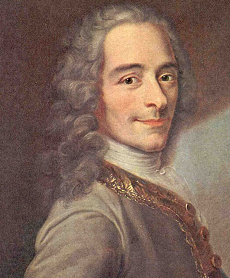
The gentleman in the image is Voltaire, who for a time graced the court of Frederick II of Prussia, known as Frederick the Great. King Fred loved to talk about the universe and everything at the end of a day’s work. He also used the salons of Berlin to get feedback in the development of public policy.
Fred would only talk in French; he regarded German as barbaric. Here we’ll use English.
The thread will be a stoush-free zone. The Comments Policy says:
The aim [of this site] is to provide a venue for people to contribute and to engage in a civil and respectful manner.
Here are a few bits and pieces that came to my attention last week.
The High Court is the most trusted institution in Australia, followed by the ABC and the Reserve Bank. They are the only ones with more than 50% trust. Political parties are the pits. Overall there doesn’t seem to be as much trust around as last year.
Journalists are 43rd out of 50, just ahead of talkback radio hosts, real estate agents and sex workers. Politicians are 49th only ahead of door-to-door salespeople.
Akira Kurosawa and Ingmar Bergman had to be on the list, but I don’t know Ikiru and Shame. Through a Glass Darkly is one of my favourite Bergman films.
Clive Palmer has blown a fresh $9 billion hole in the Abbott government’s budget by torpedoing Coalition plans to abolish the Schoolkids Bonus, the low-income superannuation contribution scheme and a bonus for welfare recipients.
Mark Thursday 10 July as the day the Abbott government achieved the trifecta. They gagged discussion on the carbon price repeal legislation while filibustering so that negotiations could proceed with Clive Palmer’s PUP in the corridor. Then the legislation was voted down.
Why did the Government trip up and score an own goal?
To meet Abbott’s media schedule, that’s why. Penny Wong to the cross-bench:
“We are already having backgrounded to media…what the Senate will be doing. Media are already being told to prepare for the Prime Minister’s announcement, because gag-and-guillotine will be moved, here in this Chamber, to get the bills on and voted on. So I want the crossbench to be clear on what you are being asked to do — you are being asked to run this Chamber so as to accord with Mr Abbott’s media schedule.
Later she called it “a special blend of arrogance and incompetence”.
Apparently it was pre-ordained on Monday that the bills would be passed today, to fit in with Abbott’s media schedule.
As far as I can make out, the problem arose when the PUP looked at the latest amendment overnight and decided it didn’t go far enough. So they came up with a new one, the third version, essentially mandating a 250% penalty for firms and other entities not passing on to customers savings from the repeal of the carbon tax.
When this was sprung in the morning Palmer reckons there was a “violent reaction” from LNP pollies with lots of angry phone calls. Nevertheless the LNP leadership acceded to the new version, but it ran into trouble because it was deemed a money bill which must originate in the House of Representatives.
Somewhere along the line the Government decided to press on with the Mark 2 amendment without telling PUP. That’s according to Palmer:
It doesn’t look like the carbon tax is going to go through in the Senate today, right, because our party will most likely vote against the bill, right.
Of course, this morning at 8.30 we had an amendment which we discussed with the Government and we left with the clerk’s office. It was to be circulated by the time Parliament came down and it hadn’t been circulated.
And our senators hadn’t been told and they were left in the dark so when the gag motion was brought, their old amendment was in there, which they thought was the new amendment, and they would have voted for that and not the critical amendment which is critical in getting electricity and gas prices back to consumers, and then under the misapprehension they would have voted to repeal the carbon tax, right.
But fortunately we discovered that and they were able to become aware of it, so I just met with them down there and their view was that in no circumstances they wouldn’t be voting today for the carbon tax repeal.
Now, of course the matter may be sorted out, I don’t know, but that’s how it stands at the moment. I think you call it double-crossing people.
We went to lodge our amendment at the clerk’s office at 8.30 and we asked that it be distributed and we had a violent reaction from the Government and our amendment nearly…
Then in the final scramble, the LNP promised to originate Palmer’s desired changes next week in the HoR if the PUP would kindly pass the existing defective version. Palmer told the 7.30 Report that he simply didn’t trust them.
The bill will now go back to the HoR and could be back in the Senate on Monday. But will it be passed?
PUP’s amendment is actually problematic and there is no certainty that six cross-benchers will approve it.
Palmer sees the amendment as applying to entities selling electricity and gas:
The list proposed by PUP includes “an individual, a body corporate, a body politics, a partnership, any other incorporated association or body of entities, a trust or any party or entity which can or does buy or sell electricity or gas”.
There is concern that other entities may be drawn in. There is concern that some firms have absorbed the cost of the carbon tax in whole or in part.
There is concern as to whether the Commonwealth can legislate to control firms in the specific manner proposed.
But it seems the Abbott Government will do anything to axe the tax.
People are wondering what the politics of it all means.
Laura Tingle says it’s karma rather than Palmer. Abbott is getting his own medicine back in spades. But
The all or nothing Abbott modus operandi is simply not going to work any more.
Whatever Palmer’s unpredictability, the Coalition team has been exposed as woefully unprepared to deal with what it faces in the upper house.
This is true in both a tactical and strategic sense. Tony Abbott has to reconsider whether his Senate team is up to the job of handling Palmer.
Bernard Keane at Crikey says:
The key to understanding Palmer is that he’s always about what’s ahead. What’s in the past is irrelevant. The issue of consistency simply doesn’t arise, because Palmer eternally moves forward, toward the next announcement, the next stunt. Clive only ever stops moving so he can momentarily bask in the media spotlight. Then it’s onward again.
They say he plays a long game and he understands the media. He grew up on the Gold Coast where Russ Hinze was big. Already wealthy he became media director for the National Party in 1986. So he was there in the last days of Joh and during the Fitzgerald inquiry.
I think on the current issue he is genuinely concerned for consumers. But he doesn’t mind making the LNP look chaotic and shambolic. Abbott is going to have to, as Tingle suggests, look for 80% and 90% solutions.
Meanwhile Xenephon thinks the gaggle of cross-bench senators are part of the solution rather than the problem. I’m not sure Eric Abetz is up to handling the situation.
1. Mandate time of use meter roll out over remaining States in the NEM (NSW, QLD, SA, TAS)
2. Reinstate the carbon tax with zero exemptions and zero compensation, but start it at a lower level, say $10/t. This would raise around $5bn of revenue and continue to discourage electricity consumption. It would send a price signal to all carbon producers, however of itself it would not induce much fuel shifting.
3. Encourage the construction of distributed PV solar on any building where the majority of the electricity consumption is during the day or where the costs of being connected to the grid are high. Examples of the former category include many Federal and State Government owned buildings, factories and warehouses. All that flat Western Sydney metal roofing is ideal for solar.
4. We would use some of the funds raised to subsidise the take-up of onsite storage and encourage grid defection and the creation of micro grids, particularly in rural areas. Network investment and pricing models would need to be sharply revised.
5. Networks in general would have their monopoly pricing status revoked. In the world of the “Nu-tility”, the network is no longer a monopoly – it competes with distributed electricity and possibly with other distribution business models. If networks put prices up too much they will face competition of their own.
6. We would incentivise closure of some brown coal fired electricity in Victoria, possibly via means of environmental regulation, but possibly with a capacity closure auction.
7. Likely continue with the current renewables target.
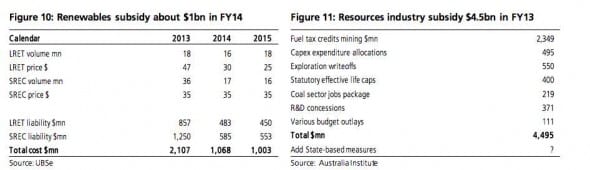
I can’t say I like all of these but they are a starting point for discussion. The article also had this table comparing renewable and fossil “subsidies”. (Excluding state subsidies which are quite significant.)
Last week, for the first time in memory, the wholesale price of electricity in Queensland fell into negative territory – in the middle of the day. For several days the price – normally around $40-$50 a megawatt hour – hovered in and around zero. Prices were deflated throughout the week.
There were several reasons for this. A restricted interconnector to NSW added to the volatile trading, as did uncertainty about the carbon price. But the overall softening of prices was primarily the result of the newest and one of the biggest power stations in the state – rooftop solar PV.
There is 1,100MW of it on more than 350,000 buildings in Queensland alone (3,400MW on 1.2 million building across the country), and it is producing electricity just at the time that coal generators used to make hay (while the sun shines).
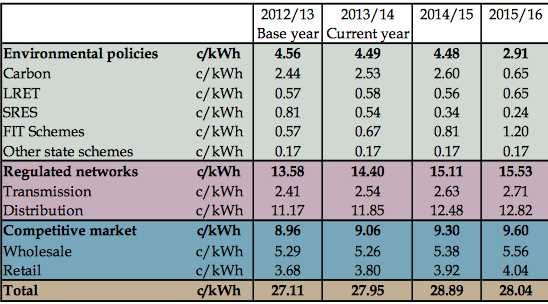
The article also had this table showing just how large the grid owners and retailers are costing consumers.
This article argues that the Japan free trade agreement may hasten the production of solar fuels from the Pilbara. A key argument is based around Japanese fears of LNG supplies being exposed to deteriorating relationships with China (as well as price uncertainty.)
Liquid ammonia is the logical solar fuel for production in the Pilbara. Renewable ammonia can be produced from renewable power, water and nitrogen from the air. Theoretical water consumption is 1.6 litres water per kg of ammonia so this shouldn’t be a problem even if desalination is required. (Other solar fuels such as gasoline require a source of CO2)
Liquid ammonia could be transported using LNG facilities. The big disadvantage of liquid ammonia is that one kg of LNG has the same energy as 2.9 kg of liquid ammonia. However, to some extent this disadvantage will be off set by the fact that ammonia can be used in fuel cells.
This article argues that “off river pumped storage” using small turkey nest dams overcomes the problems of using pumped storage systems with the dams in river valleys.
Off-river electricity storage has several advantages over typical on-river facilities:
– There are vastly more potential sites
– Sites can be selected that do not clash with environmental and other values
– The upper reservoir can be placed on top of a hill rather than in a valley, allowing the elevation difference to be maximised
– No provision needs to be made for floods (typically a major cost).
A system comprising twin 10ha reservoirs, each 30m deep, with a 750m elevation difference, can deliver about 1000 megawatts for five hours.
Between 20 and 40 of these systems would be enough to stabilise a 100 per cent renewable Australian electricity system.
How much does it cost?
As the reservoirs are tiny (just a few hectares) compared with typical hydro reservoirs, they are a minor component of the cost. Most of the cost is in the power components (pipes, pumps, turbines, transformers and transmission). Initial estimates suggest that the cost of an off-river system at a good site is around $1000 per kilowatt of installed capacity.
One m3/sec of water falling one m will generate 9.807 kW
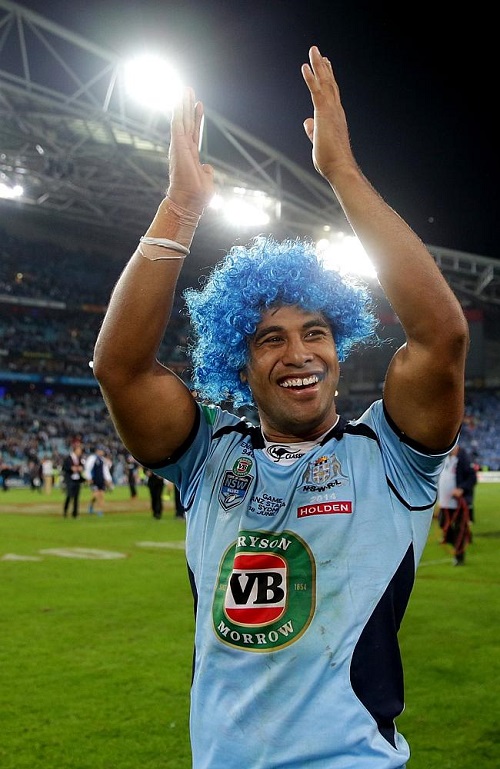
Congratulations must go to NSW for their series victory in the second State of Origin. There’s a shorter account at Wikipedia.
The match scores at 6-4 were close. The game statistics showed NSW edging Qld in most categories, except that penalties favoured the Blues 9-5 and missed tackles favoured them 29-13.
Experienced players have said that the series is the toughest they have played in. The injury carnage has been severe, with 15 players going down.
I’m not sure why the referees got the sack, except that it is what the NSW camp called for. I thought some penalties should have been blown early for extra work in the ruck. My maroon eyes saw two NSW high shots that were let go in the first 10 minutes. They probably were not sacked because they got the Thaiday no-try wrong.
“On the Sam Thaiday incident, well … it’s a try,” Harrigan told Triple M on Friday night.
“I know people are saying he (Hayne) didn’t play at the ball — of course he played at the ball.
“He knocked it out of Thaiday’s hand. It means the ball is ‘live’, it’s not a knock-on, not a loose carry.
“If he didn’t touch the ball, Sam has it in his (arm) and he scores a try.”
Mal Meninga:
“I thought Sam’s was a try, seriously,” he said.
“He was stripped and here we go, whether he knocked the ball on … it was a strip.
“In Origin that can make a difference but we won’t offer any excuses.”
If Thaiday scores NSW have to score twice. Unlikely. They scored once, courtesy of us with poor discipline giving them five consecutive sets at the line.
The dead tree version of the Courier mail showed Hayne dislodging the ball from Thaiday’s grasp with a clenched fist punch as he threw his arm around.
Them’s the breaks and we have to suck it up.
The press gives the impression that the players hate each other, but there seems to be a lot of respect, as Reynolds showed when he told Thurston “I look up to you, man.”