Category Archives: Climate Policy & Planning

Climate mitigation costs and strategies

Val at fairgreenplanet perceived two contrasting approaches to climate mitigation at the recent Australian Climate Action Summit:

  • technology can get us there, with a bit of political will

or

  • we have to change the way we live, starting from the local level

In relation to the first she also cited a recent post by John Quiggin who cites four major reports, all making the same point:

decarbonizing the world economy will involve economic costs that are
(a) small; and
(b) far outweighed by the benefits

So that’s a net gain of considerable dimensions.

This is supported at the country level by a recent report in the UK:

if the UK cut its carbon emissions by 60 per cent from 1990 levels by 2030, as it has promised, its GDP would be 1.1 per cent bigger than if it stuck with fossil fuels, says a study by consultants at Cambridge Econometrics.

About half the gain would come from cheap running costs for fuel-efficient cars, with 190,000 new green jobs and higher wages also helping. The average household would be £565 a year better off.

The four reports cited by Quiggin are as follows:

First, there’s Pathways to Deep Decarbonization an international collaborative project under the auspices of the UN.

Second, the Better Growth Better Climate report from the Global Commission on the Economy and Climate

Third, this report on Green Growth from the Center for American Progress (covers the US only)

And, most strikingly, this report from staffers at the International Monetary Fund, long the guardian of fiscal rectitude has concluded that for most countries, the local side benefits of reducing pollution would be sufficient to offset the costs for carbon prices up to $50/tonne.

I find each report has limitations in its own way, so at the end I remain agnostic.

The fourth, the IMF study, looks at carbon pricing in the top 20 emitters. As far as I can make out it comes up with two propositions. First, each country can act on its own, with benefit, no-one has to wait for the world to act. Secondly, it identifies a sweet spot, which varies quite a lot from one country to the next, where net benefits accrue from carbon pricing. In Australia’s case it’s only $11.50 per tonne.

This is all very promising but is not as such a plan for climate stabilisation at safe levels.

The third, the American study, finds the aim of reducing emissions by 40% from 2005 levels by 2035 doable and beneficial. The problem here is in the task identification. The study assumes that the US should decarbonise at the same rate as the rest of the world. It ignores the ‘carbon budgeting approach’ whereby high per capita emitters need to decarbonise rapidly to make space for developing countries to grow their economies. See Figure 5 of this post on the IPCC report. The United States is a Group 1 country, which must decarbonise rapidly:
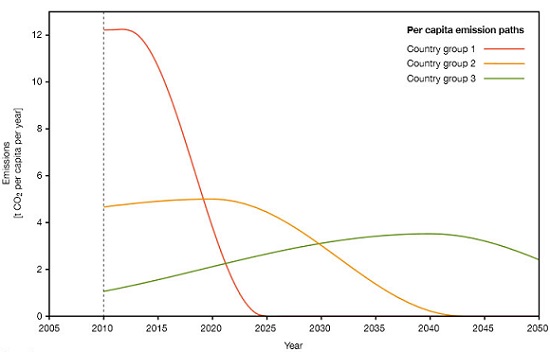
Figure 5: The climate budget approach

As we saw in this post, two thirds of increased emissions are now coming from emerging and less developed countries. In other words in reality increases from Group 2 and 3 countries are not being offset by cuts in Group 1 countries. Until we get our heads around this issue and address it we’ll stumble along on the road to perdition!

The problem facing Group 1 countries is impossible. The way around it lies in emissions trading between rich and poor countries, as per Figure 6 in that post. This would entail considerable wealth transfer, which could be mandated to be used in greening developing country economies.

Also 40% by 2035 overall is not a recipe for a safe climate, as shown below.

The first study, has two limitations. Firstly it simply does not address the issues of economic costs and social implications. Secondly, it simply accepts the stabilisation pathway for a 2°C temperature increase which sees zero worldwide emissions about 2070. In looking at the IPCC report (same as linked above), I developed this table to relate concentrations to temperature rise. RCPs are Representative Concentration Pathways (RCPs) which are expressed in terms of watts per square metre of radiative forcing (W m-2). Roughly, RCP2.6 represents the 2°C pathway, while RCP8.5 represents our present path.
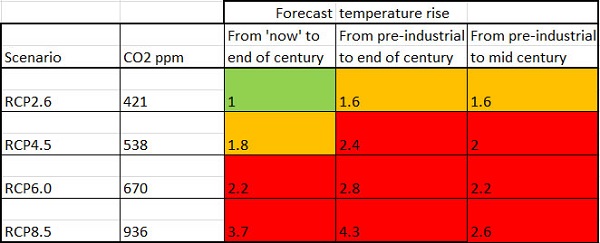
Figure 1: RCP temperature scenarios

Green indicates a comparatively ‘safe’ climate, orange indicates the increasingly contested zone which clearly carries some danger, and red to indicate breaching the 2°C guardrail which everyone with half a brain accepts as dangerous.

Strictly speaking the green box should be orange, because it sits on top of ‘now’ which is an 0.6°C increase, and the orange box below it should be red, for the same reason.

On the orange zone, the Climate Change Authority in its Review published this wondrous graph, showing that they were well aware of the inadequacies of a 2°C target:
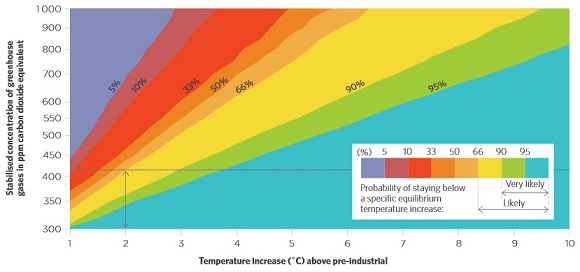
Stabilisation probabilities_croppedb_580

As I said then, in terms of CO2 equivalents we are now at 480. This gives us less than 33% chance of staying below 2°C and about a 10% chance of exceeding a civilisation threatening 4°C. These odds are unacceptable. We are already in an overshoot situation.

This is old information – very old. James Hansen told us at an American Physical Union meeting in December 2007 that we needed to aim for 350ppm in the first instance and then decide where we go from there.

The RCP2.6 path involves a 33% chance of ending up with more than 2°C, odds that should be completely unacceptable.

Turning to the third report, which specifically addresses the financial implications, it too is on 2°C path. The costs numbers when taken in isolation look large (US$45 trillion will be required in 2015–2030 for key categories of energy infrastructure), but in context are trivial:

costs of this magnitude look like “background noise” when compared with the strong underlying growth that the global economy is likely to experience.

These costs will go up if mitigation is delayed:

Costs are also likely to rise sharply with delay. If global action to reduce emissions is delayed until 2030, global CO2 emissions would have to decrease by 6-7% per year between 2030 and 2050 in order to have a reasonable chance of staying on a 2°C path. Such rates of reduction are unprecedented historically and are likely to be expensive (estimates of delay suggest an average annual consumption growth loss of around 0.3% in the decade 2030 to 2040, compared to a loss of less than 0.1% over the same period if we act now).

Fine, and perhaps not yet serious, but I’m afraid completely out of date. In 2011 the Climate Commission published this graph to illustrate the implications of delay:

Figure 4: Emissions reduction options

Under the ‘climate budget approach’ the area under the line must remain constant.

That too would have been based on a 2°C target, but it illustrates that if we delay peaking emissions worldwide, even to 2020, we’ll be in completely uncharted territory.

Chapter Five of the third report gives enormous detail of the policy work that needs to be done. It may be summarised as strong leadership, consistent policy over decades, structural change and perhaps unprecedented international co-operation, even if we start now on a task that is eminently doable and inexpensive; so more than “a bit of political will” is required.

Frankly, our best hope lies in the prospect that solar technology with storage will simply become the cheapest form of new energy, and has the advantage that it doesn’t need a large grid. Nevertheless there will be residual problems – land use and agriculture, transport, ocean acidification etc. Zero emissions transport will require planning and subsidies.

One thing we should realise, however, is that further out our future will be energy rich, not energy-constrained. Saving energy is not a reason for localism and changing the way we live.

So where does that leave Val’s second option?

Firstly, concerted long-term action and international co-operation of the kind we need is not in our DNA. We are designed to co-operate in bands of up to 150 people, the number that our big brains can cope with in terms of knowing in any detail. We are told Fukuyama, Harari for example that bands were relatively egalitarian with a leader answerable to the people. Beyond that we can co-operate in amazing ways, but at the price of setting up hierarchies and privileges, coercive elites. This occurred in general with agriculture and owning stuff, even herds. These problems can be ameliorated in a modern democratic nation-state, with it’s formal mechanisms for election, administration, justice and accountability, but we are still apt to act in the self-interest of that larger entity.

What we need is an infusion of new values and ways of perceiving, thinking and feeling. While not sacrificing individualism we need to feel and act as social beings. We also need to revalue ourselves in relation to the biological and physical systems of the planet, so that we stop acting like the top rapacious predator, the one that has decimated the wild animal kingdom by 52% since 1970. Along the way, we need to challenge a Chain of Being, that sees elite mostly European males as next to the gods and women, children, other races, other social classes, slaves, asylum seekers etc in subordinate positions.

We need to live in nature, not over nature.

While localism and social participation are necessary, the required cultural and existential changes are hard work will happen over generations if at all. The planet can’t wait. That last reference tells us:

Efforts have been made to economically quantify the world’s “stock” of natural capital and the yearly “flow” of ecosystem services they provide. The latest numbers are $142.7 trillion and $48.7 trillion, respectively. By comparison, the flow of incomes through the global economy is currently about $71.8 trillion per year. The research suggests that by 2013 we were eliminating that stock of natural capital at a rate of about $7.3 trillion per year, and that the flow of ecosystem services would be $23 trillion higher if not for human practices like deforestation, burning fossil fuels, and the like.

And underneath all this, there is the point that these creatures and the ecologies they inhabitant have an intrinsic moral worth irrespective of the dollar sign that markets can place on them. “Wildlife is and should be useless in the same way art, music, poetry and even sports are useless,” author Richard Coniff recently wrote in the New York Times.

And the climate can’t wait.

We need hierarchies to get things done, a collective will not build a battleship, but we need to civilise them and render them accountable. We even need coercive powers, to counter the selfishness of states. The only supra-national entity that the major powers take notice of is the World Trade Organisation, not the UN. We need it to police international agreements, to oversee international carbon trading, and what Quiggin’s third report calls “border carbon adjustments”.

I never thought I’d say that!

The bottom line is that we must act if we want a future for our grandchildren, and cost, the only certain Armageddon is if we do nothing or not enough. We are heading into uncharted territory but indications are that there will be benefits and the net costs are unlikely to be as bad as pessimists might think. We just don’t know. And the groupie, local stuff, well there are reasons for doing that, but it won’t solve climate change as such.

Climate clippings 107

1. No more pauses in global warming

Temperatures are likely to rise dynamically for the rest of the century, according to two separate studies.

Masahiro Watanabe of the University of Tokyo colleagues found that over the past three decades natural influences are diminishing.

In the 1980s, natural variability accounted for almost half of the temperature changes seen. That fell to 38 per cent in the 1990s and just 27 per cent in the 2000s.

The implication is that temperature rises will respond more directly to emissions with fewer pauses.

Matthew England and associates used 31 climate models to chart future temperatures. He found that if emissions keep rising the chances of a pause of 10 years or more fall to practically zero. If emissions peak by 2040 we might get a pause by the end of the century.

If we wait until 2040 for peak emissions we’ll be cooked.

2. Rockefeller family moves from fossil fuels to clean energy

The Rockefeller family is turning its back on the industry that made it its vast fortune.

As more than 120 heads of state gather in New York for a UN summit on climate change, the Rockefeller Brothers Fund is pledging to move $50 billion worth of investment in fossil fuels into clean energy.

3. War and Peace revisited

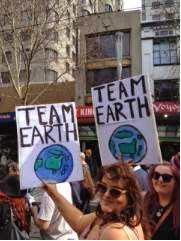
At Fair Green Planet Val has reproduced her talk at the Australian Climate Action Summit 2014. It’s about organisational form in relation to climate change action and sustainability. Val suggests we need to change from forms based on competition, hierarchy and exploitation to forms based on co-operation, egalitarianism and sustainability:

From both my research and my lived experience, it seems clear to me that the approach we need to address climate change will not be produced by the hierarchical, top down, unequal organisations that are dominant in society today – but rather by an approach like this:

team earth

These “Team Earth” posters were of course produced in response to Tony Abbott’s “Team Australia”. The posters express to me the values we really need to address climate change: a recognition that we’re all in it together, and an inclusive approach.

We need:

to go beyond climate change and live in sustainable communities – communities that are flatter, networked, egalitarian and inclusive, and recognise themselves as part of an ecosystem.

In other words, we need to change ourselves.

4. Arctic sea ice report

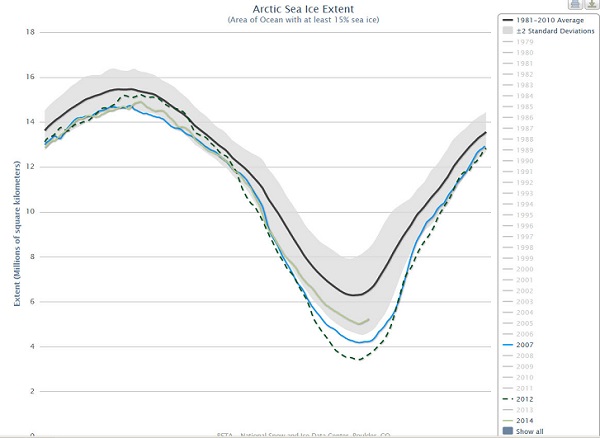
Arctic sea ice melting has now reached its maximum extent. This year was almost exactly the same as 2013, and the sixth lowest on record.

Sea ice Sept_cropped_600

The black line is the 1981-2010 average, the dotted line the 2012 record and the blue line the former 2007 record. Shading represents plus or minus 2 standard deviations.

Volume was also up a bit but still in trend decline.

What this masks is a continued decline in the proportion of older, thicker ice. An increasing proportion is first year ice. At Carbon Brief:

During the 1980s or 1990s, in an average year, around 54 to 58 per cent of ice in the Arctic would be first-year ice. Last year it was 77 per cent.

5. New York UN meeting

Last week some 125 leaders met with the UN Secretary General and each other in New York to indicate what their post 2020 emissions reduction targets might be. I reported on the outcomes here, but it seems that readers of this blog are put off by titles like the one I used.

Problem is, the bad news is getting worse and is not being addressed sufficiently by world leaders. Emissions increased by 2.5% in 2013. Every year the emissions increase the harder the problem becomes. It’s not a case that action is just delayed; we are using up a carbon budget that by some estimates is already in the red.

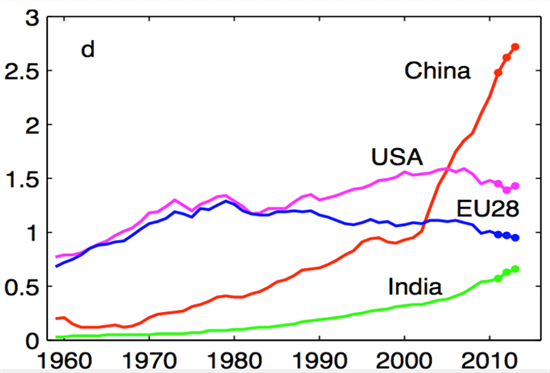
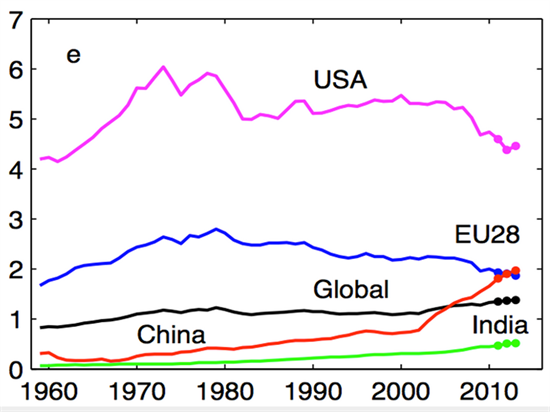
Of the major emitters only the EU was specific, nominating 40% by 2030, subject to confirmation. Not enough. There were indications that China will give concrete numbers when formal proposals are submitted next March. However, their current rate of increase is quite dramatic, as this graph shows:

gcp-country-emissions-line_550x373.jpg

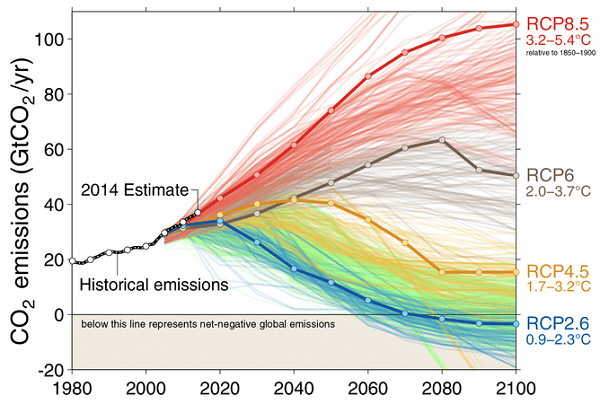
My expectation is that at best, when the bids are in, our path will match the RCP4.5 scenario (the scenarios are numbered according to the climate forcing pertaining to CO2 levels with the forcing expressed in watts per square metre).

84jyvk7k-1411262594_600

A new report puts the situation this way:

Nevertheless, the report said there is still a “gigatonne gap” between governments’ current carbon-reduction pledges and what will be needed to limit overall warming to 2C.

Delivering on current policies would only succeed in reining warming back from 4C to 3C, it predicted. The United Nations’ New York 2014 and Paris 2015 climate summits will be crucial in securing an improved deal, the report said. (Emphasis added)

Indeed. In New York on our behalf Ms J Bishop said the Government would consider what post-2020 emissions might be, but consistent with the need for economic growth. I think in her mind this means banking on cheap coal as our dominant power source.

For another view, see Christine Milne at the National Press Club:

I believe that Australia should put on the table for the 2015 negotiations a trajectory of 40 to 60 per cent below 2000 levels by 2030 and net carbon zero by 2050.

The road to Perdition

Six years ago I penned a post Last exit on the road to Perdition. It began like this:

    “Damn! I think we just passed the last exit for the Holocene!”

    “I’m sorry, honey, I wasn’t looking.”

    “We have to get off this highway. What’s the next exit?”

    “It’s a long way ahead. Goes to somewhere called Perdition.”

Those words were from a column by Gwynne Dyer, who had just spent a couple of months talking to leading climate scientists and security officials for his book Climate Wars (2009). He saw no happy outcomes.

Unfortunately the post falls in a gap in the Larvatus Prodeo record in 2008, but I was reminded of the analogy when I saw this graph from the Global Carbon Budget 2014 report (thanks to John D for the heads-up at Saturday Salon; there are articles by Canadell and Raupach at The Conversation and by Mat Hope at Carbon Brief):

84jyvk7k-1411262594_600

Armageddon is RCP8.5 and a 4°C climate. That’s where civilisation as we know it is in play. Also there is nothing to suggest that the climate would stabilise at that level. Vast beds of methane could be released, the tropical forests would likely burn off, fertile river deltas would be flooded, corals could disappear for a few million years and climate could head for 6°C or more.

Canadell and Raupach say that

    economic models can still come up with scenarios in which global warming is kept within 2C by 2100, while both population and per capita wealth continue to grow.

2°C is still attainable, which is at best borderline dangerous, but would require beyond zero emissions, that is:

    the deployment of “negative emissions” technologies during the second half of this century, which will be needed to mop up the overshoot of emissions between now and mid-century. This will involve removing CO2 from the atmosphere and storing it in safe places such as saline aquifers.

    These technologies are largely unavailable at present.

If we keep on growing emissions at 2.5% per annum for a few more years, the best on offer will be peaking by 2040, in other words RCP4.5. That’s the road to Perdition. On current form I suspect that’s where we are heading. The following graph shows that the EU was the only major emitter to reduce emissions in 2013:

gcp-country-emissions-line_550x373.jpg

In per capita terms China has now surpassed the EU:

gcp-per-capita-emissions-lines_550x412.jpg

Please note the y-axis is calibrated in tonnes of carbon. For CO2 multiply be 3.67.

As John D pointed out:

    There have been other striking changes in emissions profiles since climate negotiations began. In 1990, about two-thirds of CO2 emissions came from developed countries including the United States, Japan, Russia and the European Union (EU) nations. Today, only one-third of world emissions are from these countries; the rest come from the emerging economies and less-developed countries that account for 80% of the global population, suggesting a large potential further emissions growth.

    Continuation of current trends over the next five years alone will lead to a new world order on greenhouse gas emissions, with China emitting as much as the United States, Europe and India together.

For a couple of years now, the world had decided that we will make up our minds about what post-2020 targets we will aim for by Paris in December 2015, but the implementation phase does not begin until 2020. Kyoto was a top-down mitigation strategy. This time it will be bottom-up. Every country will set it’s own pace within a framework of “common and differentiated responsibility”. The worry is that the national interest trumps the common good. The UN meeting in New York gave some idea of the early form.

Carbon Brief tried to pick the eyes out of the announcements. Here’s a selection:

  • The US has directed federal agencies to consider climate resilience when designing programmes and allocating funds, and will share data from NASA and NOAA and help train developing countries’ scientists. Oxfam says it’s not revolutionary.
  • China will peak emissions “as early as possible”. That’s new for official language, perhaps they’ll put a date on it next year.
  • The EU will aim to cut emissions by 40% by 2030, subject to confirmation by the European Commission.
  • The Netherlands and Belgium both pledged to cut emissions in line with the EU’s regional goal of cutting emissions by 80 to 95 per cent by 2050, compared to 1990 levels. Denmark reminded the conference it aims to be fossil fuel free by 2050.
  • India did the usual – called on developed countries to show more leadership, said it would act on climate change, but on its own terms. It aims to double the amount of energy from wind and solar by 2020, they’ve said that before.
  • Indonesia said it will cut emissions by 26% by 2020, rising to 40% if it gets international help to do so.
  • Malaysia said it has a target to reduce emissions by 40% by 2020, and was on track to do so. Ethiopia said it was still committed to making its economy zero carbon by 2025.
  • Some money is flowing into the UN’s Green Climate Fund to help developing countries. France pledged $1 billion, Denmark $70 million, South Korea $100 million, Norway $33 million, Switzerland $100 million, Czech Republic $5.5 million and Mexico $10 million and Luxembourg $6.4 million. Before the summit, Germany had pledged $960m. The EU also announced it would channel $2.5 billion to developing countries during 2014-2015, with a focus on adaptation and mitigation.
  • One of the big announcements at the summit was the New York declaration on forests, signed by 27 nations, eight regional governments, 34 multinational corporations, 16 indigenous peoples’ groups and 45 NGOs. It builds on a range of existing agreements including the Warsaw framework for reduced deforestation agreed last year.

    The declaration is a voluntary commitment to “at least halve” loss of natural forest by 2020 and “strive to” end it by 2030. It is not legally binding and Brazil, one of the world’s largest rainforest nations, is not a signatory.

All that is fine and good, but frankly underwhelming. As I have already quoted David Spratt:

    We have to come to terms with two key facts: practically speaking, there is no longer a “carbon budget” for burning fossil fuels while still achieving a two-degree Celsius (2°C) future; and the 2°C cap is now known to be dangerously too high.

We dawdle towards 2015 and 2020 while options close off or become harder. Perdition looms.

Renewable Power – Sundry Items

This post brings together a number of items on renewable power including US windpower agreements setting the price as low as $US25 MWh (2.5 cents/kWh.  WA thinking of importing Indonesian coal for power generation while ignoring renewables and approval being given by the Pt Augusta council for a solar thermal installation that will be used to desalinate water and heat/cool 20 hectares of greenhouses for tomato growing.

Continue reading Renewable Power – Sundry Items

The RET Needs Bipartisanship- Contract Based Alternatives Don’t

Tony Abbott has already killed the Howard government’s RET scheme. No new large scale energy projects directly justified by the RET have been committed to since the start of 2013. In addition, since the Abbott government was elected, the price of large-scale renewable energy certificates had nearly halved to $26.00 per MWh by 11 Aug 14.  To make things worse, the RET is not going to be resurrected by a change of government or action by the Senate.

Continue reading The RET Needs Bipartisanship- Contract Based Alternatives Don’t

Climate clippings 104

This edition begins with the weather and ends with a sad tale of revenge and tribalism as the basis for climate policy.

1. June the hottest on record

When we have some cooler than normal weather people are apt to say “So much for global warming!” They should realise how small a part of the globe we are.

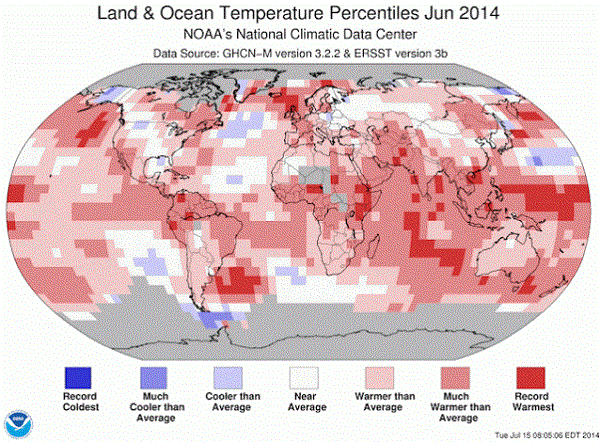
The warmest May on record for the planet has been followed by the warmest June:

June 2014_201406-600

In fact June was the highest departure from average for any month on record.

The last below-average global temperature for any month was February 1985. The last below average June was in 1975 when Gough Whitlam was PM!

2. El Niño still favoured

The majority of models still favour a spring El Niño:

Warming in the tropical Pacific Ocean since the beginning of 2014 has primed the climate system for an El Niño in 2014, although an atmospheric response is yet to be observed. As a result, the transition towards El Niño conditions has slowed in recent weeks. While five out of eight climate models surveyed by the Bureau suggest El Niño will become established by October, all have eased their strength over the past few months. Three models suggest an El Niño will not occur in 2014, while another indicates only a brief period of El Niño-like conditions.

3. Temperatures poised to rise rapidly

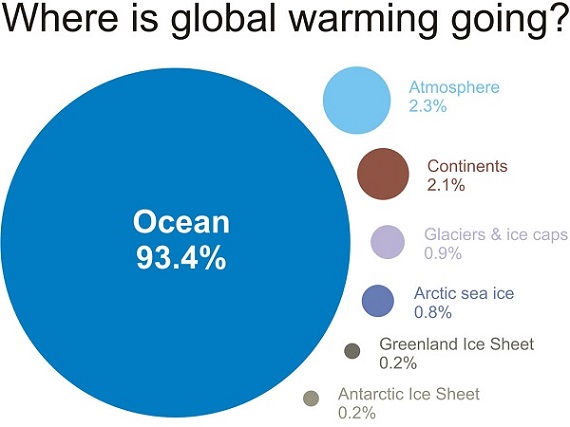
El Niño years are often associated with a higher than average temperature rise. However, there’s another reason temperatures may be about to rise. You may recall that around 93% of the extra global warming goes into the ocean and only 2.3% into the atmosphere:

GW_Components_570

In recent years the trade winds have speeded up causing deep mixing in the ocean, taking warm water deeper displacing cooler water which rises to the surface to be warmed. Sooner or later this will stabilise, with more heat going into the atmosphere.

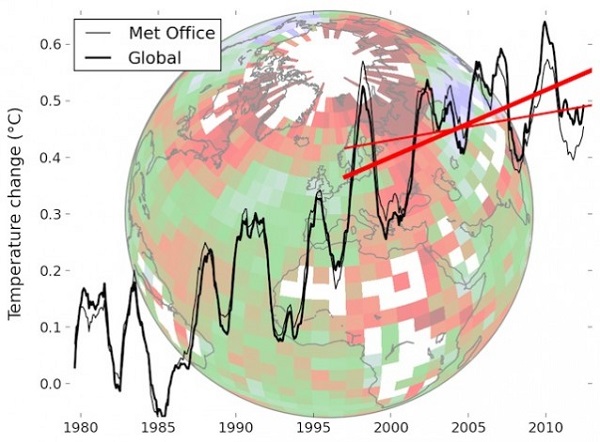
The article also points out the recent correction of the Hadley Centre temperature record, adding in an estimate for the polar regions, where there are no weather stations. This correction virtually eliminates the famous ‘pause’. The heavy lines show the corrected data:

Cowtan-600

4. Onshore wind is now the cheapest form of new energy in Denmark

6250146831_ffa2f45d46_b-500

A new analysis from the government of Denmark found that wind power is by far the cheapest new form of electricity in the country. New onshore wind plants coming online in 2016 will provide energy for about half the price of coal and natural gas plants, according to the Danish Energy Agency (DEA), and will cost around five cents per kilowatt hour.

5. Abbott bets the house on coal

Meanwhile our visionary PM bets the house on coal as the world price is collapsing and countries turn to renewables.

The price for thermal coal has plunged more than 10 per cent in the last two months as the presumed major customers – China and India – make it clear that renewable energy is offering a competitive alternative to coal and gas.

The current spot market has been below the cost of production.

China may cease to import coal in a few years. The Europeans are talking about ramping up targets for emission reductions, energy efficiency and renewable energy. The Indians are

building of “mega” capacity solar farms, off-grid solar pumps for irrigators, solar installations over canals, cuts in tariffs for solar components and a doubling of the tax on coal – has been followed by an announcement that the country will look to expand a “rent-a-roof” program from solar installations initially begun in Gujarat, the home state of new PM Narendra Modi, who has promised a “saffron revolution” of solar power.

Tata Power is providing interest free loans up to $4,000 for rooftop solar.

Bloomberg New Energy Finance last week predicted solar would beat coal plants on costs by 2020. Chile has announced a whole series of large scale solar plants. On and on it goes.

Here in Sydney there was concern at the Clean Energy Week conference that Abbott can cripple renewables by doing nothing. According to one speaker

even if the 41,000GWh target was retained, and long term certainty provided, the removal of the carbon price will make it difficult to obtain financing for wind and solar farms from financial institutions.

That’s because the carbon price and the RET were designed to work together. If the carbon price is removed, then there is a massive shortfall in revenue when the certificates issued under the RET expire in 2030…

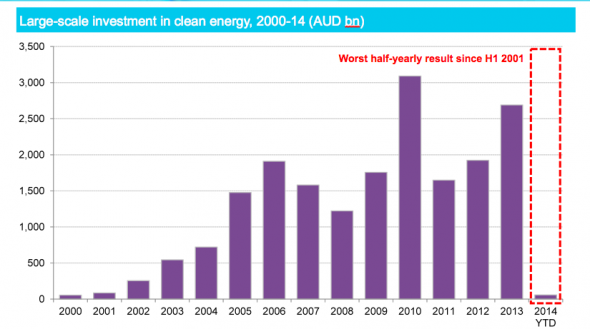
John D has been calling it but here’s a dramatic graph showing how large scale investment has stopped in its tracks:

bnef-finance-s-590x329

6. Tribal wars and revenge

I couldn’t find a decent review of Ian Chubb’s excellent book Power failure, which traces climate policy in Australia from before the 2007 election to the installation of the Abbott government. The link in the heading is to a revealing interview with the author by The Fifth Estate. Chubb:

“[Climate change denial] is a cultural issue for the Coalition. It’s nothing to do with rationality or reason or the future or business – it’s tribal. While this government is in power we can’t recreate the consensus.

“For this government burning coal to make electricity is the equivalent to eating red meat – if you don’t, you’re a sissy. So this government will never have sympathy for making renewable energy – only sissies do that. The government has attempted to shut down everything to do with renewable energy.”

He the goes on to talk about revenge, tribalism and well-flung mud.

He describes the current policy situation as current policy situation as a “ridiculous and expensive mess”. Two things might change it. One is leadership from the US. The other is that nasty things may have to happen from the climate itself.

My sense is that the damage to confidence wrought by this mob is such that a change of government with new policies may not be enough. We need the Tea Party to get real before confidence can be restored.

I need to say more about Chubb’s book which is clear-eyed about the strengths and weaknesses of both Rudd and Gillard. Anyone wondering why some of Rudd’s colleagues thought he had to go should read this extract in The Age.

Climate clippings 103

Climate clippings_175

I like to think that at Climate Plus we cover all the important issues and happenings. In this edition we look at two significant reports, one by Jeffrey Sachs to the UN Secretary General and the IEA’s World Energy Investment Outlook 2014.

As usual use Climate clippings as an open thread on climate change.

1. Deep Decarbonization Pathways

Renowned economist Jeffrey Sachs found that Australia could cut emissions from its energy sector to zero by 2050 and still grow GDP by an average of 2.4% over that period. That was in an interim report recently delivered to UN Secretary-General Ban Ki-moon plotting

specific measures for the world’s 15 largest economies, including China, India and the US, to cut their emissions quickly and deeply enough to meet an international agreed goal of limiting warming to two degrees above pre-industrial levels.

What we do matters!

The report

found that it’s technically possible for Australia to get almost all of its electricity from renewable sources by 2050 and to offset the rest by storing carbon in soil or planting more trees.

We can do that while GDP grows at 2.4% per annum, but it is interesting that our per capita growth rate is the lowest of the 15, India the highest.

There’s more about Sachs here.

2. Catalyst does sea level rise

It was scary, but could have, should have been scarier.

The program depended heavily on the last interglacial, the Eemian, as an analogue for now. It made the link through temperatures and probably got them a bit wrong. We’ll likely get more than 2°C this century, and the Eemian global average was possibly only 1°C higher than now.

Fundamentally the problem is this. CO2 levels during the Eemian which produced around 9 metres of sea level rise were never above 300 ppm. At 400 ppm, as we are now, the implied sea level rise is more like 20 to 25 metres, played out over the centuries.

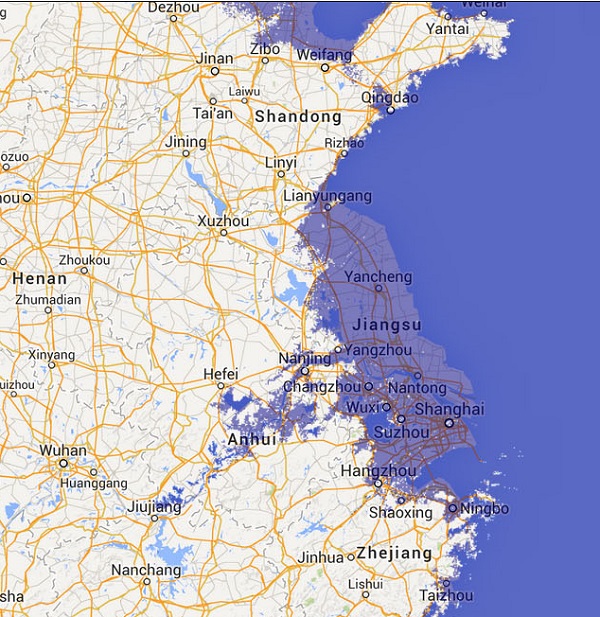
Still they could have pointed out just how horrendous a 9 metre rise would be, other than the throwaway comment about most mega cities being displaced. At 9 metres significant chunks disappear from continents as in China:

China_cropped_600

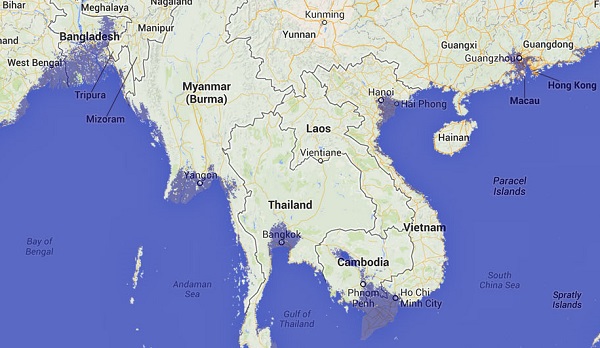
Here’s SE Asia courtesy of the Firetree flood map:

SE Asia_cropped_600

At the end it suggested that we could cope by building sea walls, except that it would be expensive. Sea walls are not going to cope with nine metres, let alone 20.

This Skeptical Science post gives useful information about the Eemian, although it too arguably needs updating. I think scientists are settling on a higher sea level rise for the Eemian than the 5 metres suggested, more like the 9 metres of the Catalyst program. Also at least some parts of Greenland are thought to have been 10°C warmer than now, rather than 5°C.

3. The search for the clean coal holy grail

Radio National’s generally excellent Background Briefing program has turned its guns on a ‘clean coal’ technology called DICE – Direct Injection Carbon Engine. Would you believe, a DICE engine runs on a slurry of finely ground coal and water? One purpose seems to be to make brown coal as emissions efficient as black coal – a pointless exercise in terms of current climate mitigation needs. Inherently significant energy must be spent to get the coal into the required state.

The history seems to be one of shonky technology projects run by shonks, but the CSIRO is now involved and our visionary government is throwing money at the venture.

4. World Energy Investment Outlook 2014

The International Energy Association’s latest report is billed as its first full update since the 2003 World Energy Investment Outlook. It’s been out since 3 June. So far I’ve failed in my ambition to do a separate post, so I’ll just do a brief note here.

This post from the Post Carbon Institute is a packet of joy. It says that the IEA report “should send policy makers screaming and running for the exits” or looking for early retirement. Seems we need a mere $48 trillion in investment through to 2035 to keep things on track. But:

The IEA forecasts that only 15 percent of the needed $48 trillion will go to renewable energy. All the rest is required just to patch up our current oil-coal-gas energy system so that it doesn’t run into the ditch for lack of fuel. But how much investment would be required if climate change were to be seriously addressed? Most estimates look only at electricity (that is, they gloss over the pivotal and problematic transportation sector) and ignore the question of energy returned on energy invested. Even when we artificially simplify the problem this way, $7.2 trillion spread out over twenty years simply doesn’t cut it. One researcher estimates that investments will have to ramp up to $1.5 to $2.5 trillion per year. In effect, the IEA is telling us that we don’t have what it takes to sustain our current energy regime, and we’re not likely to invest enough to switch to a different one.

If you look at the trends cited and ignore misleading explicit price forecasts, the IEA’s implicit message is clear: continued oil price stability looks problematic. And with fossil fuel prices high and volatile, governments will likely find it even more difficult to devote increasingly scarce investment capital toward the development of renewable energy capacity. (Emphasis added)

Keeping the score on PUP

In an earlier thread, I linked to Lenore Taylor’s article, which holds that the pattern with Palmer is to cause maximum drama then support government. Robert Merkel also linked to Taylor as well as to Ben Eltham who sees Palmer as following self interest.

For both of these to be true, the government must always act in Palmer’s interest, which seems unlikely.

According to Laura Tingle the Taylor view has become orthodoxy in the major parties:

Having sussed out the Palmer United Party, both sides of politics made pragmatic assessments that, for now at least, the PUP should be regarded as a noisy nuisance but one which would support the Coalition in most things.

She says this does not accord with the experience of the past two weeks:

Yes, the PUP ultimately supported the government’s carbon tax repeal bill with amendments. But it opposes the Coalition’s Climate Change Authority Abolition Bill, the Clean Energy Finance Corporation (Abolition) Bill and the bill to repeal the Australian Renewable Energy Agency.

It is also opposing moves to stop tax cuts associated with the carbon package, as well as opposing the abolition of the renewable energy target.

While it is supporting the repeal of the mining tax, it is opposing the repeal of the schoolkids bonus, an income support bonus and the low income superannuation contribution, which are all in the same bill.

It eventually supported changes to the Future of Financial Advice laws, but opposes a $435 million cut to higher education through an efficiency dividend, as well as the reintroduction of fuel excise indexation. It also supported Labor amendments to the asset recycling fund.

The net result is a cost to the budget of just over $13 billion before we even get to the contentious budget cuts.

To the casual observer Palmer’s back flip on the Future of Financial Advice (FoFA) looked capricious. In fact considerable work was put in by Cormann and Malcolm Turnbull who brokered the discussions at Cormann’s request.

Mr Turnbull’s involvement in the Future of Financial Advice (FoFA) matter was at the request of Senator Cormann, who did not know Mr Palmer very well. So he rang Mr Turnbull on Friday night last week asking him for help to convince Mr Palmer to talk and to set up a meeting.

Mr Turnbull spoke to Mr Palmer ­several times over the weekend and presented him with a briefing paper on the Coalition’s changes to the FoFA laws which Senator Cormann had his department prepare.

I understand Cormann and Palmer met five times in a short space of time. Presumably both gave some ground.

I think it’s too early to call a pattern in PUP voting. As to ideology, I think PUP would see itself as seeking a fair go for ordinary people. Beyond that we also have to wait and see.

Tingle’s article was mainly about pre-election positioning and selling the budget. Labor has definitely revealed its hand as supporting emissions trading. Shorten made clear that he meant an ETS rather than a tax.

Abbott is going to keep banging on about it’s really a tax and continue the scare campaign.

Labor may propose a much more modest scheme, more in line with business thinking. Business, Tingle says, is troubled by the current vacuum in real climate policy. They know the vacuum must be filled, but by what?

As to the budget, Tingle says it will need a fundamental rethink if voters are to change their opinion. Short of resolving the conflicting messages involved in, for example, plugging pensioner austerity while promoting a generous paid parental scheme, it’s hard to see what they might do.

But unless they do engage in a fundamental rethink we can expect more mayhem from PUP.

The future of emissions trading

While the Senate has not yet passed the bill to repeal the ETS the question arises as to when if ever carbon pricing will return. I’m not a psephologist but I suspect that the Palmer United Party are going to be in a similar position after the next election of having a stake in the balance of power, perhaps more so! Given that Labor appear set on retaining carbon pricing as part of their policy platform and the Greens will sign up to a reasonable scheme, the introduction of carbon pricing appears to depend on either the Liberals growing up or PUP.

Assuming PUP don’t change their mind they have said we won’t have emissions trading until India, China, the USA, Europe, Japan and South Korea do it. So the prospects of carbon pricing appear to depend on the US Tea Party losing a controlling position in the US Senate, or the Australian Tea Party turning into a mature modern party that respects the science.

The most likely to give I think is the PUP. Recall what Bernard Keane said at Crikey:

The key to understanding Palmer is that he’s always about what’s ahead. What’s in the past is irrelevant. The issue of consistency simply doesn’t arise, because Palmer eternally moves forward, toward the next announcement, the next stunt.

Palmer has said that PUP are going to be on the right side of history. The international scene is likely to be somewhat fluid leading up to the UNFCCC Conference of Parties in Paris in December 2015 where a legally binding post Kyoto deal will be attempted. Negotiations under the UNFCCC are almost continuous but the next big event is in September 2014 when UN Secretary-General Ban Ki-moon has invited world leaders to a Climate Summit Catalyzing Action:

This Summit will be a different kind of Climate Summit. It is aimed at catalyzing action by governments, business, finance, industry, and civil society in areas for new commitments and substantial, scalable and replicable contributions to the Summit that will help the world shift toward a low-carbon economy.

In preparation for the summit economist Jeffrey Sachs’s Deep Decarbonization Pathways Project has produced an interim report plotting specific measures for the world’s 15 largest economies “to cut their emissions quickly and deeply enough to meet an international agreed goal of limiting warming to two degrees above pre-industrial levels.”

The 15 economies are, in alphabetical order, Australia, Brazil, Canada, China, India, Indonesia, Japan, France, Germany, Mexico, Russia, South Africa, South Korea, the UK, the USA.

I’ve highlighted the ones nominated by Palmer.

The report

found that it’s technically possible for Australia to get almost all of its electricity from renewable sources by 2050 and to offset the rest by storing carbon in soil or planting more trees.

We can do this while growing our GDP at 2.4% pa.

The importance of Australia’s role in New York in September is possibly two-fold.

Firstly, will Abbott be embarrassing? Will he be negative and disruptive or just irrelevant? It’s extremely unlikely that he will show any vision or learn anything.

I did hear that he was going to be too busy at home destroying Labor’s legacy in climate change to attend. No doubt Julie Bishop will fill in since Greg Hunt is not allowed out alone.

Secondly, and of greater importance, will Palmer as a result of what other leaders say decide that Australia should ride at the head of the peloton and show a bit of leadership without breaking away?

Palmer saves the world!

Clive Palmer Addresses National Press Club

Meanwhile here on the local scene PUP are planning to introduce their ETS on trainer wheels as an amendment to the legislation proposing the demise of the Climate Change Authority.

Climate clippings 102

This week we start with trouble at the top and bottom of the world and finish with trouble with our leading media magnate and politician.

1. Geenland at a tipping point?

THE cracks are beginning to show. Greenland’s ice sheets slid into the sea 400,000 years ago, when Earth was only a little warmer than it is today. That could mean we are set for a repeat performance.

If Greenland goes, West Antarctica also goes, giving 13 metres of sea level rise from those sources. If that happens there will also be a complete loss of other glaciers and ice caps, thermal expansion and some partial melting from East Antarctica. A mess!

The question is how soon and what can we do? The answer is we need more research and we need to think more in terms of centuries.

We should be thinking about the next 500-1000 years, how ice sheet decay can be minimised, stabilised and headed in the other direction. Our plans for the next 50-200 years should be made in the light of this.

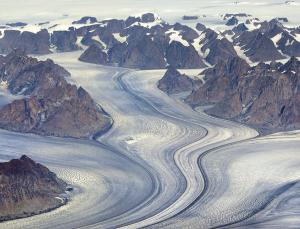
This image from the article shows a part of Greenland where the ice is quite dynamic.These areas are expected to grow.

New scientist_mg22229752.600-1_300

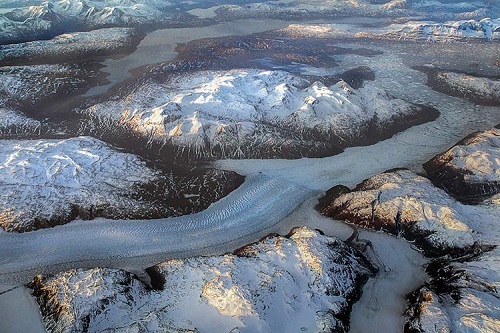
Here’s an image from another article:

greenland_cs_500

2. Big trouble in the Antarctic has been brewing for a long time

David Spratt at Climate Code Red:

“A game changer” is how climate scientist Dr Malte Meinshausen describes newly published research that West Antarctic glaciers have passed a tipping point much earlier than expected and their disintegration is now “unstoppable” at just the current level of global warming. The research findings have shocked the scientific community. “This Is What a Holy Shit Moment for Global Warming Looks Like,” ran a headline in Mother Jones magazine.

Meinshausen says this is new information. He says that the beaches we know and love all around the world will disappear. He also wonders what other nasty surprises lie this side of a 2°C temperature rise. Spratt says we told you ages ago it was coming, by James Hansen, for example and by himself and Philip Sutton in 2007.

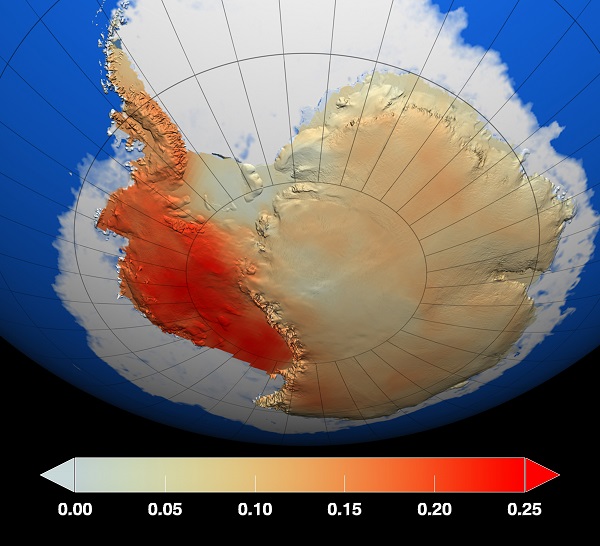
This NASA image shows the temperature changes from 1957 to 2006:

AntarcticaTemps_1957-2006_lrg_600

Hansen warned; Meinshausen says it’s happening. Spratt warns:

It’s par for the course for climate policy-makers to hope for the best, rather than plan for the worst. More than once this blog has warned that sea-level rises are being underestimated by Australian policy-makers, and that the tens of millions of dollars being put into adaptation planning for sea-level rises of no more than 1.1 metres by 2100 will be a waste of money, and all that work will have to be done again. And now that has come to pass.

3. Huge ‘whirlpools’ in the ocean are driving the weather

GIANT “whirlpools” in the ocean carry far more water than expected and have a big impact on the weather – though as yet we don’t know exactly what.

The areas of swirling water are 100 to 500 kilometres across. These “eddies” generally move west, driven by Earth’s rotation, until they stop spinning. Now, for the first time, the amount of water and heat they carry has been measured.

Article and image available also here.

dn25801_1_300

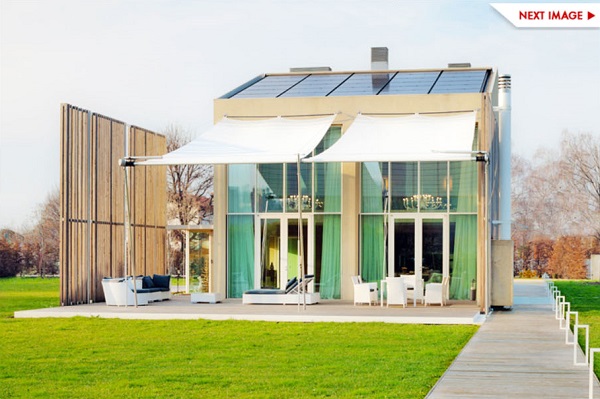
4. Gorgeous BioCasa_82

Nestled into the pastoral landscape of Treviso, Italy, BioCasa_82 is a beautiful home that boasts some seriously energy-efficient technologies.

BioCasa_82_cropped_600

The house is made from 99% recyclable materials and scores

117 points out of 136, according to the American protocol LEED Platinum, and 10 out of 11 points in regards to innovation in design, the building is a real gem in the European building practice.

According to the carbon footprint analysis, BioCasa_82 yields 60% less emissions than traditional buildings. Its photovoltaic system produces around 14kWh/mq of electricity, and a high-efficiency geothermal plant provides heat, hot water and cooling. These strategies are complemented by a rainwater harvesting system.

5. Rupert Murdoch doesn’t understand climate change basics

That is everyone’s problem since he owns a world-wide media empire.

Many of Murdoch’s news outlets are also among the worst when it comes to getting climate science wrong and disseminating climate myths and misinformation. Inaccurate media coverage is in turn the primary reason why the public is so misinformed about global warming.

I won’t go into the details, but Climate Progress observes that he ‘lowballed’ the numbers and minimized possible impacts. Here in Oz:

”We can be the low-cost energy country in the world,” he said. “We shouldn’t be building windmills and all that rubbish.”

Elsewhere Graham Readfearn finds that Tony Abbott’s views on climate are seriously crap.

Reminder: Use this thread as an open thread on climate change.