
Australia’s successful RET emission trading scheme is an Offset Credit Trading Scheme (OCTS) that has been quietly driving investment in utility scale renewable energy since 2001. Best of all, it has been doing this without causing any dramatic increase in power prices or political pain. This quiet success means that few Australian’s have heard of the RET scheme let alone understand what offset credit trading is.
Category Archives: Climate Policy & Planning
Climate clippings 96
 This edition looks at changes in the cryosphere, a major US report, the prospects for an El Niño and the problem of China burning coal.
1. Pacific Ocean hot spot
Scientists have discovered a hot spot in the Pacific Ocean which is partly responsible for global warming in the Arctic. Incredibly this hot spot is east of Papua New Guinea.
This phenomenon is attributed to natural variations rather than global warming. Therein, perhaps, lies the reason that scientists have been constantly surprised by the rapidity of the Arctic sea ice loss.
2. Southern Ocean winds strengthening and moving south
Scientists have confirmed in a study covering the last 1000 years that winds are strengthening in the Southern Ocean and moving south. They found a definite trend greater than can be explained by natural variability and attributable to the effect of increased greenhouse gases.
Hence the drying of southern Australia is expected to continue. Also the tightening of winds around Antarctica inhibits warming of the continent. Nevertheless the warming of West Antarctica is considerable.
3. Antarctic glaciers melting past point of no return
A group of melting glaciers in West Antarctica appears to have reached the point of no return according to scientists from NASA and the University of California Irvine. Even if we cut back greenhouse gas emissions savagely now the melting will continue. We are probably looking at 3 to 5 metres of sea level rise, from Antarctica alone – that is our gift to future generations. Dangerous climate change is no longer just a future possibility, it’s happening now!
The question is, how long will it take? Here there is uncertainty. It could be as short as two centuries or as long as nine. Professor Eric Rignot thinks two centuries is “not outrageous”.
4. East Antarctica more vulnerable than thought
Part of East Antarctica is more vulnerable than expected to a thaw that could trigger an unstoppable slide of ice into the ocean and raise world sea levels for thousands of years, a study showed on Sunday.
The Wilkes Basin in East Antarctica, stretching more than 1,000 km (600 miles) inland, has enough ice to raise sea levels by 3 to 4 meters (10-13 feet) if it were to melt as an effect of global warming, the report said.
The Wilkes is vulnerable because it is held in place by a small rim of ice, resting on bedrock below sea level by the coast of the frozen continent. That “ice plug” might melt away in coming centuries if ocean waters warm up.
“East Antarctica’s Wilkes Basin is like a bottle on a slant. Once uncorked, it empties out,” Matthias Mengel of the Potsdam Institute for Climate Impact Research, lead author of the study in the journal Nature Climate Change, said in a statement.
Wilkes basin could be more vulnerable than West Antarctica, but perhaps on longer time scales. Again there is concern with tipping points. James Hansen famously said, You can’t sling a rope around an ice sheet!
5. Climate change is clear and present danger, says landmark US report
Climate change is already severely impacting US economy, ecology and health, according to the the third National Climate Assessment report. Arid areas will become dryer, moist areas wetter and wildfires and storms will become more frequent and severe. For example floods have increased in frequency, mainly in the Midwest and Northeast:
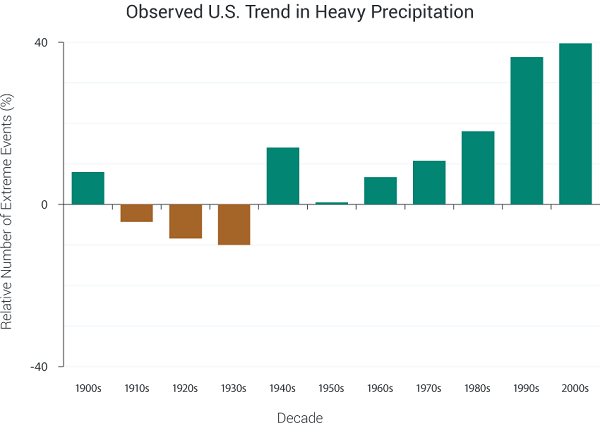
Climate change has moved from distant threat to present-day danger and no American will be left unscathed, according to a landmark report due to be unveiled on Tuesday.
The National Climate Assessment, a 1,300-page report compiled by 300 leading scientists and experts, is meant to be the definitive account of the effects of climate change on the US. It will be formally released at a White House event and is expected to drive the remaining two years of Barack Obama’s environmental agenda.
The findings are expected to guide Obama as he rolls out the next and most ambitious phase of his climate change plan in June – a proposal to cut emissions from the current generation of power plants, America’s largest single source of carbon pollution.
Joe Romm at Climate Progress has more, while Emily Atkin looks at the impact on indigenous groups in Alaska and Pacific Islands.
6. Chances of El Niño almost 4 out of 5
The chances of an El Niño developing this year are now at almost 80% according to some estimates. This graph shows the increased temperature in El Niño years.
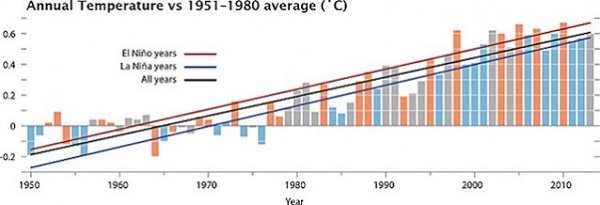
It could be a warm one.
Parts of the western United States suffering chronic drought could have flooding rains. In Oz where large areas are in drought, there would be even less chance of relief.
7. China, please stop using coal!
China should put a cap on greenhouse gas emissions from coal by 2020, and then swiftly reduce its dependency on the fossil fuel, according to a new study. Otherwise climate change will be impossible to stop.
Of relevance, back in 2011 the IEA said that after 2017 any new fossil fuel power generation should be matched by the decommissioning of equivalent existing capacity.
Reminder: Use this thread as an open thread on climate change.
Shredding the fig leaf
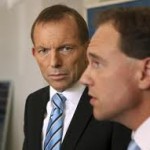
Direct Action was always a fig leaf for a government pretending to have a climate policy. Now the climate change denialists in Abbott’s cabinet have taken the opportunity to shred the fig leaf to the complete embarrassment of Greg Hunt.
Giles Parkinson thinks the 2014 budget is Abbott settling old scores, and dumping clean energy in favour of the asphalt economy.
With proposals to repeal the carbon price, dismantle the Climate Change Authority and the Clean Energy Finance Corporation, and the dilution of the Renewable Energy Target already in train, these budget measures – which include the closure of ARENA, the dumping of the million solar roofs program (both contrary to election promises) and the research funding cuts at the CSIRO, Bureau of Meteorology and elsewhere – mean that the obliteration of the Clean Energy Future package will be complete, if it can get past the Senate.
Dumping ARENA is particularly stupid, as the fund was leveraging private investment at the rate of $2.50 to one and doing much to support the off-grid activities of the mining industry.
ARENA will maintain funds of $1 billion for around 190 projects – mostly R&D – that have already been contracted since its creation in 2012, but it will have a measly budget of just $15 million over each of the next two years for new projects.
Some 150 of its 180 projects already allocated are in support of research and development, a core competency not valued by the Government.
The Emissions Reduction Fund ($2.55 billion) has been spread over 10 years, rather than four. Tristan Edis explains that $2.55 billion will be allocated over the next four years, but the scheme only pays on completion. However, this does call into question the efficacy of the scheme.
Clive Palmer wants to divert the funds to pensions and is prepared to vote it down.
The million solar roofs scheme was a featured election promise.
The million solar roofs program, once a $1 billion centrepiece of Direct Action to bring solar to lower-income earners and renters, has sunk without trace — replaced by a derisory $2.1 million program to install solar on RSLs and bowling clubs in seven electorates, many of them marginal (yes, really).
But not to worry we still have “$525 million to pay up to 15,000 under-25s to pick up litter at below-award wages under the guise of the Green Army”.
Parkinson further reports
the abrupt closure of the Energy Efficiency Opportunities, as well as rejecting calls for the revival of Low Carbon Australia, which also supported investments in energy efficiency. It has also brought an end to support for ethanol and algae fuel programs.
The Energy Efficiency Opportunities program, which was to cost $20 million to run over the next five years, had helped deliver more than $1 billion a year in savings since 2006.
Alan Pears at The Conversation has more. He says the Clean Energy Finance Corporation which has already mobilised $2.5 billion of mostly private funding for low-emission energy and agriculture projects would make a profit for the government if allowed to continue. Like ARENA the CEFC will continue trading until stopped by legislation.
Pears says that leaves the Renewable Energy Target (RET) scheme as “the last major remaining piece of federal government policy that supports ongoing investment.” It has already led to $20 billion worth of investment, but is under review with climate sceptic Dick Warburton at the helm.
There’s more at The Guardian and at Planet Oz. There Graham Readfearn tells of the axing of a small $1.3 million program, which has been supporting more than a 150 local and state-based conservation groups across the country since 1973. Such is the depth and thoroughness of the attack on the environment.
Meanwhile global renewable energy jobs surged to almost 6.5 million in 2013. In Germany, where the government strategy was to take first mover advantage, renewable energy production reached 74% the other day.
We are striving to be last.
Climate change impacts: IPCC Working Party 2 report
On 31 March the IPCC released its second report in the current series, this one on Impacts, Adaptation and Vulnerability. Follow the links from the report website. We looked at the first report, The Physical Science Basis here, here and here. The third report, Mitigation of Climate Change is now also out, and the final Synthesis Report is scheduled for in September. The series comprises the Fifth Assessment Report.
The IPCC was formed in 1988 and produced assessment reports in 1990, 1995 and 2007. As Graham Readfearn says, the message is the same – we are going to hell in a handbasket – and yes, at that level it’s becoming monotonous.
There is a change, however. It lies in the fact that the impacts of climate change are now all around us. We are not just getting warnings, we are living climate change. The impacts we see locally are integrating into a global pattern, which also includes large-scale transforming events, such as the drying of the Sahel and the loss of sea ice in the Arctic. Increased extreme weather is becoming part of the common experience. In this we are on a path where one in 100 events in any year may become one in three or five. We risk losing whole ecosystems such as the coral reefs where many are in trouble now and all will be by about mid-century, almost certainly. Finally, there is much greater certainty that climate change is happening and about our agency in it. With that certainty comes greater risk, but also opportunity to take action to adapt and to mitigate.
I’ve patterned that paragraph on Greg Picker’s explanation to Steve Austin, while changing the order of the points he made and adding some detail.
The report is organised into two “volumes”, with the first containing 20 chapters, including, for example, one on Human health: impacts, adaptation, and co-benefits and one on Human security. These sectoral reports will provide valuable reference material for years to come.
The second volume comprises 10 “regional aspects” including the ocean.
One of the 10 is on Australasia.
Impacts on Australia
Chapter 25 identifies eight significant impacts for Australia:
- There is the possibility of widespread and permanent damage to coral reef systems, particularly the Great Barrier Reef and Ningaloo in Western Australia.
- Some native species could be wiped out.
- There is the chance of more frequent flooding causing damage to key infrastructure.
- In some areas, unprecedented rising sea levels could inundate low-lying areas.
- In other areas, bushfires could result in significant economic losses.
- More frequent heatwaves and temperatures may lead to increased morbidity – especially among the elderly.
- Those same rising temperatures could put constraints on water resources.
- Farmers could face significant drops in agriculture – especially in the Murray-Darling Basin.
University of Queensland marine scientist Ove Hoegh-Guldberg worries that reefs could be severely damaged or disappear by mid-century.
A worst case scenario could see agricultural production reduce by 40% in the Murray-Darling Basin, and in south-east and south-west Australia. The National Irrigators Council says that’s why you have irrigation. However, there is a lot of dry-land farming in these areas and the future average rain is more likely to come in the form of floods when most of the water flows through to the sea.
The above scenarios are risks rather than certainties. However, they add up to a strong chance of dangerous climate change.
Increased certainty
The change in certainty in the attribution of climate change to human activity is conveyed in this image from Dr Jeff Masters’ WunderBlog last year:
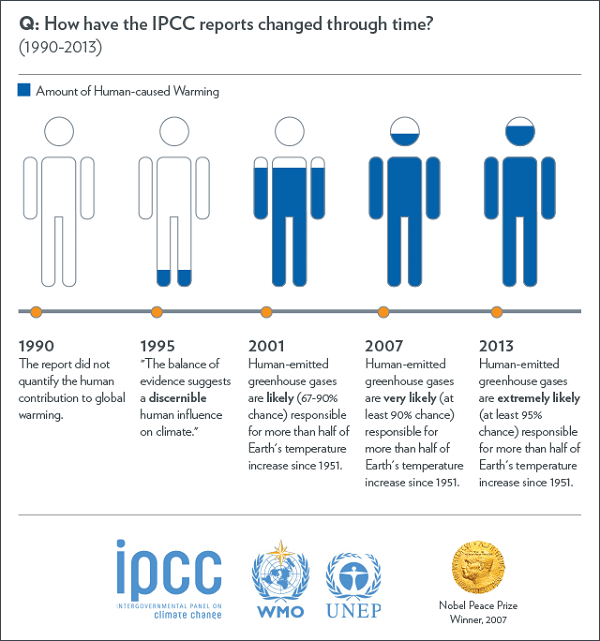
Back in 1990 we saw the possibility of continuing change but what we had experienced at that time could easily have been natural variations subject to reversal. In any case there was low confidence that we could do anything to mitigate. Furthermore, why take measures to adapt, when there was no real certainty?
Now the story has changed dramatically. The pattern and the dominant causes are clear.
Adaptation
From page 27 of the Summary for Policymakers we find a graphic packed with information about various aspects of the impacts of climate change (sorry the graphic is too large to display here!) In the right hand column we find bar graphs showing the present, near-term (2030-2040) and the long-term (2080-2100) risk with hatching to show potential for mitigation through adaptation. The long-term risk is displayed in separate 2°C and 4°C bars.
Little adaptation is possible with Australia’s coral reefs, none at 4°C when the risk becomes very high.
Terrestrial ecosystems losing ice cover in the polar regions are similarly not amenable to adaptation and become very high risk at 4°C.
Loss of crop productivity becomes very high risk at 4°C with little possibility of adaptation. Ditto for heat-related mortality in Asia, North America and, presumably, elsewhere.
Burning embers
The extensive detail in these tables is summarised in a new improved version of the ‘burning embers’ diagram, shown below:
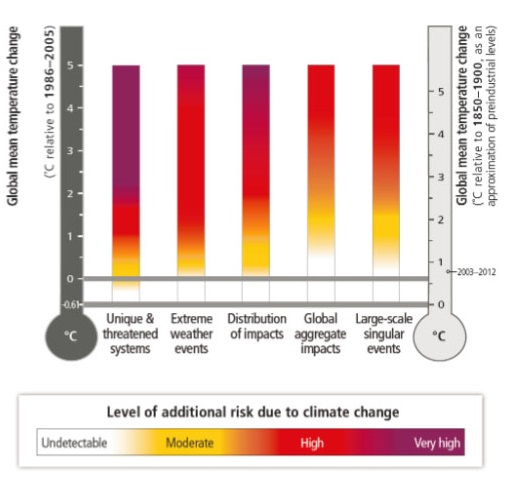
From this we can readily see that the 2°C ‘guardrail’ marks a fairly arbitrary point on the gradation from dire to downright dangerous.
Climate clippings 94
1. CO2 concentrations passing 400 ppm
Each year the atmospheric concentrations measured at Mauna Loa Observatory in Hawaii surge as spring turns into summer. We are now at the point where earlier each year they surge past 400 ppm, this year as early as March. By 2016 they will probably remain permanently above 400 ppm.
Dr Pep Canadell says crossing the 400 parts per million threshold will make it more difficult and expensive to limit climate change to two degrees.
The second part of this century we need to reduce emissions to zero and on top of it, to be removing carbon dioxide from the atmosphere so that by the end of 2100, we can stay stable under two degrees.
Canadell is head of the Global Carbon Project at the CSIRO.
2. Bio-energy with Carbon Capture & Storage
Speaking of sucking CO2 out of the atmosphere, bio-CCS is the new buzz word (I’ve also seen BECCS). The Climate Institute has released a report by Jacobs SKM Moving Below Zero: Understanding Bio-energy with Carbon Capture & Storage . Their modelling finds that
bio-energy with carbon capture and storage, or bio-CCS using food wastes, sustainable forest biomass, or crop residues, has the potential to contribute significantly to climate change efforts in Australia.
This process could remove and displace about 63 million tonnes of CO2 equivalent (MtCO2-e) annually by 2050, around 1.5 times current emissions from all cars in Australia. As well it would generate 12% of the country’s electricity.
Globally the process could remove up to 10 billion tonnes of pollution per year by 2050, according to the International Energy Agency.
The report may be downloaded from this page (scroll down). Go here for an interview with Malte Meinshausen.
3. Are coal miners responsible for greenhouse gas emissions?
No, said the Queensland Land Court in its judgement on the giant Alpha coal mine project which would dig up about 30 million tonnes of coal a year from the state’s Galilee Basin.
That’s the central fact in Graham Readfearn’s interesting story about what’s un-Australian.
Burning Alpha coal would generate 1.8 billion tonnes of CO2 over 30 years. That’s more than three times Australia’s annual emissions.
4. Abbott calls climate concerns “clutter”
In the lead up to the G20 meeting in Sydney in February, Abbott said
he didn’t want to “clutter up the G20 agenda with every worthy and important cause, because if we do, we will squander the opportunity to make a difference in the vital area of economic growth.”
The post, correctly, I think, sees Abbott as rolling back environmental and climate initiatives as hostile to economic growth, relying for economic impetus on the fossil fuel industry.
Heather Zichal, until recently President Obama’s lead climate and energy adviser, thinks otherwise:
Zichal suggests that focusing on economic productivity could be the sweet spot that Australia could use to balance climate concerns and economic growth goals. Reducing pollution and emissions from power plants and imposing strong energy efficiency measures on transport and infrastructure can boost energy productivity, save money, create jobs, and reduce emissions. “Ultimately, across all economic sectors, energy productivity is the most reliable, cleanest, and cheapest resource,” Zichal said.
Countries have to front up with their revised mitigation plans by April next year ahead of the Paris UNFCCC conference in December, hence leaving climate off the G20 agenda is simply not an option. Abbott has been told, by Christine Lagarde, managing director of the International Monetary Fund, and other powerful players.
One wonders what we will front up with next April. I predict nothing that would make a difference. We’ll see what others are doing and then do as little as possible.
5. Direst Action is a figleaf
Clive Palmer has spotted the figleaf and plans to pluck it away, says Ben Eltham. The Direct Action funding may be part of the budget, which Labor will not vote down. The Government needs no further legislation to enable expenditure, but Abbott can’t get rid of the dreaded carbon ‘tax’ without legislation. When he comes to negotiate that with PUP Direct Action will be on the table.
Eltham is right on the demographics:
While this [having no climate policy in place] may not unduly trouble the climate sceptics on the Coalition backbench, it also removes the chief utility of Direct Action, which is political, rather than environmental. Direct Action has always been used by the Coalition as a handy tool to deflect unwelcome scrutiny of its profoundly anti-environment attitudes. Without it, the Government will find it increasingly difficult to defend itself against charges of destroying the planet.
In the last Nielsen poll the 55+ group was the only one where Abbott had a clear lead, with LNP/Labor/Green at 49/33/10. This should be causing concern for the future of the conservative parties. For the young it was 32/36/26.
6. Direct Action is not scalable
Lenore Taylor points out that while Direct Action may or may not achieve 5% reductions in emissions by 2020, (most experts say, no) the policy is not scalable when the world gets a bit more serious about climate change mitigation.
according to the available modelling, even if Australia spent $88bn from 2014 to 2050 on Direct Action-type policies, emissions would still rise by around 45%. Most economists conclude that big emissions reductions under Direct Action are just not possible.
7. Green groups to use legal strategies
Given the above and the LNP’s farcical attitude to the Renewal Energy Target Review, green groups see lobbying as a waste of time and are increasingly planning legal challenges.
The Australian Conservation Foundation will be targeting voters in marginal electorates to encourage MPs to take climate change seriously. The aim is to change the current race to the bottom to a race to the top.
Reminder: Use this thread as an open thread on climate change.
Climate sceptic heads RET review
The law says that the Renewable Energy Target (RET) should be reviewed every two years, so a 2014 review is mandatory.
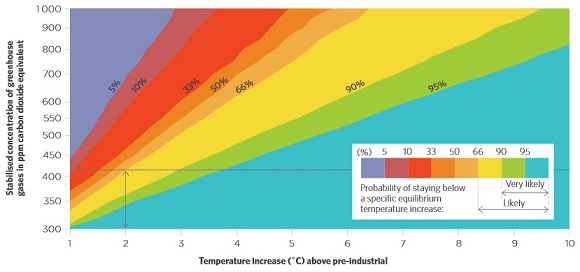
The law also says that the review should be undertaken by the Climate Change Authority (CCA), which still exists courtesy of the senate. The CCA in a draft report on the emissions target suggested the current 5% emissions reduction target was not enough if we are to pull our weight in the world. In the text they appeared to favour a 25% target, but recommended at least 15% pointing out also the an additional 4% could be added courtesy of Kyoto credits.
I believe the RET has been one of the more successful factors in restraining emissions.
Giles Parkinson reported two months ago now that the RET Review will be headed by Dick Warburton, a climate change “denier”. Warburton told RN’s AM program that the science was not settled.
I am not a denier, nor a sceptic actually, of climate change per se. What I am sceptical is the claims that man-made carbon dioxide is the major cause of global warming. I’m not a denier of that, but I am sceptical of that claim.
When asked whether he believed renewable energy had its role to play in Australia’s energy mix Warburton replied:
Yes it does. Renewable energy does have a place to play. The review is asking us to look to see whether it is an efficient and effective way of doing it as we’re doing it at the moment.
 I understand he did overtly oppose carbon pricing.
In my opinion Warburton is a denier. Given the degree of certainty in the science you either accept the science or deny it. There’s no room left for fence sitting. That being said, Warburton had a fine reputation as a businessman leading Dupont’s Australian operations, was used by the Keating government in industry renewal, has been a member of the Reserve Bank board and has had various company board roles.
It has emerged that Warburton has been the subject of an investigation into his role as a former director of a firm involved in Australia’s worst foreign bribery scandal. I would suggest that Abbott has done his due diligence and found him in the clear.
Both Abbott and Macfarlane have been emphasising their concern over renewables contributing to the cost of electricity. A second panelist is Matt Zema, the CEO of the Australian Energy Market Operator. As such he was responsible for a study recently
that found 100 per cent renewables would be possible in Australia, and concluded that the cost of electricity would be little different to business as usual, although AEMO declined to do a full cost analysis.
Greg Hunt parrots his boss’s concerns:
“We are a government that is unashamedly doing our best to take pressure off manufacturing and households through anything that can lower electricity prices,” he said in a theme frequently repeated by the conservative government.
If they are concerned about the future cost of electricity they could begin by looking at the policy of privatisation, found to be “a dismal failure” by Professor Quiggin.
A third panel member, Shirley In’t Veld, is the former head of WA government owned generation company Verve Energy which
has had a history of snubbing renewable energy and chose instead to invest in the refurbishment of the ageing Muja coal-fired generator. The refurbishment has proved to be a financial disaster, with the WA government admitting that nearly $300 million had gone down the drain.
The fourth member is Dr Brian Fisher, the former long-term head of ABARE until he left for private enterprise in 2006 to head up a fossil fuel lobby group, Concept Economics. At ABARE he gained notoriety for his positions on climate policies and is a noted free-market hardliner. Under Fisher:
ABARE was responsible for the infamous “MEGABARE” model that made Australia a laughing stock in connection to the Kyoto negotiations.
Sounds like a merry crew, Abbott’s idea of ‘balance’, and bound to add to the climate recalcitrance now so common in the Anglo-Saxon world.
There is a question as to whether the LNP deliberately lied and misled the public prior to the election. The SMH cites specific bi-partisanship as late as July 2013. Labor’s view:
“At every possible point, they tried to assure the community that there was a bipartisan consensus around the RET, and therefore the growth of renewables,” Labor climate change spokesman Mark Butler says. “What’s clear now is that it was just an utter falsehood.”
“They made it very clear; Greg Hunt staked his reputation on the maintenance of the renewable energy target,” he told said in the island state of Tasmania.
“It’s important for jobs. It’s important in terms of positioning Australia as a clean energy economy into the future.
“We’ll wait and see what they do but we’ll be holding them to account,” Mr Albanese said.
Update: Giles Parkinson tells how the Warburton Review is getting down to business today by looking at what the RET of 20% means. Presently it is a number – “41,000GWh of large-scale developments and an uncapped amount of small-scale generation”. It seems that more than half of that number can be made to disappear by changing definitions.
Climate Change Authority review
In late February the Climate Change Authority published a Draft Report of its Targets and Progress Review.
The full draft report (all 265 pages) is downloadable from the first link above. Unfortunately I don’t have time to read all of it. Clive Hamilton at The Conversation has written an excellent overview. Continue reading Climate Change Authority review
Climate clippings 93
1.Three reports
First, the Climate Change Authority released a Draft Report of its Targets and Progress Review.
I have a draft post in the bin, which I’ll publish after Easter. Labor are likely to adopt the enhanced targets it recommends, whereas the LNP have confirmed they won’t go beyond 5% by 2020.
Second, I’m working on a post on the IPCC’s second report in the current series, released on 31 March Impacts, Adaptation and Vulnerability. To get a head start you can follow the links from the report website.
I should be able to finalise the post for the week after Easter.
Third, the Summary for Policymakers of the IPCC’s third report Climate Change 2014: Mitigation of Climate Change was released on Monday. I hope to tackle it over Easter, aiming for publication the second week after Easter. The ABC has comment: politicians and Frank Jotzo and John Connor. The Carbon Brief has a lot of useful material.
2. The cost of mitigation
The IPCC mitigation report puts the cost of action at 0.06% of GDP, but calculating the cost is complex, especially when looking at the damage caused by doing nothing.
Researchers Rosen and Guenther find that the economic modelling is not possible, there are too many variables and too many unknowns.
Yet crisis trumps uncertainty, we have no real choice but to act.
3. Trouble in the vineyards
Early ripening is becoming a huge problem for growers and wineries.
growers say they’re having trouble processing their crop because it’s ripening too quickly.
Researchers are blaming climate change, with warmer conditions and drier soils accelerating the ripening process.
4. Microbes cause Permian–Triassic extinction?
The Permian–Triassic extinction event, commonly known as the Great Dying, was responsible for the extinction of roughly 90% of all life on Earth.
According to new research at MIT the event may have been caused by microbes.
The team’s research indicates that the catastrophic event was in fact triggered by the tiniest of organisms, a methane-releasing microbe called Methanosarcina. New evidence suggests that at the time of the extinction, the microbes appeared in massive numbers across the world’s oceans, spreading vast clouds of the carbon-heavy gas methane into the atmosphere. This had the effect of altering the planet’s climate in a way that made it inhospitable to most other forms of life inhabiting Earth at that time.
5. Land clearing returns to Qld
According to The Wilderness Society the Queensland Government has approved the clearing of 30,000 hectares at Strathmore Station in the Gilbert River catchment in the Gulf country, which will add the equivalent of 4.2-6.6 million tonnes of carbon dioxide into the atmosphere, the same as running up to another 2.6 million cars on our roads.
Strathmore wants to clear another 70,000 hectares. Together with another proposed Gilbert River project, IFED’s so-called Etheridge mega farm, the two schemes would clear and flood 200,000 hectares of land.
That would be like bulldozing a 10km wide strip for 200km.
6. Instruments of persuasion
Dr Rod Lamberts of the Australian Centre for Public Awareness of Science at the ANU says it’s time to dump science and facts as instruments of persuasion in favour of advertising and marketing. He says we need to appeal to people’s emotions, which will
have a stronger effect than trying to appeal to their brains via some kind of, you know, fact channel.
But please note, the facts are needed to support the campaign:
If the goal is to affect change, then I believe we need to step more into the realms of advertising and marketing and so on, in terms of delivering messages that are supported by what the science is telling us, but don’t have the science in those messages. (Emphasis added)
Jane Caro agrees on the need for a different approach:
Facts have never changed anyone’s mind about anything, sadly. It’s very hard for scientists to understand this, because they’re highly rational people, but in actual fact, no-one has ever been rationalised out of a belief.
There are only two things that change people’s attitudes and behaviour, particularly their behaviour, and they’re two emotions, and they’re hope and fear.
Again, facts and the science are surely needed to rationalise a changed belief. Beliefs need reason to support them.
Who mounts and pays for an advertising and marketing campaign? We look to governments, but in Australia they are the actual problem.
7. Direct Action less popular than the price on carbon
Meanwhile Essential Media Communications have done a survey of opinion that shows Direct Action distinctly less popular than the price on carbon. In terms of age, there is a tipping point beyond which the doubters predominate and it’s age 55. Abbott’s climate policy may come back to bite.
as the flat-earthers take control of the Federal Government, more Australians than ever have come to the conclusion that the Earth is in fact round.
Changing our policymakers seems the best way home but then Labor needs to offer more than tokenism. In my opinion Labor politicians should be the prime target group. The current mob won’t change without a spell in opposition and transformational ideological renewal.
Reminder
Use this as an open thread for climate topics.

Modelling the cost of mitigating climate change
Forget it, it’s too hard!
That’s what two researchers, Dr Rich Rosen and Edeltraud Guenther of Boston and Dresden respectively, have concluded. They say it’s impossible to calculate the cost of mitigating climate change, there are too many variables and too many unknowns. Modelling which purports to do so cannot and should not be used by policymakers.
Nevertheless mitigate we must! Crisis trumps uncertainty:
“Mitigating climate change must proceed regardless of long-run economic analyses”, they conclude, “or risk making the world uninhabitable.”
Economic modelling of climate mitigation costs against business as usual (BAU) has commonly been used in developing policy after the Stern Review of 2006 and the IPCC’s Fourth Assessment Report of 2007. For example the Australian Treasury modelled the costs of the Gillard Government’s Clean Energy Future package through to 2050.
A complete waste of time, according to Rosen and Guenther.
Nevertheless treasuries in the future will no doubt continue with their best efforts. In the end a cost has to be entered in the budget, including the forward estimates. And no doubt the long-term story will continue to be told in order to convince us that the authorities know what they are doing.
We’ll know, however, that we are being fed a work of fiction.

Copping out at COP 19 in Warsaw
Back in 2002 an Earth Summit (World Summit on Sustainable Development) nick-named “Rio + 10” was held in Johannesburg. As I recall there was a big push on to transfer the main carriage for environmental matters from the UN to the WTO. There was dancing in the aisles by environment ministers when the move failed. The mind boggles for those who recall our environment minister at the time, one rather stiff and formal Dr David Kemp.
One wonders, though, whether climate change negotiations would now be in better shape. Probably not. Since Cancún in 2003 the WTO has had its own problems. Not surprising then that there has been a report suggesting a radical rethink of the UNFCCC process. Problem is the UNFCCC would have to agree and that would take at least 20 years.
There is always much talk of ‘pathways’ and ‘stepping stones’ at UNFCCC meetings. Graham Readfearn on the way to this year’s Conference of Parties (COP) in Warsaw asked Will Australia cause a slip on the climate change stepping stones in Warsaw? He suggested that Australia may be there using its elbows to push the process off balance. According to his final report How rich countries dodged the climate change blame game in Warsaw he was on the money: Continue reading Copping out at COP 19 in Warsaw
Saving the CEFC
Sophie Vorrath at RenewEconomy reports that both Senators Xenephon and Madigan spoke against the bill to abolish the Clean Energy Finance Corporation (CEFC). The Abbott government may not be able to complete their destructive war against renewable energy, even with the new senate next July. My understanding is that they need six votes from the cross benches. These may be hard to find.
However, Vorrath gave prize for best and most impassioned Senate speech in defence of the CEFC to WA Greens Senator Scott Ludlam, who repeatedly pointed out the lack of Coalition Senate representatives to argue their side of the debate. I’ve republished here her selection of highlights in plain text rather than italics. Continue reading Saving the CEFC
Climate change: reconnecting politics with reality
After the rally on Sunday 17 November Ben Eltham took a look at climate activism in the digital age and nominated climate policy as “the central battleground of 21st century politics.” Sooner or later, somehow or other, climate activism has to be turned into real politics. As one of the ten themes in the Centre for Policy Development’s Pushing our Luck: ideas for Australian progress Professor John Wiseman, Deputy Director of the Melbourne Sustainable Society Institute at the University of Melbourne looked at the shape of climate policy for the future.
You can find his whole piece at page 142 on the pdf counter, but I’ll attempt to give a brief outline here.
First he surveys the science, our prospects and the risks. The risk of a 4C future is unacceptably high. He quotes the World Bank’s report Turn Down the Heat:
- ‘Even with the current mitigation commitments and pledges fully implemented there is roughly a 20 per cent likelihood of exceeding 4°C by 2100. If they are not met warming of 4°C could occur as early as the 2060s.’
What does 4°C mean?
- Professor John Schellnhuber, Director of the Potsdam Institute for Climate Impact Research, provides a stark assessment of the difference between a rise of two and four degrees. ‘The difference,’ he says, ‘is human civilisation. A 4°C temperature increase probably means a global [population] carrying capacity below 1 billion people’.
He then looks at the climate budget approach and posts a version of this now familiar graph:
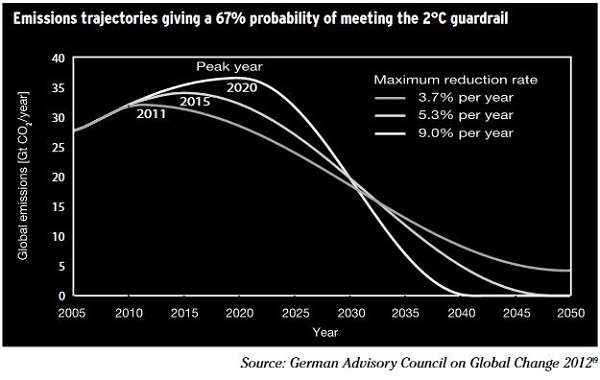
He concludes that we need more ambition and urgency, both at the national and international levels. The achievement of emission reductions at the necessary scale and speed will require transformational rather than incremental change. Continue reading Climate change: reconnecting politics with reality