Craig Emerson says we can get the gas we need, but is it necessary?
Craig Emerson has an article in the AFR, also on his site, suggesting that politicians need to urgently turn their minds to gas supply in east Australia. Emerson had warned them back in 2014, but they took no notice, and AEMO assured everyone there was no problem.
His speech set out Turnbull’s vision for Australia’s energy future – covering renewable energy, “clean” coal, gas, power prices and electricity security. He talked up coal, saying Australia as a big exporter needs to show we are using state-of-the-art clean coal-fired technology.
The Climate Council ran a Fact Check and found clean coal is NOT A THING.
Large-scale wind and solar plants are already cheaper than new “more efficient” coal plants, and waaaay cheaper than coal plants with CCS.
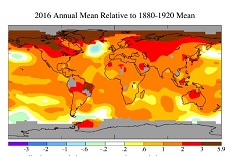
The third record year in a row has been declared. The last time it was as hot as this was 115,000 years ago. The last time CO2 was this high was in the Pliocene, 3 to 5 million years ago when the temperature became roughly 3 to 4 degrees Celsius warmer than today, and the sea level up to 40 metres higher.
Andrew Simms for The Guardianpolled a number of scientists about whether we could keep warming under 2°C. Not a single one thought we would. One scientist said “not a cat in hell’s chance”. Kevin Anderson, now professor in Uppsala, said politically we gave up years ago. Prof Joachim Schellnhuber, director of the Potsdam Institute for Climate Impact Research, would “only confirm that it is still possible to keep global warming below 2C”. Technically speaking, I assume. Continue reading Record 2016 heat spells trouble on global scale→
Start stopping now, is the short answer. No new coal mines, oil wells or gas fields, and start decommissioning existing ones now. “Managed decline” is the new imperative.
A new study released by Oil Change International, in partnership with 14 organizations from around the world, scientifically grounds the growing movement to keep carbon in the ground by revealing the need to stop all new fossil fuel infrastructure and industry expansion. It focuses on the potential carbon emissions from developed reserves – where the wells are already drilled, the pits dug, and the pipelines, processing facilities, railways, and export terminals constructed.
CSIRO researcher Dr Pep Canadell said it was the most comprehensive modelling to date and revealed a potentially dangerous climate wildcard.
“Methane emissions were stable for quite a few years at the end of the 2000s. But they’ve begun to grow much faster, in fact 10 times faster, since 2007,” said Dr Canadell, who is also the executive director of the Global Carbon Project.
Frank Jotzo recently pointed out that if we are to meet our Paris commitments of keeping global temperature rise below 2C we will need to close about one coal-fired power station every year. I believe we have 24.
He was giving evidence to a Senate inquiry into the Retirement of coal fired power stations set up by the Greens and Labor, chaired by Larissa Waters and due to report on 29 March 2017. If you follow the links there is already an Interim Report and 133 submissions available for our perusal. Continue reading Closing down coal→
An AFR article about investors piling into lithium and graphite mining stocks tells a tale. With our focus on Tesla we are missing the story of China.
Although the Western world’s focus is on Tesla’s progress, it is China’s EV push – it makes up 38 per cent of the global EV fleet, an increase from just 8 per cent in 2012 – that is really turning the dial.
Argonaut’s Hong Kong-based analyst Helen Lau says the massive subsidies available in the Chinese EV market to curb carbon emissions and lessen that country’s reliance on oil imports make electric cars up to 15 per cent cheaper to buy than conventional, internal combustion ones.
A bit further down I’m going to look at what Tristan Edis has to say about electricity pricing, but first what the whole affair is doing to Turnbull.
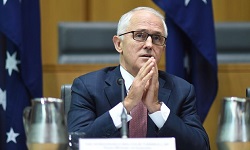
Mark Di Stefano at Buzzfeed has a detailed account of Turnbull’s year in 2016: The Year That Broke Malcolm Turnbull, and the pictures follow the story. Turnbull starts out as a confident leader, full of hope and bright ideas, and ends as just another politician that people don’t like very much. And there is rising anger about him within the conservatives of his own party.
On Monday this week energy and climate minister Josh Frydenberg suggested that an emissions intensity trading scheme for the electricity industry to help manage the transition to lower-emissions energy sources might be considered in the context of the Coalition’s reconsideration of climate change policy. A mere 33 hours later Turnbull killed off the option. It looked too much like a carbon tax, and the extreme right of the coalition gave it the thumbs down.
And so Turnbull is left looking like a coward. Frydenberg floated looking at something – not actually doing it, just considering it. The right said no thank you. Turnbull ruled it out. We’ve seen this show so many times now.
Back in November 2010 I did a post on Climate change and the Murray Darling Basin at a time when a plan for the Basin was proposed, but not yet settled. The post still gets a steady trickle of visitors.
The Murray Darling Basin Plan was passed into law in November 2012, when Julia Gillard was prime minister, and Tony Burke the minister responsible. There has been a recent kerfuffle, when Barnaby Joyce said an extra 450 GL of water probably would not be forthcoming. The reaction from SA premier Jay Weatherall and his ministers, and Senator Nick Xenophon seemed to imply the South Australia would be left high and dry. Turns out that’s not really the case. Continue reading Murray Darling Basin perspective→
Stephen Hawkins thinks we will probably go extinct on this planet if we don’t find a new one within 1000 years. Science writer extraordinaire Julian Cribb wonders whether we will make it past 2100.