Posts on sundry matters of life the universe and everything: Culture, Environment, Life, Politics & Government, Science, Social Science and Society, Technology etc.
One day soon, in the middle of the night, a bright new day is going to dawn with the official birth of a new blog about climate change, sustainability, plus sundry other stuff.
Climate Plus is due to put up a welcoming post, shall we say at 12.01 am (Eastern Standard Time of course) on Sunday 6 April. Anyway with a bit of luck I’ll be there.
This is an open thread for anyone who arrives early to chat if the spirit moves them.
Wikipedia tells us that post politics Julia Gillard signed a book deal with Penguin, purchased a house in Adelaide and was appointed honorary professor at the University of Adelaide. In that job it appears that she is actually going to do real work.
With some billions of dollars to spend and 60 participating nations the prime focus is on 57 million children who don’t go to school. Beyond that GPE advocates for the improvement of the quality of education generally.
Given the primacy of education in Gillard’s political philosophy the appointment seems particularly apt. I’m sure she’ll do a fine job and wish her well.
Australia currently provides $30 million pa in funding. They wouldn’t trim their contribution, would they? ‘They’ being Abbott, Bishop, Hockey, Mathias Cormann et al. After all theydishonoured our promise to help build a new parliament for Granada to save a measly $4 million. And to make a point.
Oure fadir that art in heuenes, halwid be thy name
Now try Old English of 1000:
Fæader ure thu the eart on heofonum, si thin nama gehalgod
When British jurist Sir William Jones arrived in Calcutta to become a member of the Bengal Supreme Court in 1783 he was already famous as a linguist for his translations of medieval Persian poetry amongst other works. At that time he already knew French, German, Latin, Greek, Welsh, Persian, Arabic, Hebrew and Gothic, the earliest written form of German. In order to do his job he decided to tool up on Sanskrit. In 1786 he announced an amazing discovery. Latin, Greek and Sanskrit stemmed from the same original language. Just had to be. He also found that Celtic, Gothic and Persian probably came from the same source. Indeed he was right.
Very common words tend not to change much. The word for mother, for example is strikingly similar across a range of languages. Hence we have Middle English moder, Dutch moeder, German Mutter, Irish máthair, Tocharian mācar, Lithuanian mótė, Latin māter, Greek meter, Russian mat’, Persian madar and Sanskrit mātṛ.
The original Proto-Indo-European word has been reconstructed as *méh₂tēr.
In fact all European languages belong to what is now recognised as the Indo-European language group (list here) except Basque, Estonian, Finnish and Magyar (Hungarian).
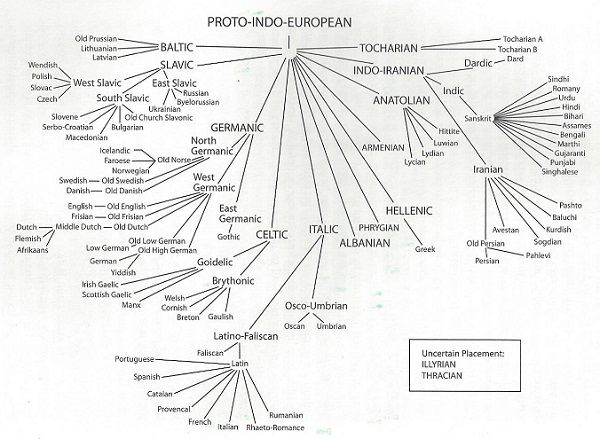
I’ve included here a chart of the Indo-European language taxonomy from David Anthony’s book:
Figure 1: Twelve branches of the Indo-European language family
Some of the individual languages are barely legible, but the overall picture is clear.
This Dan Short page provides a useful broad family tree divided into the so-called Centum and Satem groups, divided according to the word for hundred. Neither of these taxonomies helps with the timeline. Anthony gives the following as the best branching diagram, based on the Ringe_Warnow_Taylor (2002) cladistic method: Continue reading Deep origins: language→
Unless you’ve been living under a rock in the past few days you will have heard/seen Joe Hockey say that the budget is in terrible shape and he’ll have to clean up Labor’s mess. You see it’s all Labor’s fault.
Chris Bowen has been saying that $20 billion of the $17 billion budget deterioration since Labor’s pre-election statement is due to Hockey’s own decisions, that Hockey is setting us up for swingeing cuts in the budget in May next year.
I think the $20 billion is across the forward estimates (four years) and the $17 billion is just this year – it’s confusing.
Anyway, the AFR provided this helpful graph, which was sourced from Treasury, but I can’t find there:
Laura Tingle says the budget has been mugged by the deteriorating economy as well as alarming spending blowouts. There is a need, she says, not to “crunch a soft economy facing a continuing decline in national income, yet in the medium term there is a need to profoundly re-engineer the budget – and voters’ expectations.”
Yet there is so far a complete lack of what she calls “fiscal rules” to measure Hockey’s performance. There are no yardsticks or performance indicators. The future is completely open. We await the National Commission of Audit and the Government response with some trepidation.
Bruce Cockburn’s song If a tree falls sees vast swathes of forest felled. Yet single trees falling also go unnoticed. What’s happened in Queensland in the last couple of years foreshadows what we can expect. Ben Eltham’s report on the massive cuts to small and medium arts organisations in Queensland, for example, warns of worrying reverberations through the entire national arts sector. Cuts of that kind may not impinge directly on my experience, but I feel the life blood is being sucked out of the place. Yet the Newman government are now telling us how worthwhile the whole exercise has been. They are very proud of themselves. Continue reading If a tree falls in the forest…→
1. Following the recent Newspoll, the new Abbott Government has lost the two-party preferred polling lead.
2. This does not necessarily mean the government would lose an election if one was held now.
3. The Abbott Government has lost the 2PP polling lead much faster than any other new government elected from Opposition in federal polling history.
4. Tony Abbott has also recorded negative personal ratings much faster than any new PM elected from Opposition in federal polling history.
5. While polling taken at this stage has very little if any predictive value, governments that have lost the lead very early in their terms have a historically greater risk of defeat at the next election.
6. Bill Shorten’s polling as Opposition Leader appears good, but is nothing unusual by the standards of other Opposition Leaders at the same stages of their careers.
7. Furthermore the strength or otherwise of an Opposition Leader’s personal polling after only two months in the job has no relationship with their success at later elections.
Laura Tingle reckons the arrival of Turnbull’s NBN Strategic Review is deja vu all over again:
The raw politics of this is that, no matter how much the Coalition can complain that it has been left to clean up a Labor mess, a mickey mouse broadband network is now a mess that it owns and has insisted it will put its own stamp on. The cost of this decision is that we have to go back to the start to redesign NBN Co itself; the technological platform of the broadband system, the competition regime and a myriad of contracts.
This will take time.
There is going to be a cost benefit analysis and a review of NBN regulation. There will be changes to procurement strategy, renegotiation of deals with Telstra and Optus, of the special access undertaking lodged with the ACCC, reviews of NBN Co’s fixed wireless and satellite programs, a corporate plan, possible legislative and regulatory changes to access multi-dwelling units and utility infrastructure.
Tony Boyd spells out some of the detail. Significantly, the ‘multi-technology mix’ (MTM) is going to mean that
the entire NBN network technology management system will have to be redesigned. The IT systems will have to be changed and operational processes will have to be modified to support copper, HFC and FTTN.
Abbott, Hockey et al would have you believe that GM have made a decision to cease manufacturing in Australia. Kim Carr and Jay Weatherall have been saying that GM were willing to continue and had specified exactly what was required. My recall is that Weatherall said they wanted the Government to chip in $130 million. Carr told Waleed Aly that the price was significantly less than $150 million. Carr said further that the hectoring and bullying by Hockey, Abbott and others clearly let GM know they were not wanted.
I think Carr is right. The Government wanted to make the decision look as though it was made by GM alone and to a degree they have succeeded.
Tim Colebatch, in a column written before the decision was announced (sadly, his last) was clear that the decision was made by Abbott. He thinks it could precipitate a recession. And:
car programs cost $400 million a year, nothing like the $3 billion a year for diesel fuel rebates to mining companies, or the $5 billion to subsidise negative gearing. The budgetary cost of losing this industry will dwarf the cost of keeping it.
The bottom line is that “aiming for the 2°C pathway would be foolhardy” because it “would have consequences that can be described as disastrous”. The authors believe that humanity and nature, the modern world as we know it, is adapted to the Holocene climate that has existed more than 10,000 years. Departing from this climate by more than 1°C would have intrinsically harmful effects. At 2°C these effects become unacceptably severe. Moreover we enter a zone where further feedbacks, such as ice sheet response, methane release and vegetation change, are likely to push the climate towards further warming, of probably at least 3°C.
This map gives some idea of the geographic positioning of the vast Galilee Basin, one of the greatest untapped coal reserves in the world.
This map locates it in relation to some well-known towns.
Last year we were told that nine coal mines are proposed. The Alpha proposal and Kevin’s Corner (GVK and Hancock Coal) could each produce 30 million tonnes per annum for export, Palmer’s China First hopes for 40 million tonnes. The Carmichael deposit (Adani) at 10 billion tonnes is the world’s largest coal deposit. I think the plan there is for another 30 million tonne mine.
Greame Readfearn has calculated that the Alpha and Kevin’s corner projects alone will produce 3.7 billion tonnes of CO2-e when burned. He compares that to the UK which emitted 571.6 Mt of CO2-e last year. He also outlines some of the difficulties being encountered, including contestation in the land Court.
Greenpeace calculated that if the Alpha coal project was a country, its annual emissions would be higher than the likes of Austria, Columbia and Qatar.
Hardly, but he is certainly a severe critic of market capitalism. George Weigel sees his recent apostolic exhortation Evangelii Gaudium (The Joy of the Gospel) as
a clarion call for a decisive shift in the Catholic Church’s self-understanding, in full continuity with the teaching of the Second Vatican Council, Paul VI, John Paul II and Benedict XVI.
The first teaching document mainly authored by Pope Francis, Evangelii Gaudium, is a bold and thrilling bid to send the Catholic Church worldwide on mission. Energetic, direct, lyrical, its language and style model the evangelization to which the Pope is calling Catholics. In sharp critiques and passionate prose, it polarises the choices faced both by the Church and the world, gently but insistently inviting people to opt for mission – and to a journey of transformation and reform.
Politicians come in three types – straight men, fixers and maddies. … I am certainly a maddie!
That or something like it was the grab used on radio to promote the final episode of the Keating interviews with Kerry O’Brien.
I was left wishing for more. I’d be interested in what he has to say about anything, but his comments on Labor since his time would have been especially interesting – even on Gillard/Rudd!
I can still remember the fateful day on 2 March, 1996. I was mowing a lawn in Milton. There was daylight saving and by 5.20pm our time it was clear that an era had ended. Labor retained only 49 seats though the 2PP ended up 46.37/53.63. This time it was 46.51/53.49. The furniture disappears very quickly when you get into that zone!
Terry at Saturday Salonhas raised the issue of Treaurer Hockey’s decision to disallow the US company Archer Daniels Midland’s (ADM) A$3.4 billion 100% takeover bid for the Australian company GrainCorp. As Terry said, Judith Sloan went ballistic, Bernard Keane and Glenn Dyer were scathing at Crikey, as was Geoff Kitney at the AFR.
For a straightforward account of what happened, try Michelle Grattan at The Conversation. She does call GrainCorp an agri-giant, although it’s not a large company in Australian terms, may just rate as a ‘mid-cap’. In American terms it’s a tiddler. Nevertheless it would have been ADM’s biggest acquisition to date. ADM is worth about $US27 billion. Graincorp after the post-bid price fall in now worth about $A2 billion.
There are at least three reasons why the bid was rejected.
First, there is a lack of competition in the eastern seaboard grain handling market. Graincorp owns 7 out of 10 terminals and handles some 85% of the grain. From Grattan:
“Many industry participants, particularly growers in eastern Australia, have expressed concern that the proposed acquisition could reduce competition and impede growers’ ability to access the grain storage, logistics and distribution network,” he [Hockey] said
Given the transition to a more competitive network was still emerging, “now is not the right time for a 100% foreign acquisition of this key Australian business.”
Secondly,
A “further significant consideration” was that the proposal had attracted a high level of concern from stakeholders and the broader community.
Allowing the bid to proceed “could risk undermining public support for the foreign investment regime and ongoing foreign investment more generally”.
Thirdly, and down-pedalled somewhat, there were issues about ADM’s motivation and longer-term priorities and its record of providing service in its home market, in other words, questions of character. The sweetener of $200 million for additional investment and promised price caps for handling fees was too late to be persuasive. In any case there was no guarantee that farmers would not pay in the long run. Continue reading Hockey’s Graincorp decision→
Climate change, sustainability, plus sundry other stuff



 Abbott, Hockey et al would have you believe that GM have made a decision to cease manufacturing in Australia. Kim Carr and Jay Weatherall have been saying that GM were willing to continue and had specified exactly what was required. My recall is that Weatherall said they wanted the Government to chip in $130 million. Carr


 Terry at Saturday Salon
