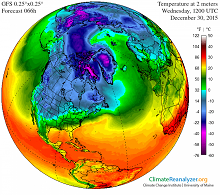
A freak heatwave has pushed the North Pole temperature to above freezing, about 20°C above average.
Nearby:
-
An Arctic monitoring point 300 kilometres from the Pole that had been recording -37°C on Monday had shot up to -8°C by Wednesday.

A freak heatwave has pushed the North Pole temperature to above freezing, about 20°C above average.
Nearby:
When the first named cyclone in July appeared off the Queensland coast some asked whether this was caused by climate change. My response would be that a single event is weather. Climate is about changes in the patterns of weather over time.
Carbon Brief has a post suggesting that climate change attribution studies are asking the wrong questions. Continue reading Climate clippings 145
Shrink That Footprint has published 11 charts to help understand climate change. Here are two of them. Continue reading Climate clippings 142
At Climate Progress Extreme Heat Wave In India Is Killing People And Melting Roads. Temperatures have reached 122°F (50°C), that’s 1°F less than the all-time record. Continue reading Climate clippings 141

An open thread where, at your leisure, you can discuss anything you like, well, within reason and the Comments Policy. Include here news and views, plus any notable personal experiences from the week and the weekend. Continue reading Saturday salon 25/4 (Anzac Day)
Mercifully Cyclone Marcia made landfall at Shoalwater Bay, a military training area between Yeppoon and Sarina, south of Mackay. The ABC coverage shows how it zigged and zagged after getting up steam in the Coral Sea:
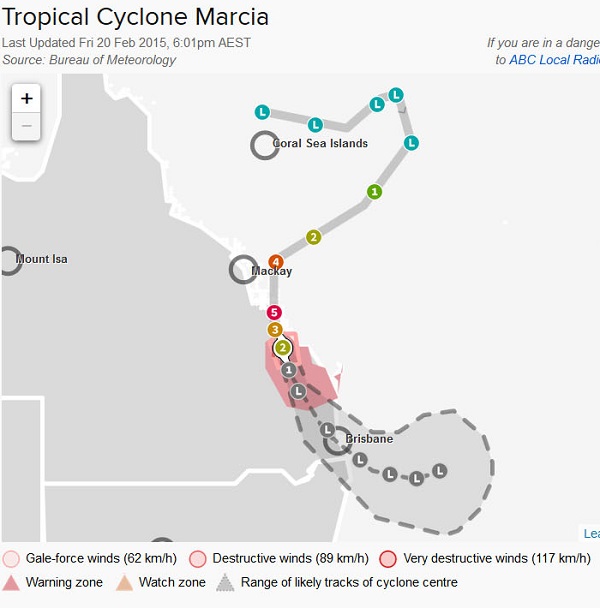
It headed for Mackay and then side-stepped. Perhaps Kolobok Norris was out there on the beach waving his fists! I do hope he and Graham Bell were safe.
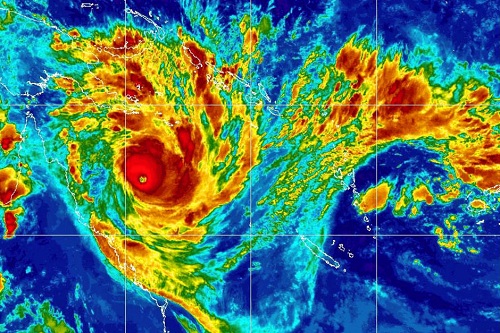
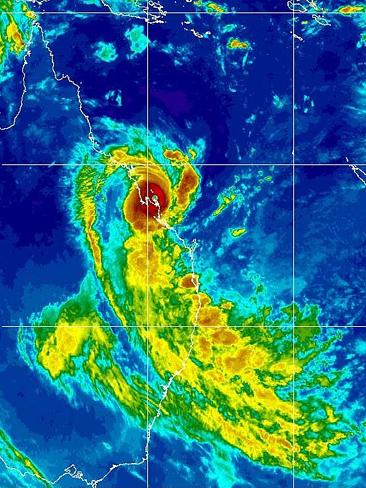
It gathered strength to become a category 5, but not nearly as big bad or ugly as Yasi. Nor will it penetrate as far into the inland, where large tracts remain parched.
Here’s an image of Yasi:
Here’s the equivalent of Marcia:
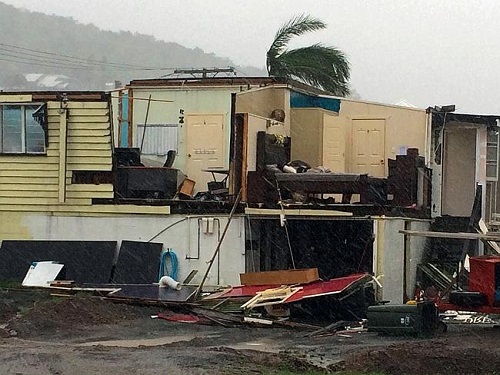
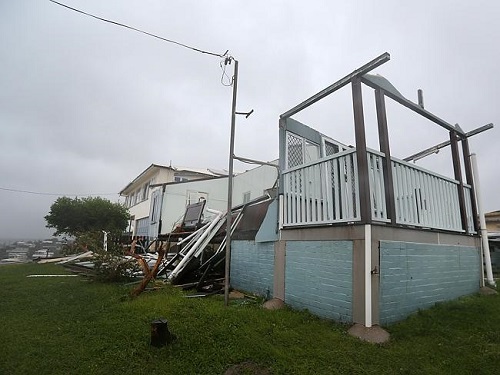
Cat 5 cyclones can destroy buildings. The Courier Mail has a photo gallery, including this:
Here’s another:
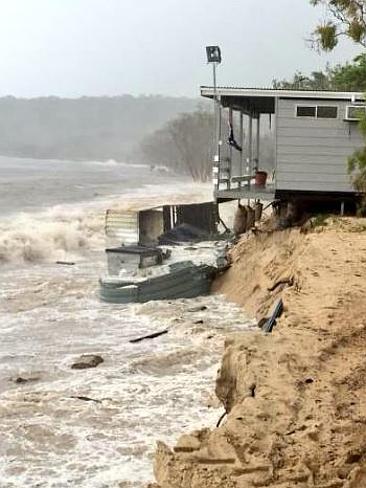
There was a three metre tidal surge and with significant erosion a tourist cabin fell into the sea on Great Keppel Island:
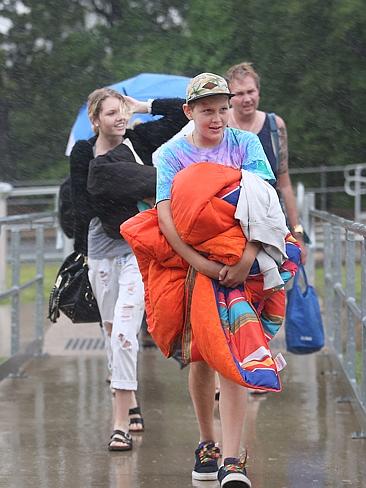
There will be a lot of personal stories of danger, escape and loss:
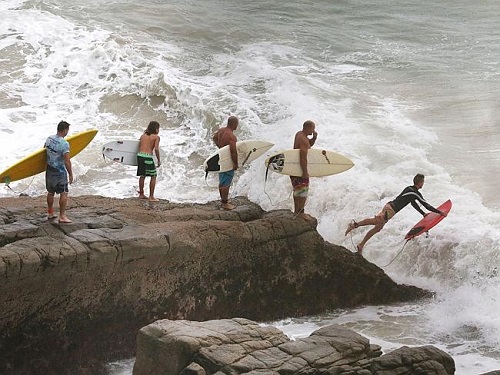
Some people, especially surf board riders, seem to be energised by these events. Here at Noosa they line up for their turn:
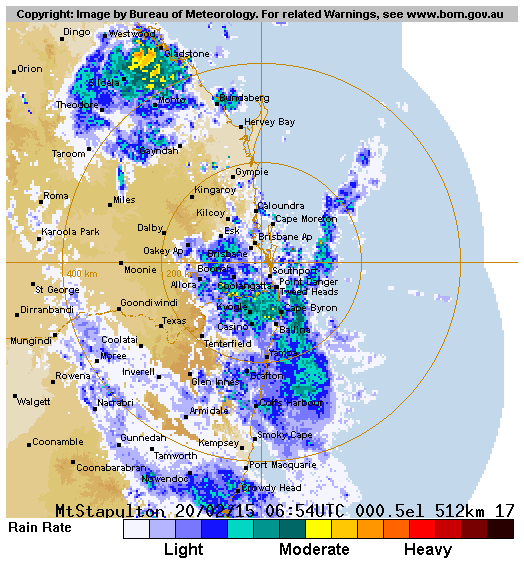
Here in South-east Queensland we’ve had a substantial rain depression for a couple of days. I gather it is related to Marcia but there is clear air between them as seen from this BOM screenshot late on Friday:
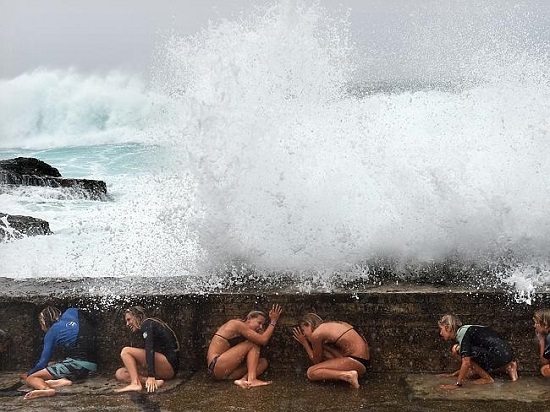
Considerable swells have already battered then Gold Coast:
Here in Brisbane we await the remnants of Marcia. I gather we are in a 12 hour interval which is like being in the eye of the storm. So far at our place we’ve had about 150 mm or six inches in the old money. We are assured that the main issues will be creek flooding and wind, with the possibility of trees bringing down power lines, hence blackouts and/or blocked roads. We are assured that it will be nothing like the floods of 2011. In fact we may get our reservoirs recharged which currently sit at a bit over 80%.
In the NT Cyclone Lam crossed the coast about 440 km east of Darwin, hitting some remote communities.
At time of posting (2 am) it looks as though Marcia has significantly fizzled and is mainly sliding through to the west of us. We’ve certainly had enough rain and it might do some good in agricultural areas.
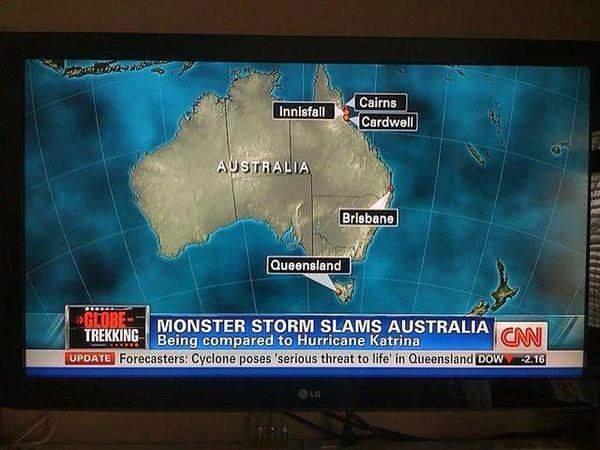
Update: Geoff Henderson has sent me a link to a CNN map shown on Facebook, with Tasmania labelled Queensland. Here it is:
In January of 2014, Denmark got just over 61% of its power from wind. For the whole of 2014 it was 39.1%, a world record.
Their leadership is working well for them. Nine out of ten offshore turbines installed globally are made in Denmark. They plan to be fossil fuel free by 2050.
Elsewhere Germany and the UK smash records for wind power generation. Scotland hopes to be fossil fuel free by 2050.
On Boxing day rooftop solar met one third of South Australia’s demand and at least 30% from 11.30am to 3.30pm. Bonaire (pop. 14,500), a small island off the coast of Venezuela, said goodbye diesel and hello 100% renewable electricity.
California Gov. Jerry Brown last week called for
the state’s electric utilities to boost their renewable energy procurements to 50% of retail electric sales and discussed future initiatives to support rooftop solar, battery storage, grid infrastructure and electric vehicles.
As Bill Lawry would say, “It’s all happening!”
The first set of figures is in, this time from the Japan Meteorological Agency, showing 2014 as the hottest year so far:
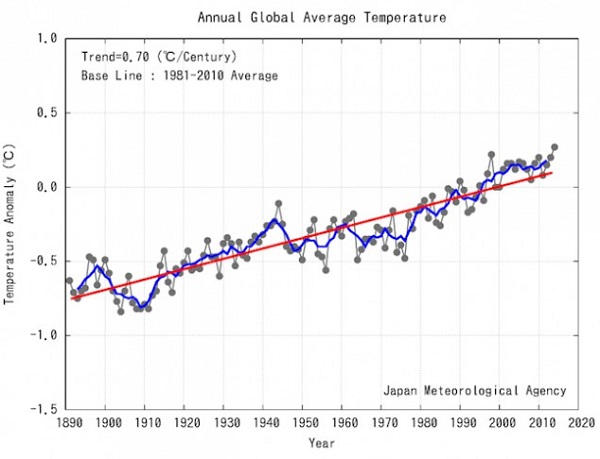
The red line is the long-term linear trend.
The blue line is the 5-year running mean.
Australia had the third hottest year on record.
3. Chinese three-wheeler is for real!
From John D’s Gizmag collection we have the Spira4u three-wheeler car:
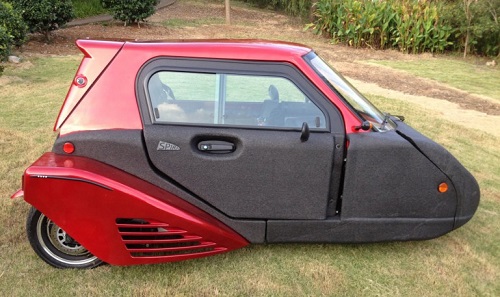
It’s not a toy, it’s a serious car which has gone into pilot production as a 10 kW electric or a fuel-injected 150 cc version with an economy of 2.94 l/100km (80 mpg).
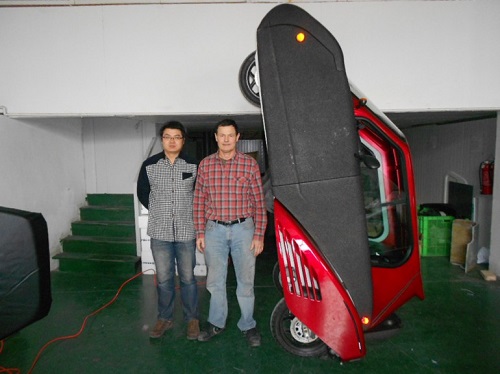
It has a handy parking option:
And it floats:
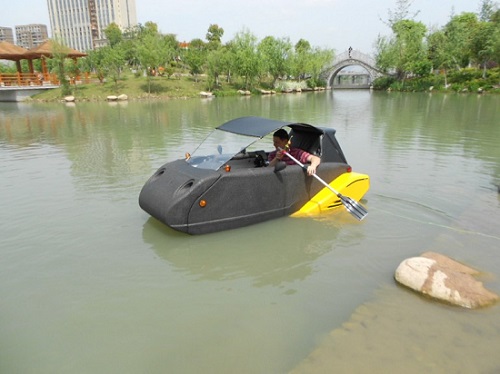
An amphibious version is under development.
4. California starts to build a high-speed rail system
The first phase of California’s high-speed rail system will be a 29-mile stretch from Fresno slightly north to the town of Madera. From there the project will link up with urban centers like Los Angeles and San Francisco, eventually allowing commuters to travel between those two cities at 220 mph and cutting the trip from nearly six hours to less than three. The system will eventually extend to Sacramento and San Diego, totaling 800 miles with up to 24 stations.
The full rail system should be in use by 2028.
5. Solar at grid parity in most of world by 2017
Investment bank Deutsche Bank is predicting that solar systems will be at grid parity in up to 80 per cent of the global market within 2 years, and says the collapse in the oil price will do little to slow down the solar juggernaut.
Quiggin at The Conversation and his place: Only a mug punter would bet on carbon storage over renewables.
6. When you are in a hole, stop digging!
From a study in the journal Nature:
“Our results suggest that, globally, a third of oil reserves, half of gas reserves, and over 80 percent of current coal reserves should remain unused from 2010 to 2050 in order to meet the target of 2°C,” write authors Christophe McGlade and Paul Ekins of University College London.
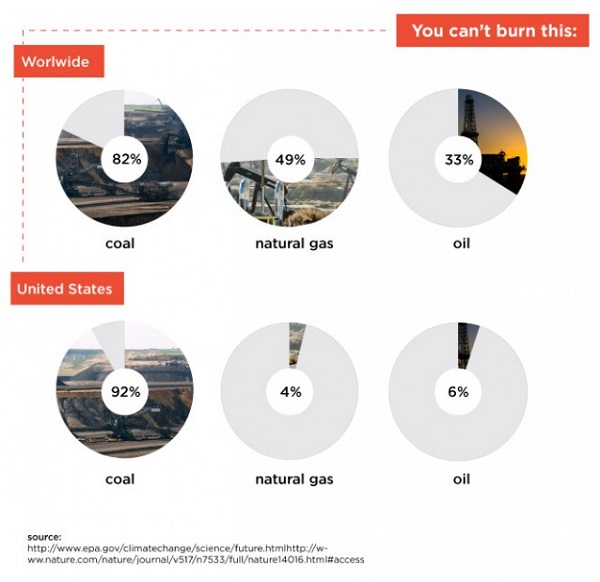
Keeping the increase in global temperatures under 2°C will require vast amounts of fossil fuels to be kept in the ground, including 92 percent of U.S. coal, most of Canada’s tar sands, and all of the Arctic’s oil and gas…
In 2013, fossil fuel companies spent some $670bn on exploring for new oil and gas resources. The figure should be zero.
7. Climate change will create more environmental refugees
Natural disasters like Typhoon Haiyan—which devastated the Philippines in 2013 displace more people than war, according to the Internal Displacement Monitoring Center in Geneva. And as climate change sets off increasingly lethal natural disasters, so will the numbers of environmental refugees increase, Reuters reported.
It is a reality that governments must prepare themselves for. In 2013, some 22 million people were displaced by extreme natural disasters like typhoons, earthquakes and tsunamis, a number three times the number of those who were forced to migrate because of war, according to the IDMC.
Earlier this summer New Zealand accepted a family who cited climate change as the reason why they had to flee their homeland, thought to be the world’s first official environmental refugees.
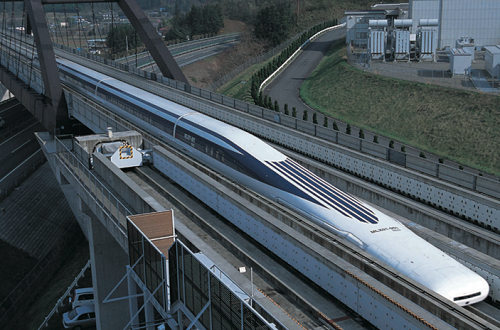
The Japanese have run an actual train with people in it at 500 km/h. The Chinese have built a train which can theoretically run at 1800 mph by encasing it in a vacuum tube.
It looks as though high speed rail could become a real alternative to air for intercity travel.
Thanks to John D for the headsup.
2. World’s first power-to-liquids production plant opens
The world’s first power-to-liquids (PtL) demonstration production plant was opened in Dresden on 14 November. The new rig uses PtL technology to transform water and CO2 to high-purity synthetic fuels (petrol, diesel, kerosene) with the aid of renewable electricity.
The article does not say how efficient the process is, but presumably less so than using the electricity directly.
3. World Bank focus on clean energy
The World Bank has traditionally been one of the world’s largest funders of fossil fuel projects. Now it:
will invest heavily in clean energy and only fund coal projects in “circumstances of extreme need”…
No doubt this policy stems from the bank’s commissioned report Turning down the heat.
4. Why the Peru climate summit matters
Hope has been injected into the Climate Change Conference in Lima, Peru, scheduled to run from 1 to 12 December by the recent US/China agreement. The optimism stems as much from the fact that the two largest emitters in the world are finally working together as the level of ambition. The EU has also recently pledged to cut emissions by 40 percent from 1990 levels by 2030.
Countries will be working on the text of the draft agreement for Paris in 2015.
Countries are expected to put forward their contributions towards the 2015 agreement in the form of Intended Nationally Determined Contributions (INDCs) by the end of March [2015]. These will then be used to craft the Paris treaty. The Lima gathering will help provide guidelines and clarity for what these INDCs must entail, especially for developing countries still reliant on fossil fuels to meet fast-growing energy demand needed to achieve developmental goals. These options could range from sector-wide emissions cuts to energy intensity goals to renewable energy targets.
We’ll be represented during the second week by Julie Bishop and Andrew Robb, a climate change denier. Seems Bishop went bananas when she found out, and Robb doesn’t want to be there anyway.
Giles Parkinson reports that we’ve sent a delegation of 14, the smallest in 20 years and probably not enough to be actively obstructive as we were in Warsaw last year.
5. 2014 looks like hottest on record
This is how it’s shaping:
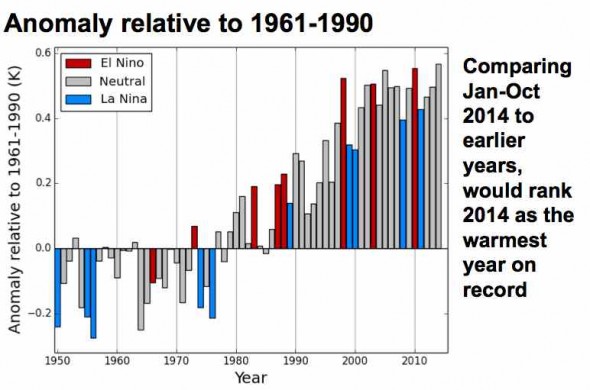
Record hot years are often El Niño years. This year is a neutral ENSO year so far.
That’s so far; there is at least a 70% chance that El Niño will be declared in the coming months, according to the BOM. Looks like a hot, dry summer.
6. Germany’s largest utility gets out of the fossil fuel business
On Sunday, Germany’s biggest utility E.ON announced plans to split into two companies and focus on renewables in a major shift that could be an indicator of broader changes to come across the utility sector. E.ON will spin off its nuclear, oil, coal, and gas operations in an effort to confront a drastically altered energy market, especially under the pressure of Germany’s Energiewende — the country’s move away from nuclear to renewables. The company told shareholders that it will place “a particular emphasis on expanding its wind business in Europe and in other selected target markets,” and that it will also “strengthen its solar business.”
E.ON will also focus on smart grids and distributed generation in an effort to improve energy efficiency and increase customer engagement and opportunity.
“With its decision, E.ON is the first company to take the necessary steps from the completely changed world of energy supply,” German Economy Minister Sigmar Gabriel, said Monday.
7. The inconvenient truth of EU emissions
The Commission and European Environment Agency’s Progress Report on climate action says:
according to latest estimates, EU greenhouse gas emissions in 2013 fell by 1.8% compared to 2012 and reached the lowest levels since 1990. So not only is the EU well on track to reach the 2020 target, it is also well on track to overachieve it.
Kevin Anderson is not impressed:
The consumption-based emissions (i.e. where emissions associated with imports and exports are considered) of the EU 28 were 2% higher in 2008 than in 1990[1]. By 2013 emissions had marginally reduced to 4% lower than 1990 – but not as a consequence of judicious climate change strategies, but rather the financial fallout of the bankers’ reckless greed – egged on by complicit governments and pliant regulation.
Then he really gets stuck in:
In the quarter of a century since the first IPCC report we have achieved nothing of any significant merit relative to the scale of the climate challenge. All we have to show for our ongoing oratory is a burgeoning industry of bureaucrats, well meaning NGOs, academics and naysayers who collectively have overseen a 60+% rise in global emissions.
1. Home solar power plus battery storage
It’s on the way, according to reports in Climate Progress and RenewEconomy. They are reporting on reports emerging from HBSC, Citigroup and UBS, so the big end of town is taking notice.
Initial interest is in short storage to cater for the peaks, but it seems that full storage systems will become competitive before the end of the decade.
For the next ten years battery technology is likely to remain lithium ion, with newer technologies introduced later.
2. Oceans warming faster than thought
The top 700 metres of the ocean have been warming 24 to 55% faster since 1970 than previously thought. The problem has been poor sampling in the Southern Ocean.
Of course this means that the whole planet has been warming faster than previously thought, since over 90% of the extra heat goes into the ocean.
3. Human hands caused 2013 heat
To me 2013 seems like a long time ago, but it is remembered for breaking a lot of heat records in Australia.
January 7 was our hottest day on record – 40.3°C.
January was the hottest month on record.
The 2012-13 summer was the hottest on record.
September was the hottest on record, exceeding the previous record by more than a degree; this was the largest temperature anomaly for any month yet recorded.
September-November was the hottest on record.
The whole year of 2013 was the hottest on record.
Five studies have now been done establishing human agency in these events. We don’t just need to be concerned about our grandchildren. Climate change caused by humans is happening now.
4. NOAA explains record Antarctic sea ice growth
First of all the record does not represent a dramatic increase on the recent average:
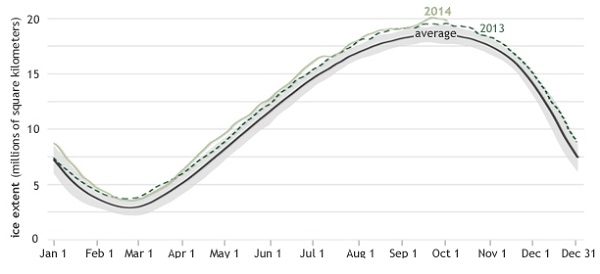
By comparison the loss of land ice has tripled in the last five years alone.
NOAA have now given a more detailed explanation of how the increase, counterintuitively, may be related to global warming. Firstly, it’s the wind:
NOAA first points out that “much of this year’s sea ice growth occurred late in the winter season, and weather records indicate that strong southerly winds blew over the Weddell Sea in mid-September 2014.”
Secondly, the melting land ice itself may have an effect:
Most of Antarctica’s ice lies in the ice sheets that cover the continent, and in recent decades, that ice has been melting. Along the coastline, ice shelves float on the ocean surface, and much of the recent melt may be driven by warm water from the deep ocean rising and making contact with ice shelf undersides.
How does the melting of land ice matter to sea ice formation? The resulting meltwater is fresher than the seawater. As it mixes with the seawater, the meltwater makes the nearby seawater slightly less dense, and slightly closer to the freezing point than the ocean water below. This less dense seawater spreads out across the ocean surface surrounding the continent, forming a stable pool of surface water that is close to the freezing point, and close to the ice onto which it could freeze.
5. Marshall Islands expendable
The United Nations chose 26-year-old Marshall Islands poet and mother Kathy Jetnil-Kijiner to be among the keynote speakers at the UN’s climate summit in New York recently. Here she is at the mike with her husband and child:
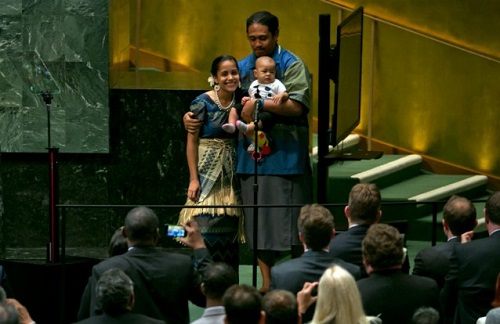
Marshall Islands sits on average about 2 metres above sea level. Already she’s seen waves crashing into their homes and their breadfruit trees wither from salt and droughts.
Jetnil-Kijiner was confident in her speech that, no matter how difficult, climate change would be solved, and her daughter would be able to go on living in the Marshall Islands.
“No one’s drowning, baby,” she said. “No one’s moving. No one’s losing their homeland. No one’s becoming a climate change refugee…We are drawing the line here.”
She said, accurately I think, that saving the Marshall Islands meant “ending carbon pollution within my lifetime.”
Some 125 world leaders were present. Some, like ours stayed away, having more important things to do. Anyone present with half a brain must have known that is not going to happen. The Marshall Islands is expendable.
6. Climate outlook, October to December
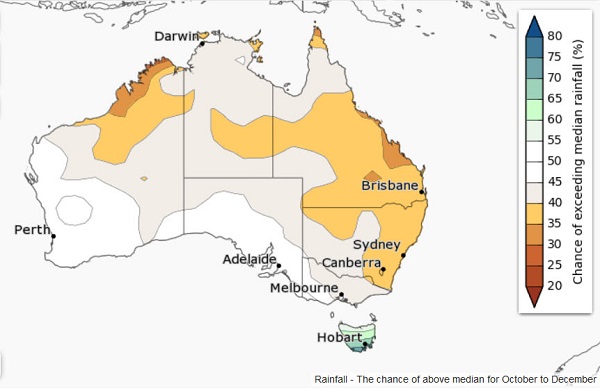
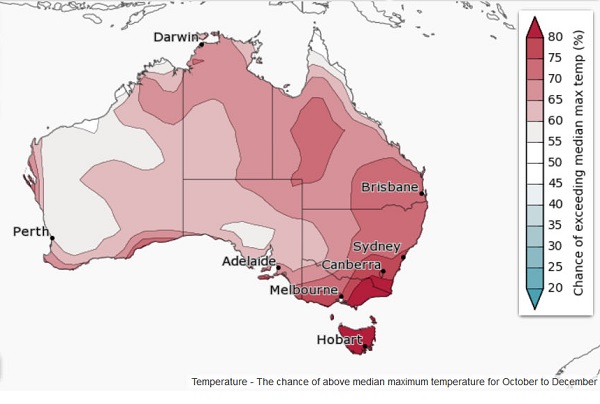
In brief, warmer and drier than average, apart from Tasmania, which looks good for rain. There’s more detail and maps here.
This is what the rainfall prospect looks like:
And maximum temperature:
Six of eight international climate models suggest a late season El Niño, or near El Niño, ENSO state is likely.
 This edition looks at changes in the cryosphere, a major US report, the prospects for an El Niño and the problem of China burning coal.
1. Pacific Ocean hot spot
Scientists have discovered a hot spot in the Pacific Ocean which is partly responsible for global warming in the Arctic. Incredibly this hot spot is east of Papua New Guinea.
This phenomenon is attributed to natural variations rather than global warming. Therein, perhaps, lies the reason that scientists have been constantly surprised by the rapidity of the Arctic sea ice loss.
2. Southern Ocean winds strengthening and moving south
Scientists have confirmed in a study covering the last 1000 years that winds are strengthening in the Southern Ocean and moving south. They found a definite trend greater than can be explained by natural variability and attributable to the effect of increased greenhouse gases.
Hence the drying of southern Australia is expected to continue. Also the tightening of winds around Antarctica inhibits warming of the continent. Nevertheless the warming of West Antarctica is considerable.
3. Antarctic glaciers melting past point of no return
A group of melting glaciers in West Antarctica appears to have reached the point of no return according to scientists from NASA and the University of California Irvine. Even if we cut back greenhouse gas emissions savagely now the melting will continue. We are probably looking at 3 to 5 metres of sea level rise, from Antarctica alone – that is our gift to future generations. Dangerous climate change is no longer just a future possibility, it’s happening now!
The question is, how long will it take? Here there is uncertainty. It could be as short as two centuries or as long as nine. Professor Eric Rignot thinks two centuries is “not outrageous”.
4. East Antarctica more vulnerable than thought
Part of East Antarctica is more vulnerable than expected to a thaw that could trigger an unstoppable slide of ice into the ocean and raise world sea levels for thousands of years, a study showed on Sunday.
The Wilkes Basin in East Antarctica, stretching more than 1,000 km (600 miles) inland, has enough ice to raise sea levels by 3 to 4 meters (10-13 feet) if it were to melt as an effect of global warming, the report said.
The Wilkes is vulnerable because it is held in place by a small rim of ice, resting on bedrock below sea level by the coast of the frozen continent. That “ice plug” might melt away in coming centuries if ocean waters warm up.
“East Antarctica’s Wilkes Basin is like a bottle on a slant. Once uncorked, it empties out,” Matthias Mengel of the Potsdam Institute for Climate Impact Research, lead author of the study in the journal Nature Climate Change, said in a statement.
Wilkes basin could be more vulnerable than West Antarctica, but perhaps on longer time scales. Again there is concern with tipping points. James Hansen famously said, You can’t sling a rope around an ice sheet!
5. Climate change is clear and present danger, says landmark US report
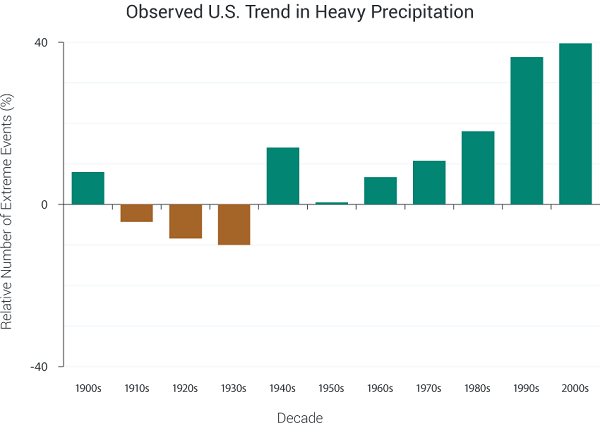
Climate change is already severely impacting US economy, ecology and health, according to the the third National Climate Assessment report. Arid areas will become dryer, moist areas wetter and wildfires and storms will become more frequent and severe. For example floods have increased in frequency, mainly in the Midwest and Northeast:
Climate change has moved from distant threat to present-day danger and no American will be left unscathed, according to a landmark report due to be unveiled on Tuesday.
The National Climate Assessment, a 1,300-page report compiled by 300 leading scientists and experts, is meant to be the definitive account of the effects of climate change on the US. It will be formally released at a White House event and is expected to drive the remaining two years of Barack Obama’s environmental agenda.
The findings are expected to guide Obama as he rolls out the next and most ambitious phase of his climate change plan in June – a proposal to cut emissions from the current generation of power plants, America’s largest single source of carbon pollution.
Joe Romm at Climate Progress has more, while Emily Atkin looks at the impact on indigenous groups in Alaska and Pacific Islands.
6. Chances of El Niño almost 4 out of 5
The chances of an El Niño developing this year are now at almost 80% according to some estimates. This graph shows the increased temperature in El Niño years.
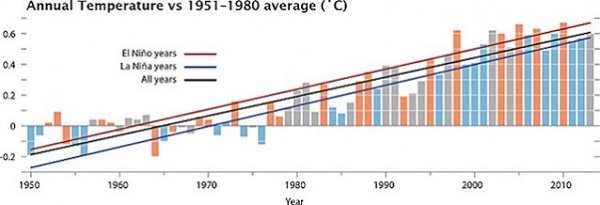
It could be a warm one.
Parts of the western United States suffering chronic drought could have flooding rains. In Oz where large areas are in drought, there would be even less chance of relief.
7. China, please stop using coal!
China should put a cap on greenhouse gas emissions from coal by 2020, and then swiftly reduce its dependency on the fossil fuel, according to a new study. Otherwise climate change will be impossible to stop.
Of relevance, back in 2011 the IEA said that after 2017 any new fossil fuel power generation should be matched by the decommissioning of equivalent existing capacity.
Reminder: Use this thread as an open thread on climate change.
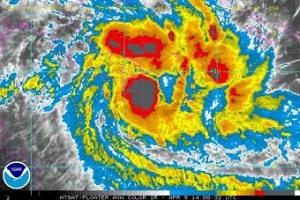 As Cyclone Ita bears down on the coast of Far North Queensland I was reminded of the post I drafted in late February on extreme weather. Ita is rated as category 4, hence severe. On the upside few people live in the expected path. On the downside the people who do are not likely to get much help from the outside world.
The incidence of cyclones is not expected to increase with climate change, although I understand the story could be different in the Caribbean and the NW West Pacific. However, we are likely to get more severe cyclones and they may be more intense.
Here’s the post as I wrote it.
This summer, Australians again endured record-breaking, extreme heatwaves and hot weather. My daughter in Adelaide, for example, experienced a record 13 days of 40°C-plus maximums. The Climate Council’s latest report Heatwaves: Hotter, Longer, More Often came up with four key findings:
First, climate change is already increasing the likelihood and severity of heatwaves across Australia. Second, heatwaves have widespread impacts including increased deaths, reduced workplace productivity, damage to infrastructure such as transport and electricity systems, mortality of heat-sensitive plants and animals, and stress on agricultural systems. Third, record hot days and heatwaves are expected to increase further in the future. And finally, limiting future increase in heatwave activity requires urgent and deep cuts to greenhouse-gas emissions.(Emphasis added)
While the 2009 Black Saturday bushfires killed more than 170 people, the preceding heatwave killed double this figure. In fact heatwaves kill more Australians than any other natural disaster, a fact largely unremarked. The following graph plots 2009 deaths against temperature and the 2004-08 average.
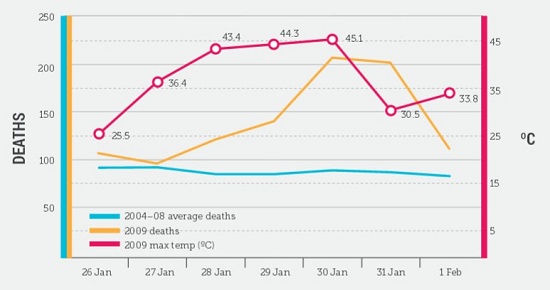
According to the report it has been estimated that heatwaves could cause an additional 6214 deaths in Victoria alone by 2050.
Adelaide’s heatwaves are an average 2.5°C hotter than they were half a century ago, and peak heat days are 4.5°C hotter.
Hot days, previously considered to be “once-in-20-years” occurrences, will start to happen every two to five years in Australia by mid-century.
At the end of the report they return to their constant theme – this is the critical decade in which to take action.
Meanwhile in Toronto where my sister lives they had an ice storm around Christmas and have been living in below zero temperatures ever since (time of writing, 19 February). The snow shovelled from their driveway doesn’t melt, so the pile goes up and up and up. Of the cities listed on the weather page of our local rag only Montreal has been consistently colder.
(Update: I think the cold spell lasted at least another month.)
At the same time weather historian Christopher C Burt blogged about record warmth in Alaska.
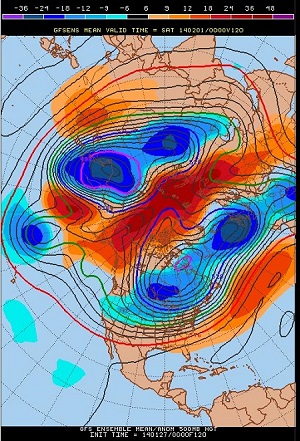
He shows an amazing map of the forecast for February 1st at the end of the post. It’s stunning, showing the Northern Hemisphere weather split by a stream of warm air directly across the North Pole:
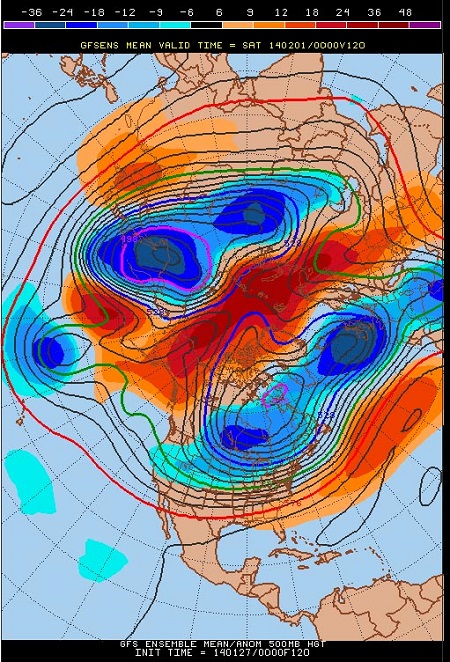
There is a related post at Dr Jeff Masters’ Wunderblog he says:
The cold air flowing out of the Arctic into the eastern half of the U.S. is being replaced by warm air surging northwards over Alaska and the North Atlantic east of Greenland. The warmth in Alaska the past three days has been particularly astonishing, with Alaska observing its all-time warmest January temperature of 62°[F] on Monday 1/27 at the Port Alsworth Climate Reference Network station, according to Rick Thoman of NWS Fairbanks. This ties the January state record set at Petersburg on January 16, 1981. Port Alsworth is about 160 miles southwest of Anchorage.
Nome, Alaska recorded a high of 51°F [10.5°C] on Monday. This was 38°[F] above average, and the warmest temperature ever observed in any November through March in Nome since record keeping began in 1907. (Emphasis added)
I think 38°F is about 21°C.
Elsewhere I’ve read that the US and Canada were 5°C colder than the 1951-1980 base in December, while north-eastern Europe and Siberia were 9°C warmer. Berlin and Moscow seem rather balmier than usual.
We are normally told that the jet stream has slowed down but for a time in February it speeded up, while being stuck in one place. The effect of this was to fling low pressure systems at the UK, where they experienced record floods.
Back in Oz again, much of the country is in severe drought, although, ironically, the grand tour by Abbott and Barnaby Joyce into the drought areas was interrupted by rain. Of course, one dump of rain doesn’t necessarily break a drought and the prospect for the coming 2014-15 summer is 75% stacked in favour of an El Niño. More records could be broken, including global average surface temperatures.
During this critical period of necessary climate action the Abbott government has appointed a climate denier Dick Warburton to head up the review of the Renewable Energy Target.
We live in interesting times.
PS One of my favourites from the archives is Remembering the floods.

CSIRO and the BOM have released their State of the Climate 2014 report. Pretty much the same story you’ve heard before, only a bit worse.
There’s a good summary at the special BOM site, where you can download the report. Other than that Climate Citizen has perhaps the best summary.
Graham Readfearn at Planet Oz riffs off the Dorothea Mackellar theme of a “sunburnt country” of “droughts and flooding rains”.
At Radio National’s PM Mark Colvin interviewed CSIRO’s Dr Penny Whetton.
At The Conversation Professor Neville Nicholls emphasises rising heatwaves and fires. Sophie Vorrath has more at RenewEconomy.
I’ll comment on a few sundry aspects.
Level of greenhouse gases
We are told that the global mean for CO2 in 2013 was 395 ppm, or “likely the highest level in at least 2 million years”. Back in the 2012 report the figure of 390 ppm for 2011 was described as “a level unprecedented in the past 800,000 years”. David Spratt at Climate Code Red added a corrective addendum “that should be 15 million years.”
Spratt referenced the work of Aradhna Tripati:
The last time carbon dioxide levels were apparently as high as they are today — and were sustained at those levels — global temperatures were 5 to 10 degrees Fahrenheit [DS: 3 to 6 degrees Celsius] higher than they are today, the sea level was approximately 75 to 120 feet [BB: 23 to 36 metres] higher than today, there was no permanent sea ice cap in the Arctic and very little ice on Antarctica and Greenland.
I’m amazed at how often these reports understate the gravity of the situation, presumably for fear of being written off as alarmist.
The report usefully adds the other main greenhouse gases to give a CO2 equivalence figure:
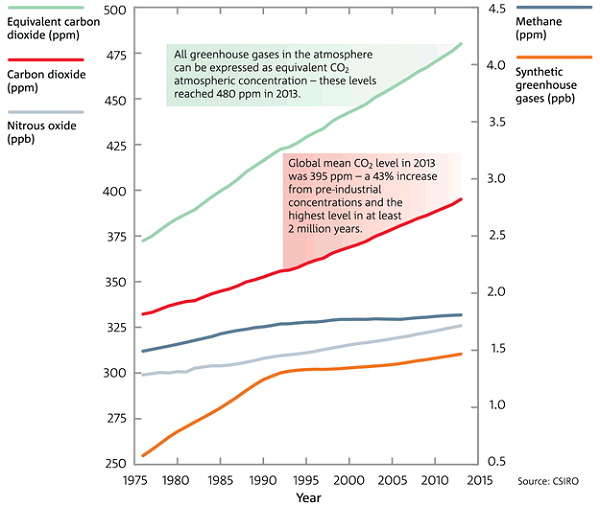
Please note the nitrous oxide and synthetic greenhouse gases are given in parts per billion.
In terms of CO2 equivalence we are now the 480 ppm. We should be red alerts everywhere and an emergency meeting of the G20, or something. The sad fact is that no policy agenda adopted by a political party has aspired to a safe climate. In fact the Garnaut Report and the Clean Energy Future Package legislated by Labor, the Greens and the indies, only ever aspired to 450 or 550 ppm CO2e. James Hansen in nominating 350 ppm as an initial target was very clear that this needed to assume net zero for the other greenhouse gases. What we are committed to now is a very unsafe climate as the effects play out in the short, mid and longer term.
Abbott was going to leave climate change off the forthcoming G20 agenda for Brisbane until the Americans complained.
Prospective temperature increases
Temperatures are projected to rise by 0.6 to 1.5°C by 2030 compared to the climate of 1980 to 1999. Warming by 2070 is projected to be 1.0 to 2.5°C for low greenhouse gas emissions and 2.2 to 5.0°C for high emissions.
We’ll achieve the upper bound if we continue as we are; the lower bound lacks credibility. To the ranges given we need to add 0.6°C in order to obtain the values for change since pre-industrial.
Again, we are clearly heading for dangerous climate change.
At time of writing there was a short piece in New Scientist citing three recent studies which indicate that climate sensitivity may have been under-estimated. Drew Shindell of NASA GISS:
“Sensitivity is not down at the low end,” Shindell says. “We can’t take any solace from warming being slower of late.”
That means we must cut our emissions fast, he says, or the planet could warm by 6°C by 2100.
Warming of 4°C is usually given as the level where civilisation as we know it comes into play. For Australia in a 4°C world, see Gabrielle Kuiper at Climate Code Red.
Hot days and heat waves
This graph shows the incidence of days in a year when the temperature is in the hottest 1% relative to 1910-2013:
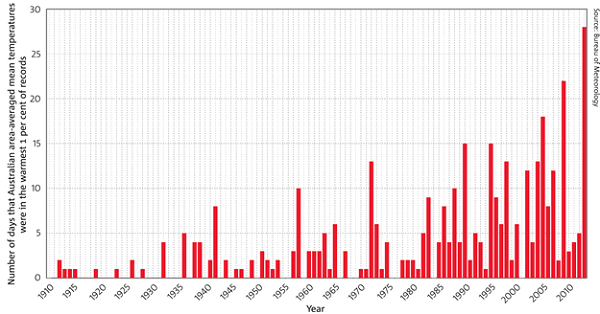
Graham Readfearn points out:
Starting from 1910 when Australia’s records start, it took 31 years for the country to rack up 28 days hot enough to fall into that top one per cent.
2013, however, managed to deliver this same number of extremely hot days in a single year.
Precipitation changes
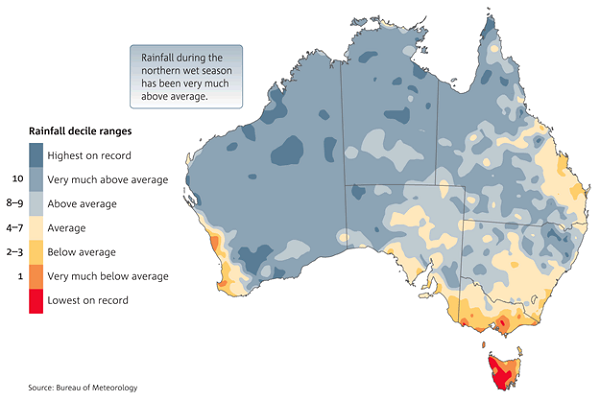
The following map shows the rainfall variation in deciles since 1995-1996 for the northern wet season of October to April:
The next map shows the rainfall variation in deciles since 1995-1996 for the southern wet season of April to November:
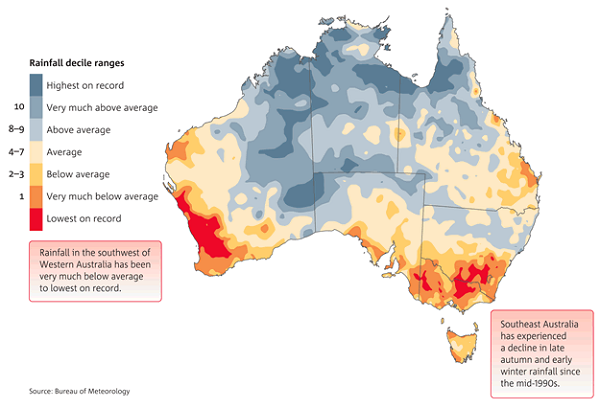
I believe that Sydney, which has dominant autumn/early winter rainfall, sits on the border between the summer and winter rainfall zones.
Clear patterns of change are becoming obvious. Apart from southern areas there is distinct drying in large tracts of Queensland, especially in winter.
This is disturbing:
The reduction in rainfall is amplified in streamflow in our rivers and streams. In the far southwest, streamflow has declined by more than 50 per cent since the mid-1970s. In the far southeast, streamflow during the 1997–2009 Millennium Drought was around half the long-term average.
Could be that we’ll increasingly have to rely on damaging floods to fill our dams.
Conclusion
There’s more, of course, including the prospect of losing our reef ecosystems.
Climate change is upon us.