Category Archives: Climate Action

Climate clippings 74

The weekend was a bit ordinary for me, but as supercoach Wayne Bennett says, if you can’t say anything nice say nothing. That’s how he addressed his troops after the thrashing they got in the previous week. This week they creamed the opposition!

This CC concentrates on climate mitigation, the practical stuff, rather than science, observations and future predictions. What I’m stepping around at the moment is politics, policy, opinion etc.

1. Renewables in surprising places

This image at Clean Technica indicates the potential of renewable energy. Please note that the amounts for coal etc are total reserves, whereas the renewables are annual.

renewable-energy-reserves

I’m not sure the natural gas is accurate as there is a lot of unconventional gas around. Continue reading Climate clippings 74

NSW coal generation under pressure

Well it is if the country stays on its present policy trajectory.

Sophie Vorrath at RenewEconomy comments on the latest pitt&sherry electricity emissions update (April data). Back in 1998 coal used to supply 90% of NSW’s National Electricity Market (NEM) electricity. Now this has fallen to less than 75%. One factor is that demand is falling more in NSW than in other states, as shown in these graphs:

Figure 1: Channges in electricity demand by state
Changes_electricity by state_cropped_580 Continue reading NSW coal generation under pressure

Climate clippings 72

Climate clippings_275

The last Climate clippings was back in March 2012. I’ve decided to start it up again, so we’ll see how we go. What I try to do is to include up to eight entries with an average of no more than 125 words. Readers who want to keep up in a general way should be able to gain a basic understanding by reading the entries without following the links.

This time the entries blew out to an average of about 150 words.

Climate clippings also serves as an open thread to share interesting links.

1. Climate Consensus – the 97%

Announced at Skeptical Science as a new Guardian blog, John Abrahams and Dana Nuccitelli will be writing at Climate Consensus – the 97%. It does have comments, but to me is not formatted like a blog. Maybe a newspaper blog.

It really started on 24 April. So far it’s not high volume, but looks interesting. Nuccitelli blogs at Skeptical Science as dana1981. The new blog is targeted at a more general audience. It appears their output is going to include correcting the errors and myths of the climate change contrarians, which is welcome. Continue reading Climate clippings 72

Tipping point for climate action?

Recently the Climate Commission issued a report in its The Critical Decade series on Extreme Weather looking at the issues of

  • Heat
  • Bushfires
  • Rainfall
  • Drought, and
  • Sea level rise.

At Radio National’s The World Today Professor Lesley Hughes, a Macquarie University ecologist, talked to Eleanor Hall.

The report looks at extreme weather experience in recent times, such as that documented in the Commission’s report The Angry Summer, puts it in a broader context using the latest science and then uses that as a window to project into the future. The message is plain. The climate has shifted, expect more and more extreme weather and we need to act now.

we really need to view all these events not in isolation but as part of a trend for the future. We need to prepare for them and we need to do our absolute best to cut greenhouse gases to stabilise the climate to prevent them getting to the point at which we cannot adapt.(Emphasis added)

Continue reading Tipping point for climate action?

National greenhouse emissions accounts

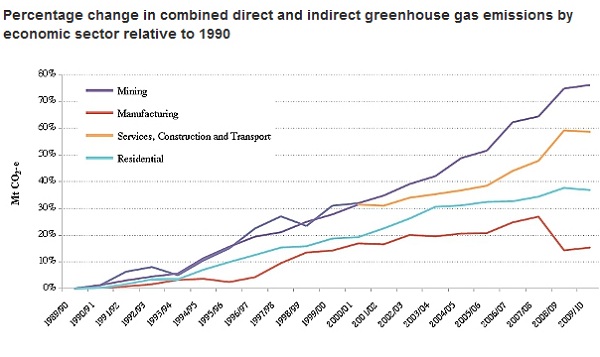
Tristan Edis at Climate Spectator makes a valid point that insufficient attention has been given to the increase in mining emissions in our national inventory.

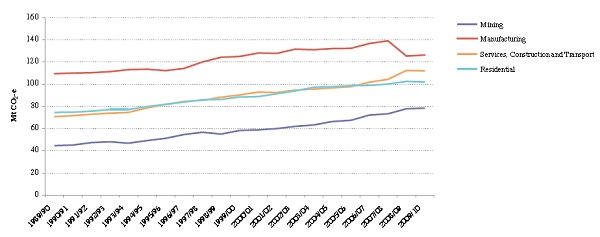
The two graphs displayed represent change in emissions. To provide context we really need to know the total quantum of emissions for each category. So I looked for the source of his graphs.

Turns out there is no one source. You have to go to this page. There is also a search facility here.

Edis has chosen his graphs well to make the points he makes, but some of the impressions may be misleading. Mining is the fastest growing sector but agriculture, residential and manufacturing are all still larger sectors. And residential in his graphs is only about half electricity consumption. The other half is mostly transport, but also includes emissions generated at residences, presumably mainly from gas. There are many messages you can dig out of the mine of information provided online. I’ll try to give a brief overview here.

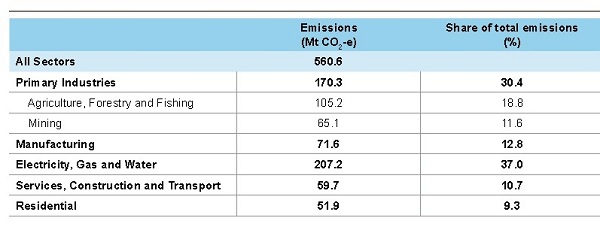
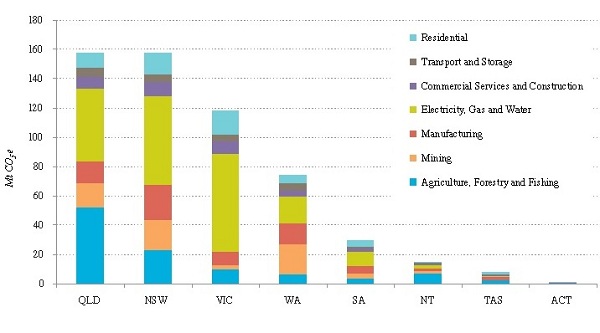
This table, from the National Inventory by Economic Sector 2009/10 gives a snapshot of Australia’s direct emissions, that is from the point they are generated:

Direct emissions

Land use, land use change and forestry (LULUCF) activities are included.

The figure for electricity needs to be largely distributed across the other sectors. For example, the residential figure cited here would comprise only transport plus other emissions generated at homes.

Edis’s first graph is Figure 6 in the Quarterly Update of Australia’s National Greenhouse Gas Inventory: December 2011. I’ll skip it and go to his second graph, which is Figure 7 of National Inventory by Economic Sector 2009/10:

Percentage change in direct and indirect emissions

The MtCO2e on the y-axis should have been omitted. Use of grid electricity is included in each sector. Agriculture is left out. It really should have been accompanied by Figure 6:

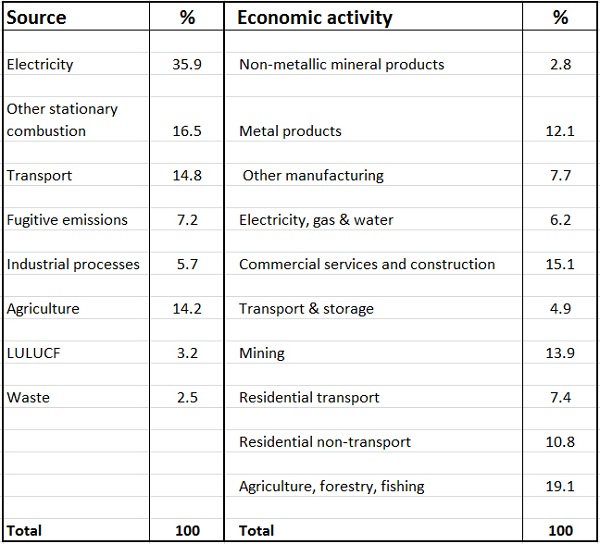
The graph that best captures everything happening now (at least in 2002-2010) is Figure 8 from the same document (p20). The graph is too big to reproduce here, so I’ve made this table:

Some thoughts.

Given the size of the electricity sector as a source and its potential in reducing emissions in the transport sector, clearly decarbonising electricity generation would go almost half way towards achieving zero emissions. Tackling electricity generation and transport represent the low-hanging fruit.

We have to ask whether an emissions trading system (ETS) by itself will achieve this in a time frame compatible with avoiding dangerous climate change. Recently I heard on Radio National that the fall in the demand for electricity is effectively locking in coal as a source of baseload power. If this article is correct we are spending $100 billion on a grid which will not be capable of handling diversified power generation.

This article is one of many detailing the falling electricity demand and some of the implications.

From the National Inventory by Economic Sector document, Figure 3 gives the direct emissions for each state:

Queensland would be the champion in per capita terms.

The Queensland LNP Government has decided to axe the policy and programs section of the Office of Climate Change. ‘Can-do’ can do whatever he wants!

Climate clippings 71b

This post was written in October 2012 trialling the site. I’ve decided to leave it in time sequence and fiddle the numbering.

1. Did climate change shape human evolution?

There’s no evidence yet that it did according to Richard Leakey.

I’m not sure about his four key questions, though. Yes, bipedalism seems to be important as does using tools to make tools. But I can’t see the importance of migration out of Africa as important to our evolution. Apart from picking up some Neanderthal genes presumably in a palm grove somewhere in the Middle East, which did boost our immune system, those of us who left Africa are much the same genetically as those who stayed behind.

I’d say the development of language was important. If you want a fourth I’d suggest our patterns of social organisation – how we interact and how we co-operate within groups. But I don’t know how much of that is in our genes.

2. Aid for climate refugees

Speaking of climate and migration, displacement by extreme weather events does not qualify you as a refugee under present UN arrangements. The International Organisation of Migration (IOM) hopes this will change at the annual United Nations climate change summit to be held in Qatar later this year, gaining access to the Green Climate Fund (GCF) and other sources. It seems that 42 million people were displaced by storms, floods and droughts in Asia and the Pacific during 2010 and 2011.

3. Ocean heat content update

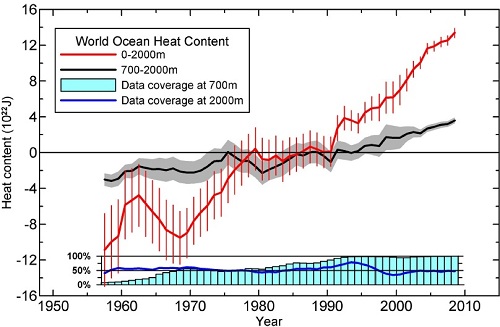
Skeptical Science recently posted on an update by Levitus et al on ocean heat content, which increases apace. Around 93% of additional warming goes into the ocean which is truly vast with, for example, an average depth of around 3,790 metres. This graph indicates the changing heat content within bands of the upper 2000m:
4. Southern Ocean research shows decrease in dense Antarctic bottom water
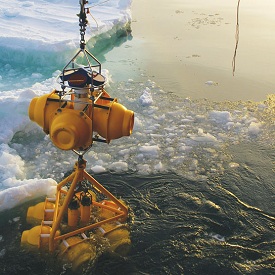
Antarctic Bottom Water is a massive current of super dense salty water which used to be which used to occupy the bottom mile of the Great Southern Ocean. Used to. Researchers are now able to report that the current is diminished by 60% compared to what it was in 1970.

Antarctic Bottom Water is colder than the normal freezing point and is a vast store of CO2. Understanding changes in this deep ocean current are crucial to understanding the likely future of global climate patterns as the planet warms. The researchers have not only been able to make direct observations, they have distributed buoys which should be able to provide data at times of the year when field work is impossible.

5. Plants flower faster than climate change models predict

For years scientists have been doing experiments to find out how much earlier plants will flower and leaf with global warming. A new study using field observations has found that plants are responding much faster than they had thought. Their research suggests that that spring flowering and leafing will continue to advance at the rate of 5 to 6 days per year for every degree celsius of warming.

What surprises me is that they thought they could model natural conditions in the lab.

It seems they will have to rethink the impacts of global warming on ecosystems and food production.

See also Science Daily.

6. Climate change experimentation goes bush

Another approach is to manipulate the environment on a large scale and monitor what happens. Researchers are using to control the amount of CO2 available to plants.

The idea is explore the role of “Australia’s large tracts of undeveloped land, known as bush” in storing carbon. They will be able to add carbon or take it away.

I’m not sure it doesn’t suffer from the same problems as experiments with plants, where only one variable was controlled, neglecting changes in precipitation patterns and cloudiness, for example.

7. Wind farms do not cause global warming

There has been a raft of articles in the MSM suggesting that wind farms cause global warming, mainly in the headlines, it seems.

In fact a study of some large wind farms in remote areas of Texas found local warming. The authors don’t know what’s going on but the suggestion is that thermal energy is being redistributed, perhaps by pulling down warmer air from higher altitudes during the nights.

For the spinning blades of wind turbines to increase the overall temperature of the planet some basic laws of physics would need to be rewritten.

Climate clippings 71

1. State of the climate 2012

BOM amd the CSIRO have produced the State of the Climate – 2012 report. BOM has a handy summary summary and link to the brochure. The CSIRO site has some added interviews. I’ve extracted two images. First is the relentless increase in ocean heat content:

Ocean heat content

Second is the rainfall pattern for April to September from 1997 to 2011:

Rainfall April to September, 1997-2011

According to the report we can expect the same only more so in the future.

See also The Conversation. Continue reading Climate clippings 71

Climate clippings 70

Stuff happens. We have a household of three with separate access to our online service and last week the youngest member blew our monthly usage budget downloading games, 11 days out from when it renews automatically on 17 March. So the speed became truly painful. Bigpond have given us a once only ‘goodwill’ 2 gigs to go on with. Trouble is, by he time I found out what was going on we’d already used a third of it.

Trouble also is that when the speed slows my email connection just doesn’t happen.

Anyway I’ve prepared a CC for this week from material to hand, then I’m going to disappear to preserve my email.

1. You’ve been told

When a link came through on a feed about a conference on what the planet would be like with 4C warming it looked a bit familiar. Then I noticed the date – October 2009. The link is now broken, but the conference is here. There’s a lot of good material in the presentation downloads, mostly depressing, some of which I looked at before things gummed up.

In the article it said that Hans Joachim Schellnhuber, who advises Angela Merkel on climate change, had dropped in on President Obama’s top people, who told him that the political system couldn’t cope with what he was saying about the science. Prof Scellnhuber was not impressed. Continue reading Climate clippings 70

Climate clippings 69

1. Electric cars

you have about 750 million cars in the world today; you’re going to have about 1.3 billion cars in about 25, 30 years; and you can’t expect them all to be running on gasoline. There isn’t that much gasoline around.

Stan Correy has a look at the future of the car industry and our potential place in it on ABC RN’s Background Briefing.

Evan Thornley, who is behind Better Place, thinks our niche in the electric car future is in the larger powerful muscle car, where we have always been. Continue reading Climate clippings 69

Climate clippings 68

1. Planning for storm surges

It seems the trickiest bit of planning for sea level rise is dealing with the increased risk of storm surges. Scientists have been taking a look at New York City.

The biggest they know about was a 3.2 metre surge in 1821, a one in 500 year event. Most buildings have a 60 to 120-year usable lifespan. With a 3-foot rise a once a century surge of 5.7 feet above tide level could occur every three to 20 years. Continue reading Climate clippings 68

Climate clippings 67

I’ve used a random image for the featured image of this post. I was going to use the one that once was my gravatar (to the left) but the original is quite small and it came up fuzzy. Continue reading Climate clippings 67

Climate clippings 66

New solar PV nanotechnology

There have been so many developments in PV technology it’s hard to know which will be significant.

Gizmag tells us about new material consisting of tiny hollow spheres, made out of nanocrystalline-silicon.

The new material is efficient, light, flexible, should be easy and cheap to make and their efficiency is less affected by the angle of the sun.

No downsides are mentioned. Continue reading Climate clippings 66