Category Archives: Climate Change & Sustainability

Posts on aspects of climate science, climate action and climate policy & planning.

Climate clippings 128

1. Hot and cold

My sister in Toronto tells us how cold it has been. She can’t remember the last time it reached -5°C.

Yet NASA finds that Feb 2014 to Jan 2015 was the hottest 12 months on record. The picture tells the story:
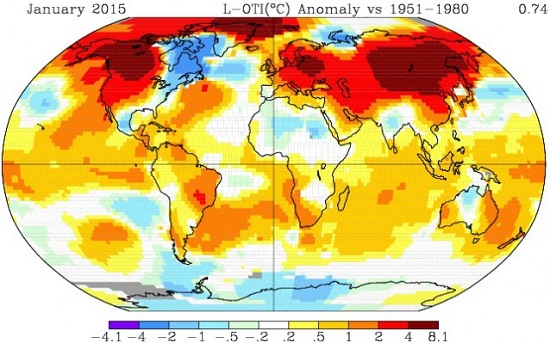
NASA1-15-550

2. Record megadroughts predicted

The American Southwest and the great Plains could experience the worst megadroughts in ancient and modern times.

According to the findings, future droughts in both regions will be more severe than even the hottest, driest megadroughts of the 12th and 13th centuries, which are believed to have contributed to the fall of ancient Native American civilizations that inhabited the Southwest, such as the Pueblo Indians.

Climate Central gives the odds.

The chances of a megadrought (lasting 35 years or longer) are up to 50%.

The odds of a decade-long drought are around 90%.

There’s also a 5-10 percent chance that parts of the region could see a state of “permanent” megadrought lasting 50 years or longer under the highest-warming scenario, a greenhouse gas emissions path we’re currently on.

3. New era of climate action and hope

Christiana Figueres reckons 2015 is going to be a transformational year in climate change action. She of course is the boss-person of the United Nations Framework Convention on Climate Change (UNFCCC) which is sponsoring the Paris talks in December.

Amongst other things she mentions the June Live Earth concerts initiated by Al Gore and Kevin Wall (reviving their 2007 effort) to be held in New York, South Africa, Australia, China, Brazil and Paris.

She also plugs the UNFCCC’s Momentum for Change initiative, including Lighthouse Activities.

4. UK parties in pact on climate change

David Cameron, Nick Clegg and Ed Miliband have agreed to work together to tackle climate change, as they warned it posed a threat to national security and economic prosperity.

In what might be seen as a surprising move in the run-up to the general election, the three party leaders have pledged to work “across party lines” to agree cuts to the UK’s carbon emissions.

They have also signed up to seeking a “fair, strong, legally binding” international climate deal, set to be negotiated in Paris at the end of the year, to limit global temperature rises to below 2C – the level beyond which “dangerous” climate change is expected.

And they pledged to move to a low-carbon economy, ending the use of coal without technology to capture and store its emissions for power generation. (Emphasis added)

5. Tesla’s fancy home battery

Tesla will start production in about six months, all going well.

“We are going to unveil the Tesla home battery, the consumer battery that would be for use in people’s houses or businesses fairly soon.”

“Some will be like the Model S pack: something flat, 5 inches off the wall, wall mounted, with a beautiful cover, an integrated bi-directional inverter, and plug and play.”

Thanks to Geoff Henderson who linked to this one recently at Saturday Salon. Yes, it could indeed be a game changer.

6. Laser ignition to replace spark plugs

A team at Princeton Optronics working on replacing conventional spark plugs with laser igniters has produced a running engine and they claim that replacing spark ignition with lasers could improve the efficiency of gasoline powered engines by 27%. Considering that the basic design of the spark plug hasn’t really changed in over a century, this would be a revolutionary step, frickin’ lasers or not.

Because the spark plug is located on the edge of the combustion chamber, not all of the fuel is combusted. Laser ignition can be directed to the centre of the chamber, or in fact to multiple parts of the chamber in extremely rapid succession. Ignition can also be more accurately timed in relation to the movement of the piston. The result is a more complete burn and greater fuel efficiency.

7. Climate oscillations and the global warming faux pause

Michael Mann posts on research he was conducted, with others, on multidecadal climate oscillations in the Pacific and the Atlantic Oceans. They found that the Pacific dominates and was the predominant cause of a slight slowing in predicted warming over the past decade-and-a-half or so.

It is possible that the downturn in the PMO [Pacific Multidecadal Oscillation] itself reflects a “dynamical response” of the climate to global warming. Indeed, I have suggested this possibility before. But the state-of-the-art climate model simulations analyzed in our current study suggest that this phenomenon is a manifestation of purely random, internal oscillations in the climate system.

This has implications for the future.

Given the pattern of past historical variation, this trend will likely reverse with internal variability, instead adding to anthropogenic warming in the coming decades.

The “false pause” may simply have been a cause for false complacency, when it comes to averting dangerous climate change.

Reminder Climate clippings is an open thread and can be used for exchanging news and views on climate.

Welcome to the the Green Tea Coalition

Traditionally, doubting climate science has been an article of faith for the US Tea Party.  Imagine my surprise at seeing this New Yorker  report that sections of the Tea Party are now actively supporting rooftop solar and teaming up with the Sierra Club to form the “Green Tea Coalition.  Coalition action includes:

helping defeat an effort by Georgia Power to impose heavy fees on customers with rooftop solar systems.”

So what is going on and are there implications for climate action in Australia?

The Tea party leader behind these moves is Debbie Dooley.  Debbie is definitely not someone from the Tea party fringe. She is

one of the twenty-two organizers of the first nationwide Tea Party protest, in 2009…. a co-founder of the Atlanta Tea Party, on the board of directors of the national Tea Party Patriots, and, since 2012, has been a fierce solar-power advocate.

In addition, much of what she says in support of solar is pure Tea Party:

“I thought that the regulated (utility) monopoly in Georgia had far too much power…” Solar, …. promised to give people energy autonomy. “The average person cannot build a power plant, but they can install solar panels on their rooftop, and they should be able to sell that energy to friends and neighbors if they wish.”

She also talks about:

solar energy, the free market, consumer choice, and national security. “Rooftop solar makes it harder for terrorists to render a devastating blow to our power grid,” she said. “There’s nothing more centralized in our nation. If terrorists were able to take down nine key substations, it would cause a blackout coast to coast.”….

and actions such as leading

a major ballot initiative that would amend that state’s (Florida) constitution to allow individuals and businesses with solar panels to sell the power that they generate directly to their tenants or neighbors. (Current law permits only utility companies to sell electricity.)

The key things here are a growing aversion to big business trying to limit the freedom of individuals in addition in addition to the traditional Tea Party aversion to big government.  There is no suggestion that the Tea party side of the coalition has suddenly decided to become climate change believers.

So what are the lessons for Australia given that the Tea party is an artifact of US culture?   For me there a few key reminders:

  1. You don’t have to believe in climate science to do things that help slow climate change.
  2. In some cases ideological things like individualism. aversion to big business/government will help with things like rooftop solar, household recycling, urban farming etc.
  3. In other cases the fracking companies are helping build the case against fossil gas while helping to build the regional Greens vote.
  4. Then there is finance.  The thing that is most likely to kill thermal coal projects and fossil power stations these days is the banks perception that these have become very risky investments.
  5. Then there is the economy.   What the world economy needs right now is a big drive against Greenhouse emissions – You don’t need to believe in climate science – Just sensible economics.

No, I haven’t gone over to the Tea party but it is worth reading the rest of the New Yorker article on the fights that Dooley has fought and won against the likes of the Koch Bros and more.

If you want to find out even more, admire the picture, imagine Abbott stewing in the Tea Cup and go to:  Green Tea Coalition

Green Tea Coalition

Bi-partisan Coalition of Environmentalists and tea party activists seeking common ground on common sense energy solutions for a stronger American economy.

Climate clippings 127

1. Queensland’s minister for the reef

Premier Palaszczuk’s new ministry contained some surprises, including the appointment of Steven Miles as Minister for the Great Barrier Reef. His full handle is Minister for Environment and Heritage Protection, Minister for National Parks and the Great Barrier Reef.

According to the WWF, Minister Miles will be responsible for delivering ALP environmental commitments including: a ban on dumping dredge spoil in the Great Barrier Reef World Heritage Area; an 80 per cent reduction in pollution run-off into the Reef by 2025; and the reinstatement of key legal safeguards.

2. Japan now has more EV chargers than petrol stations

The number of EV charging points in Japan, including fast-chargers and those installed in homes, has reached 40,000, surpassing the nation’s 34,000 gas stations, a new report has found.

The surprising figures were reported last week by Japanese auto giant Nissan, whose fully electric car, the Leaf, has been one of the world’s big EV success stories, selling 160,000 cars globally since its 2011 launch date.

Mainly in Japan, the US and Europe.

It should be noted that some of the charging stations are in private homes. Also petrol stations have multiple pumps, not reflected in the figures.

Tesla has its own network of (solar powered) charging stations in the US – and has plans to build versions of this supercharge network in China, Europe and Australia.

In Australia, local fast-charge tech company, Tritium, installed its first public Veefil EV charger in Brisbane at a BMW dealership in Fortitude Valley – the first of a planned “electric super highway” of fast chargers along the east coast.

3. Temperature records vs trends

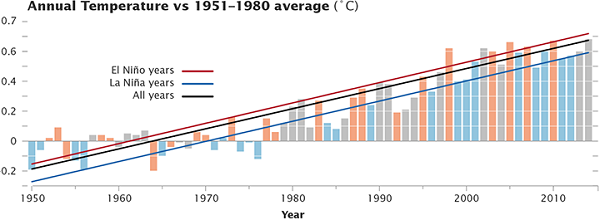
Gavin Schmidt, who has succeeded James Hansen as head of NASA GISS, has some Thoughts on 2014 and ongoing temperature trends. The shorter Schmidt is that while individual records grab the headlines, they don’t matter nearly as much as the underlying trend. This graph shows the overall trend in relation to El Niño and La Niña and years:

graph_gis_2014-1_600

The blue bars represent La Niña years, the orange El Niño and the grey neutral years. 2014 is bang on trend, but only marginally higher than 2005 and 2010. Yet it is grey to their orange.

Schmidt doesn’t mention this, but while 2014 was neutral it did feature anomalous warming in the northern Pacific, rather than the eastern equatorial Pacific warming associated with El Niños. This warming is said to have some of the same climatic effects as El Niño. Perhaps we need a new category with a fancy name.

4. Climate sensitivity conundrums

The term is “equilibrium climate sensitivity” (ECS). It represents “the global surface temperature change anticipated as a result of doubling atmospheric carbon dioxide concentrations.” John Fasullo has done a post on the current challenges and constraints in relation to the concept. It’s technical and I find it a bit boring, but ECS is an absolutely central concept to climate change discourse.

The basic problem is that the IPCC broadened the uncertainty range at the lower end from 2-4.5°C in IPCC4 to 1.5-4.5°C in IPCC5. The likely midpoint is still 3°C.

Fasullo has a lot of complex argument about the constraints arising from observations and models. What I think it comes down to is this.

The cut-off date for published papers for IPCC5 was July 2012. Prior to that date there had been several papers suggesting uncertainty at the lower end. Now the literature has swung back the other way. There was also the ‘warming pause’, which for a while back there was deemed by some to be real.

Fasullo makes it clear that the calculations are based largely on short-term effects. In Climate clippings 125 I referred to a David Spratt article which refers to the work of Hansen, Tripati and others which put longer term ECS at 4.5°C or more. And part of the point of the Michael Mann article was that we are starting to get into the longer term feedback zone.

I think they should all go back and read Hansen et al Earth’s Energy Imbalance and Implications (2011, I think) pages 4-18. The table on p17 gives ECS at 8°C or more, depending on certain definitions and circumstances.

5. Origin Energy to build Australia’s biggest rooftop solar array

Origin Energy and Zen Energy Systems are to build a 3MW solar system on the rooftop of the old Mitsubishi factory in Tonsley, Adelaide, in what will be the largest rooftop solar array in the country.

The awarding of the contracts was announced by the South Australian government this week. The intention to build the array was first announced late last year.

Origin Energy will own the rooftop array and sell the output to the tenants of the Tonsley high tech centre…, under a power purchase agreement that it is looking at replicating elsewhere in the country.

Here’s an artist’s impression of the site:

tonsley-solar-300x148

6. Origin shifts retail focus to rooftop solar and battery storage

Origin Energy has provided further details of its impending major push into the domestic solar market, saying that it expects rooftop solar to grow five-fold over the next 15 years, and battery storage will also emerge.

The Tonsley centre initiative is one example of this company reorientation. Seems AGL is looking to follow suit.

Large scale renewable energy still lives

Toowoomba Regional Council has approved a $1bn solar farm for a total footprint of up to 2 gigawatts over the next eight years.

APPROVAL has been given for the largest solar farm in the country — and possibly the largest proposed in the world — to be built in Queensland.

Construction on the 13,000-acre Bulli Creek site near Powerlink’s substation near Millmerran, southwest of Toowoomba, is expected to start next year. It will be on cleared, flat cattle grazing land.

Developer Solar Choice has received approval from Toowoomba Regional Council for a total footprint of up to 2 gigawatts over the next eight years.

The solar farm will be built in stages of multiple 100MW-plus phases, within a total planning approved envelope of 2GW.

531226-f5646aea-b1d1-11e4-8de0-9ed87417a9dc_500

If the farm reached its full potential it would take Australia 25% closer to achieving the mandated 41,000GWh target by 2020.

The ‘largest in the world’ claim relates, I think, to solar PV.

They say the project is expected to start next year but:

“The Bulli Creek project is attracting attention from a range of global investors prepared to take a medium- and long-term view,” Solar Choice said, stating it remained open to a large-scale investor.

There’s more at RenewEnergy.

Managing Director of Solar Choice, Angus Gemmell, says the Bulli Creek Solar Farm is one of a very small and select number of mega-scale solar projects that Solar Choice has strategically located at transmission nodes on broad-acre lands with high solar irradiation, west of the Great Dividing Range.

These include a 1GW solar project currently being progressed through the Whitsundays Regional Council , directly adjoining Powerlink’s 275kV Strathmore Substation at Collinsville. Another 300MW project, the Gannawarra Solar Farm in north-western Victoria, is already planning approved on the 220kV transmission lines between Swan Hill and Kerang.

“We believe that large-scale solar is on the right side of history – it’s not a matter of if these projects will be built, but when,” Gemmell told RenewEconomy in an interview.

The Toowoomba approval allows for battery storage to be added, should that become feasible.

For those who don’t know, Toowoomba at about 110,000 is the most populous inland non-capital city in the country and is the second most populous inland city overall, after Canberra.

ACT renewable energy contract

On another thread John D informed us of the ACT renewable energy contract.

The prices announced have stunned some observers, including rival bidders such as AGL Energy, which had hoped to kick-start it Silverton project. The prices are even lower than they appear, because the ACT tariff is fixed for 20 years, and it does not rise for inflation.

It appears three wind farm projects have been approved, at Bendigo ($81.50/MWh), at Ararat, west of Bendigo ($87/MWh) and at Hornsdale, south-east of Port Augusta ($92/MWh).

Battery storage

AGL Energy is planning a major new push into the rooftop solar market, along with digital meters, battery storage and home management systems.

Australia’s biggest energy utility, AGL Energy, says battery storage is already an “interesting” proposition for consumers, and it expects radical changes in the home energy market in coming years.

“We are at the point where we have got big changes going on (in energy markets),” AGL Energy managing director Michael Fraser said on Wednesday.

“We see battery storage technology going ahead in leaps and bounds.” This, in conjunction with rooftop solar and home energy management systems, would cause a “significant” and “fundamental” change in the way the energy market operates, Fraser said.

Brisbane-based Redflow says it is fast-tracking the rollout of its battery storage products to the residential and mining sector.

Redflow, which is bringing its unique zinc bromide flow battery to market, says its new products are 40 per cent cheaper than its first generation products, and are now approaching grid tariffs in some markets.

So much so, that CEO Stuart Smith says the grid, the backbone and chief source of electricity [for] more than a century, could soon be relegated to the role of mere “back-up”. This, of course, has huge implications for existing utilities – be they network operators, retailers, and/or generators.

“We believe we have a disruptive, scalable technology whose applications are continually expanding,” Smiths says.

“The future where the grid progressively becomes a backup rather than the primary source of energy is fast approaching by integrating our products with renewables such as solar and wind at a residential and commercial level.”

It seems they will be targeting Germany amongst others, where there is lots of solar and high electricity prices.

Tesla is also gearing up to enter the battery storage market. In an interesting development:

Queensland network operator Ergon Energy is installing up to one hundred 100kWh battery storage units because it is less costly than traditional grid upgrades. The units will be installed without subsidies, and other network operators are also trialling various battery storage models.

South-east Queensland is supplied by Energex. Ergon supplies the rest of the state where network costs are higher.

SA looks at nukes

South Australia has announced a Royal Commission into nuclear energy. At New Matilda, nuclear advocates Barry Brook and Ben Heard put the case in favour:

Nuclear is expensive, at least compared to coal. But when coal pays its environmental costs (especially for air pollution and greenhouse gas emissions) nuclear is not expensive at all.

Electricity from some renewables is now comparatively cheap. But when renewables pay their full system costs to overcome variability, a renewable system is very expensive indeed.

In this context, a ‘nuclear intensive’ strategy is still likely to underpin the most viable, scalable and cost-effective pathway to replace coal.

Nuclear is the safest form of large-scale energy production, when evaluated on the basis of deaths per unit of generation.

Not sure where we go with nukes, but with a bit of luck Abbott’s attempt to kill off renewables should be no more than a bump on the road in the longer term.

Climate clippings 126

1. New research reveals extreme oxygen loss in oceans during past climate change

New research published this week reveals that vast stretches of the ocean interior abruptly lost oxygen during the transition out of the last ice age that occurred 17,000–10,000 years ago.

If that happened as a result of the relatively gentle forcing caused by changes in the Earth’s orbit, imagine what is possible now!

Like most of the life on the planet, the large majority of marine organisms need oxygen to live. Most marine life, from salmon, crabs, to shellfish, respires oxygen and many forms are intolerant of low oxygen seawater.

So-called ‘dead zones’ do contain life comprised of worms, bacteria, specialized urchins and bivalves, and other extremophiles, just not the kind of tucker we like to eat.

2. India ‘walking the talk’ on climate change

India is one country a bit allergic to discussing agriculture and climate pollution. They worry about feeding the millions. They also got a serve from Obama when he was there:

During a visit to New Delhi last month, Obama warned that the world does not “stand a chance against climate change” unless developing countries such as India reduce their dependence on fossil fuels.

India, as usual, is impervious to pressure, but the environment minister reckons they are doing their bit. New prime minister Narendra Modi is keen on renewable energy:

Since coming to power in May, Modi has pledged to increase India’s renewable energy in a bid to lower coal use and bring electricity to more than 300 million poor people currently without power.

Modi, who built up a solar industry in Gujarat state when he was chief minister, has set a target for India to have 100 gigawatts of solar capacity by 2022.

3. Abbott’s decline attributed to G20 Obama snub and climate change

On Newspoll Abbott’s net approval rating is now -44 (68% disapprove, 24% approve of how he is doing his job). Jason Wison says:

After a polling mini-recovery of sorts for Abbott between July and September, November – the month of the G20 and Obama’s address – marked a turning-point. Between September and November, Abbott’s always-poor net satisfaction ratings had improved and stabilised a little; from November they declined rapidly to where they are today. In some polls, Abbott now has more than half the voters saying that he should resign. November was also the month in which Bill Shorten decisively overcame Abbott as preferred prime minister, and Shorten’s lead is now wider than ever.

Wilson reminds us that Abbott refused to accept President Obama’s request to put climate change on the G20 agenda. Obama’s response was to kick off his stay with an address at the University of Queensland embarrassing Abbott with his references to Australia and climate change.

4. Maurice Newman wrongly claimed a UK charity had blamed the deaths of elderly people on renewable energy policies

Maurice Newman is of course Tony Abbott’s top science advisor. Graham Readfearn investigated his claim and found:

Newman is not only misrepresenting the charity’s position, he appears to be making up positions that the charity simply does not hold.

Also:

between 2004 and 2011 the average annual energy bill in the UK went up from £610 to £970.

Only £30 of that £360 increase was due to costs related to low-carbon power generation.

Most of the increase, the analysis said, was down to higher gas prices and network costs (maintaining poles and wires).

In my view, Newman’s attempt to pin the blame for the deaths of UK pensioners on renewable energy policies is either disgustingly dishonest or pathetically sloppy.

In the rest of the article Readfearn gives an explainer on how world surface temperature is measured.

5. Miocene temperatures

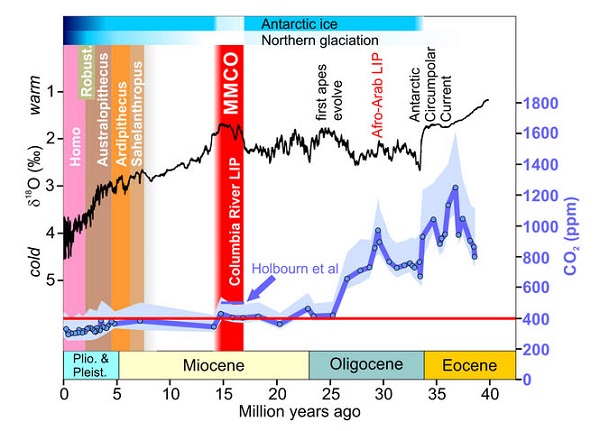
This Skeptical Science post gives a detailed account of what happened 14 to 17 million years ago in the “Mid Miocene Climate Optimum” (MMCO):

The MMCO was ushered in by CO2 levels jumping abruptly from around 400ppm to 500ppm, with global temperatures warming by about 4°C and sea levels rising about 40m (130 feet) as the Antarctic ice sheet declined substantially and suddenly.

Over the succeeding 2-3 million years Antarctic ice fluctuated dynamically in response to orbital wobbles, showing it was balanced on a knife-edge between a world with little ice and a world with substantial ice caps. Ice-free parts of Antarctica were rain-drenched and supported lush vegetation, while Arctic land was covered by temperate forests. Parts of the planet that had been arid before the MMCO rapidly re-greened and reforested (eg Patagonia).

This graph plots temperature and CO2:

Miocene_cropped_600

There were some differences between then and now. The Isthmus of Panama had not closed, for example. The warming happened on a warmer base.

Our warming is about 1000 times faster, giving less time for ecosystems to adapt. This is problematic for ocean acidification inter alia.

Climate clippings 125

1. Paris climate talks won’t keep warming below the dangerous 2°C Limit

Joe Romm at Climate Progress believes the Paris climate talks should not be written off as a failure if they don’t do enough to keep warming below 2°C. He thinks the CFC ozone layer example is apt. The Montreal Protocol was concluded in 1987. Initially the protocol’s targets and timetables slowed the rate of growth of concentrations only slightly and would have still led to millions of extra cases of skin cancer by mid-century.

President Reagan endorsed the protocol, and the Senate ratified it. By the end of 1988, 29 countries and the European Economic Community — but not China or India — had ratified it. The treaty came into effect the next year. But it took many more years of negotiations, continuous strengthening of the scientific consensus, and significant concessions to developing countries before amendments to the treaty were strong enough and had enough support from both rich and poor countries to ensure that CFC concentrations in the air would be reduced.

Elsewhere 14 high-profile CEOs want to decarbonise the economy completely by 2050. They are the B Team led by Virgin founder Richard Branson. See also at The Guardian.

2. 2013 record heatwave ‘virtually impossible’ without climate change

That’s according to a new report from the Climate Council.

From The Guardian:

The country experienced its hottest day, month, season and calendar year in 2013, registering a mean temperature 1.2C above the 1961-90 average.

The Climate Council says recent studies show those heat events would have occurred only once every 12,300 years without greenhouse gas emissions from human activities.

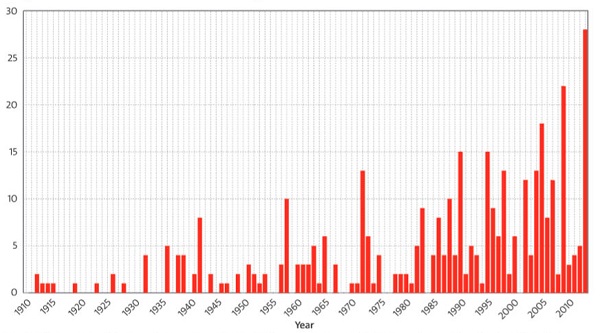
Record hot days have doubled in Australia over the past 50 years. During the past decade heat weather records were set three times more often than cold ones.

Heatwaves across Australia are becoming hotter, lasting longer, occurring more often and starting earlier.

The ABC article has handy links to other sites.

The following graph shows the number of days each year where the Australian area-averaged daily mean temperature was above the 99th percentile for the period 1910-2013:

Hot days Australia_cropped_600

3. Two degrees by 2036

Michael Mann using an Earth energy balance model has calculated that we could reach 2°C of warming as early as 2036. To stay within the 2°C guardrail we need to limit CO2 concentrations to 405 ppm. It would be 450 ppm but for the aerosol issue. If we cease burning coal we lose the cooling effect of the crap that coal spews into the atmosphere along with CO2.

Mann has done the calculation on the basis of climate sensitivity of 3°C. Problem is, he says, that this modelling is based only on short term feedbacks.

David Spratt at Climate Code Red has done a long and thorough post based on Mann’s article. Spratt looks in some detail at the longer term climate sensitivity issue, drawing also on the work of James Hansen, Aradhna Tripati and others. Hansen found that climate sensitivity with long term feedbacks was considerably higher than 3°C; Tripati found that in the Miocene with CO2 concentrations similar to now “temperatures were ~3° to 6°C warmer and sea level was 25 to 40 meters higher than at present”.

Spratt also reminds us that 2°C warming is not safe.

4. Would turfing Abbott help climate change policy?

In short, yes, but perhaps not a lot. The conservative side of politics is still infested with climate change denialists.

Mother Jones in an article One of the World’s Worst Climate Villains Could Soon Be Booted From Office would clearly like to see the back of Abbott. Julie Bishop has a background of denialism, but is pragmatic and has understood from the Lima experience that our stance on climate is negatively affecting our international standing.

Turnbull stated back in 2009:

“I will not lead a party that is not as committed to effective action on climate change as I am.”

He would now, of course.

Tristan Edis looks at actions Turnbull might get away with. Giles Parkinson thinks he might rescue renewable energy and could adapt Direct Action into a baseline and credit scheme.

See also Lenore Taylor at The Guardian.

Climate clippings 124

1. Totten Glacier melting from below

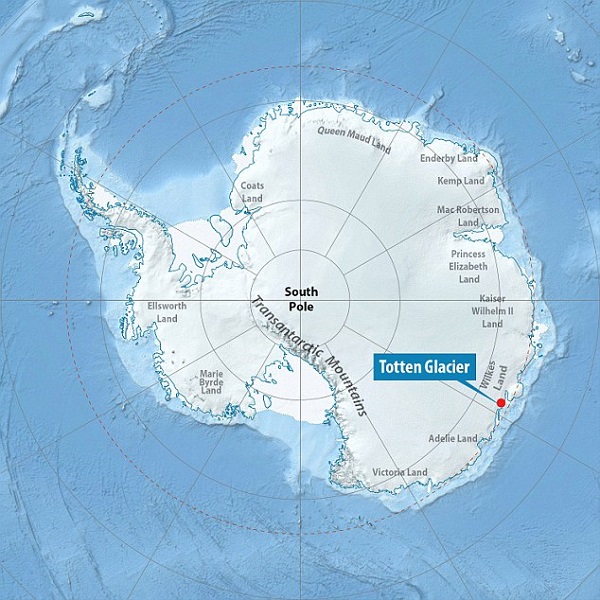
Scientists have found that waters around Totten Glacier are warmer than expected and that it is melting from below. Amazingly the glacier, in East Antarctica, has never been studied before.

Totten glacier_251552E400000578-2926354-image-a-31_1422281876786_600

A team of scientists on the Australian icebreaker Aurora Australis has recently taken a look. They don’t have comparative historical data to go by, but the concern is large. Totten is the biggest of the big and holds enough water to raise the sea level 6 metres. That’s somewhere between West Antarctica and Greenland!

2. State of the Climate 2014

The CSIRO and the Bureau of Meteorology have released their State of the Climate 2014 report. There is a summary at the ABC.

One thing that was new was a prediction of more extreme El Niño and La Niña events. They are talking here of extreme La Niña’s appearing once in 13 years rather than once in 23 years. So it’s not the garden variety events, rather the exceptional events.

For the rest of the report, it seems on a quick look to be much as expected – less rainfall in southern Australia, more extreme hot days, less snow, continued ocean acidification, more worries about sea level rise and so on. I’ll take a closer look if I get time.

Graham Readfearn points out that in 1995 at Amberley near Brisbane the mercury climbed above 35C on 12 days per year on average. That could become 55 days per year.

3. Australian sport needs to lift game on climate issues, Olympians and sport bosses say

It has been a year since extreme heat wreaked havoc at the Australian Open, with players forced to endure temperatures over 40 degrees Celsius on the courts.

Some athletes said the conditions were akin to “tap-dancing on a fry pan”.

Unfortunately Tennis Australia are not on their lonesome in forcing athletes to perform in dangerous conditions. There are concerns also for spectators and venues, for example subject to flooding. The Climate Institute has produced a report analysing the vulnerability amongst sports like AFL, tennis, cricket and cycling as well as winter snow sports.

Part of The Climate Institute’s ongoing research into climate risk and resilience, this report will form the basis of ongoing discussions in the sporting world, including with the newly formed Sports Environment Alliance, chaired by former International Cricket Council CEO Malcolm Speed.

4. Keystone showdown and American climate opinion

The Senate has passed legislation approving the controversial Keystone XL tar sands oil pipeline on a 62-36 vote.

asked Thursday about the vote, White House Press Secretary Josh Earnest reiterated that Obama would veto.

The Senate requires 67 votes to overturn a presidential veto.

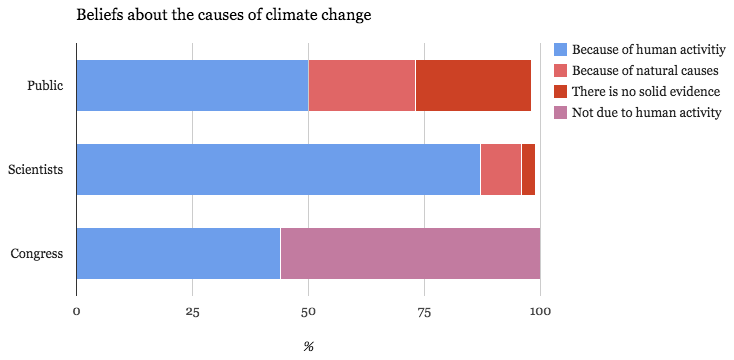
Meanwhile Carbon Brief takes a look at the gap in opinion between scientists, the public, and politicians on climate change from Pew Center research. This is how it pans out:

Screen Shot 2015-01-30 at 11.04.43

A case of the blind leading the partially sighted.

Across the ditch Hot Topic posts about a book that meticulously goes through the development of climate science from the time of Arrhenius. Seriously, there isn’t an argument any more about the basic science.

5. Economists begin to take climate change, and poverty, seriously

I find this surprising:

current economic models… generally conclude that the economically optimal pathway results in a global surface warming around 3–3.5°C.

Current economic models mainly treat economic growth as an external factor. In these models, global warming and its impacts via climate change don’t significantly affect the rate at which the economy grows.

A new study finds:

while the economies of rich countries continue to grow well in a warmer world, the economic growth of poor countries is significantly impaired.

That’s not so surprising.

The authors find that:

the best path for society would limit temperatures to between 1.6 and 2.8°C warming in 2100, with a best estimate of around 1.7°C warming.

Meanwhile the rulers of the world at the Davos World Economic Forum conference were given a straight message:

In particular, the nexus between climate protection and development is a striking conclusion of the World Bank analysis: without climate stabilization at still manageable levels, development advances, especially in the poorest countries, are set to be reversed. Indeed, development work of past decades (involving significant financial resources) is at risk and with it the well-being of the most vulnerable citizens on Earth.

The “World Bank analysis” is Turn down the heat : confronting the new climate normal, a report prepared for the World Bank by the Potsdam Institute for Climate Impact Research and Climate Analytics.

Climate clippings 123

1. Mushroom packaging

mushrooms_3128266.large

Biodegradable packaging has been made from mushrooms for use as foam, insulation and the like.

The article doesn’t say whether it is cost competitive.

2. Climate’s threat to wheat

A new study finds that wheat yields drop on average by 6% for every degree Celsius rise in temperature.

Global production of wheat was 701 million tonnes in 2012, but most of this is consumed locally. Global trade is much smaller, at 147 tonnes in 2013.

The loss of production per degree equates to 42 million tonnes, with obvious implications for shortages and prices. Year-to-year variability is likely to increase.

An obvious strategy is to develop and use heat tolerant varieties. My understanding is that there has been a reduced research capacity generally in agriculture across the world.

3. Solar has done well

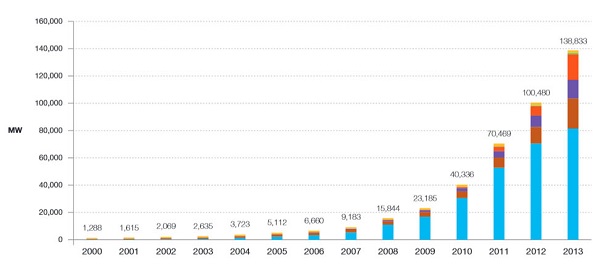
Worldwide, solar energy has continued to grow even when economies were shrinking. By 2013, almost 138.9 gigawatts (GW) of photovoltaic (PV) had been installed globally, states the European Photovoltaic Industry Association in the report Global Market Outlook for Photovoltaics 2014-2018.

Solar 2013_cropped_600

From the bottom, blue is Europe, brown is Asia Pacific, purple is the Americas and orange is China.

The pdf is here.

Europe added almost 11 GW, second only to wind.

In the US alone, there are now about 174,000 jobs linked to solar energy, with 36,000 new jobs expected by the end of this year.

India’s plans to build a solar PV modules manufacturing plant over the next three years worth US$4 billion and 20,000 new jobs.

Giles Parkinson tells how the costs of solar will fall a further 40% in the next two years, reaching grid parity in 80% of global markets.

4. Australia could become manufacturing hub of battery storage

The International Renewable Energy Agency (IRENA) met in Abu Dhabi last weekend, ahead of the World Energy Future Conference in the same venue. Australia thumbed its nose by sending an embassy staffer rather than a minister, as a country genuinely interested in renewables would have done.

Australia is increasingly being seen as a “no-hoper” and an “outlier” in terms of large scale renewable energy.

No-one seems to have told Donald Sadoway, a professor from the Massachusetts Institute of Technology, who is seeking to strike up research partnerships with Australian universities and secure funding of $50 million for a pilot manufacturing plant of the liquid flow batteries.

Sadoway thinks Australia would provide a strong home market, ideal for remoter population centres difficult to serve with a high quality grid.

The LMBs [liquid metal batteries] are being hailed as a potentially low cost option for utility-scale battery storage. That is because the nature of the technology means that they can cycle – or discharge – thousands of times without having its capacity reduced.

The batteries could last for 300 years.

No doubt the minister for industry will quietly tell him that we don’t do large scale renewables, or manufacturing, in Australia.

5. Inconvenient truths hit the cutting room floor

Inconvenient words about climate change and torture were snipped out of President Obama’s State of the Union speech when posted on the (Republican) Speaker’s official site. Words like this:

The best scientists in the world are all telling us that our activities are changing the climate, and if we do not act forcefully, we’ll continue to see rising oceans, longer, hotter heat waves, dangerous droughts and floods, and massive disruptions that can trigger greater migration, conflict, and hunger around the globe.

Pathetic!

6. Republican opinion on climate change

Meanwhile the Republican-controlled US Senate has voted 98-1 to say the climate change is real and not a hoax. However, that doesn’t mean that humans are the cause. After all the Bible tells of climate change and it’s just arrogance to think humans are the cause!

At least Mitt Romney thinks humans are the cause and thinks (again) that we should do something to stop it. How arrogant is that?!

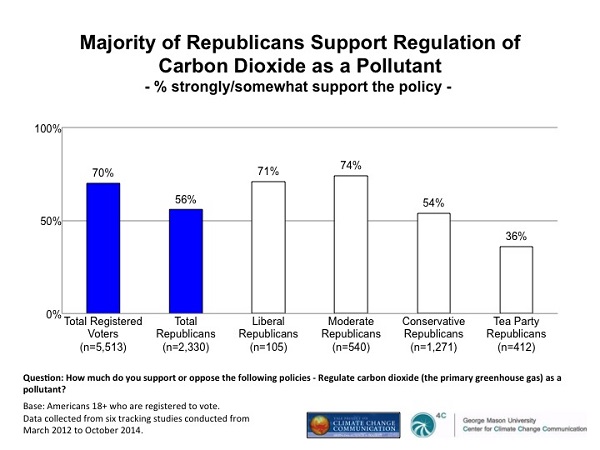
A recent Yale study identifies four different kinds of Republicans – liberal, moderate, conservative and Tea Party. While overall only 44% of Republicans think global warming is happening, the sub-groups vary considerably:

R-belief_600

Yet overall 56% think CO2 should be regulated as a pollutant, again with vast variations of opinion:

R-reg_as_pollutant_600

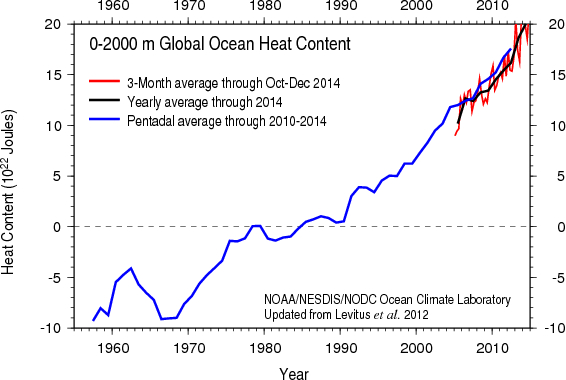
7. Ocean warming accelerating

The story about 2014 being the hottest year has upstaged a more important fact – ocean warming is off the charts:

NOAA2014heat_content2000m

2014 heat referred to surface temperature. Since about 93% of additional heat resulting from global warming ends up in the oceans, they give a better indication of changes in the Earth’s energy system.

John Abraham at The Guardian links to a thorough review of ocean heat measurement methods.

Climate clippings 122

1. Court challenge will test coal mining’s climate culpability

A new legal challenge to the proposed Carmichael coal mine – Australia’s largest – will test in the federal court whether climate change caused by greenhouse gas emissions should be taken into account when assessing prospective coal licences in Australia.

The challenge, by the New South Wales Environmental Defenders Office on behalf of the Mackay Conservation Group, will argue that federal environment minister Greg Hunt failed to take into account the climate impact of greenhouse gases emitted by the burning of coal from the Carmichael mine when assessing whether to grant its licence.

It cites the impact of global warming on the Great Barrier reef, an area of world and national heritage, as a relevant consideration which the minister should have been taken into account.

The linked article cites some of the legal precedents, which show that this case is far from vexatious or frivolous.

Interesting!

2. Queensland Labor renews support for coal

0a0cf284-0505-4e4e-a7c3-4ec2c99d7884-600

Outgoing deputy Labor leader, Tim Mulherin, said coal remained “an important and vital energy source for Queensland and the rest of the world”.

Thermal coal from nine proposed projects in the Galilee, when burned in export markets such as China and India, would produce an estimated 705m tonnes of CO2, more than Australia’s total greenhouse gas emissions of 542m tonnes a year.

However, Labor in not going to spend hundreds of millions of dollars on building the railway line to the coast.

3. Humanity is in the existential danger zone

Back in 2009 a team lead by Johan Rockstrom of the Stockholm Resilience Centre identified nine planetary boundaries we should not cross if we are to avoid undermining the biophysical systems upon which our species depends. These nine boundaries are climate change, ocean acidification, stratospheric ozone depletion, alteration of nitrogen and phosphorus cycling, freshwater consumption, land use change, biodiversity loss, aerosol and chemical pollution.

A new paper led by Will Steffen of the ANU and the Stockholm Resilience Centre argues that climate change along with “biodiversity integrity” should be recognised as core elements of the Earth system. We are in trouble with both.

The world as we know it developed during the Holocene from which we are rapidly departing. We need urgently to get atmospheric concentrations of CO2 back to 350 ppm.

Background extinction rates without human impacts are thought to be about ten a year per million species.

Current extinction rates are anywhere between 100 to 1000 times higher than that.

4. Catholics in Australia join global movement to curb climate change

Australia’s Catholics are preparing to step up campaigns to address climate change ahead of an expected call to action by Pope Francis.

The Global Catholic Climate Movement, an international coalition of Catholic groups including Catholic Earthcare Australia, was launched on Thursday to bolster support for a global climate treaty at the Paris summit planned for December.

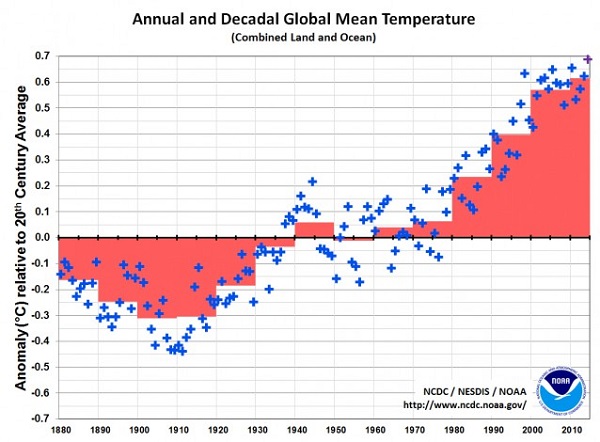
5. NOAA declares 2014 the hottest

NOAA has declared 2014 the hottest year to date with this graphic:

decadal-NOAA 2014-600

If you drew parallel trend lines from about 1970 it would be full bore ahead with 1998 a slight outlier.

At Climate Central we are told that 13 of hottest 15 years on record have all occurred since 2000. The odds of that happening randomly without the boost of global warming are 1 in 27 million.

6. Sea level rise

There’s been some excitement about a new study of sea level rise. The difficulty in establishing long term trends is that prior to the satellite era (1979, I think) it has been very difficult to establish what happened. Data is globally patchy and incomplete. Tide gauge measurements suffer because the wind blows the water around, and the land that it is referenced to might be rising or sinking.

The clearest account of the new research by Carling Hay and others I’ve found is at Carbon Brief. Hay et al found sea levels from 1900 to 1990 to be 1.2 mm pa on average, lower than the 1.5 previously thought. This makes current sea level rise some two and a half times faster, with the implication that ice sheets a contributing more than previously thought.

Over at RealClimate Stefan Rahmstorf gives a technical review of the state of play. He regards the new research as important, but his bottom line is this:

Ultimately, it is not clear down to what level of accuracy we will ever know the sea level evolution over the past hundred years or so. But for practical purposes, I don’t think it matters whether the rise from 1900 AD has been 3 centimetres more or less. I do not think this changes our outlook for future sea-level rise in any significant way.

But if I understand him correctly, he would already have been considerably concerned about the decay of ice sheets and how that process could accelerate. However, he strikes me as wanting to be super careful not to run ahead of the data, which is entirely commendable.

One comment was that this research could add a metre to prospective sea level rise this century. I think Rahmstorf is suggesting that is premature.

Carbon pricing: a dangerous distraction?

It is almost axiomatic to say that the mitigation necessary for 2°C limit to warming is best delivered through market-based instruments (MBIs) – where a price is placed on each tonne of carbon dioxide emitted.

Dissenter-in-chief is Kevin Anderson, professor of energy and climate change at the University of Manchester and deputy director of the Tyndall Centre, the UK’s leading academic climate change research organisation:

I hold that such an approach is doomed to failure and is a dangerous distraction from a comprehensive regulatory and standard based framework (within which price mechanisms may play a niche role).

Crucial in making this judgement is the notion that the mitigation rates are not marginal. We don’t need to knock off just one or two percent of emissions each year. We need, says Anderson, a whopping 10% per annum.

That seems extraordinary, but I’ll repeat here three graphs I’ve used before. They all come from 2009, the last two from The Copenhagen Diagnosis.

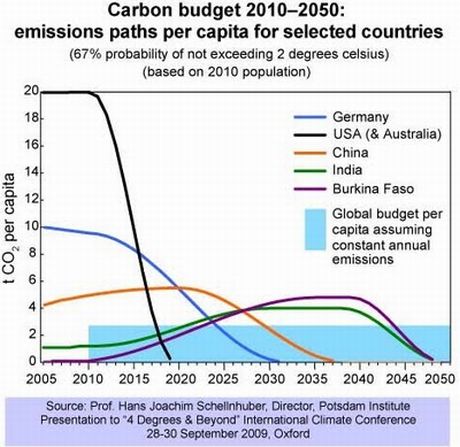
First we have Hans Joachim Schellnhuber’s estimate of the reductions needed using the ‘budget approach’, whereby the budget of permissible emissions is divided between countries on a per capita basis, and then the stabilisation path plotted given their existing per capita emissions levels:

2C trajectories Schellnhuber

Anderson variously says the ‘we’ need to reduce emissions by 80 to 90% by 2030 and to zero soon thereafter. I think he is referring to the UK, which would have a similar stabilisation path to Germany. Note that Schellnhuber is basing these trajectories on only a 67% chance of keeping warming within the 2°C limit.

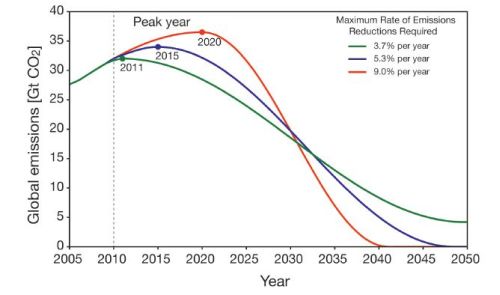
In the second graph the stabilisation path for the whole world is calculated, given different peaking dates:

Copenhagen diagnosis Fig 22 n

That shows a 9% per annum reduction required to reach zero about 2040 with peaking in 2020. In those terms Anderson’s 10% figure is in the ball park.

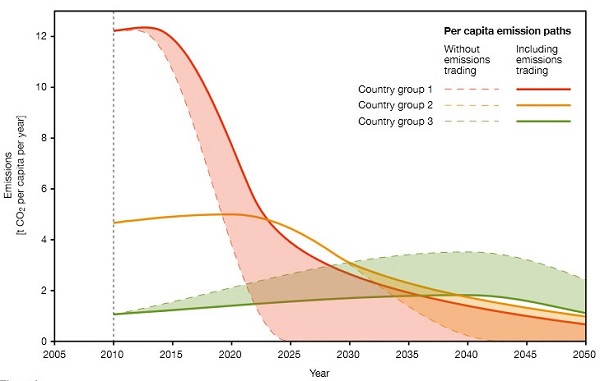
The third graph shows how the trajectories could be varied if countries were grouped into three categories, roughly advanced industrial countries, developing countries and in the middle newly industrialising countries. Carbon trading between them is assumed:

Budget approach with emissions trading_cropped_600

This too is a dangerous distraction. While rational it assumes that China, India and the US will commit themselves to definite reduction paths through international agreement. It’s simply not politically feasible.

I think Anderson is in the right ball park. His argument is that MBIs work fine when the reductions required are marginal. If you crank them up to get the result required a very high price will result. The rich will pay and continue to pollute while the poor will be devastated.

Anderson doesn’t discuss compensation, as was built into the Australian scheme, but pricing and compensation on the scale required is probably not politically feasible.

Anderson favours a regulatory or standards-based approach and gives these examples:

  • Strict energy/emission standards for appliances with a clear long-term market signal of the amount by which the standards would annually tighten; e.g. 100gCO2/km for all new cars commencing 2015 and reducing at 10% each year through to 2030
  • Strict energy supply standards; e.g. for electricity 350gCO2/kWh as the mean emissions level of a suppliers’ portfolio of power stations; tightened at ~10% p.a.
  • A programme of rolling out stringent energy/emission standards for industry equipment
  • Stringent minimum efficiency standards for all properties for sale or rent
  • World leading low-energy standards for all new-build houses, offices etc.
  • Moratorium on airport expansion
  • Technological and operational standards for shipping operating in UK waters
  • A suite of iterative mechanisms to counter, or at least alleviate, issues of rebound; this may include price mechanisms, progressive metering tariffs, etc.
  • Revisit the viability of Personal Carbon Trading as a mechanism for improving societal engagement in non-marginal change
  • Appoint a senior minister with the principal responsibility for maintaining an equitable transition to a low-carbon society

Taking the first two, rather than standards for appliances, I would focus on making stationary electricity supply renewable as an urgent task through direct action. Other than that all the ideas are grist to the mill, but I like John Wiseman’s approach as outlined in the post Climate change: reconnecting politics with reality which concentrates on the necessary political and institutional actions to be taken. After a priministerial announcement he recommends:

Then we would need an Australian Climate Solutions Act which set up the targets, the structures and the priority actions. Principal amongst these would be an Australian Climate Solutions Taskforce chaired by the Prime Minister and drawing from state and local governments, business, trade unions and community organisations.

Then we would need six key action plans.

First, an Australian Renewable Energy Plan to achieve 100 per cent renewable energy within 10 years.

Second, an Australian Economic Electrification Plan with initial priorities including a modal shift in passenger and freight transport from road to rail; the rapid replacement of fossil fuel based cars with electric vehicles; and the full electrification of household and industry heating and cooling.

Third, an Australian Energy Efficiency Plan that identifies the regulatory, planning, educational and financial initiatives that could achieve the overall goal of a rapid transition to a zero waste economy.

Fourth, an Australian Sustainable Consumption Strategy.

Fifth, an Australian Sustainable Agriculture and Forestry Plan designed to reduce land-based emissions and increase carbon sequestration.

Finally, state and local governments, community sector and business organisations would collaborate to develop and implement a comprehensive, long-term Australian Climate Change Adaptation and Resilience Plan.

I applaud the priority Wiseman gives to an Australian Renewable Energy Plan to achieve 100 per cent renewable energy within 10 years.

Carbon pricing similar to the Australian scheme may be one of a suite of actions to send a message and raise funds, but climate action on the scale now required compels us to address the issues much more directly. Overall my aim for the planet would be to reduce atmospheric CO2 to 350 ppm by 2050, for a safe climate. Well, as safe as it ever gets.

Climate clippings 121

1. Denmark winds up wind

In January of 2014, Denmark got just over 61% of its power from wind. For the whole of 2014 it was 39.1%, a world record.

Their leadership is working well for them. Nine out of ten offshore turbines installed globally are made in Denmark. They plan to be fossil fuel free by 2050.

Elsewhere Germany and the UK smash records for wind power generation. Scotland hopes to be fossil fuel free by 2050.

On Boxing day rooftop solar met one third of South Australia’s demand and at least 30% from 11.30am to 3.30pm. Bonaire (pop. 14,500), a small island off the coast of Venezuela, said goodbye diesel and hello 100% renewable electricity.

California Gov. Jerry Brown last week called for

the state’s electric utilities to boost their renewable energy procurements to 50% of retail electric sales and discussed future initiatives to support rooftop solar, battery storage, grid infrastructure and electric vehicles.

As Bill Lawry would say, “It’s all happening!”

2. 2014 the hottest year

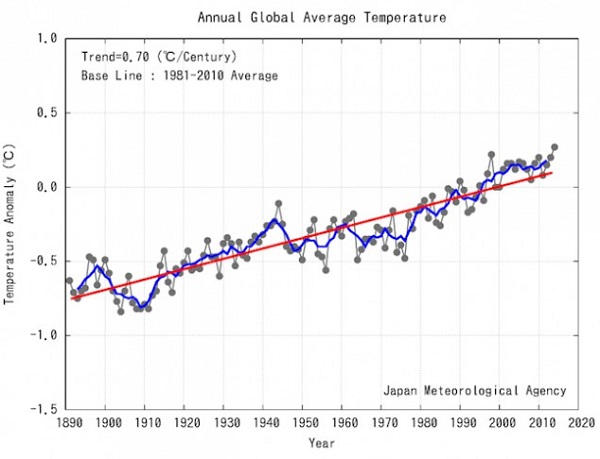
The first set of figures is in, this time from the Japan Meteorological Agency, showing 2014 as the hottest year so far:

JMA2014-cropped_600

The red line is the long-term linear trend.

The blue line is the 5-year running mean.

Australia had the third hottest year on record.

3. Chinese three-wheeler is for real!

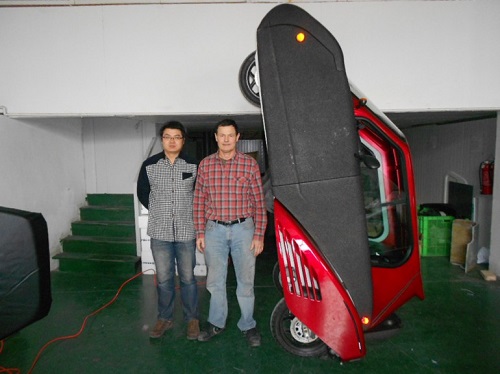
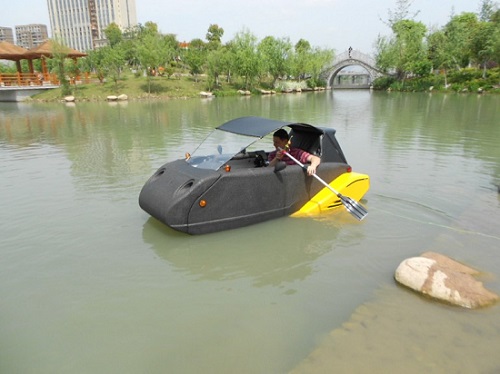
From John D’s Gizmag collection we have the Spira4u three-wheeler car:

spira-production-version-2_500

It’s not a toy, it’s a serious car which has gone into pilot production as a 10 kW electric or a fuel-injected 150 cc version with an economy of 2.94 l/100km (80 mpg).

It has a handy parking option:

spira-production-version-14_500

And it floats:

spira-production-version-11_500

An amphibious version is under development.

4. California starts to build a high-speed rail system

The first phase of California’s high-speed rail system will be a 29-mile stretch from Fresno slightly north to the town of Madera. From there the project will link up with urban centers like Los Angeles and San Francisco, eventually allowing commuters to travel between those two cities at 220 mph and cutting the trip from nearly six hours to less than three. The system will eventually extend to Sacramento and San Diego, totaling 800 miles with up to 24 stations.

The full rail system should be in use by 2028.

5. Solar at grid parity in most of world by 2017

At RenewEconomy:

Investment bank Deutsche Bank is predicting that solar systems will be at grid parity in up to 80 per cent of the global market within 2 years, and says the collapse in the oil price will do little to slow down the solar juggernaut.

Quiggin at The Conversation and his place: Only a mug punter would bet on carbon storage over renewables.

6. When you are in a hole, stop digging!

From a study in the journal Nature:

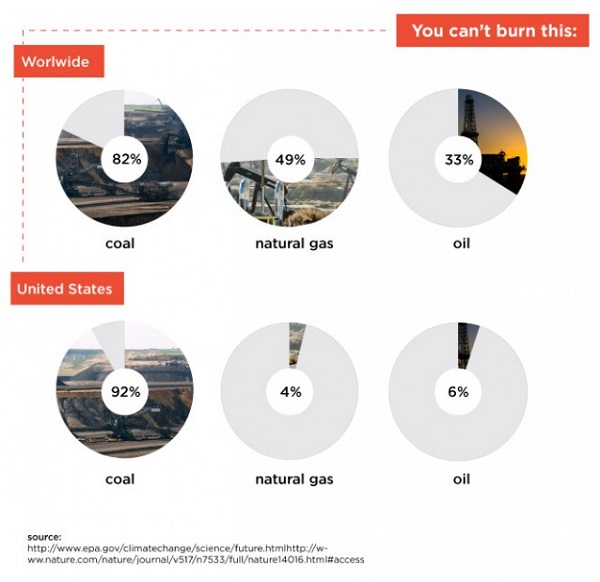
“Our results suggest that, globally, a third of oil reserves, half of gas reserves, and over 80 percent of current coal reserves should remain unused from 2010 to 2050 in order to meet the target of 2°C,” write authors Christophe McGlade and Paul Ekins of University College London.

stay-in-the-ground-cropped_600

Keeping the increase in global temperatures under 2°C will require vast amounts of fossil fuels to be kept in the ground, including 92 percent of U.S. coal, most of Canada’s tar sands, and all of the Arctic’s oil and gas…

In 2013, fossil fuel companies spent some $670bn on exploring for new oil and gas resources. The figure should be zero.

7. Climate change will create more environmental refugees

Natural disasters like Typhoon Haiyan—which devastated the Philippines in 2013 displace more people than war, according to the Internal Displacement Monitoring Center in Geneva. And as climate change sets off increasingly lethal natural disasters, so will the numbers of environmental refugees increase, Reuters reported.

It is a reality that governments must prepare themselves for. In 2013, some 22 million people were displaced by extreme natural disasters like typhoons, earthquakes and tsunamis, a number three times the number of those who were forced to migrate because of war, according to the IDMC.

Earlier this summer New Zealand accepted a family who cited climate change as the reason why they had to flee their homeland, thought to be the world’s first official environmental refugees.

Climate clippings 120

1. Pope Francis becomes active on climate change

Pope Francis is going to give climate change action a red hot go in 2015:

In 2015, the pope will issue a lengthy message on the subject to the world’s 1.2 billion Catholics, give an address to the UN general assembly and call a summit of the world’s main religions.

The reason for such frenetic activity, says Bishop Marcelo Sorondo, chancellor of the Vatican’s Pontifical Academy of Sciences, is the pope’s wish to directly influence next year’s crucial UN climate meeting in Paris, when countries will try to conclude 20 years of fraught negotiations with a universal commitment to reduce emissions.

He also wants to change the financial system from one based on raw consumerist exploitation to one based on ethics which respect ecological principles. He should have a chat with Naomi Klein!

Giles Parkinson has more at RenewEconomy, including the note that Pope Benedict kicked things off by buying carbon credits in the form of a Hungarian forest to make the Vatican carbon neutral, and the possibility that the Catholic church may divest funds invested in the fossil fuel industry.

2. 2014: the year climate change undeniably arrived

John H. Cushman Jr. at InsideClimate News in reviewing the year thinks 2014 was the year climate change undeniably arrived. It was the hottest year ever, the science became conclusive, and a mushrooming climate movement pressed world leaders to act, which to some extent they did.

On the science, he was referring mainly to the IPCC report where already in 2013 the Physical Science Working Group moved the probability of human causation up a notch from “very likely” (>90%) to “extremely likely” (>95%) which is about as good as it gets. In the Synthesis Report of 2014 the language was ramped up saying that harm from greater warming if we stay on the current course could be “severe, pervasive and irreversible.”

Action looked promising with mitigation pledges by the EU, China and the US, also the UN climate talks at Lima.

On the “mushrooming climate movement he is talking about a:

phenomenon that emerged in a spectacular way in September, on the eve of Ban Ki-moon’s UN summit—the coming of age of a new popular movement demanding climate action now.

Hundreds of thousands of marchers filled the streets of Manhattan, curb to curb for 50 blocks or more. Their presence attested to a new dynamic in which inside-the-beltway lobbyists and well-heeled think tanks joined forces with grassroots anti-fracking and anti-pipeline protestors, in which labor unions and school kids found common cause.

A fine effort, but then, you see, sensible voters stayed at home and allowed the Republicans to take over Congress.

3. Precarious Climate

Climate and political blogger James Wight at Precarious Climate reviews the year, kind of, mostly by listing his best posts.

The last, Australia continues climate obstructionism in Lima, was an excellent wrap of the Lima talks. I was not aware (I’d wondered) that Julie Bishop is a climate denier, along with Andrew Robb, just the pair we needed to represent us at international climate talks.

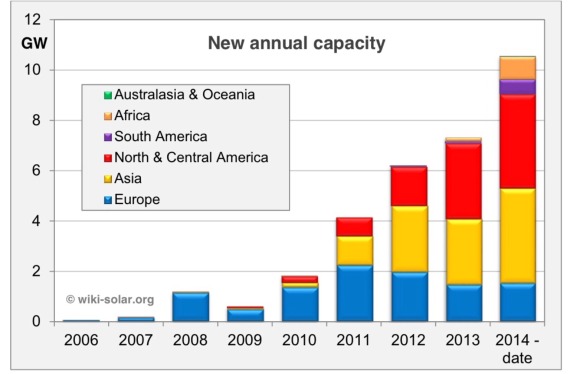
4. Utility scale solar surges

But not in Australia:

image3-570x374

The big surge is in Asia and North America, but other continents have come to life through installations in Chile and South Africa.

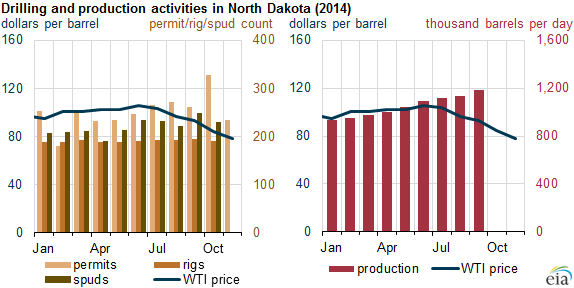
5. Production of shale oil increases

The production of shale oil in North Dakota has increased month by month in 2014, in spite of falling prices.

ndoil

Meanwhile falling oil prices have hidden a new global warming fee on the purchase of gasoline in California.

6. Compressed air technology

Not everyone reads the discussion threads, so I’m repeating here some links made by Jumpy to compressed-air technology.

Danielle Fong with her company LightSail Energy is bringing compressed-air energy storage technology to the market.

Both Peugot and Citroën are developing compressed-air hybrid cars that use 2 litres per 100 kilometres of fuel. Apart from the hybrid compressed-air powertrain both cars are using light-weight materials and aerodynamics to improve economy. The also have narrow tyres pumped up high.

Of course these cars use twice as much fuel as the electric hybrid Volkswagen XL1 which plans to put 250 cars on the road, at a price. That article is from July 2013 – not sure how they are going.