Category Archives: Climate Action

A failure of ambition: the UNEP Emissions Gap Report:

Cover_cropped_175

The United Nations Environment Programme (UNEP) has published its Emissions Gap Report 2014 a couple of weeks before the UN Conference on Climate Change in Lima, Peru. The latter is the annual UNFCCC Conference of Parties (COP), the penultimate one before the 2015 conference in Paris where, with a bit of luck, legally binding medium and long-term targets will be set for each country for emissions reduction. Each year since Copenhagen in 2009 the UNEP has reported on the gap between explicit pledges made by member states and what is required to have a likely (67%) chance of the planet staying within the 2°C guardrail. This is a necessary activity, because since Copenhagen each country determines its own targets within a framework of “common but differentiated responsibility”, which is a bunch of words that effectively allow each country to do as it pleases.

Someone needs to keep a tally as to what all this voluntary activity adds up to. UNEP had taken on that role.

The UNEP report takes note of and is broadly consistent with the IPCC Synthesis Report. Hence it accepts the IPCC ‘budget approach’ which states that we have already emitted 1,900 gigatonnes of carbon dioxide (Gt CO2) from an allowable budget of 2900 Gt since the dawn of the industrial era, leaving an estimated remaining budget of just 1,000 gigatonnes of carbon dioxide (Gt CO2). That’s roughly 20 years worth of emissions at the current rate.

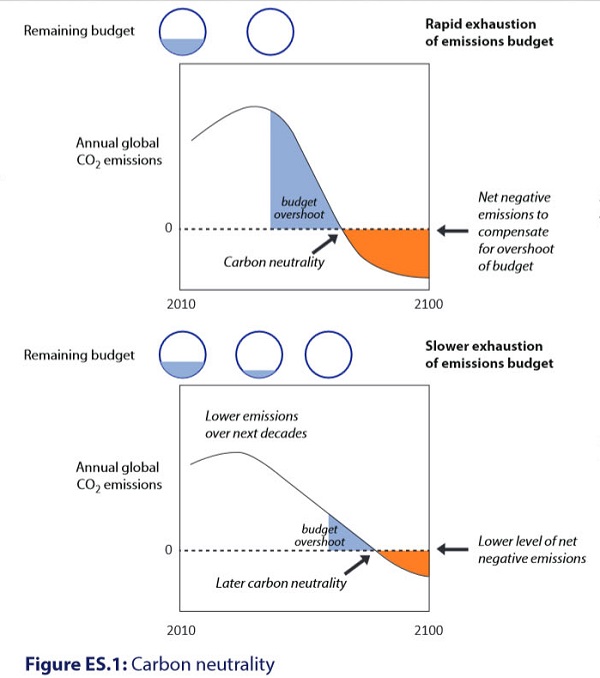
Whereas the IPCC has given a range of scenarios, (scientists giving a range of options to policy makers) the UNEP has plotted just one which sees us peaking within about 10 years, halving CO2 emissions by 2050 and reaching net zero thereafter, they say between 2055 and 2070.

Net zero implies that some remaining CO2 emissions could be compensated by the same amount of carbon dioxide uptake, or ‘negative’ emissions, so long as the net input to the atmosphere due to human activity is zero, the report finds.

Because this scenario involves overshoot we will have to have net negative emissions during the last decades of the century. The less we act now the harder it gets later, as illustrated here:
Carbon neutrality_cropped_600

Hopefully this will sink into the brains of those attending the Lima conference, and more importantly the brains of their masters back home.

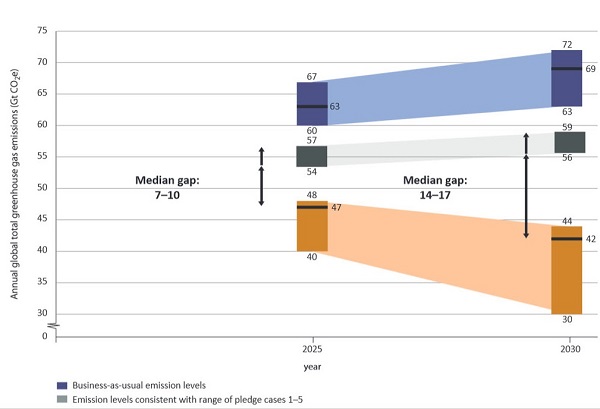
UNEP have done the sums and find that emissions in 2020 should not be higher than 44Gt CO2e to have a 67% chance of staying within
the 2°C target. If countries honour their current pledges we are heading for 52–54 Gt CO2e in 2020, leaving a gap of 8–10 Gt CO2e.

UNEP then looked at whether countries were on track to honour their pledges.

After reviewing available evidence from the G20 (with the EU 28 taken as a group) it appears that five parties to the United Nations Framework Convention on Climate Change – Brazil, China, the EU28, India and the Russian Federation – are on track to meet their pledges. Four parties – Australia, Canada, Mexico and the USA – are likely to require further action and/or purchased offsets to meet their pledges, according to government and independent estimates of projected national emissions in 2020. Conclusions are not drawn for Japan, the Republic of Korea, Indonesia and South Africa because of various uncertainties, nor for Argentina, Turkey and Saudi Arabia because they have not proposed pledges.

In 2010 we were at 49Gt CO2e; in 2020 we are likely to be at 55 Gt CO2e. The broad situation out to 2030 is represented as follows:
Emissions gap_cropped_600

I take it that our current form will get us to 56 to 59 Gt CO2e (grey), whereas we should at the very least be at 42 Gt CO2e (in the orange zone).

The gap is still widening.

There are several comments that need to be made.

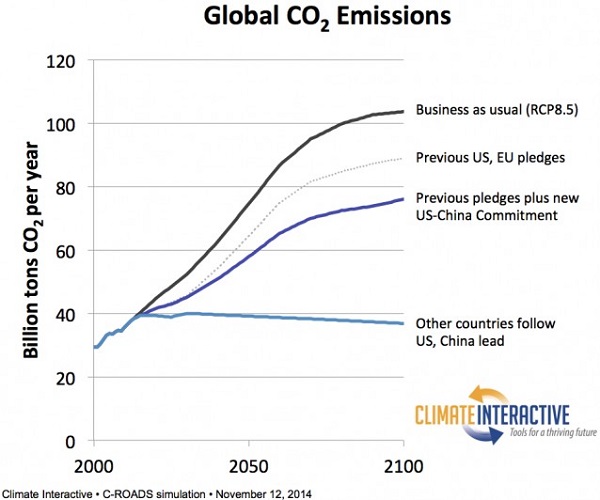
First, the UNEP calculations would not have taken on board the China-US agreement. As stated in that post, Climate Interactive worked out that if other countries matched the US-China effort the following stabilisation scenario would ensue:
China-deal-600

For the first time we have a prospect of peaking emissions, but this does not come within a bulls roar of zero emissions in the second half of this century. The current level of ambition is lamentably lacking.

Secondly, and admirably, the UNEP report takes into account all greenhouse gases from all sources, calculated in terms of CO2 equivalent. Too often scientific reporting is limited to fossil fuel emissions.

Thirdly, the report is conceived within a framework that is irresponsible, bordering insane. A 67% chance of not breaching the 2°C guardrail represents lousy odds when we are dealing with the viability of major ecosystems on the planet and the future of civilisation.

The 2°C guardrail itself is now clearly inappropriate, when, for example as I explained in this post and elsewhere that preserving more than 10% of coral reefs worldwide in 2100 would require limiting warming to below 1.5°C.

The World Bank report Turn down the heat contains examples like this:

In Brazil, at 2°C warming, crop yields could decrease by up to 70 percent for soybean and up to 50 percent for wheat.

The scientists from the Potsdam Institute for Climate Impact Research and Climate Analytics who put that report together for the World Bank are telling it like it is. Sadly the international array of scientists and others involved in the UNEP report (plenty of Germans but none I can see from Potsdam) are making concessions to what they think will be politically acceptable and doable, as, unfortunately, does the IPCC report.

The stakes are too high for such dissembling diplomacy!

Update: Len @ 1 asked:

It would be nice to at least know what level of action is needed to reach a 95% level surety. Is this stated anywhere?

Back in 2008 James Hansen told us that we had already overshot and that in the first instance we should get concentration levels down to 350 CO2e. Hower, he seems to be about a decade ahead of the bulk of the scientific/political community concerned with climate change. The 2°C guardrail had been invented by the Germans in the 1990s and was accepted by the UNFCCC process as a desirable aim in Copenhagen in 2009. Since then it has become the ‘widely accepted standard’ we should aim at. As such it provides the framework within most climate mitigation scientists work.

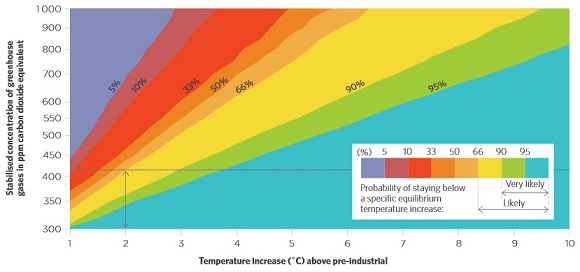
The IPCC Fifth Assessment report (AR5) (my post on the Synthesis Report here – see second table) did not look at stabilisation scenarios aiming at less than 450 ppm CO2e. They have a column for <430 but didn't fill it in, because of a lack of studies in the scientific record. The IPCC relies on studies in the scientific literature, with a cutoff of about December 2012, and insufficient studies were available for them to fill in the numbers. So the failure is with the scientific community, sadly. I can give you two pointers. The first is this wondrous graph which I first picked up in The Climate Authority Review of targets:
Stabilisation probabilities_croppedb_580

The graph has Malte Meinshausen’s name on it. He was at the time at the Potsdam Institute, I believe he is now at the University of Melbourne. His work is excellent.

From the graph you can see that 350 ppm will only get you about a 95% chance of staying below 2.5°C, not 2°C.

If you want a 1.5°C climate you need about 320 ppm. We are currently at 480 ppm CO2e.

It is notable that David Spratt and Philip Sutton wrote in 2008 that we should be aiming at 320 ppm. Spratt blogs at Climate Code Red, where under Publications you will find a book by the same name which was originally published online in 2008 as The Big Melt written in response to the astonishing Arctic melting in 2007, since easily surpassed in 2012. Spratt is a science writer rather than a scientist, and consistently publishes critiques of the mainstream approach, as I picked up, for example in The game is up, where he says:

We have to come to terms with two key facts: practically speaking, there is no longer a “carbon budget” for burning fossil fuels while still achieving a two-degree Celsius (2°C) future; and the 2°C cap is now known to be dangerously too high.

He concludes that there is no longer a non-radical option, only one path remains viable: the emergency ‘war economy’ mode.

Climate Code Red identifies practical strategies we need to adopt.

The Australian group Beyond Zero Emissions consistently publish material on rapid decarbonistaion. My mate John Davidson has investigated them more than I have and regards them as sound. I hope to post on one of their reports soon.

Elsewhere Kevin Anderson from the UK is worth keeping an eye on. See his personal site and Real clothes for the emperor.

Professor John Wiseman, Deputy Director of the Melbourne Sustainable Society Institute at the University of Melbourne looked at the shape of climate policy for the future for the Centre for Policy Development. See Climate change: reconnecting politics with reality. He has an appropriate sense of urgency and sets out the specific strategies we need to adopt in Australia for rapid decarbonisation. He, for example, sees the need for 100% renewables in 10 years.

People like Spratt, Anderson, Wiseman and BZE are all looking for “the achievement of emission reductions at the necessary scale and speed [which] will require transformational rather than incremental change”. The war analogy is not inappropriate. Abbott would have us fiddle while Rome burns. His approach is essentially one of tokenism. You run a climate mitigation program off to one side in order to have one on your books, at the least expense you can get away with. It’s essentially a sop to the electorate which doesn’t interrupt your central vision of the generation of wealth based centrally on the fossil fuel industry.

This is delusional – see The folly of Galilee basin coal.
Climate clippings 115

1. Australia’s coal and gas exports are being left stranded

Just four countries account for 80% of Australia’s fossil fuel exports – China, Japan, Korea and India.

China is on the verge of “peak coal”, rebalancing the economy away from energy intensive industry and introducing a national emissions trading scheme.

Japan is on an energy efficiency drive to reduce its fuel import bill.

Korea has introduced a tax on coal of AU$18 per tonne and is finalising an emissions trading scheme.

India has doubled its tax on coal which funds renewable energy projects and has signalled its intention to stop importing coal within 2-3 years.

Official forecasts are in denial.

2. Are Australian and US climate targets the same?

Environment minister Greg Hunt, Radio National, November 17:

If you use the full Kyoto period — 1990 to 2020 — the US is minus 5% and Australia is almost exactly the same.

Joe Hockey made a similar statement that “If you compare apples with apples, the American position and our position on reductions are effectively the same.”

The comparisons are complex, because the starting and finishing dates are different, so are the population increases. Moreover Australia has forestry and tree clearing in the mix.

Malte Meinshausen and Anita Talberg make the necessary adjustments and find:

An apples-with-apples comparison shows that Australia lags far behind the United States in efforts to reduce greenhouse gas emissions from its energy, transport and industrial sectors.

To match US efforts, Australia would have to increase its 2020 ambitions from the current 5% below 2000 to 21% or even 29%, depending on whether different population growth is taken into account, or not.

In short, they lie!

3. The genius of Tony Abbott’s stance on climate

Abbott-stetsonS_7

At New Matilda Tom Allen comments on Tom Switzer’s claim the Abbott is a climate change genius. Switzer is a climate change denialist, so we won’t bother with that! Allen finds Abbott has proved one thing – that a carbon tax works!

Abbott

will be remembered as the Prime Minister who proved that the carbon tax worked. After it was introduced, Australia’s carbon dioxide emissions fell, the economy continued to grow and the sky remained in place.

When Abbott repealed it and the country’s emissions began to rise again, using Australia as a vast laboratory, Abbott confirmed it: carbon taxes work.

4. Record growth in electricity sector emissions

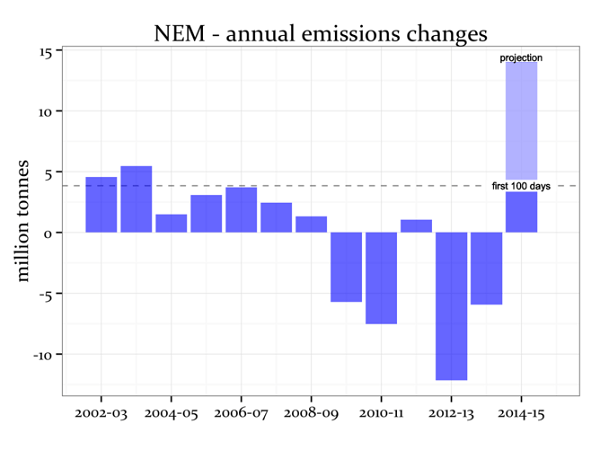
Abbott’s genius is demonstrated by this graph of emissions change from electricity production:

bb5r55v4-1415038197_600

The reductions started well before the carbon ‘tax’, but whatever the reason Abbott seems to have made a difference.

WORST. PRIME MINISTER. EVER!!

As Tom Allen said, it’s nothing personal.

The worst things about him are his policies, and his stance on climate change is worst of all.

5. Record-breaking ocean temperatures

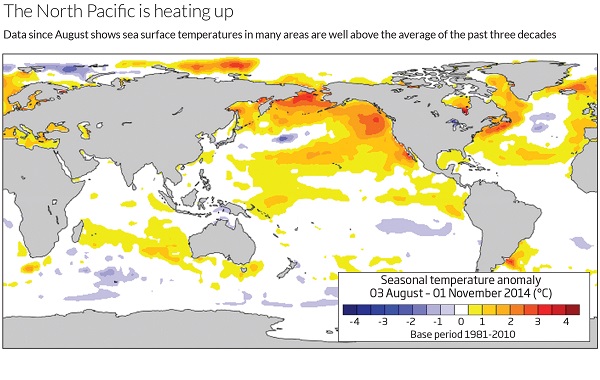
The world’s oceans are the hottest they’ve ever been in the modern record, especially in the northern Pacific.

In July this year, ocean surfaces were 0.55 °C above the average since 1890, just beating the previous record of 0.51 °C in 1998. In the North Pacific, the temperatures were about 0.8 °C above average, which is 0.25 °C warmer than the 1998 peak.

29954001_600

No explanation is given as to why this pattern has emerged. However, it does seem to be disrupting the development of an El Niño. Small mercy, because the northern Pacific warming has effects similar to an El Niño:

This includes more hurricanes in the Pacific, as well as more storms curling over into mainland US. Meanwhile, there have been fewer hurricanes in the Atlantic, just as happens during El Niño. Elsewhere, dry conditions have occurred across Australia, and the Indian monsoon was delayed – effects all arising from warm oceans, despite the lack of an El Nino event.

6. Turn down the heat : confronting the new climate normal

This is volume 2 of 2 of a report prepared for the World Bank by the Potsdam Institute for Climate Impact Research and Climate Analytics, and hence highly authoritative. The lead author was Hans Joachim Schellnhuber of the Potsdam Institute.

It’s a massive 320 page report. This is from the Foreword:

There is growing evidence that warming close to 1.5°C above pre-industrial levels is locked-in to the Earth’s atmospheric system due to past and predicted emissions of greenhouse gases, and climate change impacts such as extreme heat events may now be unavoidable.

As the planet warms, climatic conditions, heat and other weather extremes which occur once in hundreds of years, if ever, and considered highly unusual or unprecedented today would become the “new climate normal” as we approach 4°C—a frightening world of increased risks and global instability.

The consequences for development would be severe as crop yields decline, water resources change, diseases move into new ranges, and sea levels rise. Ending poverty, increasing global prosperity and reducing global inequality, already difficult, will be much harder with 2°C warming, but at 4°C there is serious doubt whether these goals can be achieved at all.

That’s about as far as I could get tonight. Climate Progress has a post.

Climate clippings 114

1. Ocean acidification charted

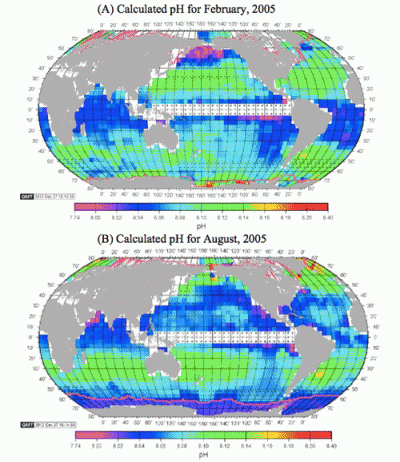
Apparently there has been no baseline data for ocean acidification, which varies around the world. Now a database of the current state of the ocean has been compiled. Here is a map showing the rough state of play:

11_18_14_Brian_OceanAcidificationBaseline_400_462_s_c1_c_c

The current rate of acidification for the ocean is the greatest seen in the past 300 million years. 25% of co2 emitted ends up in the ocean.

This article offers some hope that some species may adapt.

2. Warmest October

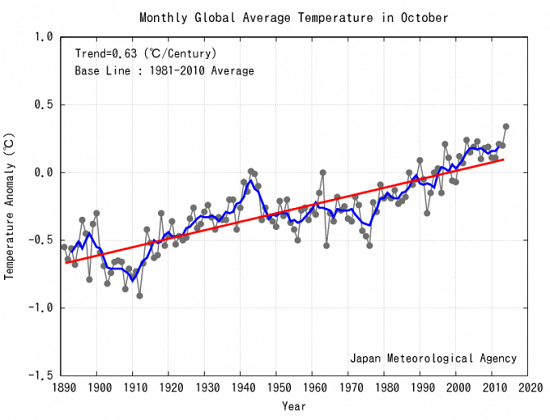
NASA has October as the warmest since 1880 along with 2005. The Japanese Meteorological Agency has it as the warmest ever:

11_14_14_Brian_JMAOctTemp_679_519_s_c1_c_c_550

No warming pause there!

So far an El Niño still has not developed, which would make things warmer.

3. Climate Council report fingers us

The Climate Council has published a new report Lagging Behind: Australia and the Global Response to Climate Change. The key findings are:

  • China and the US have firmly moved from laggards to global leaders on climate change.
  • In the last five years most countries around the world have accelerated action on climate change as the consequences have become more and more clear.
  • Australia, a crucial player in global climate action, moves from leader to laggard.
  • Global action must accelerate to protect Australia and the world from the consequences of a changing climate, sea level rise and more frequent and intense extreme weather.

Now, 39 countries and over 20 sub-national jurisdictions are putting a price on carbon. China has the world’s second largest carbon market with 250 million people covered. In the US 10 states have carbon markets, covering 79 million people.

Germany has decoupled growth from carbon pollution. Since 1990 GDP has increased 37% while emissions have fallen 25%.

According to the IEA and the OECD for every $1 spent to support renewable energy, another $6 is spent on fossil fuel subsidies, but investment in renewable energy at US$192 billion now exceeds that in fossil fuel energy at US$102 billion.

Australia is the 15th largest emitter out of 186 countries. We emit roughly the same as France, Italy and Turkey, each with three times the population.

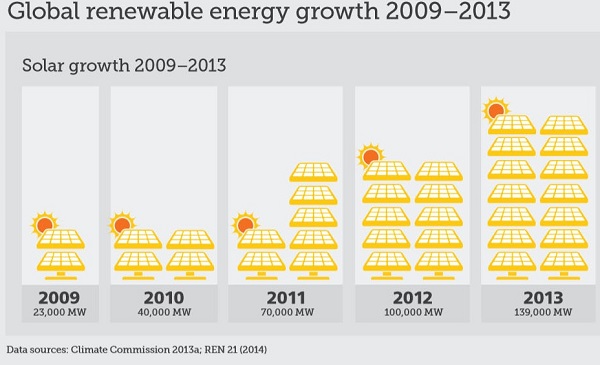
Here’s the world wide solar growth:

Solar_cropped_600

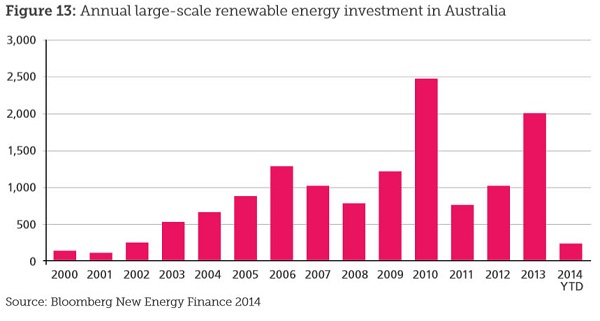
Our record on large scale renewables:

Aust renewables_cropped 600

Time to get on our bike!

4. Climate Council on renewables

The Climate Council report finds that around the world important initiatives on renewables are often taken at the sub-national level. In Australia:

  • South Australia is striding forward leading the Australian States on renewable energy.
  • Victoria and NSW have moved from leaders to laggards in Australia’s renewable energy race.
  • Australia has substantial opportunities for renewable energy. A lack of clear federal policy has led to a drop in renewable energy investment.

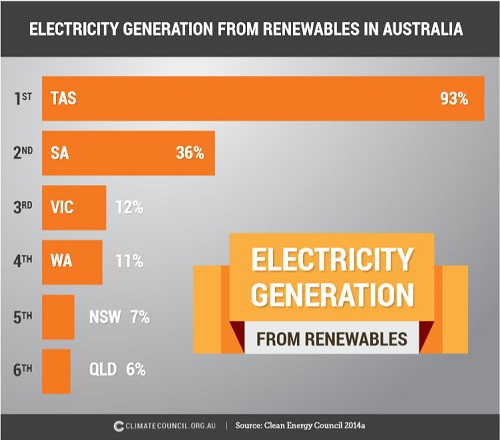
Only SA and the ACT have renewable energy targets – SA 50% of electricity by 2025, the ACT 90% by 2020. The current state of play is:

Renewable energy generation_cropped_500

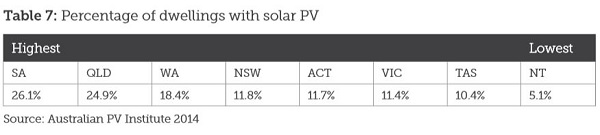
SA narrowly pips QLD in terms of percentage of dwellings with solar PV:

Solar PV_cropped_600

Both have roughly a quarter.

The potential for renewables in Australia is huge – some 500 times current electricity generation.

Australia produces per capita 23.96 tCO2e as against an OECD average of 12.47. As I said, time to get on our bike!

5. China caps coal use by 2020

From Climate Progress

The Chinese government announced Wednesday it would cap coal use by 2020. The Chinese State Council, or cabinet, said the peak would be 4.2 billion tonnes, a one-sixth increase over current consumption.

This is a staggering reversal of Chinese energy policy, which for two decades has been centered around building a coal plant or more a week. Now they’ll be building the equivalent in carbon-free power every week for decades, while the construction rate of new coal plants decelerates like a crash-test dummy.

The 2020 coal peak utterly refutes the GOP claim that China’s recent climate pledge “requires the Chinese to do nothing at all for 16 years.” Indeed, independent analyses make clear a 2020 coal peak announcement was the inevitable outcome of China’s game-changing climate deal deal with the U.S. last week, where China agreed to peak its total carbon pollution emissions in 2030 — or earlier.

6. Australia a pariah

Giles Parkinson thinks other nations are deliberately trying to embarrass Australia on climate change. Certainly Obama’s remarks can be interpreted that way. Then he (Giles) really gets stuck in:

We are, quite possibly, witnessing the most incompetent and ideologically blind government ever to hold power in Canberra. It’s effectively the Tea Party of Australia, pretending to be something else.

Climate clippings 113

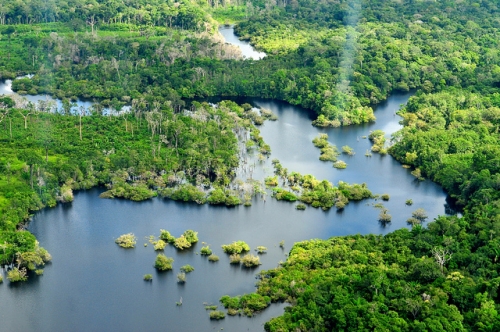
1. The Amazon is drying

AmazonRainforest_500_332_s_c1_c_c

Since 2000, rainfall has decreased by up to 25% across a vast swath of the southeastern Amazon, according to a new satellite analysis.

The area of concern is 12 times the size of California. The Amazon overall takes up 25% of the global carbon cycle that vegetation is responsible for, so it’s a significant carbon sink. With further drying the Amazon could become a carbon source rather than a sink.

Causes are not clear, but it’s possible that rainfall patterns have moved further north with global warming.

In related news, the re-election of Dilma Rousseff as president is seen as a significant negative for the environment in Brazil.

2. Great Barrier Reef protection plan ‘ignores the threat of climate change’

In its formal response to the Reef 2050 long-term sustainability plan, which was drawn up by the Australian and Queensland governments, the Australian Academy of Science states the strategy is “inadequate to achieve the goal of restoring or even maintaining the diminished outstanding universal value of the reef.”

There is “no adequate recognition” in the 2050 plan of the importance of curbing greenhouse gases.

Professor Terry Hughes, director of the Australian Research Council Center of Excellence for Coral Reef Studies and an academy fellow, said the plan was focused on the sustainable development of four “mega ports” adjacent to the reef, rather than conservation of the reef itself.

The Great Barrier Reef has lost around half its coral cover in the past 30 years. The question now is whether UNESCO will list the GBR as endangered.

3. Limiting global warming to 2°C is unlikely to save most coral reefs

In this recent post I mentioned that “preserving more than 10 per cent of coral reefs worldwide would require limiting warming to below +1.5°C (atmosphere–ocean general circulation models (AOGCMs) range: 1.3–1.8°C) relative to pre-industrial levels”. Following the links, the paper by K. Frieler at al is here.

It annoys me that the dangers to reefs from temperature change and ocean acidification are almost never mentioned, even by greenies. Opposition pollies should be speaking up too! That paper has been around since 2011.

4. Carbon capture and storage research budget slashed

The government has cut almost half a billion dollars from research into carbon capture and storage – which the Intergovernmental Panel on Climate Change (IPCC) deems crucial for continued use of coal – despite the prime minister insisting coal is the “foundation of our prosperity”.

In the budget the government cut $459.3m over three years from its carbon capture and storage flagship program, leaving $191.7m to continue existing projects for the next seven years. The program had already been cut by the previous Labor government and much of the funding remained unallocated.

John Connor, the chief executive of the Climate Institute, said CCS “has to be one of the clean energy options available because all the modelling says that to avoid temperature rises of more than two degrees, we have to take carbon dioxide out of the atmosphere”.

The first full-scale CCS power plant, the Boundary Dam Carbon Capture and Storage Project in Canada, opened last month.

5. Poland rejects zero coal by 2100

Poland and a bunch of eastern Europe countries “have categorically rejected the target put forward by the world’s top climate scientists to reduce carbon emissions to zero by 2100 to avoid dangerous global warming…”

You might recall that when Poland hosted the UNFCCC Conference of Parties in 2013 it was positively promoting coal.

The EU has not yet apportioned the effort between countries in planning to meet recently announced emissions reduction targets. The fun is about to begin!

6. Roof top solar in San Francisco

New regulations in San Francisco will require new buildings to have roof top solar or gardens or both.

7. Tesla solar supercharging network

Tesla is rolling out a solar supercharging network for electric vehicles throughout the world eventually. Soon they will make a beginning in Australia.

The superchargers provide half a full charge in as little as 20 minutes, and are usually located near amenities like roadside restaurants, cafes, and shopping centers. Usually they have between 4 and 10 stalls.

The $5 billion “giagfactory” to be built in Nevada will generate more than 100% of its electricity needs with wind and solar.

The world is changing!

8. News of energy storage is a big, big deal

So says Sophie Vorrath at RenewEconomy:

The big announcements keep coming from the energy storage sector, with news this week that US behind-the-meter startup, Stem, has been tapped to provide 85MW of distributed energy storage to households in the West Los Angeles Basin.

The deal, a multi-year agreement awarded to Stem by Southern California Edison (SCE), marks America’s largest distributed energy storage project to date, and the first time energy storage has competed with traditional energy sources like natural gas at this scale.

For its part of the deal, Stem will deploy its advanced, behind-the-meter energy storage technology at customer locations in the Western LA Basin to act as dispatchable capacity to enhance the local reliability of the region.

In other words, using the combination of storage and its proprietary software platform, Stem will allow customers to monitor and manage energy use, which in turn will provide additional capacity to SCE.

9. Billboard banned

You may have heard that Brisbane Airport banned a billboard suggesting to incoming G20 delegates that climate change should be on their agenda. Apparently the billboard was “too political”.

image_6531_full_600

Getup and a bunch of other NGOs are campaigning to have the decision reversed.

The billboard was based on the experience of South Australian grape grower David Bruer, a farmer from South Australia who lost $25,000 worth of grapes in one day when temperatures soared to 45°C last year.

IPCC Synthesis Report: you’ve been told!

Damian Carrington at The Guardian:

    Climate change is set to inflict “severe, widespread, and irreversible impacts” on people and the natural world unless carbon emissions are cut sharply and rapidly, according to the most important assessment of global warming yet published.

    The stark report states that climate change has already increased the risk of severe heatwaves and other extreme weather and warns of worse to come, including food shortages and violent conflicts. But it also found that ways to avoid dangerous global warming are both available and affordable.

    “Science has spoken. There is no ambiguity in the message,” said the UN secretary general, Ban Ki-moon…(Emphasis added)

The IPCC Fifth Assessment Report (AR5) is found here.

Roger Jones at The Conversation:

    acting on climate is ultimately an ethical, not an economic, consideration. Insufficient policy action is a declaration of self-interest, condemning our children, grandchildren and the planetary system that supports them, to a dystopian future. That’s what the report should say.

Ban Ki-moon:

    “Leaders must act. Time is not on our side.” He said that quick, decisive action would build a better and sustainable future, while inaction would be costly.

Tony (‘coal is good for humanity’) Abbott still refuses to address climate change at the G20 meeting as it would distract from discussion on growth. Nicholas Stern says climate change is core business if you’re concerned about growth:

    The G20 is the most effective forum for the discussion of the growth story of the future, the transition to the low-carbon economy.

    Yet the local politics of a country of less than 25 million is being allowed to prevent essential strategic discussions of an issue that is of fundamental importance to the prosperity and well-being of the world’s population of 7 billion people.

As Giles Parkinson told radio National

    essentially what the IPCC is saying to Australia is, on its current policy settings, ‘wrong way, go back’.

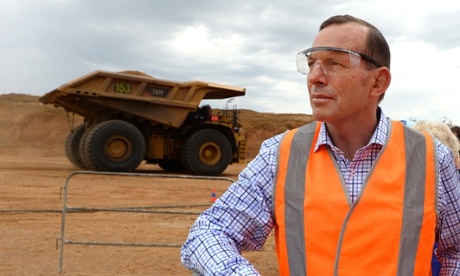
Here’s Abbott in visionary mode:

2749d2c2-02b0-4301-8523-763518db0449-460x276

Carrington above provides a useful summary of the IPCC report. Jones identifies a change in approach:

    Instead of dealing largely in forecasts and responses, as in previous syntheses, it now frames the climate problem squarely in terms of risk management.

Jones then identifies some of the myths the report busts. Roz Pidcock at The Carbon Brief identifies what’s new and interesting about the report.

C. Forbes Tompkins and Kelly Levin at Climate Code Red list 9 significant scientific findings too recent to be included in the new IPCC report. Two of them relate to sea level rise, an increased fragility of both the Greenland and Antarctica ice sheets.

There are more links at the end of the post. I wish to comment on the appropriateness of the 2°C guardrail, the view of risk taken in relation to the 2°C and then some conclusions.

Is a 2°C temperature rise safe?

David Spratt addressed this issue in September 2013. To summarise some of what he said:

  • The tipping point for Greenland Ice Sheet has been revised down to +1.6ºC (uncertainty range of +0.8 to +3.2ºC) above pre-industrial. We are likely to hit +1.6ºC within a decade or two.
  • It has been shown that “preserving more than 10 per cent of coral reefs worldwide would require limiting warming to below +1.5°C (atmosphere–ocean general circulation models (AOGCMs) range: 1.3–1.8°C) relative to pre-industrial levels”.
  • Large-scale thawing of permafrost may have already started, but a 1.5ºC global rise in temperature compared to pre-industrial should be enough to start a general permafrost melt.
  • Current levels of CO2 at about 400 ppm place us in the Middle Pliocene epoch (3.0–3.5 Myr ago) when sea levels were 25m plus or minus 5 higher than now.
  • During the Eemian 123,000 years ago sea-level rises of 3 metres occurred within 50 years due to the rapid melting of ice sheets, when the energy imbalance in the climate system was less than at present.

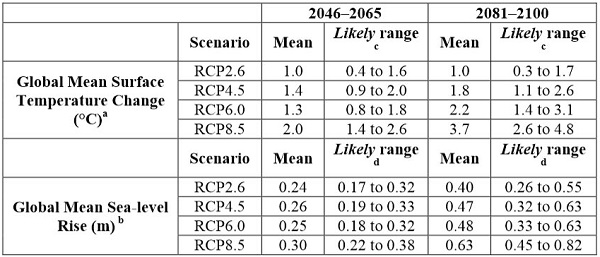
On sea level rise, here are the projections given in the Long Report p. 60:

Temperature and sea level_cropped_600

In a footnote we are told:

    Based on current understanding (from observations, physical understanding and modelling), only the collapse of marine-based sectors of the Antarctic ice sheet, if initiated, could cause global mean sea level to rise substantially above the likely range during the 21st century. There is medium confidence that this additional contribution would not exceed several tenths of a metre of sea-level rise during the 21st century.

They’ve covered themselves on Antarctica, but missed the fragility of Greenland. On page 30, they say this:

    There is low confidence in the available models’ ability to project solid ice discharge from the Antarctic ice sheet. Hence, these models likely underestimate the Antarctica ice sheet contribution, resulting in an underestimation of projected sea-level rise beyond 2100. (p30, Long report)

On sea level rise unfortunately for the next seven years we will be quoted the means given in the tables, without the qualifications, which themselves are inadequate in the late of the latest science. So the talk will be about half a metre, or up to a metre maximum.

For these and the other reasons quoted, plus a few I didn’t highlight, a 2°C guardrail looks foolhardy to say the least.

View of risk taken in relation to the 2°C

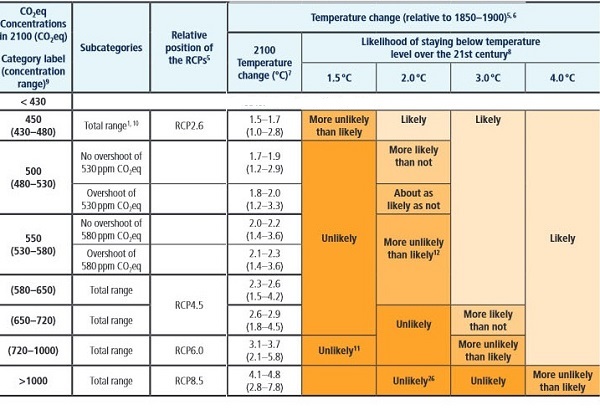
This table gives some overview of the relationship between the emissions levels, RCP scenarios, temperature change and the likelihood of staying below various temperature levels. I’ve actually taken the table from Working Group 3 and adapted it by taking out four columns (relating to quantums of CO2 and emissions reduction targets for 2050 and 2100) to highlight the broad relationships:

Implications of scenarios_cropped_modified

Much of the same information is given in the table on p23 (Short Report) and footnotes.

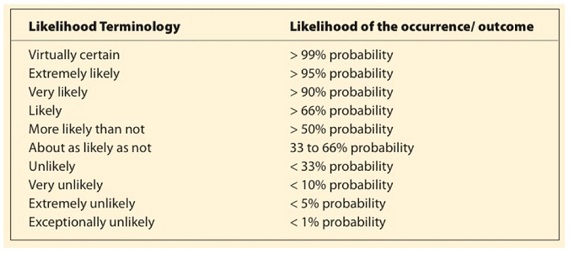
In the Short Report (p15) we are told that CO2e levels in 2011 were 430 ppm. Unfortunately the CSIRO/BOM State of the climate report says that in 2014 we are at 480 ppm of CO2 equivalent. So realistically the best on offer is the 500 zone with overshoot. This sees us with a likely as not chance of staying below 2°C. Here’s what the official language means:

kbwvscpc-1379916947_570

In other words a 33 to 66% chance of staying below 2°C, or if we act quickly and drastically a 66% chance. When you consider the implications even of a 1.5°C climate, this is desperately insane and simply not acceptable.

David Spratt suggests a risk-averse (pro-safety) approach, say, of less than 10% probability of whatever target we deem appropriate. I’d suggest a less than 5% probability of a 1.5°C temperature rise and then see whether that is doable. Are we game to talk about what really needs to be done for a livable, sustainable ecosystem for future generations? Or are we going to continue eating our children’s future?

Conclusions

Back in 2007 environmentalist Bill McKibbin asked James Hansen what the appropriate levels of CO2 should be. Hansen gave his answer in December 2007 at the American Geophysical Union meeting. At that very time the UNFCCC Conference of Parties was meeting in Bali. Hansen’s response was that we had overshot and that we should aim at 350 ppm by taking CO2 out of the atmosphere. To clarify, Hansen’s answer assumed that we would achieve net zero in other greenhouse gases, so he was really talking about CO2e. McKibbin went off and started up 350.org.

In a strict sense the IPCC Report is agnostic about a 2°C guardrail. It simply identifies risks, vulnerabilities and impacts at various temperature levels. However, when it comes to mitigation scenarios, it deals with what is out there in the scientific literature. Here it seems the vast bulk of the modelling contemplates scenarios where the 2°C guardrail is simply part of the furniture. Yet what has been called CCS (carbon capture and storage) and the report (see Short Report p.15 for example) re-badges as CDR (carbon dioxide removal) is also part of the furniture.

It seems to me that the scientific community is struggling to catch up with where Hansen was seven years ago. Perhaps they are concentrating on what’s doable, but at the same time they are holding out false hope. While the world’s scientists and governments have issued their bluntest warning yet, we seem to be letting go the idea of a safe climate. I heard head honcho Rajendra K Pachauri on the radio saying that we only had a budget of 275Gt of carbon (that’s about 1000GT of CO2) left that could be used. In fact, rationally, we don’t have a budget at all, we are in the red. Rationally, all the fossil fuel reserves should be left in the ground – all of them, unless offset with CCS or CDR, for which our visionary PM has just slashed the research budget.

Update:

Al Jazzeera rounds up some of the opinion warning that 2°C is foolhardy and dangerous.

    “There is no such thing as a safe rise,” said Bob Watson, who was the chair of the IPCC from 1997 to 2002. “You will see food and water insecurity, human health problems, and sea level rise even with a 2 C rise.”

And so on.

See also:

UN Climate Report Rings Alarm, Offers Guidance

World’s Scientists Warn: We Have ‘High Confidence’ In The ‘Irreversible Impacts’ Of Climate Inaction

Media round-up: The IPCC synthesis report

That last link from The Carbon Brief is quite comprehensive and includes a list of their six posts.

Related IPCC posts, in chronological order:

Crisis or catastrophe? What will the IPCC say?


A choice of catastrophes: the IPCC budget approach

Commentary on IPCC WG1: Part 1

Commentary on IPCC WG1: Part 2

Climate change impacts: IPCC Working Party 2 report

Adding to the muddle? The IPCC climate change mitigation report

Climate mitigation costs and strategies

PUP does a deal on Direct Action

Palmer_Article Lead - wide6279022411dszqimage.related.articleLeadwide.729x410.11dt8w.png1414570114131.jpg-620x349

If we didn’t know before, we know now that Clive Palmer will do a deal with the devil. He’s going to vote for a scheme that he comprehensively rubbished, said was a complete waste of money and he would never vote for it.

His price?

Clive Palmer won a Government commitment to salvage the Climate Change Authority and to ask it to conduct an 18-month review of the PUP plan to legislate an emissions trading scheme (ETS) at a zero rate.

This is of course a good thing. I understand that the Climate Change Authority will have something to say about targets before we have to make commitments in Paris next December. And the review can take into account Paris outcomes. The review and the work of the CCA may provide a road to redemption for the backsliders in the LNP. Bernie Fraser sees his task in this light, as he was quoted on PM:

What you’ve heard today is perhaps the beginning, the beginnings of an emerging broad, broader political consensus on climate change and the need to take effective action. Because that’s what this country needs more than anything else – the development of a broad political consensus.

Of course, the Government needs six votes from the cross bench.

Victorian senators Ricky Muir and John Madigan and South Australian senator Nick Xenophon have also given their vote to the Government after negotiations.

Xenephon was said to have won four out of five of his requirements. Included was his penalties for big emitters proposal.

To win the necessary support, the government has accepted a proposal by Senator Xenophon to put in place a “safeguard mechanism” to ensure companies comply with the scheme’s requirements.

Details of the safeguard mechanism will be mapped out later. Observers expect it to include some form of penalty for companies that fail to meet government-set benchmarks, although it remains uncertain what the penalties would be.

Uncertain too what the benchmarks will be.

Not included was Xenephon’s proposal to set aside $500 million to buy carbon offsets from abroad to ensure the target is met. No doubt that would be too much like carbon trading for the LNP to stomach.

Christine Milne slammed the direct action policy as “embarrassing”. She reminded us that Palmer helped the Government tear down the ETS. Here’s their Facebook entry.

Bill Shorten:

“Tony Abbott has once again sold his soul to Clive Palmer and Australia will pay the price,” he said.

“This is a dirty deal that will send our country backwards.”

The Climate Institute welcomed the preservation of the independent Climate Change Authority but wanted to see more details about the review.

“Moreover, we are deeply concerned that the amendments to the CFI Bill fail to establish a climate policy that gives a reasonable chance of achieving even the lowest level of Australia’s 5-25 per cent 2020 target range, let along the deeper decarbonisation of the economy that will be needed beyond 2020. The Climate Change Authority has recommended Australia adopt a 2030 emission reduction target of 40-60 per cent below 2000 levels.”

“Without access to international carbon permits, stronger domestic regulations will be needed to meet Australia’s emission goals. The ‘safeguard mechanisms’ in the legislation—the emission limits that companies will have to adhere to—will need to be very strong and get more stringent over time, and regulations to limit emissions and tighten energy efficiency standards across the economy will also be needed.”

Greg Jericho made the excellent point that the Abbott Government “has been extremely successful in making climate change policy more about electricity prices than about climate change.” Maybe Bernie Fraser and the CCA can gently nudge it in a different direction!

There’s more at The Conversation.

Update: Bret Harper and Hugh Grossman give the detail of the agreement on Direct Action. They include:

The government will also withdraw its Clean Energy Finance Corporation (Abolition) Bill 2014 and the Australian Renewable Energy Agency (Repeal) Bill 2014 during the Spring 2014 parliamentary sittings.

The CCA will produce three reports, going into targets for Copenhagen as well as emissions trading schemes.

Climate clippings 111

1. Record warmth

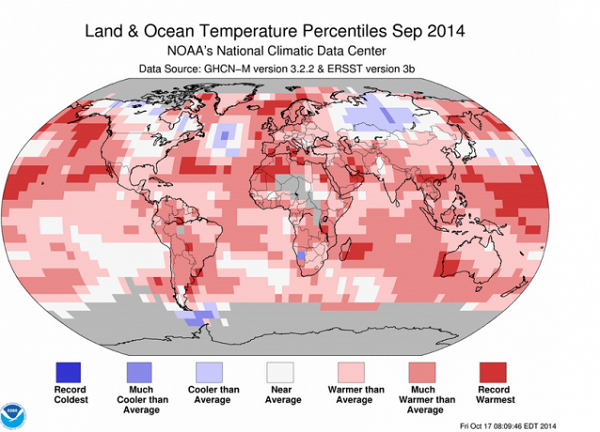
September followed August as record heat for the month worldwide. The period January-September was equal hottest with 1998 and 2010. The 12 months from October 2013 to September 2014 was the hottest 12-month period on record. The heat was just about everywhere, except for central Russia, some areas in eastern and northern Canada, and a small region in Namibia:

Screen-shot-Sept 2014-AM-600

2. Coal is good for humanity!

Thus spake Tony Abbott, repeating lines imprinted on his mind by coal industry lobbyists.

In an important post Graham Readfearn tells how big coal is hijacking the energy poverty issue

telling the world that the only way the poorest nations can pull themselves out of poverty is by purchasing lots of their product.

The point that those same people will likely be hit earliest and hardest from the impacts of climate change being driven by that same product, is neatly swerved or underplayed.

So we have Peabody Energy “fueling the world with energy essential to sustain life”.

Pardon me while I have a quiet chunder!

3. New 2030 climate targets for the EU

On the whole climate campaigners are disappointed with the new emissions targets set by the EU – 40% reduction in emissions, 27% cut in energy use and 27% of energy must be from renewables.

The ETS is seen as essential in reaching these targets, so it will be reformed in an as yet undesignated way.

Rich countries like Germany, the UK and France will have to do better than the designated cuts to compensate for the continued reliance on coal by the likes of Poland, Bulgaria and Romania.

At Climate Progress it seems the American reaction is more favourable. They point out that the targets are the first substantive offer from any member of the international community ahead of the UN climate talks to be held in Paris in 2015. The Americans and the Chinese are unlikely to go so far.

Personally when they aim for net zero emissions by 2030 and aim for 350 CO2e ppm by 2050 I’ll say they are reconnecting politics with reality.

4. Arctic sea ice escalator

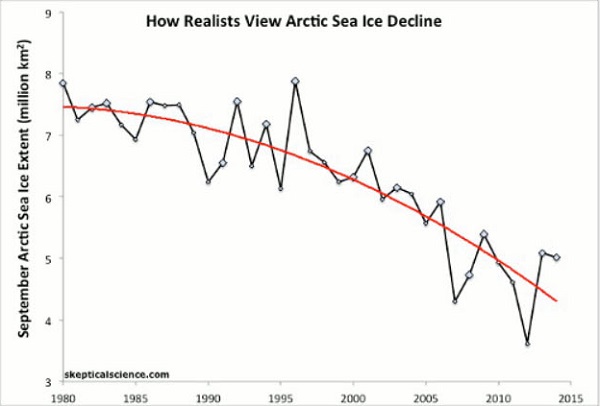
BilB drew attention to Skeptical Science’s Arctic sea ice escalator:

Sea ice 2014_cropped

He’s right, the next break downwards could shock some doubters.

Perhaps enough to shake pollies of all stripes out of their torpor.

If you look at the trend from the late 1990s it looks even more dramatic.

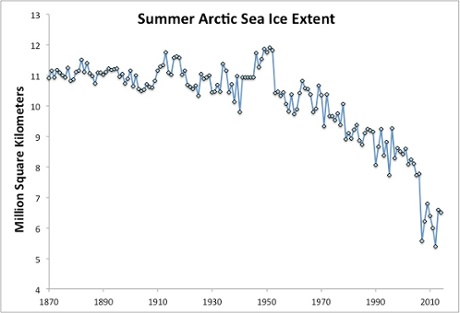
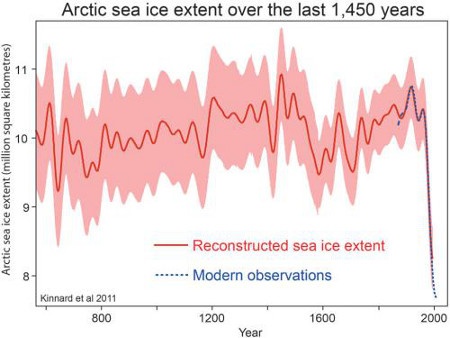
The full article has two further graphs:

00c36199-0fac-468c-86d4-76d93ce98cba-460x313

120afee8-e360-4a99-ab75-cabf94d6b08c-bestSizeAvailable

Actually there’s something wrong with both. The y axis should go below 4. It’s like where you have a graph on a wall and the line falls off the graph and onto the wall.

5. Pacific warriors blockade Newcastle

Climate Change Warriors from 12 Pacific Island nations paddled canoes into the world’s largest coal port in Newcastle, Australia, Friday to bring attention to their grave fears about the consequences of climate change on their home countries.

The 30 warriors joined a flotilla of hundreds of Australians in kayaks and on surfboards to delay eight of the 12 ships scheduled to pass through the port during the nine-hour blockade, which was organised with support from the U.S.-based environmental group 350.org.

The warriors came from 12 Pacific Island countries, including Fiji, Tuvalu, Tokelau, Micronesia, Vanuatu, The Solomon Islands, Tonga,
Samoa, Papua New Guinea and Niue.

6. Norway takes to electric cars

Norway, not a member of the EU, now has 15% electric cars. Since 2011 Nissan LEAF has become the nation’s third best-selling car.

Norway is not a member of the EU. It gets 98% of its power from renewables. Presumably it doesn’t go around preaching that oil is good for humanity!

7. How to build without bricks and cement

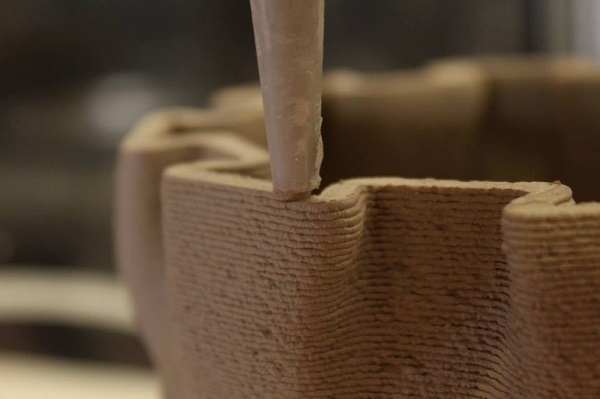
Just print houses out of mud!

wasp_3d_printed_mud_homes-3_600

Thanks to John Davidson for those last two items.

Climate clippings 110

1. 25 climate change disasters

Business Insider, Australia tells us that 25 disasters may befall us from climate change. The assumptions are conservative – 2°C and half a metre of sea level rise by 2100, though the text sometimes specifies more. Some of the predictions are disturbing: Continue reading Climate clippings 110

Divesting Investments on Social, Environmental and Ethical Grounds

The Australia Institute is a progressive think tank that produces credible, fact based economic reports on the issues facing Australia.  What I have copied here is a short article from their periodic email on recent decisions by the ANU and others to divest the shares they held of companies whose business and/or behaviour is unacceptable on social, environmental etc. grounds.

It is just part of the pressure being encouraged by organizations such as 350.org to encourage banks, super funds etc. to stop investing in and financing unethical activities such as extracting fossil fuels:

Divestment movement hits a nerve

The fossil fuel divestment movement seemed to hit a particularly sensitive nerve this week. The Australian Financial Review has published a litany of critical front page stories, editorial and opinion pieces. In particular, special outrage flowed over divestment decisions taken by the Australian National University (ANU).

ANU announced last week it would divest from seven resources companies on environmental, social and governance (ESG) grounds. ANU is home to a long running student campaign calling on them to divest from fossil fuels. Under pressure, ANU sought professional ESG research and declared it would knock out the companies that ranked worst. The companies impacted include gas giant Santos, Oil Search and other miners extracting copper, nickel and a range of other minerals.

ANU’s decision has drawn ire, not only from the companies themselves, but also from SA Premier Jay Weatherall, previous Resources and Energy Minister Gary Gray and some Indigenous groups. There have been all manner of complaints: the companies say they weren’t consulted; they have won ESG awards; Santos is a proud Australian “pioneer”; fossil fuels cure poverty “whatever the effects of carbon dioxide ­emissions on climate”; mining is essential to modern life, and so on. One company is talking about legal action.

Others have baulked at the unusual enthusiasm in the reactions and coverage. A Canberra Times editorial said it “verged on hysterical”. Clean energy commentator Giles Parkinson, himself an ex-AFR deputy editor, said the reaction was “as though someone had committed treason against Team Australia. Or at the very least against Team Coal.”

At first glance, coal has nothing to do with it. ANU is not divesting from coal companies – unlike Stanford, which is divesting from all big coal companies, and Glasgow University which this week said it would divest from fossil fuels. Indeed, without a sector wide screen, ANU is likely to reinvest in fossil fuels. But when ABC’s Lateline covered ANU’s decision this week, theMinerals Council sent the head of their Coal Division into bat for the miners. Maybe that’s because coal is most at risk from the reputational effects of divestment campaigns. Coal is the heaviest emitter, cheapest to substitute with renewables and at most risk of being displaced by new clean energy.

ANU Vice Chancellor Prof. Ian Young defended the ANU’s move:

as “a major researcher in environment and alternative energy, we need to be able to put our hand on our heart when we talk to our students and to our alumni and to our researchers and be able to say that we’re confident that the sort of companies that we’re investing in are consistent with the broad themes that drive this university.

ANU economist Warrick McKibbIn did not agree, saying “you need proper, clear, transparent policies such as carbon pricing… You don’t get the sort of adjustment we need by these token gestures by institutions like a university.”

But Swiss investment bank UBS endorsed the strategy in a recent investor note. UBS said this was a “potentially effective campaign”, noting that:

“many of those engaged in the debate are the consumers, voters and leaders of the next several decades. In our view, this single fact carries more weight than any other data point on the planet for this issue: time, youthful energy and stamina are on the side of the fossil fuel divestment campaign.”

Australia trashes its renewables industry

Climate Progress has picked up on the story:Australia’s clean energy development plummets below Algeria, Myanmar, Thailand, and Uruguay .

Large scale clean energy development is basically dead in Australia, thanks to the Abbott Government’s negativity and delays. Giles Parkinson says that the Government is effectively trashing the industry:

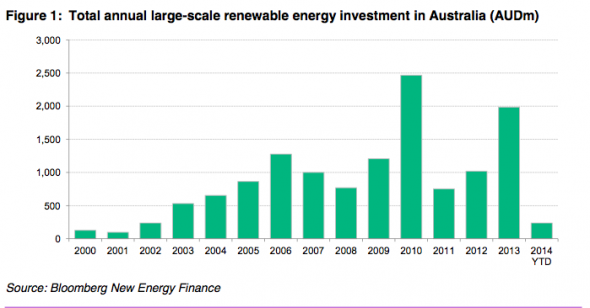
Bloomberg New Energy Finance data shows that Australia is on track to record its lowest level of asset financing for large-scale renewables since 2002 – as just $193 million was committed in the third quarter of the year. From ranking No 11, in the world in 2013, Australia has fallen behind Algeria and even Myanmar.

This graph tells the story:

bnef-investment-590x308

Australia, which should be one of the world’s leaders in the industry, is seeing its industry collapse. The three biggest Australian investors in renewable energy are in deep trouble.

Industry Funds Management is being forced to write down the value of Pacific Hydro, the largest specialised investor in renewables in the country, by $685 million, according to the Australian Financial Review. This from a business that was to have been floated a year or so ago with a value of more than $2 billion.

Infigen Energy, the largest listed investor in renewables, has said it is facing massive writedowns, and potentially taking dramatic action to protect shareholder funds. It has brought Australian investments to a halt. So has Silex Systems, which has effectively abandoned the solar industry.

International investors have also made clear that their investment in Australia will end soon un less policy stability is restored. These include First Solar, Chinese wind turbine leader Goldwind, and numerous others. The US-based Recurrent Energy has already packed its bags, Spanish based FRV has said its $1.5 billion pipeline is at risk.

Australia’s year-to-date investment of $238 million in large-scale renewables development so far this year compares to Canada’s $3.1 billion.

The world leaders are now China and Japan.

China may add more than 14 gigawatts of solar capacity this year — almost a third of the global total, according to BNEF.

China is fast approaching its goal of installing 35 gigawatts of solar by the end of 2015.

Apparently they believe in picking winners and subsidies, as does Japan:

Japan, the world’s second-largest solar market, increased spending 17 percent to $8.6 billion in the third quarter. Japan has approved about 72,000 megawatts of clean energy projects since the country’s feed-in tariff program started in 2012, with about 96 percent being solar projects.

Meanwhile the LNP have entered into negotiations with Labor on the Renewable Energy Target, presumably having given up on PUP and the cross bench. Labor seems to favour a numerical target similar to the status quo, whereas the LNP favours an actual 20% target, which would be a reduction and disastrous for the industry. Labor seems to be prevailing. There is talk of an exemption for aluminium processing.

We’ll have to wait and see whether what comes out is too little too late, and whether the LNP plays fast and loose with yet another industry sector.

Climate mitigation costs and strategies

Val at fairgreenplanet perceived two contrasting approaches to climate mitigation at the recent Australian Climate Action Summit:

  • technology can get us there, with a bit of political will

or

  • we have to change the way we live, starting from the local level

In relation to the first she also cited a recent post by John Quiggin who cites four major reports, all making the same point:

decarbonizing the world economy will involve economic costs that are
(a) small; and
(b) far outweighed by the benefits

So that’s a net gain of considerable dimensions.

This is supported at the country level by a recent report in the UK:

if the UK cut its carbon emissions by 60 per cent from 1990 levels by 2030, as it has promised, its GDP would be 1.1 per cent bigger than if it stuck with fossil fuels, says a study by consultants at Cambridge Econometrics.

About half the gain would come from cheap running costs for fuel-efficient cars, with 190,000 new green jobs and higher wages also helping. The average household would be £565 a year better off.

The four reports cited by Quiggin are as follows:

First, there’s Pathways to Deep Decarbonization an international collaborative project under the auspices of the UN.

Second, the Better Growth Better Climate report from the Global Commission on the Economy and Climate

Third, this report on Green Growth from the Center for American Progress (covers the US only)

And, most strikingly, this report from staffers at the International Monetary Fund, long the guardian of fiscal rectitude has concluded that for most countries, the local side benefits of reducing pollution would be sufficient to offset the costs for carbon prices up to $50/tonne.

I find each report has limitations in its own way, so at the end I remain agnostic.

The fourth, the IMF study, looks at carbon pricing in the top 20 emitters. As far as I can make out it comes up with two propositions. First, each country can act on its own, with benefit, no-one has to wait for the world to act. Secondly, it identifies a sweet spot, which varies quite a lot from one country to the next, where net benefits accrue from carbon pricing. In Australia’s case it’s only $11.50 per tonne.

This is all very promising but is not as such a plan for climate stabilisation at safe levels.

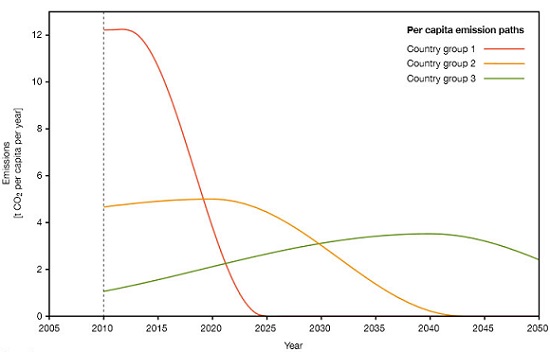
The third, the American study, finds the aim of reducing emissions by 40% from 2005 levels by 2035 doable and beneficial. The problem here is in the task identification. The study assumes that the US should decarbonise at the same rate as the rest of the world. It ignores the ‘carbon budgeting approach’ whereby high per capita emitters need to decarbonise rapidly to make space for developing countries to grow their economies. See Figure 5 of this post on the IPCC report. The United States is a Group 1 country, which must decarbonise rapidly:

Figure 5: The climate budget approach

As we saw in this post, two thirds of increased emissions are now coming from emerging and less developed countries. In other words in reality increases from Group 2 and 3 countries are not being offset by cuts in Group 1 countries. Until we get our heads around this issue and address it we’ll stumble along on the road to perdition!

The problem facing Group 1 countries is impossible. The way around it lies in emissions trading between rich and poor countries, as per Figure 6 in that post. This would entail considerable wealth transfer, which could be mandated to be used in greening developing country economies.

Also 40% by 2035 overall is not a recipe for a safe climate, as shown below.

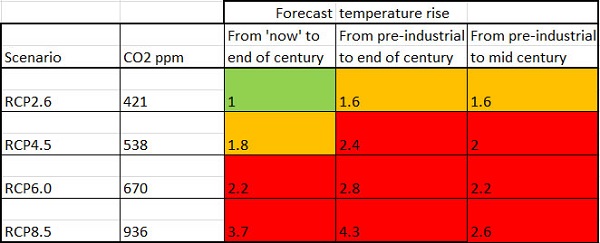
The first study, has two limitations. Firstly it simply does not address the issues of economic costs and social implications. Secondly, it simply accepts the stabilisation pathway for a 2°C temperature increase which sees zero worldwide emissions about 2070. In looking at the IPCC report (same as linked above), I developed this table to relate concentrations to temperature rise. RCPs are Representative Concentration Pathways (RCPs) which are expressed in terms of watts per square metre of radiative forcing (W m-2). Roughly, RCP2.6 represents the 2°C pathway, while RCP8.5 represents our present path.

Figure 1: RCP temperature scenarios

Green indicates a comparatively ‘safe’ climate, orange indicates the increasingly contested zone which clearly carries some danger, and red to indicate breaching the 2°C guardrail which everyone with half a brain accepts as dangerous.

Strictly speaking the green box should be orange, because it sits on top of ‘now’ which is an 0.6°C increase, and the orange box below it should be red, for the same reason.

On the orange zone, the Climate Change Authority in its Review published this wondrous graph, showing that they were well aware of the inadequacies of a 2°C target:

Stabilisation probabilities_croppedb_580

As I said then, in terms of CO2 equivalents we are now at 480. This gives us less than 33% chance of staying below 2°C and about a 10% chance of exceeding a civilisation threatening 4°C. These odds are unacceptable. We are already in an overshoot situation.

This is old information – very old. James Hansen told us at an American Physical Union meeting in December 2007 that we needed to aim for 350ppm in the first instance and then decide where we go from there.

The RCP2.6 path involves a 33% chance of ending up with more than 2°C, odds that should be completely unacceptable.

Turning to the third report, which specifically addresses the financial implications, it too is on 2°C path. The costs numbers when taken in isolation look large (US$45 trillion will be required in 2015–2030 for key categories of energy infrastructure), but in context are trivial:

costs of this magnitude look like “background noise” when compared with the strong underlying growth that the global economy is likely to experience.

These costs will go up if mitigation is delayed:

Costs are also likely to rise sharply with delay. If global action to reduce emissions is delayed until 2030, global CO2 emissions would have to decrease by 6-7% per year between 2030 and 2050 in order to have a reasonable chance of staying on a 2°C path. Such rates of reduction are unprecedented historically and are likely to be expensive (estimates of delay suggest an average annual consumption growth loss of around 0.3% in the decade 2030 to 2040, compared to a loss of less than 0.1% over the same period if we act now).

Fine, and perhaps not yet serious, but I’m afraid completely out of date. In 2011 the Climate Commission published this graph to illustrate the implications of delay:

Figure 4: Emissions reduction options

Under the ‘climate budget approach’ the area under the line must remain constant.

That too would have been based on a 2°C target, but it illustrates that if we delay peaking emissions worldwide, even to 2020, we’ll be in completely uncharted territory.

Chapter Five of the third report gives enormous detail of the policy work that needs to be done. It may be summarised as strong leadership, consistent policy over decades, structural change and perhaps unprecedented international co-operation, even if we start now on a task that is eminently doable and inexpensive; so more than “a bit of political will” is required.

Frankly, our best hope lies in the prospect that solar technology with storage will simply become the cheapest form of new energy, and has the advantage that it doesn’t need a large grid. Nevertheless there will be residual problems – land use and agriculture, transport, ocean acidification etc. Zero emissions transport will require planning and subsidies.

One thing we should realise, however, is that further out our future will be energy rich, not energy-constrained. Saving energy is not a reason for localism and changing the way we live.

So where does that leave Val’s second option?

Firstly, concerted long-term action and international co-operation of the kind we need is not in our DNA. We are designed to co-operate in bands of up to 150 people, the number that our big brains can cope with in terms of knowing in any detail. We are told Fukuyama, Harari for example that bands were relatively egalitarian with a leader answerable to the people. Beyond that we can co-operate in amazing ways, but at the price of setting up hierarchies and privileges, coercive elites. This occurred in general with agriculture and owning stuff, even herds. These problems can be ameliorated in a modern democratic nation-state, with it’s formal mechanisms for election, administration, justice and accountability, but we are still apt to act in the self-interest of that larger entity.

What we need is an infusion of new values and ways of perceiving, thinking and feeling. While not sacrificing individualism we need to feel and act as social beings. We also need to revalue ourselves in relation to the biological and physical systems of the planet, so that we stop acting like the top rapacious predator, the one that has decimated the wild animal kingdom by 52% since 1970. Along the way, we need to challenge a Chain of Being, that sees elite mostly European males as next to the gods and women, children, other races, other social classes, slaves, asylum seekers etc in subordinate positions.

We need to live in nature, not over nature.

While localism and social participation are necessary, the required cultural and existential changes are hard work will happen over generations if at all. The planet can’t wait. That last reference tells us:

Efforts have been made to economically quantify the world’s “stock” of natural capital and the yearly “flow” of ecosystem services they provide. The latest numbers are $142.7 trillion and $48.7 trillion, respectively. By comparison, the flow of incomes through the global economy is currently about $71.8 trillion per year. The research suggests that by 2013 we were eliminating that stock of natural capital at a rate of about $7.3 trillion per year, and that the flow of ecosystem services would be $23 trillion higher if not for human practices like deforestation, burning fossil fuels, and the like.

And underneath all this, there is the point that these creatures and the ecologies they inhabitant have an intrinsic moral worth irrespective of the dollar sign that markets can place on them. “Wildlife is and should be useless in the same way art, music, poetry and even sports are useless,” author Richard Coniff recently wrote in the New York Times.

And the climate can’t wait.

We need hierarchies to get things done, a collective will not build a battleship, but we need to civilise them and render them accountable. We even need coercive powers, to counter the selfishness of states. The only supra-national entity that the major powers take notice of is the World Trade Organisation, not the UN. We need it to police international agreements, to oversee international carbon trading, and what Quiggin’s third report calls “border carbon adjustments”.

I never thought I’d say that!

The bottom line is that we must act if we want a future for our grandchildren, and cost, the only certain Armageddon is if we do nothing or not enough. We are heading into uncharted territory but indications are that there will be benefits and the net costs are unlikely to be as bad as pessimists might think. We just don’t know. And the groupie, local stuff, well there are reasons for doing that, but it won’t solve climate change as such.