Tag Archives: extreme weather

Climate clippings 69

1. Electric cars

you have about 750 million cars in the world today; you’re going to have about 1.3 billion cars in about 25, 30 years; and you can’t expect them all to be running on gasoline. There isn’t that much gasoline around.

Stan Correy has a look at the future of the car industry and our potential place in it on ABC RN’s Background Briefing.

Evan Thornley, who is behind Better Place, thinks our niche in the electric car future is in the larger powerful muscle car, where we have always been. Continue reading Climate clippings 69

Climate clippings 66

New solar PV nanotechnology

There have been so many developments in PV technology it’s hard to know which will be significant.

Gizmag tells us about new material consisting of tiny hollow spheres, made out of nanocrystalline-silicon.

The new material is efficient, light, flexible, should be easy and cheap to make and their efficiency is less affected by the angle of the sun.

No downsides are mentioned. Continue reading Climate clippings 66

Climate clippings 64

I’m currently working on another project, which is taking up much of my time. This week we had about 200mm of rain in one day. That could have been why my cable connection to the internet disappeared for 36 hours. I’m grateful to John D who sent me the links for each item in the following except the last.

Zero-emissions engine that runs on liquid air

A new zero-emissions engine capable of competing commercially with hydrogen fuel cells and battery electric systems appeared on the radar when respected British engineering consultancy Ricardo validated Dearman engine technology and its commercial potential.

The Dearman engine operates by injecting cryogenic (liquid) air into ambient heat inside the engine to produce high pressure gas that drives the engine – the exhaust emits cold air. It’s cheaper to build than battery electric or fuel cell technology, with excellent energy density, fast refuelling and no range anxiety. It just might be a third alternative.

Among the advantages are that it doesn’t catch fire or explode and doesn’t require rare materials. Continue reading Climate clippings 64

Climate clippings 63

China report on climate change

China's economicChina's advance will be hampered by climate change, a government report finds

(Photo from Reuters, via The Age.)

From Reuters we hear about the Second National Assessment Report on Climate Change which sums up advancing scientific knowledge about the consequences and costs of global warming for China:

Global warming fed by greenhouse gases from industry, transport and shifting land-use poses a long-term threat to China’s prosperity, health and food output, says the report.

In 2010 China’s emissions grew by 10.4%. This rate is expected to slow, but for reductions we will have to wait until about 2030, “with big falls only after mid-century”.

Here’s the Executive Summary. Continue reading Climate clippings 63

Remembering the floods

As I write we have brutal heat in Brisbane, with a dry west wind. On 11 January last year Robert Merkel put up a post, Queensland floods get worse. Later that day Mark put up a post, Brisbane flood maps and up to date flood information and slaved mightily for a time passing on information gleaned from twitter and other sources, until he went quiet. By the 12th he was a refugee at my place. His place was high and dry, but the power went off. By the 14th the Brisbane floods were in retreat.

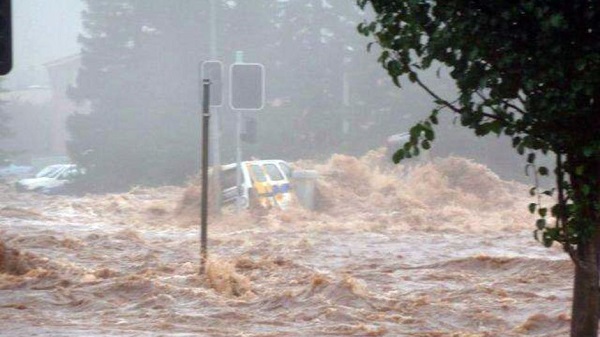
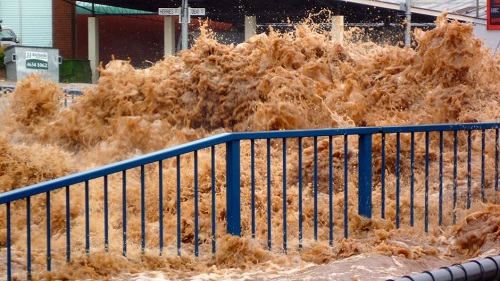
Earlier on the 10th there had been what we used to call a ‘cloudburst’ on the Toowoomba Range, when 150mm (6 inches in the old money) fell in about half an hour. I posted some Toowoomba flood pics taken by my cousin’s brother-in-law. Yesterday I heard Anna Bligh tell the story of a year ago, how she was addressing the umpteenth press briefing on the Queensland floods. From September 2010 there had been many cities and towns flooded across Queensland, some of them totally evacuated several times. As she fronted the media a minder handed her a sheet with breaking news. She found herself talking about swift water rescues in the main street of Toowoomba. “This can’t be right”, she thought. “It’s impossible.” It wasn’t. This is what was going on in Toowoomba:

Toowoomba flooding
Raging floods in Toowoomba

Continue reading Remembering the floods

Climate clippings 61

David Archer on methane

Arctic methane plumes

Climate clippings 58 led with an item on Methane worries. @ 18 I identified David Archer as one who is “very knowledgeable on the matter [and] thinks the process will be chronic rather than catastrophic.” Continue reading Climate clippings 61

Climate clippings 55

WMO Greenhouse Gas Bulletin

The World Meteorological Organization’s Greenhouse Gas Bulletin has just been released. These graphs show the ‘progress’ of the main gases.

The WMO is agnostic about the reason for the increase in methane emissions, but in this ABC story Paul Fraser from the CSIRO tells us what they are thinking and it’s not good news.He says that the increase of methane is coming from high and low attitudes, which seems to indicate that northern permafrost and tropical wetlands may be the source.

The story also looks at HFCs and refrigeration. As linked on the last thread, go here to Figure 2.21 for the IPCC’s graph on forcings. Continue reading Climate clippings 55

Climate clippings 54

Wind electricity to be fully competitive with natural gas by 2016

So says Stephen Lacey at Climate Progress:

The best wind farms in the world are already competitive with coal, gas and nuclear plants. But over the next five years, continued performance improvements and cost reductions will bring the average onshore wind plant in line with cheap natural gas, even without a price on carbon.

That’s according to Bloomberg New Energy Finance. They say that cost reduces by 7% for every doubling of installed capacity, while efficiency has steadily improved. Continue reading Climate clippings 54

Climate clippings 53

GLOBAL warming is unusual

A common response to AGW warmists is that climate has always changed and always will. It’s natural and humans have nothing to do with it. Now via Climate Progress we learn from a study by Svante Björck of Lund University that apart from general moves into and out of ice ages the hemispheres do not warm or cool in sync. When one hemisphere changes the other stays the same or moves in the opposite direction. For example he found that during the Little Ice Age in Europe there were no corresponding changes in the southern hemisphere.

Last week I posted this graph to show that we are giving the system a helluva jerk. In fact we need to go back 15 million years to find CO2 levels as high as today. (if you are concerned about Antarctic thawing be very afraid.)

However, the following graph shows that the hemispheres are not perfectly in sync now:

Hemispheric land-ocean temperatures

The northern hemisphere is pulling away. The reason, presumably, it has more land, and at higher latitudes. Continue reading Climate clippings 53

Climate clippings 52

7 billion and counting

With the world’s population passing 7 billion there have been reports and analysis all over the media.

George Monbiot, clear-headed as usual, says the real problem is consumption. He also takes a look at the UN calculations, and is not impressed, but one way or another the graph is going to go up for about four decades.

Fred Pearce is not an economist, but he may have a point in saying that ageing is the trend and with that your economy goes down the tube. Japan has become the land of the setting sun.

Those two are part of The Guardian’s Crowded Planet series. Our ABC has 7 challenges for 7 billion put together by 7 academics. Continue reading Climate clippings 52

Climate clippings 50

This is serious!

First we were told that rising temperatures would make it difficult to grow tea in
Uganda and in Kenya, then it was going to become too hot for chocolate. Now Starbucks is warning that climate change will threaten the world supply of coffee.

This story has gone viral, but I liked this neat post. Obama should indeed do something. What Al Gore said. Continue reading Climate clippings 50

Climate clippings 45

Arctic ice

Let’s get this one over with. Arctic ice seems to have bottomed out on 9 September, about two weeks earlier than usual. 2011 was the second lowest on record by a thin margin. I’ll freeze the graph here for the record:

Arctic ice extent

Here’s the important bit:

The last five years (2007 to 2011) have been the five lowest extents in the continuous satellite record, which extends back to 1979. While the record low year of 2007 was marked by a combination of weather conditions that favored ice loss (including clearer skies, favorable wind patterns, and warm temperatures), this year has shown more typical weather patterns but continued warmth over the Arctic. This supports the idea that the Arctic sea ice cover is continuing to thin. (Emphasis added)

Continue reading Climate clippings 45